
AI Phone Answering Service: Boost Leads and Cut Costs Today
Let's be honest, you can't be in two places at once. When you're busy running your business, a ringing phone can feel more like an interruption than an opportunity. An AI phone answering service is a new kind of front line for your business, using smart conversational AI to make sure every single call gets answered, 24/7. It's like having a virtual receptionist who can capture leads, book appointments, and handle common questions automatically—so you never miss out just because you're on a job or it's after hours.
How an AI Phone Answering Service Ends Missed Opportunities
Picture this: you're a plumber, knee-deep in a tricky installation. Your phone buzzes with a new lead, probably a high-value emergency job, but you can’t possibly pick it up. The call rolls to voicemail. That potential customer, who needs help now, isn't going to wait. They're already dialing your competitor.
This happens all day, every day. It's a huge, silent drain on revenue for so many businesses. In fact, a staggering 85% of callers who hit voicemail just hang up and don't call back. That one missed call is a permanently lost opportunity.
This is exactly the problem an AI phone answering service was built to fix. It acts as your most dependable employee—one who never needs a break, never calls in sick, and never misses a single call. It’s always there, ready to engage every caller professionally and effectively, whether it’s noon on a Tuesday or 3 AM on a Sunday.
Your Perfect Virtual Receptionist
Don't think of this as a clunky, robotic system. A good AI answering service is more like a perfectly trained virtual receptionist. It uses advanced conversational AI to understand not just the words a caller says, but the intent behind them. It doesn't just passively take a message; it actively steers the conversation toward a goal.
Here’s what that looks like in the real world:
- It Understands the "Why": The AI instantly figures out why someone is calling. Is it a new customer wanting to book a service? An existing client checking on an appointment? Or just someone asking about pricing?
- It Gathers the Right Info: The system knows what questions to ask to get the critical details—name, number, address, and exactly what service they need.
- It Takes Action: This is the key part. The AI can book appointments directly onto your calendar, answer frequently asked questions on the spot, and log every detail of the call right into your CRM.
For example, a caller might say, "Hi, my sink is leaking everywhere and I need someone to come out and fix it." The AI receptionist would respond naturally, ask for their address and preferred time, and then check your calendar for an open slot. Once it finds one, it confirms the booking with the caller and sends a text message to lock it in—all in about a minute.
The Best of Both Worlds: Efficiency and a Human Touch
This isn't about replacing your team with robots. A truly smart AI phone answering service understands its own limitations. It's designed to handle all the routine, predictable calls with perfect efficiency, which in turn frees up your actual staff to focus on the more complex, high-value conversations.
The system is intelligent enough to recognize when a caller is getting frustrated, has a true emergency, or asks a question it isn't programmed to answer. In those critical moments, it seamlessly transfers the call to a real person.
Practical example: Imagine a client calls your home inspection business and says, "I'm calling about the report for 123 Maple Street; there are some major issues I need to discuss right now." The AI detects the urgency and keywords like "major issues" and immediately transfers the call to your lead inspector's mobile phone, ensuring the high-stakes conversation is handled by an expert.
This hybrid model gives you the best of both worlds. You get incredible efficiency for the vast majority of your calls while making sure a real human is there for the situations that require genuine empathy and deep expertise. The result is a system that captures every lead, makes your operations smoother, and provides a top-notch customer experience—without the massive overhead of a 24/7 in-house team.
AI Phone Answering Service vs. Traditional vs. Voicemail
To really get a feel for how an AI phone answering service changes the game, let's walk through a scenario every home service business owner knows well.
Imagine it's 9 PM on a Tuesday. A homeowner is in a full-blown panic because a pipe just burst in their basement, and water is everywhere. They frantically search online and find your plumbing business. What happens next depends entirely on how you answer the phone.
With standard voicemail, they get a recorded greeting, leave a desperate message, and immediately hang up to call the next plumber on the list. They can't wait until morning. You just lost that high-value emergency job without even knowing it existed.
With a traditional answering service, a live operator picks up. They're polite, professional, and take down the caller's name, number, and a quick note. It's better than voicemail, but the operator can only promise that a plumber will call back in the morning. For the homeowner with a flooded basement, "tomorrow" is an eternity. They're already dialing your competitor.
Now, let's replay that call with an AI phone answering service. The AI picks up instantly and, based on the caller's panicked tone and words like "burst pipe" and "emergency," it immediately understands the urgency. It skips the standard script, confirms their address, checks the on-call schedule, and books the earliest available technician right then and there. Within two minutes, the appointment is confirmed, and the relieved homeowner gets a text message with the details.
You didn't just take a message; you secured a profitable job while your team was sound asleep.
So, Where Does Each Service Shine (or Falter)?
To make the differences crystal clear, let's put these three options side-by-side. This table breaks down how each one stacks up across the things that actually matter to your business.
Service Comparison: AI vs. Traditional vs. Voicemail
As you can see, the gap is significant. Voicemail is a black hole for leads, and traditional services, while well-intentioned, act as a temporary holding pen. An AI service, on the other hand, is built to take immediate, decisive action.
Beyond Just Answering: Taking Action vs. Taking Messages
The biggest leap forward is moving from passive message-taking to active problem-solving. Voicemail just sits there, waiting for you to check it. A traditional service is a step up—at least a human is there—but they’re still just a middleman.
An AI receptionist, however, is a true extension of your business. It works around the clock, not just fielding calls but actually doing something with them. It qualifies leads, books jobs directly into your calendar, and turns every ring into a real business opportunity.
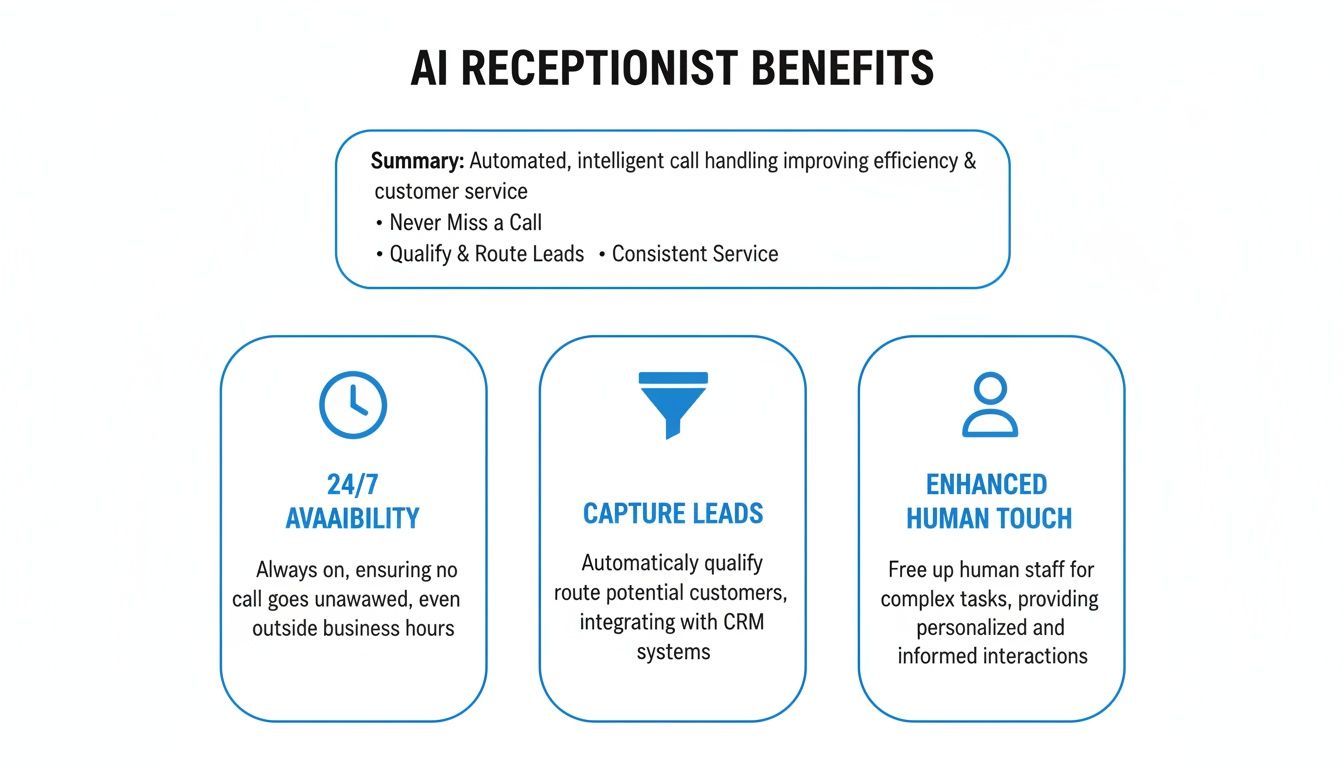
This ability to be always on, always helpful, and always ready to book the next job is what sets a modern AI system apart.
The Hard Costs of Missed Calls
The numbers don't lie. The financial hit from missed calls is staggering—small businesses can leak an average of $126,000 in revenue each year simply because no one picked up the phone. And don't count on them trying again; research shows a whopping 85% of callers who don't get an answer will not call back.
AI plugs this leak for good. Not only does it capture revenue you’d otherwise lose, but businesses often see savings of up to 80% compared to the salary and overhead of an in-house receptionist. It’s a smarter financial move all around, which is a key reason so many companies are exploring how AI is transforming call center economics.
The real magic here isn't just about answering the phone. It's about turning a simple phone call into a confirmed, revenue-generating appointment on your calendar without a single human having to step in.
What to Look for in a High-Performing AI Receptionist
Let's be clear: not all AI receptionists are built the same. Some are little more than fancy voicemail systems, while others can become a genuine engine for business growth. To get real results, you need to look past the marketing hype and focus on specific, powerful features. These aren't just bells and whistles; they are the core functions that turn a ringing phone into captured revenue and smoother operations.
So, what separates a basic bot from a high-performing asset?
First and foremost, the foundation of any great system is its constant availability. A top-tier AI receptionist works 24/7/365. This means you never miss a lead, whether it comes in during a holiday, overnight, or while your team is tied up on another job. For most businesses, this alone plugs a massive and often invisible revenue leak.
Intelligent Lead Qualification
A truly effective AI receptionist does more than just answer the phone—it understands the conversation. It uses intelligent lead qualification to figure out who's a hot prospect and who's just kicking tires. Instead of just taking a name and number, it's programmed to ask the right questions to gauge a caller's needs, budget, and urgency.
Practical example: A potential client calls your construction company and says, "I'm thinking about a kitchen remodel." A basic system would just take a message. An intelligent one digs deeper:
- "Are you looking for a full gut renovation or just updating countertops and cabinets?"
- "Do you have a specific timeline in mind for this project?"
- "Have you already set a budget for this remodel?"
Based on those answers, the system can instantly flag this as a "hot lead" and book a consultation, making sure your sales team is always focused on the most promising opportunities first.
Automated Appointment Scheduling
This is a game-changer. The ability to book appointments directly into your calendar without a human touching it saves an incredible amount of admin time and captures leads when they're most interested. The system should sync in real-time with your team's calendars (like Google Calendar or Outlook), so it only ever offers slots that are actually free.
Practical example: A real estate agent gets a call on a Saturday from someone wanting to see a property. The AI receptionist checks the agent’s linked Google Calendar, sees an open slot at 2 PM, and offers it to the caller. The caller accepts, and the AI schedules the viewing, sends a confirmation text to the buyer, and adds the appointment to the agent's calendar automatically. The agent just gained a showing without ever touching their phone. As the technology evolves, it's worth checking out the new appointment scheduling for an AI receptionist to see just how efficient this process can be.
Seamless CRM and Tool Integration
Your AI receptionist shouldn't be an island. It needs to plug directly into your existing workflow, especially your Customer Relationship Management (CRM) software and other business tools.
A high-performing AI service doesn't just email you the details of a new lead. It automatically creates a new contact in your CRM, logs the full call transcript, and can even kick off a follow-up marketing campaign.
Practical example: A new lead calls your roofing company for a quote. The AI gathers their name, address, and the type of roof they have. After the call, it automatically creates a new lead record in your CRM (like Salesforce or HubSpot), attaches the call transcript, and assigns a task for a salesperson to follow up. This ensures no lead is forgotten and eliminates manual data entry.
Smart Call Routing and Escalation
While automation is powerful, a smart system knows its own limits. This is where smart call routing comes in, providing that essential human touch when it's needed most. The AI can be trained to detect keywords, a frustrated tone of voice, or a complex request that requires a real person.
Practical example: If a caller says, "I'm very unhappy with the service I received yesterday," the AI shouldn't try to solve the problem. Instead, it should immediately say, "I understand your frustration. Let me connect you with our customer support manager right away." If the manager is unavailable, it can offer to have them call back within a specific timeframe, like one hour, ensuring the issue is prioritized.
This intelligent handoff ensures that urgent or sensitive issues are handled with empathy and expertise. It's this blend of AI efficiency and human connection that truly defines a great AI phone answering service—one that works not just for you, but with you.
How Different Industries Benefit from AI Answering
An AI phone answering service isn't a generic, one-size-fits-all solution. Its real value comes to life when you see how it tackles the unique, day-to-day problems that different businesses face. While the core goal is always about capturing more opportunities, how that plays out in a plumbing company versus a law firm is completely different.
Seeing these systems in action makes their impact tangible and easy to grasp.

Let's dig into a few real-world examples of how businesses are using AI receptionists to sharpen their operations, boost efficiency, and grow in ways that actually matter to their bottom line. Each scenario addresses a common industry headache, turning a frustrating bottleneck into a genuine competitive edge.
Home Services: Maximizing Billable Hours
If you run a home services business—think plumbing, HVAC, or electrical work—you know that every minute a technician spends on the phone is a minute they aren't on a billable job. The constant stream of calls for quotes, scheduling, and routine maintenance can pull your best people away from the work that actually makes money, creating an administrative logjam that slows everything down.
An AI receptionist completely flips that script.
- Scenario: The first cold snap hits, and an HVAC company is flooded with calls for furnace tune-ups. At the same time, a high-value emergency call comes in from a commercial client whose entire heating system just failed.
- AI in Action: The AI receptionist fields all the routine tune-up calls. It answers questions about pricing, checks the calendar, and books the appointments automatically. This frees up the human dispatcher to give their full attention to the urgent commercial call, ensuring the most profitable job gets handled immediately.
By automating the predictable, the AI ensures your technicians start their day with a perfectly optimized route of paying jobs, not a backlog of voicemails they need to return.
Healthcare Clinics: Reducing No-Shows
In a busy healthcare setting like a dental clinic or medical practice, the front desk is mission control. Staff are constantly juggling patient check-ins, insurance queries, and a relentless phone line. Two of the biggest time sinks are appointment reminders and new patient intake—both are critical, but they can grind the office to a halt.
An AI phone answering service acts like a dedicated administrative assistant that never takes a break, handling repetitive tasks with perfect consistency. This allows your front desk team to focus on providing a better, more personal experience for the patients standing right in front of them.
- Scenario: A busy dental clinic struggles with last-minute cancellations.
- AI in Action: The AI is set up to automatically call every patient two days before their appointment to confirm. If someone needs to reschedule, the AI can find and offer a new time slot right then and there. For new patients, the AI can handle the entire intake process over the phone, collecting insurance details and medical history before they even walk in the door. This simple, automated workflow can cut no-shows by 20-30%.
Law Firms: Qualifying Leads Efficiently
For law firms, time is quite literally money. Attorneys and paralegals need to dedicate their expertise to billable casework, not screening every person who dials their number. A huge percentage of incoming calls are from people whose cases don't even fit the firm's practice areas, which means a lot of wasted time for everyone involved.
An AI receptionist can serve as an intelligent, 24/7 legal intake specialist.
- Scenario: A personal injury firm gets dozens of calls a day. The AI is programmed to ask a few key qualifying questions, like the date of the incident and the type of injury.
- AI in Action: Based on the caller's responses, the AI determines if the case meets the firm's criteria. If it's a match, it gathers the person's contact info and schedules an initial consultation with a paralegal. If it's not a fit, it can politely refer them to a local bar association, saving the firm's staff hours of unproductive phone calls every week.
This rapid adoption is why the global call center AI market—the engine behind these services—grew to USD 1.95 billion in 2024. North America is leading the charge with a 36.92% market share, as businesses in healthcare, legal, and other fields put AI to work for their bottom line. You can explore more data on how AI is transforming customer communication on Fortunebusinessinsights.com.
These examples are just the tip of the iceberg. To see more detailed scenarios, check out our full breakdown of solutions for AI receptionists in various industries.
Getting Your AI Answering Service Up and Running
The thought of rolling out a new piece of technology can feel a bit daunting. But you can breathe easy—setting up an AI phone answering service is surprisingly straightforward and much faster than you might think. We're not talking about a massive IT project that drags on for weeks. Most providers have a simple, guided setup that can get you from zero to fully operational in less than an hour.
The whole process is designed to be painless, taking the anxiety out of a technical switch. It’s really just a few logical steps to get you in the driver's seat.
Step 1: Map Out Your Call Flows
First things first, you need to decide what the AI should do when someone calls. Think of this as creating a simple roadmap for every possible conversation. This is your call flow. You don't need any technical skills here; just put yourself in your customers' shoes.
What are the top reasons people call you? Usually, it's for a handful of things:
- Booking a new appointment or consultation
- Getting a price quote
- Checking on the status of an order or service
- Trying to reach a specific person or department
Practical example: A caller to a landscaping company might press 1 for "New Service" or 2 for "Existing Clients." If they press 1, the AI asks qualifying questions about their yard size. If they press 2, the AI asks for their address to pull up their service history before transferring them to an account manager.
For each of these scenarios, you'll simply tell the AI what to do next. If a caller wants to book, the AI will tap into your calendar to find an open slot. If they're after a quote, it can ask a few qualifying questions and then pass that info along to your sales team. This step is all about making sure the AI handles calls exactly the way a perfectly trained human would.
Step 2: Customize Your Scripts
Now for the fun part: making the AI sound like you. This is where you give the system its personality and ensure it aligns with your brand's voice. You get to customize the greetings, the questions it asks, and how it responds.
A well-crafted script is a game-changer. Instead of a bland, robotic "How may I direct your call?" a local plumbing company could program its AI to answer with a warm, "Thanks for calling Precision Plumbing! How can we help you out today?"
That simple change makes the interaction feel instantly more human and professional. It keeps your brand voice consistent and helps build trust from the very first hello.
Step 3: Connect Your Tools and Go Live
With your call flows and scripts dialed in, the last piece of the puzzle is connecting everything to your existing business software. This is where the real power is unlocked, and it usually only takes a few clicks.
You’ll link the AI to your most important tools, like your calendar for scheduling or your CRM for logging customer interactions. This allows the AI to do its job automatically, without you having to manually transfer data later. When exploring the different AI answering services available, look for one that easily integrates with the software you already rely on every day.
Once you’re connected, you'll want to run a few test calls to make sure everything is working just right. Just dial your number, act like a customer, and go through a couple of the scenarios you mapped out. After you’ve confirmed it’s all running smoothly, you're ready to flip the switch and start catching every single call that comes your way.
Calculating the ROI of Your AI Phone Service
At the end of the day, any new business tool has to answer one simple question: is it worth the money? With an AI phone answering service, the return on investment (ROI) isn't some abstract concept. It's a clear, measurable number you can see on your balance sheet.
To really grasp its value, you need to look past the monthly subscription fee and track a few key metrics that show the tangible impact it has on your revenue and efficiency.
Key Metrics to Track
The first place to look is the number of qualified leads captured that you were previously missing. Think about all those calls that used to go to voicemail—after hours, on weekends, or when your lines were tied up. Those aren't just missed calls; they're lost opportunities.
Next, you'll want to keep an eye on the conversion rate from call to appointment. A smart AI receptionist does more than just take a message; it actively books jobs right on the spot. Tracking how many of those calls turn into actual, revenue-generating appointments is where the magic happens.
Finally, don't forget to calculate the hours of administrative time saved. How much time does your team currently spend answering the same basic questions, scheduling appointments, or manually typing call notes into your CRM? Automating that work frees up your people to focus on tasks that actually grow the business. For many, this time savings alone is enough to justify the cost.
A Simple ROI Calculation
Let's run the numbers with a real-world example to see how this plays out.
Imagine your AI phone service costs you $250 a month. In that first month, it answers calls you would have otherwise missed and manages to book just three new jobs. If your average job value is $1,000, you’ve just brought in $3,000 in new revenue.
In this simple scenario, you spent $250 to make $3,000. That's a 12x return on your investment from just a handful of calls that used to slip through the cracks. It really shows how powerful this can be.
This potential for huge returns is why the conversational AI market is exploding, projected to hit USD 41.39 billion by 2030. When you consider that 85% of missed callers don't return, plugging that revenue leak becomes a top priority. Some providers are seeing their clients achieve an average 15x ROI by capturing more leads while cutting down on costs. You can dig into more stats on how AI is boosting business communications at Nextiva.com.
Using this simple framework, you can build a solid business case and see for yourself how the service pays for itself many times over. To see how other businesses have achieved similar results, you can explore a variety of AI phone service case studies.
Common Questions About AI Phone Answering Services
Bringing any new tech into your business raises questions, and an AI phone answering service is no exception. Most business owners I talk to have the same core concerns: How will this AI represent my brand? Can it really handle the nuances of a real customer conversation?
Let's tackle these common questions head-on so you can feel confident about your decision.
Will It Sound Robotic to My Customers?
This is always the first question, and for good reason. We all remember the robotic, clunky automated voices of the past. The good news is that modern conversational AI is a completely different ballgame. The technology today uses incredibly advanced voice synthesis that creates natural-sounding speech, complete with human-like pacing and intonation.
But it's about more than just the voice. A truly smart system is designed for a genuine two-way conversation. It’s built to understand context, gracefully handle interruptions, and give relevant answers. The best part? These systems are smart enough to know their own limits. They're designed to recognize when a caller is getting frustrated or has a problem too complex for AI, and will seamlessly hand the call off to a live person for that essential human touch.
Is the Setup Process Difficult and Time-Consuming?
Not at all. It’s actually surprisingly straightforward. Most platforms are built for business owners who don't have time for a complicated IT project. You'll typically find a simple, no-code setup that lets you connect your existing tools—like your CRM or booking calendar—in just a few clicks.
The whole process is usually guided, walking you step-by-step through customizing your call flows and deciding how calls should be routed. Honestly, you can be up and running in less than an hour.
Many providers offer a risk-free trial period, which I always recommend. It lets you see the direct impact on your business and experience how easy it is to use before you commit to anything.
How Secure Is My Customer Data?
Security is non-negotiable, and any reputable provider makes it a top priority. Leading AI phone answering services are built to meet strict data protection standards. This means all your call data—from the audio recordings and transcripts to any customer details collected—is fully encrypted, both when it's being transmitted and when it's stored.
If you're in an industry like healthcare, you can find services that are fully HIPAA-compliant. This ensures your clients' sensitive information is handled with the same care and professionalism you provide in person, protecting both your customers and your business.
Ready to see how an AI receptionist can change the game for your business? Recepta.ai blends powerful AI with the critical element of human oversight to ensure you never miss a lead.
Start your 30-day risk-free trial and experience the difference for yourself. Learn more at https://recepta.ai.