
What is quality assurance in call center: A Practical Guide
Quality Assurance (QA) in a call center is the framework you build to systematically review customer interactions and make sure they’re hitting the mark. It’s not about catching people making mistakes. Think of it more like a coach reviewing game footage with the team—the goal is to find opportunities to sharpen skills, refine the playbook, and win more consistently. This process ensures that what your agents are doing day-to-day directly supports bigger business goals, like keeping customers happy and operating efficiently.
What Quality Assurance Really Means for Your Call Center

Imagine Quality Assurance as the compass that keeps your entire customer service team pointed toward "true north." It’s a structured way to stop hoping for great customer interactions and start actively engineering them. The whole idea is to first define what a fantastic customer experience actually looks like for your business, and then build a system that helps your team deliver it, time and time again.
This system isn't just about phone calls anymore. It involves monitoring interactions across every channel—from calls and emails to live chat and social media—to see how performance stacks up against a clear set of standards. It goes beyond just what an agent says. A solid QA program also measures how they say it, looking at things like tone, empathy, and their knack for truly solving the customer's problem.
Why It's More Than Just Checking Boxes
One of the biggest myths about QA is that it's just a rigid checklist used to ding agents for every little mistake. Nothing could be further from the truth. A modern, effective QA program is a dynamic tool for coaching, development, and support. Its real purpose is to uncover insights that lead to better agent training, smoother internal processes, and a more confident, capable team.
A well-executed QA program transforms your call center from a reactive cost center into a proactive engine for customer loyalty and business growth. It provides the data needed to make informed decisions that benefit everyone.
For instance, QA reviews might reveal that several agents are stumbling when explaining a new product feature. That’s not a sign of individual failure; it’s a massive clue that the initial training or documentation wasn't clear enough. By fixing the root cause, you elevate the entire team's performance, which means customers get clearer answers and are more likely to adopt the new feature.
The Core Goals of a QA Program
At the end of the day, any good QA program is about building a culture of continuous improvement. The information you gather from reviewing interactions gives you a roadmap for getting better. The first step in this journey is listening, and you can learn more about this foundational piece in our guide on call monitoring software.
Ultimately, every QA effort is driving toward a few key objectives:
- Boost Customer Satisfaction: When you consistently provide high-quality, empathetic support, you don't just solve problems—you create loyal brand advocates. A customer calling a home repair service with a flooded basement will remember the agent who was calm, clear, and reassuring, not just the one who booked the appointment.
- Enhance Agent Performance: Giving agents specific, actionable feedback helps them grow their skills. This leads to higher job satisfaction and, just as importantly, lower agent turnover. Instead of saying "be better," you can say, "Let's work on summarizing the customer's issue before offering a solution."
- Improve Operational Efficiency: A great QA program shines a spotlight on process bottlenecks and knowledge gaps. Fixing them means you can resolve customer issues faster and more accurately on the first try. If QA shows that 30% of calls are about password resets, you can build a more robust self-service option, freeing up agents for complex issues.
The Building Blocks of an Effective QA Program
A strong quality assurance program doesn't just happen by accident. It's carefully built from three core components that work together. Think of it like building a house: you need a solid foundation (call monitoring), sturdy walls (QA scorecards), and a perfectly aligned roof (calibration sessions) to create a structure that holds up. Each part supports the others to form a complete and effective system for ensuring quality.
Call Monitoring: The Foundation of QA
The first building block is call monitoring, which is simply the process of reviewing agent-customer interactions. In the old days, this meant a manager might randomly listen to a few calls per agent each month. The problem? That approach gives you a tiny, often misleading, snapshot of performance.
Today, technology has completely changed the game. Modern QA programs, especially those powered by AI, can analyze 100% of all interactions. This is a massive leap forward. You go from making educated guesses based on a handful of calls to making solid decisions based on the complete picture. It allows you to spot trends, catch compliance risks early, and understand how every agent really performs day-to-day. For a deeper dive, our guide on call detail reporting offers more context on the data behind this.
QA Scorecards: The Walls of Objectivity
Next up are QA scorecards. These are the tools you use to evaluate interactions against a set of clear standards. This is where you take your abstract idea of "a great call" and turn it into something tangible and measurable. A well-designed scorecard strips away subjectivity and ensures every agent is measured by the same yardstick.
Let's say you run a home services business. Your scorecard might focus on actions that are critical to your success, like:
- Greeting & Branding (10 points): Did the agent use the official company greeting: "Thank you for calling [Company Name], this is [Agent Name]. How can I help you today?"
- Active Listening & Empathy (20 points): Did the agent acknowledge the customer's frustration (e.g., "I understand how upsetting a plumbing leak can be") and confirm understanding by repeating the issue?
- Accurate Information & Scheduling (30 points): Was the service booked correctly for the right time slot and location without errors?
- Upsell Opportunity (10 points): If applicable, did the agent mention the annual service plan?
- Closing (10 points): Did the agent summarize the next steps and thank the customer for their call?
A great scorecard zeroes in on the behaviors that directly drive customer satisfaction and business outcomes. It’s less about nitpicking minor word choices and more about measuring what actually moves the needle.
Calibration Sessions: The Roof of Consistency
Finally, calibration sessions tie it all together. Imagine a panel of Olympic judges getting together before an event. They all watch the same performance and score it to make sure they are on the same page. That way, every athlete is judged fairly. Calibration is the exact same concept for your call center.
In these meetings, managers and QA analysts listen to the same call and score it on their own. Afterward, they compare scores and talk through any differences. For example, one manager might have given full points for "Empathy," while another gave half. They discuss why: "I felt the agent used the right words, but their tone was rushed." This discussion ensures everyone agrees on what a "five-star" interaction looks and sounds like. For a comprehensive look at building QA frameworks, check out this A Practical Guide to Quality in Call Center Operations. Ultimately, these sessions build the fairness, consistency, and trust your entire QA process depends on.
The Metrics That Really Matter in a Call Center
To get a real handle on quality assurance, you have to look at the data. Vague goals like “better service” are nice in theory, but impossible to track. That's where Key Performance Indicators (KPIs) come in.
Think of them as the vital signs for your customer service operation. They give you a clear, objective look at the health of your customer interactions, turning abstract ideas about "quality" into hard numbers. With the right KPIs, you can measure progress, pinpoint weak spots, and make decisions based on facts, not guesswork.
Customer Satisfaction (CSAT)
This is the big one. Customer Satisfaction (CSAT) gets right to the heart of the matter by asking a simple question: "How happy are you with this interaction?" It’s usually measured with a quick post-call survey asking customers to rate their experience, often on a 1-to-5 scale.
A low CSAT score is a major red flag. Imagine you're a law firm—trust is everything. One bad call can shatter that trust. A client who feels unheard or poorly handled isn't just a lost case; they're a source of negative word-of-mouth, which can seriously damage a firm's reputation.
In the world of call center QA, CSAT is a cornerstone. While the average U.S. CSAT score hovered around 73% in 2022, top-tier teams consistently shoot for 85% or higher. How do they do it? Rigorous QA, often supercharged by technology. The practice of using AI to monitor 100% of calls is on the rise—jumping from 28% to 37.5% between 2022 and 2023—because it helps teams find exactly what's impacting customer happiness. You can find more details about these call center statistics and what they mean for service quality.
The diagram below shows how core QA activities—monitoring, scorecards, and calibration—form the foundation for hitting your target KPIs.
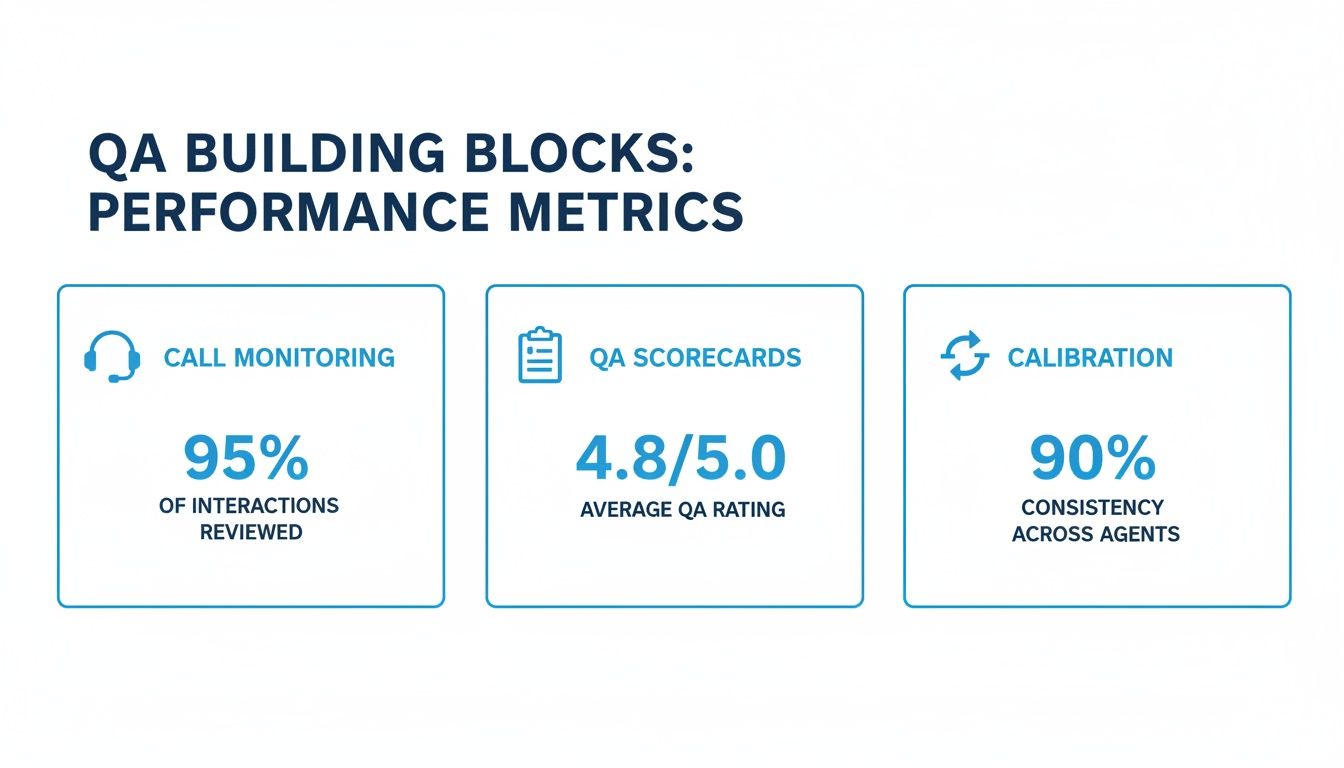
These three pillars are not just separate tasks; they work in tandem to build a structure that consistently improves performance and creates better customer experiences.
First Call Resolution (FCR)
First Call Resolution (FCR) is all about getting it right the first time. It measures the percentage of customer issues that are completely solved during the initial interaction, with no need for a callback or transfer. A high FCR rate is a win-win: it’s a sign of incredible efficiency and a massive driver of customer satisfaction. It proves your agents are knowledgeable and empowered to solve problems on the spot.
A low FCR rate often creates a domino effect. One unresolved call can quickly turn into multiple follow-ups, tying up agent time and multiplying customer frustration.
Think about a plumbing emergency. A customer calls with a burst pipe. If the agent messes up the dispatch on that first call, the customer has to call back—now even more stressed—and your company wastes time and money handling the same problem twice. For any service business, nailing the FCR is non-negotiable.
Average Handle Time (AHT)
Average Handle Time (AHT) tracks the average length of a customer interaction, from "hello" to all the after-call work. It's a classic efficiency metric, but one you have to handle with care.
If you push agents to slash their AHT too aggressively, quality is almost guaranteed to suffer. You'll get rushed conversations, incomplete solutions, and plummeting CSAT scores.
Take a busy dental clinic, for example. The goal isn't just to get the caller off the phone. The agent has to collect patient info accurately, explain pre-appointment instructions, and show a little empathy to someone who might be nervous. A slightly longer AHT that results in a prepared, confirmed patient is far more valuable than a 30-second call that leads to a no-show. The real power of AHT is using it to spot process issues, not to pressure agents into cutting corners.
Essential QA Metrics at a Glance
Navigating call center KPIs can feel overwhelming. This table breaks down the most critical metrics, showing you what they measure, what to aim for, and why they matter to your bottom line.
These metrics don't exist in a vacuum. A low QA Score for an agent might explain their poor FCR rate, which in turn is dragging down the team's overall CSAT. Understanding how they connect is the key to a truly effective quality assurance program.
Actionable Best Practices for Modern QA

A truly effective quality assurance program feels less like a report card and more like a playbook for success. Agents should see it as a tool for their own professional growth, not a reason to dread performance reviews. This shifts the entire culture from reactive correction to proactive coaching, building a team that's confident, skilled, and pulling in the same direction.
Here are some proven best practices to build a QA system that actually gets results.
Set Unambiguous Evaluation Criteria
The foundation of any solid QA program is absolute clarity. If your agents don't know what "good" looks like, they're flying blind. Vague criteria just lead to inconsistent scoring and frustrated team members who feel the rules are always changing.
Your QA scorecard needs to be a clear roadmap, not a confusing maze. Every single item should be specific and measurable. For example, instead of a fuzzy goal like "be empathetic," spell out the observable behaviors that demonstrate empathy.
- Vague: Be more empathetic.
- Actionable: Acknowledge the customer's frustration with phrases like, "I can definitely understand why that would be difficult," or, "That sounds very frustrating; let's see how we can fix this for you."
This simple change removes the guesswork, ensuring every evaluation is fair and consistent. It also gives agents a concrete checklist of actions they can take to improve their scores and—more importantly—the customer experience. For a deeper dive into agent performance, check out our guide on call handling best practices.
Deliver Consistent and Constructive Feedback
Feedback is the fuel for improvement, but how you deliver it determines whether it accelerates growth or kills morale. The goal is always to coach, not to criticize. Think of QA data as the starting point for a supportive conversation.
The most effective feedback is a dialogue, not a monologue. Frame your coaching sessions around collaboration. Start by asking agents for their perspective on an interaction before you share your own.
Imagine a manager at an insurance company reviewing a tricky call. Instead of just listing mistakes, they might say:
"Hi Alex, let's talk about that claims call with Mrs. Davis. I know she was quite upset. From your side, how did you feel the call went? I noticed you did a great job confirming her policy number right away. Let's brainstorm some ways we can show more empathy right from the start of those tougher conversations to help bring the tension down."
This approach turns a performance review into a collaborative problem-solving session, empowering the agent to own their development.
Monitor Every Customer Channel
Your customers don’t just call you anymore. They interact across phone, email, live chat, and social media. A modern QA strategy has to provide a complete picture by monitoring all of these channels. If you're only evaluating phone calls, you're missing huge parts of the customer journey and agent performance.
Since the pandemic, metrics like First Call Resolution (FCR) have become more critical than ever. The average FCR rate dropped by 4%, with many businesses now hovering around 65%. Think about what a small improvement could do. Bumping that up to 75% could eliminate hundreds of follow-up contacts, saving a ton on operational costs and making customers much happier. Analyzing every channel helps you pinpoint exactly where and why those resolutions are failing.
How AI Is Changing the Game for Call Center Quality Assurance
The old-school approach to quality assurance—manually pulling a few random calls for review—is on its way out. It’s a bit like trying to understand an entire movie by watching a handful of disconnected scenes. You get glimpses, but you miss the plot, the character arcs, and the really important moments.
Artificial intelligence flips this script entirely. Instead of just sampling, AI gives us the power to analyze every single customer interaction. This doesn't just improve QA; it completely redefines what is quality assurance in a call center.
Think of AI not as a replacement for your team, but as a super-powered assistant. It handles the monotonous, time-sucking tasks that once buried QA teams, freeing up managers and coaches to focus on what humans do best: mentoring their people and solving complex problems.
Getting the Full Picture with Automated Analysis
Right out of the gate, the biggest win with AI is its ability to monitor 100% of all interactions, whether they happen over the phone, via chat, or through email. This is huge. It means you can spot hidden trends, catch compliance risks, and identify coaching opportunities that would be invisible with random sampling.
For instance, AI can perform real-time sentiment analysis, picking up on subtle changes in a customer's tone that signal growing frustration—long before they ever threaten to speak to a manager.
This is especially powerful for businesses with more than one location.
Practical Example: An AI system is listening to calls for a multi-location HVAC franchise. It flags a conversation where a customer is sounding more and more agitated because the agent seems unsure about warranty details. The system sends an instant alert to the local manager with a link to the call and a note: "Negative sentiment detected: customer confused about warranty." The manager can then listen in, provide targeted coaching to the agent via private message, and help resolve the customer's problem before it turns into a scathing online review.
To make sense of all this data, a powerful AI feedback analysis tool is essential for turning mountains of conversations into clear, actionable insights for your QA team.
Cutting Down Handle Times and Boosting Productivity
AI also delivers a major boost to your operational efficiency, especially when it comes to Average Handle Time (AHT). This metric, which covers talk time, hold time, and after-call work, is a core measure of agent productivity.
With AI tools providing automated call summaries and transcriptions, agents are no longer stuck spending precious minutes after each call typing up manual notes. If you're curious how this works, we break it down in our guide to the modern AI phone answering service.
This simple change can slash after-call work by as much as 25%, which frees up agents to help the next customer in line. As call volumes continue to climb, contact centers using AI have seen AHT reductions of around 20%, a significant gain in productivity.
The dashboard below shows how AI can serve up these critical insights in an easy-to-digest format.
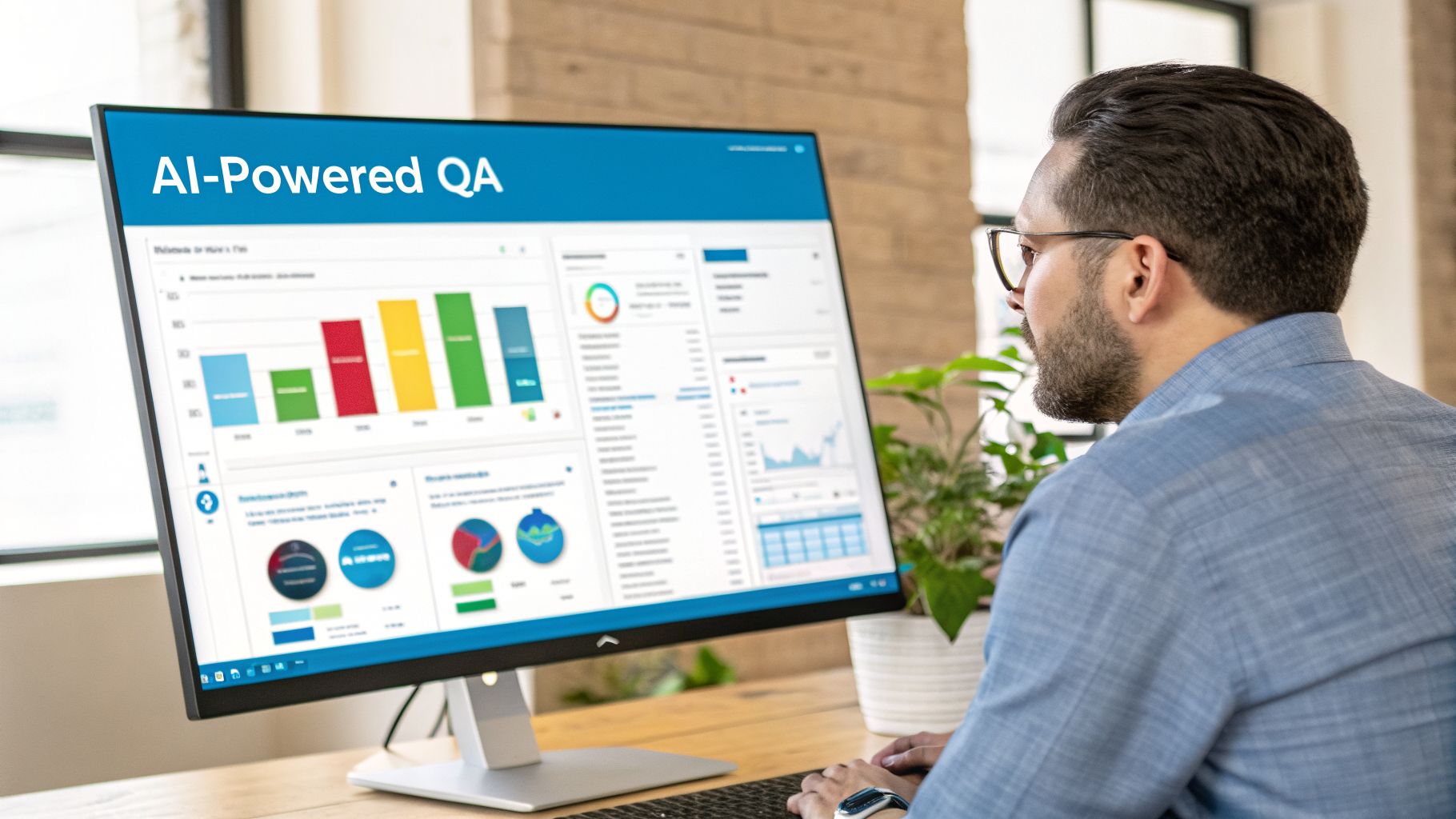
This kind of centralized view gives managers an immediate, clear look at performance trends, paving the way for data-driven coaching and much faster decision-making.
Common Questions About Call Center QA
Even with a clear plan, diving into a new quality assurance program—or overhauling an old one—is bound to bring up questions. Getting these common hang-ups sorted out early can make the whole process feel less intimidating and a lot more manageable. Let's tackle some of the most frequent questions people ask when putting call center QA into practice.
How Many Calls Should We Monitor for QA?
For years, the industry standard was a tiny sample: maybe three to five calls per agent, per month. But that's like trying to judge a restaurant's entire menu by tasting a single spoonful of soup. You miss the vast majority of the picture, which often leads to skewed or flat-out wrong conclusions about an agent's performance.
Today, best practice has shifted dramatically, thanks in large part to AI. The gold standard is now monitoring 100% of all interactions. This gives you a complete, unbiased view, making it easy to spot real trends, catch compliance issues, and understand performance accurately. If you're still doing things manually, aim for a more realistic 10-15% of interactions and work your way up from there.
What Is the Biggest Mistake to Avoid When Starting?
Without a doubt, the most destructive mistake you can make is treating QA as a way to punish people. The moment agents see a scorecard as a gotcha-tool designed to get them in trouble, you've lost. It breeds a culture of fear, defensiveness, and resentment.
Quality assurance has to be about coaching, not catching. It’s a supportive process built to help agents grow their skills and feel more confident in their roles. The data should spark constructive conversations about improvement, never disciplinary action.
Think of it this way: your goal is to build a stronger, more capable team. A positive, coaching-first mindset is the only way you'll get agents on board and invested in their own success. For example, instead of focusing on a low score, frame it as an opportunity: "Your score on call openings was a bit low this week. Let's practice a few different greetings together so you feel more confident."
Can a Small Business Implement an Effective QA Program?
Absolutely. You don't need a huge budget or a dedicated team to run a high-impact QA program. For a small business, the secret is to start simple and focus on what matters most. You can build a surprisingly effective QA scorecard by tracking just three to five critical behaviors.
- Did the agent use our standard greeting ("Thank you for calling City Smiles Dental...")?
- Was the patient's name and date of birth verified correctly?
- Did the agent show empathy for the patient's issue (e.g., "I'm sorry to hear you're in pain")?
- Was the appointment scheduled accurately?
- Did the agent clearly state the appointment time and location before ending the call?
You can even use free tools like Google Forms to create and manage these simple scorecards. And as you grow, platforms with built-in QA can automate the heavy lifting, making a top-tier program affordable and accessible for any size team.
A smart, AI-driven platform can make all the difference. Recepta.ai gives you automated call summaries, real-time analytics, and 24/7 coverage, turning quality assurance from a manual chore into an engine for growth. Learn how we can help you build a world-class QA program at https://recepta.ai.