
Your Guide to a Call Answering Service for Small Business

Think of a call answering service for small business as your always-on, professional front desk—just without the physical desk. It’s a team of remote receptionists ready to answer every call with your business name, making sure you never miss an opportunity to capture a new lead, book an appointment, or just deliver amazing customer service.
Essentially, it's a strategic partner that ensures your customers reach a real person, 24/7, instead of hitting voicemail and calling your competitor next. For example, a roofer can't answer calls while on a job site, so the service acts as their remote office manager, qualifying leads and scheduling estimates in real-time.
Why Your Business Is Leaking Customers Every Day

Picture this: you’re a plumber, halfway through a tricky pipe repair under a client's sink. Your phone buzzes in your toolbox with a new number. You can’t exactly drop everything to answer it. That single ring isn't just a missed call; it's a brand new customer you probably just handed over to the competition.
This isn't a rare occurrence. It's the daily reality for countless small business owners. Whether you're a one-person show or managing a small, busy crew, every unanswered call is a lost opportunity. In a world where people expect immediate answers, voicemail has become a black hole where your revenue goes to die.
The True Cost of a Missed Call
The consequences of an unanswered call go way beyond a single lost sale. The issue is huge—startling data shows that small businesses in the US only manage to answer 37.8% of their inbound calls. Another 37.8% are sent to voicemail, and a shocking 24.3% get no answer at all. You can dive deeper into these business phone statistics to see the full picture.
This problem gets even more intense for the 80% of US businesses that are "nonemployers"—think solopreneurs who have no one else to grab the phone. Each one of those missed calls chips away at your hard-earned reputation, slows your growth, and puts money directly into your competitors' pockets.
A missed call is more than a simple operational slip-up. It sends a clear message to a potential customer that you're either too busy or simply unavailable to help. That perception is all it takes to send them straight to the next name on their Google search.
To truly grasp the damage, it helps to see how the impact of one missed call ripples through your business, affecting everything from your immediate cash flow to your long-term brand health.
The True Cost of a Missed Call for Your Business
As the table shows, failing to answer the phone isn't just a minor inconvenience. It's a series of missed opportunities that accumulate over time, holding your business back from its true potential.
Why Small Businesses Struggle with Calls
So, why does this happen? A few common pain points are almost always to blame. Recognizing them is the first step toward plugging the leak.
- Limited Staffing: You and your team are already wearing a dozen different hats. For example, the owner of a boutique gym is also the lead trainer, marketer, and bookkeeper. Playing full-time receptionist on top of those jobs just isn't feasible.
- Peak Hour Overload: Many businesses get slammed with calls at specific times. A local restaurant gets crushed with reservation and takeout calls between 5 PM and 7 PM. Without a system to handle that surge, calls are bound to be dropped.
- After-Hours Inquiries: A customer with an emergency at 10 PM isn't going to leave a message and wait until morning. A homeowner whose basement is flooding will keep calling plumbers until someone—anyone—picks up.
A call answering service for small business is built to solve these exact problems. It’s your safety net, catching every lead and making every customer feel valued, no matter what time it is or how busy you are. It’s not just about answering the phone; it’s about securing your revenue and building a rock-solid reputation for being there when it counts.
How Does a Call Answering Service Actually Work?
Let's get one thing straight: a call answering service for small business isn't just a fancy voicemail. Think of your business line as the digital front door to your company. When a call goes to voicemail, you've essentially locked that door and put up a "Sorry, we're closed" sign. A potential customer is left on the sidewalk, likely ready to walk over to your competitor next door.
An answering service, on the other hand, is like having a friendly, professional concierge stationed at that door 24/7, ready to greet everyone who stops by.
It’s pretty simple on the surface. When someone calls your business number, the call is instantly forwarded to the service instead of ringing endlessly in an empty office. A highly trained agent—or a remarkably smart AI—picks up the phone, greeting the caller with your business name and a custom script. Just like that, you've created a great first impression, whether you're busy on a job, in a client meeting, or fast asleep.
The Different Flavors of Answering Services
Not all answering services are cut from the same cloth. The best fit for you really boils down to your business needs, how many calls you get, and what you want to happen when someone dials your number.
Here's a quick rundown of the three main types you'll encounter:
- Traditional Live Receptionist Services: This is the classic setup. A real person answers your calls, follows your script, takes down messages, and can even transfer the really important calls directly to your cell. This is ideal for a therapy practice where a new patient might feel more comfortable speaking to a compassionate human first.
- Automated IVR Systems: You know these well. It's the "Press 1 for sales, Press 2 for support" menu. An Interactive Voice Response (IVR) system acts like a digital switchboard, guiding callers to the right place using their phone's keypad. A property management company might use this to route tenant calls to maintenance and leasing inquiries to the right department.
- Modern AI-Powered Services: This is where things get really interesting. AI receptionists can have surprisingly human-like conversations, pull key details from a caller, answer common questions, and book appointments right into your calendar. To see how this technology is changing the game, check out the different AI-driven call answering services available now.
In a world where you have about 47 seconds to grab a customer's attention, every missed call is a missed opportunity. For a law firm or an HVAC company, that's not just a missed call; it's a valuable lead calling a competitor who actually picked up. If you want to dive deeper, these business phone statistics on ambscallcenter.com paint a clear picture.
Matching the Service to Your Business
Picking the right service is everything. The goal isn't just to stop the phone from ringing—it's to make every caller feel heard and guide them to the next step.
The goal isn’t just to answer the phone; it's to create a seamless and professional experience that moves a customer or lead to the next step—whether that's booking a job, scheduling a consultation, or simply getting the information they need.
Let’s look at a couple of real-world examples.
A busy plumbing company that fields frantic calls about burst pipes at 2 a.m. would do well with a live receptionist. That human touch provides empathy and reassurance, which is exactly what someone needs in an emergency. The agent can take down the details and dispatch a technician right away.
Now, consider a dental office that mostly gets calls for routine cleanings. An AI-powered service is a perfect fit here. It can access the clinic’s schedule, offer up available time slots, and book the appointment without needing a staff member to lift a finger. This frees up the front desk team to focus on the patients who are physically in the office. Meanwhile, a larger business with clear-cut departments might find an IVR system is the most efficient way to funnel a high volume of calls to the right people.
Five Ways Answering Services Unlock Business Growth

Think of a call answering service as more than just a safety net for calls you miss. It’s a growth engine. By having a strategy for your inbound calls, you can directly boost lead capture, sharpen your operations, and build a rock-solid professional reputation.
Let's dig into the five core areas where a call answering service for small business delivers real, tangible results.
1. Capture Every Single Lead, Around the Clock
Your business might close at 5 PM, but your customers don't stop having problems or questions. Opportunities can pop up at any hour—a homeowner with a burst pipe at 2 AM or a potential client researching their options on a Sunday afternoon. Answering services offer true 24/7 availability, making sure every single call is met by a professional, not a voicemail box.
That constant readiness is what turns a curious caller into a paying customer. When someone has an urgent need, they aren't going to wait for a callback. They'll just move on to the next name on their list.
Answering every call is the most direct way to get the most out of your marketing spend. You've already paid to make the phone ring through ads, SEO, or referrals. Letting it go to voicemail is like setting that money on fire.
Practical Example:An HVAC company uses a 24/7 answering service. A customer's AC dies during a sweltering heatwave at 11 PM. A live agent immediately takes their details, confirms it's an emergency, and dispatches the on-call tech. The company just landed a high-value job that would have gone straight to a competitor—all while the owner was asleep.
2. Streamline Your Day with Automated Scheduling
How much time do you lose just trying to schedule appointments? Every minute spent playing "calendar tag" is a minute you're not spending on the work that actually makes you money. A core feature of modern answering services is automated appointment scheduling, which hooks right into the calendar you already use.
This turns your phone line into an efficient booking machine, cutting out the endless back-and-forth. It frees up your team to focus on what they do best. For a deeper dive, check out how you can integrate new appointment scheduling for an AI receptionist into your own workflow.
Practical Example:A busy law firm has its answering service handle new client calls. The agent follows a script to ask a few qualifying questions (e.g., "Is this related to a personal injury or a family law matter?"), grabs their contact info, and books a 30-minute consultation directly into the right attorney's calendar. The lawyer walks in the next morning to a pre-vetted, fully booked schedule.
3. Polish Your Professional Image
First impressions are final. When a call is answered professionally with a custom greeting like, "Thank you for calling Apex Landscaping, how can I help you?", it instantly signals that your business is organized, established, and cares about its customers. Whether it's a warm, friendly agent or a polished AI, that first interaction builds immediate trust.
This consistent, professional front is what separates you from the competition who lets calls ring endlessly or uses a generic "leave a message" greeting. It tells callers you value their business from the very first second.
4. Make Smarter Decisions with Real Data
A good answering service isn't just taking messages; it's collecting valuable data. Every call that comes in is a goldmine of insights you can use to run your business better.
Most services provide detailed call reports and analytics that can help you spot:
- Peak Call Times: Know exactly when you need the most coverage.
- Common Questions: See what information you need to add to your website or marketing.
- Lead Sources: Find out which of your marketing efforts are actually making the phone ring.
Practical Example:A cleaning service owner reviews her call analytics and discovers that 40% of her booking calls come in between 6 PM and 9 PM, likely after people get home from work. Armed with that knowledge, she shifts her online ad budget to be more aggressive during those hours. The result? A 15% jump in qualified leads without spending a single dollar more on ads.
5. Get Your Focus (and Your Sanity) Back
Finally, the biggest benefit might just be the peace of mind. Knowing every call is handled by a professional is a massive weight off your shoulders, especially when you're a small business owner pulled in a million different directions.
Let’s be honest, the constant spam and robocalls don't help. A detailed report that analyzed over 62 million calls confirmed that while phone calls are still a top source of leads, the endless interruptions make it almost impossible for small teams to keep up. An answering service acts as your gatekeeper, filtering out the junk so only real opportunities get through. You're free to focus on what really matters: growing your business.
Answering Services in Action: Real-World Scenarios
It's one thing to talk about features, but the real magic of a call answering service happens when you see it solve the everyday problems that drive business owners crazy. It’s about turning those operational headaches into real, measurable growth. Let's look at a few stories of how these services became a total game-changer for owners just like you.

Take 'Sarah,' who runs a busy home cleaning franchise. Her crew did amazing work, but her biggest problem was juggling teams in the field while trying to grab calls from new leads. More often than not, she'd miss the call, which meant losing a potential customer to a competitor who was just faster to pick up the phone.
Frustrated, Sarah brought in an answering service. Now, when a potential client calls for a quote, a professional agent grabs their details, answers basic questions from a script (like square footage and number of bedrooms), and books a consultation right into Sarah's calendar. She doesn't even have to touch the phone.
The result? Sarah saw her new client sign-ups jump by 25% in the first quarter alone. She no longer had to choose between managing today's jobs and securing tomorrow's.
It’s Not Just for One Type of Business
The great thing is, these benefits aren't confined to a single industry. A good call answering service is flexible enough to adapt to all sorts of businesses, each with its own unique goals and challenges.
Think about the cost and hassle of hiring a dedicated in-house team just for phones. Data shows that even small call centers only handle about 50-100 calls per agent daily. For a small business with unpredictable call volume, a full-time team just doesn't make financial sense.
Here are a few more industry-specific examples to show you what I mean.
The Busy Dental Clinic: The front desk of a dental office is pure chaos—patients checking in, phones ringing off the hook. By offloading appointment confirmations and reminders to an answering service, one clinic automated a huge time-suck. This freed up the front desk staff to focus on the patients right in front of them, leading to an 18% drop in no-shows and a much smoother patient experience.
The Ambitious Law Firm: Legal problems don’t follow a 9-to-5 schedule. A personal injury firm realized that most of their best leads were calling late at night, right after an accident. By switching to a 24/7 service, they made sure every single urgent call got answered. Agents used a custom script to capture all the critical intake details, so no potential case ever slipped through the cracks.
The true power of a call answering service is its ability to handle your customers' "right now" moments. Whether it's an emergency, an urgent question, or just a simple inquiry, being there in that moment is what builds trust and wins business.
Instant Routing for Real Estate Agents
In real estate, speed is everything. An agency with a team of agents was fumbling leads because all calls went to a central number. The office manager would have to play detective, trying to track down the right agent for a specific listing while the potential buyer waited. It was a recipe for lost opportunities.
They switched to a service with intelligent call routing. Now, when a call comes in about a specific property, the system automatically sends it to the listing agent’s direct line. If they don't answer, it hops to the next agent in line. This simple fix slashed response times and ensured every hot lead got connected to the right person, instantly.
These stories aren't just hypotheticals—they show that a call answering service is so much more than an admin tool. You can read through several case studies of businesses that have seen similar wins. It's a strategic asset that captures revenue, smooths out your operations, and delivers the kind of professional experience that helps small businesses punch above their weight.
Calculating Your Return on Investment
It’s easy to look at a call answering service for a small business and see just another monthly bill. But that’s the wrong way to think about it. This isn't just another expense; it's a tool for growth. When you actually run the numbers and calculate the return on investment (ROI), you start to see how a service like this can pay for itself over and over again.
The math behind it isn't as complicated as it sounds. It really just comes down to one simple question: what’s the real cost of a single missed call? Once you have that number, you can see the clear financial upside of catching every opportunity.
The True Cost of a Missed Opportunity
First things first, you need to know what a new customer is actually worth to your business. This is often called your Average Customer Value (ACV). For a cleaning company, maybe the average contract is worth $2,400 a year. If you're a plumber, maybe the average job is $350. Whatever your number is, start there.
Next, get real about how many potential customers you miss each month. Think about all the calls that hit your voicemail while you're busy, on another line, or simply closed for the day. Let's say you guess you're missing about 10 good leads every month. Now you have what you need to see how much revenue is slipping through your fingers.
A Quick ROI Breakdown
Let’s walk through a real-world example. Imagine you run a small marketing agency and you're looking at an answering service that costs $250 per month.
Here's how you'd figure out the ROI:
- Pinpoint Your Average Customer Value: Your typical client is on a $500 monthly retainer.
- Estimate How Many Leads You'll Capture: You're confident the service will help you grab at least five extra leads each month that you were missing before.
- Calculate Your New Revenue: Five new clients at $500 a pop? That's $2,500 in new monthly revenue.
ROI Calculation: (New Revenue - Service Cost) / Service Cost
($2,500 - $250) / $250 = 9
That's a 900% return on your investment—a 9x ROI. All of a sudden, that $250 monthly fee doesn't feel like a cost anymore, does it? It looks more like one of the smartest investments you could make. When you're ready to see what the numbers could look like for your own business, you can explore different options by looking into call answering service pricing.
This is where a solution like Recepta.ai really makes a difference. By combining smart AI with a human touch, it ensures 100% of your calls are answered 24/7, completely wiping out that 62% industry miss rate. Users see up to 30% more qualified leads and save as much as 80% compared to hiring an in-house receptionist, effectively turning missed calls into booked appointments. You can dig deeper into the stats on the impact of unanswered calls on ambscallcenter.com.
How to Choose the Right Answering Service Partner
Picking a call answering service for your business is a big deal. You're not just hiring someone to pick up the phone; you're choosing a partner to represent your brand on the front lines. With so many options out there, from live receptionists to sophisticated AI, it's easy to get lost in the sales pitches. The key is to focus on what actually matters for your day-to-day operations.
A great partner will feel like a natural extension of your team, fitting right into your workflow. The wrong one? It just creates confusion for customers and major headaches for you. Let's walk through how to ask the right questions to find a service that solves today's problems and is ready to grow with you tomorrow.
Evaluate Core Technical Capabilities
Before you even glance at a pricing sheet, you need to make sure a provider can handle your technical needs. A service that doesn’t play well with the tools you already use is like hiring an employee who can't use your software—it just creates more work.
Start by digging into the nitty-gritty of their platform. You need to know if it will genuinely simplify your life or just add another layer of complexity.
Key Questions to Ask About Integration and Customization:
- Does it sync with my CRM? Don't settle for a vague "yes." Ask them to name the specific CRMs they integrate with, like Salesforce, HubSpot, or Jobber. A seamless connection means new lead info gets logged automatically, saving you from tedious data entry.
- Can I customize the call scripts? Your business has its own unique voice. Find out if you can provide your own scripts and, just as importantly, how easy it is to update them for new promotions or seasonal changes.
- How does it handle appointment scheduling? Ask if the service connects directly to your calendar, whether it's Google Calendar, Outlook, or another platform. A top-tier service should be able to book, reschedule, and cancel appointments in real-time without you lifting a finger.
Assess Scalability and Future Growth
Your business isn't going to stay the same size forever, and your answering service shouldn't hold you back. True scalability means the service can easily handle a sudden flood of calls during your busy season or grow alongside you as you expand your team. Without that flexibility, you’ll be stuck searching for a new provider right when you’re hitting your stride.
The best call answering service for a small business is one that feels like it was built just for you today, but is ready for the company you plan to be in three years. True scalability is about growing with you, not just serving you.
Think about your future needs right now to avoid a painful migration process down the road. Ask potential vendors exactly how their service adapts to changing business demands.
This decision tree helps visualize the potential ROI by plugging in your average customer value and monthly lead volume.
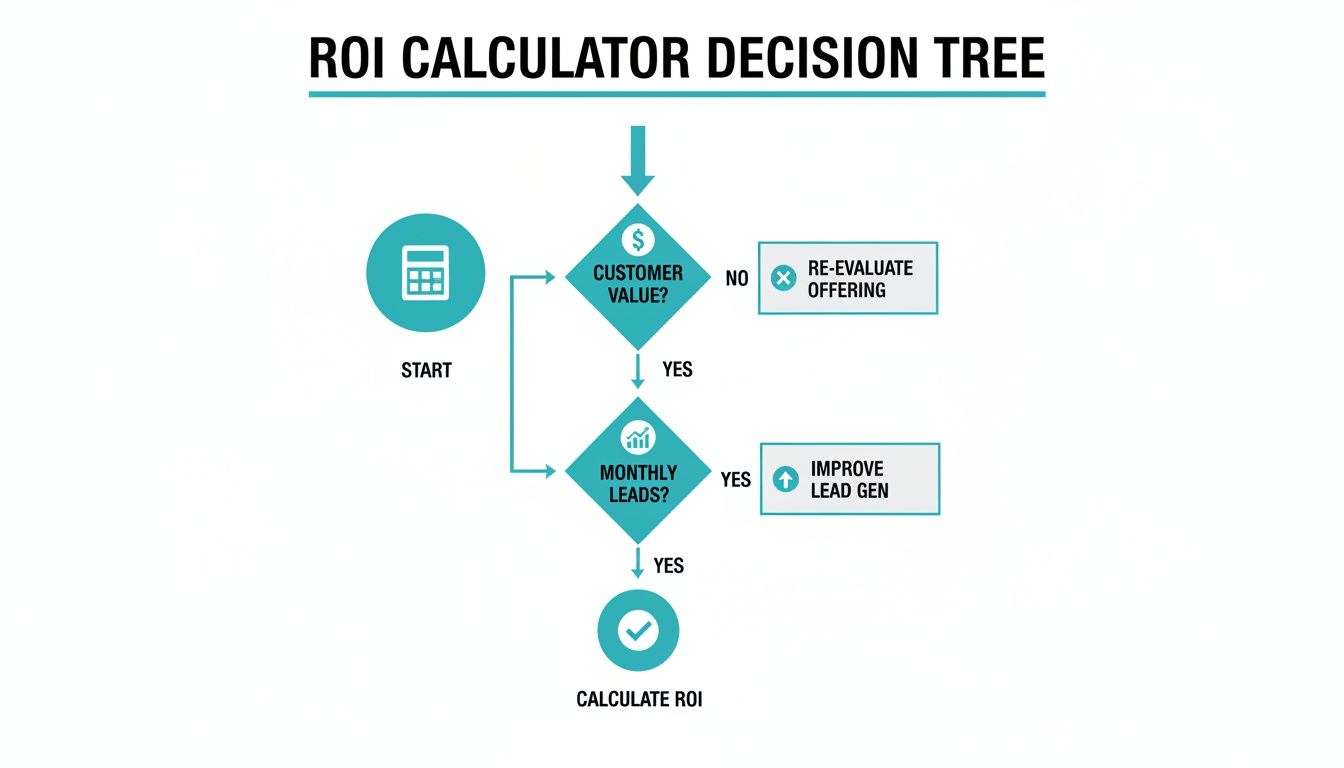
As you can see, even capturing just a handful of extra leads each month can generate a massive return, quickly turning the service into a profit center.
Verify Security and Compliance Standards
In many industries, protecting customer information isn't just a good idea—it's the law. If you handle sensitive data in fields like healthcare, law, or finance, your answering service must meet strict compliance standards. A security breach traced back to a third-party vendor can be devastating for your reputation and your finances.
For instance, a medical practice has to ensure its answering service is HIPAA compliant to protect patient privacy. A law firm needs a partner that deeply understands client confidentiality. Don't just take their word for it; ask to see proof of their security protocols and compliance certifications. This due diligence protects your customers and your business from very serious risks.
To help you compare your options side-by-side, I’ve put together a simple checklist. Use this table to ask pointed questions and organize the answers you get from different providers. It’s a great way to cut through the marketing fluff and see who really delivers.
Vendor Comparison Checklist Must-Ask Questions
After you've filled this out for a couple of top contenders, the right choice often becomes much clearer. The goal is to find a partner whose capabilities line up perfectly with what your business needs to thrive.
Frequently Asked Questions
It’s smart to have a few lingering questions before you pull the trigger on a new service. Even with all the benefits laid out, you need to know the practical details. Here are some of the most common questions we get from small business owners trying to figure this out.
How Much Is This Going to Cost Me?
There’s no single price tag, as the cost really depends on how you plan to use the service. Most providers offer a few different ways to pay, and the best one for you hinges on your call volume and what you need the agents to actually do.
- Per-Minute Plans: You're billed only for the time an agent is actively on a call. This is a great fit if your call volume is low or swings wildly from one month to the next.
- Per-Call Plans: A simple, flat fee for every single call handled, no matter the duration. If you hate surprises on your bill and want predictable costs for budgeting, this model is a lifesaver.
- Flat-Rate Monthly Plans: Think of this as a subscription. You get a set block of minutes or calls for one fixed price each month. It's the go-to for businesses that have a steady, predictable flow of incoming calls.
To put it in perspective, a contractor who mainly gets emergency calls after hours would probably save money with a per-call plan. On the other hand, a busy marketing agency that needs constant appointment scheduling would likely find a monthly plan with a big bucket of minutes to be more economical.
Will My Customers Realize They're Talking to an Answering Service?
This is probably the biggest worry we hear, and the answer is a resounding no—as long as you choose a quality service. Top-tier answering services are chameleons; their entire job is to blend in and become part of your brand.
During the setup, you'll work with them to nail down the exact greeting you want, develop custom scripts, and teach them the specific tone you use with your customers.
A good answering service doesn’t just answer calls; it becomes an invisible extension of your in-house team. The agents are trained to sound like they're right there in your office, not miles away in a call center.
Whether it’s a highly-trained live agent or a sophisticated AI, the entire interaction is built to feel natural and authentic. They’ll greet callers by your company's name and follow your instructions to the letter, so your customer experience stays consistently excellent.
How Long Does It Take to Get Everything Set Up?
You'd be surprised at how quickly you can get this going. For a basic setup, you can be live in less than 24 hours. The whole process is designed to be painless.
- Kick-off Chat: You’ll start with a quick conversation to go over your needs, typical call volume, and what you want to achieve.
- Scripting & Workflows: You’ll work together to create the perfect script and map out how different types of calls should be handled. For example, "If a caller mentions 'emergency leak,' patch them through to the on-call plumber immediately."
- Forward Your Number: This is the easy part. You just forward your existing business line to the number they provide.
Now, if you need a more involved setup, like integrating with your CRM or building out complex appointment-setting rules, it might take a few days to iron out all the details. But for most small businesses, you can start reaping the rewards of never missing a call in just a few hours.
Stop letting missed calls become missed revenue. Recepta.ai acts as your smart, 24/7 receptionist, ensuring every lead is captured and every appointment is booked automatically. It works seamlessly with the tools you already rely on.
Find out how much your business can grow. Start your 30-day risk-free trial and see for yourself. Learn more at recepta.ai.