
A Guide to After Hours Answering Services for Business Growth
So, what exactly is an after-hours answering service? It's a professional service designed to manage all your business calls that come in outside of your typical 9-to-5 workday. Think of it as a seamless extension of your own team, making sure every single customer, potential lead, or urgent call gets a prompt, professional response.
This isn't just about preventing missed calls; it's about stopping revenue from walking out the door.
What an After-Hours Answering Service Really Does
Picture this: your office doors lock at 5 PM, but a huge potential client has a burning question at 8 PM. Without an after-hours service, they hit your voicemail and immediately start dialing your competitors. With one, they’re greeted by a professional who understands their needs and captures their information.
That’s the real magic here. It’s not just a message-taking service—it’s a proactive tool that turns your closed hours into a productive pipeline. It bridges the gap between the old-school workday and the 24/7 reality of modern customers, transforming what used to be dead air into qualified leads and booked appointments. Essentially, it ensures opportunity never sleeps, even when you do.
Why Immediate Response Matters More Than Ever
Let's face it, we live in an on-demand world. Patience is thin, and customer expectations for instant answers have skyrocketed. The data backs this up: 42% of customers expect service outside of traditional business hours, and a massive 73% say a fast response is the most critical part of good customer service. Yet, an almost unbelievable two-thirds of potential customers fail to reach a live person on their first call. You can discover more insights about these market trends on researchandmarkets.com.
This disconnect between what customers want and what most businesses deliver is where you can gain a serious competitive edge. For some industries, a single missed call can be a disaster.
- For Home Services: A homeowner with a burst pipe at 2 AM isn't leaving a voicemail. They're calling the next plumber on the list until someone picks up. An answering service snags that emergency job on the spot.
- For Legal Practices: That first call from a potential client is crucial. If they get a machine, their confidence wavers, and they’ll likely move on to a firm that seems more available.
- For Healthcare Providers: Patients love the convenience of scheduling or canceling appointments after hours. This simple service helps cut down on no-shows and keeps your calendar packed.
By putting one of the many available after hours answering services to work, you ensure these critical interactions are captured, not lost.
An after-hours service isn’t just a defensive measure to stop losing calls; it’s an offensive strategy to actively capture revenue, improve client satisfaction, and build a reputation for reliability around the clock.
Comparing Different Types of Answering Services
Picking the right after-hours answering service isn't a "one-size-fits-all" deal. The best choice for your business really hinges on your specific goals, what your customers expect, and of course, your budget. To find that perfect fit, you first need to get a handle on the three main ways these services operate.
Each model brings something different to the table, from the warm, understanding touch of a real person to the non-stop efficiency of AI. Once you see how they work, you can zero in on the one that solves your after-hours puzzle and keeps your callers happy.
This flowchart shows exactly where these services fit in. They’re the safety net that catches every call you’d otherwise miss when the office is closed.
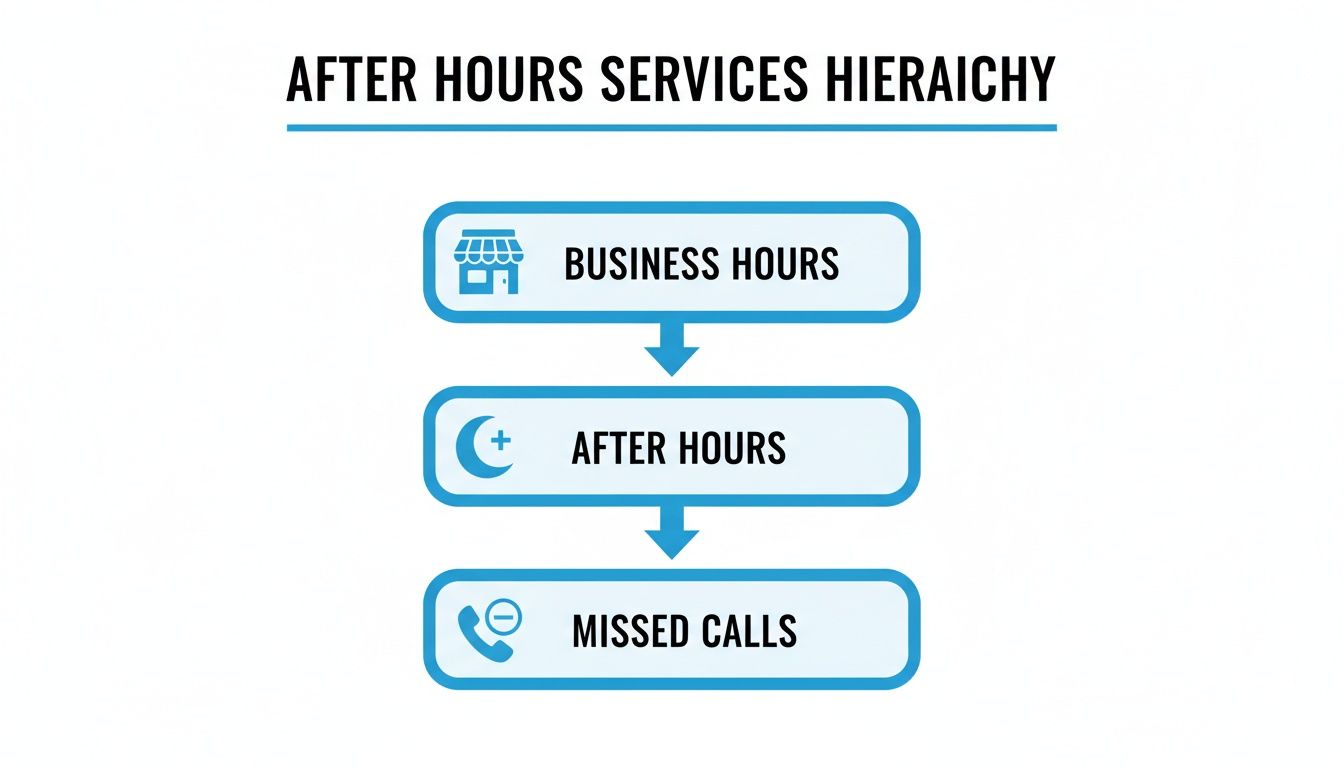
As you can see, whether a call comes in during a busy workday or in the middle of the night, a dedicated service ensures it never becomes a lost lead.
Traditional Live Agent Services
This is the classic approach. A team of trained, professional human agents answers calls for you. This model really shines when you need to handle complex, sensitive, or high-value conversations where a little empathy and genuine understanding go a long way.
Practical Example: A potential client calls a criminal defense law firm late at night in distress after an arrest. A live agent can offer real reassurance, collect crucial case details with care, and explain the next steps for a consultation in a way an automated system simply can't. While you’ll pay more for this human touch, it’s absolutely worth it for businesses where building immediate trust is everything.
Fully Automated AI Answering Services
On the other side, you have fully automated AI services. These are the workhorses—built for speed, efficiency, and cost-effectiveness. They're perfect for handling routine, repetitive tasks 24/7.
An AI receptionist can instantly:
- Book appointments right into your calendar.
- Answer common questions about your hours or services.
- Qualify new leads by asking a few simple, pre-set questions.
Practical Example: A busy dental practice uses an AI receptionist. A patient calls at 3 AM to schedule a teeth cleaning. The AI pulls up the clinic's calendar, offers several open slots, confirms the appointment, and sends a calendar invite, all without anyone having to lift a finger. This frees up your front desk staff to focus on the patients right in front of them during business hours. The incredible pace of this technology is a big reason the global after-hours answering service market is expected to hit USD 2.896 billion by 2033. You can read the full research on this growing market on datainsightsmarket.com.
The Best of Both Worlds: A Hybrid Model
The hybrid model is where things get really smart, blending the sheer efficiency of AI with the irreplaceable judgment of a human agent. Here’s how it works: an AI fields the call first, taking care of simple requests like scheduling or providing basic info.
But the second a call gets too complex, emotional, or urgent, the system knows to pass it off to a live agent. This guarantees that routine calls are handled cheaply and quickly, while your most important opportunities get the human attention they need to convert.
Practical Example: A plumbing company uses a hybrid service after hours. A customer calls at 11 PM to book a non-urgent drain cleaning for next week—the AI handles it from start to finish. But then another call comes in about a burst pipe flooding a basement. The AI immediately flags the emergency and connects the caller straight to an on-call plumber for dispatch.
This intelligent mix lets you keep costs down without ever compromising on the quality of your customer service. And integrations are getting smoother all the time, especially when you can connect an AI receptionist with CRM systems to keep all your customer data in one place. By combining automation with a human backup, the hybrid approach offers a powerful, balanced solution for 24/7 coverage.
Comparing After Hours Answering Service Models
To make the decision a bit easier, this table breaks down how each of the three models stacks up against the others. Think about your most common types of calls and what kind of experience you want to provide when you’re not there to answer yourself.
Ultimately, there’s no single "best" option—just the one that’s best for you. Whether you prioritize the personal touch of a live agent, the affordability of an AI, or the balanced approach of a hybrid system, the goal is the same: never miss another opportunity.
Key Features That Drive Revenue and Efficiency
Think of a modern after-hours answering service less like a digital receptionist and more like a powerful business engine. It’s a toolset designed to do one thing exceptionally well: turn missed calls from a costly problem into a valuable asset. Instead of a caller hitting a cold, generic voicemail, they're greeted by a smart system ready to turn their interest into real business.
These features aren’t just bells and whistles. They’re designed to work together, creating an automated system that captures opportunities around the clock, keeps your workflow organized, and makes sure every caller gets a professional response—even at 2 AM.
This is all about turning a simple phone call into a captured lead, primed and ready for your team to follow up.
A good service is engineered to never miss an opportunity, handling every call with the same care and precision, no matter when it comes in.
Turn Every Call into a Qualified Lead
The most immediate payoff you'll see is 24/7 Lead Capture. Just because your office doors are locked doesn't mean your sales pipeline should be. An effective answering service becomes your tireless sales assistant, engaging callers and gathering all the essential information.
And it goes way beyond just taking a name and number. A smart system can ask crucial pre-qualifying questions to figure out a caller's needs, budget, or level of urgency.
- For a law firm: It might ask, "Are you looking for representation for a new case?" or "Are you an existing client?" to instantly sort callers.
- For an HVAC company: The system could ask, "Is this for a repair, a new installation, or a maintenance quote?" to get straight to the point.
This means your team walks in the next morning to a list of warm, qualified leads. They’ll have all the initial details they need to hit the ground running and close the deal.
Fill Your Calendar While You Sleep
Another game-changer is Automated Appointment Scheduling. This feature gives callers the power to book meetings, consultations, or service calls directly into your team’s live calendar. No one on your staff has to lift a finger.
It completely eliminates the frustrating email tag and phone tag that comes with scheduling, filling your calendar with confirmed appointments. When hooked up correctly, the system sees real-time availability, so you never have to worry about double-bookings. You can see just how powerful this is by exploring the details of AI-powered new appointment scheduling for receptionists. This one feature can have a huge impact on your team's productivity.
Practical Example: A dental practice closes at 5 PM. At 9 PM, someone with a toothache calls to book their first check-up. The after-hours service pulls up the clinic's calendar, offers a few open slots for the following week, and books the appointment on the spot—all in one quick, automated conversation.
Route Critical Calls Intelligently
Let's be honest, not all after-hours calls are created equal. A quick question about your business hours is a world away from a true emergency. That’s where Intelligent Call Routing proves its worth.
You can set up custom rules to identify the nature of a call and send it to the right place. This ensures that genuine emergencies are escalated immediately, while routine inquiries are handled without waking up your on-call staff.
Practical Example: A property management firm sets up call routing rules. A tenant calls at midnight about a leaky faucet. The service logs the request for the maintenance team to handle the next business day. But an hour later, another tenant calls to report a fire alarm. The system instantly recognizes the urgency and patches the call straight through to the on-call emergency manager's cell.
This smart filtering protects your team’s time and sanity while guaranteeing that the truly critical issues get the immediate attention they need.
How to Choose the Right Service Provider for Your Business
Picking an after-hours answering service is a lot like hiring a key team member. Get it right, and you’ll see your business grow. Get it wrong, and you're in for a world of frustration. This isn't about finding the cheapest rate; it's about finding a true partner that can act as a seamless extension of your brand.
To make the right call, you need to dig deeper than the sales pitch and really look at what makes a provider tick. A few key areas will tell you whether a service will genuinely help you hit your goals or just end up as another line item on your monthly bill.
Look for Proven Industry Specialization
Every industry speaks its own language and has unique customer needs. A generic answering service can probably take a message, but they won't grasp the subtle details that matter to your callers. That’s why industry specialization isn't just a "nice-to-have"—it's essential.
Practical Example: A medical office needs agents who are experts in HIPAA compliance. They need to know the difference between a routine appointment request and a call that requires a nurse triage. A specialized service understands medical terminology and can handle sensitive patient calls with the right mix of empathy and professionalism. A legal intake service has to know how to qualify potential clients and gather crucial case details without crossing the line into giving legal advice. According to Clio’s 2024 Legal Trends Report, a staggering 62% of potential clients sign with the very first law firm that gets back to them, which shows just how critical that specialized first touch is.
Before you even think about signing a contract, ask for proof. Get case studies or references from other businesses in your field.
Assess Integration and Automation Capabilities
Your answering service can't be an island. To get real value, it needs to plug directly into the software you already rely on every day, like your CRM, scheduling tools, and helpdesk platforms.
The real power of an after hours answering service comes alive when it can automatically push new leads into your CRM, book appointments straight into your calendar, and log every call without anyone on your team having to lift a finger.
Practical Example: An HVAC company integrates its answering service with its CRM (like Salesforce) and scheduling software (like ServiceTitan). When a homeowner calls at 10 PM to report a broken AC, the service captures their details, creates a new lead record in Salesforce, and books a service appointment directly in ServiceTitan for the next morning. The technician receives an automated notification, and the sales team sees the new lead when they log in—no manual data entry required.
A system that’s properly connected saves countless hours of administrative work and cuts out the risk of data entry mistakes. It makes sure the information gathered overnight is ready and waiting for your team to act on the moment they walk in the door.
Prioritize Security and Compliance Standards
For many businesses, data security isn't just a good idea—it's the law. When you hand over your customer interactions to a third party, you're also trusting them with sensitive information. You have to be absolutely sure they take security and compliance as seriously as you do.
Think about what your specific industry demands:
- Healthcare: Is the service fully HIPAA compliant? You should ask to see their Business Associate Agreement (BAA) to confirm they meet federal standards for protecting patient data.
- Legal & Finance: What kind of data encryption and security measures do they use to protect confidential client files and financial details?
- Home Services: How do they keep customer addresses, payment details, and other personal information safe when booking jobs?
A trustworthy provider will be completely open about their security protocols and will have no problem showing you documentation to back it up. Don't just take their word for it—always ask for proof. It’s the only way to protect your customers, your reputation, and your business from serious legal trouble.
Calculating the ROI of Your Answering Service

It all sounds great in theory, but let's get down to the real question: does an after-hours answering service actually pay for itself? It's one thing to talk about better customer service, but it's another to translate that into hard numbers. To do that, you need a clear-eyed look at what you’re currently spending—and losing—by not having 24/7 coverage.
The return on investment (ROI) here isn't just about adding new revenue. It's also about plugging the financial leaks you might not even see. We'll break down a simple way to compare the cost of a modern service against two very expensive alternatives: hiring someone in-house and the silent, hidden cost of missed opportunities.
Cost of Missed Opportunities vs. a Service Subscription
Every call that goes to voicemail after 5 PM is a potential sale slipping through your fingers. It’s a harsh reality, but most people—especially new prospects—won't leave a message. They just hang up and call the next name on their list.
This is where the ROI calculation really starts. You have to figure out the value of a single new customer and put it up against the monthly cost of an after-hours answering service. The result is often an eye-opener.
A Quick Example: A Law Firm
Let's say a small law firm knows the average new client brings in $5,000 in revenue. They decide to try a hybrid answering service for $400 a month. If that service captures just one new client who would have otherwise gone to a competitor, the math is pretty simple.
- Gain from Investment: $5,000 (new client revenue)
- Cost of Investment: $400 (monthly service fee)
- Net Return: $4,600
- ROI: ($4,600 / $400) x 100 = 1,150%
In this scenario, the service didn't just pay for itself; it delivered a massive return from a single captured lead. For many businesses, the numbers are just as compelling, and you can see a variety of case studies demonstrating similar high-ROI outcomes for yourself.
Cost of In-House Staff vs. an AI-Hybrid Service
The other route businesses consider is hiring a dedicated overnight receptionist. While you get a human touch, the cost is often completely out of reach for small to medium-sized companies. The expense goes way beyond just an hourly wage.
A full-time, in-house employee brings a ton of overhead with them:
- Salary: You'll likely pay a premium for overnight shifts.
- Benefits: This includes everything from healthcare to retirement contributions and paid time off.
- Taxes: Payroll taxes add a significant chunk to your labor costs.
- Training and Equipment: Getting a new hire onboarded and set up with the right tools costs time and money.
When you add it all up, a single overnight employee can easily run you $45,000 to $60,000+ per year. Compare that to a sophisticated AI-hybrid answering service, which might only cost a few hundred dollars a month for reliable, 24/7 coverage. That's a tiny fraction of the price.
This huge cost difference is a big reason the global contact center outsourcing market hit USD 97.31 billion in 2024. Businesses are looking for ways to control labor costs while extending their hours. With AI delivering up to 80% cost savings compared to in-house reception, the financial argument for a modern answering service has never been stronger.
The choice becomes pretty clear. You can either invest in an affordable, scalable service that captures leads and grows your bottom line, or you can face the high costs—both direct and hidden—of trying to manage it all yourself.
Answering Your Top Questions
Deciding to bring on an answering service is a big step, and it's smart to have questions. Most business owners I talk to are curious about the same things: how long it takes to get started, what their customers will think, and whether their data will be safe. Let's tackle those head-on.
How Long Does It Take to Get Set Up?
Forget about long, drawn-out implementation projects. The idea that this takes weeks is a thing of the past. Modern answering services are built to get you up and running fast.
In many cases, you can be live in just a few hours. The process is pretty straightforward: you'll forward your lines, work with the provider to nail down your scripts and call flows, and connect it to the tools you already use, like your calendar or CRM. That means you can stop missing calls and start capturing leads almost right away.
Will My Customers Know They're Not Talking to My Staff?
This is a big one, especially if you’ve built your business on personal relationships. A professional after hours answering service should feel like a seamless part of your team, never like an obvious third party.
Here’s how top-tier services make that happen:
- Custom Scripts and AI: The system is loaded with your specific business details, answers to common questions, and your brand's unique voice. Whether it's an AI or a live agent on the other end, they’ll answer the phone with your company name and follow your exact instructions.
- Highly-Trained Agents: With a hybrid service, you get access to professional receptionists who are experts at representing different brands. They become an extension of your team, making sure every call is handled just the way you would.
The bottom line? Your customers just feel taken care of. They get the help they need, and they never have to know they’ve reached an answering service.
Is It Secure Enough for My Industry?
For any business handling sensitive information, security isn't just a feature—it's everything. Reputable providers don't treat security as an add-on; it’s baked into the core of their platform.
A great answering service doesn't just talk about security; they prove it with certifications and compliance specific to your industry. This is crucial for maintaining trust and avoiding massive legal headaches.
For a medical practice, this means the service must be HIPAA compliant and ready to sign a Business Associate Agreement (BAA) to protect patient data. For law firms or financial advisors, it means demanding strong data encryption and strict access protocols. Don't be shy about asking a potential provider for their security and compliance credentials—it's your right and your responsibility.
Ready to see how a 24/7 answering service can transform your business by capturing every lead and appointment? With Recepta.ai, you can set up a custom AI receptionist in minutes and start converting missed calls into revenue. Explore our 30-day risk-free trial today!