
Phone: phone answering service that boosts leads and support in 2026
At its core, a phone answering service is a team or system that handles your business's incoming calls. Think of it as a professional front line, ready to capture leads, book appointments, and provide support whenever you or your team can't get to the phone. The goal is simple: make sure no customer ever gets sent to voicemail or, even worse, ignored completely.
Why Your Business Can’t Afford Missed Calls
Picture your potential revenue as water in a bucket. Every time your phone rings and goes unanswered, it’s like poking a new hole in that bucket. Valuable opportunities—and your customers' trust—start to drain away. You might think voicemail is a good enough net, but let's be honest, it's often a dead end where potential clients go to disappear.
This isn't just a tiny drip, either. For most businesses, it's a serious leak. It's pretty shocking to learn that only 38% of small businesses actually answer their inbound calls. Where do the rest go? A whopping 37.8% are sent straight to voicemail, and an incredible 24.3% get no answer at all.
This creates a massive disconnect. Studies show that 77% of customers expect to talk to a live person right away. When they can't, they simply move on to a competitor who will pick up the phone. This customer expectation is what's driving the global call center market toward a projected $500.1 billion by 2030.
The High Cost of Unanswered Calls
The numbers don't lie. When a call isn't handled properly, it has a direct and often immediate impact on your business.
Looking at this breakdown, it’s clear that over 60% of calls to small businesses are fumbled. That’s a lot of lost revenue and wasted marketing spend.
From Lost Leads to Loyal Customers
Every missed call has a real cost that goes far beyond a single lost sale. It hurts your reputation, wastes your marketing budget, and holds back your growth. When a new prospect calls and you don't answer, the money you spent to get them to call in the first place has just been used to send them straight to your competition.
For so many businesses, the first one to answer the phone wins the job. A missed call isn't just a missed conversation; it's a forfeited opportunity to build a relationship and secure revenue.
This is where a professional answering service stops being a simple convenience and becomes a powerful strategic tool. It’s not just about taking messages—it’s about actively plugging the leaks in your sales process.
Moving from Passive Voicemail to Active Growth
A modern answering service turns your phone line from a passive, unreliable tool into an active, revenue-generating asset. Instead of letting calls pile up in a voicemail box you’ll check "later," the service engages callers the moment they reach out.
Here’s what that looks like in the real world:
- Lead Capture: A new customer calls your plumbing business after hours with a burst pipe. Instead of leaving a frantic voicemail and calling the next name on Google, a 24/7 service answers, gets their details, and schedules an emergency dispatch.
- Appointment Booking: Someone wants to book a consultation with your law firm. The answering service syncs with your calendar, finds an open slot, and books the appointment on the spot. No back-and-forth emails needed.
- Customer Retention: An existing client calls your software company with a basic account question. Instead of waiting for an email reply, the service provides a fast, accurate answer based on your knowledge base, reinforcing their decision to choose you and building lasting loyalty.
By expertly managing these crucial interactions, an answering service makes sure your business is always open, responsive, and ready to grow. You can learn more about how to keep your business running around the clock with an after-hours answering service in our detailed guide.
Human vs. AI Answering Services: A Look Across the Spectrum
When you’re looking into a phone answering service, you’ll find they aren’t all built the same. The choice is a lot like picking the right tool for a job. You wouldn't use a sledgehammer for a finishing nail, right? The landscape of services runs from entirely human-operated teams to fully automated AI receptionists, with some really interesting options popping up in the middle.
A traditional, human-only answering service is like having a dedicated person on your team. These agents bring a level of empathy and understanding to the table that can't be programmed. They’re fantastic at navigating complex, emotional conversations, which is absolutely vital for businesses where that personal connection is everything.
On the other side of the spectrum, you have your basic AI answering services. Think of these as a simple, automated phone tree. They do a great job with straightforward, repetitive tasks—like taking a message or answering a basic question—but they can get stuck if a caller asks something unexpected.
The Rise of the Hybrid Model
Lately, the most effective solution we've seen is the hybrid model, which smartly blends artificial intelligence with a human touch. It’s a bit like a modern navigation app that uses data to find the best route but lets you report a real-time traffic jam. The AI handles all the routine work, like capturing leads or booking appointments, but it knows exactly when a conversation needs a human to step in.
This simple graphic shows just how costly a single missed call can be—and how a service steps in to prevent that loss.
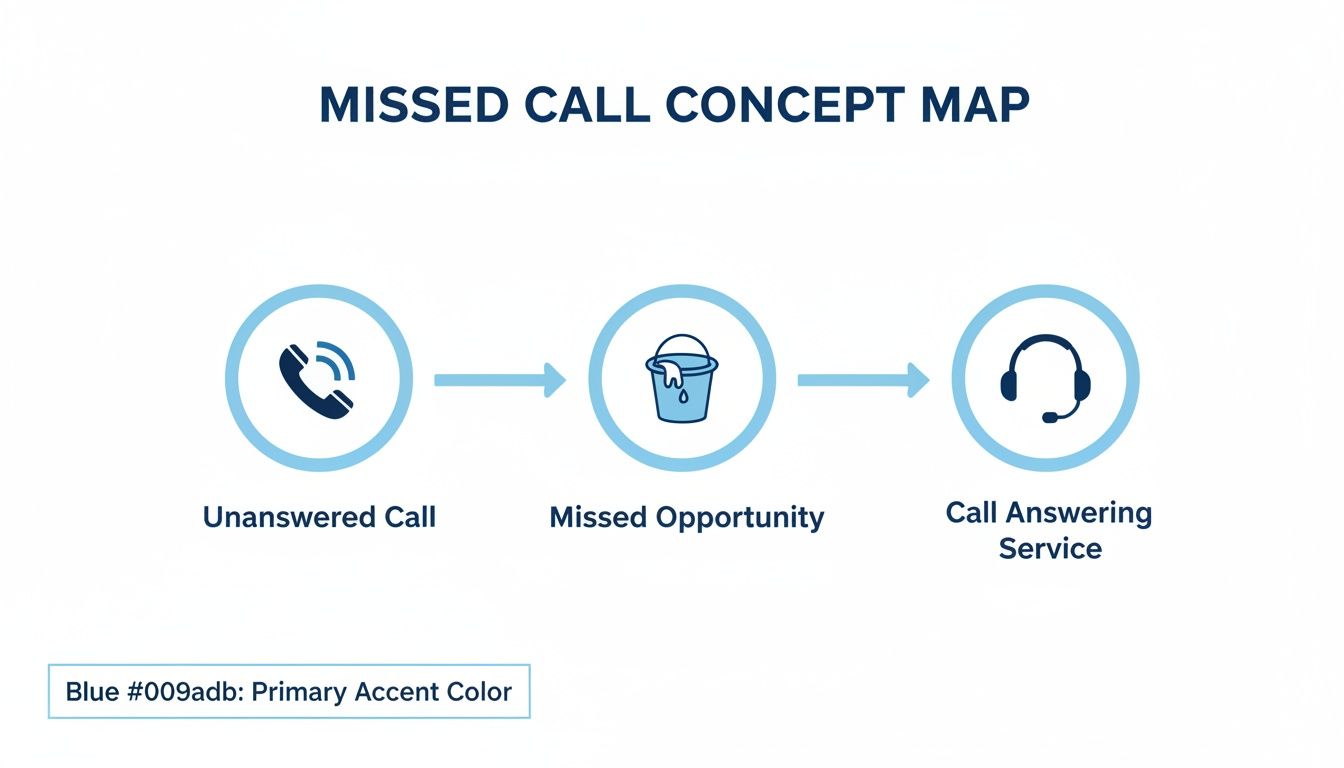
As you can see, an unanswered call isn't just a missed call; it's a missed opportunity. That's the core problem a great answering service is designed to solve.
A platform like Recepta.ai really leans into this hybrid approach. The AI handles the high volume of predictable calls with speed and precision, but there are always trained human agents on standby, ready to jump in for conversations that need empathy or creative problem-solving.
A study of law firms revealed something startling: 62% of potential new clients end up hiring the very first firm that gets back to them. This really drives home the importance of being available the second they call, whether that response comes from a person or smart AI.
That statistic alone shows why an instant response isn't just nice to have; it's a must. The right service guarantees you're always the first one to pick up the phone.
Human vs. Hybrid in the Real World
So, how do these different models stack up in day-to-day business? Let's look at a couple of practical examples.
Imagine a small family law practice. The calls they get are often from people in highly emotional and sensitive situations, such as discussing a divorce or child custody. In this case, the empathy of a human-led service is invaluable. A potential client needs to feel heard and understood, a quality where a real person will always have the edge.
Now, picture a busy HVAC company. They get slammed with calls every day, ranging from simple maintenance questions to full-blown emergencies.
- A human-only service could easily get bogged down during a heatwave, leading to long hold times and frustrated customers.
- A basic AI might not be able to tell the difference between a general inquiry ("How much is a tune-up?") and a real emergency, like a broken furnace on a freezing night.
- A hybrid service is perfect for this scenario. The AI can instantly answer FAQs and schedule routine cleanings, which frees up the human agents to focus their energy on dispatching technicians for urgent, high-value emergency calls.
This blended approach ensures every call is handled perfectly, keeping customers happy and maximizing revenue. For many businesses, learning what an AI receptionist for small business can do is the first step to finding that ideal balance.
Ultimately, your choice boils down to what your callers truly need. Do they require a high degree of emotional support, or are they looking for quick, efficient answers to routine questions? By understanding the full spectrum from human to AI, you can find a phone answering service that's a perfect fit for your business goals and, most importantly, your customers.
The Core Features That Drive Business Growth
A modern phone answering service is much more than a simple message-taking machine—it's a real growth engine for your company. Forget basic call forwarding. Today's services are packed with features designed to capture more revenue, smooth out your operations, and create a far better customer experience. They turn your phone line from a passive tool into a proactive asset.
The most important feature, without a doubt, is 24/7 availability. Opportunity doesn't stick to a 9-to-5 schedule, and your business shouldn't either. By being available around the clock, you can connect with leads the moment they decide to reach out, not just during your open hours.
Capture and Qualify Leads Around the Clock
Think about a plumbing company that used to send all its after-hours calls to voicemail. Now, with a 24/7 answering service, a frantic call about a burst pipe at 2 a.m. gets answered right away. The service gathers the caller's details, confirms the emergency, and dispatches the on-call plumber. Just like that, a potential disaster becomes a secured, high-value job.
This kind of immediate response is make-or-break. Many callers, especially those with an urgent problem, will just hang up and dial the next business on their list if they don't get a live person on the first try.
A modern answering service acts as your always-on sales front, ensuring you’re the first to respond and win the business, even while you sleep.
But it’s not just about answering the phone. Another key feature is intelligent lead qualification. Let’s be honest—not every call is a ready-to-buy customer. A great service uses a custom script to sift through inquiries, separating serious prospects from solicitors or people just looking for basic info.
Actionable Example: Real Estate Agency
A competitive real estate agency uses a service to screen all its incoming calls.
- Before: Agents wasted hours each day talking to unqualified renters about properties listed for sale, or dealing with spam calls.
- After: The answering service now asks callers key qualifying questions, like "Are you pre-approved for a mortgage?" or "Are you looking to buy or rent?" Hot leads are transferred directly to an agent, while others receive helpful resources via text. This keeps the agents focused on what they do best: closing deals.
Automate Scheduling and Integrate Your Workflow
Another game-changing feature is seamless appointment scheduling. The endless back-and-forth of trying to find a time that works for everyone is a huge time-waster. A phone answering service with scheduling integration completely gets rid of this headache.
Actionable Example: Dental Practice
- Before: The front desk staff is overwhelmed trying to manage check-ins, payments, and a constantly ringing phone. Callers wanting to book a cleaning often face long hold times or are sent to voicemail.
- After: When a new patient calls to book an appointment, the answering service accesses the clinic's real-time calendar (like Dentrix or a shared Google Calendar), finds an open slot, and locks in the appointment on the spot. This automates a tedious administrative task, filling the calendar with qualified appointments while the in-office team focuses on patient care.
To make all this work together, powerful CRM and software integrations are non-negotiable. For instance, a service like Recepta.ai can connect with over 2,500 different apps.
This deep integration means:
- No More Manual Data Entry: A new lead's contact info is automatically piped right into your CRM (like Salesforce or HubSpot).
- Real-Time Updates: An appointment booked by the service instantly shows up on your Google Calendar or Outlook.
- Synced-Up Operations: Call notes and outcomes are logged in your project management software (like Asana or Trello) without anyone on your team having to lift a finger.
This level of connectivity makes sure all your systems are perfectly in sync. To see what this data can really do for you, check out our guide on how to use call detail reporting for smarter business decisions. Of course, solid protocols for call center quality assurance are also critical to ensure every interaction is a positive one. When you bring these core features together, a phone answering service becomes a true cornerstone of both operational efficiency and revenue growth.
How Different Industries Use Answering Services
The real magic of a phone answering service happens when it’s dialed into the specific needs of your industry. A generic, off-the-shelf solution simply can't keep up. Every business field has its own rhythm, its own unique set of challenges—from after-hours emergencies to strict compliance rules—and the right service acts like a highly specialized extension of your team.
Think of it this way: you wouldn't use a hammer to turn a screw. The value isn't in just having a tool; it's in having the right tool for the job. It needs to speak your language and handle your specific calls with precision. Let's dig into some practical, real-world examples of how a well-chosen answering service can make a world of difference.
Home Services: Plumbers, Electricians, and HVAC
For anyone in the trades—plumbers, electricians, HVAC techs—availability isn't just a nice-to-have; it's the entire business. A burst pipe doesn't care that it's 3 a.m. A dead furnace on a freezing Saturday night demands an immediate fix.
A specialized phone answering service is the bridge that ensures you never, ever miss one of these urgent, high-value jobs.
Actionable Example: Emergency Dispatch for an HVAC Company
- Before: An HVAC business sends all after-hours calls to voicemail. A homeowner's AC unit dies on a scorching hot Saturday night. They call, leave a message, and immediately start dialing the next company on Google. That job is gone before the business owner even hears the message.
- After: With a 24/7 answering service, a live agent answers the call. Following a custom script ("Is your system completely down? Do you have a backup heat source?"), they quickly confirm it's an emergency, collect the address and problem details, and dispatch the on-call technician exactly as the company protocol dictates. The job is won, and the customer is beyond relieved.
By capturing just one or two extra emergency jobs per month, the answering service often pays for itself. It transforms a major operational weakness—after-hours downtime—into a consistent revenue stream.
This kind of immediate, professional response turns potential chaos into a structured, profitable part of your business. It's how you build a rock-solid reputation for being reliable.
Healthcare: Dental and Medical Practices
In healthcare, communication is a completely different ballgame. It’s governed by strict privacy laws and demands a high degree of empathy and accuracy. A medical or dental office can't just pick any service off the shelf; it absolutely must be HIPAA-compliant to protect sensitive patient data.
But it goes beyond just compliance. The service needs to manage specific tasks like booking appointments, handling prescription refill requests, and expertly routing urgent patient calls to the correct on-call doctor. This frees up your in-office staff from the constantly ringing phone, letting them focus on the patients standing right in front of them. For a deeper dive, you can learn more about choosing the right answering service for medical offices and its specific advantages.
Actionable Example: Secure Patient Appointment Booking
- Before: A busy dental practice's front desk is swamped. They're trying to check patients in, process payments, and answer a phone that won't stop ringing. Callers wanting to book appointments face long hold times, get frustrated, and hang up.
- After: A HIPAA-compliant answering service takes all the overflow and after-hours calls. It securely logs into the practice's scheduling software to book, confirm, or reschedule appointments. It can even answer basic questions like "Do you accept Delta Dental insurance?" This lets the front-desk team deliver stellar in-person care, while new patient inquiries are captured and booked—directly fueling the practice's growth.
The Legal Field
For a law firm, that first phone call is everything. Potential clients are often calling during a moment of crisis and need to feel that a competent, professional person is on the other end of the line. Miss that call, and you likely miss the case. In fact, studies show that 62% of potential clients will hire the very first law firm that answers their call.
A legal answering service provides trained intake specialists who understand the critical importance of discretion and detail. They can perform new client intake, screen callers against the firm's case criteria, and schedule those all-important initial consultations.
Actionable Example: New Client Intake for a Personal Injury Firm
- Before: A solo attorney is in a meeting and misses a call from someone who was just in a car accident. The call goes to voicemail. The potential client, feeling anxious and unheard, immediately dials the next firm on their list—one that answers live.
- After: A legal intake specialist answers the call, 24/7. Following a carefully crafted script, they gather crucial case details—like the date of the accident, type of injury, and whether a police report was filed—all while conveying genuine empathy. The qualified lead's information is securely relayed to the attorney for immediate follow-up. The opportunity is secured, not lost.
Franchises and Multi-Location Businesses
One of the biggest headaches for franchises or any business with multiple locations is brand consistency. You want a customer in Miami to have the same positive experience as a customer in Seattle. Every interaction should reflect the same brand voice and service quality.
A unified phone answering service is the key to achieving this. It operates from a master script that ensures the core brand message is always delivered, while allowing for slight tweaks for each location (like store hours or local promotions). This centralized system also provides consolidated reporting, giving corporate leaders a bird's-eye view of call volume, customer issues, and performance across the entire network.
A Practical Checklist for Choosing Your Answering Service
Choosing a partner to handle your front-line communication is a big deal. This isn't just another vendor relationship; it's like hiring a key employee who will directly shape your brand's reputation and your bottom line. You need a service that meshes perfectly with how your company operates, both technically and culturally.
The right answering service should feel like a seamless extension of your in-house team. To find that perfect fit, you have to ask the right questions and look past the shiny sales pitches. This checklist will help you do just that, guiding you through the critical factors that really matter.
First, Figure Out What You Actually Need
Before you even start Googling providers, take a step back and define what success looks like. Are you drowning in after-hours calls and losing leads? Or do you need someone to manage the flood of calls during the 9-to-5 rush? A clear picture of your goals will instantly help you weed out services that don’t make sense for you.
Start by asking yourself these simple questions:
- What’s the core problem I’m trying to solve? (e.g., missed calls leading to lost plumbing jobs, unqualified leads wasting my sales team's time, scheduling headaches for my dental clinic)
- What specific jobs will this service do? (e.g., book appointments, capture lead details, handle basic support, dispatch emergency calls)
- What are my absolute "must-have" features? (e.g., HIPAA compliance, integration with my CRM, 24/7 coverage)
With these answers in hand, you’ve got a scorecard. It keeps you focused on your real needs instead of getting sidetracked by flashy features you'll never use.
Ask the Tough Questions When You Start Talking to Providers
Once you have a short list of potential services, it's time to dig in. Treat this like a job interview, because it is. You need to understand how they work, how they protect your data, and how they’ll fit into your daily routine.
Here are some essential questions to ask every potential phone answering service:
- What’s your onboarding and training process like? A great partner will want to learn the ins and outs of your business, help you create custom scripts, and truly understand your ideal customer. A practical follow-up: "Can you walk me through how you'd create a script for my specific business?"
- How do you keep our data secure? If you're in an industry like healthcare or law, get specific. Ask directly about HIPAA compliance or other protocols that matter to you.
- What software does your service connect with? Make sure they can sync up with your CRM, calendar, and other tools you rely on. Manually entering data from one system to another is a huge time-waster and defeats the whole purpose.
- How do you track and report on call performance? You should expect detailed reports on things like call volume, how long calls take, and what the outcomes were. A good follow-up: "Can I see a sample report?"
The answers you get here will tell you everything you need to know about a provider's professionalism and capability. This is what separates the basic message-takers from a true communication partner.
When you're ready to start comparing your options, a simple checklist can make the process much clearer. It helps you organize your thoughts and make a side-by-side comparison based on what you've learned.
Phone Answering Service Provider Comparison Checklist
Use this checklist to evaluate and compare potential phone answering service providers on the features that matter most.
Having a structured way to see how each provider stacks up will give you the confidence to make the right choice for your business.
Always Test Drive Before You Buy
At the end of the day, you can't really know if a service is right for you until you see it in action. Any reputable provider should be confident enough in their service to let you test it out in your own real-world environment.
So many business owners worry about getting locked into a long-term contract for a service that just doesn't deliver. That's why a no-risk trial period is so powerful. It lets you experience the workflow, the agent quality, and the overall feel of the service before you put any money down.
A risk-free trial, like the 30-day period offered by Recepta.ai, is the best way to be sure. It allows you to test everything with your actual customers, making certain it's a perfect fit for both your team and your brand.
Picking the right service is more critical than ever, especially when you look at how high customer expectations are. Projections for 2026 show that 77% of callers expect to connect with a human instantly, and customer satisfaction drops to just 44% when phone support is poor. With 58% of U.S. customers saying they'd pay more for great service, you can't afford to gamble. A provider that guarantees live availability and empathetic support is simply non-negotiable. Explore more compelling statistics on the state of customer service to see just how high the stakes have become.
The Future of AI-Powered Customer Communication
Customer communication is evolving far beyond just picking up the phone when it rings. The future of the phone answering service is all about smart, proactive conversations powered by advanced conversational AI, seamless omnichannel support, and predictive insights. This isn't just about keeping up with today's demands; it's about getting your business ready for what’s just around the corner.
Think about an AI that doesn't just schedule an appointment. Imagine it also sends intelligent reminders, follows up with personalized messages based on the call, and even starts to anticipate what that customer might need next. That’s where the industry is headed. To stay competitive, it's becoming crucial to understand what tools like AI Voice Agents can really do.
The Shift to Proactive Engagement
This whole shift is being driven by huge changes in both technology and customer behavior. Gartner predicts that conversational AI will cut contact center labor costs by an incredible $80 billion worldwide by 2026.
On top of that, the market for cloud-based contact centers is expected to jump from $27.22 billion in 2024 to $87.10 billion by 2029. With 70% of customers now expecting a connected experience across all channels, AI-driven platforms are quickly becoming essential.
The goal is shifting from merely answering calls to creating a continuous, intelligent conversation that builds loyalty and drives growth. An AI-hybrid service future-proofs your business against rising customer expectations.
Bringing on an AI-hybrid platform like Recepta.ai is more than a quick efficiency boost—it’s a strategic move to ensure your business stays nimble. By blending the best of automation with the essential touch of human empathy, you're building a customer communication system that’s prepared for whatever comes next.
Common Questions About Phone Answering Services
Dipping your toes into the world of call handling can feel a bit overwhelming. Naturally, you probably have a lot of questions about how a phone answering service will fit into your budget, your daily operations, and your company's identity. Let's walk through some of the most common questions we hear from business owners just like you.
How Much Does a Phone Answering Service Cost?
The price tag on an answering service can swing quite a bit depending on how it's structured, but it's almost always a smarter financial move than hiring a full-time, in-house receptionist. You'll typically see plans billed per minute, per call, or as a flat monthly fee that includes a certain number of calls or minutes.
But here's the thing: focusing only on the price misses the bigger picture. You have to think about the return on your investment. The true value shines through in the new leads you snag, the appointments that get booked, and the time you save on administrative tasks. For most businesses, the service pays for itself—and then some—by simply preventing one or two valuable leads from falling through the cracks each month.
Actionable Example: A plumbing company pays $300/month for an after-hours answering service. That month, the service captures one emergency water heater replacement job on a Saturday night that would have otherwise gone to a competitor. The profit on that single job is over $800. The service has already generated a positive ROI.
Can It Really Understand My Specific Business?
Yes, it absolutely can, but this hinges entirely on the provider's setup process. A quality service won't just throw a generic script at your callers. Instead, they’ll take the time upfront to really get to know your business, your industry, and what a perfect customer looks like for you.
This deep dive usually includes:
- Custom Scripting: They'll work with you to build call flows and questions that sound just like they're coming from you or your team.
- In-Depth Onboarding: A dedicated session where they learn the ins and outs of your services, pricing, and what makes you different from the competition.
- Software Integration: They’ll connect the service to the tools you already use, so booking an appointment or logging a new lead happens right inside your existing systems.
Think about it this way: a service for a law firm needs to be trained on legal intake, confidentiality, and specific terminology. That’s a world away from a service for an HVAC company, which needs to know how to spot an emergency leak versus a routine tune-up call. This level of customization is what makes the service feel like a genuine part of your team.
Will My Customers Know They Aren’t Speaking to My Staff?
When it’s done well, your customers should have no clue. The whole point is to create a seamless experience that perfectly mirrors your brand's personality and professionalism. This magic happens through a combination of well-trained agents and intelligent AI that knows when to hand off a call.
The best phone answering services operate as a silent partner. They use your scripts, follow your protocols, and integrate so smoothly into your operations that the experience feels entirely in-house, building caller trust from the first "hello."
By working with you to nail down your brand's voice—whether you're warm and chatty or more formal and direct—the service ensures every single call feels consistent. That polish and professionalism make it practically impossible to tell the difference between the service and a top-tier receptionist sitting in your office.
How Fast Can I Get Set Up?
This is one of the best parts of modern, cloud-based answering services: they're incredibly fast to get going. You can forget about waiting weeks for someone to install complicated hardware. Most high-quality platforms can have you up and running in just a few hours.
Actionable Example: A marketing agency signs up for a trial on a Monday morning. By noon, they've had their onboarding call, customized their lead qualification script, and set up call forwarding from their main business number. By Monday afternoon, the service is already handling their incoming calls, qualifying leads, and scheduling them directly into the sales team's calendars.
Many providers also offer a trial period, which is a great way to test-drive the service in your real-world environment before you commit, making sure it’s a perfect fit.
Ready to see how an AI-powered answering service can capture more leads and streamline your operations? Recepta.ai combines intelligent automation with expert human support to ensure you never miss an opportunity. Start your 30-day risk-free trial today and discover a better way to manage your calls.