
Empathy Customer Service: Mastering empathy customer service for happier clients

Empathy in customer service isn't just about being polite. It’s about putting yourself in your customer's shoes to truly understand what they’re feeling and experiencing, and then using that understanding to guide your response. It’s the critical shift from just solving a problem to making a person feel heard and valued.
This approach transforms a simple transaction into a genuine human connection. And in the long run, those connections are what build a resilient brand that people actually want to do business with.

Why Empathy Is Your Strongest Customer Service Asset
It's so easy for support teams to get stuck on the "what." What's the issue? What's the fix? But the real magic happens when you focus on the "how"—how is this problem making the customer feel right now? Frustrated? Anxious? Confused?
Think of it like a doctor’s bedside manner. A technically perfect diagnosis is essential, but it’s the doctor’s ability to deliver the news with compassion that builds the trust a patient needs to feel safe and follow the treatment plan. It's the same in support. Solving the ticket is the diagnosis; delivering that solution with empathy is what secures a customer's trust for the long haul.
The Business Impact of Empathetic vs Transactional Service
This isn't just a "soft skill" with fuzzy benefits. Empathy drives hard business results. When customers feel truly understood, they stick around, even after a stumble. A single, supportive interaction can turn a furious customer into one of your biggest fans.
Practical example: A customer's online order is delayed, causing them to miss a birthday.
- Transactional service: Offers a refund for the shipping fee. The customer gets their money back but still feels let down.
- Empathetic service: The agent says, "I am so sorry this happened; missing a birthday is awful. Let me refund the shipping and send a replacement order with expedited shipping, no charge." The customer feels understood and cared for, turning a negative experience into a positive one.
Let's look at how these two approaches stack up side-by-side. The difference is stark.
Ultimately, a transactional mindset gets you a closed ticket. An empathetic mindset gets you a loyal customer.
Empathy as a Competitive Differentiator
In a marketplace where features and pricing are easily copied, the experience you provide is one of the few things that can truly set you apart. A competitor might be able to undercut your price, but they can't easily replicate a culture built on genuine human connection. This is your moat.
Unfortunately, there’s a huge gap between what customers expect and what they actually get.
A landmark 2020 Genesys survey found that only 52% of consumers felt they were treated with empathy during a support interaction. That’s a massive opportunity for any business willing to do better.
This is where you can win. By prioritizing empathy in customer service, you stop just closing tickets and start building real relationships. To dig deeper into this, check out our guide on how to build rapport with customers. When you consistently show customers you get it, you create an experience that’s not just memorable—it’s irreplaceable.
The Growing Disconnect Between Technology and Human Needs
We’re living in a strange paradox. Technology gives businesses a crystal-clear view into customer data, yet most people feel like just another ticket number. This growing disconnect is one of the biggest challenges in customer service today.
Automation and AI tools promise to make things faster and more personal, but something important often gets lost in translation: the human touch. The result is an experience that checks all the technical boxes but feels emotionally hollow.
Personalization Is Not Empathy
It’s easy to mix up personalization and empathy, but they are worlds apart. Confusing the two is a fast track to customer friction.
Personalization is all about data. It’s using a customer's name in an email, remembering what they bought last time, or suggesting a new product based on their clicks. It’s a fantastic tool for making things relevant and convenient.
Empathy, on the other hand, is about understanding. It's the uniquely human ability to connect with what a customer is feeling—their frustration, their confusion, their excitement. It’s about sensing their emotional state, not just knowing their purchase history.
Practical example: An airline's app knows you prefer a window seat (personalization). But when your flight is canceled, an empathetic agent says, "I see you're trying to get to a wedding. This must be incredibly stressful. Let's look at all our partner airlines to get you there today," (empathy).
An automated system can personalize all day long, but it can’t genuinely empathize. A chatbot can spit out your order history in a second, but it has no clue about the knot in your stomach because that package contains a time-sensitive gift for a loved one.
This gap is widening. While 71% of respondents believed customer service had become more personalized over the past five years, nearly half (48%) still sensed a lack of compassion. Discover more insights about this customer service trend from Nextiva's 2024 report.
This data tells a very clear story: companies are getting better at knowing what we buy, but they’re failing to understand how we feel.
When Automation Creates Friction
Let's be honest, we've all been there. Trapped in a phone menu, shouting "speak to an agent" into the void, only for the robot to cheerfully ask if you’d like to hear the main menu options again. That’s technology creating friction.
These automated systems, built in the name of efficiency, often crumble when faced with a complex or emotional problem. When a customer is already at their wit's end, a rigid, unfeeling process just pours fuel on the fire. This is precisely why an automated phone answering service needs to be smart enough to know when to pass the baton to a human.
The core problems with over-automation usually boil down to three things:
- Lack of Context: A script can’t read between the lines or understand the emotional weight behind a customer’s words.
- Inflexibility: If the problem doesn't fit into a neat little box, the system hits a dead end, and so does the customer.
- Emotional Blindness: These systems treat a calm, simple question and a desperate, frustrated plea with the exact same robotic tone.
The real challenge for modern businesses isn’t replacing humans with technology. It's about using technology to free up your team for what they do best: providing the high-value, empathetic support that turns frustrated customers into loyal advocates.
Practical Techniques for Empathetic Communication
It’s one thing to understand why empathy matters in customer service, but it's a whole different ballgame to actually put it into practice during a tough conversation. Moving from theory to action means equipping your team with a real toolkit—specific techniques they can pull out to de-escalate tension, build trust, and make a customer feel truly heard. These methods are the bedrock of consistently empathetic communication.

Real empathy isn't about following a script. It’s about mastering a few core skills that let you adapt to any situation with grace. Each technique here serves a specific purpose, from making sure you’ve grasped the issue correctly to validating how the customer is feeling.
Master Active Listening
Active listening goes way beyond just hearing words. It’s about absorbing the whole message—the facts, the tone, and the emotions simmering underneath. Too many support agents fall into the trap of "listening to reply," just waiting for a keyword so they can jump to a pre-canned solution. Empathetic listening, on the other hand, is about focusing completely on the customer without mentally rehearsing your next line.
A simple, powerful way to do this is to paraphrase. After the customer lays out their problem, repeat it back to them in your own words.
Practical example: A customer calls because their new software subscription isn't working. They mention they have a big client presentation in an hour.
- Transactional listening: "Okay, your license key is invalid. Let me generate a new one."
- Active listening: "So, it sounds like the software isn't activating, and you're on a tight deadline for a client presentation. That's a stressful situation. Let's get this fixed for you right away."
That one small shift does two crucial things: it confirms you understand the technical problem and it acknowledges their panic. Instantly, they know you're on their side. Great listening is a huge part of keeping a conversation going in a productive way, especially when the pressure is on.
Use Empathetic Language
The words you choose can either build a bridge or put up a wall. Empathetic language is all about using phrases that directly acknowledge and validate what the customer is feeling. It shows you’re connecting with their human experience, not just their account number.
Actionable phrases to use:
- "I can see how frustrating that must be."
- "That sounds incredibly stressful. I'm here to help you through it."
- "I understand why you're upset; I would be too."
- "Let's walk through this together."
- "Thank you for your patience while we figure this out."
Think of these phrases as emotional signposts. They signal to the customer that their feelings are valid and have been heard. This immediately shifts the dynamic from a confrontation ("you vs. me") to a partnership ("us vs. the problem").
Learn Perspective-Taking
Perspective-taking is the thinking side of empathy. It’s the conscious act of putting yourself in the customer's shoes. What else is going on in their day? What pressures are they under? This quick mental exercise helps agents respond with far more compassion.
To truly excel here, your team needs a solid foundation in essential workplace communication skills. That foundation makes advanced techniques like perspective-taking feel much more natural and less like a chore.
Practical example: A customer calls to complain about a "simple" feature missing from your project management tool.
- Transactional View: "That feature is on our roadmap for Q4."
- Empathetic View: "This person is likely a small business owner trying to manage a team. This missing feature is probably creating a bottleneck and costing them time and money."
By taking a moment to imagine their stress, an agent can approach the conversation with a different tone: "I can understand why that feature is critical for your workflow. While it's planned for a future release, let's explore a workaround that could help you manage your team's tasks more easily right now."
These techniques don't exist in a vacuum; they build on each other to create a genuinely supportive experience:
- Active Listening: First, you listen to understand the full picture—both the facts and the feelings.
- Empathetic Language: Next, you use phrases that prove you were listening and that you "get it."
- Perspective-Taking: Finally, you let that understanding guide your solution, tailoring it to their specific emotional and practical needs.
When you equip your team with these actionable skills, you empower them to handle even the most difficult conversations with confidence and care. This is how you turn the concept of empathy customer service into an everyday reality.
Real-World Scenarios Where Empathy Makes The Difference
Knowing the theory is one thing, but seeing empathy in action is what really makes it click. The gap between a robotic, by-the-book response and a genuinely human one is massive—it’s often the difference between losing a customer for good and creating a loyal fan for life. Sometimes, just a few well-chosen words are all it takes to defuse a tense situation, show someone you’re listening, and turn a disaster into a moment of connection.
To bring this to life, let’s walk through a few 'before and after' examples from different industries. Notice how the "after" version uses empathy and active listening to completely change the tone and direction of the conversation.
The Home Services Scheduling Error
We’ve all been there: you take a day off work for a service appointment, clear your schedule, and… nobody shows up. It’s infuriating. For a business, this is a make-or-break moment where empathy is non-negotiable.
Scenario: A customer calls, clearly agitated, after waiting four hours for a plumber who never arrived.
- Before (The Cold Shoulder): "I see. Let me check the system. It looks like there was a dispatch error. We can reschedule you for Friday at 2:00 PM."
This response is a masterclass in what not to do. It’s technically correct but emotionally vacant. It completely ignores the customer's wasted time, offers zero apology, and blames an impersonal "system." The customer is left feeling dismissed and invisible.
- After (The Human Connection): "I am so sorry to hear that. I can only imagine how frustrating it must be to take time out of your day and have no one show up. That’s completely unacceptable, and I want to make it right."
Right away, this agent validates the customer’s frustration ("I can only imagine how frustrating it must be"). They take full ownership of the mistake ("That's completely unacceptable") instead of hiding behind a vague system error. This simple act of acknowledgment instantly shifts the dynamic from a confrontation to a collaboration.
The agent continues: "Let me find a solution for you right now. Since we caused this major inconvenience, I can not only get a technician to you first thing tomorrow morning, but I'll also apply a 25% discount to your service. How does that sound?"
Here, the solution fits the scale of the problem. The agent takes charge, offers a real, valuable fix, and puts the customer back in control by asking, "How does that sound?" This is how you turn a one-star review waiting to happen into a powerful display of accountability.
The Worried Medical Patient
In healthcare, people are often at their most vulnerable. Anxiety is high, and a little bit of empathy can go a long way in providing comfort. On the flip side, a transactional response can easily pour fuel on the fire of a patient’s stress.
Scenario: A patient calls a clinic, confused and worried after seeing some test results on their online portal without any explanation.
- Before (The Brick Wall): "The doctor will discuss the results at your next appointment. You'll have to wait until then. Do you need to schedule that?"
This is rigid, dismissive, and frankly, unhelpful. It sticks to the rules but completely ignores the patient's very real anxiety. The phrase "You'll have to wait" comes across as a command, leaving the patient feeling unheard and even more stressed out than before.
- After (The Reassuring Guide): "I understand it can be unsettling to see test results before you’ve had a chance to speak with the doctor. It’s completely normal to feel worried when you don’t have the full context. Let me see how I can help."
This response immediately starts with validation ("I understand it can be unsettling"). It normalizes their fear ("It's completely normal to feel worried"), which is an incredibly powerful way to offer reassurance. Then, the agent becomes an ally: "Let me see how I can help."
"While I can't interpret the results for you, I can see that the doctor has reviewed them and hasn't noted anything for urgent follow-up. We can schedule a telehealth call for you this afternoon to discuss them, so you don't have to wait with this uncertainty."
This is a brilliant approach. It respects clinic policy ("I can't interpret the results") while still addressing the patient's core emotional need. By providing a key piece of context (no urgent flags) and offering a proactive solution (a same-day telehealth call), the agent directly tackles the source of the patient’s anxiety: the fear of the unknown.
Empathetic Responses for Common Customer Service Challenges
To make these differences even clearer, here’s a quick-reference table. Think of it as a cheat sheet for turning common customer frustrations into opportunities to build trust.
In every single one of these scenarios, the better response leads with feeling, validates the customer's experience, and then shifts to finding a solution together. This is the heart of empathy in customer service—it’s what builds a reputation for genuinely caring about the people you serve.
Building and Scaling an Empathetic Team Culture
Real empathy isn't something you can just add to a script. It has to be the cultural bedrock of your entire customer service operation. Think about it: a single empathetic agent can turn a customer's bad day around, but an entire team that lives empathy can build an unshakeable brand.
But scaling this deeply human quality isn't easy. It requires a deliberate, strategic framework.
Without a strong culture backing them up, even the most well-intentioned agents will falter under pressure. To deliver excellent empathy customer service as you grow, you have to weave it into everything—how you hire, how you train, and how you use technology. These three pillars work together to create an environment where empathy is the default, not the exception.
This image shows the two paths a customer interaction can take. One leads to frustration, the other to loyalty.
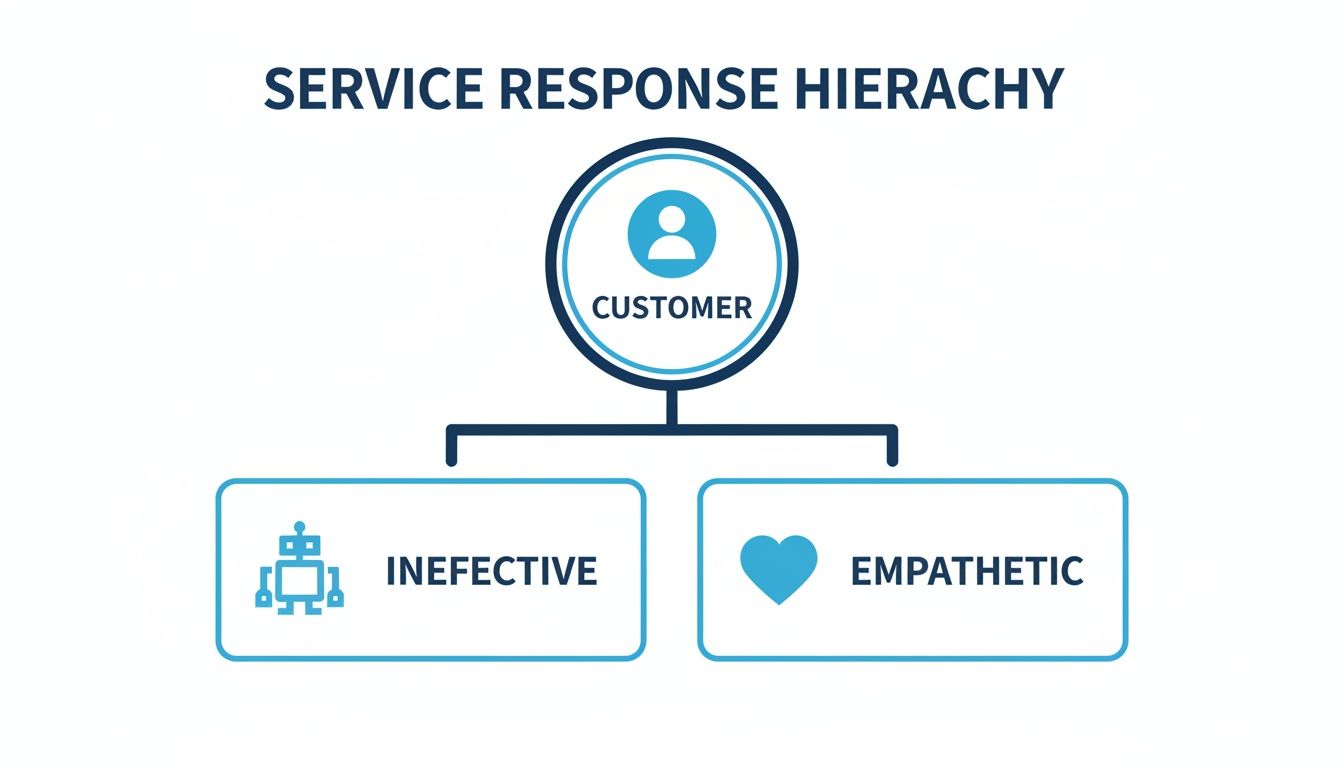
The key takeaway here is that the agent’s initial approach sets the tone for the entire customer journey, making it absolutely critical.
Hiring for Natural Empathy
You can train someone on a new software, but you can't easily teach them how to genuinely care. That's why making empathy a priority in your hiring process is the single most effective first step toward building a compassionate team. This means looking past the resume to ask questions that get to the heart of a candidate's emotional intelligence.
In interviews, you're looking for people who instinctively think about the human on the other end of the line.
Actionable Interview Questions to Spot Empathy:
- Behavioral: "Tell me about a time you had to give a customer bad news. How did you handle their reaction, and what happened next?"
- Situational: "Imagine a customer is furious because their delivery is late, and it was for a special occasion. What are the first three things you do?"
- Hypothetical: "If you could change one policy at a previous company to be more empathetic to customers, what would it be and why?"
Listen for answers that focus on understanding the customer's feelings, not just rattling off policy or jumping to a solution. The best candidates will talk about validating emotions and working with the customer to find a fix.
Training for Consistent Application
Once you've got the right people on board, training is what makes empathy a repeatable, reliable skill. Forget boring slide decks. The most effective training is hands-on, built around real-world scenarios that build muscle memory for those tough conversations.
This is where role-playing becomes an invaluable tool.
Role-Playing Scenario Example:
Have one agent play a frustrated homeowner whose brand-new air conditioner just died on the hottest day of the year. The other agent has to practice active listening, validate their frustration ("I can only imagine how uncomfortable that must be for your family right now"), and map out a solution without making promises they can't keep.
This kind of practice builds confidence and gives agents a toolkit of proven phrases and de-escalation tactics. A huge part of this also involves actively fostering an inclusive workplace. When your team feels understood and valued, they are far better equipped to extend that same understanding to a diverse customer base.
Using Technology to Enable Human Connection
Finally, technology shouldn’t replace your team—it should empower them. The goal is to automate the robotic, repetitive tasks so your agents can save their energy for the complex, emotional situations where a human touch makes all the difference.
Practical example: An e-commerce company uses a chatbot to handle basic order tracking inquiries ("Where is my package?"). This frees up human agents to deal with a customer whose package was stolen from their porch. The agent can then focus on expressing genuine concern ("That's awful, I'm so sorry that happened") and quickly arranging a replacement shipment, rather than just processing another tracking number.
Smart systems can handle routine questions like order status updates or appointment confirmations, freeing up your team's bandwidth. An AI-powered platform, for instance, can manage the initial lead capture, gather basic info, and then seamlessly hand off the conversation to a human agent the second a customer signals frustration or has a more complicated need.
This hybrid approach drives efficiency while preserving your most valuable resource: your team’s emotional energy for the moments that truly matter.
How to Measure the ROI of Empathy
Trying to prove the value of a "soft skill" like empathy can feel a bit like trying to bottle lightning. It’s not a hard number, right? But its impact on your bottom line is very real and, more importantly, very measurable.
The trick is to look beyond basic satisfaction scores. To really show the return on investment from building a more empathetic team, you have to connect those positive, human interactions directly to concrete business outcomes. It’s about proving how making a customer feel heard and understood translates directly into loyalty and revenue.
Measuring empathy isn't about finding a single magic number. It's about tracking a collection of key performance indicators (KPIs) that, when viewed together, paint a clear picture of its financial impact. When your agents are truly practicing empathy in customer service, you'll see these metrics move in the right direction.
Key Metrics to Track
The right data tells a compelling story. Instead of just looking at something like Customer Satisfaction (CSAT), which is really just a snapshot of a single moment, it’s better to focus on metrics that reflect the health of the entire customer relationship.
Start by tracking these three powerful KPIs:
- Customer Effort Score (CES): This metric answers a simple, crucial question: how easy was it for the customer to get help? Empathetic agents who actively listen and take ownership of a problem make things feel effortless for the customer. A lower CES score is a clear sign that you're delivering a smoother, more empathetic experience.
- Net Promoter Score (NPS): This is the classic loyalty metric, asking how likely a customer is to recommend your company to others. Genuinely empathetic interactions are what people remember and talk about. This is how you turn neutral customers into passionate brand advocates.
- First Contact Resolution (FCR): When an agent is tuned in and empathetic, they listen more carefully. They ask better questions, dig a little deeper, and truly get to the root of the problem. The natural result? They solve the issue correctly the first time, which is a massive win for both efficiency and the customer's sanity.
Qualitative and Sentiment Analysis
Numbers only tell half the story. To really get the full picture, you need to understand the why behind the data. This is where digging into qualitative feedback becomes so important.
Dive into the actual words your customers are using in support tickets, reviews, and survey comments. Modern sentiment analysis tools can quickly scan all this text to identify emotional tones, flagging words tied to frustration, delight, or confusion. This allows you to connect specific empathetic—or unempathetic—interactions directly to how a customer is feeling.
For instance, a global study from SurveyMonkey to understand these nuances revealed just how different customer perceptions can be. While 77% of Germans felt service was getting more personal, a staggering 33% of people in New Zealand felt it had gotten worse. This proves a one-size-fits-all approach is a recipe for failure. Sentiment analysis helps you fine-tune your empathetic approach for different audiences.
When you combine hard numbers like NPS and FCR with the rich, qualitative insights you get from things like call detail reporting, you build an undeniable, data-driven case. You can finally prove that empathy isn’t just a nice-to-have. It’s a powerful driver of retention, referrals, and revenue.
Your Questions About Empathy in Customer Service, Answered
Even with the best game plan, questions always pop up when you're putting a new strategy into action. Let's tackle some of the most common questions about building an empathetic customer service team.
Can You Actually Train Someone to Be More Empathetic?
Yes, you absolutely can. While some people are naturally more tuned in to others' feelings, empathy is a skill, not just a personality trait. And like any skill, it can be taught and practiced.
The goal isn't to force agents to feel a certain way. Instead, it's about teaching them specific, repeatable behaviors that show empathy.
Effective training moves beyond theory and gets into hands-on practice:
- Active Listening Drills: Teach agents to listen for the real problem and then repeat it back, like, "So if I understand correctly, the delivery was late and the box was damaged. Is that right?" This simple step makes customers feel instantly heard.
- Perspective-Taking Scenarios: Have agents walk a mile in the customer's shoes. Ask them to describe the problem from the customer's point of view, focusing on the frustration or inconvenience it caused.
- Role-Playing: Nothing builds confidence like practice. Simulating those tough, emotionally-charged conversations in a safe setting helps agents learn how to keep their cool and de-escalate a situation before it boils over.
With enough repetition, these actions stop feeling like a script and become second nature.
Empathy vs. Sympathy: What’s the Real Difference?
This is a big one. The difference between empathy and sympathy is subtle but incredibly important in a support setting. Getting it right changes the entire tone of a conversation.
Sympathy is feeling sorry for someone. It’s often a detached acknowledgment, like, "I'm sorry to hear that." It can unintentionally create a wall between the agent and the customer.
Empathy, on the other hand, is about feeling with someone. It's the ability to connect with their frustration and see the situation from their perspective. It sounds like, "I can imagine how frustrating that must be, especially when you were counting on it."
Empathy is a powerful tool because it validates the customer's feelings. It tells them, "You're not crazy for feeling this way; I get it." This simple act of understanding builds a bridge and turns a confrontation into a collaboration.
How Can AI and Empathy Possibly Work Together?
It's a common misconception that AI and empathy are at odds. The reality is they make a fantastic team when used correctly. The smartest approach is to let AI handle the predictable, low-stakes stuff, which frees up your human agents to do what they do best: connect with other humans.
AI is brilliant at handling things like order status updates, password resets, or answering basic FAQs. It does this instantly and accurately, 24/7. This means your team isn't wasting its emotional energy on repetitive tasks.
Instead, they can focus their attention on the complex, emotionally charged issues—the moments where a customer is truly upset, confused, or just needs someone to listen. AI can even act as a lookout, analyzing conversation sentiment to flag a chat or call where a customer is getting agitated, allowing a human agent to step in at the perfect moment.
Ready to deliver consistently empathetic experiences at scale? Recepta.ai combines intelligent automation with expert human support, ensuring every customer feels heard, 24/7. Discover how we can help you capture more leads and build lasting loyalty by visiting Recepta.ai.