
Your Guide to an Automated Phone answering Service
An automated phone answering service is a game-changer for businesses, using conversational AI to handle your calls 24/7. It's not just voicemail; it's a digital receptionist that can book appointments, capture new leads, and answer customer questions, with the smarts to hand off complex calls to a real person when needed.
What an Automated Phone Answering Service Really Is
Let's clear the air right away. Forget those clunky, robotic phone trees that everyone hates. A modern automated phone answering service is like having the world's most reliable receptionist—one who never calls in sick, takes a vacation, or misses a single call. It's the perfect blend of smart technology and a vital human touch.
At its heart, this kind of service guarantees that every person who calls your business gets an immediate, professional answer, no matter the time of day. It's built to solve a huge headache for small businesses: missed calls, which almost always mean missed money.
It's a Lot More Than a Fancy Answering Machine
Many people hear "automated" and think it's just a souped-up answering machine. That's not even close. A voicemail just takes a message that you have to deal with later. An automated service, on the other hand, takes action right now. It actively works for your business, and that difference is what makes it such a powerful tool.
Practical Example: Imagine a potential customer calls your plumbing business at 8 PM with a leaking faucet. Voicemail simply records their panic. An automated service, however, can ask, "Is this a plumbing emergency?" and, if the caller says yes, immediately forward the call to your on-call technician's cell phone. That's the difference between a lost opportunity and a secured job.
The market backs this up. In 2024 alone, telephone answering services in the U.S. became a $2.5 billion industry. That explosion is fueled by AI agents that handle the heavy lifting—sorting calls, booking jobs, and qualifying leads—passing only the trickiest situations to human staff. It's a clear sign that intelligent reception is the new standard.
The goal isn't to replace your team, but to supercharge them. An automated service takes care of the repetitive, predictable calls so your staff can focus on the high-value conversations that truly need a human expert.
So, What Does It Actually Do?
Okay, let's get down to brass tacks. What can you expect an automated phone answering service to do for your business day-to-day? It's much more than a friendly greeting. A good system is designed to handle concrete, money-making tasks.
Here are the four core functions:
- Lead Capture: A new customer calls after hours? No problem. The service gets their name, number, and what they need, so you have a hot lead waiting for you in the morning. For example, a caller might say, "I'm interested in getting a quote for landscaping." The AI logs their contact details and the request, then emails it directly to your sales team for a morning follow-up. You'll never miss an opportunity again.
- Appointment Scheduling: The AI hooks directly into your company calendar. It can book new appointments, move existing ones, or handle cancellations on the fly, all based on your real-time availability. For instance, a patient can call your clinic, say "I need to book a cleaning," and the AI will offer, "We have an opening this Tuesday at 10 AM or Wednesday at 2 PM. Which works for you?" Zero manual effort required.
- Answering FAQs: It can instantly answer all those simple, repetitive questions like "What are your hours?" or "Do you serve my area?" This frees up your team from being a broken record all day. A practical case is when a caller asks, "Are you open on Saturdays?" The AI can immediately respond with your weekend hours and even your address.
- Smart Call Routing: The system is smart enough to know who needs what. It can send an emergency call straight to the on-call technician's cell while routing a billing question to the office manager. For example, if a caller says "I have a question about my last invoice," the AI can transfer them directly to the billing department's extension.
By managing these critical jobs, the service truly becomes a part of your team. You can dive into the full range of AI receptionist services to see exactly how these features work for all sorts of businesses, from plumbing to medical practices.
How an AI Answering Service Actually Works
The idea of an automated phone answering service can sound a bit futuristic, but how it works is surprisingly practical. Think of it as a smart filter for your phone lines—one that’s designed to give every caller a great experience without leaving them stuck in a frustrating phone tree. It's not just about picking up the phone; it's about understanding what someone needs, getting it done, and knowing exactly when to pass the call to a human.
So, let's walk through what happens from the moment a customer dials your number. This journey really shows off the powerful mix of smart AI and a necessary human touch.
Step 1: The AI Makes First Contact
The second a call comes in, the AI picks up. No waiting, no endless ringing. Its first job is to figure out who’s calling and what they need. Using what’s called Natural Language Processing (NLP), the AI does more than just listen for keywords. It actually gets the gist of the conversation—the intent, the context, and even the caller's mood.
Practical Example: Instead of just hearing "appointment," the AI can distinguish between "I need to make an appointment," "I need to cancel an appointment," and "I'm running late for my appointment." Each phrase triggers a different, appropriate action. This is what allows the AI to have a normal, back-and-forth conversation. It can ask follow-up questions to clarify things and figure out the caller's goal in just a few seconds. This initial chat is the key to getting the call routed to the right place or handled on the spot.
Here’s a quick look at how the process flows from that first "hello" to a finished task.
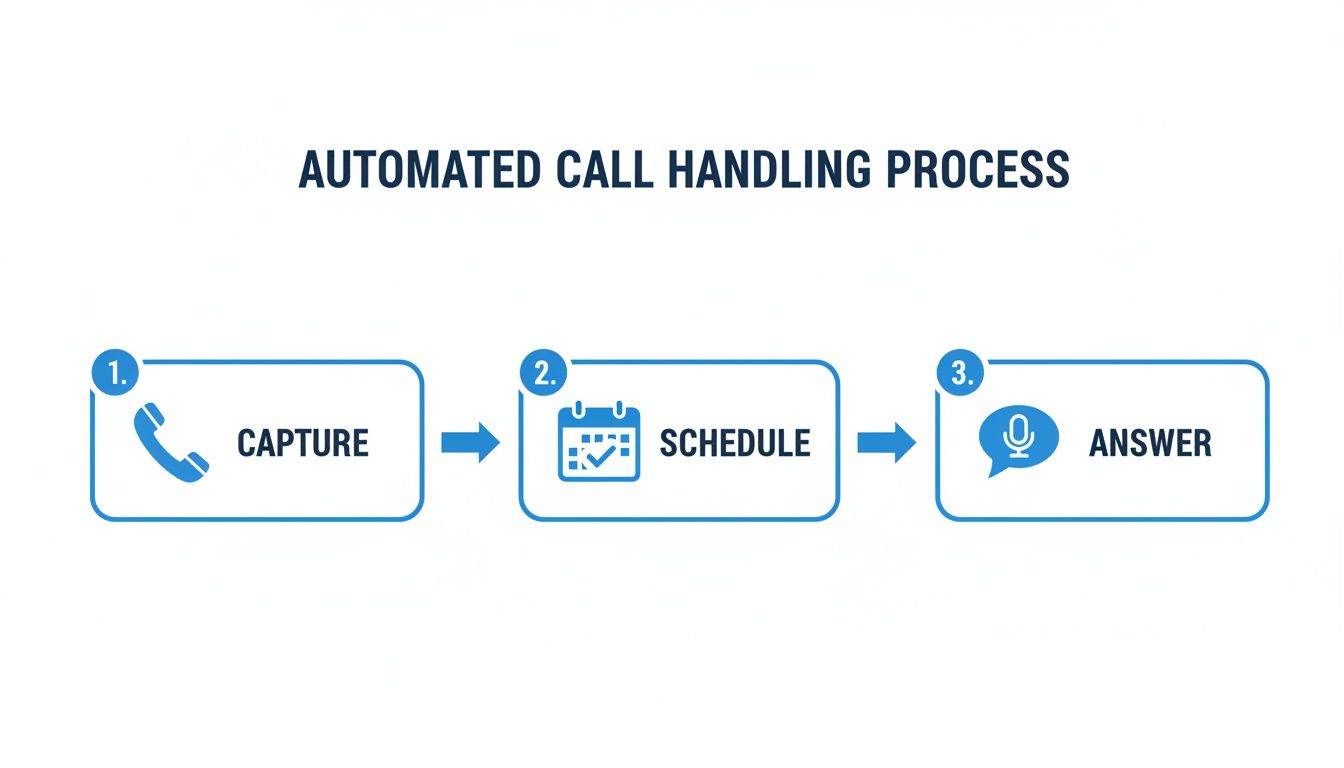
As you can see, the whole system is built for action—scheduling a job, answering a question—not just passively taking a message.
Step 2: The System Gets to Work Immediately
Once the AI knows what the caller wants, it gets down to business. This is where a true automated answering service leaves a simple voicemail or call forwarding system in the dust. The AI is wired directly into your business software.
Let's say a customer's AC just died, and they need an urgent repair from your HVAC company. Here's what happens:
- The AI instantly checks your company's live calendar (e.g., Google Calendar or a scheduling app like Jobber).
- It finds the next open slots for emergency calls.
- It offers the caller a few specific times, waits for them to pick one, and books it right then and there.
- To finish, it zips off a confirmation text or email to the customer with the appointment details.
That whole exchange happens in one brief conversation, and your team didn't have to lift a finger. The same goes for sales leads. The AI can ask a few qualifying questions and pop the caller’s info straight into your CRM. It’s incredibly efficient, especially when you have a direct AI receptionist integration with CRM systems.
Step 3: The All-Important Human Handoff
But what about those tricky calls? The ones where a customer has a complicated problem or a sensitive issue the AI isn't trained for? This is where having a "human in the loop" is non-negotiable. A great automated answering service is never 100% robotic.
The entire system is built on one core rule: a caller should never get stuck. If the AI picks up on frustration, hears complex questions, or catches trigger words like "complaint" or "legal," it immediately flags the call for a human.
Picture a potential client calling a law firm. The AI is perfect for the initial intake—getting their name, number, and a general idea of their case. But the moment the caller says something complex like, "My previous lawyer mishandled my case and I need to know my options," the AI recognizes this requires legal expertise. It seamlessly transfers them to a live paralegal, saying, "This sounds like something our team should handle directly. Please hold for one moment while I connect you."
Best of all, that paralegal gets the full context from the AI’s conversation, so the client never has to repeat themselves. This approach gives you the best of both worlds: machine efficiency for routine tasks and human empathy for the moments that matter most. It guarantees every caller gets a professional, reliable experience, every single time.
The Real Financial Impact of Automating Your Phone Lines
It's easy to get caught up in the technology, but for any business owner, the real question is simple: what’s the financial upside? An automated phone answering service isn't just another shiny new tool; it’s a strategic investment that can slash your costs and open up entirely new revenue streams. The return on that investment becomes crystal clear once you look past the monthly fee and focus on the bigger picture.
Let's run the numbers. A full-time, in-house receptionist can easily cost $35,000 or more per year once you factor in salary and benefits. Even bringing someone on part-time might set you back $20,000 for limited coverage. In contrast, a powerful automated service often costs just a few hundred dollars a month. You can get a better feel for this by exploring various automated answering service pricing plans to see what fits your call volume.
This is a fundamental shift in how businesses can manage their front desk. A mid-tier automated plan might run about $6,000 annually, which represents a massive 70-80% savings compared to a full-time employee—all while giving you 24/7 coverage. That's a huge cost reduction that frees up cash to reinvest in what actually grows your business, like marketing or new equipment. You can find more insights on this topic in GoSameDay.com's article on how AI phone automation drives profitability.
Turning Missed Calls into Captured Revenue
The most powerful financial gain, though, comes from plugging the leaks in your sales funnel. Every single call that hits voicemail is a potential customer who's one click away from dialing your competitor. An automated service makes sure every call gets answered, turning those lost opportunities into actual profit.
Think about it in a real-world scenario. Let's say you run a pest control company. A frantic homeowner calls on a Saturday morning with a wasp nest by their front door. If you’re not open, that call goes to voicemail, and they're immediately back on Google calling the next business on the list.
But with an automated system, that call is answered instantly. The AI understands the urgency, grabs their details, and books the job for your on-call tech right then and there. That one call just brought in $400 or more. If that happens just three times a month, you've added $1,200 in monthly revenue that would have otherwise vanished.
This isn't just for home services, either. A dental clinic can use automation to fill last-minute appointment cancellations, and a law firm can capture new client inquiries over the weekend. You're effectively transforming your phone line from a 9-to-5 tool into a round-the-clock revenue generator.
Slashing Administrative Overhead and Boosting Productivity
Beyond the new business it brings in, an automated phone answering service gives you back your most valuable resource: your team's time. Repetitive admin tasks are a notorious productivity killer. Answering the same basic questions, scheduling appointments, and manually typing call notes into a CRM chew up hours that could be spent on more important work.
Practical Example: Let's say your office manager spends 15 minutes per hour on routine calls (scheduling, answering FAQs). Over an 8-hour day, that's two full hours lost to simple tasks. By automating these calls, you reclaim those 10 hours per week. That's time your manager can now spend on high-value activities like negotiating with suppliers, managing payroll, or improving internal processes.
Just think about all the time your staff spends on routine calls:
- Answering FAQs: Fielding endless questions like "What are your hours?" or "Where are you located?"
- Manual Scheduling: The back-and-forth dance of finding an open slot on the calendar.
- Data Entry: Tediously logging every call and new lead into your systems.
By automating these tasks, you can easily reclaim 5-10 hours per week for your team. This lets your skilled people focus on high-value activities that actually move the needle—like providing amazing in-person service, following up on complex sales leads, or strengthening client relationships. The boost in productivity doesn't just make for a happier team; it directly contributes to a healthier bottom line. The financial impact isn’t just about saving money—it's about making more of it.
Seeing It in Action with Industry Examples
Theory is one thing, but seeing how an automated phone answering service actually performs in the real world is where it all clicks. This isn't a one-size-fits-all tool. Instead, it adapts to the unique rhythm and language of your specific industry, acting like a highly trained digital receptionist who already knows your business inside and out.
Let's walk through a few day-in-the-life scenarios to show you how this service becomes a genuine part of the team.
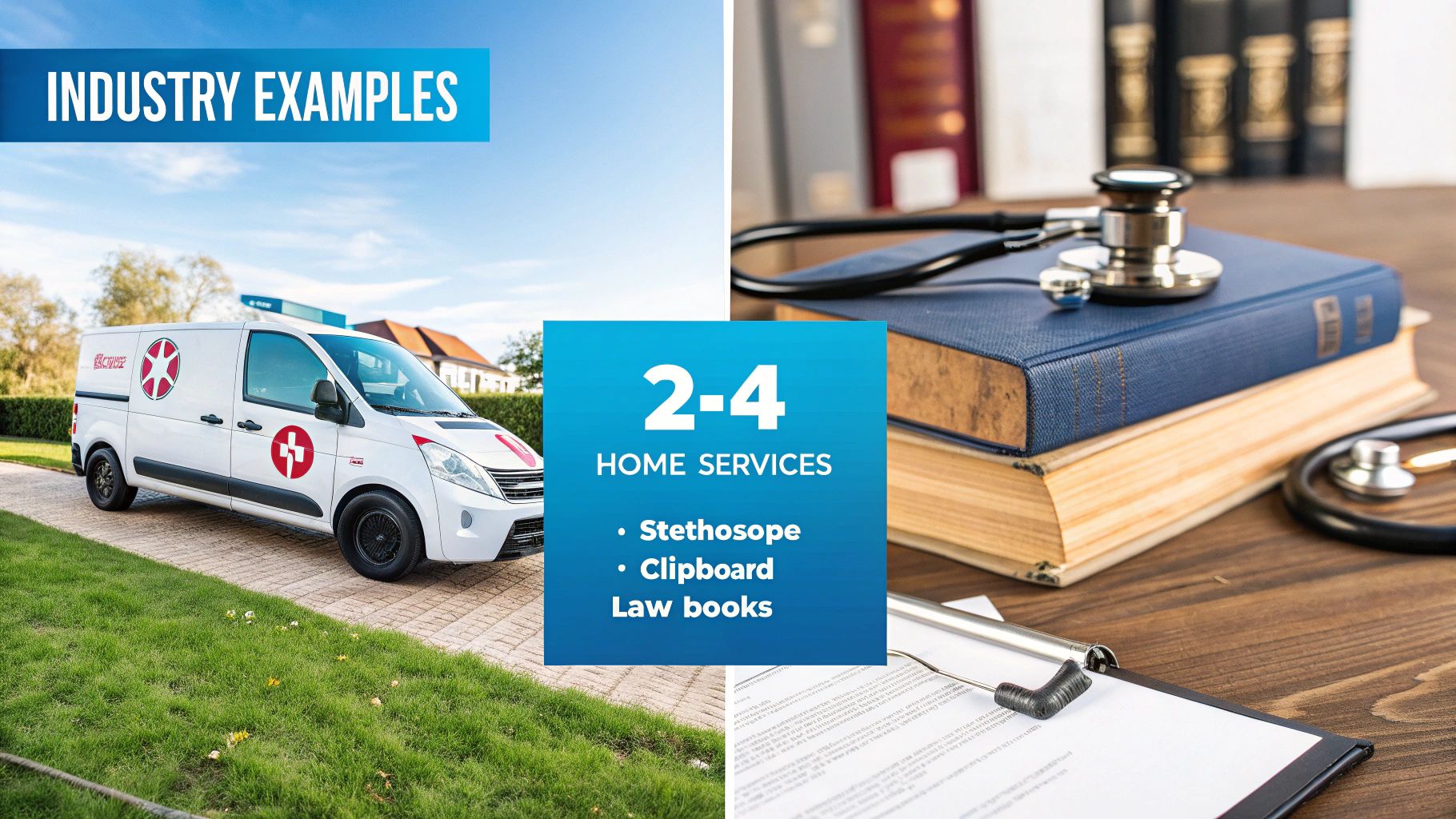
These examples are just scratching the surface. If you want to see the real-world numbers and impact, I’d recommend checking out these detailed customer success stories and case studies. They really show how businesses are getting big results from phone automation.
Home Services: Where Every Call Is an Emergency
For businesses like HVAC, plumbing, or pest control, a missed call is more than just a lost lead—it’s a customer in crisis who is seconds away from dialing your competitor. An automated service works around the clock, ready to catch those urgent, high-value jobs that always seem to come in after hours or on a holiday weekend.
Picture this: It’s 10 PM on a Friday. A homeowner’s pipe bursts, and they’re frantically searching for an emergency plumber. They find your number and call.
- Immediate Triage: Instead of hitting voicemail, the AI answers instantly. It's been trained to pick up on keywords like "burst pipe," "flooding," or "no water," immediately flagging the call as a top-priority emergency.
- Intelligent Dispatch: The system cross-references the on-call schedule, pinpoints the right technician, and patches the call straight to their cell phone. No delays, no confusion.
- Job Secured: The tech speaks directly with the homeowner, calms them down, and confirms they're on the way. Just like that, you’ve secured a profitable emergency job that your competitors completely missed.
This isn't just fancy call forwarding. It's a smart process that filters, qualifies, and acts on urgent needs, making sure your most critical calls get handled perfectly every time.
Healthcare: Where Compassion Meets Compliance
In a medical or dental office, the phone is a lifeline. But front-desk staff are constantly juggling in-person patients, which often leads to long hold times and frustrated callers. An automated phone answering service can step in to handle all the routine administrative traffic while strictly adhering to patient privacy laws.
Think about a busy dental clinic. A patient needs to reschedule an appointment but keeps getting a busy signal. With an automated service, their experience is totally different.
- Appointment Management: The AI greets them, understands the request to reschedule, and taps directly into the clinic's scheduling software to offer available time slots. For example, it can say, "I see your appointment is for Tuesday at 3 PM. We have openings on Wednesday at 11 AM or Friday at 1 PM. Would either of those work for you?"
- HIPAA Compliance: The entire conversation is secure from start to finish. The service is built to handle protected health information (PHI) without improperly storing sensitive data, ensuring you remain 100% HIPAA compliant.
- Reduced No-Shows: Once the new time is booked, the system zips over a confirmation text. It can even place an automated reminder call the day before, which does wonders for cutting down no-show rates.
Professional Services: That Demand Confidentiality
Law firms, financial advisors, and insurance agencies live and die by their reputation for professionalism and discretion. An automated service can run the initial client intake with the precision and confidentiality these fields demand, making sure potential new clients feel heard and respected from the very first call.
Let's say a potential client is looking for a divorce attorney and feels most comfortable calling after the kids are in bed. They dial your firm at 9 PM.
- Confidential Intake: The AI receptionist follows a custom script to gather the essential, non-sensitive details—name, number, and the best time for a paralegal to call back.
- Lead Qualification: It asks a few pre-set questions to get a general idea of the situation, like, "Is this related to family law, personal injury, or another matter?" This helps route the lead to the correct department.
- Seamless Handoff: All the information is logged securely in the firm’s CRM, and an alert is sent to the intake team. When the paralegal calls back the next morning, they're already up to speed, creating a smooth, professional start to a potential client relationship.
In each of these industries, the automated phone answering service is doing far more than just taking a message. It's actively solving problems, capturing revenue, and delivering a polished, reliable customer experience that builds trust right from the start.
Key Automation Features by Industry
While the core technology is consistent, the most valuable features often change depending on the industry. Here’s a quick look at which automations tend to matter most for different types of businesses.
This breakdown highlights how the right set of features can be tailored to solve the most pressing communication challenges a business faces, turning the phone system into a strategic asset.
How to Choose the Right Automated Answering Service
Picking the right automated phone answering service isn't about finding the "best" one on the market—it's about finding the one that fits your business like a glove. It’s easy to get lost in a sea of feature lists, but a clear, structured approach will help you find a partner that genuinely helps you grow, not one that just creates new headaches.
Think of it this way: you’re looking for a service that acts as a true extension of your team. That means you need to look past the sticker price and really dig into the features that will make a difference in your day-to-day operations and, most importantly, for your customers.
Start with Your Must-Have Features
Before you even glance at pricing, make a simple checklist of your non-negotiables. This is the fastest way to weed out services that just won't work for you. Start by thinking about your biggest communication bottlenecks right now. What problems are you trying to solve?
Your checklist should zero in on these key areas:
- Integration Capabilities: Does it play nice with the software you already depend on? We’re talking about your CRM (like Salesforce or HubSpot), scheduling calendar (Google Calendar, Calendly), or any industry-specific tools you use (like Jobber for home services). If it doesn't integrate, you'll be stuck manually copying information back and forth, which pretty much defeats the whole point.
- AI-to-Human Handoff: How graceful is the transition from AI to a live person? If you can, test this yourself. A clunky handoff is frustrating for customers. Actionable Tip: During a trial, call in and pretend to be a frustrated customer to see how quickly and smoothly you are transferred to a live agent. The goal is a seamless switch where the human agent gets all the context from the AI so the caller never has to repeat themselves.
- Customization Options: Can you make it sound like you? You need to be able to create custom scripts and call flows using your industry's terminology and your brand's unique voice. A generic, robotic-sounding AI can do more harm than good for your professional image. For example, a high-end spa should be able to script a calm, welcoming greeting, while an IT support firm might need a more direct, problem-solving tone.
A great automated phone answering service should feel like it was built just for your business. If it forces you to change your proven processes to fit its mold, it’s the wrong choice.
Evaluate Security and Compliance Standards
For many businesses, security isn't just a nice-to-have; it's a legal necessity. If you handle any kind of sensitive customer data—from medical histories to payment details—you have to be absolutely certain the service meets the strictest compliance standards. This is a black-and-white issue with no gray area.
Be sure to ask for proof of the following:
- HIPAA Compliance: This is non-negotiable for any business in the healthcare space, from dental offices to mental health clinics. The service must be fully HIPAA compliant to protect patient health information (PHI).
- Data Encryption: Confirm that all your data, including call recordings and transcripts, is encrypted from end to end—both while it's being transmitted and when it's stored.
- Confidentiality Agreements: The provider should have crystal-clear policies on data privacy and be able to show that their agents are thoroughly trained in confidentiality.
Understand the True Cost
Finally, it’s time to talk money. Take a hard look at the pricing model to make sure you won’t be hit with surprise charges later. That attractive monthly fee you see on the homepage often doesn't tell the full story.
Get direct answers to these questions before you sign anything:
- Is pricing based on minutes, calls, or users? You need a model that makes sense for your typical call volume. A per-minute plan might be costly if your calls are long, while a per-call plan is better for quick interactions.
- What are the overage fees? Know exactly what happens if you have a busy month and go over your plan’s limits. Ask for a specific cost-per-minute or cost-per-call for overages.
- Is there a setup fee or a long-term contract? Ideally, you want a provider that offers a risk-free trial so you can put the service through its paces before committing.
Choosing the right partner is a strategic move. By focusing on practical needs like integrations, handoff quality, security, and transparent pricing, you’ll find a platform that does more than just answer calls—it will actively improve your customer experience.
Future-Proofing Your Business Communication
Bringing an automated phone answering service into your business isn't just a minor operational change. It’s a strategic move that lines your business up with where customer communication is headed. Let's face it, we live in an on-demand world, and customer expectations have completely changed. People want instant answers and 24/7 access, whether they're trying to book a haircut at midnight or calling about a busted pipe on a Sunday.
This isn’t some passing fad; it’s a deep shift in how people behave. If you’re still clinging to a traditional 9-to-5 phone setup, you’re playing by yesterday's rules. Putting an intelligent, automated system in place means you're ready to meet customers on their terms, keeping your business relevant and a step ahead of the competition.
Meeting the Demand for Instant Gratification
At the heart of all this is a growing intolerance for waiting. A phone that just rings and rings—or worse, dumps a caller into a voicemail black hole—is a great way to lose business. An automated service guarantees that every single call gets an immediate, professional response, capturing leads that would otherwise slip through your fingers.
Practical Example: A potential client is searching for a law firm after business hours. They call Firm A and get voicemail. They immediately hang up and call Firm B, which has an automated service. The service answers, asks a few qualifying questions, and schedules a consultation for the next morning. By the time Firm A checks its voicemail, Firm B has already secured the new client.
The real goal here is to create a superior customer experience that builds loyalty. This technology isn't just about being efficient; it's about making your business easier, faster, and more professional to deal with than anyone else.
That immediate connection shows that your business is modern, responsive, and, most importantly, that you value your customer's time.
Embracing the Future of Conversational AI
This push toward automation is backed by some serious market trends. Projections show that by 2026, voicebots and chatbots will be handling about 10% of all interactions at contact centers, especially for routine stuff like scheduling or answering common questions. Why? Because automation cuts operational costs by an average of 30% and completely eliminates hold times, making service lightning-fast.
The conversational AI market is exploding—it's expected to reach $41.39 billion by 2030. This tells us that talking to an AI as the first point of contact is quickly becoming normal for millions of people. If you want to dive deeper, you can explore the latest research on contact center trends.
By putting an automated phone answering service in place now, you’re not just solving today's problem of missed calls. You’re building a foundation to stay ahead of customer expectations and lead the pack in your industry for years to come.
Common Questions About Automated Answering Services
It's smart to have questions before you jump into a new system, especially one that handles your customer calls. I talk to business owners all the time who are curious about automated phone answering services but worry about how it will actually feel for their customers and how much work it is to get started.
Let's walk through some of the most common questions and get you the straightforward answers you need.
Will an AI Receptionist Sound Robotic and Frustrate My Customers?
That's probably the number one concern I hear, and it’s a fair one. We've all been trapped in those awful, robotic phone menus from a decade ago. But today's conversational AI is a completely different ballgame. The technology has gotten so good that the voices are remarkably natural and engaging. They're built to understand the intent behind what someone is saying, not just hunt for keywords.
But here’s the most important part: a good service isn't 100% robot. Think of it as a smart filter. If a caller gets frustrated, has a really tricky problem, or says something that flags the issue as urgent, the system knows its limits. It's designed to seamlessly pass the call to a professionally trained human agent, making sure your customer gets the right help, every single time.
How Difficult Is It to Set Up?
You'll be pleasantly surprised. The best platforms are designed for busy business owners, not tech wizards. Honestly, you can be up and running in a matter of minutes.
Getting started usually just involves a few quick steps:
- Forward your existing business number over to the service. This is a simple setting you change with your current phone provider (e.g., Verizon, AT&T).
- Connect your calendar and CRM with their easy, built-in integrations. This often just means logging in to your Google Calendar or Salesforce account through their platform.
- Plug in some basic info about your company, like business hours and answers to common questions. You might fill out a simple form like: "Our address is 123 Main St." or "Our weekend hours are 10 AM to 4 PM."
The provider takes care of all the complicated stuff behind the scenes. No technical expertise is needed on your end.
Can an Automated Service Handle My Industry-Specific Needs?
Absolutely. In fact, this is where a quality service really shines. It’s not a one-size-fits-all solution; it’s designed to be molded to your specific business. You can train it with custom scripts, unique industry jargon, and the exact call flows you already use.
Whether it’s routing an emergency HVAC call after hours, using the right terminology for a medical practice ("Are you a new or existing patient?"), or handling the confidential intake for a law firm ("Is this regarding a family law or personal injury matter?"), the system becomes a genuine extension of your team. It learns the unique context of your business and your customers.
What Happens If a Caller Has a Problem the AI Can't Solve?
This is where that crucial safety net—the hybrid AI-human model—comes into play. The AI is programmed to know what it doesn’t know. It recognizes triggers that signal a need for human intervention. When it hits a complex problem, a sensitive emotional issue, or a situation it hasn't been trained on, it doesn't just take a guess.
Instead, the call is instantly and smoothly transferred to a live agent. Better yet, that agent gets the full context of the AI’s conversation, so your caller never has to repeat themselves. It’s a smart system that ensures every single problem is handled effectively, keeping your standard of customer service high no matter what.
Ready to see how an AI receptionist can change the game for your business communications? Recepta.ai provides a 24/7 automated phone answering service with seamless human handoff, ensuring you capture every lead and deliver a professional experience. Start your 30-day risk-free trial and discover the difference.