
The Ultimate Guide to a Call Answering Service
If you run a business, you know the sound of a constantly ringing phone. When you're swamped with work, every call that goes unanswered isn't just a missed conversation—it's a lost opportunity. That could be a high-value client ready to sign, or a customer with an urgent problem who will simply call your competitor next.
What Is a Call Answering Service and Why It Matters Now
At its core, a call answering service is your professional, 'always-on' front desk. It's a team of live agents or smart technology ready to handle your calls, qualify new leads, and even schedule appointments for you 24/7. They’re on the job even when you’re busy, out on a project, or your office is closed for the night.
This isn't just about having someone pick up the phone. It’s about shifting from a reactive "I'll answer when I can" approach to a proactive system where every single customer interaction is captured and managed. That shift is critical because the cost of a missed call is far higher than most people realize. A professional answering service is your key to capturing that lost revenue and making sure no customer ever gets sent to a voicemail box again.
The Modern Shift in Customer Communication
The way businesses handle calls has changed dramatically. Clunky, expensive on-premise phone systems are quickly being replaced by flexible, cloud-based platforms that can scale with you. This isn't just a small trend; it's a massive market shift.
The global Contact Center as a Service (CCaaS) market—the technology powering modern answering services—was valued at $7.08 billion in 2025. It's on track to hit $8.33 billion in 2026 and an incredible $30.15 billion by 2034. You can dig deeper into these contact center statistics and their business implications to see the full picture.
This explosive growth, with North America leading the charge at a 39% market share, shows a clear demand. Businesses want round-the-clock availability without the headache and high cost of managing the physical infrastructure themselves.
Practical Examples of Answering Services in Action
So, what does this actually look like day-to-day? Let's ground this in a few real-world scenarios.
For a Plumbing Business: A pipe bursts in a homeowner's basement at 2 AM. Instead of a frantic voicemail, they reach a calm, professional agent who gathers the essential details (name, address, nature of the emergency), confirms the urgency, and schedules an emergency dispatch according to your pre-set rules. The plumber wakes up to a confirmed, high-value job already in the queue.
For a Law Firm: Someone needs legal advice for a personal injury case and calls your firm after hours. The service agent doesn't just take a message; they capture their contact info and key case details using a custom intake form, then use your firm’s calendar to book a consultation for the next morning. You arrive at the office with a qualified potential client already on your schedule.
For a Dental Clinic: It's a hectic Tuesday afternoon, and a patient calls to reschedule. The answering service agent pulls up the clinic's calendar, finds an open time slot that works for the patient, and confirms the new appointment via text message. Your front desk staff never even had to stop assisting the patients right in front of them.
In every case, the business not only captured an opportunity that would have been lost but also delivered a far better customer experience while making their own operations run smoother.
How to Choose Your Call Answering Service Model
Picking the right call answering service isn't just about finding someone to pick up the phone. It's about choosing a strategic partner that aligns with your business, your customers, and your goals. The best choice really comes down to what you need to accomplish, how complex your calls usually are, and the kind of first impression you want to make.
This decision tree lays out the fundamental choice every business owner faces: Do you keep juggling calls yourself and risk burnout, or do you bring in a service to ensure you always sound professional and can finally get some peace of mind?
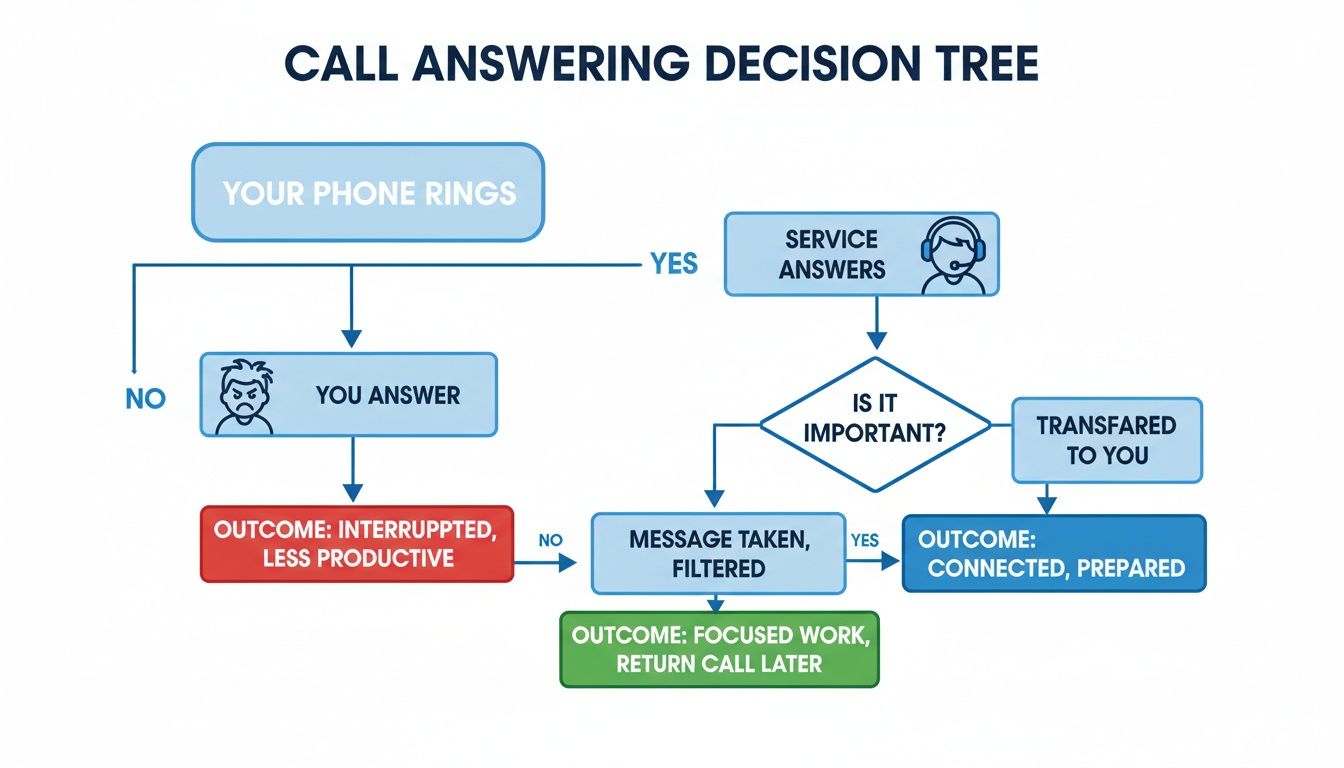
The real takeaway here is that delegating your calls is more than just offloading a task. It’s a deliberate move to guarantee every single caller gets a fast, professional answer, which in turn protects both your revenue and your hard-earned reputation.
Let's break down the three main ways you can do this.
Live Receptionist Services
Think of a traditional live receptionist service as a shared, off-site front desk staffed by real people. Their biggest strength is the personal, empathetic touch they bring to every conversation. This is absolutely critical for any business that deals with sensitive situations or complex customer problems.
Practical Example: A family member is calling a funeral home after a recent loss. The empathetic, patient tone of a live receptionist provides comfort and guidance during a difficult time, a feat impossible for an automated system. The agent can gently walk them through the initial steps, demonstrating the compassion the business is known for. In fact, research shows that 62% of potential clients sign with the very first law firm that gets back to them. That immediate, human connection isn't just nice to have; it's a powerful business advantage. This model is perfect for anyone whose business is built on trust from the very first hello.
Automated IVR Systems
On the other end of the spectrum, you have automated Interactive Voice Response (IVR) systems. You’ve run into these a million times—it’s the classic "press 1 for sales, press 2 for support" menu you get when calling your bank or a big corporation. An IVR is basically a digital phone tree designed to route callers or let them handle simple tasks on their own.
It's built for predictable, high-volume tasks like:
- Bill Payments: A customer for a utility company can call, enter their account number, and pay their bill using their keypad without ever needing to speak with a person.
- Account Information: A user can call their credit card company, verify their identity, and quickly check their current balance or last five transactions.
- Basic FAQs: A caller to a retail store can hear an automated message with store hours, location, and holiday closures without tying up a sales associate.
While IVRs are undeniably efficient for these kinds of straightforward interactions, they can quickly become a source of frustration for callers with a unique problem or who simply want to talk to a human. They work best when your call patterns are highly predictable and don't require any real nuance.
The AI-Human Hybrid Model
Finally, we have the most modern approach: the AI-human hybrid model. This is where you truly get the best of both worlds. It uses sophisticated conversational AI to manage the vast majority of calls with incredible speed and accuracy, but it keeps trained human agents on standby for the moments they’re needed most. It’s the perfect blend of smart automation and the irreplaceable human touch.
You can think of an AI-human hybrid as an intelligent filter. The AI fields all the routine calls—booking appointments, qualifying new leads, answering common questions—and it does it 24/7 without a single complaint. The magic happens when a caller gets frustrated, asks something truly complex, or says a keyword that signals an emergency. At that moment, the system instantly and seamlessly passes the call to a live agent.
Practical Example: Imagine a home services company. The AI can book dozens of routine jobs, like annual HVAC maintenance checks or requests for quotes for a new fence, all on its own by integrating with the company's scheduling software. But the second a caller says, "My basement is flooding," the AI recognizes the urgency and immediately connects them to a human dispatcher who can mobilize an emergency crew. This ensures every call gets the exact right response, maximizing both your team's efficiency and your customer's satisfaction.
This hybrid approach, blending powerful AI with expert human oversight, is precisely what we’ve perfected at Recepta.ai.
Comparing Call Answering Service Models
To make the choice clearer, it helps to see the models compared side-by-side. Each one has its own strengths and is best suited for different types of businesses and call volumes.
| Feature | Live Receptionist | Automated/IVR | AI-Human Hybrid (e.g., Recepta.ai) |
|---|---|---|---|
| Primary Strength | Empathetic, personal touch | High-volume, simple task automation | Efficiency, scalability, and the human touch when needed |
| Best For | Complex, sensitive, or high-value calls (e.g., legal, medical) | Simple, repetitive queries (e.g., bill pay, status checks) | Businesses with mixed call types seeking efficiency and great CX |
| Cost Model | Higher per-minute or per-call cost | Lower cost, typically a flat monthly fee | Cost-effective; pay for AI efficiency with human backup |
| 24/7 Availability | Often available, but at a premium cost | Yes, standard feature | Yes, standard feature |
| Caller Experience | Excellent, but dependent on agent quality | Can be frustrating for complex issues | Highly positive; seamless and context-aware |
| Scalability | Limited; requires hiring more agents | Highly scalable for simple tasks | Extremely scalable; AI handles volume, humans handle exceptions |
Ultimately, there is no single "best" model—only the one that's best for you. By understanding these core differences, you can make a much more informed decision that turns your phone line from a daily chore into a powerful engine for growth.
The Real-World Payoff: What an Answering Service Actually Does for Your Bottom Line
It’s easy to think of an answering service as just a convenience, but that misses the bigger picture. A modern service is a powerful tool that directly impacts your most critical business numbers. We're talking about tangible results you can see in your bank account, not just abstract benefits.
The entire telephone answering industry is evolving fast, driven by the demand for 24/7 availability and smarter AI. This is part of a much larger trend: the call center cloud market is expected to rocket from $27.22 billion in 2024 to an incredible $87.10 billion by 2029. As detailed in this comprehensive market analysis, this growth is all about giving businesses like yours the ability to handle calls more intelligently.
When your answering service is powered by modern tech, you get more than just a person on the line—you get data-driven support that directly improves your business.
Stop Missing Calls and Start Capturing Leads
The most immediate and obvious win? You’ll capture way more leads. Think about it: every time a call rings out or hits a full voicemail box, that’s a potential customer who is likely dialing your competitor next.
With a service providing 24/7 coverage, you’re always open for business. Those after-hours calls, weekend inquiries, and overflow calls during your busiest times suddenly become booked appointments and qualified opportunities.
Practical Example: You're a plumber and a frantic homeowner calls with a burst pipe at 2 AM. Instead of that call disappearing into the void, the service answers, gets the details, and secures the emergency job. That’s a high-value sale you captured while the competition was sound asleep. Our guide on after-hours answering services explores how to turn your off-hours into your most profitable ones.
Radically Reduce Your Overhead Costs
Hiring an in-house receptionist is expensive—and the cost goes far beyond their salary. Once you factor in benefits, payroll taxes, training costs, sick days, and vacation coverage, the true cost can easily top $50,000 per year.
In contrast, an answering service gives you far more coverage (often 24/7 instead of 40 hours a week) for a predictable, low monthly fee. It’s not uncommon for businesses to save up to 80% by switching from a full-time hire to a service.
Practical Example: A small accounting firm pays a receptionist $45,000/year plus benefits. They switch to an AI-hybrid answering service for $300/month ($3,600/year). They save over $40,000 annually, which they reinvest into new tax software and a local marketing campaign that brings in 15 new clients. This move turns a significant fixed cost into a flexible operating expense that scales with their needs.
Build a Reputation for Incredible Customer Service
First impressions are everything. A modern answering service guarantees that every single caller is greeted promptly and professionally, building immediate trust and setting a positive tone for the entire customer relationship.
This consistency is the bedrock of a fantastic customer experience. To see the true value, you need to measure customer experience by looking at metrics like first-call resolution. You'll quickly see how responsive, professional communication translates directly into better reviews, repeat business, and powerful word-of-mouth referrals.
Practical Example: A boutique hotel uses an answering service to handle reservations and inquiries. Every caller is greeted with "Thank you for calling The Serene Vista Hotel, how may I help you?" This consistent, professional greeting reinforces the hotel's upscale brand, whether the call comes in at 3 PM or 3 AM. The service books rooms, answers questions about amenities, and provides directions, ensuring a seamless experience that leads to glowing online reviews mentioning the "excellent service."
What Features Should I Actually Look For in a Call Answering Service?

When you're shopping for a call answering service, it helps to think of it less like buying software and more like hiring a new team member. The features you prioritize will make or break your team's efficiency, your customers' happiness, and your ability to scale.
Honestly, some capabilities are just non-negotiable if you want to turn your phone line from a simple utility into a real business asset.
Integrations That Actually Connect to Your Business
First things first: your answering service can't be an island. It has to talk to the other tools you use every single day, or you're just creating more work for yourself.
A solid integration with your CRM is probably the most important connection. When a call comes in, the service should already know if it’s an existing client or a new lead, pulling up their history or creating a new record on the fly.
Practical Example: A marketing agency gets a call from a new lead. Instead of scribbling down notes to type in later, the answering service automatically:
- Creates a new contact in their HubSpot CRM with the caller's name and number.
- Logs the call details and a transcript under the new contact record.
- Connects to their Calendly to schedule a discovery call with a senior strategist.
- Sends a calendar invite to the lead and the strategist, and adds the meeting to the CRM timeline.
This isn't just about saving a few minutes of typing. It’s about eliminating the risk of human error, preventing hot leads from going cold, and giving your team the full context they need to close a deal. Our guide to an AI phone answering service digs deeper into how these automated workflows can be a game-changer.
Smart Call Escalation
Not every call is a five-alarm fire. Your answering service needs to be smart enough to tell the difference between a simple question about your business hours and a key account with an urgent, show-stopping problem. That’s where intelligent escalation paths come in.
These are just rules you set up to tell the service where to direct certain calls. A routine inquiry can be handled with a quick answer, no need to interrupt your team. But a frustrated, high-value client needs to get to the right person, right now.
Practical Example: A property management company sets up the following escalation rule: If a caller says keywords like "leak," "fire," or "no heat," the call is immediately and automatically transferred to the 24/7 on-call maintenance manager's cell phone. If the call is about "rent" or "application status," it's handled by the service and a note is left in the tenant's file. This protects the manager's time while ensuring true emergencies are handled instantly.
Security and Compliance You Can Trust
For many businesses, customer privacy isn’t just a nice-to-have—it's the law. If you're in healthcare, law, or finance, you can’t afford to gamble with a service that doesn’t take security and compliance seriously.
Don’t even consider a provider unless they can confirm:
- HIPAA Compliance: Absolutely essential for any medical or dental practice that handles protected patient information. A signed Business Associate Agreement (BAA) is a must.
- Data Encryption: All data—from call recordings to transcripts—must be locked down and secure, both when it's being transmitted (in-transit) and when it's stored (at-rest).
- Secure Data Centers: You need to know their servers are physically and digitally protected from threats, often demonstrated by SOC 2 or ISO 27001 certifications.
A data breach can lead to crippling fines and can completely shatter the trust you've built with your customers.
Analytics and Reporting That Tell a Story
Finally, a good answering service doesn't just answer calls; it gives you the data to understand what's happening on your phone lines. You need a platform with a clear, easy-to-read analytics dashboard.
At a minimum, you should be able to track key metrics like:
- Call Volume by Day/Hour: Pinpoint your busiest times to manage staffing or see when marketing campaigns are hitting the mark.
- Call Duration: Figure out how long it takes to solve different problems for your customers.
- Lead Sources: See exactly which marketing channels are making your phone ring by tracking calls from different marketing numbers.
Practical Example: A law firm notices from their analytics dashboard that call volume spikes between 4 PM and 6 PM on weekdays. They also see that their "First-Call Resolution" rate is lower during this time. Using this data, they adjust their in-house staff's schedule to ensure an extra paralegal is available to take escalated calls during that window, improving client satisfaction and capturing more cases.
How Top Industries Use Call Answering Services
The real power of a call answering service isn't in its features, but in how it solves specific, real-world problems. While the basic idea—capturing calls—is universal, the application looks completely different from one industry to the next. This isn't a blunt, one-size-fits-all product; it's more like a Swiss Army knife that adapts to the unique pressures of your business.
Let's look at how some of the top industries are using these services to fix their biggest communication bottlenecks and, frankly, to make more money.
Home Services: HVAC, Plumbing, and Construction
If you run a home service business, you know that every missed call is a lost job. Simple as that. When a homeowner's pipe bursts at 3 AM or their furnace dies in a blizzard, they aren't going to leave a voicemail. They're going to call the next company on their list, and the first one to answer gets the job. A 24/7 call answering service is your lifeline for capturing these urgent, high-value opportunities.
- Practical Example: An HVAC company gets swamped with calls during a summer heatwave. The answering service fields everything, booking non-emergency tune-ups directly into the calendar for the following week. They only escalate the "my AC is completely dead" calls to the on-call tech, preventing burnout and maximizing profits by scheduling jobs efficiently during their busiest season.
Healthcare and Wellness
In any medical or dental practice, the front desk is a constant whirlwind of activity. When your staff is trying to manage patients in the lobby, they can't give callers the attention they need. A HIPAA-compliant call answering service changes this dynamic entirely, securely handling a huge volume of patient calls.
- Practical Example: A multi-doctor pediatric clinic uses a HIPAA-compliant answering service. The service handles all incoming calls for appointments, routing them to the correct doctor's schedule. For after-hours calls, it presents two options: "If this is a medical emergency, please hang up and dial 911. If you need to speak with the on-call physician, press 1." This ensures true emergencies are handled correctly while non-urgent calls are filtered, protecting doctors' time and ensuring compliance.
Legal and Professional Services
For a law firm, the first conversation with a potential client is everything. A specialized legal answering service acts as an intelligent, professional filter, ensuring an attorney's time is reserved for qualified, serious cases. Think about this: studies show 62% of potential clients hire the very first law firm that gets back to them. Speed is your single biggest advantage.
- Practical Example: A personal injury law firm programs its answering service with a detailed intake script. When a new potential client calls, the service asks for the date of the accident, the type of injury, and whether they have received medical attention. This information is automatically sent to the firm's legal case management software, allowing the attorneys to quickly assess the case's viability before they even call the person back.
Franchises and Multi-Location Businesses
One of the toughest challenges for any franchise is maintaining a consistent customer experience. When you have dozens or even hundreds of locations, the brand voice can easily get diluted. A centralized call answering service is the perfect solution.
- Practical Example: A national pizza franchise uses a centralized answering service to handle all phone orders. A customer calls a local number, which is routed to the central service. The service uses the caller's phone number to identify their nearest location and their last order ("Hi, Sarah! Getting your usual large pepperoni and a side of wings tonight?"). This creates a personalized, fast, and consistent ordering experience across all 200+ franchise locations.
Your Checklist for Choosing the Right Partner
Think of picking a call answering service like you’re hiring a key team member. It's a big decision, one that will directly impact how customers see your business and how smoothly things run behind the scenes. To help you move from simply looking at options to making a confident choice, here's a checklist of the critical questions to ask. This is what separates a basic service from a true growth partner.
Core Functionality and Customization
The first place to look is how the service will actually fit into your day-to-day operations. A great partner should adapt to your business, not force you to adapt to them. Can you truly make the service your own, with customized scripts and call routing that sound like you?
- Integrations: Does the service play nicely with the tools you already rely on, like your CRM and calendar? A seamless connection means a lead captured from a phone call can pop up in your sales pipeline and get a meeting booked automatically—no more manual data entry.
- Customization: Can you dictate exactly how different types of calls are handled? For instance, a plumbing company needs to escalate a frantic "burst pipe" call completely differently than a routine "schedule maintenance" request.
Actionable Question: "Can you show me a demo of how your service would integrate with [Your CRM, e.g., Salesforce] and [Your Calendar, e.g., Google Calendar]? I want to see how a new lead's information is captured and how an appointment is booked in real-time."
Security, Support, and Scalability
Once you've nailed down the functional fit, your focus should shift to trust and the future. How will this provider protect your sensitive information and support you as your business grows?
You need to see clear, upfront answers about their security certifications. This is especially true if you're in a regulated field like healthcare (HIPAA) or law. Protecting your data is simply non-negotiable.
The industry is making a huge shift toward smarter, AI-driven solutions. Think about this: conversational AI is on track to cut global agent labor costs by $80 billion by 2026. This is part of a larger trend where 76% of operations are now using 'human-in-the-loop' models—letting AI handle routine queries while human agents tackle the high-stakes conversations. You can explore more of these call center industry trends on alpharun.com.
Actionable Question: "My business is in [Your Industry, e.g., Healthcare]. Can you provide me with your HIPAA compliance documentation, including a Business Associate Agreement (BAA)? Also, what is your technology roadmap for the next 12-18 months to ensure the service will continue to meet my needs as we grow?"
The Final Decision and Implementation
Alright, let's get to the brass tacks. You need to see their claims in action with a real-world test drive. Any provider who is confident in their service will let you try before you buy.
Here are the final questions to ask before you sign on the dotted line:
- Is there a free trial? The only way to know for sure is to test the service with your actual calls. A trial removes all the risk and gives you a clear picture of how the system will perform for you.
- How fast is the setup? A modern platform shouldn't take weeks to get running. You should be able to get your scripts configured, connect your essential tools, and go live in minutes, not days.
Actionable Question: "If I sign up for a trial today, can you walk me through the exact steps to get my main greeting script, business hours, and one escalation path set up? How long will that take, and can we have it live by the end of the day?" By asking these pointed questions, you can cut through the noise and find a partner that won't just answer your phone, but will actively help you grow your business.
Frequently Asked Questions About Call Answering Services
Even after seeing all the benefits, it's completely normal to have a few lingering questions. Let's tackle some of the most common ones we hear from business owners so you can feel confident in your decision.
How Is This Different from a Website Chatbot?
It’s a great question. Think of it this way: a website chatbot is like a helpful, but very literal, digital assistant that lives on your site. It’s fantastic for answering simple, typed-out questions based on a script it’s been given.
A true call answering service, on the other hand, handles the complex and unpredictable world of live phone conversations. It can pick up on a caller’s tone, navigate a multi-step appointment booking by connecting directly to your calendar, and, most importantly, knows exactly when a situation needs a human touch.
Practical Example: A chatbot might be able to tell a user your business hours. A call answering service can hear the frustration in a caller's voice when they say, "I've been trying to get through all day!" and respond with an empathetic, "I'm so sorry to hear that, let's get this sorted for you right now," before escalating the call to a manager.
Will My Customers Know They Are Talking to an AI?
The goal isn't to trick anyone. It’s all about giving your customers what they want: a fast, accurate solution to their problem. The best systems are built for efficiency and transparency, not for pretending to be human.
The system’s real job is to solve the caller's problem quickly and effectively. It’s smart enough to know its own limits—like when a caller sounds frustrated or has a complicated emotional issue—and can instantly pass the call to a live agent who can provide the necessary empathy.
How Much Does a Call Answering Service Cost?
This is where the value really becomes clear. Instead of locking yourself into the high, fixed salary of a full-time receptionist—which can easily top $50,000 a year with benefits—a service works as a flexible operational expense.
Pricing is usually based on how much you use it, like the number of calls answered or the total minutes used each month. This pay-as-you-go model lets your costs scale up or down with your business activity, making it a much more budget-friendly option for most small and growing companies.
Practical Example: A small business might use a service with a plan that includes 100 minutes for $150/month. During a slow month, they pay $150. During a busy marketing campaign, they might use 200 minutes and pay $250. This is far more cost-effective than paying a receptionist's fixed $3,500/month salary regardless of call volume.
How Long Does Setup Take?
You’ll be surprised at how fast you can get up and running. Most modern platforms are cloud-based and designed for a quick launch, meaning you could be live the very same day you sign up.
The setup process is typically very straightforward:
- Customize your scripts to make sure the service sounds like your brand.
- Connect your tools, like your CRM and scheduling software.
- Set your rules for when a call should be escalated to you or a team member.
Many providers even offer a risk-free trial. This lets you go live in minutes and see how it handles real customer calls before you commit to anything.
Ready to see how an intelligent front desk can help your business grow? Recepta.ai combines smart automation with expert human support to make sure you capture every single opportunity, 24/7. Discover how much you can save and grow with a free 30-day trial.