
10 Essential Call Handling Best Practices to Implement in 2026
In today's competitive landscape, the first phone call is more than just a conversation; it’s a critical moment that defines your brand, captures revenue, or sends potential customers straight to your competitors. A single missed call can represent thousands in lost business, especially for high-value services in sectors like home repair, legal counsel, or healthcare. Yet, many businesses still rely on outdated, inefficient phone systems that lead to missed opportunities, frustrated callers, and administrative bottlenecks.
This article moves beyond generic advice and provides a prioritized, actionable list of 10 modern call handling best practices that are non-negotiable for success. We will provide real-world examples, specific scripts, and practical templates tailored for industries where every call counts, including home services, medical practices, law firms, and real estate. You will learn precisely how to refine every stage of the customer interaction, from the initial ring and lead qualification to final follow-up and appointment scheduling.
We will also explore how integrating smart technology, such as AI-powered receptionists, can automate and optimize these processes, transforming your customer communication from a simple cost center into a powerful, consistent growth engine. This guide is designed to be a direct blueprint for implementing superior call handling that not only satisfies customers but actively drives revenue and operational efficiency.
1. First Response Time Optimization
In the world of customer communication, speed is a non-negotiable asset. First Response Time (FRT) optimization is the practice of answering incoming calls and responding to voicemails with maximum urgency, typically within the first few rings or minutes. This core tenet of call handling best practices directly impacts lead conversion, customer satisfaction, and brand perception. When a potential client reaches out, they are at their highest point of interest; a delay gives them time to call a competitor.
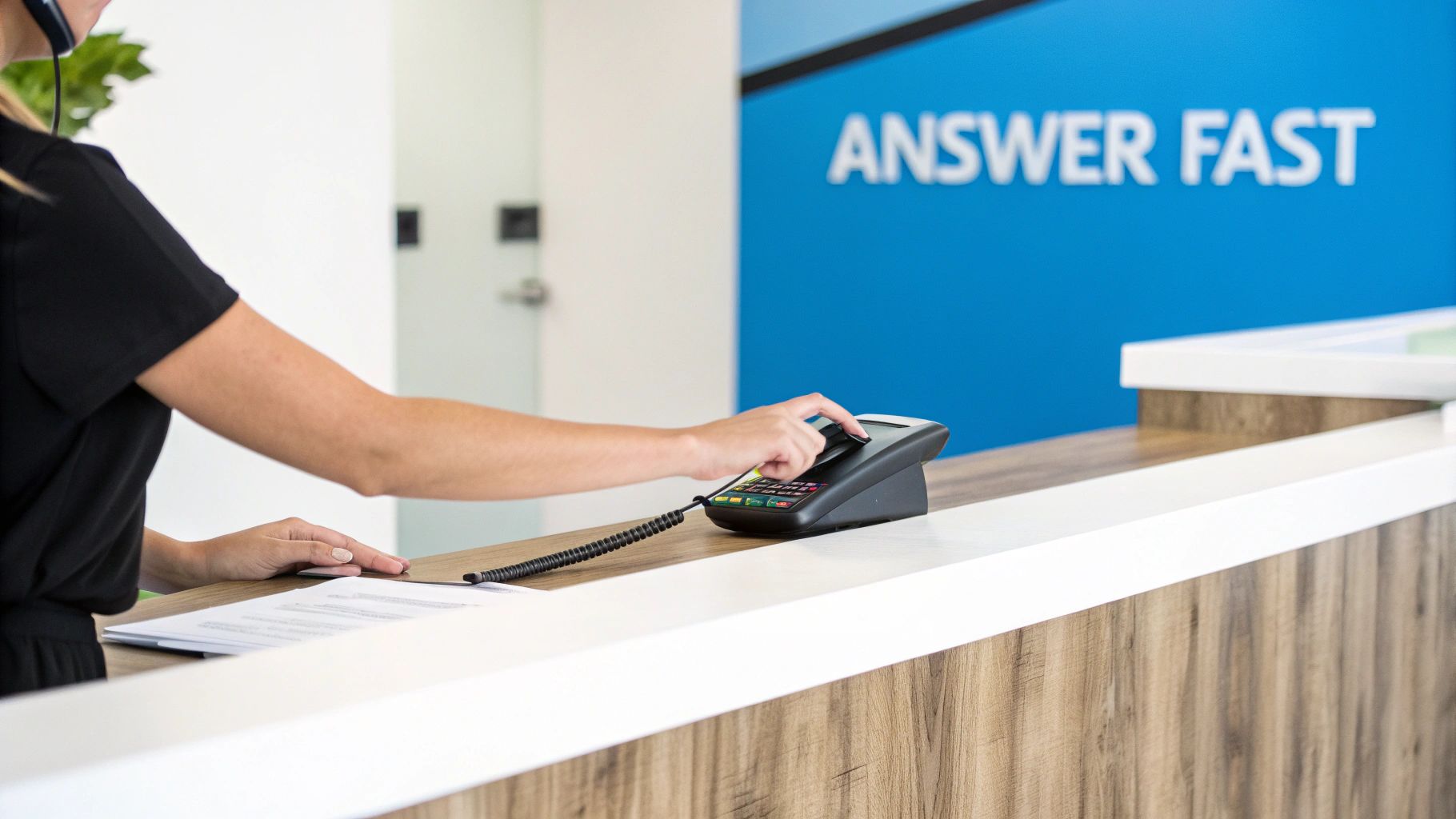
The "why" is simple: an immediate response makes callers feel valued and heard. A slow response signals inefficiency and a lack of care. For service-based businesses, this is critical. An HVAC company that answers an emergency call on the first ring is far more likely to secure a high-value repair job than a competitor who lets the call go to voicemail. Similarly, Recepta.ai clients in healthcare report that answering appointment requests immediately can reduce no-show rates by over 20% because the patient's commitment is captured at peak intent.
How to Implement Rapid Response Times
Improving your FRT doesn't require doubling your staff. Strategic implementation of technology and process is key.
- Deploy AI Receptionists: Use conversational AI like Recepta.ai to provide an instant, 24/7 first point of contact. The AI can handle initial greetings, answer common questions, schedule appointments, and route complex calls to the appropriate human agent, ensuring no call ever goes unanswered.
- Establish Smart Call Queues: If all agents are busy, implement a system that informs callers of their estimated wait time. Actionable Example: Record a message like, "Thank you for calling. All our agents are currently assisting other clients. Your estimated wait time is two minutes. For faster service, press 1 to schedule an automated callback."
- Set and Track KPIs: You cannot improve what you don't measure. Set a team-wide Key Performance Indicator (KPI) for answering 90% of calls within three rings. Use your phone system's analytics to track metrics like Average Speed of Answer (ASA) and call abandonment rates.
- Define Escalation Protocols: Create a clear rule for when a call needs to be escalated. Actionable Example: If an AI receptionist detects words like "emergency" or "leak," it should bypass the standard queue and immediately transfer the call to the on-call technician's line.
2. Active Listening and Customer Verification
Beyond simply hearing words, active listening is the practice of fully concentrating on what is being said, understanding the message, and confirming that understanding. This foundational element of call handling best practices involves verifying customer details and repeating back information to ensure absolute accuracy. It is a direct strategy to build trust, reduce costly errors, and demonstrate that you value the customer's time and needs.
The "why" is rooted in precision and empathy. When a caller feels genuinely understood, their loyalty and confidence in your business grow exponentially. This is especially crucial in high-stakes industries where small misunderstandings can have significant consequences. For instance, a law firm that actively listens and verifies case details prevents critical legal missteps. Similarly, a dental office that confirms a patient’s specific concerns and appointment time not only reduces no-shows but also improves the quality of care by preparing the clinician in advance.
How to Implement Active Listening and Verification
Integrating this practice requires a conscious effort to shift from a passive to an engaged conversational style.
- Train with Key Phrases: Equip your team with scripts that encourage verification. Actionable Example: For a real estate agent, use, "Okay, to make sure I have this right, you're looking for a three-bedroom, two-bath home in the Northwood district, with a budget of around $500,000. Is that correct?"
- Leverage AI for Intent Detection: Modern conversational AI, like Recepta.ai, uses natural language processing (NLP) to understand caller intent, not just keywords. The AI can be programmed to ask clarifying questions and verify details like names, phone numbers, and service requests before escalating or booking.
- Use Open-Ended Questions: Encourage callers to provide more detail by asking questions that can't be answered with a simple "yes" or "no." Actionable Example: Instead of asking a home services client, "Is your AC broken?" ask, "Can you tell me what you're experiencing with your AC unit?"
- Review and Coach: Use call recordings and AI-generated summaries to review conversations. Coach your team by identifying moments where active listening succeeded or could have been improved, turning every call into a learning opportunity.
3. Strategic Call Routing and Escalation
Intelligent call routing is the practice of automatically directing incoming calls to the most appropriate person or department without manual intervention. This foundational element of call handling best practices eliminates unnecessary transfers, reduces caller frustration, and significantly boosts first-call resolution rates. When a customer connects with the right expert on the first try, their problem is solved faster, and their confidence in your organization grows.
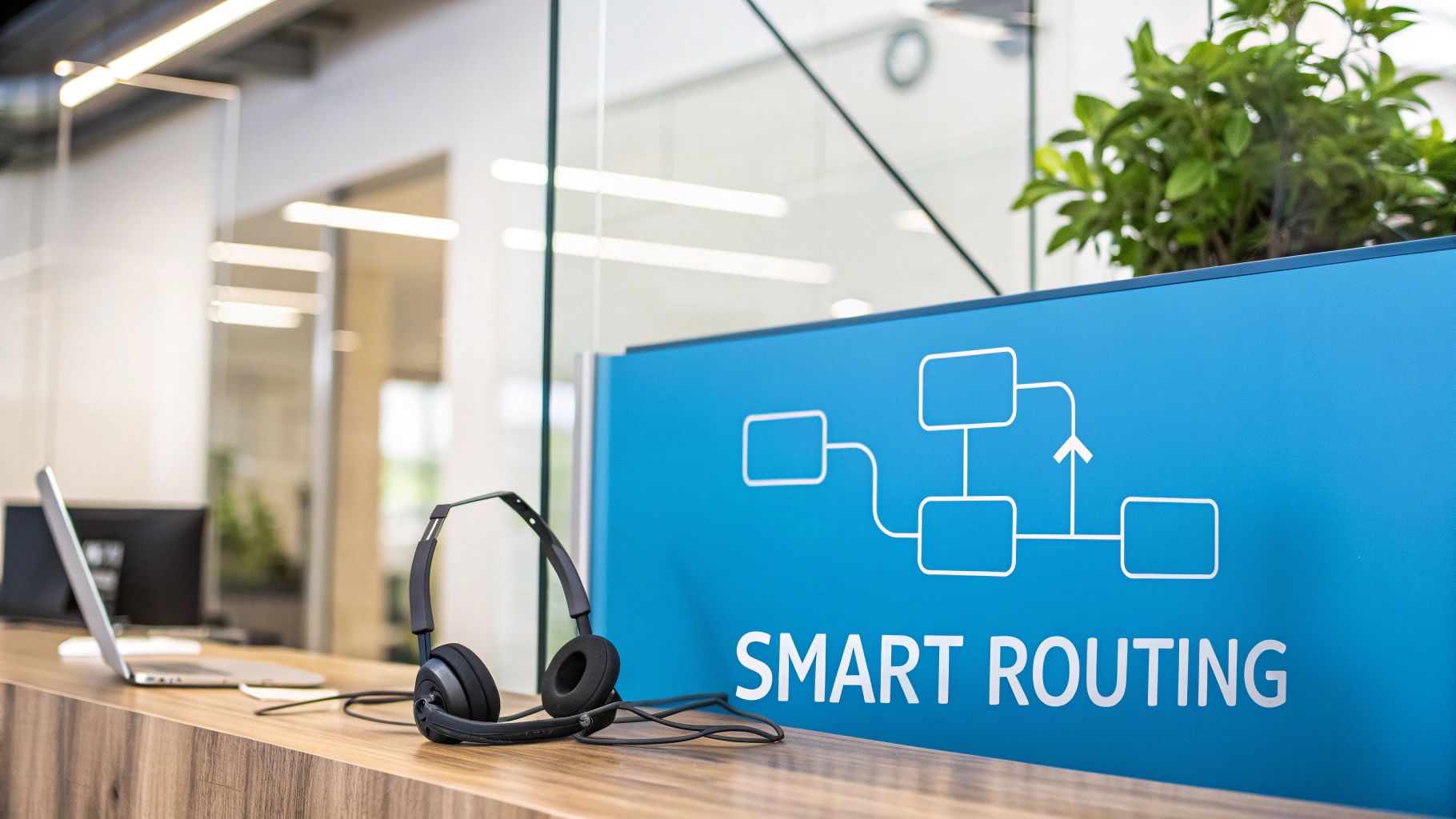
The "why" is rooted in efficiency and expertise. Getting a caller to the right destination immediately prevents the dreaded "phone tag" and ensures complex issues are handled by specialists. For example, a multi-location plumbing franchise can automatically route a caller to the nearest branch based on their ZIP code, while a law firm can direct inquiries about corporate law to its business litigation team, bypassing the family law department entirely. This precision not only saves time for the client but also maximizes the productivity of your team by protecting their focus.
How to Implement Strategic Routing and Escalation
Effective routing relies on a clear understanding of your call flows and the technology to execute them.
- Leverage Contextual AI Routing: Use a system like Recepta.ai that goes beyond simple IVR menus. Conversational AI can understand the caller's intent from their natural language ("I need to file a new claim," or "I'm having a medical emergency") and route them to the correct specialist, queue, or emergency protocol instantly.
- Establish Clear Escalation Triggers: Define specific criteria for when a call needs to be escalated. Actionable Example: A medical practice's AI can handle routine appointment scheduling, but if a caller mentions "chest pain" or "severe bleeding," the system should immediately escalate the call to a live triage nurse.
- Ensure Warm Handoffs: The worst customer experience is having to repeat information. Actionable Example: The AI should announce the transfer with context: "I'm transferring you to our billing specialist, Sarah. I've let her know your name is John Doe and you're calling about the invoice from May 15th."
- Track and Refine Routing Rules: Your business needs change over time. Regularly review call routing data, such as transfer rates and resolution times per department. Use these metrics to identify bottlenecks and refine your routing rules quarterly to ensure ongoing efficiency.
4. Call Documentation and Data Logging
Accurate call documentation is the backbone of reliable customer relationship management and operational continuity. This practice involves systematically recording call summaries, outcomes, and critical customer data immediately after each interaction. This core component of call handling best practices ensures no detail is lost, creates a dependable record for follow-ups, and provides invaluable business intelligence. Forgetting a key detail from a client call can lead to a lost sale, a botched service appointment, or even compliance issues.

The "why" is rooted in accuracy and efficiency. Manual note-taking is prone to human error, inconsistency, and delays, leading to outdated or incomplete CRM records. Automated data logging, by contrast, creates a perfect, real-time "single source of truth." For example, a law firm using automated call logging can ensure every detail from a prospective client consultation is instantly saved to their case management system, protecting against malpractice risks. Similarly, a multi-location franchise can use centralized call data to identify service trends and training opportunities across all its branches.
How to Implement Effective Call Documentation
Automating your data logging process is more accessible than ever and delivers an immediate return on investment by freeing up staff time and improving data quality.
- Integrate AI with Your CRM: Deploy an AI receptionist like Recepta.ai that automatically logs call details, transcriptions, and outcomes directly into your CRM or practice management software. This eliminates manual data entry and ensures every lead and service request is captured. To discover how this integration transforms workflows, you can learn more about AI receptionist integration with CRM systems.
- Use Transcription Summaries: Leverage call transcription technology to generate concise summaries of conversations. Actionable Example: A sales manager can review a 5-point summary of a 15-minute call in 30 seconds, quickly identifying the client's budget, timeline, and main pain points without listening to the recording.
- Establish Data Validation Rules: Set up rules within your CRM to ensure all essential fields (like name, phone number, and reason for calling) are populated correctly. This maintains a clean and reliable database for marketing and follow-up activities.
- Ensure Data Compliance: Be vigilant about regulations like GDPR, CCPA, and TCPA, especially concerning call recording and data storage. Actionable Example: Start every recorded call with an automated disclosure: "For quality and training purposes, this call may be recorded."
5. Professional Communication Standards and Brand Voice
Consistent, professional communication is the foundation of brand credibility and customer trust. Establishing clear standards for brand voice ensures every caller receives a uniform, high-quality experience that reinforces your company's identity. This crucial component of call handling best practices involves defining the appropriate language, tone, pacing, and courtesy used in every interaction, making your brand recognizable and reliable from the first word.
The "why" is rooted in perception. A premium cleaning service that uses a polished, professional tone immediately justifies its higher price point. In contrast, a healthcare practice that employs a calm, empathetic voice can significantly reduce patient anxiety and build lasting rapport. For example, a dental office that trains its receptionists to greet nervous callers with a warm, reassuring tone is more likely to retain patients than one with an abrupt, transactional style. This consistency transforms a simple phone call into a powerful brand-building opportunity.
How to Implement a Consistent Brand Voice
Standardizing your communication is a strategic process that blends documentation, training, and technology.
- Create a Brand Voice Guide: Develop a clear document that outlines your desired tone (e.g., formal, friendly, authoritative), key phrases to use and avoid, and personality attributes. Actionable Example: A guide for a luxury real estate agency might specify: "Tone: Confident and sophisticated. Use: 'Certainly,' 'My pleasure.' Avoid: 'No problem,' 'Yup.'"
- Use Customizable AI Receptionists: Modern conversational AI can be a powerful ally in maintaining consistency. Recepta.ai allows for extensive voice customization, ensuring your AI receptionist perfectly matches your established brand voice, 24/7. You can learn more about new voice customization for AI receptionists and how it reinforces brand identity.
- Provide Script Frameworks: Offer structured greeting and closing scripts but train your team to use them as a flexible framework, not a rigid mandate. Actionable Example: A standard greeting could be: "Thank you for calling [Company Name], this is [Agent Name]. How may I help you today?"
- Conduct Call Quality Reviews: Regularly review recorded calls with your team. Use these sessions to provide constructive feedback, celebrate examples of excellent communication that perfectly captured the brand voice, and identify areas for improvement.
6. Objection Handling and Problem Resolution
Effective objection handling and problem resolution are the hallmarks of a customer-centric business. This practice involves skillfully navigating customer concerns, complaints, and sales objections during a call to prevent escalation and turn potentially negative interactions into positive ones. In the context of call handling best practices, this is about transforming a frustrated caller into a loyal advocate by demonstrating empathy, competence, and a genuine commitment to finding a solution.
The "why" is crucial for retention and reputation. A customer with a problem is at a critical juncture; your response determines whether they churn or become more loyal. For instance, when a home services client calls to complain about a missed appointment, a well-trained receptionist who acknowledges the frustration, sincerely apologizes, and immediately offers a priority rescheduled slot with a discount can salvage the relationship. Similarly, a medical practice that addresses a billing error with transparency and offers a clear resolution path builds trust and reinforces patient confidence.
How to Implement Proactive Problem Resolution
Mastering objection handling requires a combination of training, empowerment, and the right tools. It's about shifting from a reactive "damage control" mindset to a proactive, solutions-oriented approach.
- Develop an Objection Playbook: Document common objections and complaints specific to your industry. Actionable Example: For a plumber's office: "Objection: Your price is too high." Response: "I understand our quote may seem higher. We use premium parts and offer a 2-year warranty, which can save you money on future repairs. We also have financing options available. Would you like to hear about those?"
- Train for De-escalation: Coach your team on active listening and de-escalation techniques. This includes using a calm, even tone, validating the customer's feelings ("I understand why you're frustrated"), and reframing the conversation toward a solution.
- Empower Your Front Line: Give your receptionists or first-line agents the authority to offer small, pre-approved solutions like a 10% discount, a waived cancellation fee, or priority booking. This resolves issues faster without needing manager approval.
- Leverage AI for Early Detection: Modern AI receptionists like Recepta.ai can be configured to detect keywords or tones indicating frustration. The AI can then immediately escalate the call to a designated human agent, providing them with context before they even answer.
- Track and Analyze Complaints: Use your CRM or call management system to log all complaints. Regularly review this data to identify recurring problems, which could indicate deeper systemic issues in your operations that need to be addressed.
7. Appointment Scheduling Accuracy and Calendar Integration
Flawless appointment scheduling is the backbone of any service-based operation. This practice ensures that every booking is captured accurately, synced with real-time calendar availability, and confirmed without error. It's a critical component of call handling best practices that directly prevents double-bookings, reduces costly no-shows, and eliminates operational chaos. When a client calls to book, they expect a seamless, confident process, not a hesitant "let me check and call you back."
The "why" is rooted in efficiency and customer trust. An HVAC company that books a technician for two different emergency calls at the same time creates a customer service disaster. In contrast, a dental practice using real-time calendar integration can instantly offer a patient the next available slot, confirm it on the spot, and automatically send a reminder, drastically cutting down on missed appointments. Recepta.ai clients in the legal field report that direct integration with attorneys' calendars has reduced scheduling errors by over 95%, freeing up paralegals from the back-and-forth of coordinating availability.
How to Implement Accurate Scheduling and Integration
Automating your scheduling process with integrated tools is the most effective way to ensure accuracy and efficiency without overwhelming your team.
- Integrate AI with Your Calendar: Use an AI receptionist like Recepta.ai that syncs directly with your business calendar (e.g., Google Calendar, Acuity, or industry-specific software). The AI can see real-time availability and book appointments 24/7 without manual oversight. You can learn more about how AI receptionists manage new appointments.
- Standardize Booking Information: Train all staff and program your AI to confirm four key details on every booking call: customer name, date and time, specific service required, and contact information. This simple checklist prevents critical data gaps.
- Automate Confirmations and Reminders: Implement a system that sends an instant booking confirmation via email or SMS. Actionable Example: Schedule an automated text reminder for a dental appointment: "Hi [Patient Name], this is a reminder of your appointment with Dr. Smith tomorrow, June 5th, at 10 AM. Please reply YES to confirm or call us to reschedule."
- Buffer Service and Travel Time: For mobile service businesses like cleaning or pest control, automatically build travel time or service buffers into your calendar. Actionable Example: If a job takes 60 minutes and the next client is 30 minutes away, configure your system to block out 105 minutes (60 + 30 + 15 min buffer) to prevent delays.
8. Lead Capture and Qualification Process
A ringing phone is an opportunity, but not all opportunities are created equal. A structured lead capture and qualification process is the practice of systematically gathering key information from callers to determine their potential value and sales-readiness. This essential component of call handling best practices transforms your front desk from a simple message-taking service into a powerful revenue-generating engine, ensuring your sales team invests time on high-intent prospects, not dead ends.
The "why" is rooted in efficiency and ROI. By qualifying leads upfront, you filter out tire-kickers and direct serious inquiries to your top closers immediately. For a law firm, distinguishing between a caller with a high-value personal injury case and one with a minor traffic dispute is critical for resource allocation. Similarly, a home services contractor using this method can prioritize a large-scale kitchen remodel lead over a small faucet repair request, dramatically boosting productivity and maximizing profit on every call answered.
How to Implement Lead Capture and Qualification
Integrating a qualification framework into your call handling process is about asking the right questions at the right time. This can be achieved through both human training and AI-driven automation.
- Create Qualification Scorecards: Develop a simple checklist based on frameworks like BANT (Budget, Authority, Need, Timeline). Actionable Example: For a home remodeling company: Is the project over $10,000? (Budget) Is the caller the homeowner? (Authority) Is the project for a kitchen or bath? (Need) Do they want to start in the next 3 months? (Timeline). Three "yes" answers qualify the lead as "hot."
- Train Staff for Conversational Probing: Equip your team to ask qualifying questions naturally. Instead of a robotic interrogation, train them to weave questions into the conversation, such as, "To make sure I connect you with the right specialist, could you tell me a bit about the urgency of your situation?"
- Leverage AI for Initial Screening: Implement a tool like Recepta.ai to handle the initial capture and scoring. The AI can ask pre-programmed questions, analyze responses for keywords indicating urgency or high value, and then route the pre-qualified, data-rich lead directly to the appropriate sales rep's CRM.
- Establish Instant Handoff Protocols: Once a lead is identified as "hot" or "qualified," the process must ensure an immediate transfer to the sales team. A delay of even a few minutes can cause a high-intent lead to cool off or contact a competitor.
9. Follow-up and Callback Management
In an ideal world, every call is answered on the first ring. In reality, missed calls and voicemails are inevitable. Strategic follow-up and callback management is the process of creating a systematic safety net to ensure every missed opportunity is revisited promptly. This practice is a cornerstone of effective call handling best practices because it transforms potential losses into converted leads and satisfied customers. Letting a missed call fade away is equivalent to letting a motivated buyer walk out of your store.
The "why" is rooted in modern consumer expectations. A prospect who leaves a voicemail about an urgent plumbing leak or inquires about a legal consultation expects a swift reply. A callback within one or two hours reinforces their initial interest and demonstrates your company's reliability and attentiveness. Recepta.ai clients in home services have found that a structured callback system can recover up to 40% of leads that would have otherwise been lost to competitors who answered their phones faster.
How to Implement a Robust Callback System
A successful follow-up strategy combines proactive processes with smart technology to ensure no lead is left behind. It’s about creating a reliable workflow for every single inbound communication.
- Automate Voicemail Processing: Use a system like Recepta.ai that automatically transcribes voicemails into text. This allows your team to quickly triage messages, understand the caller's needs without listening to audio, and assign the callback to the right person with full context.
- Establish a Callback SLA: Set a strict Service Level Agreement (SLA) for your team, such as a "1-Hour Callback Guarantee" for all missed calls during business hours. This creates accountability and sets a clear standard for performance.
- Create CRM-Driven Workflows: Integrate your phone system with your CRM to automatically create a follow-up task for every missed call or voicemail. Actionable Example: A missed call from a new number can trigger an automated workflow that creates a "New Lead" contact in your CRM and assigns a task to a sales rep: "Call back [Name] at [Number] by 3 PM."
- Personalize Your Outreach: When returning a call, be specific. Actionable Example: Instead of a generic, "You called us," try, "Hi, this is Mark from Apex Legal. I'm returning your call from 2 PM today regarding a free consultation for a real estate matter." This shows you are organized and attentive.
10. Call Quality Monitoring and Continuous Improvement
Excellent call handling is not a one-time achievement; it's a standard that requires constant maintenance and refinement. Call quality monitoring is the systematic process of reviewing, scoring, and providing feedback on agent interactions to ensure they align with your brand's standards. This data-driven approach, a cornerstone of effective call handling best practices, transforms customer service from a subjective art into a measurable science, ensuring every call reinforces client trust and operational excellence.
The "why" behind this practice is clear: consistency builds reputation. A law firm that ensures every call is handled with the same level of confidentiality and empathy builds an unshakable foundation of client trust. For home service companies, monitoring calls for lead capture completeness and professionalism can directly boost conversion rates. Without a formal quality assurance (QA) program, service levels can vary dramatically between agents, leading to an inconsistent customer experience and missed opportunities.
How to Implement a Quality Monitoring Program
Creating a continuous improvement loop is about establishing objective standards and providing constructive, regular feedback. It empowers your team to grow and your service quality to evolve.
- Create an Objective Scorecard: Develop a detailed scoring rubric that evaluates key interaction elements. Actionable Example: Categories for a medical office could include: 1) Used warm and empathetic tone (1-5), 2) Verified patient identity correctly (Yes/No), 3) Accurately captured reason for visit (1-5), 4) Confirmed appointment time twice (Yes/No).
- Leverage AI for Triage: Manually reviewing every call is impossible. Use tools like Recepta.ai to generate AI-powered call summaries and sentiment analysis. This allows you to quickly flag calls with potential quality issues (e.g., negative sentiment, long silences) for a targeted manual review.
- Establish a Review Cadence: Commit to reviewing a set percentage of calls, such as 10-15%, on a monthly or bi-weekly basis. This provides enough data to identify trends and individual coaching needs without being overly burdensome.
- Conduct Regular Coaching Sessions: Use scorecard results as the basis for one-on-one coaching. Focus on specific, actionable feedback. Instead of saying "be more professional," say "let's work on using the client's name and actively confirming their details." It's also vital to share examples of excellent calls to model desired behaviors.
- Track KPIs Over Time: Use an analytics dashboard to monitor quality scores alongside other metrics like customer satisfaction and first-call resolution. Tracking these trends helps prove the ROI of your quality program. For more insights on this, you can learn more about how Recepta.ai's upcoming enhanced analytics dashboard will facilitate this process.
10-Point Call Handling Best Practices Comparison
Unify Your Communication and Never Miss an Opportunity Again
Navigating the landscape of modern business communication can feel like a high-wire act. One misstep, one missed call, one poorly handled interaction can mean the difference between securing a loyal client and losing a valuable opportunity forever. Throughout this guide, we've dissected the essential components of elite call handling, moving beyond generic advice to provide a strategic blueprint for transforming your phone lines into a powerful engine for growth.
The journey from a good to a great communication strategy isn't about simply answering the phone faster. It's about building a cohesive, intelligent system. It starts with mastering that critical First Response Time and making a stellar first impression, then flows directly into the nuanced art of Active Listening, where you don't just hear a client's words but understand their intent. This foundational respect sets the stage for everything that follows.
From Foundational Skills to a Systemic Approach
Implementing these call handling best practices is a strategic investment in your business's reputation and bottom line. We've explored how a seemingly simple process like Strategic Call Routing can dramatically improve customer satisfaction by connecting callers to the right expert on the first try. We've also detailed how rigorous Call Documentation and adherence to Professional Communication Standards create a consistent, trustworthy brand experience, regardless of which team member picks up the phone.
Think of each practice as an interlocking gear in a larger machine:
- Objection Handling and Problem Resolution turn potential complaints into moments of trust-building.
- Accurate Appointment Scheduling respects your clients' time and keeps your operations running smoothly.
- A refined Lead Capture and Qualification Process ensures your sales team spends their time on the most promising prospects.
- Proactive Follow-up and Callback Management demonstrates a level of care that your competitors often neglect.
This is not a checklist to be completed once; it's a cycle. The final, crucial piece is Call Quality Monitoring and Continuous Improvement, which provides the data and insights needed to refine every other step in the process. This commitment to ongoing evolution is what separates industry leaders from the rest.
The Hybrid Future: Blending Human Empathy with AI Efficiency
Adopting these best practices doesn't mean you need to double your administrative staff. The true breakthrough lies in creating a hybrid system where technology handles the predictable and repetitive, freeing your human team to manage the complex and emotional. Imagine an AI-powered system that instantly captures lead details from a new caller, logs the interaction in your CRM, and schedules a follow-up task, all before your human receptionist even says hello.
This is where the principles we've discussed become truly scalable. An AI-driven front line can ensure 24/7 availability, handle routine scheduling, and intelligently route calls based on urgency and need. When a situation requires genuine empathy, complex problem-solving, or a high-stakes negotiation, the system can execute a seamless handoff to a human expert. This symbiotic relationship ensures you are always responsive, efficient, and professional, turning every single call into a stepping stone for business success and a testament to your commitment to exceptional service.
Ready to transform your communication from a liability into your greatest asset? See how Recepta.ai can automate your call handling, capture every lead, and integrate seamlessly with your team to deliver a flawless customer experience 24/7. Discover the power of an AI-driven receptionist at Recepta.ai and start building a more efficient, profitable business today.