
Mastering Customer Service on Telephone: A Guide for Modern Businesses
When a customer picks up the phone to call your business, it’s not just a casual inquiry. It’s a high-stakes moment of truth. In an age of endless emails and chatbots, a phone call signals something more—an urgent problem, a complex question, or simply a need for a real human connection that digital channels just can't provide.
Why Every Phone Call Is a Moment of Truth
Think about it: when a customer calls, they've already decided against easier, lower-effort options like checking your FAQ page or filling out a contact form. Their decision to call means the issue is important to them.
They might be dealing with a confusing bill, a service outage that's costing them business, or a sensitive personal matter that demands a reassuring voice. This is especially true for businesses where trust is the entire foundation of the relationship—think healthcare providers, law firms, or home repair services. For them, the telephone is the front line where relationships are either cemented for life or shattered in a single conversation.
A real human voice provides a level of empathy and on-the-spot problem-solving that automated systems can't even begin to imitate. This direct line to your business is a powerful chance to build incredible loyalty. But if you handle it poorly, you risk creating a very vocal critic.
The Real Business Impact of a Single Call
It’s tempting to see phone calls as just another operational task to get through, but each one carries significant weight. A genuinely helpful, positive interaction can transform a first-time caller into a lifelong advocate for your brand. On the flip side, one negative experience can completely undo months of hard-earned marketing efforts.
The numbers back this up. Phone support is still the king of customer service, with 69% of consumers saying they prefer talking to a person on the phone for complex issues. And while the global call center market is a massive $352.4 billion industry in 2024, a shockingly low 44% of customers actually report having positive experiences. That gap highlights a massive opportunity for any business willing to get it right. You can read more about these customer support statistics and trends to see just how big the opportunity is.
The crucial takeaway is this: Your phone line isn't just a support channel; it's a direct reflection of your company's values and competence. Every ring is a chance to prove you are reliable, empathetic, and effective.
Quick Audit Your Current Phone Process
Before we get into the nitty-gritty of scripts and tactics, let's do a quick reality check on your current setup. A simple audit can instantly reveal some obvious pain points you can fix.
Ask yourself these honest questions:
- The First Impression: What does a customer hear in the first 10 seconds? Is it a warm, friendly greeting? A confusing automated menu from the 90s? Or just endless, frustrating ringing?
- Clarity and Confidence: Can your team answer the most common questions without fumbling around or putting the customer on a long, awkward hold? For example: If you run a property management company, can your receptionist confidently state the rental application requirements without saying, "Um, let me check"?
- Problem Ownership: Does the first person who picks up the phone take full responsibility for finding a solution, or do they just pass the caller around like a hot potato? For example: When a customer reports a billing error, does your agent say, "Let me personally look into this for you," or "You need to talk to accounting, let me transfer you"?
Answering these questions honestly is the first step. It sets the stage for building a truly exceptional customer service on telephone strategy that people will remember for all the right reasons.
Designing Call Flows That Sound Human
Throw out the rigid, word-for-word scripts. They're a surefire way to make your team sound like robots and leave customers feeling like they're talking to a wall. The real goal isn't to lock your agents into a conversational prison; it's to design a flexible call flow. Think of it as a reliable framework that guides the conversation without stamping out your agent's personality.
This approach is what builds a genuine connection. A great call flow has clear milestones—an opening, a diagnosis, and a closing—but it leaves plenty of room for natural conversation. This structure is what drives efficiency and consistency. After all, first-call resolution (FCR) is king. Customers are 2.1x more likely to recommend you when their issue is solved on the first try.
Yet, a staggering 63% of consumers say they have to repeat their issues over and over again on different calls. That’s a massive point of frustration, and it's exactly what a well-designed call flow helps you avoid.
Building Blocks of a Natural Call Flow
Instead of handing your team a script, give them objectives for each stage of the call. This ensures all the important information gets gathered without sacrificing the human element.
- The Opening: Start with a warm, consistent greeting that immediately identifies your company and the agent. Actionable Example: For a local plumbing company, it could be as simple as: "Thank you for calling Rapid Rooter, this is Sarah. How can I help you today?" It's clear, professional, and welcoming.
- The Diagnosis: This is the listening phase. Train agents to use open-ended questions. Actionable Example: Instead of "Is your sink clogged?", which elicits a yes/no answer, ask "Could you tell me a bit more about what's happening with your sink?" This encourages the customer to share the full story in their own words.
- The Closing: Always end the call by summarizing the resolution and outlining what happens next. Actionable Example: A medical clinic could wrap up with: "Okay, Mrs. Davis, your appointment with Dr. Smith is confirmed for Tuesday at 10 AM. You'll get a text reminder the day before. Was there anything else I could help with today?"
This isn't a "set it and forget it" process. You need a simple way to audit and refine your call handling based on real-world interactions.
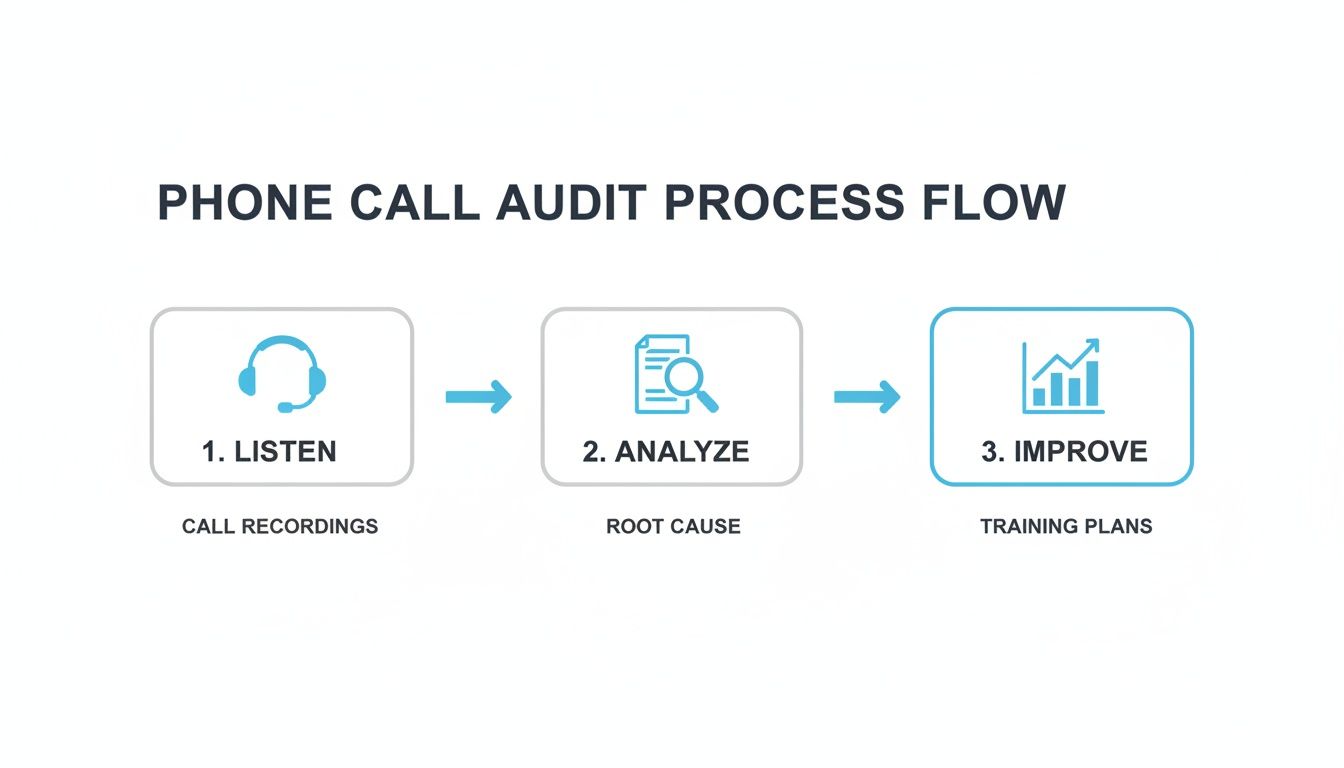
This Listen, Analyze, and Improve model ensures your call flows actually evolve with your customers' needs, rather than just being something that looked good on paper six months ago.
The Golden Rule of Call Flow Design
If you remember one thing, make it this: empower your team to be human.
Give them the green light to use phrases that build rapport and show they're really listening. Actionable Example: If a customer sounds stressed, your agent should feel comfortable saying something like, "It sounds like you're having a really tough day with this; let's figure out how we can get it sorted out for you."
The best call flows are skeletons, not cages. They provide structure and ensure consistency while giving your team the freedom to connect with customers on a personal level.
That human touch is what separates adequate service from a truly memorable experience. It’s also why many businesses are looking into things like voice customization for AI receptionists, trying to make sure even their automated interactions feel more natural and on-brand. Finding that perfect balance between a reliable framework and authentic conversation is the secret to mastering customer service over the phone.
The Art of Empathy and De-Escalation Over the Phone
Fielding a call from an upset customer is one of those make-or-break moments. Handled poorly, it can destroy a relationship. Handled with skill, it can surprisingly turn a furious customer into a loyal advocate.
When a caller is frustrated, the natural impulse is to jump straight into problem-solving mode. Resist it. The real first step is to manage their emotions. Nailing customer service on the telephone is all about defusing the tension before you even start talking about a solution.
It all begins with a technique called active listening. This is more than just staying silent while they vent; it’s about proving you’re actually hearing them. The simplest, most effective way to do this is by paraphrasing their concerns.
Once they've laid out their issue, repeat it back to them in your own words.
Actionable Example: A customer from a software company calls, frustrated that a key feature isn't working. Instead of jumping to solutions, the agent says: "Okay, so if I'm hearing you correctly, the report generator isn't exporting to PDF, which is stopping your team from meeting a deadline. That must be incredibly stressful. Is that right?"
That single sentence does two powerful things: it confirms you've grasped the problem and, more importantly, it shows the customer you were truly paying attention.
Use Phrases That Validate Without Admitting Fault
Next, you need to validate their feelings with empathetic language. This is a crucial distinction: validating their feelings doesn't mean you have to agree with their position or accept blame for the company. It’s simply acknowledging that, from their point of view, their emotional reaction makes sense.
Here are a few phrases I’ve seen work wonders:
- "I can absolutely see how that would be frustrating."
- "It sounds like this has been a really difficult experience."
- "Thank you for being so direct about this. Let's figure this out together."
These kinds of statements build a bridge. Suddenly, you're not adversaries in a confrontation; you're a team focused on a shared goal. To build that bridge even stronger, it’s vital to remove any communication barriers, which is why forward-thinking services now offer options like bilingual support for AI receptionists to make sure every caller feels understood from the very start.
Real-World Scenario: A Law Firm Invoice Dispute
Let's put this into practice. A client calls your law firm, absolutely livid about an unexpected charge on their latest invoice. They feel blindsided, overcharged, and their trust is hanging by a thread.
Instead of immediately defending the bill, the paralegal who takes the call listens patiently without saying a word until the client has finished. Then, they put these techniques to work.
Paralegal: "Mr. Smith, thank you for calling and for telling me what's going on. I hear how upset you are, and I want to get to the bottom of this. It sounds like the main issue is the $500 charge for document review that you weren't expecting. I can definitely see how that would come as a shock. Why don't we walk through the invoice together so I can explain that entry and we can make sure there hasn't been a mistake?"
Let's break that down. The paralegal acknowledged the emotion ("I hear how upset you are"), paraphrased the specific problem, and validated the feeling ("I can see how that would come as a shock"). Only then did they propose a clear, collaborative path forward. This approach immediately brings the temperature down and opens the door for a calm, productive conversation.
Tracking Phone Support Metrics That Actually Matter
If you're not measuring your phone support, you're flying blind. Going beyond a simple call log is the only way to get a real picture of what’s happening on your front lines. The right Key Performance Indicators (KPIs) don't just give you numbers; they reveal the health of your customer service and its direct impact on your bottom line.
These metrics tell a story about customer happiness, how efficiently your team is working, and where you might be losing money. Let's break down the ones that truly move the needle.
First Call Resolution (FCR)
Of all the phone support metrics, First Call Resolution is the one to obsess over. It's the percentage of calls where a customer's problem is completely solved on the first try, with no need for a callback or escalation.
A high FCR is the hallmark of an efficient, well-trained team. Actionable Example: When a client of a financial advisory firm calls to ask a complex portfolio question and gets a complete, accurate answer in that single call, it builds incredible trust and loyalty. On the flip side, a low FCR is a sign of friction. It means frustrated customers and your team doing the same work twice.
Industry Benchmark: A good FCR target is between 70-79%. Top-tier teams push this even higher, but if you're dipping below 70%, it's a clear signal that something in your process or training needs fixing—fast.
Average Speed of Answer (ASA)
How long does it take your team to actually pick up the phone? That’s your Average Speed of Answer. It measures the average time a customer waits on hold before speaking to a real person, and it’s their very first impression of your responsiveness.
Nobody likes waiting. Long hold times are one of the fastest ways to create a negative experience. In fact, one study found that 90% of customers believe an "immediate" response is crucial, with many defining that as under 10 minutes.
Call Abandonment Rate
This one is simple but powerful. The Call Abandonment Rate is the percentage of people who hang up before ever reaching one of your agents. It’s a direct measure of your customers' patience (or lack thereof) and is tightly linked to your ASA. If people wait too long, they just leave.
Actionable Example: Imagine you run an HVAC company in the middle of a July heatwave. A homeowner with a broken AC calls, waits on hold for 90 seconds, and then hangs up to call your competitor. Every single abandoned call is a potential emergency repair job—and thousands in revenue—walking right out the door.
- A healthy abandonment rate is anything under 5%.
- If your rate is high, dig into your call logs to find your peak hours. You can either staff up during those times or use an AI receptionist to handle the overflow and stop bleeding leads.
To really get a handle on these numbers, you need the right tools. For example, an enhanced analytics dashboard for your AI receptionist can give you this kind of insight automatically.
Essential KPIs for Telephone Customer Service
Tracking the right metrics is about more than just hitting targets; it's about understanding the story your data is telling. This table breaks down the most critical KPIs, what they mean, and why they should be on your radar.
By focusing on these core KPIs, you turn your phone support from a necessary expense into a powerful asset. You’ll stop guessing about what works and start making data-driven decisions that boost both customer loyalty and your bottom line.
How to Use AI for Smarter Phone Coverage
Let's be realistic: your best leads and most urgent client calls rarely stick to a 9-to-5 schedule. But staffing your phones around the clock is a massive expense. This is where a smart "hybrid" model comes into play, blending AI with your talented team to turn your customer service on the telephone into a 24/7 opportunity machine.
The idea isn’t about replacing your people; it’s about making them more effective. When you let an AI receptionist field the simple, repetitive questions, your human agents are freed up to handle the complex conversations that truly need their expertise and a personal touch.
This approach means you never miss a lead, but you also don't burn out your team. The AI can instantly tackle the common questions that tie up your phone lines, giving callers immediate answers and a far better experience than voicemail ever could.
The Hybrid Model in Action
Think about a dental practice with multiple locations. Before, any call after 5 PM went to a generic voicemail box. A potential new patient with a toothache wasn't going to leave a message; they'd just call the next clinic on Google. That's lost revenue, every single night.
Now, that same practice uses an AI receptionist for after-hours and overflow calls. Here’s what that looks like:
- Lead Capture & Scheduling: A new patient calls at 9 PM on a Tuesday. The AI answers, understands they're a new patient with a toothache, and books an available appointment directly into the clinic's calendar for the next morning.
- FAQ Handling: A current patient calls asking for post-op care instructions after a wisdom tooth removal. The AI instantly provides the approved, standard information, no human needed.
- Intelligent Escalation: A caller mentions a "cracked tooth" or "unbearable pain." The AI recognizes these trigger words as an emergency and immediately routes the call to the on-call dentist's cell phone.
With this system, no new patient ever gets lost to voicemail. Routine calls get handled on the spot, and genuine emergencies receive the immediate human attention they deserve.
By automating the predictable, you humanize the exceptional. The AI acts as a tireless front-line filter, ensuring that when a human agent does get involved, it's for a conversation that truly matters.
Integrating AI With Your Existing Tools
The real magic happens when your AI receptionist communicates with your other business software. Modern AI solutions can connect directly with your calendar for seamless booking or with your CRM to log every call automatically. This completely eliminates manual data entry and keeps your client records perfectly up-to-date.
For any business considering this, it's crucial to see how an AI receptionist integrates with popular CRM systems. That connection is what transforms a simple answering service into a core part of your business operations, capturing valuable data and driving action from every single call, day or night.
Building Your Telephone Service Training Playbook
Excellent phone support isn’t magic—it’s the result of great training. If you leave your team to "wing it," you're really just leaving your customers to chance. A solid training playbook, however, empowers your agents to handle any call with confidence and consistency.
Think of this playbook as a living guide for your team. It’s not just about which button to press on the phone. It's about teaching your people how to be a helpful, human extension of your brand with every single interaction.
Core Training Modules for Success
A truly effective training program for customer service on the telephone rests on a few essential pillars. Each one builds a different skill, from mastering the tech to nailing the human-to-human connection.
Your training needs to cover these bases:
Systems Proficiency: This is more than just answering the phone. Your team needs to be fluent in your CRM, booking software, and any other tools they use daily. Actionable Example: Time your new hires. Can they look up a customer's order history in your CRM in under 15 seconds? If not, they need more practice to avoid creating awkward silences on live calls.
Brand Voice and Tone: How do you want your business to sound? If you're a law firm, your tone will be more formal and professional. A local pet groomer? You'll want warm and friendly. Your agents need to embody this voice to deliver a consistent experience.
Call Flow Mastery: Train your team on the flexible call flows we covered earlier. They need to understand the purpose of the opening, the discovery phase, and the closing, all without sounding like they're reading from a script.
These fundamentals lay the groundwork for more advanced training, where agents can put their skills to the test in real-world situations.
The Power of Practice and Feedback
Knowing what to do is one thing, but actually doing it under pressure is another skill entirely. This is why hands-on practice is the heart and soul of your training playbook. Theory doesn’t prepare an agent for a genuinely frustrated customer on the other end of the line.
Role-playing is absolutely essential. It’s the safest way to simulate tough conversations without risking a real customer relationship. It builds the muscle memory needed to handle difficult moments with grace.
Create a library of common scenarios your team will actually face. Actionable Example: Have a manager role-play as a customer whose service appointment was missed. This gives a new hire a chance to practice empathy and de-escalation in a controlled environment, offering feedback like, "That was a great start. Next time, try validating their frustration before you look up their appointment details."
You should also use recordings of real calls as coaching tools. Sit with an agent and review a call together. Point out what they did well—maybe they showed great empathy or expertly guided the conversation. Then, find opportunities for growth, like a moment where they could have paraphrased the customer's issue more clearly. This kind of ongoing feedback is what transforms good agents into great ones.
Answering Your Top Questions
Getting phone support right often comes down to a few key questions. Let's tackle some of the most common ones we hear from businesses looking to improve their customer service over the phone.
How Can We Cut Down on Customer Wait Times?
Nothing frustrates a caller more than being stuck on hold. The truth is, most people expect someone to pick up almost immediately. The first step is to dig into your own call data. Figure out when your peak call times are and staff accordingly—it sounds simple, but many businesses don't do it.
Beyond staffing, smart call routing is your best friend. Getting the caller to the right person on the first try prevents those dreaded internal transfers. But for a truly effective and budget-friendly fix, an AI receptionist can be a lifesaver. It can handle routine calls—like checking business hours or booking an appointment—which immediately shortens the queue and frees up your team to handle the more complex conversations.
What's the One Skill Every Great Phone Rep Needs?
If I had to pick just one, it’s active listening. This isn't just about not talking; it's about truly hearing what the customer is saying, picking up on their tone, and understanding the real problem behind their words.
Actionable Example: A customer calls complaining about a late delivery. An average rep hears "late delivery." A great rep hears the frustration and anxiety in their voice because it was a birthday gift. The great rep says, "It sounds like we didn't just miss a delivery date; we put a special occasion at risk. I am so sorry about that." This shows they're not just hearing the words, but the meaning behind them.
This one habit ensures you're both on the same page before you even start looking for a solution.
How Can a Small Business Possibly Offer 24/7 Phone Support?
This is where a hybrid approach, blending AI and human agents, really shines for customer service on the telephone. For a small business, staffing a phone line around the clock is usually out of the question financially. An AI receptionist, however, can provide that 24/7 coverage for a tiny fraction of the cost.
Think of what an AI can do for you while you're closed:
- Capture New Leads: Never miss a potential customer just because they called after hours. The AI can grab their details for a follow-up.
- Book Appointments: It can sync directly with your calendar to schedule consultations or service calls.
- Answer Common Questions: It can handle the basics instantly, satisfying the caller without needing a person.
Actionable Example: A plumbing company can set up smart escalation rules. The AI is programmed to recognize the words "burst pipe" or "flooding" as emergencies. If a caller uses those words after hours, the AI immediately texts the on-call technician's cell phone. However, if a caller says "faucet drip," the AI logs it for a callback the next business morning. It’s all about making sure you never miss a critical call again.
Ready to capture every call and deliver exceptional service 24/7? See how Recepta.ai can transform your phone support by blending advanced AI with a human touch. Learn more at recepta.ai.