

Managing a Sales Pipeline That Actually Closes

A lead contacted within five minutes was 21 times more likely to be qualified than one contacted after 30 minutes, according to research summarized by Voiso's lead response time guide. That finding changes how a sales team should think about pipeline management. The problem often isn't that representatives need another reminder. The problem is that the business hasn't built a reliable system to capture intent, route it, respond quickly, and record the outcome.
Managing a sales pipeline is therefore less about watching activity counts and more about preserving trustworthy evidence. A call logged without a next step isn't progress. A proposal with no confirmed decision process isn't a forecastable opportunity. A full CRM with missing calls, duplicate contacts, and stale close dates is a polished version of guesswork.
What Managing a Sales Pipeline Actually Means in 2026
Sales pipeline management is a measurement discipline. It tracks how prospects move through defined stages, identifies where opportunities stall, and supports forecasting through stage-specific conversion rates. Benchmark compilations report that B2B funnels typically convert approximately 1% to 3% of website visitors into leads, 31% of leads into marketing-qualified leads, 13% of marketing-qualified leads into sales-qualified leads, 30% to 59% of sales-qualified leads into opportunities, and 22% to 30% of opportunities into customers. These benchmarks are summarized in sales funnel conversion data from SHNO.
Those figures explain why a single “lead-to-customer” rate hides operational problems. Overall B2B lead-to-customer conversion is commonly reported around 2% to 5%, while the marketing-qualified-lead-to-sales-qualified-lead transition is a major loss point. A business can generate plenty of inquiries and still produce little revenue if qualification, routing, or follow-up breaks between stages.
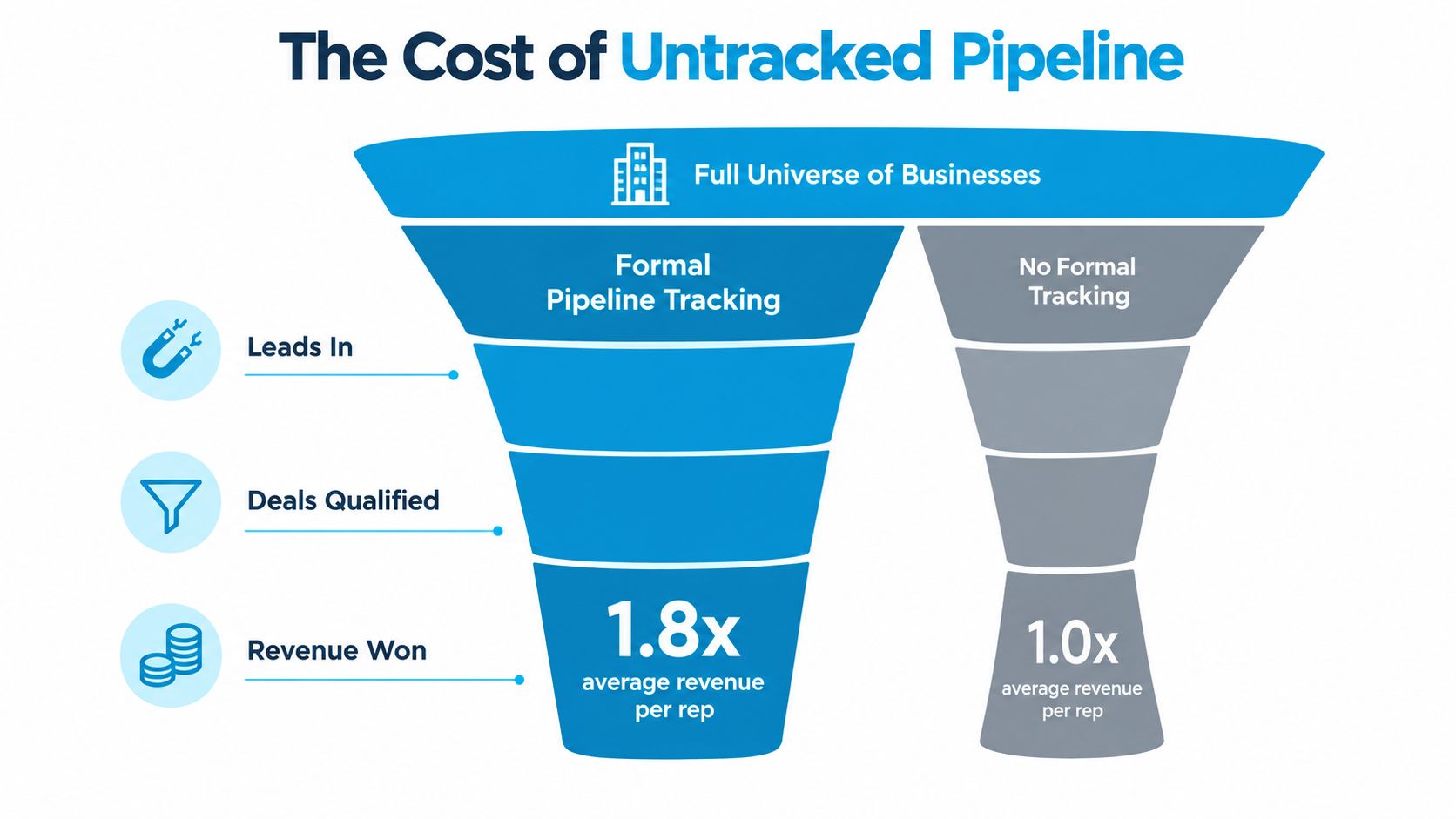
Use one shared stage spine
For most small and mid-sized businesses, start with six core stages:
- New Lead: An inquiry exists and has a source, timestamp, and owner.
- Qualified: The prospect fits the service area, need, authority, timing, and commercial criteria.
- Discovery: The team has documented the problem, stakeholders, and agreed next step.
- Proposal: A commercial offer has been delivered and acknowledged.
- Negotiation: The buyer is discussing terms, scope, price, or contract conditions.
- Closed Won or Lost: The outcome is supported by a signed agreement, completed purchase, or explicit loss reason.
Home services and healthcare practices may need operational milestones such as appointment scheduled or treatment plan accepted, but the underlying principle stays the same. Every transition should correspond to a verifiable buyer action or business document, not a representative's feeling that the deal is “hot.”
Teams often inherit stages such as Warm, Hot, Followed Up, Almost There, and Likely to Close. Those labels feel intuitive, but they don't tell a manager what happened, what must happen next, or whether two representatives are applying the same standard. A useful introduction to the discipline is this practical overview of what is pipeline management, especially for teams moving away from informal deal tracking.
By the end of a proper rollout, the business should have a stage dictionary, required CRM fields, conversion and aging dashboards, a speed-to-lead SLA, routing and automation rules, and a 30-60-90 implementation plan that a sales operations hire can execute.
Designing Pipeline Stages Around Real Buyer Actions
A stage should answer one question: what has the customer done that proves this opportunity belongs here? If the answer is “the representative believes the buyer is interested,” the stage is too subjective.
Start with the six-stage spine, then attach entry requirements, required fields, and exit triggers. For a dental practice, “Qualified” might require a confirmed treatment need, serviceable location, decision-maker status, and insurance or payment constraints. For a plumbing company, it might require the job type, property location, urgency, and the customer's agreement to an estimate.
Build the dictionary before building reports
| Stage | Entry Criteria | Required CRM Fields | Exit Trigger |
|---|---|---|---|
| New Lead | Inquiry received through a form, call, referral, or other defined source | Source, timestamp, contact record, consent status, owner | Contact completed or lead disqualified |
| Qualified | Need and basic fit are documented | Budget range, authority status, need, location, timing | Discovery meeting or service assessment booked |
| Discovery | A structured conversation has occurred | Written summary, stakeholders, problem, next action | Requirements confirmed and solution path agreed |
| Proposal | Offer prepared for a defined need | Proposal value, sent date, document link, expected close date | Read receipt, proposal meeting, or documented buyer response |
| Negotiation | Buyer is discussing commercial or contractual terms | Objections, decision process, revised terms, next-step date | Redlined contract, verbal commitment, or final decision |
| Closed Won or Lost | Decision is known | Signed agreement or explicit loss reason | Fulfillment handoff, nurture, or closed record |
A useful stage definition can be audited by someone who wasn't on the call. If a manager can't understand why a deal advanced from Discovery to Proposal by reading the CRM record, the process is relying on memory rather than data.
The sales cycle stages guide is a useful reference for aligning stage names with the actual buying journey. Don't copy a framework mechanically, though. A short appointment-driven sale may combine stages that a complex legal or healthcare engagement must separate.
Keep ownership explicit
Assign one person to own the stage dictionary. That owner maintains definitions, required fields, validation rules, and reporting logic. Review the dictionary quarterly, and only change it when the buying process has changed, not because a team wants a different color on the dashboard.
Disqualification triggers should be equally specific. A lead outside the service area, a duplicate record, a request the business can't fulfill, or a prospect with no identifiable need shouldn't remain as an open opportunity. Recycle genuine future interest into Nurture, and record why it left the active pipeline.
The Pipeline KPIs That Drive Decisions
Activity metrics answer what representatives did. Pipeline metrics answer whether customer decisions are advancing. The difference matters. A representative can make many calls without completing qualification, while a single well-documented conversation can materially improve the quality of a forecast.
Track three measures every week.
Stage conversion rate
Stage conversion rate = deals advancing ÷ deals entering the stage
Calculate it separately for New Lead to Qualified, Qualified to Discovery, Discovery to Proposal, and each later transition. This reveals where opportunities disappear. The benchmark data cited earlier shows why stage separation matters, particularly around qualification and handoff.
Pipeline velocity
Pipeline velocity = number of open deals × average deal size × win rate ÷ average sales cycle length
Use a consistent time unit, such as revenue per week, and calculate it by source, location, service line, and representative when volume allows. The formula doesn't tell you what to fix by itself. A low result may come from too few opportunities, weak qualification, small average deals, low win rate, or a long cycle.
Forecast coverage
Forecast coverage = weighted pipeline ÷ remaining quota target
Weight each opportunity using historical stage conversion, not optimism. A proposal isn't automatically a likely win because a representative entered a favorable close date.
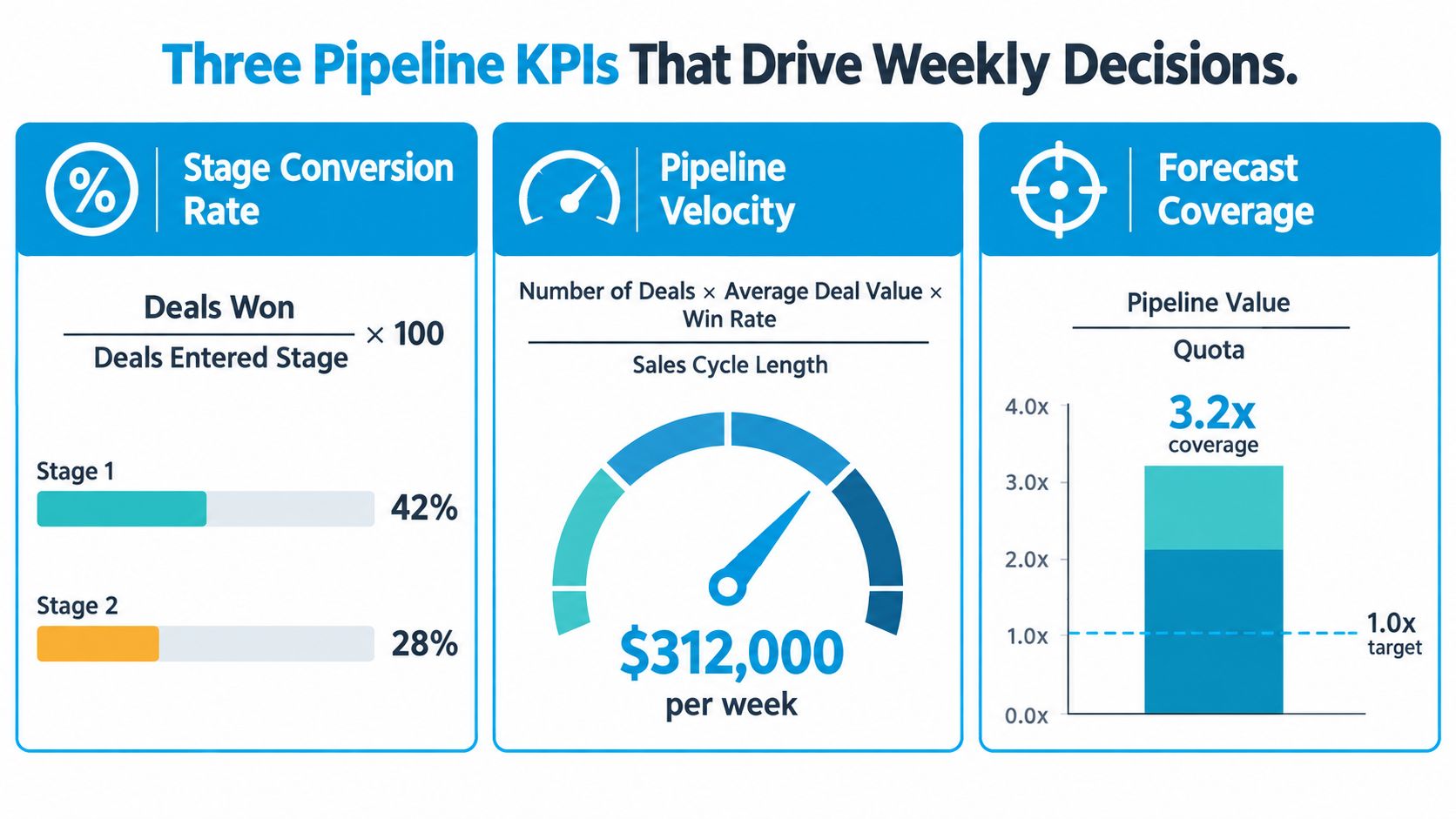
Separate visible pipeline from observable pipeline
A pipeline can show 3x coverage and still be unreliable if many records are stale, duplicated, or missing a next action. Observable pipeline coverage counts only opportunities with recent activity and a verified future step. A practical definition is activity within the last 7 days plus a dated next action, as described in the verified pipeline guidance.
That distinction changes the Monday review. Instead of arguing about whether a deal “feels real,” filter the dashboard into four queues:
- Moving: Recent activity, valid stage, and next action recorded.
- Aging: No stage movement within the expected cycle for that stage.
- Unobservable: No recent activity or no future-dated action.
- Exception: Missing value, owner, close date, or required qualification field.
Use 3x coverage as a planning floor, then set the appropriate velocity target from your own historical cycle, win rate, and deal value. Don't treat 3x as a universal guarantee. The right question is whether enough of the coverage is observable and distributed across the stages needed for the target period. Teams wanting a broader operational view can connect this analysis to a sales performance dashboard.
Building a Speed-to-Lead Operating Procedure
Speed-to-lead fails when a business treats it as individual discipline. If a receptionist is helping a patient, a technician is on-site, or every representative is already handling calls, “someone should follow up” isn't an operating procedure. The system needs a timestamp, a routing rule, a fallback owner, and an outcome definition.
Define the intake event
Create Lead Created At when a form is submitted, a call connects, or an AI receptionist hands off an inquiry. Store the source, contact details, consent status, location, and owner at the same time.
Then route according to the type of inquiry:
- Round-robin routing balances general inbound demand.
- Skill-based routing sends technical, clinical, legal, or high-value requests to the right specialist.
- Overflow routing moves an inquiry to a queue or backup employee when the assigned representative misses the SLA.
The control target is a first contact attempt within 5 minutes. Research across approximately 1.25 million inbound leads found that contacting a lead within one hour made qualification nearly seven times more likely than waiting another hour, while delays of 24 hours or more reduced qualification likelihood by roughly 60-fold versus sub-hour response. A separate analysis covering 5.7 million leads and 55 million sales activities reported approximately eight times higher conversion when the first attempt occurred within five minutes. These are directional observational benchmarks, not guaranteed outcomes, as explained in the speed-to-lead research summary.
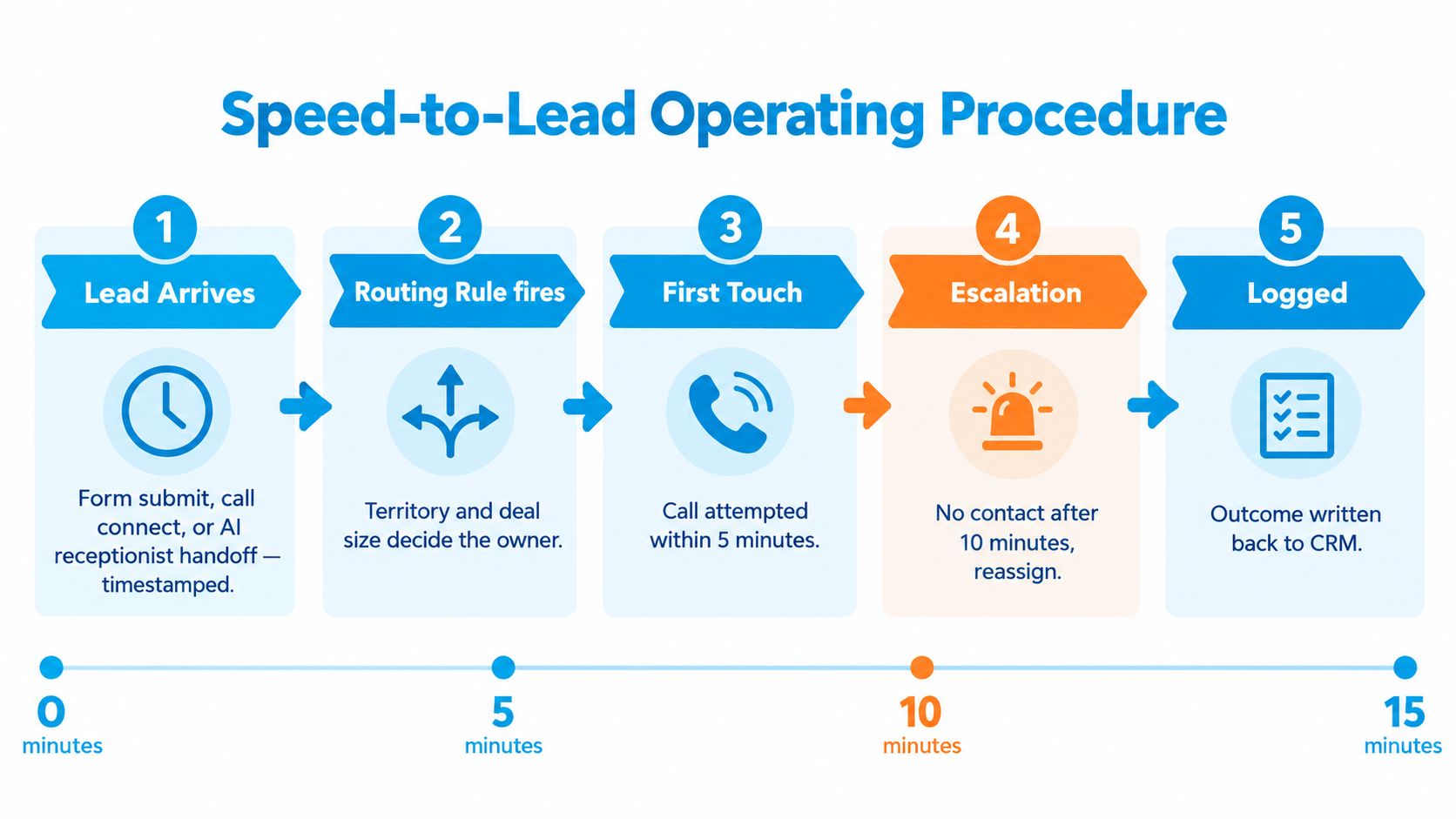
Measure meaningful outcomes
Set the first attempt within five minutes, a second attempt at two hours, and a third attempt as internal controls. If there's no connection, move the record into a three-day nurture sequence using email and SMS where consent allows. The CRM should record First Touch At, Attempt Count, Disposition, and Owner Reassigned At.
The disposition must describe an outcome, not an activity. Use Connected, Qualified, Nurture, Disqualified, or Unreachable. For appointment-driven businesses, also track routed, booked, escalated, and canceled. The question isn't merely whether an email was sent. It's whether the prospect was qualified, booked, or handed to a person who could resolve the request.
The operating logic behind the first few minutes after intent is especially relevant when inquiries arrive outside normal hours. Acknowledgement can preserve trust, but it shouldn't be counted as a completed sales conversation unless the buyer's need and next step are known.
Review time-to-first-touch, connect rate, and the gap between MQL creation and first activity every week. For implementation ideas covering the subsequent cadence, see these lead follow-up best practices.
Common Pipeline Pitfalls and How to Fix Them
Broken pipelines usually don't fail because the CRM lacks another field. They fail because the business allows records to advance without evidence or remain open without accountability.
| Symptom | Likely Root Cause | Practical Remedy |
|---|---|---|
| Win rate collapses after a high volume of inquiries | Every inbound record is treated as qualified | Require documented need, authority, serviceability, and timing before creating a real opportunity |
| Forecast repeatedly misses despite healthy coverage | Representatives skip stages or use optimistic close dates | Enforce exit criteria and compare entered close dates with historical cycle times |
| Deals remain stuck in one stage | Stale data, unclear next steps, or weak buyer commitment | Review stage age, require one future-dated action, and re-qualify stalled records |
| Activity is low across a team | Representative overload or broken routing | Inspect owner workload, unassigned records, response SLA breaches, and overflow coverage |
| The pipeline appears full but produces little revenue | Duplicate, unobservable, or poorly qualified records | Deduplicate, separate Nurture from open opportunities, and report observable coverage |
| Closed-lost deals distort stage reporting | Closed-lost is treated as an active stage | Move every final outcome into Closed Lost with a mandatory reason and recycle only when appropriate |
A plumbing lead shouldn't remain Qualified after a short phone call if the business still doesn't know the job type, service location, timing, or decision process. A medical consultation request shouldn't remain open because a receptionist sent an acknowledgement. The record needs a disposition and a next action.
Use the gap between Created At and Last Activity At to find records that appear active only because they exist. The verified stage guidance supports a weekly pass that removes duplicates and stale opportunities, enforces one future-dated action on every open deal, inspects records exceeding stage-aging thresholds, and separates Best Case, Commit, and Upside forecasts.
Practical rule: Calls and emails don't justify stage advancement unless the buyer has completed the stage's exit condition.
A weekly hygiene pass should reassign records with no owner, recycle genuine future demand, and disqualify opportunities that cannot close. Don't delete the evidence. Preserve the source, outcome, and loss reason so conversion reports improve rather than just look cleaner.
CRM Integrations, Automation, and AI Receptionist Workflows
A connected pipeline has one response loop, not separate systems for forms, calls, calendars, SMS, and CRM notes. The basic flow is straightforward:
- Lead source captures contact: A form, phone system, referral partner, or chat interaction records the inquiry and channel.
- CRM creates the record: The system writes source, timestamp, consent status, owner, and contact details.
- Routing starts the response: An automation rule sends the inquiry to the right queue and triggers the approved communication sequence.
- Conversation produces an outcome: A representative or AI receptionist answers, qualifies, schedules, escalates, or records an unreachable result.
- CRM receives the evidence: The transcript, call summary, appointment, disposition, and next action return to the opportunity record.
This is the foundation of rapid growth pipeline automation, but automation only helps when the underlying fields are mapped consistently.
Rules should create accountability
Configure the system to notify a manager when the five-minute SLA is breached. Trigger nurture when an open opportunity has no activity for seven days. Create a follow-up task when the stage changes. Recycle or disqualify a deal after 30 days of inactivity, unless a documented exception exists.
An AI receptionist can answer missed or after-hours calls, capture intent, qualify basic requirements, book directly into the calendar, and write the conversation back to the CRM. The handoff must be explicit. If the request involves clinical judgment, legal advice, complex technical scope, a complaint, or uncertainty, the system should route it to a named human owner and preserve the handoff payload.
Every automated action needs an audit trail. Store when the interaction began, what information the system collected, which rule fired, what the AI did, who received the handoff, and what outcome followed. Without those records, automation creates a second version of the pipeline that managers can't reconcile.
Integration failures are usually ordinary
Deduplicate contacts before enabling bidirectional sync. Map fields deliberately, because a status in the phone platform may not mean the same thing as a stage in the CRM. Make consent capture visible before triggering SMS, and define what happens when a calendar booking fails or the CRM is temporarily unavailable.
The CRM integration guide is useful for thinking through those data flows. In practice, start with one source, one CRM object, one owner field, and one outcome taxonomy. Expand only after the write-back is accurate.
Your 30-60-90 Day Pipeline Rollout Plan
A pipeline rollout works best when the team fixes definitions before adding automation. The first month establishes what a deal means, the second protects response speed, and the third connects automation to reliable reporting.
Days 1 to 30
Lock the six-stage dictionary, qualification criteria, required fields, loss reasons, ownership rules, and stage-aging expectations. Export current records, remove duplicates, assign owners, and separate open opportunities from Nurture and Closed Lost.
| Block | Task | Owner | Exit Criteria |
|---|---|---|---|
| Days 1 to 30 | Define stages and exit criteria | Sales operations lead | Every stage has an observable entry and exit condition |
| Days 1 to 30 | Configure required CRM fields | CRM administrator | New records cannot advance with missing critical data |
| Days 1 to 30 | Clean existing opportunities | Sales manager and representatives | Duplicates, stale records, and unowned deals are resolved |
| Days 31 to 60 | Build routing and response SLA | Operations and revenue owner | Every inbound source creates a timestamped, owned record |
| Days 31 to 60 | Launch attempt cadence | Sales manager | Attempts and dispositions are logged consistently |
| Days 31 to 60 | Start weekly review | Sales manager | Review produces named actions and owners |
| Days 61 to 90 | Add automation and handoffs | Operations and systems owner | Rules create tasks, alerts, nurture, and escalation records |
| Days 61 to 90 | Publish forecast coverage | Revenue owner | Weighted and observable coverage appear in the same report |
| Days 61 to 90 | Audit integration quality | CRM administrator | Duplicates, field conflicts, consent gaps, and failed writes have owners |
Days 31 to 60
Wire the intake sources to the CRM, then test routing during business hours, evenings, weekends, and peak service periods. Track median first response time, 90th-percentile response time, unassigned leads, connect rate, and the gap between lead creation and first meaningful outcome.
The weekly review should follow a fixed agenda:
- Stage movement: Which opportunities advanced, regressed, or entered?
- Slippage: Which close dates moved, and what buyer evidence supports the new date?
- Deal aging: Which records exceed the expected time for their stage?
- Next-step quality: Does every open opportunity have a dated, customer-relevant action?
- Data exceptions: Which records lack an owner, value, source, consent status, or loss reason?
Days 61 to 90
Add manager alerts, nurture sequences, calendar handoffs, conversation summaries, and forecast views only after the team trusts the underlying records. Use confidence bands when data completeness is uncertain. A complex score can't recover a missed call or an unlogged conversation.
The leading indicators of a functioning pipeline are median first response under five minutes during business hours, stage conversion variance below 15% week over week, forecast coverage between 2.5x and 3x, and a logged next step on at least 80% of open opportunities. Treat these as operating thresholds for inspection, not promises of revenue. When one moves outside range, investigate the affected source, owner, location, and stage instead of pressuring representatives to increase superficial activity.
Recepta.ai captures and qualifies inbound calls, schedules appointments, supports follow-up across communication channels, and synchronizes conversation details with CRM and calendar systems. If you want to replace missed inquiries and disconnected handoffs with a measured response workflow, visit Recepta.ai to explore the platform.