
Best AI Answering Service: 10 Top Picks for 2026
A prospective customer calls your HVAC company after closing time. A patient wants the next available appointment. A franchise customer reaches the wrong location and needs a fast transfer. In each case, the best AI answering service isn't automatically the cheapest tool or the one with the most human-sounding voice. The right choice depends on whether it can capture the opportunity, complete the next action, protect sensitive information, and bring in a person when the conversation becomes too complex.
This comparison evaluates ten services through practical operating scenarios: after-hours lead capture, appointment booking, complex-call escalation, multi-location routing, and compliance review. It also considers integrations, pricing transparency, deployment effort, vertical fit, security verification, and measurable outcomes. The broader category is expanding quickly. One market estimate projects AI customer service growth from $18.30 billion in 2026 to $66.14 billion by 2032, while another projects growth from $14.5 billion in 2026 to $78.5 billion by 2033, with both sources pointing to increased demand for continuous, scalable support (Ringly's 2026 market analysis).
Recepta.ai appears as one candidate among a broader field, not as an automatic winner. If you're also planning automation across a franchise network, its role makes more sense alongside a broader artificial intelligence franchise playbook 2026.
1. Recepta.ai
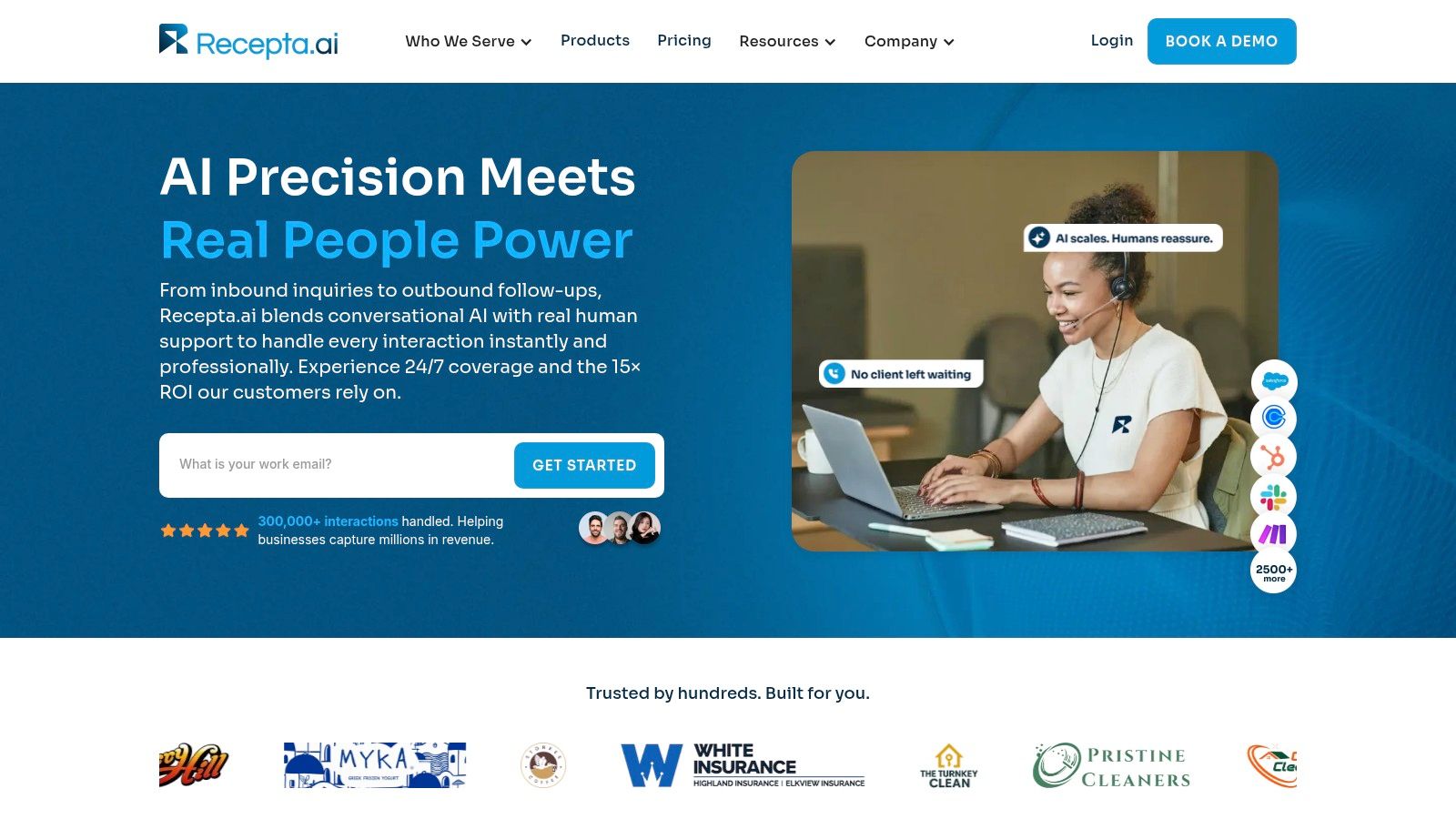
Recepta.ai is the strongest broad-use option for teams that need an AI receptionist with a human safety net. It handles inbound and outbound calls, lead qualification, appointment scheduling, follow-ups, call summaries, and workflow guidance. When a caller needs empathy or subject-matter expertise, the service can escalate to trained human agents rather than forcing the AI to improvise.
That hybrid design matters because complexity changes the correct operating model. A neutral contact-center study of 9,177 customer interactions found that human escalation rose from 5.3% in low-complexity cases to 87.0% in high-complexity cases (the study's reported findings). For a dental practice, that could mean letting AI handle appointment requests while transferring clinical questions. For a law firm, it could mean collecting matter type and urgency before routing the caller to the right team.
Where Recepta.ai fits best
The platform is designed for home services, healthcare, legal, finance, insurance, real estate, franchises, and other small-to-multi-location operations. It connects with 2,500+ business tools, including CRMs, calendars, and industry systems, so a booked appointment or qualified lead can update records without manual re-entry. Teams can create a receptionist in about 15 minutes, according to the product information, and test it through a 30-day risk-free trial.
The publisher reports 300,000+ interactions handled, plus outcomes of up to 30% more qualified leads, approximately 80% cost savings versus in-house reception, and a 15× ROI. Treat those as reported outcomes, not guaranteed results. Before buying, ask Recepta.ai to define the baseline, attribution method, call mix, and time period behind each figure.
Procurement rule: Ask for a live test using your own greeting, calendar, escalation rules, and compliance requirements. A polished demo doesn't prove that the workflow will work for your callers.
The main weakness is pricing transparency. Exact rates aren't publicly displayed, so teams will need a quote and a model covering usage, human transfers, integrations, onboarding, and overages. Healthcare and legal buyers should also verify the exact certifications, recording controls, data-retention settings, and configuration required for their obligations. Recepta.ai's combination of integrations, analytics, human escalation, and a trial makes it a strong candidate, but the buyer still needs to validate its reported outcomes against an internal baseline.
2. Smith.ai
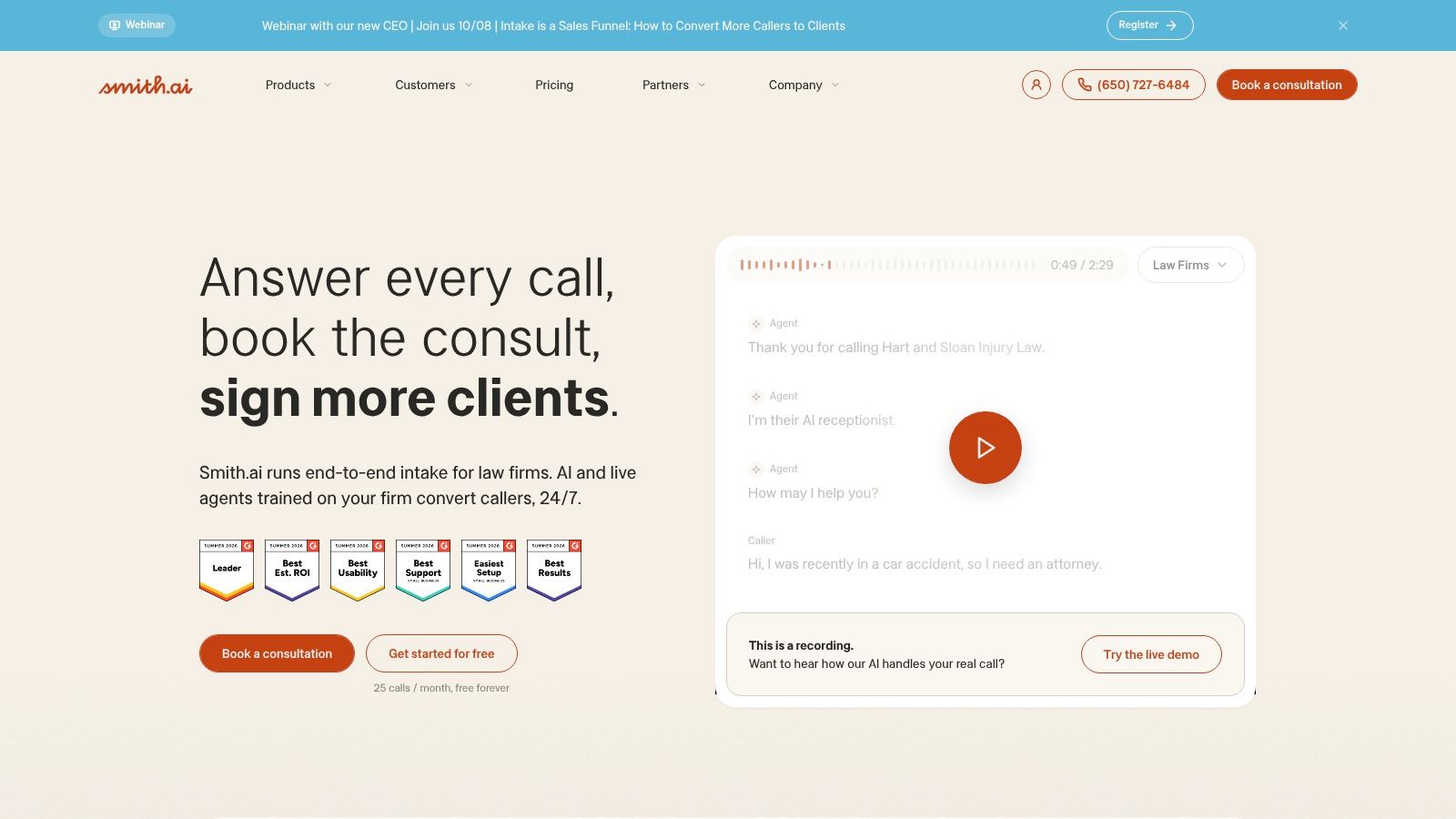
Smith.ai suits businesses that want AI to handle routine calls while trained live receptionists remain available for callers who request a person or trigger a complexity rule. Its AI Receptionist can answer inbound calls, qualify leads, book appointments, route calls, and perform warm transfers. Call recordings, transcripts, summaries, caller classification, and CRM or calendar connections support later review.
A legal practice is a natural fit. The AI can ask whether the caller is a new or existing client, collect a matter category, and check appointment availability. A human receptionist can then handle a sensitive intake or warm-transfer the caller to the correct staff member. Home-service companies can use the same pattern for quote requests, service-area checks, and urgent calls.
Cost control and setup
Smith.ai offers a per-call billing option and a spam-call allowance, which can make the service easier to test when volume is uncertain. Its documentation, trial option, outbound follow-up capability, and vertical experience are useful for a small firm that doesn't have a dedicated implementation team.
The trade-off is complexity in plan selection and add-ons. Advanced integrations, transfer rules, and call guidance may need tuning before they perform consistently. Buyers should model the difference between routine AI calls, live-agent calls, outbound follow-ups, and calls that require multiple transfers.
For a fuller comparison with other providers, see this analysis of virtual receptionist companies. The practical question isn't whether Smith.ai can answer. It's whether your monthly call pattern makes hybrid human coverage worth the additional operational cost.
3. Abby Connect
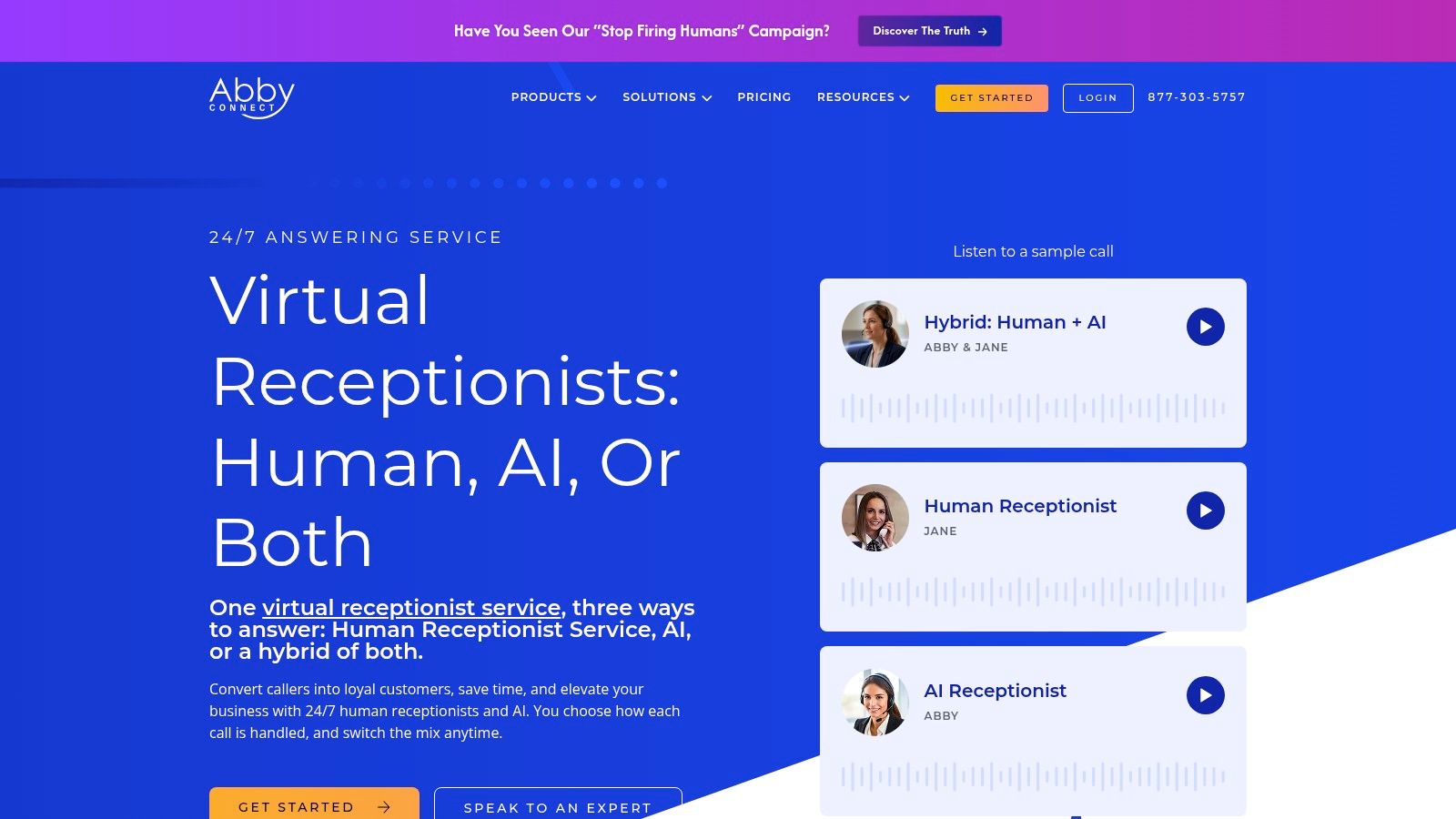
Abby Connect combines AI receptionists with human receptionists in one operating model. The AI can answer questions, route callers, and book appointments, while administrators set rules for warm transfers to Abby's U.S.-based receptionists or the client's own team. Its bilingual coverage is particularly relevant for practices and service companies that routinely serve callers in more than one language.
The service uses a minute-based model, with AI minutes counted as half-minutes. That can stretch coverage for short routine calls, such as checking business hours, confirming an address, or sending an appointment link. It can also complicate forecasting if calls regularly involve long qualification flows or multiple transfers.
A practical Abby workflow
Consider a plumbing company with one dispatcher. The AI can identify the service type and ZIP code, collect contact details, and route an emergency request to the dispatcher. A non-urgent quote request can be logged for follow-up, while a simple availability question can be resolved without human involvement.
Published pricing and a free trial make Abby easier to evaluate than a quote-only provider. Its portal includes transcripts and summaries, and its scheduling and CRM connections can help managers review what happened after a busy day. The main limitation for high-volume teams is the per-minute structure. Buyers should calculate the cost of average calls, not just the advertised unit price, and test whether AI conversations are classified as expected.
Healthcare teams should ask specifically about the available HIPAA-friendly configuration, data handling, recording controls, and the systems used for booking. This comparison of virtual receptionist services is useful context, but Abby's suitability still depends on the buyer's workflow and compliance review.
4. Posh
Posh is aimed at small and midsize businesses that want a voice agent trained around their own business. It can answer frequently asked questions, book or reschedule appointments, qualify leads, and route calls. The service supports AI-only coverage as well as a hybrid arrangement with live virtual receptionists.
Its strongest practical scenario is after-hours service intake. A home-improvement company can use Posh to ask what work the caller needs, identify the service area, collect photos or details through a follow-up process, and route urgent requests according to a predefined rule. An appointment-based business can let the AI handle rescheduling while sending unusual requests to a person.
What buyers should verify
The app or portal provides call details and voicemail transcriptions, which gives managers a way to inspect failed or incomplete interactions. Setup shaped by your industry is helpful because an HVAC call flow shouldn't ask the same questions as a medical office or a property-management company.
Posh's AI-first approach may reduce the need for live coverage, but pricing specifics generally require a sales conversation. Enterprise integration details are also less public than the basic receptionist features. Ask for a written list of supported systems, transfer charges, call-recording policies, implementation responsibilities, and the steps required to change the script after launch.
A good pilot would include one after-hours number, one booking calendar, and a small set of escalation rules. Review every call that ends in a transfer, abandoned interaction, or manual callback before expanding the workflow.
5. Moneypenny
Moneypenny brings an established receptionist operation together with AI-powered answering. The AI can provide continuous coverage, while calls needing judgment or a human touch can move to a Moneypenny receptionist. Bilingual options, industry routing, scheduling, client intake, and integrations support businesses that want a managed service rather than a self-configured voice bot.
For a real-estate office, the service could identify whether a caller wants to buy, sell, rent, or schedule a viewing, then route the request to the relevant team. A legal office could use intake questions to direct new inquiries while reserving sensitive conversations for human agents.
Mature operations versus pricing clarity
Moneypenny's operational maturity is a meaningful advantage for owners who don't want to manage every prompt and call-flow change themselves. Its hybrid handoff also limits the risk of an AI dead end when a caller has a complex request.
Detailed AI pricing isn't fully public without engaging sales, and advanced capabilities may vary by plan and volume. That makes a quote comparison essential. Request separate costs for standard answering, live transfers, bilingual coverage, appointment booking, integration work, recordings, and additional locations.
Businesses in regulated sectors should verify the exact compliance option rather than relying on a general statement that HIPAA-compliant services are available. Confirm what data the AI stores, how agents access it, how recordings are controlled, and whether the selected configuration meets the organization's requirements.
6. RingCentral AI Receptionist
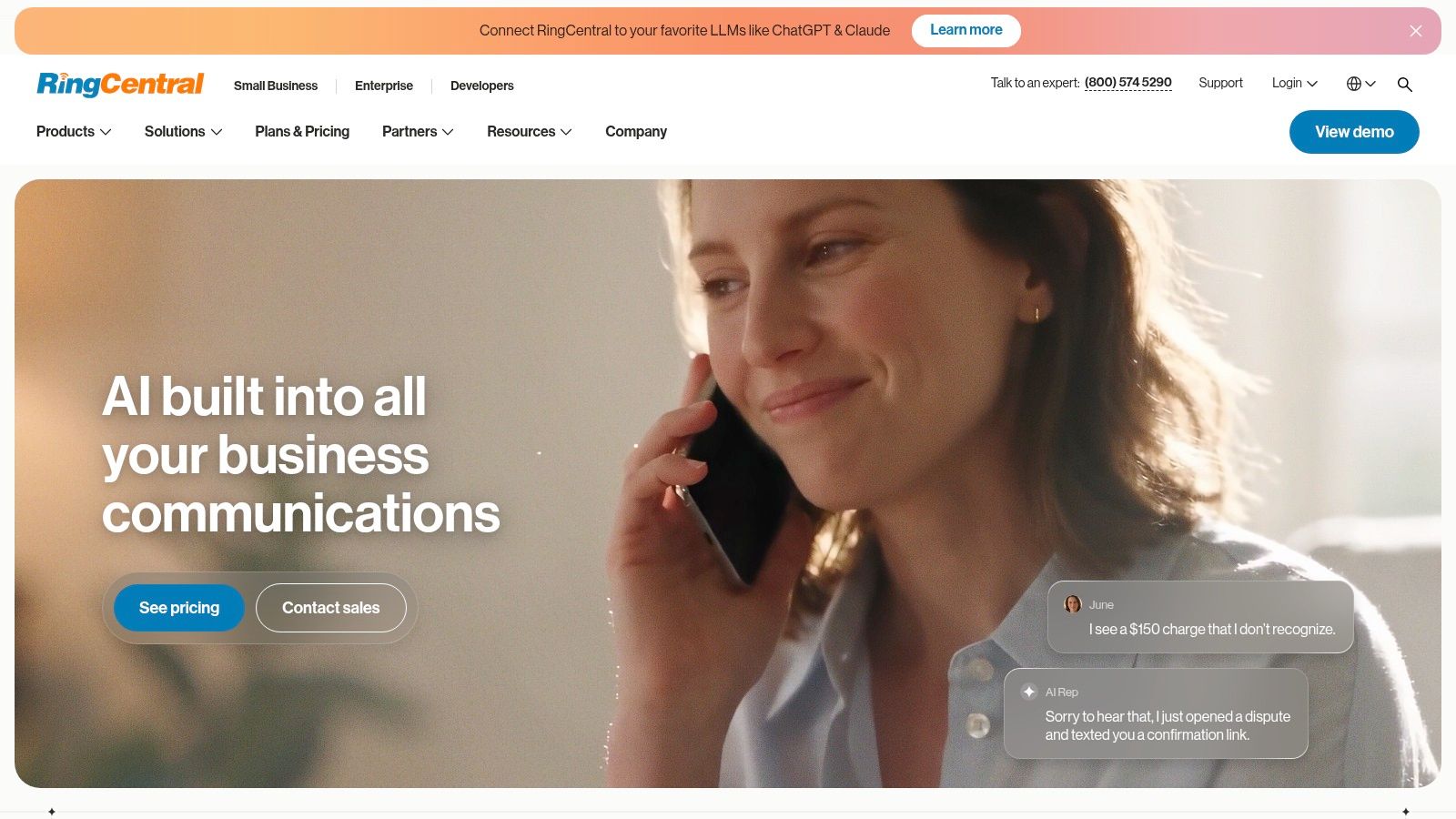
RingCentral AI Receptionist is most compelling for organizations already using RingCentral or looking for AI inside a broader unified communications platform. It answers and triages calls and texts, captures leads, books appointments, and works with call queues, calendars, and CRMs. Inbound SMS workflows add a useful recovery path when a caller can't stay on the phone.
A multi-location repair company could use one central number for new inquiries, route by location or service type, and send a booking link by text. An overflow queue could activate after the local team fails to answer, while after-hours calls follow a different script.
Platform fit and deployment effort
Native placement inside a phone system is valuable because call routing, numbers, queues, and administrative controls can remain in one environment. It can also make deployment heavier for a very small business that only needs a standalone receptionist. Pricing is generally presented through bundles or add-ons and may require an existing RingCentral subscription.
Before committing, map the current phone architecture. Identify which locations use direct numbers, which calls enter shared queues, how transfers work, and where SMS consent is recorded. Then confirm whether AIR can perform the exact booking and routing actions without forcing a change to the team's operating habits.
For buyers comparing phone-system costs with receptionist costs, this guide to AI receptionist pricing offers useful framing. The best choice depends on whether the organization values native telephony integration enough to accept the additional platform overhead.
7. Aircall
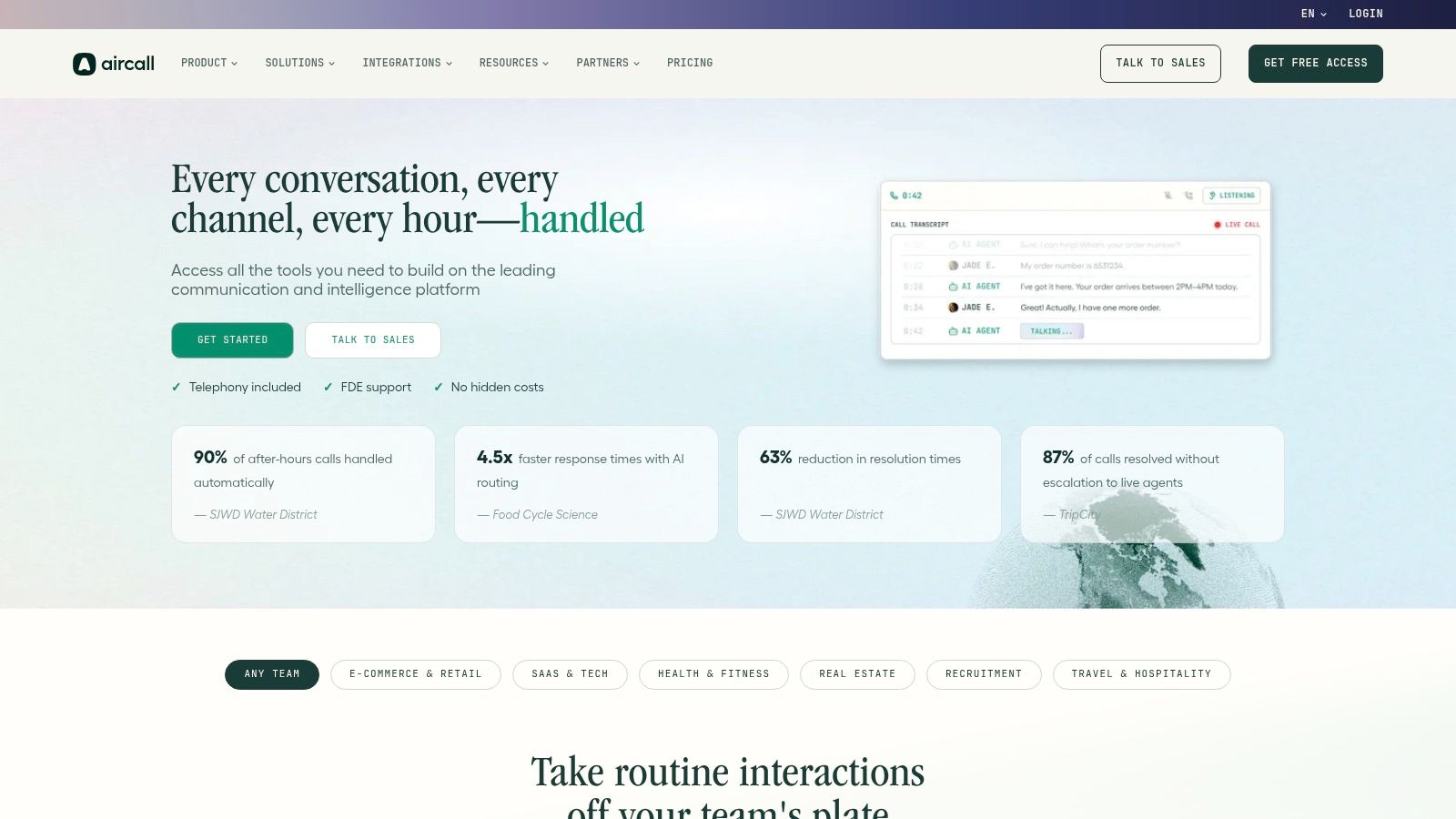
Aircall's AI Voice Agent is designed for teams already using Aircall as their cloud telephony provider. It can answer inbound calls, book appointments, look up order information, send SMS links during conversations, and synchronize data with CRM systems. Aircall manages voice and model updates, which reduces the need for a small team to maintain the underlying AI layer.
The strongest scenario is inbound overflow. An ecommerce company can use the agent to check an order, send a tracking link by SMS, and transfer exceptions to support staff. A service company can use it to offer appointment times while the main team is busy.
Fast provisioning with a dependency
Aircall's number provisioning and multi-country phone support are useful for teams operating across locations or markets. Its actions are more valuable than simple message-taking because the agent can complete a task during the call rather than merely create a callback request.
The drawback is platform dependency. The AI Voice Agent is most practical when Aircall is already the telephony provider, and pricing typically requires a sales conversation. A company comparing it with a standalone tool should include phone-system migration, number porting, staff training, and integration work in the implementation estimate.
Run a test that includes a successful booking, an unavailable appointment, an order lookup failure, an SMS link, and a human transfer. Those cases reveal more than a demonstration of the default greeting.
8. PolyAI
PolyAI is an enterprise-grade voice-assistant platform for organizations that need production call handling, custom conversational flows, and formal support. It emphasizes multi-turn dialogue, task completion, enterprise service levels, emergency support, and guidance for build-versus-buy decisions.
That profile makes it relevant to banks, hospitality groups, franchises, and other operators with complex routing requirements. A franchise network might need the caller's location, service category, membership status, and preferred action before sending the call to a local team. A simple receptionist tool may answer the phone, but an enterprise deployment must also manage exceptions, reporting, uptime expectations, and changes across locations.
Suitable for scale, not casual experimentation
PolyAI's natural voice quality and scalability can justify an enterprise evaluation when call volume, brand consistency, and operational risk are significant. Its implementation work is also part of the value proposition. The team needs to define intents, backend actions, escalation rules, authentication requirements, and ownership for ongoing optimization.
The enterprise sales cycle and budget are drawbacks for a small business that mainly wants to stop calls going to voicemail. Buyers should ask for a phased rollout, an integration inventory, service-level commitments, security documentation, and a plan for monitoring failed task completion.
Use PolyAI when the organization needs a managed voice operation, not merely a low-cost after-hours answering layer. Its value is likely to appear in complex routing and repeatable task completion, provided the business is prepared to invest in implementation.
9. Slang.ai
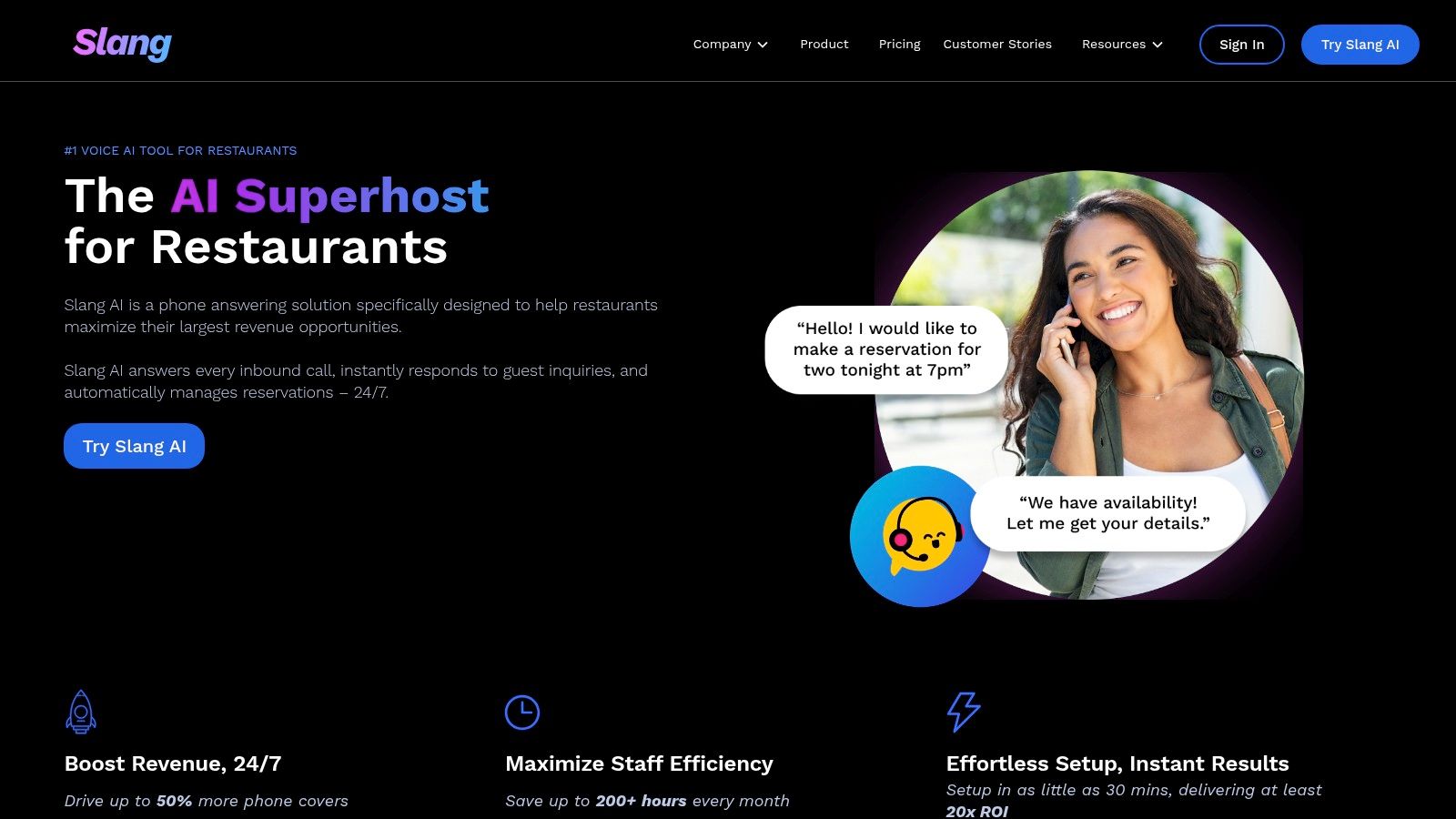
Slang.ai focuses on restaurants and retail, where callers frequently ask about hours, directions, menus, reservations, ordering, and location details. Its voice agent can answer and triage calls, deflect routine questions with SMS links, and use location-aware routing. Dedicated numbers for each location can simplify deployment across a restaurant group.
That specialization is useful when the call patterns are predictable and the business needs immediate relief for front-of-house staff. A restaurant can send a menu link by text, handle reservation requests, and route a caller to the correct location instead of interrupting staff during service.
Multi-location deployment
A new-number approach can make rollout faster because each location gets a clearly defined entry point. It also creates an operating responsibility. Managers need to keep hours, holiday closures, menus, reservation rules, and location data current across every number.
Slang.ai is less suitable for a law firm, medical practice, or contractor with long qualification workflows. Pricing varies by location and volume, and details often require a custom discussion. Ask whether the quote includes every location, SMS usage, onboarding, updates to business information, and escalation to staff.
For restaurant operators comparing specialized tools with broader platforms, this overview of restaurant and hospitality answering workflows provides another useful reference point. The decision should turn on integration depth, location management, and the cost of a missed reservation or ordering call.
10. SoundHound Smart Answering for Restaurants
SoundHound Smart Answering is built for restaurants and multi-location operators. It answers phones, routes orders, handles frequently asked questions, and reduces the number of calls staff must manage during service. Its restaurant technology integrations, including POS and ordering systems, are central to its appeal.
A chain can use the platform to standardize phone handling across locations while allowing each restaurant to maintain its own hours, menu details, ordering rules, and escalation path. That is a different requirement from a single independent restaurant using AI mainly to answer questions.
Where the enterprise restaurant model helps
SoundHound's mature speech technology and restaurant focus are relevant when callers expect the system to understand common ordering language and move requests into an existing restaurant workflow. Resources for multi-location rollout can help a brand plan training, data maintenance, and local ownership.
The main limitation is vertical focus. A healthcare practice or insurance agency won't get the same value from restaurant-specific ordering capabilities. Pricing isn't published publicly, so operators should request a location-level model that separates implementation, ongoing service, integrations, call usage, and changes to menus or ordering systems.
Test the difficult cases, not only a standard order. Include unavailable items, location confusion, allergy questions, order corrections, payment handoff, and a request for a human. Those scenarios reveal whether the system protects both customer experience and staff time.
Top 10 AI Answering Services Comparison
| Solution | Core Capabilities | Quality (★) | Pricing / Value (💰) | Target Audience & USP (👥 ✨) |
|---|---|---|---|---|
| 🏆 Recepta.ai | 24/7 AI + human escalation, inbound/outbound calls, scheduling, lead capture, 2,500+ integrations | ★★★★★ | 💰 Custom/quote · 30‑day risk‑free trial | 👥 Home services, healthcare, legal, finance, franchises · ✨ AI+white‑glove hybrid, fast setup, real‑time analytics |
| Smith.ai | 24/7 AI receptionist, live-agent handoff, call transcripts, calendar/CRM sync | ★★★★☆ | 💰 Per‑call options; some add‑ons · contact sales | 👥 Legal, home services, professional services · ✨ Strong vertical experience, per‑call billing flexibility |
| Abby Connect | Bilingual AI + U.S. human receptionists, routing, scheduling, transcripts | ★★★★☆ | 💰 Published pricing · per‑minute billing (AI minutes counted as half) | 👥 SMBs wanting hybrid coverage · ✨ Transparent pricing, HIPAA‑friendly options |
| Posh | LLM voice agent trained to business, 24/7 AI, escalation to live agents, portal | ★★★★☆ | 💰 Quote-based; contact sales | 👥 SMBs, home improvement & service businesses · ✨ Quick customization and fast setup |
| Moneypenny (US) | AI answering with live handoff, bilingual, scheduling, industry routing | ★★★★☆ | 💰 Tiered plans; sales engagement for details | 👥 Legal, real estate, trades · ✨ Established brand, mature operations |
| RingCentral AIR | Native AI voice agent in UCaaS, call+SMS triage, CRM/calendar integration | ★★★★☆ | 💰 Bundled/add‑on pricing · RingCentral subscription | 👥 Organizations on RingCentral, enterprises to SMBs · ✨ Native UCaaS integration, inbound SMS workflows |
| Aircall | AI voice agents for tasks (booking, lookups), SMS links, easy number provisioning | ★★★★☆ | 💰 Best value when on Aircall platform · contact sales | 👥 Teams using Aircall telephony · ✨ Fast provisioning, managed model/voice updates |
| PolyAI | Enterprise voice assistants, multi‑turn task completion, SLAs, emergency support | ★★★★★ | 💰 Enterprise pricing · sales cycle | 👥 Franchises, multi‑location enterprises · ✨ High‑fidelity conversations, enterprise SLAs |
| Slang.ai | Restaurant/retail voice agents, location-aware routing, SMS ordering links | ★★★★☆ | 💰 Custom per‑location/volume | 👥 Restaurants & retail chains · ✨ Vertical focus, per‑location deployment |
| SoundHound (Restaurants) | Order handling, FAQ & deflection, POS/ordering integrations, rollout tools | ★★★★☆ | 💰 Custom enterprise pricing | 👥 Restaurant chains & multi‑location operators · ✨ Industrial speech tech, POS integration |
Turn the Shortlist Into a Safer Buying Decision
The best AI answering service is the one that fits the calls your team can't afford to mishandle. Start by listing the actual scenarios that occur during peak hours, after closing, on weekends, and during staff absences. Separate routine requests from calls involving urgency, money, sensitive information, complaints, or emotional situations.
A practical test script should include:
- After-hours lead capture: Ask the service to collect name, contact details, location, service need, urgency, and preferred callback time.
- Appointment booking: Test available, unavailable, rescheduled, cancelled, and double-booking scenarios.
- Complex-call escalation: Ask a question that requires judgment, specialist knowledge, or a supervisor.
- Routing and transfers: Test location, department, language, and staff availability rules.
- SMS workflows: Confirm that links, confirmations, forms, and consent handling work as expected.
- Failure recovery: Disconnect, provide unclear information, interrupt the agent, and ask what happens next.
Don't judge voice quality in isolation. A caller may accept an AI voice if the system responds quickly, understands the request, completes the task, and offers a clear human path. One benchmark-style report suggests that fewer than 10% of callers could correctly identify a modern AI receptionist on the first call by 2026, while conversational latency below about 400 milliseconds is associated with a more natural interaction (the 2026 receptionist benchmark). Treat those as procurement signals, not universal guarantees. Ask vendors to demonstrate latency and caller disclosure in your own environment.
The operational case for coverage is clear. One industry summary reports that small businesses answer only 37.8% of inbound calls, while 37.8% go to voicemail and 24.3% receive no response (the reported small-business call-answering figures). Another source cites estimates of approximately $126,000 in annual missed-call losses for small businesses and says 85% of callers who reach voicemail never call back (the missed-call analysis from Fonea). Those figures won't describe every company, but they show why answer rate and callback recovery belong in the business case.
Verify the commercial and technical model
Request the full pricing model in writing. Include subscription fees, per-minute or per-call charges, human transfers, SMS, phone numbers, integrations, onboarding, support, recording storage, and overage rules. A low entry price can become expensive when every booking, transfer, or additional location carries a separate charge.
Then verify the systems that matter to daily work:
- CRM integration: Does the service create or update the correct record, with source and call outcome?
- Calendar integration: Can it respect appointment types, buffers, staff availability, and location rules?
- Phone integration: Can it preserve existing numbers, queues, forwarding rules, and emergency paths?
- Industry systems: Can it connect to the scheduling, case-management, POS, ordering, or practice system your team uses?
- Data controls: Can administrators control recordings, transcripts, retention, access, and deletion?
- Compliance evidence: Will the vendor provide the relevant documentation for your industry and selected configuration?
The full dataset in one contact-center study found that 30.8% of AI-enabled interactions were escalated to a human and 69.2% were resolved through automation (the study's full dataset). That split isn't a target for every business. It does show why a useful deployment needs deliberate boundaries. Let AI resolve routine scheduling and intake, but define precise handoff rules for billing disputes, urgent medical questions, legal sensitivity, angry callers, and requests it cannot verify.
Use a simple ROI model
Calculate the business case with your own baseline:
Net monthly value = recovered opportunities + labor avoided + administrative time saved, minus implementation costs and ongoing service fees.
For example, count the qualified calls that currently reach voicemail, multiply them by the proportion that becomes a booked appointment or sale, and use your real contribution margin. Add the value of staff time no longer spent transcribing messages, correcting CRM records, or returning routine calls. Subtract onboarding, integration work, subscriptions, usage charges, transfer fees, and the internal time needed to maintain the system.
Track the same measures during a controlled trial:
- Answer rate: How many inbound calls receive a live response?
- Qualified leads: How many callers meet the business's qualification criteria?
- Bookings: How many appointments or reservations are completed?
- Transfer success: How often does the right person receive the call?
- Abandoned calls: Where do callers stop engaging?
- Administrative time saved: How much manual logging and callback work disappears?
- Escalation quality: Do complex callers reach trained staff with enough context?
Recepta.ai deserves a close evaluation for teams seeking broad integrations, hybrid human escalation, analytics, automatic logging, and a 30-day risk-free trial. Its reported outcomes, including up to 30% more qualified leads, approximately 80% cost savings versus in-house reception, and a 15× ROI, should be validated against your own call volume, labor cost, conversion rate, and implementation assumptions. Healthcare, legal, finance, and insurance teams should also verify the exact compliance requirements before moving sensitive calls into production.
Run the pilot on one line, one location, or one after-hours workflow first. Review transcripts and recordings where permitted, correct routing rules, test failure paths, and compare results with the baseline before switching every number.
Recepta.ai combines 24/7 AI call answering with appointment scheduling, lead capture, follow-ups, real-time analytics, integrations with 2,500+ tools, and human escalation for complex conversations. Visit Recepta.ai to test whether its hybrid workflow and 30-day risk-free trial fit your missed-call, booking, and routing priorities.