
What Is Omnichannel Customer Service A Guide to Seamless Support
Picture this: you start a conversation with a company via a quick text message, hop on a phone call to clarify a detail, and then get a follow-up email to finalize things. The best part? You never have to repeat yourself. The person on the other end knows exactly what you talked about at every step.
That, in a nutshell, is omnichannel customer service. It’s an approach that weaves every customer conversation into one continuous experience, no matter how they choose to connect with you.
Defining the Omnichannel Experience

At its core, an omnichannel strategy brings all your communication channels—phone, email, SMS, web chat, and more—under one roof. The real magic is that the context of a customer's issue follows them as they move from one touchpoint to the next, creating a completely seamless journey.
This is a huge leap from the more common (and frustrating) multichannel approach. A multichannel business might have a phone number, an email address, and a chat widget, but none of them talk to each other. They’re like separate rooms with no connecting doors; a conversation started in one can't just pick up in another.
A Practical Example of Omnichannel in Action
Let's look at an HVAC company to see how this works in the real world. A homeowner, Sarah, notices her air conditioner is making a strange noise and uses the company's website chat to ask about it. The AI-powered chat gathers some initial details, but then Sarah has to run out.
A little later, she gets an SMS asking if a technician can visit tomorrow. She simply texts back to confirm the time. The next day, the technician calls her before heading over, and he already knows all about the "strange noise" from her original chat conversation. After the visit, the invoice lands in her email inbox.
Sarah’s experience was effortless because the conversation flowed naturally across four different channels:
- Website Chat: Kicked off the inquiry and gathered key information.
- SMS: Handled the appointment scheduling and confirmation.
- Phone Call: The technician had full context for a productive conversation.
- Email: Wrapped everything up with billing and a service summary.
This interconnected journey is the very heart of omnichannel service. It shows you respect the customer's time and makes your business look organized and attentive. The impact is real, too: companies with strong omnichannel engagement see a 9.5% increase in annual revenue on average.
To really grasp the concept, this table breaks down the core principles of an omnichannel approach.
Omnichannel Service at a Glance
Ultimately, this all boils down to creating a better, more human-centric experience for every single customer.
Why This Matters for Your Business
Switching to an omnichannel strategy isn't just about offering more ways for people to contact you. It's about intelligently connecting those channels to place the customer at the absolute center of the universe. This simple shift solves one of the most common frustrations people have: repeating their story over and over again to different people.
When you unify your customer conversations, you build a more responsive, professional, and trustworthy brand. Every customer feels like they’re in a single, ongoing dialogue with your business—not stuck in a series of disconnected, frustrating encounters.
The Critical Difference Between Omnichannel and Multichannel
It’s easy to think you’re offering a top-tier customer experience just because you have a phone number, an email address, and a Facebook page. But simply having multiple ways for customers to reach you is only step one. It doesn't guarantee a smooth, connected journey.
This is where we need to get clear on the difference between multichannel and omnichannel. It's a distinction that can make or break your customer relationships.
Think of it this way. A multichannel setup is like a track meet where several athletes run their own individual sprints. They’re all on the same team, sure, but they’re not working together. Each race is a standalone event.
An omnichannel approach, on the other hand, is a relay race. The entire strategy hinges on how seamlessly each runner passes the baton to the next. It’s one continuous, connected effort working toward a single goal. That collaborative handover is what makes an omnichannel strategy work.
Multichannel Is All About the Company
A multichannel strategy is built from the company's perspective. The goal is to be present wherever your customers are, casting a wide net to make sure people can find you. You offer plenty of doors for them to walk through.
Here’s the problem: those doors often lead to completely separate rooms. A conversation started on your website’s live chat doesn't automatically carry over to a phone call. The agent answering an email has no clue what the customer was just discussing on social media. This puts all the work on the customer, forcing them to repeat their story over and over again.
It's a bigger problem than you might think. A staggering 56% of customers say they have to explain their issue multiple times because support channels aren't connected. That's not just a minor hassle—it's a major source of frustration that chips away at customer loyalty.
From the customer's point of view, this disjointed experience makes even the most well-meaning business look disorganized.
Omnichannel Puts the Customer First
In sharp contrast, an omnichannel strategy is fundamentally built around the customer. It starts with the understanding that a customer's journey isn't a straight line and rarely happens on just one channel. Instead of just offering channels, it weaves them together into one seamless conversation.
This means the context of the interaction—who the customer is, their past interactions, and their current problem—travels with them from channel to channel. This continuity is what creates that frictionless, “wow” experience. If you're looking to bridge these gaps, you might want to explore how to enhance multi-channel support for an AI receptionist.
Let’s see how this plays out for a law firm:
- Initial Contact: A potential new client lands on the firm's website and fills out a contact form late at night.
- Instant Follow-Up: A moment later, they get an automated SMS on their phone. It confirms the form was received and asks when would be a good time for a call.
- Seamless Handoff: The next morning, a paralegal calls the person. Thanks to an integrated system, the paralegal already sees the info from the web form and the entire SMS chat. The client doesn't have to repeat a single thing.
The whole interaction feels effortless, professional, and efficient. The baton was passed perfectly from the website to the text message to the live person, creating one unified conversation. That’s the power of true omnichannel service—it makes your business feel like a single, intelligent partner that respects your customer's time.
The Financial Impact of Adopting Omnichannel Strategies
It’s one thing to understand the theory behind an omnichannel strategy, but as a business owner, you’re probably asking the real question: what’s the bottom-line impact? Let’s be clear—adopting a truly unified customer service approach isn’t just a nice-to-have. It’s a powerful revenue engine that delivers tangible financial results.
When you smooth out the customer journey and get rid of the classic frustration of having to repeat information, you’re building trust. That trust translates directly into higher conversion rates, bigger sales, and client relationships that your competitors can't easily poach.
Turning Customer Retention Into a Profit Center
One of the biggest financial wins from an omnichannel strategy is its direct impact on customer retention. We all know that getting a new customer is expensive—it can cost five times more than keeping an existing one. A clunky, disconnected service experience is one of the fastest ways to send a hard-won customer straight to your competition.
In contrast, an omnichannel system makes every conversation feel connected and effortless. That consistency keeps customers happy and coming back, which drastically cuts down on your long-term acquisition costs. Instead of constantly pouring money into a leaky bucket, you build a stable, growing base of repeat clients who generate predictable revenue.
This visual really drives home the difference between a siloed multichannel setup and a truly connected omnichannel experience.
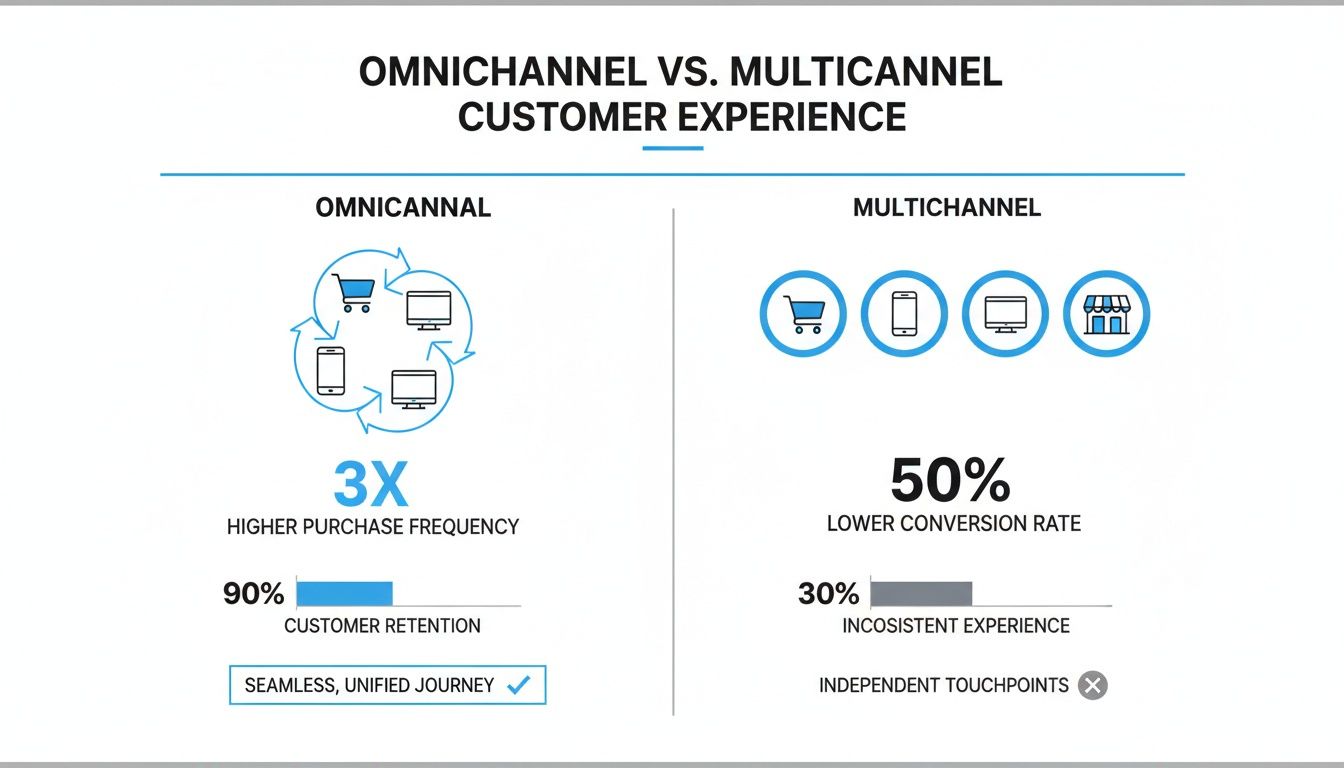
The takeaway here is simple. Multichannel gives customers options, but only omnichannel weaves those options together into a single, seamless journey.
Quantifying the Growth from a Unified Strategy
The financial upside here isn't just theoretical; it's backed by some pretty compelling data. Companies that get omnichannel right see a 9.5% year-over-year increase in revenue, blowing past the 3.4% growth seen by businesses with disconnected systems.
The numbers get even better from there. The customer purchase rate on omnichannel platforms is a staggering 250% higher than on single-channel ones, and the average order value is 13% higher per purchase. Perhaps most importantly, businesses with a solid omnichannel strategy achieve a 91% greater year-over-year customer retention rate compared to those without. These are the kinds of numbers that explain why, even though 43% of leaders find it challenging, they are making a unified experience a top priority. You can find more omnichannel statistics that highlight the business case.
For service-based businesses like HVAC companies, law firms, or dental practices, this financial impact is immediate. A seamless experience means more appointments booked, fewer no-shows, and a much more predictable stream of income.
Driving Real-World Business Outcomes
An omnichannel approach does more than just keep customers happy—it drives specific, measurable results that directly boost your financial health. By knitting all your communication channels together, you create a system that works smarter, not just harder.
Here are a few practical wins you can expect:
- Increased Lead Conversion: A potential client starts by asking a question on your web chat, gets a follow-up SMS with a booking link, and schedules a consultation. This smooth transition makes them far more likely to convert than if they had to call back during business hours.
- Higher Average Appointment Value: A dental patient has a seamless experience booking their cleaning. During the follow-up call, the happy patient is more receptive when the office manager suggests adding a whitening treatment. A great experience builds the trust needed for upselling.
- Reduced Operational Waste: When your CRM, phone system, and scheduling software are integrated, your team spends less time hunting for information across different apps. This efficiency boost means a paralegal can prepare for client calls faster, lowering the cost per interaction.
Ultimately, investing in an omnichannel strategy is an investment in sustainable growth. It transforms your customer service from a necessary cost center into a proactive, revenue-generating part of your business.
What Goes Into a Successful Omnichannel System?
Building a true omnichannel customer service system is a lot like assembling a high-performance engine. It’s not about just having a pile of expensive parts; it’s about making sure every single component works in perfect harmony to create a smooth, powerful experience for your customers. To get beyond a clunky, disconnected multichannel setup, you need a specific blueprint that blends the right tech with a smart human strategy.
The good news is, this kind of blueprint isn't just for massive corporations anymore. Modern tools have made it accessible for just about any service business looking to deliver a genuinely better customer journey. Let's break down the essential components you need to get it right.
A Unified Customer Database as Your Foundation
The absolute cornerstone of any real omnichannel system is a unified customer database. This is usually managed within a Customer Relationship Management (CRM) platform, and it acts as the central nervous system for all your customer operations. It has to be the single source of truth for every single interaction, no matter where it happens.
When a customer calls, sends a text, or starts a web chat, the system should instantly pull up their entire history—past appointments, previous questions, notes from other team members, you name it. Without this unified view, your team is flying blind, and that seamless experience you're aiming for is pretty much impossible.
An integrated CRM isn't just a nice-to-have; it's non-negotiable. It’s what turns separate, disjointed conversations into a single, continuous dialogue and gives your team the power to provide personalized, context-aware service every single time.
Integrated Communication Channels
Once your foundation is solid, the next step is to connect all your communication channels so they can actually "talk" to each other. This is about more than just offering a phone number, an email address, and an SMS line. You need a platform that weaves them all together into one cohesive workflow.
This integration is what makes that seamless "baton pass" we talked about earlier a reality. For instance, an AI receptionist can answer a call, capture the new lead's details, and then automatically trigger an SMS to that person with a link to book their first appointment. The whole exchange gets logged in the CRM, ready for any team member who needs to see it next.
This kind of tech is critical for staying competitive. According to the latest omnichannel customer service trends, 73% of agents feel this setup helps them do their job better. And it's not just a feeling—companies with integrated platforms see up to 30% faster issue resolution than those with siloed systems. That speed comes directly from having every interaction in one place.
The Right Blend of AI and Human Support
The most effective omnichannel strategies today don't force a choice between automation and people—they blend them. This hybrid model uses AI for what it does best (handling things with speed, being available 24/7, and processing data) while keeping your human experts focused on what they do best (showing empathy, solving complex problems, and building real relationships).
Here’s how this powerful partnership works in the real world:
- AI handles the frontline: An AI receptionist can work 24/7 to answer calls, qualify new leads by asking questions like "Are you a new or existing client?", and schedule appointments directly into your calendar. This means you never miss an opportunity, even at 2 a.m.
- Humans manage the complexity: When a customer has a sensitive legal issue or a complex plumbing emergency, the AI can seamlessly escalate the conversation to a human agent who already has the full context of the initial interaction.
This blended approach is exactly what customers want. While AI is great for efficiency, a staggering 75% of people still prefer to talk to a person when dealing with complex issues. By combining both, you deliver the best of both worlds: instant, always-on support for routine tasks and expert human help when it truly matters.
A Deeper Look at the Technology Stack
Getting all these pieces to work together requires a specific set of tools. It's not just about buying a CRM; it's about building an interconnected system where data flows freely between platforms.
Below is a table that breaks down the key technologies you'll need and the role each one plays in creating a unified customer experience.
Comparing Omnichannel Technology Stacks
Ultimately, the goal is to create a technology ecosystem where every part is communicating, ensuring that both your team and your customers have a smooth, consistent experience from start to finish.
Robust Analytics and Reporting
Finally, a truly successful omnichannel system has to be able to measure its own performance. Without data, you're just guessing. You can't spot what's working, find the real bottlenecks, or make smart decisions to improve your customer experience over time. Your system needs a powerful analytics dashboard that gives you clear insights into the metrics that matter.
This means you should be tracking things like:
- Channel Volume: Are most new leads coming from web chat or phone calls? This helps you allocate resources effectively.
- First-Contact Resolution: What percentage of HVAC repair requests are fully scheduled in the first interaction without needing a callback?
- Customer Satisfaction Scores: After an appointment, an automated SMS can ask clients to rate their experience from 1-5, giving you instant feedback.
By keeping a close eye on this data, you can constantly refine your strategy, optimize your workflows, and make sure your customer service evolves right alongside your business. If you're curious about what this looks like, you can learn more about using an enhanced analytics dashboard for your AI receptionist. This cycle of continuous improvement is what separates pretty good customer service from a truly great one.
Putting Omnichannel Customer Service into Action
Theory is great, but seeing omnichannel customer service work in the real world is what really makes the concept click. Forget generic retail examples for a moment. Let's walk through the customer journey for a few specific service businesses to see how a truly connected strategy can turn everyday interactions into smooth, professional experiences.
These scenarios show what happens when a platform is built to handle complex, often high-stakes conversations across every single touchpoint. It’s all about making your business feel organized, responsive, and incredibly easy to work with—from the very first search to the final payment.

A Day in the Life of an HVAC Company
Picture this: It's a sweltering summer evening, and a homeowner named David is scrolling through social media when his AC unit grinds to a halt. He sees a targeted ad for a local HVAC company and taps it, landing on their website. The omnichannel journey starts right here.
Web Chat Initiation: On the website, David clicks the chat widget and starts a conversation with an AI assistant. He quickly explains the problem, and the bot gathers the essentials—his address, the AC unit's model, and the urgency.
Seamless SMS Transition: David gets pulled away from his computer. The system knows this and automatically texts his phone: "Thanks for reaching out! We have technicians available. Want to book an emergency repair for tomorrow morning?" He simply replies "YES" via text.
Automated Scheduling: Just like that, the appointment is confirmed and added directly to a technician's schedule. David gets another text with the confirmation details and a two-hour service window.
Proactive Technician Call: The next morning, the technician, Mark, calls David. "Hi David, this is Mark. I see your AC unit went out last night and I'm about 30 minutes away." Because he has the full conversation history from the web chat, Mark is already completely in the loop.
Email for Billing: After the repair is finished, an invoice is automatically generated and sent to David’s email. He can click a link and pay it online in seconds.
The entire interaction flowed across five different channels—social media, web chat, SMS, phone, and email—without a single hiccup. David never had to repeat himself, and the company looked incredibly efficient and on top of things. That's the power of a truly connected system.
A Modern Experience for a Law Firm
Now, let's switch gears to a different high-stakes scenario: a potential client looking for legal help. Sarah needs an attorney to review a business contract. Her journey shows how an omnichannel approach can build trust and confidence right from the start.
Website Form Submission: Sarah finds a local law firm's website and fills out their detailed contact form late on a Tuesday night, not expecting to hear back until morning.
Instant AI Follow-Up: Within moments, her phone rings. It's an AI receptionist: "Hello Sarah, this is the AI assistant for Smith & Associates. We received your inquiry about a business contract. I can schedule a free 15-minute consultation with one of our attorneys. Are you available Thursday afternoon?"
Voice-Based Scheduling: Sarah confirms a time over the phone, and the appointment is instantly booked on the attorney's calendar. At the same time, the system sends a calendar invite and an SMS confirmation to her.
Contextual Handoff: When the attorney calls Sarah for the consultation on Thursday, they aren't starting from scratch. They have the original web form submission and a full transcript of the AI call right in front of them, making the conversation productive from the very first second.
In both of these scenarios, the technology works quietly in the background to create an experience that feels totally effortless for the customer. It removes friction, cuts down on administrative busywork for the team, and makes sure no valuable lead ever slips through the cracks. This approach is also incredibly adaptable to diverse client needs; for example, firms can offer AI receptionist support in Spanish to serve a broader community without missing a beat.
How to Power Your Omnichannel Strategy
So, how do you actually bring an omnichannel strategy to life? It’s not just about adding more channels; it’s about having an intelligent engine running in the background that connects every conversation. The most effective way to do this is with a blended model—one that marries the efficiency of conversational AI with the nuanced touch of your human team.
Think of this hybrid system as the ultimate modern receptionist, one that never misses a beat. The AI is your frontline, working 24/7 to handle initial inquiries, capture new leads, and book appointments with perfect precision. This immediately stops you from losing business to missed calls or after-hours messages.
The real magic happens with the handoff. When a conversation gets too complex or requires a level of empathy only a person can provide, it’s seamlessly escalated to a human agent who already has the full context from the AI’s initial chat.
Unifying Your Operations
For this blended approach to work, deep integration is non-negotiable. The right platform has to plug directly into the tools you rely on every day, like your CRM and scheduling software. When the AI schedules a meeting, it should instantly appear on your team's calendar. When it qualifies a new lead, that contact information needs to land directly in your CRM.
This completely gets rid of tedious manual data entry and, more importantly, gives everyone on your team a single, unified view of every customer interaction. To see a real-world example of this, you can learn more by reading about AI receptionist integration with CRM systems.
This practical application of what is omnichannel customer service is where the theory becomes reality. It’s how you deliver the kind of polished, professional experience that today’s customers expect, all while making your business run smoother and more efficiently. Your customer service stops being a reactive cost center and becomes an intelligent system built for growth.
Got Questions About Omnichannel Service?
Making the switch to an omnichannel approach can feel like a big step, so it's completely normal to have questions about how it all works in the real world. Business owners often want to know what this looks like day-to-day, from setup time to how it affects their team. Here are some straightforward answers to the questions we hear most often.
Getting these details ironed out will help you move forward with confidence, giving you a clear picture of what an omnichannel strategy really means for your business.
How Long Does It Take to Get an Omnichannel System Up and Running?
This is probably the number one question we get, and the answer is usually a pleasant surprise. While it always depends on the specifics of your business, modern platforms are built to get you started incredibly fast. Forget the old-school IT projects that dragged on for months.
A good solution will plug right into the tools you already use, like your CRM or scheduling software. This means the heavy lifting can often be done in just a few hours. The whole point is to get you capturing more leads and having better customer conversations right away, without missing a beat.
This quick setup means you start seeing a return on your investment almost immediately. It’s all about boosting your communication power with minimal disruption to your daily operations.
Isn't Omnichannel Service Just for Big Companies?
That's a myth we're happy to bust. The reality is that today's technology makes powerful omnichannel tools both affordable and practical for small and medium-sized businesses. In fact, you could argue that providing a seamless, personal customer experience is even more crucial when you're a smaller company trying to build a loyal customer base.
The right platform is designed to grow with you. It allows you to offer the kind of sophisticated, responsive service that used to be reserved for huge corporations, but without needing a massive budget or a dedicated IT team to keep it running.
Will AI Replace My Staff in an Omnichannel Setup?
Not a chance. The best omnichannel strategies—the ones that actually work—rely on a blended model. Think of AI as the ultimate assistant for your team, not a replacement. Its job is to handle the repetitive, high-volume tasks that tie up your best people.
Here’s what that teamwork looks like:
- AI is your 24/7 frontline, making sure you never miss a call, text, or web chat. It’s perfect for qualifying new leads, booking appointments, and answering common questions instantly, any time of day.
- Your team can then focus on high-value conversations that need a human touch—things like empathy, complex problem-solving, or navigating a sensitive customer issue. The AI simply hands off the conversation to a team member who already has all the context they need.
This partnership makes your team far more efficient and frees them up to give every customer the attention they deserve.
Ready to deliver an experience that keeps customers coming back? Recepta.ai combines smart AI with expert human support, ensuring you never miss a lead or an opportunity to provide amazing service. Start your 30-day risk-free trial and see what a true omnichannel approach can do for you.