
Answering Service Real Estate Guide for Maximum Lead Capture
At its core, an answering service for real estate is a specialized communication partner. It's designed to do one thing exceptionally well: make sure you never miss an opportunity because you couldn't get to the phone. Think of it as a professional front desk that's always on, ready to capture every call, qualify leads, and even schedule appointments on your behalf.
Why Every Missed Call Costs You a Commission
Let's paint a picture. You're in the middle of a tough negotiation for a client, totally in the zone. Just then, a highly motivated buyer spots your "For Sale" sign and dials your number. It goes straight to voicemail. An hour later, you finally get a moment to check your messages and call back, but it's too late—they've already booked a showing with another agent who answered on the first ring.
That wasn't just a missed call; it was a lost commission. In the breakneck pace of real estate, speed is the name of the game. Clients want answers now, and the first agent to respond is usually the one who gets the business. Every time your phone rings unanswered, a potential client is already moving on to the next agent in their search results.
In real estate, your phone is the cash register. If you don't answer when it rings, you are literally giving money away to your competitors who are available to pick up the phone.
This reality shifts an answering service real estate solution from a mere business expense into a serious revenue-generating tool. It solves the classic agent's dilemma: how can you be everywhere at once—at showings, closings, and client meetings—while still being available 24/7 for the next big lead?
The Financial Impact of a Single Voicemail
The data backs this up in a big way. Responding to a lead within the first five minutes can boost your contact and qualification rates by an incredible 400 percent compared to waiting any longer. When the industry's average lead conversion rate is only about 4.7%, you simply can't afford to let any advantage slip through your fingers. This is why you need a plan for calls that come in both during and after business hours.
A professional answering service guarantees an immediate, skilled response to every single inquiry. This is especially vital for capturing leads after 5 PM and on weekends, which is precisely when many serious buyers and sellers are doing their research. You can learn more about how after hours answering services can protect your business from these exact scenarios.
It's About More Than Just Lead Capture
While catching new leads is a huge part of the equation, the benefits don't stop there. A good service also acts as a filter, separating the hot buyer leads from a tenant's routine maintenance request or a call from a vendor. This frees you up to concentrate on the high-value, commission-generating activities that actually grow your business.
For example: Instead of pausing a client meeting to answer a call about a leaky faucet in a rental unit, the service logs the maintenance request and forwards it to your property manager. You stay focused on closing the deal in front of you, knowing the tenant issue is being handled professionally.
Ultimately, an answering service does more than just stop the bleeding from lost leads; it builds your reputation as a responsive, reliable professional. To take your growth to the next level, it's worth exploring other powerful real estate lead generation strategies as well. By putting a seamless communication system in place, you’re sending a clear message: your business is always open and ready to turn the next call into your next closing.
How a Specialized Real Estate Answering Service Works
What's the real difference between a generic call center and a service built specifically for real estate? It’s like comparing a general practitioner to a heart surgeon. Both are doctors, but when your chest starts to hurt, you want the specialist who lives and breathes that specific field.
It's the same in real estate. An answering service for real estate isn't just a receptionist service; it's a front-line extension of your brokerage, designed to speak the language of buyers, sellers, and renters.
This specialized focus goes way beyond just taking a message. It's an active system designed to capture, qualify, and convert leads the moment they come in, ensuring you never miss a beat—or a commission check. Every time a potential client calls, a meticulously planned process kicks into gear.
The diagram below shows the simple but painful journey of a missed call. It's a straight line from a ringing phone to lost revenue.
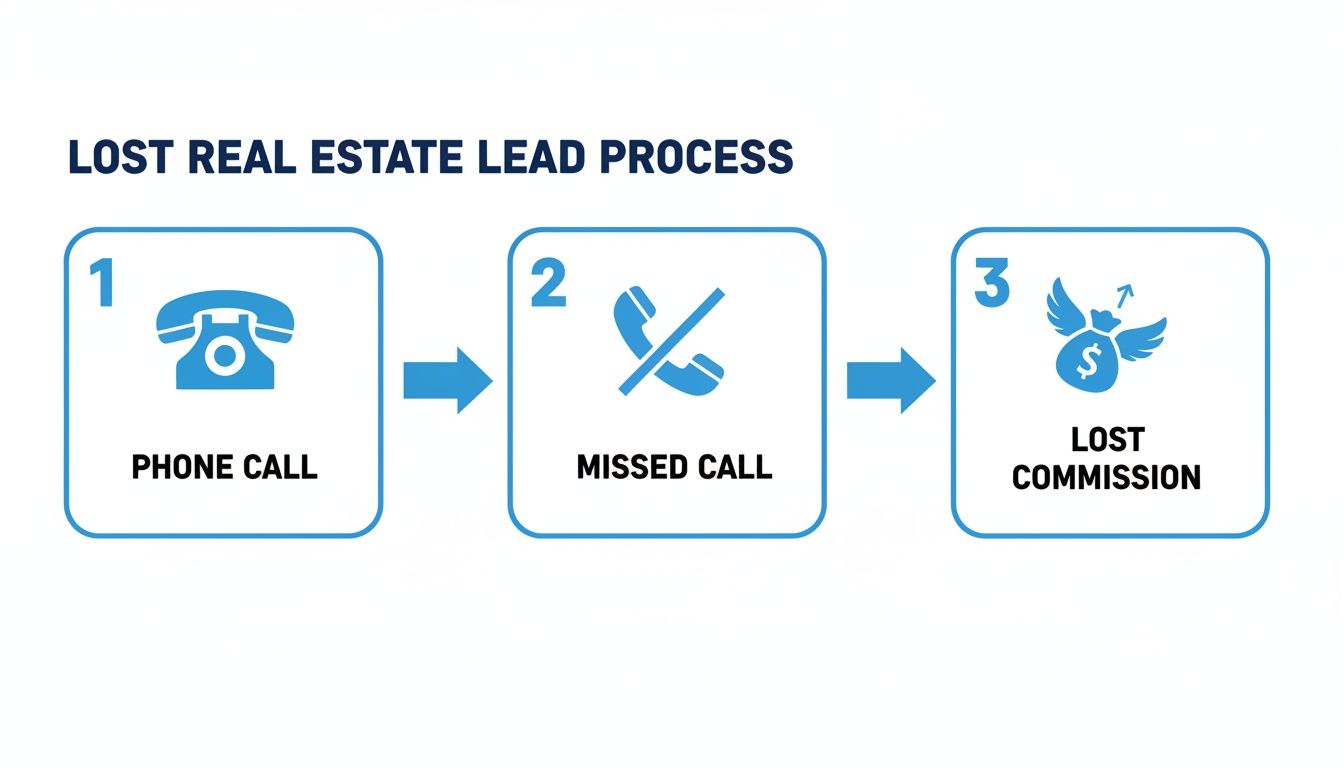
As you can see, a missed call isn't just an inconvenience. It’s a preventable leak in your sales pipeline that directly costs you money.
The Anatomy of a Call
Let's walk through a real-world scenario. A potential buyer is driving through their dream neighborhood and spots your "For Sale" sign. They pull over and call, excited to learn more. Instead of hitting your voicemail, they're instantly connected to a trained receptionist, whether it's a live agent or a sophisticated AI.
This is where the specialization really pays off. The receptionist doesn't just say, "Can I take a message?" They follow a custom script you’ve approved, asking smart qualifying questions to understand the caller's true intent.
- "Are you currently working with another real estate agent?"
- "Have you already been pre-approved for a mortgage? If so, for what amount?"
- "What's your ideal timeline for moving into a new home?"
- "Are there any must-have features you're looking for, like a home office or a fenced-in yard?"
This quick screening immediately tells you who's a serious buyer and who's just kicking tires.
From Conversation to Conversion
With a qualified lead on the line, the service takes the next critical step. The receptionist checks your synced calendar in real-time and books a property viewing right then and there. This completely gets rid of the frustrating phone tag and email chains that kill momentum.
A specialized answering service isn't a passive message taker; it's an active business development partner. It transforms an initial inquiry into a scheduled appointment, moving the sales process forward before you even pick up your phone.
But it doesn’t stop there. Every single detail from that conversation—contact info, qualifying answers, the appointment time—is automatically pushed directly into your CRM. Whether you're on Follow Up Boss, Zillow Premier Agent, or something else, the data is there instantly for you and your team. You can get a deeper look at how a realtor virtual receptionist handles these tasks to keep your pipeline full.
This seamless integration means you get a notification about a fully vetted, qualified lead that’s already on your calendar. All the background info you need is right there. The service handled the initial contact, the qualification, the scheduling, and the data entry. You’re now free to do what you do best: build relationships and close deals.
What to Look For in a High-Performing Answering Service
Picking the right partner is the difference between simply taking messages and actively closing more deals. All answering services aren't created equal, and for a real estate pro, the feature set is absolutely everything. These aren't just nice-to-haves; they are the non-negotiable tools that turn a phone call into a commission check.
A truly effective answering service for real estate is more than just a person on the other end of the line—it's a carefully engineered system. Let's break down the must-have components, complete with a look at how they play out in the real world.
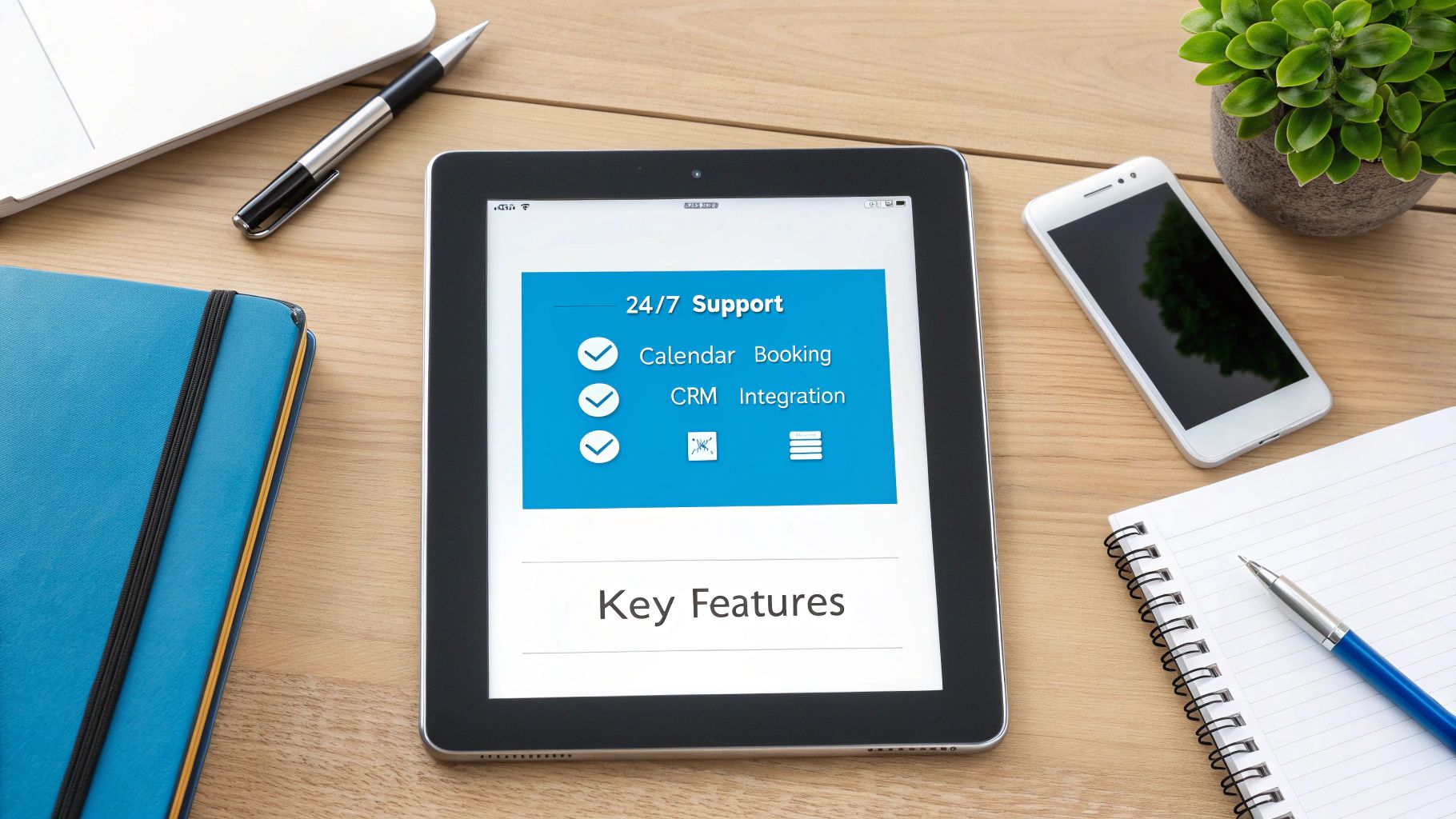
24/7 Live Answering
The real estate market doesn't punch a clock, and neither do your best leads. That high-value prospect might be an executive browsing Zillow at 11 PM after a long day or an early bird checking listings before their commute. If their call hits your voicemail, that opportunity is likely gone for good.
Here's a practical example: An out-of-state executive is relocating for a new job and has a tight window to find a home. She calls your sign at 10:30 PM on a Tuesday. Instead of a machine, a professional receptionist answers, confirms the property is available, captures her info, and even schedules a virtual tour for the next day. By morning, you have a qualified, high-intent buyer already on your calendar.
Intelligent Lead Qualification
Let's be honest, not every call is a hot lead. A great answering service acts as your professional filter, using smart, scripted questions to separate serious buyers from tire-kickers or wrong numbers. This alone ensures you only spend your precious time on conversations that can actually lead to a closing.
A well-designed script is the key. The service should work with you to craft questions that get right to the heart of a caller's motivation.
Actionable Example - A Qualifying Script:
- Receptionist: "Thanks for calling about the property on Elm Street. To best help you, may I ask if you're currently working under contract with another real estate agent?"
- Caller: "No, I'm just starting my search."
- Receptionist: "Great! To help the agent prepare for your call, have you already been pre-approved for a mortgage?"
- Caller: "Yes, for up to $450,000."
- Receptionist: "Perfect. The agent has an opening for a call tomorrow at 10 AM. Does that work for you?"
Real-Time Appointment Scheduling
The biggest bottleneck between a new lead and a showing is the endless back-and-forth of scheduling. A top-tier answering service kills this friction by plugging directly into your calendar.
The goal is to move a lead to the next step on the very first call. Direct calendar integration prevents the nightmare of double-booked showings and cuts out the delays that give a hot lead time to go cold.
Here's a practical example: A qualified buyer calls about your new listing. The receptionist sees an open slot in your Google Calendar for 4:00 PM the next day. They book the showing on the spot, and the system instantly sends calendar invites to both you and the buyer. You simply get a notification that a new, pre-vetted showing is on your schedule—zero effort required from you.
Seamless CRM Integration
Manual data entry is a soul-crushing chore that pulls you away from dollar-productive activities. Your answering service absolutely must connect directly with your CRM, whether it's Follow Up Boss or another platform. This automation is what keeps your pipeline organized and flowing.
Here's a practical example: After a call, a new contact is instantly created in your CRM. The call recording, transcript, and notes (e.g., "Pre-approved for $500k, looking for 4 bedrooms") are all logged under their profile. An automated workflow you've created then triggers, sending them a welcome email and adding them to your "New Buyer Leads" list.
Bilingual Support
In today's diverse markets, speaking only one language means you're leaving money on the table. Offering bilingual support (e.g., English and Spanish) isn't just about being inclusive; it's a powerful business strategy that opens up entirely new streams of revenue.
Here's a practical example: A Spanish-speaking family is looking for their first home but has struggled to communicate effectively with other agents. They call your number and are relieved to be greeted in their native language. That immediate connection builds trust and positions you as the go-to agent for their community, unlocking a loyal client base you might have otherwise missed.
Essential Features of a Top-Tier Real Estate Answering Service
The difference between a basic message-taker and a specialized service is stark. A true real estate partner understands the nuances of the industry and has the tools to actively help you grow your business, not just answer the phone.
Ultimately, a specialized service acts less like a simple receptionist and more like an extension of your own team—a dedicated front desk focused on converting leads into appointments.
Figuring Out the Real Return on Your Answering Service
All the features in the world—CRM integration, 24/7 coverage, you name it—don't mean much if they don't impact your bottom line. So, let’s get straight to the point: does a real estate answering service actually make you money?
The answer comes down to a simple comparison. You have to weigh the monthly cost of the service against the very real, and often painful, cost of a missed call. When you do the math, the return on investment (ROI) becomes crystal clear.
Let's Run the Numbers: A Realistic Scenario
Think about a typical week. You’re bouncing between showings, inspections, and closings. It's not hard to imagine missing five calls from new leads, right? It sounds like a small number, but those little misses add up fast.
Here’s a look at what that actually costs you over a year:
- Missed Calls Per Week: 5
- Total Missed Calls Per Year: 5 calls/week × 52 weeks = 260 missed opportunities
- Industry Average Conversion Rate: 4.7%
- Average Commission Per Deal: $9,000
Now, let's put it all together. Out of those 260 calls that went to voicemail (or worse, just rang out), some of them were serious buyers or sellers ready to move.
Calculation: 260 missed calls × 4.7% conversion rate = 12.2 potential new clients lost.
Losing a dozen clients a year is a tough pill to swallow. But what does that look like in dollars and cents?
Annual Lost Revenue: 12.2 lost clients × $9,000 average commission = $109,800 in lost revenue.
Suddenly, the monthly fee for a professional answering service—maybe a few hundred bucks—doesn't seem like an expense anymore. It’s an investment that protects a six-figure chunk of your income. The ROI isn't just a little positive; it's massive.
Tracking What Matters
Of course, you need to prove this value to yourself. That means tracking the right Key Performance Indicators (KPIs) to see exactly how the service is fueling your business growth. This takes the guesswork out of it and gives you hard data.
If you want to dig deeper into getting these kinds of insights, our guide on call detail reporting is a great place to start.
Key KPIs to Keep an Eye On:
- Cost Per Lead (CPL): Practical Example: Your service costs $300/month and it captured 15 qualified leads. Your CPL is $20. Now you can compare this to your other marketing channels, like Zillow or Facebook Ads.
- Cost Per Appointment Set: Practical Example: Of those 15 leads, 10 were booked as appointments. Your Cost Per Appointment is $30 ($300 / 10 appointments). This is a powerful metric for ROI.
- Lead-to-Showing Ratio: Of all the leads the service captures, what percentage turn into actual showings? This number tells you a lot about the quality of the leads being qualified.
- Conversion Rate from Service Leads: This is the big one. How many leads that came through the answering service ended up as closed deals? This is your ultimate measure of ROI.
The "Soft" ROI: More Than Just Money
While the financial return is easy to see, the "soft" benefits are just as important for your long-term success and sanity. These are the things that don't fit neatly on a spreadsheet but make a huge difference.
Imagine having dinner with your family without your phone buzzing every five minutes. That peace of mind is invaluable.
Then there's your reputation. When every single caller is greeted by a calm, professional voice—day or night—it builds a brand image of reliability and excellent service. That consistency creates trust before they even meet you.
This all leads to higher client satisfaction. A smooth, easy process for booking an appointment makes a fantastic first impression, which often translates into better reviews, more referrals, and a business that grows stronger year after year.
Weaving an Answering Service into Your Daily Workflow
Bringing a new tool into your brokerage is one thing. Making it an indispensable part of your daily hustle is something else entirely. A successful launch isn't about just flipping a switch; it's about smart, thoughtful integration that makes life easier, not more complicated.
This guide will walk you through the setup, ensuring a smooth transition that boosts your business without throwing a wrench in your current operations.

Think of it like getting ready for a big open house. You don’t just unlock the door and hope for the best. You prep the property, plan your pitch, and know exactly what you want to achieve. The same mindset applies here. An answering service is a perfect example of effective real estate workflow automation, taking tedious communication tasks off your agents' plates so they can focus on what they do best.
Step 1: Define Your "Big Win"
Before you get into the weeds, you have to know what you’re trying to fix. What's the single biggest headache this service needs to solve for you? Nailing down your main objective from the get-go will guide every other decision you make.
Is your primary goal to:
- Capture every single after-hours lead? Stop losing out on prospects who call at 8 PM on a Friday.
- Filter out tenant calls? Separate the "my sink is leaking" emergencies from the "what's the wifi password" questions to give your property managers their sanity back.
- Pre-qualify buyer inquiries? Make sure your agents are only spending time with motivated buyers who are ready to go.
Pick one clear goal to start. This focus keeps things simple and gives you a concrete way to measure if this whole thing is working.
Step 2: Craft Your Call Scripts
Your scripts are the playbook for the answering service. They need to sound like you, reflect your brand, and, most importantly, achieve the goal you just set. Any decent service will help you with this, but you need to come to the table with a solid idea of what you want said.
Your scripts will naturally change depending on who's calling.
- For a Buyer Inquiry: "Thanks for calling about 123 Main Street! To get you the best info, can I ask if you're already working with an agent? And have you been pre-approved for a mortgage?"
- For a Seller Lead: "We'd love to help you figure out your home's value. Is this the best number for one of our listing specialists to call you back?"
- For a Tenant Request: "Can you please describe the issue for me? Is there any active water leaking right now? This helps us know if we need to dispatch someone immediately."
Step 3: Connect Your Technology
This is where the magic happens. Syncing the answering service with the tools you already use every day is what turns it from a simple message-taker into a powerhouse of efficiency. Make a quick checklist so nothing gets missed.
An answering service should feel like a natural part of your existing systems, not another clunky tool you have to manage. Seamless integration is what eliminates busywork and lets you get back to business.
Your tech checklist should cover these bases:
- Calendar Sync: Connect your Google Calendar, Outlook, or Calendly so the service can book showings and client meetings directly into your agents' schedules.
- CRM Integration: Link it to your CRM (like Follow Up Boss) so every call, note, and new contact is logged automatically. No more manual data entry.
- Call Forwarding: Set up your business lines to forward to the service when you want them to—like after the fourth ring or anytime outside of business hours.
Step 4: Get Your Agents On Board
Your team needs to be in the loop. A quick training session is essential to make sure everyone understands how this new system works and what to expect. You want them to be excited about the qualified leads, not confused by the new process.
Actionable Tip: Hold a 30-minute kickoff meeting. Show them exactly what the notification for a new appointment looks like via email or text. Walk them through a sample CRM entry created by the service. When they see how much administrative work it saves them, they'll buy in quickly.
Step 5: Launch, Review, and Tweak
Time to go live! But your job isn’t done just yet. Think of the first few weeks as a trial run. Dive into the call logs and analytics. Are the scripts working as intended? Are you getting the call-to-appointment ratio you hoped for?
Actionable Tip: Schedule a 15-minute check-in with your service provider at the end of week one and week three. Review 3-5 call recordings together. You might find a question in your script that's confusing callers, and a simple wording change can dramatically improve your lead quality.
Navigating the Common Hesitations About Outsourcing Your Calls
Even when you see the potential for more revenue and a saner schedule, it’s completely normal to have some reservations. Bringing on an answering service is a big decision for your real estate business, and most agents wrestle with the same few concerns. Let's tackle them one by one.
"It Costs Too Much"
This is almost always the first thing that comes to mind. It's easy to look at the monthly fee as just another line item on your expense sheet, but that’s looking at it from the wrong angle.
A practical comparison: A quality answering service might cost $400/month. Hiring a part-time, in-house receptionist to cover evenings and weekends could easily cost $2,000/month or more after wages and taxes. The service provides more coverage for a fraction of the cost.
"They Won't Understand My Business"
This is a totally valid point. You've poured years into building your reputation, and the last thing you want is a generic operator fumbling a call from a serious lead. This is precisely why specialization matters.
A top-notch service doesn't just answer phones; they become an extension of your team. They'll work with you to create custom scripts and train their receptionists on your specific listings, your brokerage's value proposition, and how you like things done.
Here’s what that sounds like in action for a new listing inquiry:
"Thank you for calling about 123 Maple Street! That's a beautiful 3-bedroom home in a fantastic school district. Are you currently working with an agent? I see the listing agent, Jane Doe, has a few showing times available tomorrow. Would 2:00 PM or 4:30 PM work for you?"
See the difference? That script immediately shows property knowledge and smoothly guides the caller to the next logical step: booking a showing.
"I'll Lose My Personal Connection"
So many successful agents build their business on personal relationships. The fear is that an answering service puts a cold, corporate wall between you and the people you serve. But in practice, it actually achieves the opposite.
The service acts as a professional filter. It takes care of the initial intake, answers the common questions, and weeds out the spam calls. This frees you up to give your personal attention where it truly counts—to qualified buyers and sellers who are already booked on your calendar. You end up spending less time just answering and more time actually connecting.
"Is My Client Data Secure?"
Trust is everything in this business, and handing over client information is a huge leap of faith. We're dealing with names, phone numbers, and sometimes even financial details, so security has to be rock-solid.
Actionable Tip: When vetting a service, ask them specific questions like: "Are you SOC 2 compliant?" or "How is client data encrypted both in transit and at rest?" A reputable provider will have clear, confident answers to these questions. If they hesitate, it's a major red flag.
Got Questions? We've Got Answers
Let's tackle some of the most common questions agents and brokers ask when they're thinking about bringing on an answering service.
What’s the Real Cost of a Real Estate Answering Service?
Pricing can be all over the map, but you’ll typically find plans that charge per call, per minute, or offer a flat monthly rate. You can expect to see plans starting around $150 a month and going up to $1,000+ per month for high-volume brokerages or those needing advanced features.
But here’s the best way to think about the cost: how much is one missed deal worth? If the service captures just a single new lead that turns into a commission check, it can easily pay for itself for the entire year.
Can the Same Service Handle Both Sales Calls and Property Management Issues?
Yes, and that’s one of the biggest advantages. A well-trained, specialized service will use different scripts and follow different rules depending on who's calling and why. This is a huge win for firms that do it all.
For instance, the same service can seamlessly:
- Book a showing for a hot new buyer lead.
- Log a detailed maintenance request from a tenant.
- Patch an emergency repair call straight through to the on-call property manager.
Is an AI Receptionist Better Than a Live Person?
This is a great question, and the answer really comes down to what you're trying to achieve. AI is incredibly fast and cost-effective, which makes it perfect for handling simple, repetitive questions 24/7. Live agents, on the other hand, bring empathy and nuance to the table—something you can't fake in a complex, high-stakes conversation.
The real magic happens when you combine them. A hybrid approach uses AI to instantly screen and qualify calls, then intelligently routes the serious, high-intent callers to a live professional. You get the best of both worlds.
This way, simple inquiries get handled instantly, while your most valuable clients get the personal attention they deserve.
Ready to capture every opportunity and grow your business? Recepta.ai combines the best of AI and human expertise to ensure you never miss a lead. Learn how Recepta.ai can transform your real estate communications today.