
Mastering customer service on the telephone: Scripts, Empathy, and Lead Capture
Excellent customer service over the phone isn't just about answering calls anymore. It's your first, best chance to forge a real, personal connection that builds lasting loyalty. For a small business, this direct line to your customers is a massive competitive advantage, letting you solve problems and build trust in a way that clicks and keyboards just can't.
Why The Humble Phone Call Is Still Your Secret Weapon
In a world buzzing with chatbots, DMs, and automated emails, picking up the phone might feel a bit old school. But think about it—when a customer has a genuinely urgent or tricky problem, what do they really want? A direct conversation. The human element of a phone call offers a level of reassurance and speed that other channels simply can't match.

Picture a homeowner in a complete panic as a pipe bursts, flooding their kitchen. They aren't going to calmly fill out a web form or wait for an email to land in their inbox. They need an immediate, empathetic voice on the other end of the line confirming that help is on the way, right now. This is the moment where outstanding phone service turns a crisis into a loyal customer for life.
Today's Customers Still Reach for the Phone
You might think it's only the older generations who prefer to call, but the data tells a different story. Phone support is still a cornerstone of great service, with a solid 69% of consumers saying they prefer the phone for complicated issues. And here’s a shocker: 71% of Gen Z customers see phone calls as the fastest way to get a problem solved, completely busting the myth that younger people live exclusively online.
But here's the catch. There's a huge gap between what customers want and what they actually get. While most people want to call, only 44% say their phone experiences are positive. This is a massive opportunity for any business that decides to get it right.
The big question for any small business is simple: how do you deliver on these expectations for instant, 24/7 availability without the crippling cost of a dedicated call center? The secret is blending smart technology with a human touch.
A Smarter Way to Handle Customer Calls
To make the most of your phone service, you first need a healthy stream of calls coming in. For local service businesses, that means getting your digital marketing in order with effective strategies to get more customer calls using things like local SEO. Once your phone starts ringing, a modern hybrid approach is the answer.
This is where a service like Recepta.ai changes the game. It combines AI-powered efficiency for the simple stuff (like bookings or basic questions) with a seamless handoff to a real person for the more complex issues. This kind of intelligent system ensures every call gets answered, every lead is captured, and every customer feels heard—all without breaking your budget.
The Three Phases of a Perfect Customer Service Call
Think of every customer phone call as a short but crucial journey. It has a clear beginning, a middle, and an end. When your team masters each part, your customers feel heard and helped from the moment you say "hello" until you say "goodbye." This structure isn't about being robotic; it's about creating a reliably positive experience, every single time.
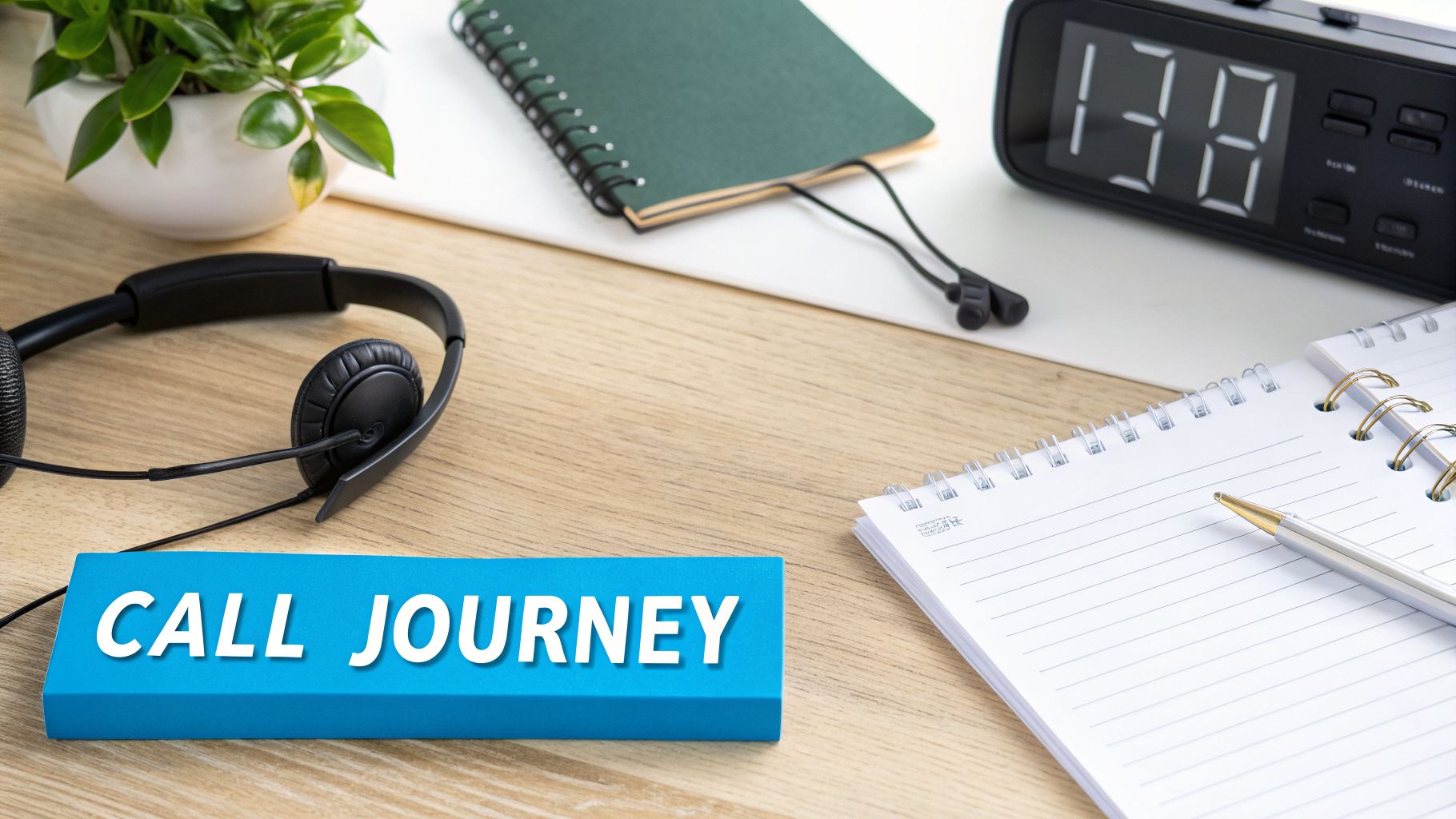
We can break this journey down into three simple phases. By understanding the goal of each stage, your team can guide conversations with confidence, build genuine trust, and deliver the kind of service that people remember.
Phase 1: The Welcoming Start
The first 15 seconds of a call set the entire tone. Your goal here is to establish immediate trust and professionalism. A warm, confident opening reassures the caller that they’ve reached the right place and are in good hands. It’s your one shot at a great first impression.
An effective start isn’t just about picking up the phone quickly. It’s about immediately communicating competence and a genuine willingness to help. This simple step can instantly lower a caller's stress, which is especially important if they're calling with a complaint or an urgent problem.
- Practical Example: Instead of a generic "Hello?", a powerful opening is: "Thank you for calling Apex Electrical, this is Maria. How can I help you today?" This immediately confirms the company name, introduces the agent, and opens the door for the customer's query in one professional sentence.
Phase 2: The Empathetic Discovery
Once you’ve made that positive connection, the next step is to truly understand what the customer needs. This is where active listening becomes your superpower. The goal is to move beyond the surface-level request and uncover the real issue the customer is facing.
This means asking the right kinds of questions—specifically, open-ended questions that encourage the customer to share details rather than just "yes" or "no."
The discovery phase isn't an interrogation; it's a collaboration. You're working with the customer to diagnose the problem so you can find the best solution.
For example, if a customer says, "My internet is down," don't just jump into a technical checklist. Use empathetic discovery to learn more about their situation.
How to Ask Better Questions:
Instead of: "Did you restart your router?"
Try: "I'm sorry to hear you're having trouble. Could you walk me through what you're seeing on your end?"
Instead of: "Is your bill wrong?"
Try: "I can definitely look into that for you. Can you tell me more about what seems incorrect on the statement?"
These questions invite a story, not just a one-word answer. They show you care about the context, which is the foundation of excellent customer service.
Phase 3: The Positive Resolution
The final phase is all about delivering the solution and ending the call on a high note. Your goal isn't just to solve the problem but to make sure the customer feels confident in the outcome. A great closing reinforces the positive experience and leaves a lasting good impression.
First, confirm the solution with the customer. Clearly state what you've done or what will happen next, and make sure they understand and agree. This simple step prevents misunderstandings and avoids frustrating repeat calls.
- Practical Example: After scheduling a service, say: "Okay, so I have our technician, David, scheduled to arrive between 10 AM and 12 PM this Friday. You'll receive a confirmation text message in just a moment. Does that sound good?" This confirms all key details and asks for agreement.
Finally, always thank the customer. A simple "Thank you for calling" is good, but adding a personal touch is even better. This is your last chance to show you appreciate their business and strengthen the relationship.
Here are a few practical scripts your team can adapt to start and end customer service calls with professionalism and confidence.
Effective Call Opening and Closing Scripts
Remember, these are starting points. The key is to sound natural and adapt the words to fit the specific conversation while keeping the tone helpful and professional from start to finish.
How to Convey Empathy and Tone Through Voice
On the phone, you can’t rely on a reassuring smile or open body language to show you care. Your voice is the only tool you have to build rapport and communicate empathy. The tone, speed, and words you choose have the power to turn a frustrating situation into a positive one—or make things a whole lot worse.
Mastering vocal empathy means learning to consciously manage these elements. It's about becoming a calm, guiding presence for the customer, especially when they're upset or confused. Your voice alone can de-escalate tension and build a bridge of trust.
The Three Pillars of Vocal Empathy
Great customer service over the phone really comes down to controlling three key aspects of your voice. Think of them as dials you can adjust to meet the emotional needs of any conversation. When you get them right, you create a subconscious connection that makes the customer feel truly heard.
Your Tone of Voice: This isn't just about what you say, but how you say it. A warm, friendly tone signals that you're ready to help, while a flat or monotone voice can come across as dismissive.
- Actionable Tip: Smile while you talk. Even though the customer can't see it, it genuinely changes the tone of your voice, making it sound warmer and more approachable.
Your Pacing and Speed: Speaking too quickly can make a customer feel rushed and steamrolled. On the other hand, speaking too slowly might sound like you’re uncertain. The goal is to find a clear, deliberate, and confident pace.
- Actionable Tip: If a customer is speaking quickly and is flustered, consciously slow your own pace down. This forces you to be more deliberate and has a calming effect on the caller.
Your Word Choice: The specific phrases you use can either validate a customer's feelings or shut them down completely. Empathetic language is your most direct way to show you're on their side.
- Actionable Tip: Replace negative phrases like "I don't know" with positive, proactive ones like "That's a great question, let me find that out for you."
- A poor response (flat tone): "What's the order number."
- An empathetic response (warm tone, measured pace): "I can absolutely understand why you're frustrated, and I'm very sorry you had to wait. Let's get this sorted out for you right away. Do you have your order number handy?"
- Practical Example: A dental clinic identifies its top three call reasons: 1) New Patient Bookings, 2) Existing Patient Rescheduling, and 3) Billing Questions. They design a simple phone menu: "Press 1 for new appointments, Press 2 for existing appointments, Press 3 for billing." This immediately routes callers to the right person, saving everyone time.
- Practical Example: A policy at a software company might be: "If a user reports a system-wide bug that you cannot replicate, escalate immediately to a Tier 2 support specialist."
- Who to Escalate To: Create a simple cheat sheet. Billing disputes go to the office manager. Complex product questions go to the senior technician. Make it obvious who owns what.
- Practical Example: A proper handoff sounds like: "Mr. Smith, this issue requires our senior technician, John. I'm going to brief him on everything we've discussed so you won't have to repeat yourself. Please hold for one moment while I connect you."
- A new lead calls after hours: The AI receptionist greets the caller, asks a few qualifying questions you’ve set up (like, "Are you calling about a personal injury case?"), and neatly captures their contact info.
- An existing client needs to reschedule: The AI can look at the firm's calendar, find an open time that suits the client, and lock in the new appointment right then and there.
- A caller has a complex legal question: The AI is smart enough to know when it's out of its depth. It recognizes the need for a real expert and routes the call directly to the right paralegal or attorney during business hours.
- Seamless CRM Integration: The AI can automatically pop a new contact into your CRM for every new lead, complete with their name, number, and why they called. This kills manual data entry and makes sure no lead ever gets lost in the shuffle.
- Instant Call Summaries: Right after a call ends, a quick, easy-to-read summary gets generated and can be zipped over to your team via email or Slack. Everyone stays in the loop without needing to listen to lengthy recordings.
- Practical Example: A plumbing company reviews its call analytics and discovers a 40% spike in calls about "leaky faucets" every Sunday night. They use this data to create a targeted blog post and special offer for faucet repairs, and they ensure an extra technician is on standby Monday mornings.
First Call Resolution (FCR): This is the gold standard. FCR measures how many customers get their problem completely solved on the first try—no callbacks, no follow-ups, no frustration. A high FCR, typically in the 70-75% range, is a clear sign your team is knowledgeable and your processes are working smoothly.
- Practical Example: A customer calls your HVAC company because their AC isn't working. If your team can diagnose the issue over the phone and schedule the right technician with the right parts all in that one conversation, that's a perfect FCR.
Average Handle Time (AHT): This is the total time spent on a call, from the moment it starts to the moment the after-call notes are finished. The goal isn't to rush people off the phone. It's about being efficient. A good AHT means your team has the information they need right at their fingertips.
- Practical Example: A law firm's receptionist using a digital FAQ can give directions to the office in 60 seconds. Someone fumbling through papers might take three minutes. The difference isn't the conversation; it's the preparation.
Abandonment Rate: This number tells you how many people hang up before they even get to talk to someone. If your abandonment rate creeps above 5-8%, it’s a major warning sign. It usually points to long wait times or a confusing phone menu, and every abandoned call is a missed opportunity.
- Practical Example: A restaurant sees their abandonment rate spike to 20% on Friday nights. They realize callers wanting to make reservations are getting stuck in a queue. They implement a callback feature, reducing hang-ups and capturing more bookings.
Putting Vocal Empathy into Practice
Knowing the theory is one thing, but putting it into action is what really counts. One of the most effective techniques is vocal mirroring. This involves subtly matching the customer’s pace of speech to build a natural, easy rapport. If they speak slowly and thoughtfully, slow your own pace down a bit. If they're a fast talker, you can pick up your speed slightly to match.
The key is to mirror their speed, not their emotion. If a customer is angry and speaking quickly, your job is to remain calm and measured. Your steady pace acts as an anchor, helping to slow them down and defuse the tension.
Imagine a customer calls, audibly frustrated, saying, "I've been on hold for ten minutes and my delivery is late!"
The second response immediately validates their feelings and signals your intent to help, all before you even start solving the problem. Mastering this skill is a game-changer, and you can learn more about how empathy transforms the customer experience in our detailed guide.
Building Your Empathy Phrasebook
Having a few go-to phrases in your back pocket can make a world of difference. These statements show you're actively listening and that you care about the customer's perspective. They act as verbal nods, reassuring the caller that you're engaged and on their team.
The table below contrasts phrases that build connection with those that can create distance or escalate a situation.
By consistently using positive, validating language and managing your tone and pace, you become more than just a problem-solver. You become a "calm harbor in a storm," capable of guiding even the most difficult customer service on the telephone toward a positive resolution.
Designing Call Flows That Actually Work
Even the most talented person on your team will struggle if your system is a mess. To really nail customer service over the phone, you need a smart, repeatable strategy for managing every call. The backbone of this strategy is a well-designed call flow—think of it as a roadmap that guides a customer's query to the right person or answer, fast.
A good call flow is your best defense against the dreaded "customer bounce," where a caller gets passed from person to person, forced to repeat their story over and over. That’s a one-way ticket to frustration. The whole point is to make their journey from problem to solution feel effortless.
Mapping Your Most Common Scenarios
First things first, figure out why people are calling you. For a local business, this is usually pretty straightforward: appointment bookings, questions about a bill, or maybe an urgent service request. Once you’ve got your list, you can build a simple, logical path for each one.
A new patient trying to book a check-up at a dental clinic, for instance, shouldn't have to fight their way through a confusing phone menu. The best flow gets them straight to the receptionist who manages the schedule. Simple as that.
A well-designed call flow acts like a GPS for customer inquiries. It anticipates the destination and provides the most direct route, eliminating wrong turns and unnecessary delays that lead to frustration.
By mapping out these common journeys, you make sure routine calls are handled quickly and efficiently. This frees up your team to spend their valuable time on more complex issues, which boosts the quality of your service across the board.
The visual below breaks down the three key vocal elements—tone, pacing, and words—that are crucial for communicating effectively within any call flow you design.

It’s a great reminder that how you say something is just as important as the process you follow.
Creating a Clear Escalation Path
Let's be realistic—not every problem can be solved by the first person who picks up the phone. That’s why a clearly defined escalation path is non-negotiable. This is simply the official procedure your team follows when they need to bring in a manager, a technical expert, or someone from another department.
A solid escalation plan needs to answer three questions:
When you formalize this, you give your team the confidence to handle tough situations like pros. You can dive deeper into structuring these moments by reviewing some essential call handling best practices.
Using Technology to Automate Routing
Here’s where modern tools can give you a serious edge. AI-powered systems like Recepta.ai can completely automate that initial routing, acting as an intelligent receptionist for your business.
The system listens to what a caller says or notes their menu choice to figure out what they need in an instant. From there, it automatically sends the call to the right person or department, no manual transfers needed. For example, if someone says, "I need to book a new appointment," the AI can route them directly to your scheduling team. This doesn't just make things faster; it makes them more accurate, creating a much smoother experience from the very first hello.
How AI Can Supercharge Your Phone Service

Bringing new technology into your customer service doesn't mean you have to lose that essential human touch. In fact, it's about making it better. For most small businesses, the real headaches with phone service are frustratingly practical: getting swamped during peak hours, missing calls after you've closed for the day, and the ever-present cost of keeping the phones staffed.
This is where smart tech, especially AI, can be a game-changer. It helps you build a hybrid system where automation takes care of the predictable, repetitive stuff. This frees up your best people to handle the conversations that really need their expertise, ensuring you never miss a lead or frustrate a customer just because you're busy.
The Hybrid AI Model: A Real-World Look
Think about a busy law firm. The phone is ringing off the hook with new client inquiries, current clients asking for updates, and people trying to schedule meetings. Juggling all of that pulls paralegals and attorneys away from the critical, billable work they should be doing.
An AI receptionist, like Recepta.ai, steps in as the perfect first line of defense, 24/7. It answers every single call the moment it comes in, so a potential new client never has to hear that dreaded voicemail greeting.
Here’s how it might play out:
With a system like this, simple tasks get done instantly, any time of day. The more complex issues? They're intelligently escalated to the exact person who can help.
Let Your Team Focus on High-Value Work
The biggest win here is efficiency. When your team isn't bogged down answering the same basic questions over and over, they can put their full brainpower into the work that actually grows your business. For any company looking to grow without burning out their staff, learning to automate customer service with AI is a massive leap forward.
An AI receptionist isn't here to replace your people—it's here to empower them. Think of it as the perfect assistant, handling all the administrative noise so your experts can be experts.
This split in duties creates a better experience all around. Customers get instant help for simple needs, and your team gets to focus on building relationships and solving real problems. It keeps everyone happier and more productive. To see more on how this works, check out our guide on the benefits of an AI phone answering service.
Turn Every Phone Call into Usable Data
Modern AI doesn't just answer the phone; it turns your call system into a goldmine of information. Every conversation is logged, summarized, and analyzed, giving you insights that used to be incredibly difficult to get your hands on.
This automated backend work gives you a few powerful advantages:
By taking over these administrative chores, an AI-powered system doesn't just improve your customer service on the telephone—it gives you the business intelligence to run a tighter, more effective operation.
How to Measure Telephone Service Performance
You can't fix what you can't see. If you want to get serious about improving your customer service over the phone, you have to look past just "getting calls answered." The real magic happens when you start to understand the data behind those calls.
Tracking a few key performance indicators (KPIs) tells you a story. It shows you what’s working well and, more importantly, where a few small tweaks could make a huge difference for your customers and your bottom line. This isn't about drowning in spreadsheets; it's about focusing on the numbers that matter most.
The Most Important Telephone KPIs
Think of these metrics as the dashboard for your customer service engine. Each one gives you a different piece of the puzzle, helping you pinpoint exactly where you can improve.
Here are the essentials for any local business:
Keeping an eye on these metrics isn’t just about catching problems. It’s about spotting opportunities. For instance, a rising AHT might not mean your team is getting slower; it could mean you're getting more valuable, complex calls that require more time and attention.
Essential Telephone Service KPIs Explained
Understanding the key metrics for tracking and improving the quality of your phone support is the first step toward excellence. This table breaks down what each KPI measures and why it's so crucial for your business's success.
By regularly reviewing these numbers, you can turn raw data into actionable insights that directly improve your customer's experience and your business's reputation.
Making Measurement Easy
Let's be honest, nobody wants to track these numbers with a manual tally sheet. This is where a platform like Recepta.ai makes a world of difference. Its dashboard automatically logs and displays these core metrics for you.
In an instant, you can see your busiest call times, check your FCR rate, and find out exactly how many calls were abandoned yesterday. It takes the guesswork out of the equation and lets you make decisions based on real data. To get a better sense of what this looks like in practice, you can learn more about call detail reporting and see how these insights can help you constantly fine-tune your service.
Frequently Asked Questions
When you're focused on improving your customer service over the phone, a lot of practical questions come up. Let's tackle some of the most common ones we hear from business owners just like you.
How Can I Train My Team on a Budget?
Great training doesn't have to break the bank. You can start by simply sharing this guide with your team. Use the scripts we provided as a jumping-off point for role-playing exercises in your weekly meetings.
A great tactic is to focus on improving just one skill each week, whether it's active listening or swapping out bland phrases for more empathetic ones. If you get caller consent, you can even record a few calls to review together. This is a goldmine for spotting what’s working and what needs a little polish. Tools like Recepta.ai can even generate automated summaries, giving you fantastic training material at no extra cost.
What Is the Single Biggest Phone Service Mistake?
Letting calls go to voicemail. Hands down. Today’s customers just don’t wait around—in fact, research shows that over 76% of callers won't leave a message. They’ll just hang up and dial your competitor. Every one of those missed calls is a lost lead and a direct hit to your revenue.
The only way to win is to make sure every call gets answered, 24/7. That's the bottom line. Using a reliable answering solution, whether it's an in-house hire or an AI service like Recepta.ai, ensures you never miss an opportunity again.
How Do I Keep Customer Data Secure?
Protecting customer data isn't just a good idea; it's a must. The most important rule? Train your team to never ask for sensitive information like full credit card numbers or passwords over the phone. For payments or account changes, always guide the customer to a secure online portal.
If you bring on a partner like an answering service, do your homework. Make sure they are compliant with critical standards like HIPAA for healthcare or PCI for payment processing. Any professional service worth its salt will make security a top priority to protect you and your customers.
Should My Team Use Scripts or Be Natural?
The sweet spot is a mix of both. Scripts are fantastic for getting new hires up to speed and making sure every call starts and ends professionally. They create a consistent baseline for quality.
But you don't want your team to sound like robots. Encourage them to see scripts as a framework, not a cage. They need the freedom to listen and respond like a real human being. That blend of professional structure and genuine connection is what builds real, lasting customer loyalty.
Ready to capture every lead and deliver exceptional service 24/7? See how Recepta.ai can transform your customer communications. Start your 30-day risk-free trial today!