
Your Guide to Call Detail Reporting for Business Growth
Think of every phone call your business handles as a potential story. Call detail reporting is what gives you the full manuscript, chapter and verse. It’s a complete breakdown of every call, showing you who called, when they called, and what happened—was it answered, missed, or did it end up in voicemail?
Essentially, it's like a detailed receipt for all your phone communications. This isn't just raw data; it's a powerful tool that helps you see exactly where you can improve customer service and, ultimately, grow your business.
What Is Call Detail Reporting and Why It Matters

Ever look at your marketing spend and wonder why it isn't leading to more appointments on the books? Call detail reporting is the tool that gives you clear, undeniable answers. Don't think of it as a technical log file; it's much more like an itemized receipt for every single call your business makes, takes, or misses.
This "receipt" tells a story far beyond just a phone number and a timestamp. It reveals what actually happened during that interaction. Was the call picked up on the first ring? Did it go to voicemail after a long wait? Or did the caller get stuck on hold and give up? Each of these details is a crucial piece of your customer journey puzzle.
The True Cost of a Missed Call
Every mishandled call is more than just a momentary blip. It's a lost opportunity, plain and simple. That potential client who gets your voicemail? They're probably calling your competitor next. That loyal customer who gets frustrated with a long hold time might start looking for other options.
Practical Example: A home remodeling company spends $2,000 on a local advertising campaign. Their call detail report shows they missed five calls from the unique tracking number assigned to that ad. If their average job is worth $5,000 and they typically close one out of every five leads, that single day of missed calls represents a potential loss of $5,000 in revenue, more than double their ad spend.
Call detail reporting shines a bright light on these hidden costs, turning vague problems into specific issues you can actually solve. It's the bedrock of modern business communications, providing the kind of insights that inform everything from network performance to customer behavior patterns. You can find more information about Call Detail Records data on techsalerator.com.
Call detail reporting isn't just about tracking calls. It's about understanding the entire communication experience your customers have with your business, from the first ring to the final goodbye.
By digging into this data, you can start making smarter, more informed decisions that have a real impact on your bottom line. As we go through this guide, we’ll explore how you can use these insights to:
- Elevate customer service: Pinpoint and fix the frustrating bottlenecks that are driving customers away.
- Streamline daily operations: Adjust staffing and schedules based on when your phones are actually ringing.
- Boost your revenue: Make sure every marketing dollar counts by capturing and converting every single lead.
Decoding the Metrics That Drive Your Business
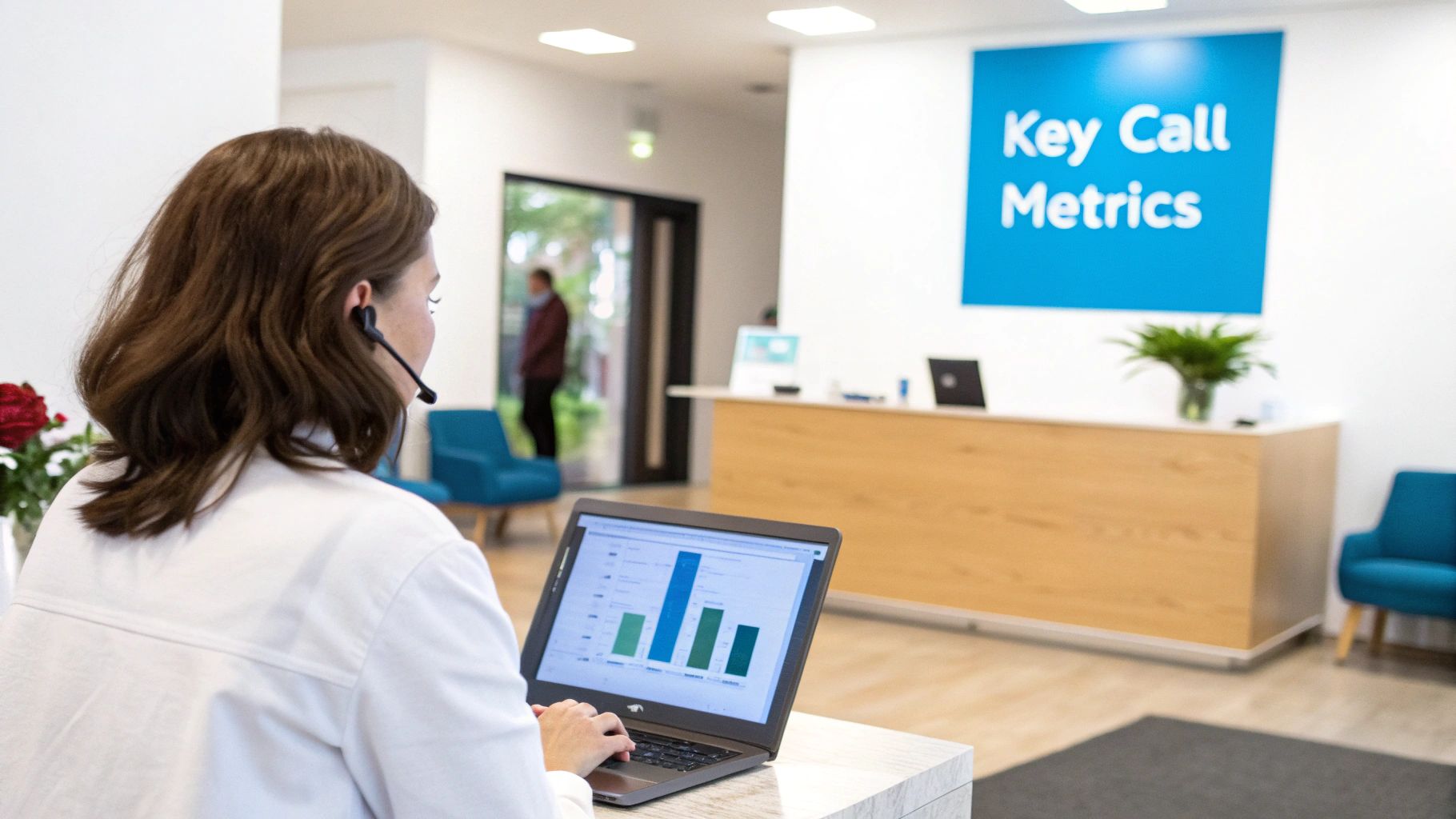
A fresh call detail report can look like a spreadsheet full of technical jargon. But once you know what to look for, it's less of a data dump and more of a treasure map, with "X" marking the spot for happier customers and a healthier bottom line. The real skill is learning to translate those abstract numbers into actions you can take today.
Don't just stare at the stats. Think about what they represent in your day-to-day work. Every single metric tells a small story, and when you put them all together, you get a clear picture of how well your business is communicating with the outside world.
Moving from Data Points to Business Decisions
Let’s get practical. One of the most common metrics in call detail reporting is Average Handle Time (AHT). This is simply the total time an employee spends on a single call, from "hello" to "goodbye," including any wrap-up work. For a busy dental office manager, a high AHT isn't just a number—it’s a bottleneck. It means patients are stuck on the phone for too long, which stops other people from getting through to book appointments.
Another crucial one is First Call Resolution (FCR). Picture a law firm. A potential client calls with a time-sensitive question. If the paralegal who answers can resolve their issue right then and there, the firm doesn't just gain a new client; it builds instant trust. On the flip side, a low FCR means that person is getting bounced around, growing more frustrated by the minute and likely taking their business elsewhere.
These metrics aren't just for massive call centers. They are the vital signs for any business that depends on the phone to serve clients and grow. Ignoring them is like a doctor ignoring a patient's chart—you miss the early warnings of much bigger problems down the road.
When you start looking at these terms through the lens of your own daily challenges, the path to improvement becomes incredibly clear.
Essential Call Detail Reporting Metrics at a Glance
To cut through the noise, let's break down the metrics that truly matter. This table gives you the plain-English definition for each, explains why you should care about it, and offers a straightforward tip to start making improvements.
Think of these as the core building blocks. By mastering them, you're not just reading a report; you're gaining the insight you need to make smarter, faster decisions for your business.
How to Turn Raw Call Data Into Real Insights
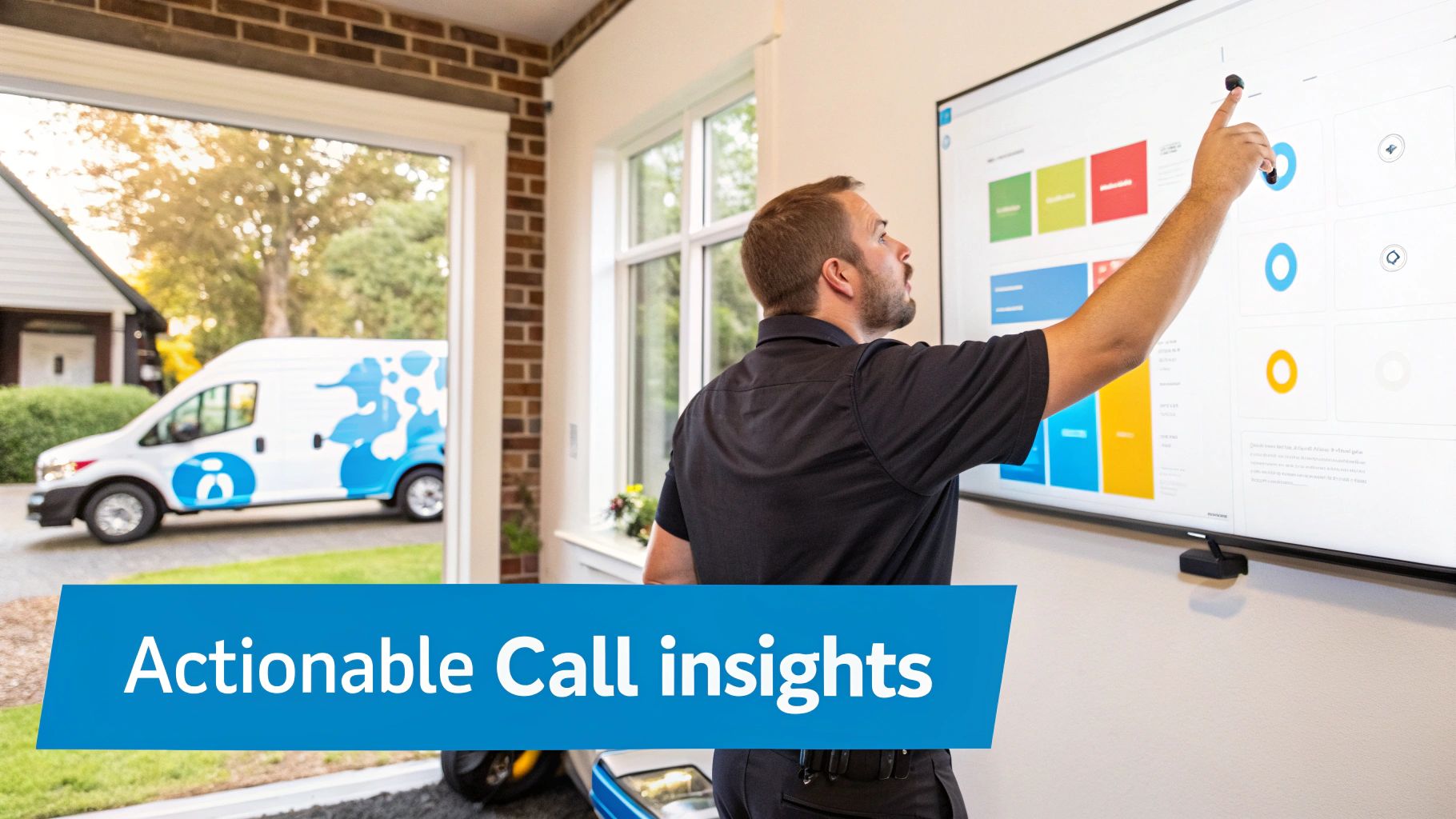
Raw data is just a jumble of numbers until you find the story it’s trying to tell. A call detail report, packed with timestamps and metrics, only becomes useful when you start connecting the dots to see the bigger picture. This is where individual stats transform into real business intelligence that can genuinely improve how you operate.
To make this tangible, let’s follow a fictional home services company, "Prime Plumbing & HVAC," as they dive into their call detail reports for the first time. Their goal is straightforward: figure out why so many potential customers are slipping away before booking a service.
Asking the Right Questions to Find Patterns
The team at Prime Plumbing starts by asking a simple question: "When are we missing the most calls?" Instead of relying on gut feelings, they filter their call detail report to show every missed call over the past month and group them by the time of day.
A pattern jumps out almost immediately. They see a huge spike in missed calls every weekday between 12:00 PM and 1:00 PM. It doesn't take long to realize this is the company's main lunch hour, when only one person is left to field calls. That single piece of data tells a powerful story about lost opportunity.
By isolating one metric—missed calls—and layering it with a time-of-day analysis, the company found a critical operational flaw. This wasn't a marketing problem; it was a simple staffing issue costing them real leads every single day.
Armed with this clarity, they make an immediate, practical change. They stagger lunch breaks to ensure at least two people are always available to answer the phones. Actionable Step: The manager creates a new schedule where one person takes lunch from 11:30 AM to 12:30 PM, and the other from 12:30 PM to 1:30 PM. Within just one week, their missed call rate during that lunch hour drops by over 90%, and they book several jobs that would have otherwise gone straight to voicemail.
Optimizing Marketing Spend with Call Data
Next, the Prime Plumbing team wants to figure out which of their marketing campaigns are actually working. They’re running two big ones: an "emergency plumbing" campaign and another focused on "bathroom remodel" consultations. They use their call reporting platform, which automatically tracks the source of every call, to compare performance.
The data reveals another game-changing insight. While both campaigns bring in a similar number of calls, the leads from the "emergency plumbing" ads are converting to booked jobs 50% faster than the "bathroom remodel" leads. The call duration for emergency calls is also shorter and more to the point, signaling a much higher intent to buy right now.
This discovery allows them to adjust their marketing budget with confidence. They decide to funnel more money into the emergency campaign to capture those high-intent customers. At the same time, they start refining the remodel campaign to better qualify leads before they even call. This is a perfect example of how the right call detail reporting tools offer clear, actionable direction. For businesses just starting to explore this, you can learn more about the best call tracking software in our detailed guide.
How Different Industries Use Call Reporting to Win
While the metrics themselves are universal, the real magic of call detail reporting happens when you see it in action. It's about how different businesses take this data and use it to solve their own unique, industry-specific challenges. This isn't just about counting calls; it's about turning call data into strategic moves that lead to happier clients, smoother operations, and a healthier bottom line.
Think of these as mini-stories of how real businesses turn raw numbers into a serious competitive edge. Each one follows a simple but powerful blueprint: a common business headache, a key insight uncovered by the data, and the tangible results that followed.
Home Services: Proving Marketing ROI
The Problem: A local HVAC company was sinking thousands every month into a mix of marketing channels—Google Ads, local radio spots, direct mail, you name it. The phone was ringing, but their marketing budget felt like a black hole. They couldn't confidently say which campaigns were actually driving valuable calls.
The Insight: Once they started using call detail reporting with source tracking, the picture became crystal clear. They found that their expensive radio ads were bringing in barely any calls. Meanwhile, one specific Google Ad campaign for "emergency AC repair" was responsible for 70% of their most profitable jobs.
The Actionable Solution: Armed with that knowledge, they pulled the plug on the radio ads and funneled that budget directly into their top-performing Google Ad. The result? An immediate 30% increase in qualified leads the very next month.
Healthcare: Optimizing Patient Access
The Problem: A busy dental clinic was getting an earful from patients about long hold times. The receptionists felt buried under calls, and patient satisfaction was taking a nosedive. The office manager suspected they were understaffed at certain times, but without data, it was just a hunch.
The Insight: Their call detail reports told the real story. Call volume shot through the roof every weekday between 9 AM and 11 AM, and the average speed of answer during that window was nearly three minutes. Worse, the call abandonment rate was high, meaning potential patients were getting frustrated and hanging up.
The Actionable Solution: The fix was surprisingly simple. By adjusting one receptionist's schedule to start an hour earlier, they slashed wait times, improved the patient experience, and started filling appointment slots that used to go empty.
The push to analyze phone interactions is growing fast. The global call recording market—a core piece of detailed reporting—was valued at US$ 369.5 million in 2024. It’s projected to nearly triple to US$ 1,017.4 million by 2030. This shows just how critical these insights are becoming.
Legal Services: Capturing After-Hours Leads
The Problem: A personal injury law firm built its reputation on being there for clients. But their call reports uncovered a massive blind spot. A shocking 25% of their missed calls were happening after 5 PM, long after their receptionists had gone home.
The Insight: These weren't just stray calls; they were high-value potential clients who could only call after their own workday ended. These calls often had longer ring times, indicating the caller was patient and serious about their inquiry.
The Actionable Solution: Realizing this, the firm brought in a 24/7 answering service to handle these after-hours inquiries. This single change, driven by the data, allowed them to capture thousands in new business that was previously going to voicemail—or, more likely, to a competitor.
If you're looking to tighten up your own process, check out our guide on call handling best practices.
Integrating Call Data Into Your Daily Workflow
The real magic of call detail reporting happens when you stop thinking of it as just another dashboard to check. Its true power is unleashed when you weave that data directly into the software you use to run your business every single day.
When call data flows into your daily tools, it becomes the central nervous system for all your customer conversations. It’s no longer a chore; it’s an active, intelligent part of your operations. This approach gets rid of the soul-crushing task of manual data entry and finally gives you a single, unified view of every customer interaction.
Imagine your systems doing the heavy lifting for you—automatically linking phone calls to customer records and making sure no lead or follow-up ever falls through the cracks.
Automating Workflows for Maximum Efficiency
The end goal here is to turn your call data into an active participant in your workflow, not just a passive report you look at once a week. A modern system can set off a chain reaction of automated tasks from a single phone call, freeing up your team's time and guaranteeing a consistent process for every single lead.
Let’s walk through a practical example of how this works for a service business:
- A potential customer calls your business after finding you through a Google Ad for "leaky faucet repair."
- Your call reporting system instantly recognizes where the call came from.
- Without anyone lifting a finger, it creates a new lead in your CRM (like Jobber or Housecall Pro). The system automatically fills in the caller's number, the time of the call, and tags the lead with "Google Ads - Leaky Faucet" as the source.
- At the same time, it schedules a follow-up task for a sales rep and logs the call, creating a complete customer history from the very first touch.
This entire sequence unfolds in seconds. This kind of automation ensures every lead gets captured and followed up on, which can have a huge impact on your conversion rates. If your business is scaling, it's also worth exploring how a modern small business phone system can facilitate these kinds of powerful integrations.
By connecting call reporting to your other platforms, you're building an intelligent, self-updating system that not only saves time but also provides richer context for every customer relationship.
This connected approach is exactly why businesses are clamoring for smarter analytics. The market for contact center analytics, which includes call detail reporting, is on track to hit USD 2.9 billion by 2027, growing at a healthy clip of 11.7% annually. This trend underscores just how critical it is for companies to find solutions that turn raw call data into something truly useful. You can learn more about the contact center analytics market on marketsandmarkets.com.
Keeping Your Call Data Secure and Compliant
All this call data gives you incredible insights, but it also comes with a serious responsibility to protect it. When you're handling call recordings and client details, you have to do it with care—it's about maintaining customer trust and meeting your legal obligations.
Securing this information isn't just a job for the IT department; it's a fundamental part of how you do business. The whole thing starts with a simple but powerful principle: only give people access to the information they absolutely need to do their jobs. Nothing more.
This process map shows you how a call's data travels from the first ring all the way to becoming a lead in your CRM.
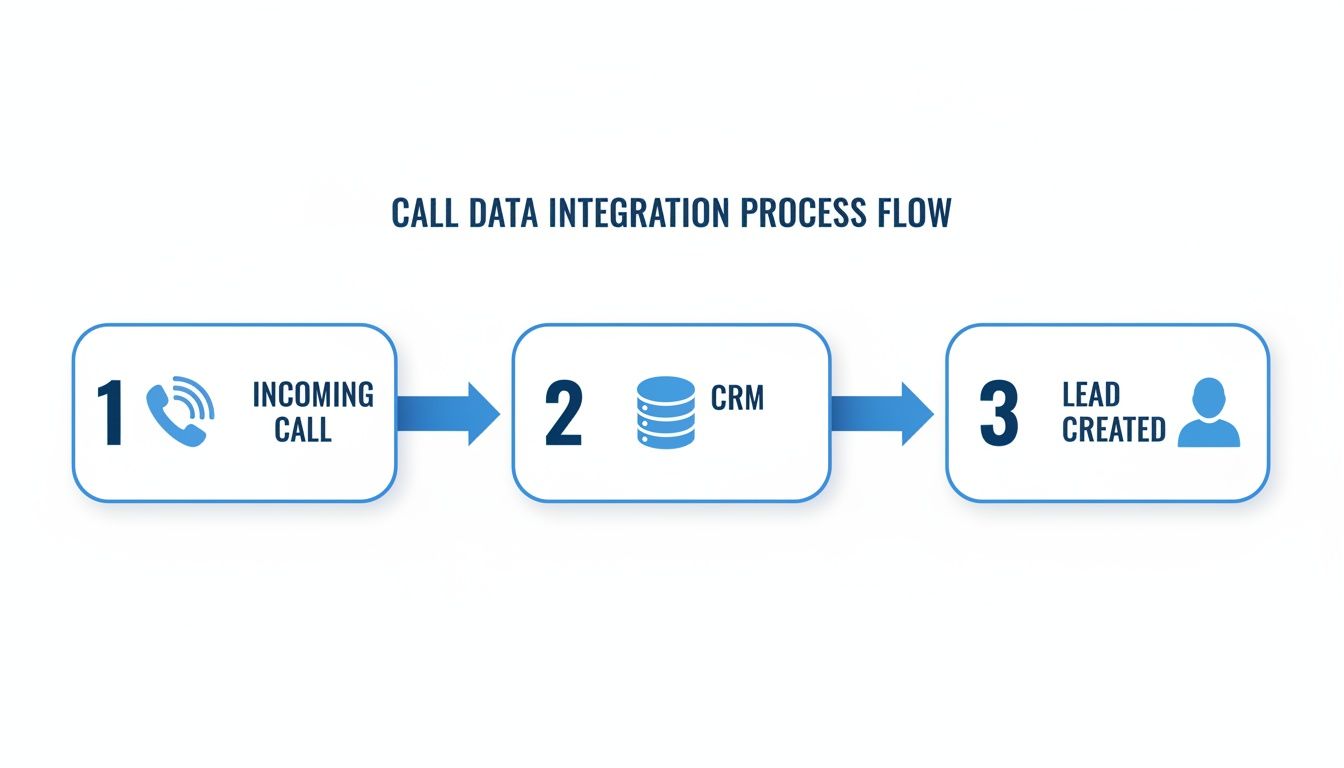
As you can see, the data moves between systems, and securing each hand-off is critical to keeping that information safe.
Practical Steps for Data Protection
Putting strong security in place doesn't need to be overwhelming. It's really about building layers of defense around your customer data with a few practical measures. Think of a dental office—they have to handle patient calls and data in a way that aligns with strict HIPAA rules.
The foundation of data security is access control. If everyone has access to everything, it's impossible to maintain confidentiality or accountability. Start by defining roles and limiting permissions accordingly.
Here are a few best practices that make a huge difference:
- Role-Based Access Control: Don't give everyone the same master key. Create different user roles with specific permissions. Practical Example: A sales manager can be given access to view their entire team's call logs and recordings to monitor performance, but an individual sales representative can only access their own call data to protect the privacy of their colleagues' customer interactions.
- Data Encryption: Make sure your call reporting provider encrypts data both when it's being stored (at rest) and when it's being sent over the network (in transit). This basically scrambles the information, making it unreadable to anyone who shouldn't see it.
- Partner with Secure Vendors: Your technology partners are an extension of your security posture. Choose providers who are serious about security and compliance and are transparent about their protocols and certifications.
Creating a secure framework for your call detail reporting is not optional. It’s what lets you confidently use call insights to grow your business while protecting your customers and your reputation. If you want to explore related tools, our guide on call monitoring software is a great next step.
Frequently Asked Questions About Call Detail Reporting
If you're just starting to look into call detail reporting, you're not alone. Most business owners have a few key questions. Let's cut through the noise and get you some straight answers.
How Is This Different from My Phone Bill?
Think of your phone bill as the summary at the top of a receipt—it tells you what you paid. A call detail report is the itemized list below it, showing you exactly what you paid for and why. It's a strategic tool, not just a financial one.
Your bill doesn't show you the story behind the numbers. For instance, it won't tell you that a hot lead hung up after being on hold for 45 seconds. A call detail report flags that abandoned call, turning a vague problem into a specific, fixable issue that just saved a potential sale.
Do I Need to Be a Data Expert to Use This?
Not at all. The beauty of modern call reporting platforms is that they do the heavy lifting for you. They’re built for busy managers and owners, not data analysts.
Forget about getting lost in spreadsheets. These tools translate raw call data into simple, visual dashboards. You’ll see easy-to-read charts pinpointing your busiest hours or graphs showing which marketing campaigns are actually making the phone ring. The goal is to give you clear insights you can act on immediately.
Is Call Reporting Really Worth It for My Small Business?
Absolutely. For a small business, where every single customer interaction counts, call reporting offers a massive return for a modest investment. It's one of the most direct ways to plug leaks in your sales and service funnels.
Here’s a practical example: A small accounting firm uses call reporting and discovers they miss 30% of their calls during the first two weeks of April. This insight leads them to hire a temporary receptionist just for tax season, immediately improving client service and capturing leads they would have otherwise lost during their busiest time.
It really helps you do:
- Stop losing leads: Pinpoint exactly why calls are being missed and fix the root cause.
- Boost customer service: Optimize your team's schedule based on real call volume, not guesswork.
- Prove your marketing ROI: Finally get concrete data on which ads, flyers, or campaigns are generating calls.
Ready to turn every call into a growth opportunity? Recepta.ai provides the clear insights and automated workflows you need to capture more leads, improve service, and streamline your operations. See how our AI-powered receptionists can transform your business communications by visiting https://recepta.ai.