
Call Monitoring Software: Boost Interactions with call monitoring software

Ever wondered what's really happening on your customer calls? Call monitoring software gives you a front-row seat, letting you record, analyze, and pull valuable insights from every phone conversation. This isn't about micromanaging your team; it's a powerful coaching tool designed to elevate service quality, sharpen training, and ultimately, make customers happier.
What Is Call Monitoring Software and Why Does It Matter
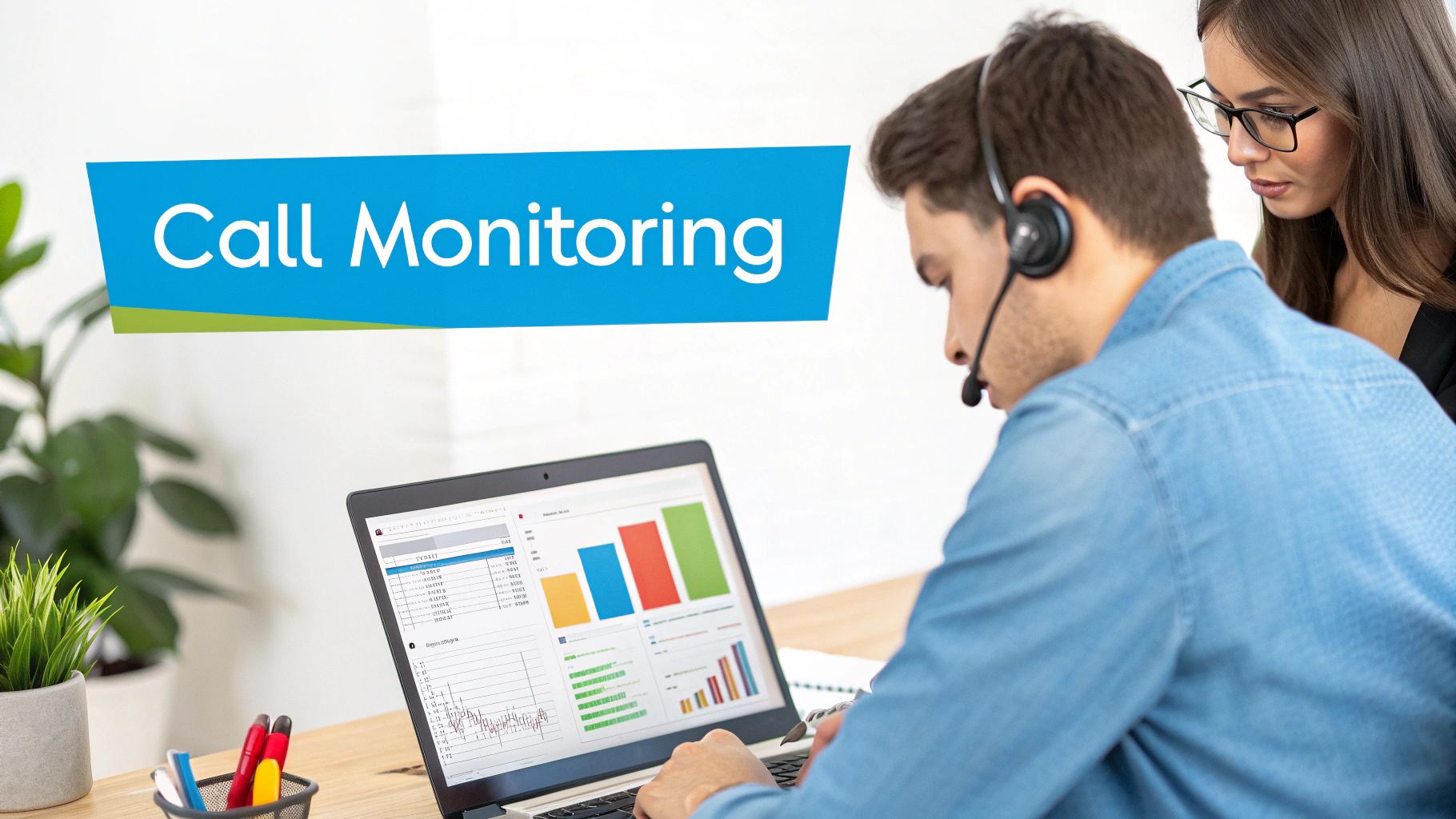
Think of call monitoring software as the "game tape" for your business's customer interactions. Professional sports teams pour over recordings to pinpoint winning strategies and fix mistakes, and this software lets you do the same for your calls. It creates an objective record of what was said, the tone it was said in, and the final outcome.
This kind of insight is crucial for any business that relies on the phone. For a local plumbing company, it's about making sure dispatchers capture every lead's details perfectly. For a healthcare clinic with multiple locations, it’s about ensuring the front desk handles patient questions with the right mix of empathy and accuracy.
The Strategic Value of Reviewing Calls
The whole point is to stop guessing what your customers are experiencing and start knowing. Instead of relying on a few customer comments here and there, managers can identify the exact moments a conversation succeeded or stumbled. This shift to data-driven improvement is why the market is booming.
The global call center software market is expected to rocket from USD 16.2 billion in 2025 to almost USD 35 billion by 2035. This surge is driven by companies hungry for better efficiency and deeper customer understanding, with AI-powered tools already delivering a 65% increase in call center productivity.
At its heart, call monitoring transforms conversations from simple transactions into valuable business intelligence. It’s the difference between hearing a customer and truly understanding their needs, frustrations, and motivations.
More Than Just Recording
Today’s platforms are a world away from simple recording devices. Many are now a core part of a broader technology known as conversation intelligence, which uses AI to dig deep into the substance of your calls. This opens up a whole new playbook of features that turn audio files into actionable strategies.
Here’s a taste of what modern tools can do with practical examples:
- Live Coaching: A manager can listen to a live call and "whisper" advice directly to an agent without the customer hearing a thing. Practical Example: A new sales rep at a software company is struggling to answer a technical question about an integration. Their manager whispers the correct answer and a follow-up question, saving the sale and training the rep simultaneously.
- AI Analysis: The software can automatically transcribe calls, flag keywords, and even detect customer sentiment, highlighting moments of frustration or delight. Practical Example: An e-commerce business flags every call where the word "refund" is mentioned. The system then analyzes these calls for common product complaints, revealing a defect in a popular item that needs to be addressed.
- Performance Scoring: You can build custom scorecards to evaluate calls against consistent standards, making quality assurance fair and objective for everyone. Practical Example: An insurance agency scores agents on whether they confirmed the caller's identity, used the proper greeting, and mentioned a new policy bundle, ensuring a consistent and compliant customer experience.
Ultimately, this technology helps you standardize what "great service" looks like across your organization. It ensures every customer gets your A-team experience, no matter who picks up the phone. If you’re exploring ways to enhance your call management, our guide on the best call tracking software is a great next step.
What's Really Inside Call Monitoring Software?
To really get what call monitoring software can do, you need to look beyond a simple checklist of features. The magic isn't in what the tools are, but what they let your business do. Each capability is there to solve a real-world problem, turning mountains of call data into actual improvements in your service quality, team training, and customer happiness.
Think of these features less like technical specs and more like the essential tools your team will use every single day to get better at their jobs.
Call Recording and Transcription
This is the bedrock of any good system. At its core, the software creates a complete, searchable library of every conversation that comes through your phone lines. This isn't just about having a backup; it’s your source of truth for resolving disputes, verifying details, and creating powerful training material. Many modern systems use AI powered transcription software to turn spoken words into accurate, searchable text.
Practical Example: A busy law firm uses recorded transcripts to confirm client instructions on a critical case. If there's ever a question about what was agreed upon, they can pull up the transcript in seconds to get clarity, protecting everyone involved.
Live Monitoring and Whisper Coaching
This is where managers become mentors. Live monitoring lets you listen in on calls as they're happening, but the real power comes from "whisper coaching." It’s the ability to give private, real-time advice to an agent without the customer hearing a thing.
It’s like having an experienced co-pilot sitting next to a trainee, quietly guiding them through a tricky situation. This kind of on-the-spot support builds confidence and helps solve customer problems on the very first try—a cornerstone of great service you can learn more about through call handling best practices.
Practical Example: A home services manager notices a new dispatcher getting tangled up in a complex scheduling request. Using whisper coaching, the manager privately prompts them with the right questions to ask ("Have you checked the availability of our senior technician for that specific zip code?"), guiding them to the perfect solution. The customer is happy, and the employee just got a priceless, in-the-moment training lesson.
Quality Assurance Scoring
You can't improve what you don't measure. Quality assurance (QA) scoring takes the guesswork out of performance reviews by letting you build custom scorecards to evaluate calls against a clear set of standards.
This feature helps you formally define what a "great call" means for your business. From there, you can measure every agent's performance against that benchmark, providing fair and consistent feedback.
Quality assurance isn't about finding fault; it's about defining success. By scoring calls against clear, objective criteria, you give your team a roadmap to consistently deliver outstanding customer experiences.
Practical Example: An insurance agency uses a simple QA scorecard that breaks down like this:
- Opening: Did the agent use the proper greeting? (10 points)
- Empathy: Did they acknowledge the customer's situation? (20 points)
- Accuracy: Was the policy information they gave correct? (30 points)
- Compliance: Did they include the required legal disclaimer? (20 points)
- Closing: Did they wrap up professionally and outline next steps? (20 points)
AI-Powered Sentiment Analysis
This is where things get really smart. The software can automatically analyze the words, tone, and even the pace of a conversation to figure out how the caller is feeling. It can spot frustration, confusion, or happiness, often before your agent even does.
Think of it as an early-warning system. Instead of finding out about a problem from a scathing online review days later, the system can flag a call that's going south right now, giving a manager a chance to step in.
Practical Example: A customer is getting increasingly agitated during a call with a utility company's billing department. The system detects rising frustration in their voice and instantly pings a supervisor with a notification: "High negative sentiment on call with agent Smith." That supervisor can then join the call to de-escalate the situation and find a solution before the customer hangs up furious.
Reporting and Analytics Dashboards
Finally, the software gathers all this rich data and presents it in easy-to-read reports and visual dashboards. This is your 30,000-foot view of your entire call operation, showing you trends and patterns you'd never spot otherwise.
Practical Example: A medical office manager looks at their dashboard and sees that call volume skyrockets every Monday between 9:00 AM and 11:00 AM, with an average hold time of over five minutes. Armed with that data, they adjust staffing to bring in an extra receptionist during that peak window, dramatically cutting down on patient hold times.
The table below breaks down how these core features translate into tangible benefits across different industries.
Key Features and Their Real-World Impact
By looking at these features through the lens of real-world application, it becomes clear that call monitoring software is less about surveillance and more about empowerment, insight, and operational excellence.
The Real-World Payoff: What Call Monitoring Actually Does for Your Business
It's one thing to talk about features like call recording and analytics, but what does that really mean for your bottom line? The true value of call monitoring software comes to life when you see how it solves real-world business problems. It’s about turning phone conversations from a black box of unrecorded data into a treasure trove of strategic insights.
And businesses are catching on—fast. The market for inbound call tracking software is expected to hit an impressive USD 6.47 billion by 2032, expanding at a healthy 13.4% each year. This isn't just a niche trend; it shows a fundamental shift in how companies view their phone lines. They're investing in tools that connect the dots between a ringing phone and tangible success. You can explore more data on this market growth to see just how big this shift is.
Elevate Your Quality Assurance Game
Every business owner wants to deliver consistently great service, but without the right tools, "quality" is just a guessing game. Call monitoring acts like a game tape for your customer interactions, letting you see exactly what’s working and what isn’t. It moves you from subjective feedback to data-driven coaching.
Practical Example: A local cleaning service was plagued by booking errors. Some receptionists were great, capturing every detail; others weren't. This led to mixed-up schedules and unhappy clients. By monitoring their calls, the owner could:
- Pinpoint the exact techniques their best scheduler used.
- Build a simple, standardized script from those successful calls.
- Train the whole team using real recordings of what "good" sounds like.
The result? Scheduling mistakes plummeted, and positive reviews started rolling in. Customers finally got the same professional, reliable experience no matter who answered the phone.
Nail Your Compliance and Cut Down on Risk
If you work in a regulated field like finance or healthcare, one wrong word on a phone call can lead to massive headaches and legal fees. Call monitoring and recording give you an ironclad, undeniable record of every conversation, which is your best defense.
Practical Example: A financial advisory firm must make specific legal disclosures on every single client call—no exceptions. With call monitoring software, they automatically record and transcribe these conversations. A manager then uses keyword search ("required disclosure") to quickly verify that the disclaimers were made on every client call, protecting both the client and the firm from compliance violations.
Call monitoring transforms compliance from a hope-and-pray activity into a proactive, evidence-based system. It gives you the proof you need to operate with confidence.
Supercharge Employee Training and Onboarding
Forget dusty training manuals and awkward role-playing sessions. The best way for new team members to learn is by listening to real conversations handled by your seasoned pros. Call monitoring provides a library of these real-world examples, drastically cutting down the time it takes for new hires to get up to speed.
Practical Example: A new technician joins a pest control company. Instead of just reading a script about handling upset customers, their manager creates a "Best Of" playlist in the call monitoring software. The new hire listens to five calls where a veteran agent masterfully calms down an anxious homeowner, explains the treatment process, and closes the deal. This is practical, on-the-job learning at its best.
Boost Sales and Stop Losing Leads
Every call that comes in is a potential sale, but so many of these opportunities slip through the cracks. Call analysis helps you find the exact moments where your sales conversations go off the rails, so you can fix them and close more deals.
Practical Example: A real estate agency used call analytics and discovered their agents weren't asking the right qualifying questions upfront. They were wasting hours on tours with people who weren't serious buyers. After identifying the problem, they tweaked their script to include questions like, "Have you been pre-approved for a mortgage?" and used whisper coaching to prompt agents in real-time. This simple change led to a 20% jump in qualified appointments, turning insights directly into revenue.
How to Choose the Right Call Monitoring Software
Picking the right call monitoring software can feel overwhelming. With so many options out there, it's easy to get lost in feature lists and technical jargon. The secret is to step back and get crystal clear on what your business actually needs to solve its most pressing problems. A smart, focused evaluation process will help you find a partner that not only fixes today's issues but also grows right alongside you.
This simple flowchart breaks down the two main paths that lead businesses to call monitoring: the drive for growth and the need for better quality.
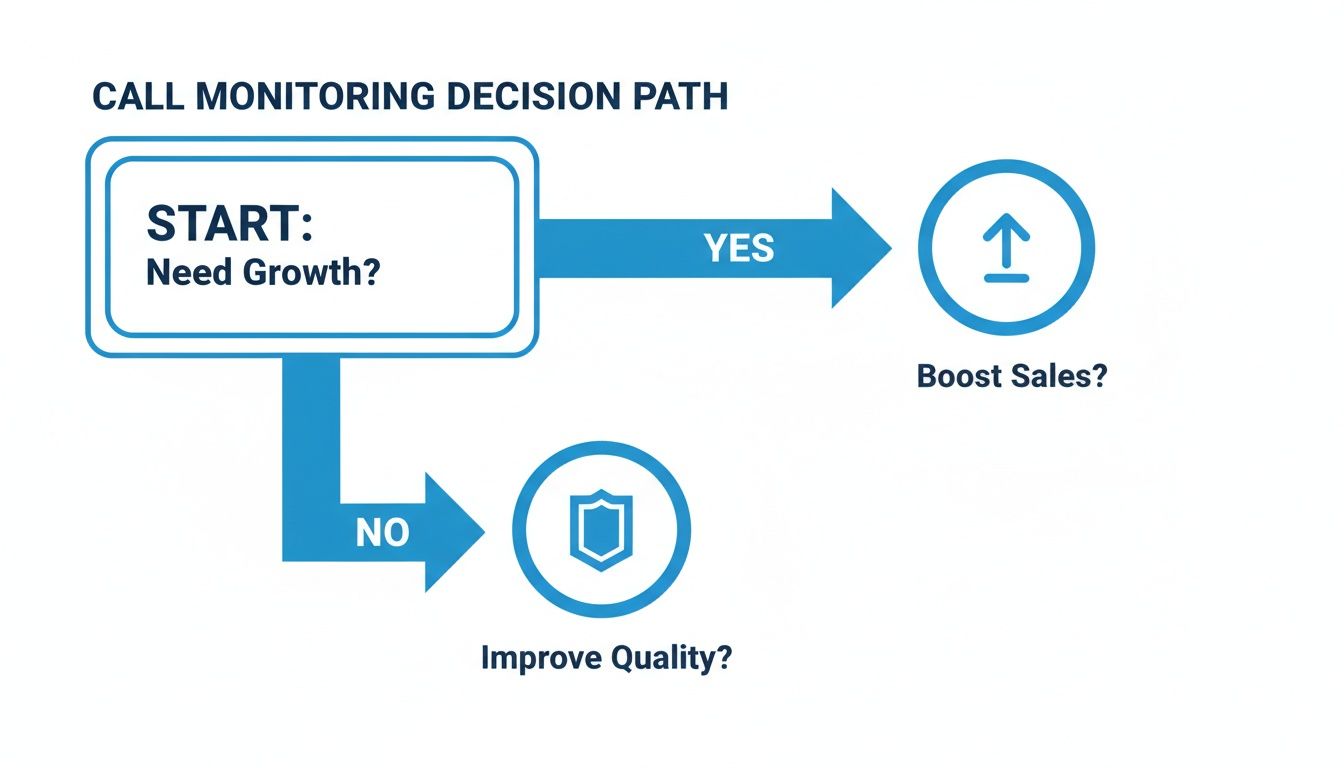
As you can see, whether you're focused on boosting sales or shoring up your service, call monitoring is a foundational tool. The first step is to figure out where your biggest challenges lie and match them to the software's core capabilities.
Start With Your Pain Points, Not Their Features
Before you even book a single demo, make a list of what's holding you back. Are promising leads slipping through the cracks? Is your customer service inconsistent from one agent to the next? Are you spending way too much time getting new hires up to speed?
Your answers will build a personalized checklist of must-have features. For example, a franchise owner managing ten locations needs centralized reporting to get a bird's-eye view of the entire operation. A solo lawyer, on the other hand, might put a higher premium on iron-clad call recording for liability protection.
The goal is to avoid paying for bells and whistles you'll never use. Focus on the tools that directly solve your problems.
Your Call Monitoring Software Evaluation Checklist
Choosing the right platform requires asking the right questions. This checklist is designed to guide you through a thorough evaluation, ensuring you cover all the critical bases from features to scalability. Use it to compare different providers and find the best fit for your specific business needs.
By working through this checklist, you’ll be in a much stronger position to make an informed decision that truly benefits your business in the long run.
Demand Seamless Integrations
Even the most powerful software is useless if it operates on an island. Your call monitoring platform has to play nice with the other tools you rely on every day, especially your Customer Relationship Management (CRM) system. This connection is absolutely critical for maintaining a single, accurate view of your customer relationships.
A great call monitoring tool should act as a bridge, not an island. It should feed valuable conversation data directly into your CRM, patient management system, or field service software, enriching every customer record automatically.
Practical Example: When an agent at a marketing agency finishes a call, the recording and AI-summary automatically attach to the client's record in their CRM. When the account manager follows up next week, they can see the full context of that conversation without having to ask the agent what happened.
Put Security and Compliance First
In today's world, security isn't just a feature—it's the bedrock of trust, especially if you handle sensitive information. The software you choose must meet the specific compliance standards for your industry.
- Healthcare: Any platform used in a medical setting must be HIPAA compliant to protect patient health information.
- Finance & E-commerce: If your team takes payments over the phone, the software must meet PCI DSS standards to keep credit card data secure.
- Legal: Law firms need tools that ensure client confidentiality and offer robust, secure data storage.
Don't be shy. Always ask potential providers for their compliance certifications and to walk you through their data security practices.
Plan for Tomorrow's Growth
The software that fits your business today should also fit the business you plan to be in five years. Scalability means the platform can handle more users, more calls, and more features as you grow, without forcing you into a costly and complicated migration down the road.
Practical Example: A small plumbing business with just two technicians starts with basic call recording. As they expand to a fleet of ten, they can easily upgrade their plan to add advanced analytics and QA scorecards to maintain quality across a larger team. A scalable platform lets them switch on those features as their needs evolve.
Understand the Price Tag
Finally, let's talk about money. Most call monitoring software is priced in one of two ways, and knowing the difference is key to understanding the true cost.
- Per-User, Per-Month: You pay a predictable flat fee for each person who needs access. This model is straightforward and makes budgeting easy.
- Usage-Based: Your bill is based on how much you use the service—for instance, the number of minutes recorded or calls analyzed. This can be a great option for businesses with fluctuating call volumes.
Make sure to ask about any one-time implementation fees, training costs, or extra charges for data storage. Getting the full picture ensures the investment makes sense for your budget long-term. Ultimately, choosing the right software is a huge part of building an effective small business phone system that actively helps you reach your goals.
Supercharge Your Team with an AI Receptionist
Call monitoring software is fantastic for honing your team's skills and ensuring quality, but it mostly deals with what happens during and after a call. What about the constant stream of calls coming in? This is where an AI receptionist becomes the perfect partner, creating a seamless system for handling your phone communications from start to finish.
Think of an AI receptionist as your smart, automated front line. It handles the repetitive, time-draining tasks 24/7, like scheduling appointments, qualifying new leads, and answering basic questions, all without needing a human. This lets you point your call monitoring efforts squarely at the high-stakes conversations where human expertise truly shines.
Automation Handles Volume, Monitoring Refines Quality
It’s really about a smart division of labor. The AI receptionist takes care of the high volume of predictable calls, making sure no lead falls through the cracks and every customer gets an immediate answer. This frees up your human agents to focus on the complex, urgent, or emotional conversations—exactly the moments where coaching and quality control make the biggest difference.
Practical Example: An HVAC company uses an AI receptionist to book all its routine maintenance appointments and handle basic quote requests, even in the middle of the night. This leaves the human team—backed by call monitoring and whisper coaching—free to manage high-priority emergency calls, like a customer with a broken furnace in winter. The AI handles the routine, so your team can perfect the critical.
This pairing creates a brilliant feedback loop. The AI receptionist filters and qualifies calls, so by the time an agent steps in, the conversation is already set up for success. That makes it a perfect, targeted coaching opportunity for your call monitoring software.
This move toward automating front-end tasks is exploding. Just look at the predictive dialer software market, which automates outbound calls; it’s projected to grow at a massive 42.3% CAGR from 2025 to 2030. This trend, highlighted in market analysis from Grand View Research, shows just how hungry businesses are for automation in call management.
The Practical Impact of a Combined Approach
When you pair these two technologies, the gains in efficiency and customer experience are incredible. Your AI receptionist guarantees you're always responsive and capturing leads, while the call monitoring platform fuels constant improvement in your team's performance.
Here are some of the direct benefits of this dual strategy:
- Never Miss a Lead: The AI receptionist works around the clock. It grabs every opportunity, even after hours or during busy spikes, stopping potential customers from hitting voicemail and calling a competitor instead.
- Elevated Agent Focus: With routine calls off their plate, your team can pour all their energy into solving tough customer problems, closing major sales, and building lasting relationships.
- Data-Rich Coaching: Calls handed off by the AI often arrive with valuable context, giving managers a head start when they review recordings for training.
Ultimately, adding an AI receptionist doesn't replace call monitoring—it makes it more powerful. By automating the front line, you create the perfect environment for your human team to do their best work. You can see more on how this synergy works in our guide on the benefits of an AI receptionist for small business.
How to Measure Your Return on Investment
So, you're thinking about investing in call monitoring software. It's a smart move, but how do you prove it was worth it? The real magic happens when you can point to tangible results and show how better conversations are directly beefing up your bottom line.
Measuring your return on investment (ROI) isn't just a numbers game for the finance team. It’s the clearest way to see if your training and feedback are actually creating better customer experiences. It gives you the hard data you need to justify the cost and really lean into what's working.
Key Metrics to Track for ROI
To get a real sense of your ROI, you need to focus on metrics that hit your operational efficiency, customer happiness, and—of course—your revenue. Think of each KPI as a piece of a larger story, showing how the software is making a difference across the business.
Let’s start with these four critical areas:
- Practical Example: A home services franchise used to spend six weeks training new dispatchers. By creating a playlist of their top agents' best calls in the monitoring software, new hires were confidently booking jobs in just three weeks. That's getting people productive 50% faster.
- Practical Example: A medical clinic kept getting repeat calls about insurance eligibility. After listening to a few recordings, they identified common points of confusion and developed a simple script for the front desk. The result? Their FCR for insurance questions shot up by 30%, freeing up phone lines for other patients.
Connecting Quality to Customer Happiness
Internal metrics are great, but the real test is how your customers feel. You need to connect the dots between your team's performance and actual customer satisfaction. This is where you prove that your efforts are truly paying off.
The ultimate proof is seeing your internal QA scores move in lockstep with your external customer satisfaction ratings. When that happens, you know you’re focusing on what truly matters to your customers.
A fantastic way to track this is with Improved Customer Satisfaction (CSAT) Scores. Once you start using QA scorecards, watch what happens. You should see a clear pattern: agents who get high marks from you also get high marks from customers on post-call surveys. That’s how you know your coaching is hitting the mark.
Tying Monitoring Directly to Revenue
Now for the most powerful argument: connecting call monitoring directly to new business. By digging into call recordings, you can find out exactly where leads are falling through the cracks and tighten up your sales process.
Increased Lead Conversion is the perfect metric here. Practical Example: A construction company noticed in their call recordings that agents got nervous whenever a caller asked about pricing. Using whisper coaching, managers could jump in and guide them in real-time, helping them explain the value behind the cost. Within just two months, they saw a 15% increase in booked estimates, a direct line from the software to more revenue.
Your Call Monitoring Questions, Answered
Jumping into call monitoring software naturally brings up a few questions. Before you can choose the right tool, you need clear, practical answers. Let's walk through the common concerns we hear from businesses just like yours.
We’ll get straight to the point on everything from the legal side of things to pricing and how quickly you can get a system up and running.
Is It Legal and Ethical to Monitor Calls?
This is the big one, and for good reason. The simple answer is yes, monitoring calls is legal as long as you handle consent properly. Laws differ depending on where you operate, but they generally fall into one of two buckets: one-party consent (where only one person, like your employee, needs to know) or two-party consent (where everyone on the line must be notified).
The best policy is always transparency. It keeps you compliant and builds trust.
- For Customers: A simple automated message like, "This call may be monitored or recorded for quality assurance purposes," is all it takes to meet legal requirements in most jurisdictions.
- For Employees: Be upfront. Detail your call monitoring policy in the employee handbook and make it part of your training. Position it as what it is: a tool for coaching and professional growth, not a "gotcha" system.
How Much Does This Software Typically Cost?
There’s no single price tag for call monitoring software. The cost really hinges on what you need—the complexity of the features, the size of your team, and how many calls you handle. Most vendors structure their pricing in a few predictable ways.
Think of it like a cell phone plan. You can pick a flat rate per user that's easy to budget for, or you might prefer a pay-as-you-go model if your call volume swings wildly from month to month.
You'll often see a per-user, per-month fee (say, $50 per agent) or a usage-based model that charges per minute recorded. Always make sure to ask about any one-time setup fees or data storage costs so you have a complete picture of the investment.
Will This Integrate With My Current CRM?
A call monitoring platform that doesn’t play well with your other tools is more of a headache than a help. The most crucial connection is with your Customer Relationship Management (CRM) system. When they’re synced up, call recordings and notes automatically populate the right customer profile.
This creates a single, reliable history of every conversation, so your team has the full story without digging through different apps or manually copying data. Before you commit, double-check that the provider has solid, ready-to-go integrations for the specific software your team lives in every day.
How Long Does Implementation Take?
Getting a new system off the ground is probably faster and less painful than you imagine. With most modern cloud-based platforms, you can be up and running in a matter of hours or days, not weeks.
The typical process involves creating user accounts, connecting your phone numbers, and linking your other software. Any good provider will walk you through a clear onboarding process to make sure you’re set up for success right away. The whole point is to get you seeing the benefits quickly, without getting bogged down in a complex technical project.
Ready to see how intelligent call management can transform your business? Recepta.ai combines 24/7 AI-powered call handling with expert human support, ensuring you capture every lead and deliver a flawless customer experience. Discover how Recepta.ai can boost your ROI today.