
HVAC Business Management Software Your Guide to Total Control
If you've ever run an HVAC business, you know the feeling. It's a special kind of controlled chaos: phones ringing off the hook, technicians crisscrossing the city, paperwork piling up, and someone always needs to track down an invoice late at night.
Now, imagine a different reality. One where every job is scheduled perfectly, every tech has the right parts, and payments are handled right on the spot. That's not a fantasy—it's what happens when a business gets powered by modern hvac business management software. It’s a single hub built to finally tame the operational storm.
From Daily Chaos to Total Control
Let's be honest, running a successful HVAC company is a juggling act. You're trying to keep field technicians productive, office staff organized, and customers happy all at the same time. When you're relying on a patchwork of spreadsheets, whiteboards, and endless text threads, things inevitably fall through the cracks.
This isn't just inconvenient; it's expensive. A tech shows up to a job missing a specific filter because the notes from the initial call got lost. Or worse, two technicians get dispatched to the same house because of a simple scheduling mix-up. These little mistakes bleed time, fuel, and profit, not to mention they leave customers fuming.
The Shift to a Single Command Center
This is where HVAC business management software steps in. It acts as the central nervous system for your entire operation, replacing all those manual, disconnected processes with smart, automated workflows. It connects every part of your business in real time. Think of it less like a piece of software and more like the operational blueprint you need to scale.
The real goal here is to shift your business from being reactive—constantly putting out fires—to proactive. You start anticipating customer needs, making the most of your resources, and actually having time for strategic planning.
This change empowers everyone on your team. Your staff can finally stop drowning in administrative busywork and focus on what they were hired to do: provide top-notch service. You can learn more about how modern solutions like AI receptionists can further support your HVAC team and streamline customer interactions.
What This Transformation Looks Like
By bringing everything onto one platform, you start solving your biggest operational headaches and find new ways to be profitable. This guide is here to show you exactly how—from the must-have features and real-world benefits to the practical steps for choosing and launching the right system for your company.
You'll see how this software helps you:
- Eliminate guesswork with live technician tracking and up-to-the-minute job statuses.
- Improve cash flow by creating invoices and taking payments on-site, instantly.
- Enhance customer loyalty with complete service histories at your fingertips and automated maintenance reminders.
- Boost team productivity by automating schedules and optimizing daily routes for maximum efficiency.
What Is HVAC Business Management Software?
At its heart, HVAC business management software is the command center for your entire operation. It's designed to pull you out of the chaos of juggling spreadsheets, paper work orders, a whiteboard schedule, and a constant flood of text messages.
Think of it as the central nervous system for your company. Without it, you’re basically running an orchestra without a conductor. Your office team has one version of the schedule, your techs in the field have another, and your bookkeeper is left piecing it all together after the fact. Everyone is doing their best, but nothing is in sync. That's how you end up with missed appointments, lost billing, and unhappy customers.
The Conductor for Your Business
This software is that conductor. It makes sure every piece of your business—from the moment a customer calls to the final payment—is perfectly harmonized. It creates a single, reliable source of information that connects your dispatchers, technicians, and customers in real-time.
When a job is booked in the office, the tech assigned to it instantly gets all the details on their phone or tablet. They don't just see an address; they see the customer's complete service history, the equipment they have, and any notes from previous visits.
This is about more than just going paperless. It’s about building a smooth, automated workflow from start to finish. The goal is to eliminate repetitive tasks, give you a bird's-eye view of your operations, and empower your team to deliver top-notch service every single time.
This diagram perfectly illustrates the journey from operational chaos to the streamlined control good software provides.
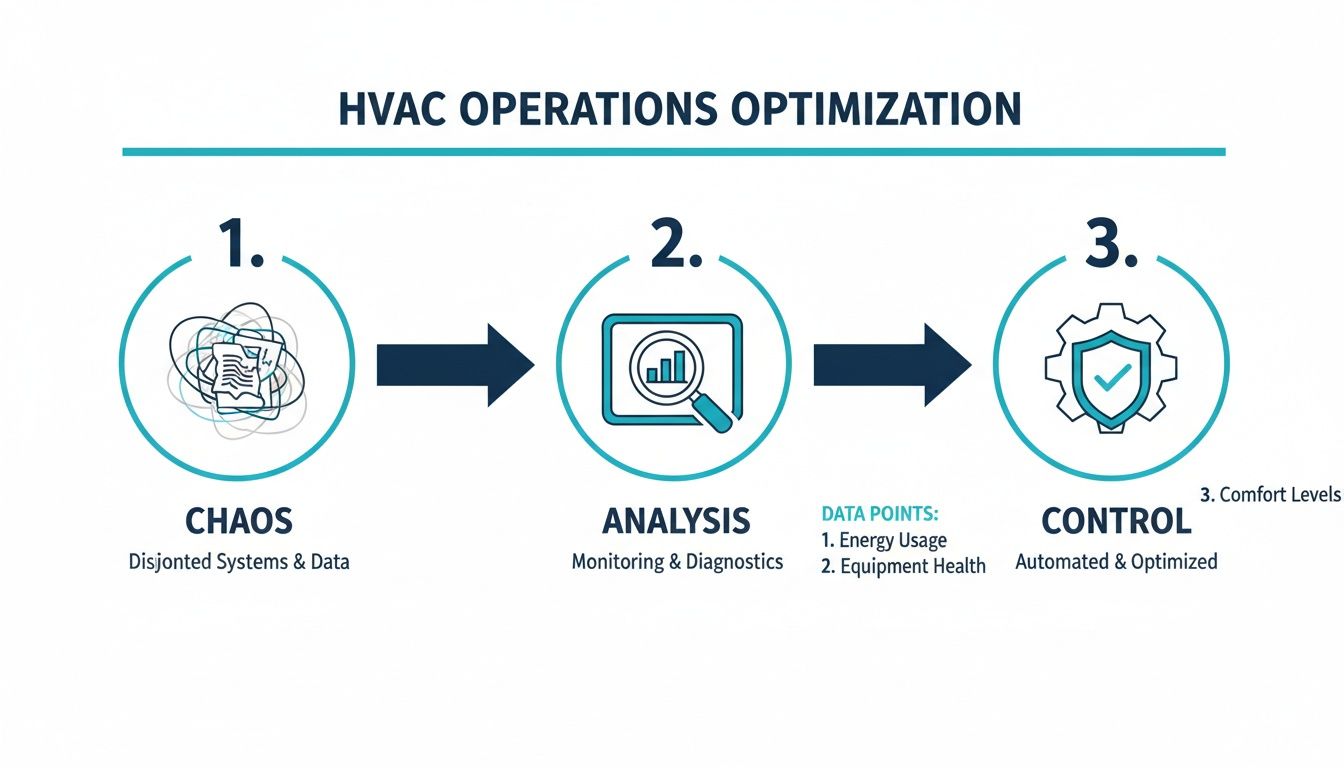
As you can see, it takes all those tangled, manual processes and straightens them out into an efficient, predictable system.
How It Works in a Real-World Scenario
Let’s walk through a typical service call to see the difference it makes. Imagine it’s the hottest day of the year, and a customer’s AC just died.
The Old Way: Your dispatcher answers the phone, scribbles the details on a sticky note, then starts calling technicians to see who’s free. They finally text the address to someone. The tech shows up blind, with no idea what kind of unit it is or if they’ve been there before, wasting valuable time just figuring things out. At the end, they hand over a crumpled paper invoice that someone has to manually punch into QuickBooks later.
With HVAC Software: The call comes in, and the dispatcher immediately pulls up the customer’s complete profile. They see the specific AC unit, its warranty status, and a full service history. A live map shows the closest available technician with the right skills, and the job is assigned with a click. The tech gets an instant notification with everything they need to know before they even arrive.
Once the repair is done, the technician creates a professional, digital invoice right on their tablet, captures the customer's signature, and takes a credit card payment on the spot. That payment automatically syncs with your accounting system. No more double-entry, no more lost paperwork, and no more communication breakdowns. The entire workflow is handled in one place, helping you run a smarter, more profitable business.
Core Features That Drive Profitability
The real magic of HVAC business management software isn't just about going digital; it's about the specific tools inside that turn your daily operational headaches into genuine opportunities for growth. Think of these features less as bells and whistles and more as engines designed to solve the most common—and costly—problems every HVAC owner faces.
Let's dig past a simple features list and get to the "why" behind each one. We'll explore how these tools actually work in the real world to create a smoother, more profitable business from the ground up.
To really understand the value, let's break down what these core features do and the direct impact they have on your bottom line.
Key Features and Their Impact on Your Business
This table shows how each function translates into a real-world benefit that you'll feel in your daily operations and see in your bank account.
Each piece works together, creating a system that’s far more powerful than the sum of its parts.
Intelligent Scheduling and Dispatching
For most HVAC shops, the scheduling board is the heart of the chaos. Your dispatcher is constantly juggling phone calls, text messages, and a messy whiteboard, trying to solve the ever-changing puzzle of who goes where. It’s a recipe for mistakes and wasted time.
Intelligent scheduling completely changes the game. Instead of relying on guesswork, it uses data to make the smartest dispatching moves for you. The system knows every technician's skill set, their current location via GPS, and their real-time job status.
When a new service call comes in, the software doesn't just find the closest tech; it finds the best tech for that specific job who is also nearby and available.
- Before: Your dispatcher burns 15 minutes trying to track down a free technician, only to accidentally send a residential expert to a complex commercial boiler repair.
- After: The system instantly assigns the job to your certified boiler specialist who is finishing up a job just two miles away. No wasted time, no mismatched skills.
This one feature is a powerhouse for efficiency. It cuts down on drive time and fuel costs, minimizes the dead time between jobs, and makes sure you solve the customer's problem correctly on the first visit.
A Centralized Customer Relationship Manager
Your customer data is pure gold, but it’s worthless when it’s scattered across sticky notes, random spreadsheets, and your dispatcher's memory. A built-in Customer Relationship Management (CRM) tool organizes all that critical information into one place that anyone on your team can access instantly.
Every interaction is logged in the customer’s profile, from their first call to their most recent maintenance visit. And when you connect it with tools like an automated phone answering service, every new lead is captured and fed directly into the CRM, so no opportunity ever slips through the cracks.
Imagine a technician pulling up to a house and already knowing:
- The exact make and model of the customer's air conditioner.
- The full service history, including the date it was installed.
- Notes from a previous tech about a tricky wiring setup.
That level of insight empowers your team to deliver faster, smarter, and more personal service. It’s how you build real trust and turn one-time customers into lifelong clients.
Mobile Access for Technicians in the Field
The gap between your office staff and your field technicians is where inefficiency thrives. Techs often show up to a job with half the story, forcing them to make constant calls back to the office for information, which slows everything down.
A good mobile app closes that gap for good. It transforms every technician’s phone or tablet into a mobile command center, giving them everything they need to do their job right.
From the job site, they can:
- See their full daily schedule with routes already optimized.
- Pull up complete job details and the customer's entire service history.
- Build professional-looking quotes and get a digital signature on the spot.
- Process credit card payments and immediately email a receipt.
This constant connection ensures your field crew and office team are always on the same page. It gets rid of duplicate data entry, kills the mountain of paperwork, and dramatically speeds up the entire process from arrival to getting paid.
The numbers prove it. HVAC field service software is especially powerful for small to medium-sized businesses, which make up 67% of all users. Companies with fewer than 25 technicians report they can handle 21% more jobs per day thanks to digital scheduling. On top of that, automated invoicing slashes payment cycles by 26% and reduces billing errors by a whopping 32%.
Automated Invoicing and On-Site Payments
There's nothing more frustrating than finishing a job and then spending the next month chasing the customer for payment. It’s a cash flow killer. HVAC management software puts an end to this by letting you get paid the moment the work is done.
As soon as a job is finished, the technician can generate a perfect, itemized invoice right on their tablet. They can show it to the customer, swipe their credit card using a mobile reader, and send the receipt before they even pack up their tools.
This simple change has a huge effect on your business. You’re no longer waiting for checks in the mail or dealing with bounced payments. All the payment data syncs straight to your accounting software, saving your office staff hours of tedious reconciliation and keeping your books accurate and current.
The Tangible ROI of HVAC Software
Bringing new technology into your business always feels like a big spend. But the right hvac business management software isn't just another line item on your expense sheet—it's a profit-generating machine. Forget the bells and whistles for a moment; the real story is in the measurable return on your investment (ROI). This kind of software directly fattens your bottom line by helping you earn more, spend less, and build a base of loyal customers who keep coming back.
It’s no surprise that investing in these platforms is quickly becoming the dividing line between thriving companies and those just getting by. The numbers tell the same story: the HVAC service management software market was valued at USD 2.00 billion in 2025 and is expected to rocket to USD 7.03 billion by 2035. Even better, shops that have already made the switch report an average operational efficiency boost of 32%.
Boosting Revenue by Doing More with Less
So, where does the money come from? The most immediate ROI comes from simply getting more profitable work done each day. Smart scheduling and dispatching are the engine behind this. You can fit more jobs into a technician's schedule without tacking on overtime or running your team ragged.
Think about it in real-world terms. A tech finishes a repair 30 minutes ahead of schedule. Without software, that’s dead time—they might wait for a call from the office or start the long drive back. With it, the system instantly sees their availability and GPS location, then automatically assigns them a quick tune-up that just came in from a customer two miles away. That one extra job a day can easily add up to thousands in new revenue every single month.
On top of that, modern tools turn your techs into a sales force. When they discover a 15-year-old AC unit needs a major repair, they can pull out their tablet and instantly generate three good-better-best replacement quotes. The customer can review them, sign off, and schedule the install on the spot.
The software turns every service call into a potential sales opportunity. It closes the gap between identifying a need and closing a deal, capturing revenue that would otherwise be lost to follow-up calls or competitor quotes.
Slashing Hidden Operational Costs
Most HVAC businesses are leaking profits from a thousand tiny cuts—small inefficiencies that add up fast. HVAC software is designed to plug those leaks by optimizing routes, tightening up inventory, and killing administrative busywork.
Optimized routing is a classic example. Instead of techs bouncing across town like a pinball, the software lays out the most direct, fuel-efficient route for the day's appointments.
- Fuel Savings: A single truck driving just 15 fewer miles a day can save you over $1,200 a year in fuel. Got a fleet of ten trucks? Now you're looking at $12,000 back in your pocket.
- Reduced Wear and Tear: Driving less also means less strain on your vehicles, stretching their lifespan and cutting down on expensive repair bills.
Inventory management is another huge money-saver. The software gives you a real-time view of every part, from the warehouse shelf to the back of a tech's van. This stops you from over-ordering expensive components that just collect dust and makes sure your techs have what they need for the job the first time, eliminating those frustrating and costly second trips.
Increasing Customer Lifetime Value
Finally, this software helps you build your most critical asset: a loyal customer base. A smooth, professional experience is what earns five-star reviews and, more importantly, locks in those profitable annual service agreements. Automated reminders for maintenance keep you top-of-mind and create a steady stream of predictable, recurring revenue.
When a customer calls in, your team can pull up their entire service history in a second. They can greet them by name and know exactly what equipment is in their home. This kind of personal touch builds trust and makes customers feel like you actually know them, turning them from one-time clients into long-term advocates for your business.
Of course, to truly see the results, you need to measure them. Learning how to calculate marketing ROI gives you a clear picture of what's working. You can also get more specific by tracking where your best leads originate, something we cover in our guide to the best call tracking software for service businesses.
How to Choose the Right Software for Your Company
Picking the right HVAC business management software is a huge decision, one that can genuinely shape the future of your company. Let’s be clear: this isn't a one-size-fits-all kind of deal. The perfect platform for a three-truck residential team is worlds apart from what a 30-truck commercial outfit needs. To get it right, you have to look past the flashy sales pitches and zero in on what will actually work for your business on a day-to-day basis.
The whole process starts with an honest look in the mirror. Before you even think about watching a demo, you need to get crystal clear on your biggest headaches, your goals for the next few years, and how your team actually gets work done. This self-assessment is the bedrock of a smart decision that pays off for years to come.
Assess Your Current Operations
First things first, get specific about what your business is. Are you running a high volume of residential service calls, tackling massive commercial installations, or trying to balance both? That one answer immediately tells you which features should be at the top of your list.
- Residential Focus: If your bread and butter is service and maintenance, you absolutely need rock-solid scheduling, a mobile app for your techs that isn’t a nightmare to use, and automated reminders for service agreements.
- Commercial Focus: For bigger, more complex projects, you'll want software with strong job costing, real project management tools, and the ability to handle progress billing and other tricky invoicing scenarios.
Your team size matters, too. A small crew needs something they can learn in an afternoon. A bigger company, on the other hand, will probably need more advanced tools like custom user permissions to make sure the right people have access to the right information (and keep sensitive financial data locked down).
Key Evaluation Criteria
Once you have a handle on what you need, you can start sizing up the options based on a few make-or-break factors. It can even be helpful to see how other industries lean on their essential platforms for professional services to get a sense of what true operational efficiency looks like.
Here are the non-negotiables to keep on your radar:
Scalability: Ask yourself, "Will this software grow with me?" The system you pick today needs to handle your business tomorrow when you’ve added ten more trucks and expanded into a new county. Steer clear of any platform that feels like it has a low ceiling or will nickel-and-dime you for every new user.
Ease of Use: This one is huge. If your technicians find the mobile app clunky or confusing, they just won't use it, and your investment is toast. Your ROI is directly tied to how many people actually adopt the software, so look for a clean, intuitive interface. The best systems feel like they were designed by someone who’s actually spent time in a service truck.
Integration Capabilities: Your HVAC software can't be an island. It has to connect seamlessly with the other tools you depend on, especially your accounting package like QuickBooks. A solid integration means no more mind-numbing double data entry and ensures your books are always accurate.
A quality system ensures that a job booked in the field automatically syncs with your accounting platform, dispatch board, and the customer's record. This single point of data entry saves countless administrative hours and prevents costly errors.
Look for World-Class Support
Even the most straightforward software has a learning curve. Don’t just buy the product; buy the support that comes with it. You're looking for a provider that offers serious onboarding help and is there for you long after the sale. You want a real partner who will pick up the phone, help you troubleshoot, and solve problems fast.
Dig into reviews and ask for references from companies like yours. How quick is their support team to respond? The last thing you want is to be stuck for days waiting on an email when a critical issue is keeping you from dispatching techs or sending out invoices. This kind of reliability is crucial, especially for handling unexpected customer calls. On that note, you might find our guide on setting up dependable after-hours answering services useful for making sure no lead ever slips through the cracks. A great software partner should offer that same level of round-the-clock peace of mind.
Frequently Asked Questions
Jumping into new software is a big deal for any HVAC company. It's completely normal to have a ton of questions before you commit. Here are some straight-up answers to the things HVAC owners ask us most often.
How Long Does It Really Take to Get My Team Up and Running?
This is always one of the first questions, and for good reason—time is money. The real answer comes down to two things: how easy the software is to use and how open your team is to a new way of doing things. Most modern, well-built platforms are surprisingly intuitive, and you can get everyone comfortable in a much shorter time than you might think.
Here’s what a typical rollout often looks like:
- Week 1: Your core office team (think dispatchers and managers) gets hands-on with the provider's support team. They'll focus on the big stuff: getting your customer list imported, setting up your pricebook, and defining your scheduling rules.
- Week 2: Time for the techs. A solid half-day training session focused entirely on the mobile app usually does the trick. They’ll learn the essentials: how to see their jobs for the day, update their status, build an invoice, and take a payment right on the spot.
- Weeks 3-4: You're live! The team starts using the software for real jobs. There will be small hiccups, but this is where the provider’s support team helps smooth things out. By the end of the first month, the new workflow should feel like second nature.
The secret to a fast transition is picking a system that just makes sense. When you're watching a demo, ask yourself a simple question: "Could my least tech-savvy guy figure this out with a little coaching?" If the answer is no, you're signing up for a long, frustrating process.
Is My Customer Data Actually Safe on This Thing?
We get it. Your customer list is the lifeblood of your business. Any software provider worth their salt knows this and invests heavily in security. You're not just buying software; you're trusting them with your most critical asset.
Look for platforms that talk about security in specific terms. You want to see things like multi-level authentication, encrypted data storage, and especially role-based access controls.
Role-based access is a huge deal. It means you decide exactly who sees what. For instance, your techs can see their schedules and job notes, but they can't peek at the company's profit-and-loss statement. Your office manager can send invoices but maybe can't change the company-wide settings. This kind of granular control is your best defense against both accidental mistakes and intentional data breaches.
What Happens if We Need Help a Month From Now?
Ongoing support shouldn't be an afterthought—it's essential. Your business doesn’t stop after training week, and your software support shouldn't either. Before you sign anything, get a crystal-clear understanding of their support structure.
The best companies offer help in multiple ways, so you can solve problems fast:
- Phone and Email Support: A direct line to a real person who can walk you through a fix.
- Live Chat: Perfect for those quick "how do I do this?" questions that pop up during the day.
- Online Knowledge Base: A 24/7 library of videos and guides for when you want to figure it out yourself.
Think about this real-world scenario: It’s 8 AM on a Monday, the dispatch board is frozen, and you have a dozen techs waiting for their first jobs. A great support team gets you on the phone with a specialist in minutes to get you back online. A bad one leaves you in a ticket queue for hours, watching your day's profits circle the drain.
Can This Software Talk to QuickBooks and My Other Tools?
Yes, and this is where you start saving massive amounts of time. A good HVAC platform should never be an island. Its ability to connect with the other tools you rely on, especially accounting software like QuickBooks, is what truly eliminates the headache of double-entry.
Here’s how a seamless integration works: a tech finishes a job, builds the invoice on their tablet, and takes the customer's payment. The moment they hit "complete," all of that financial data—the invoice, the payment, the customer info—is automatically synced over to your QuickBooks file. Your bookkeeper doesn't have to re-type a single thing. This doesn't just save hours; it practically eliminates the human errors that can mess up your books.
Is This Kind of Software Overkill for a Small HVAC Business?
Not at all. In fact, many of the best platforms out there were built specifically for small- to medium-sized shops. They know you don't have a dedicated IT department, so they focus on being affordable, easy to set up, and centered on the core features that give you the biggest bang for your buck—scheduling, dispatching, mobile tech access, and invoicing.
The magic word is scalability. A great system will let you start small and grow into it. You might begin with just three licenses for you and your first two techs. As you hire more people, you can simply add more users without having to rip everything out and start over. It’s about investing in a tool that solves your problems today while being ready to handle your success tomorrow.
Ready to stop juggling chaos and start building a more profitable, organized business? Recepta.ai ensures you never miss a customer call or a new lead, integrating seamlessly with your business software to automate booking and follow-ups. See how our 24/7 AI-powered receptionist service can transform your customer experience by visiting https://recepta.ai.