
247 Call Answering Service Guide: Costs and How to Choose
In 2025, 78% of 1,000 U.S. consumers surveyed by CallRail said they had abandoned a business after an unanswered call, according to CallRail survey reporting summarized by Redial BPO. That figure changes the question. A 24/7 call answering service isn't valuable because someone lifted a receiver. It's valuable only when the caller reaches the correct next step, with the right details recorded and a named person owning follow-up.
Most buyers compare hours covered and pickup speed. I'd judge harder. Did the emergency reach your on-call tech? Did the routine booking land on the calendar? Did the sensitive intake get a human, a transcript, and a callback time? If the answer is no, a fast pickup only creates a faster failure.
What a 24/7 Call Answering Service Actually Covers
A 24/7 call answering service picks up every inbound call at any hour and either resolves it or passes it to the right person. Think of a night-shift building concierge. The concierge checks each visitor against a list, admits the expected ones, and calls the manager only for anything unusual.
Coverage models compared
| Model | Hours Covered | Handles Complex Calls | Usual Cost Basis | Best Fit |
|---|---|---|---|---|
| Voicemail only | Recorded messages only | No | Typically included in phone plan | Low call volume with flexible callbacks |
| In-house receptionist | Staffed hours only | Yes | Salary, benefits and payroll overhead | Steady daytime call volume |
| AI-only answering | 24/7 | Limited to scripted flows | Monthly subscription or per-minute usage | Scheduling, FAQs and simple status checks |
| Live answering service | 24/7 | Yes, within the provider's scripts | Per call, per minute or monthly plan | Overflow, after-hours and peak periods |
| Hybrid AI plus human | 24/7 | Yes, with defined handoff | Base subscription plus usage fees | Mixed routine and urgent call work |
Voicemail records a message but resolves nothing, so the caller still waits. An in-house receptionist handles nuance well, but only during staffed hours and at full employment cost. AI-only answering handles scripted work cleanly and struggles with exceptions, while a live service absorbs overflow and after-hours peaks. A hybrid setup lets automation take routine calls and trained people take the complicated ones.
A service is not a phone system. It answers, qualifies, and records. Your business still owns the follow-up.
Run a simple test this week. Count calls received outside staffed hours last month, then count how many reached a person. That gap tells you whether you need full coverage, overflow backup, or just a better callback routine.
How Many Calls Go Unanswered and What It Costs
Start with a hard benchmark. In a 30-day study of 85 small businesses across 58 industries, published in 2016, only 37.8% of inbound calls reached a live person, while 37.8% went to voicemail and 24.3% received no answer and no voicemail option, as reported in CallForce's analysis of missed-call costs. Add the last two groups and about 62.1% failed to connect a caller with a human.
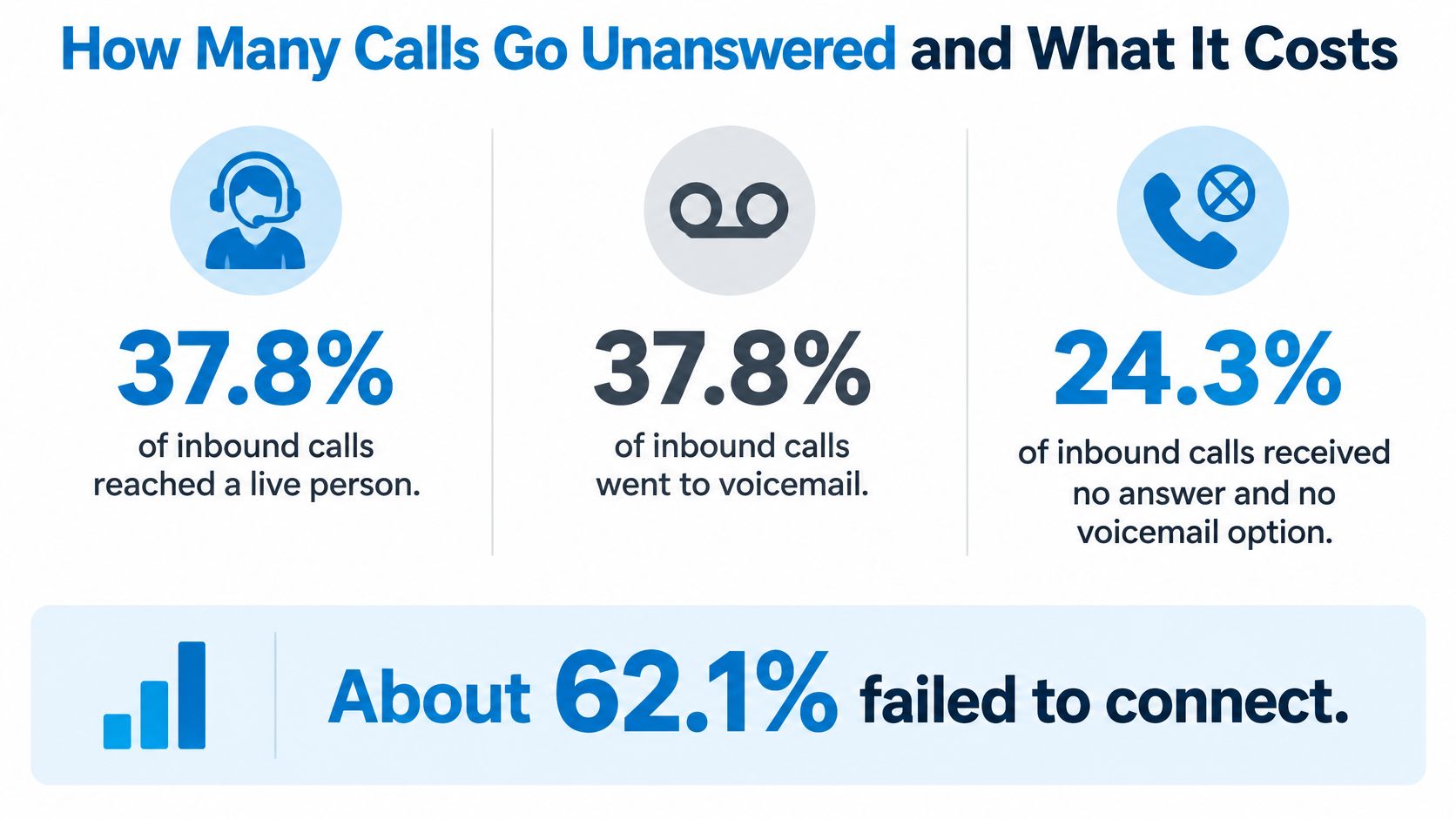
That doesn't mean six in ten callers were ready to buy. It means six in ten never gave staff a chance to find out. A missed call interrupts the booking path before anyone learns the caller's need, address, or urgency. Many callers won't leave a message and wait. They'll call the next business on the list.
What the leak looks like in money
Don't estimate from a national benchmark. Use your own week.
- Count missed calls: Pull one week of after-hours, voicemail, and no-answer calls.
- Apply your booking rate: Multiply by the share of answered calls that normally become jobs or consultations.
- Multiply by average value: Use your average job, visit, or signed-case value, not your best ticket.
Say a shop misses 40 calls in a week, one in four answered calls usually books, and the average job is worth a few hundred dollars. The monthly leak quickly reaches several thousand dollars, even before you count repeat business. The small sample behind the benchmark matters here. Treat it as a warning sign, not a current national average, and let your call log set the actual number.
Real Scenarios From Home Services and Professional Firms
An HVAC inquiry at 8 p.m.
Say an HVAC company receives a web inquiry at 8:00 p.m. The answering workflow confirms the problem, collects the address and preferred appointment window, and alerts the on-call technician immediately instead of postponing contact until morning. That speed matters because Harvard Business Review research covering 1.25 million sales leads found companies attempting contact within one hour were nearly seven times more likely to qualify a lead than companies waiting another hour, and more than 60 times more likely than companies waiting at least 24 hours.
For home service businesses, we provide inbound and outbound call handling, scheduling, and customer support, so that evening inquiry becomes a booked visit rather than an inbox item. The same urgency logic applies to tree work. For tree service companies, Recepta.ai answers calls around the clock and triages urgency, booking serious situations under the customer's rules.
A plumber separating emergencies from routine work
Say a plumbing company gets five evening calls. Two involve active leaks, three are routine fixture installs. A reported 2025 CallRail survey found 34% of home-services businesses waited until the next morning to respond to after-hours inquiries, while only 48% responded immediately, according to LeadDuo's summary of lead response time statistics. A good service books the urgent jobs for the on-call plumber and logs the nonurgent ones for the next available schedule, which cuts the chance a customer calls another provider overnight. If you're weighing coverage for crews, our guide to a contractor answering service covers the dispatch side in detail.
A law firm intake rule
Say a law firm sets one rule for every new consultation call. Intake captures name, matter type, jurisdiction, urgency, and conflict-check details, then sends a summary to a qualified staff member for follow-up within the same hour. For law firms and professional service providers, we provide confidential inbound and outbound call handling and client support, which fits that rule. Each scenario shares one trait. The caller reaches a next step with the right data attached.
How One After-Hours Call Moves Through the System
Follow one call from ring to owned follow-up. The stakes are real, since a call-tracking analysis of approximately 70 million calls across 10 industries found 44% of calls were classified as missed, including 48% in home services and 46% in healthcare, while calls lasting longer than 30 seconds reached a 71% answer rate. Short, urgent calls are the ones most at risk.
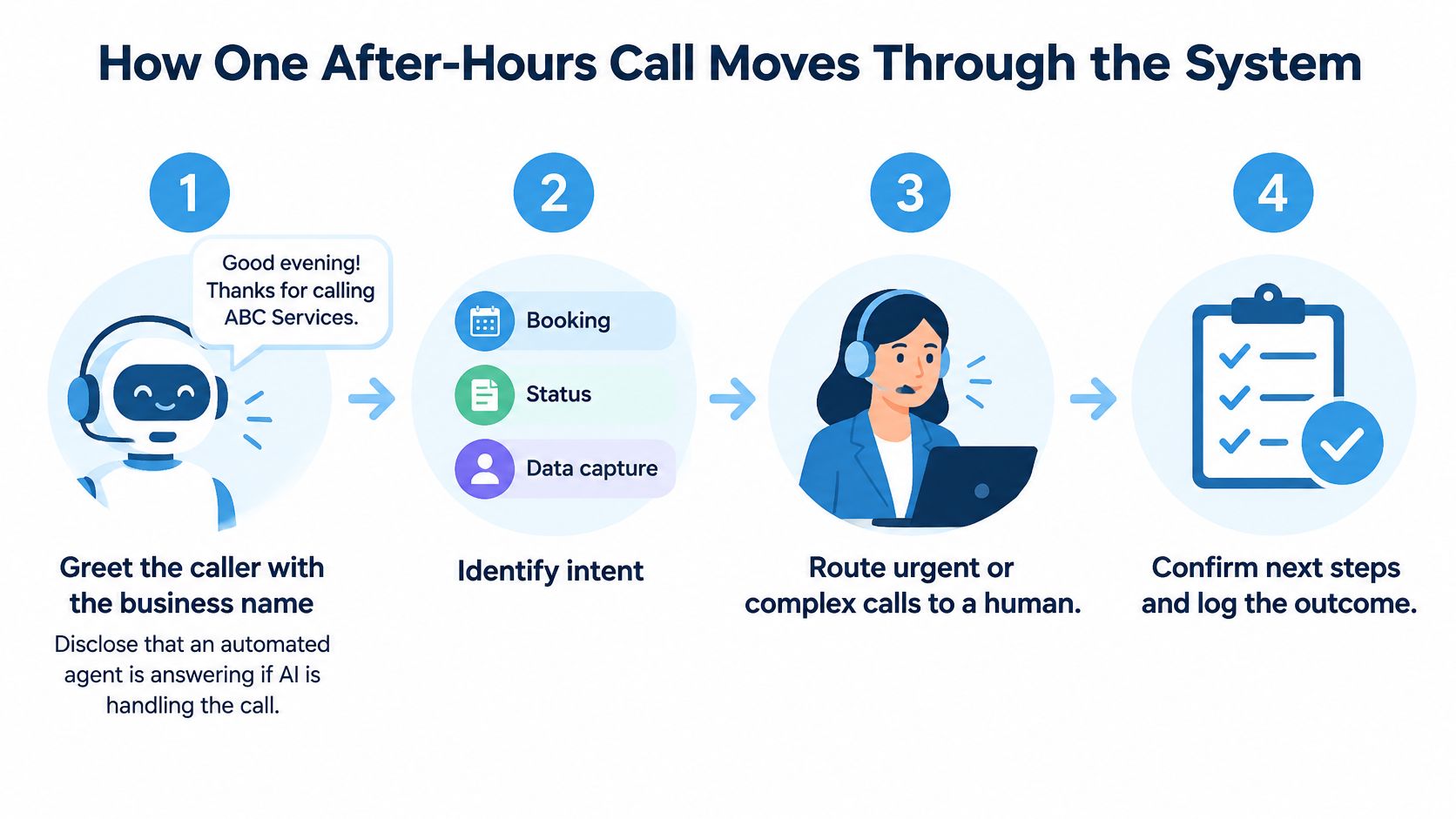
- Greet and disclose: Answer with the business name, and disclose that an automated agent is answering if AI handles the call. Callers who feel misled hang up.
- Identify intent: Sort the call into booking, status check, quote, complaint, or emergency. Everything downstream depends on this label.
- Check urgency against the playbook: A gas smell or water through a ceiling goes straight to an on-call person. A routine cleaning request continues. Smart call scripts follow your custom playbook so every caller receives the right response every time.
- Check the calendar: Offer two real appointment windows. A vague promise to call back loses to a competitor with a confirmed slot.
- Capture core fields: Record name, callback number, address, issue, and preferred window. A missing address forces a second call.
- Write to the system in real time: Push those fields to the CRM or scheduling system. Every workflow is customized to the business, and we connect with CRMs, calendars, messaging platforms, and industry-specific systems. An unlogged booking gets double-booked in the morning.
- Confirm both ways: Send a text confirmation to the caller and notify staff by SMS, email, or dashboard.
- Close the loop: Record a voicemail for anything unresolved and log an outcome code.
The pattern is why 24/7 emergency plumbers Los Angeles listings matter to homeowners searching at midnight. They call expecting dispatch, not a message box. Our overview of an answering automated service explains how that routing stays consistent.
After any call, run one check. You should see the caller, the need, the appointment, and the person who owns the next step.
Which Calls Go to a Human and When
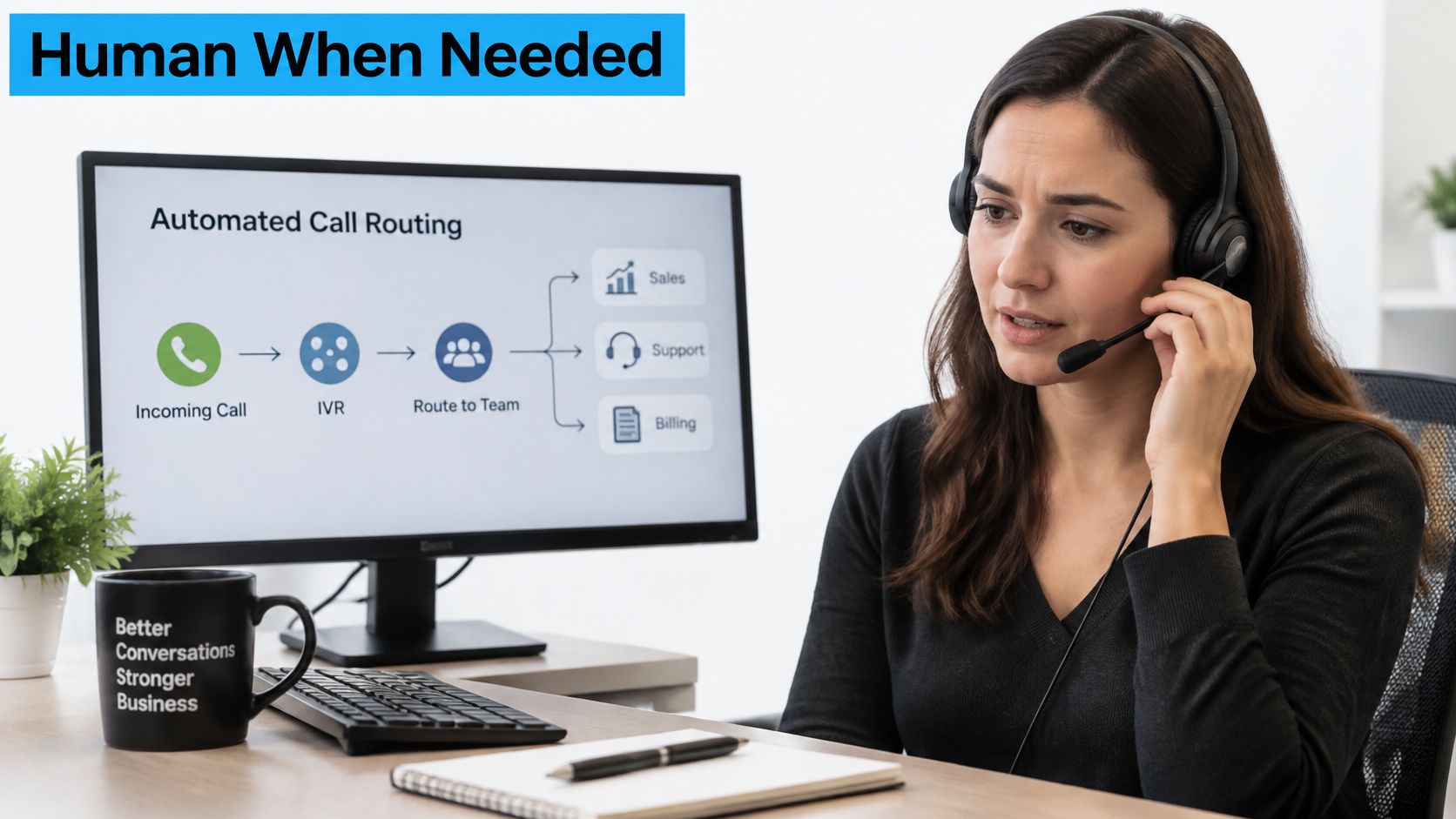
A call is useful only when it reaches the right next step. AI can handle routine requests quickly, while trained receptionists provide support when a caller's situation requires judgement, empathy, or a more nuanced response.
A 2025 survey of 2,243 U.S. adults found that 65% considered voice the fastest way to resolve a customer-service issue. Preferences still vary by task, emotional state, accessibility needs, language, and stakes. A caller may prefer AI for a booking and a person for a billing dispute.
A trained receptionist supported by AI can take over when a conversation calls for human attention. The key is a clear handoff that gives the receptionist enough context to respond without making the caller repeat everything.
Call types and who should answer them
| Call Type | Handle With | Why It Goes There |
|---|---|---|
| Routine booking or reschedule | AI with calendar sync | A structured request can be handled quickly |
| Status update on an existing job | AI with CRM lookup | Current records can answer routine questions |
| Emergency such as a gas smell or flooding | Immediate human escalation | Safety and urgency call for prompt attention |
| Complaint or refund request | Human receptionist | The caller may need empathy and a considered response |
| Complex estimate or legal intake | Human after AI intake | A trained person can handle details that require judgement |
| Caller fails identity check | Human | A person can review the situation before sensitive information is shared |
Recepta.ai's Hybrid Receptionist service uses AI for high-volume, routine conversations and trained agents for complex situations. When AI detects that a caller needs more nuanced help, it hands the call to a human receptionist following the business's playbook. That human support keeps the caller moving toward a resolution rather than leaving them at a transfer prompt.
A useful handoff gives callers a way to reach a person, passes along the conversation context, and makes the next step clear. Businesses that prefer text-first contact can also consider live chat solutions from Premier Broadband, while keeping a voice route available for urgent calls. Recepta.ai's AI answering service explains how AI and human support can work together. Track whether calls reach the right person, whether callbacks happen, and whether callers need to repeat themselves.
What Drives the Price and How to Compare Quotes
There's no single price for a 247 call answering service. Your bill depends on the billing structure and your volume, so compare structures before you compare totals.
Billing structures and their cost risks
| Pricing Model | How It Bills | Main Cost Risk | Best Fit |
|---|---|---|---|
| Flat monthly plan | Fixed fee with included calls or minutes | Overage fees above plan limits | Steady monthly volume |
| Per-minute billing | Charged for each minute of answered calls | Long calls raise cost quickly | Short, predictable calls |
| Per-call billing | Fixed fee per answered call | Spam and repeat calls add cost unless filtered | Low volume with variable peaks |
| Base plus usage fees | Subscription plus AI or human usage | Rates vary by usage tier, see the order | Mixed routine and urgent work |
Run the 900-minute example
Say a plumbing company receives 300 calls a month averaging 3 minutes. That's 900 billable minutes. Compare a flat plan with 1,000 included minutes against per-minute billing using the rate from each written quote. Multiply 900 by that rate, then find the break-even point, the volume where one model becomes cheaper than the other. If the flat plan costs less at 900 minutes but your peak month hits 1,300, the overage line decides the final price.
Ask four questions on every quote.
- What's included: Which minutes, calls, transfers, and integrations sit inside the base fee?
- What's the overage rate: When does it apply, and is it rounded per call or per minute?
- How are junk calls counted: Are spam and wrong-number calls filtered or billed?
- What's the setup cost: Does onboarding, script building, or number setup carry a fee?
Read the overage line before signing. If usage exceeds plan limits, we may charge overage or usage-based fees at the rates shown on the pricing page or in your order. Any rate a provider hasn't published is a question to ask in writing, not a figure to assume. Our guide to after-hours answering service cost shows where those lines usually hide.
Practical rule: Model three months of realistic peak volume, not your average month. Storms, campaigns, and holidays set your bill.
How to Judge a Provider Beyond Pickup Rate
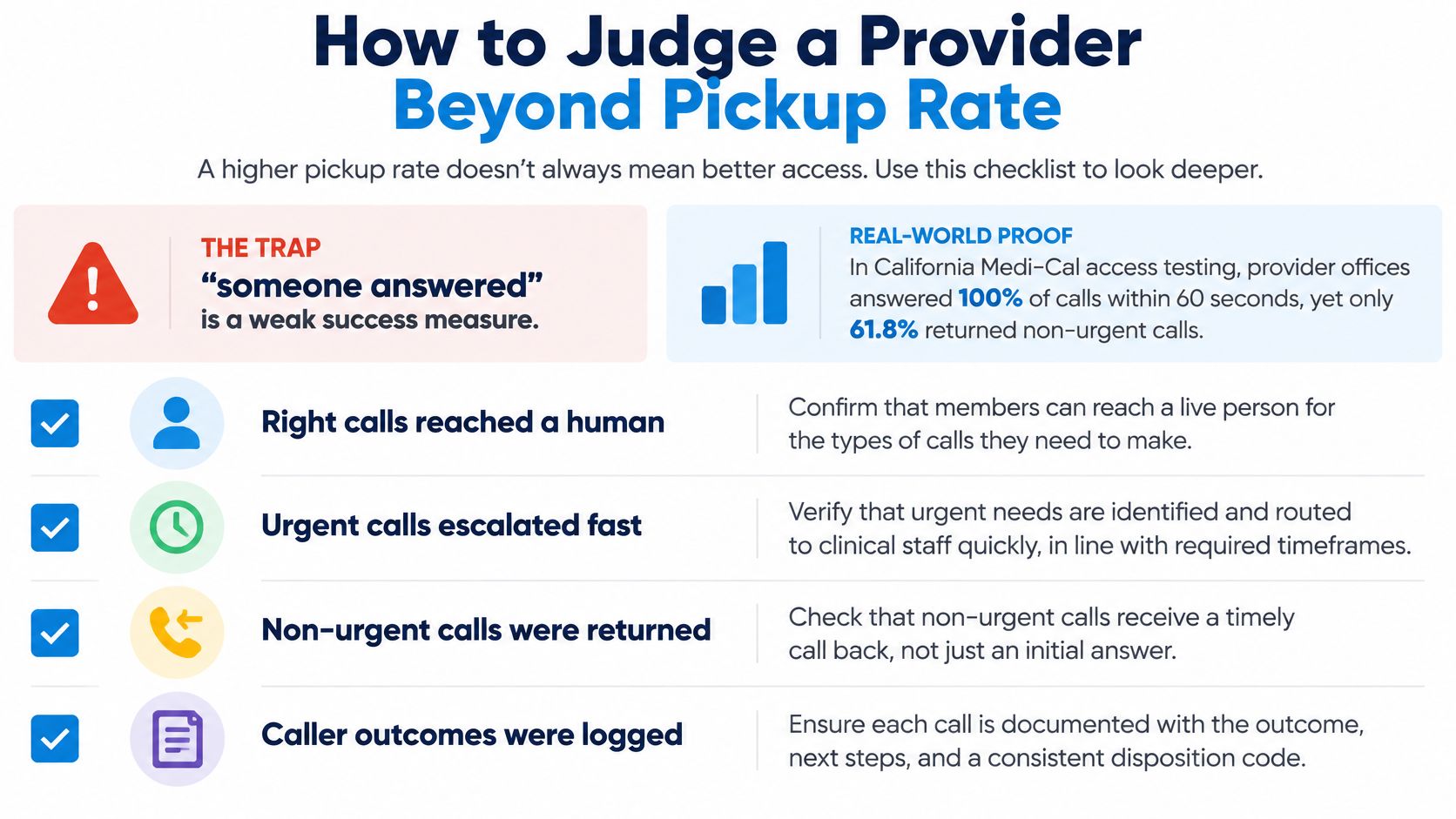
Someone answered is a weak success measure. Recent California Medi-Cal access testing showed provider offices achieved a 100% rate for answering within 60 seconds, yet only 61.8% met the standard for returning non-urgent calls within one business day, according to Health Net's 2025 provider access survey results. Fast pickup, slow follow-up. The caller still waits.
Judge with contact-center metrics instead. The conventional benchmark in the CallForce call center dashboard guide is the 80/20 target, answer at least 80% of offered calls within 20 seconds, with shrinkage at roughly 30 to 35% of paid time unavailable for handling calls. Measure service level separately for business hours, evenings, weekends, and holidays, because one average hides after-hours decline.
Service metrics to request from providers
| Metric | Benchmark or Target | What It Reveals |
|---|---|---|
| Service level | 80% of offered calls answered within 20 seconds | Whether overnight staffing holds up |
| Average speed of answer | Tracked per time window, not one average | Queue wait for answered calls |
| Abandonment rate | Tracked per window; rising rate signals understaffing | Callers who hang up while waiting |
| Shrinkage | Roughly 30 to 35% of paid time unavailable for calls | Real capacity behind the promise |
| Callback completion | Non-urgent calls returned within one business day | Whether promised follow-up actually happens |
| Escalation accuracy | Every urgent call routed to the named on-call person | Whether urgent calls are routed correctly |
Shrinkage explains why a thin overnight roster fails. Breaks, training, and absence eat paid hours, queues grow, and callers abandon. We offer 24/7 coverage with AI and humans on the clock so no call is missed, and our AI receptionist can operate 24/7 with human support layered in where appropriate. That layering only helps if overflow routes to a staffed backup queue before callers wait past the threshold.
Shortlist checklist
- Escalation rules in writing: Named contacts, order of attempts, and time limits per urgent category.
- CRM and calendar integration: Bookings written in real time, not emailed as notes.
- Recording and retention terms: Who can listen, how long files stay, and how access is logged.
- Language coverage: Real support for your callers, not a menu prompt.
- Outcome reporting and exit terms: Booked appointments and qualified leads by window, plus a clean way out.
I'd run a two-week test with your own scripts, then review recordings against the escalation rules. Score the handoffs, not the greetings.
Run a 30-Day Test on Your Own Missed Calls
You don't need a long procurement cycle. Run this sequence with your own numbers.
- Set the baseline: Pull last month's call log and count calls received after hours, calls that went to voicemail, and calls never returned. If your current tooling can't split those out, compare call tracking tools for roofers and other trades to find reporting that can.
- Shortlist three providers: Use the coverage and metrics tables, and keep only providers that commit to the 80/20 service standard in writing and publish their escalation rules.
- Ask how calls reach them: Each customer gets a dedicated local or toll-free number to use for calls. You can forward existing calls to that dedicated number, or have your current business number ported to Recepta.ai completely free of charge. Get cost and timing for each route from any provider in writing.
- Run a 30-day trial: Use your own scripts and playbook, and review recordings each week against the escalation rules. We offer a 30-day trial that's risk-free, backed by a money-back guarantee.
- Measure against the baseline: Compare answer rate, after-hours coverage, escalation accuracy, callback completion, and booked appointments with your step one figures.
- Decide with the numbers: Keep the provider whose outcomes beat the baseline. Drop any service that answers quickly but leaves callers without a next step.
After each urgent call, can you see who called, why, and who owns the follow-up? That one test tells you more than any pickup-rate claim.
Stop losing evening and weekend callers to voicemail and unowned follow-up. Recepta.ai answers around the clock with AI plus trained human receptionists, books appointments to your calendar, escalates urgent calls under your playbook, and logs every outcome so your team can act fast. Start your 30-day risk-free trial at Recepta.ai and judge us on booked jobs and completed handoffs, not rings answered.