
AI Answering Service vs Human Receptionist: Key Differences
About 62% of inbound calls to small businesses go unanswered, including calls that reach voicemail and calls that receive no response at all. An AI answering service addresses that gap by answering immediately, handling routine questions, capturing lead details, routing callers, and booking appointments when your team can't pick up.
That changes the role of the telephone. It isn't just a communication channel or a front-desk task. For a home-services company, medical practice, law firm, insurance agency, or multi-location business, the phone is often the first moment when a prospective customer decides whether to continue. A system that responds consistently can protect that opportunity, but only if it knows its limits and hands sensitive conversations to people.
Why Missed Calls Are Costing You Business
An observational study of 85 small businesses across 58 industries found that only 37.8% of inbound calls were answered by a live person. Another 37.8% went to voicemail, while 24.3% received no response, meaning about 62% of calls went unanswered overall, according to the small-business missed-call analysis.
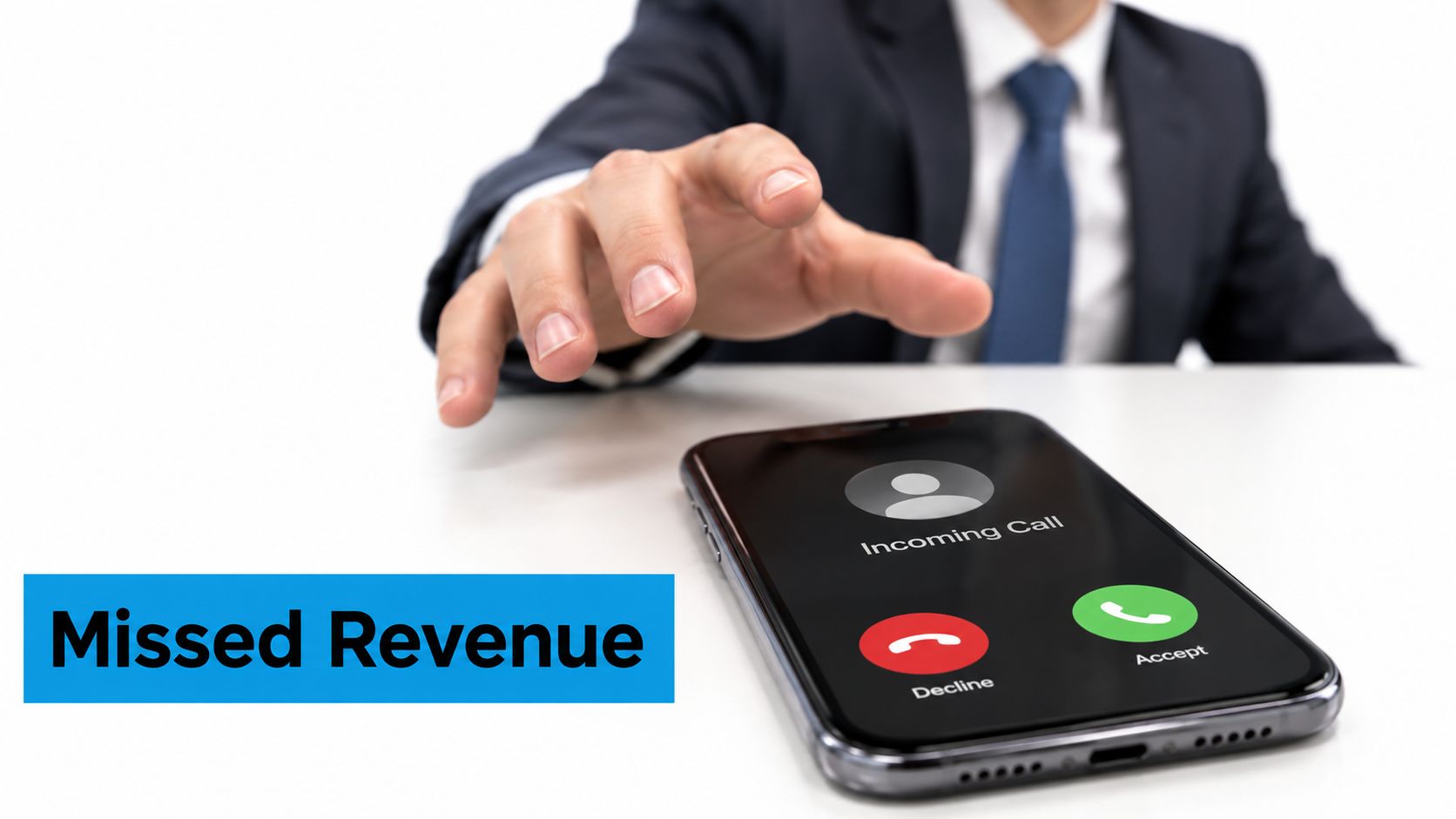
The commercial problem isn't limited to lost conversations. A caller may be trying to schedule a service, ask whether a clinic accepts new patients, check an appointment, or report an urgent repair. Voicemail makes the caller responsible for waiting, explaining the situation again, and trusting that someone will respond. Many just continue looking.
Business owners face a real trade-off. A human receptionist can interpret unusual requests and create rapport, but one person can't cover every hour or absorb every surge. An AI answering service supplies an always-on first response, while a human team handles work that requires judgment, empathy, or authority.
From answering calls to protecting revenue
A capable system can greet callers, answer approved frequently asked questions, collect names and contact details, qualify an inquiry, and route the conversation by intent. It can also connect to a calendar to book, reschedule, or cancel appointments rather than merely recording a message. Practical missed-call recovery workflows show why the follow-up process matters as much as the initial answer.
For example, a pest-control company could ask for the property location, identify whether the request falls within its service area, and offer an available visit. A dental practice could provide office-hours information and send a new-patient request to the appropriate scheduling path. In both cases, the useful outcome is not “the call was answered.” It's the next operational step was completed.
Practical rule: Treat every inbound call as a workflow trigger. Decide what information the system must collect, what action it may take, and which conditions require a person.
The strongest implementation doesn't try to make AI replace every receptionist. It assigns automation to repetitive, well-defined interactions and reserves human attention for exceptions. That approach turns availability into a controlled operating process instead of a promise that depends on someone noticing a ringing phone.
The Rise of AI Phone Support in Business
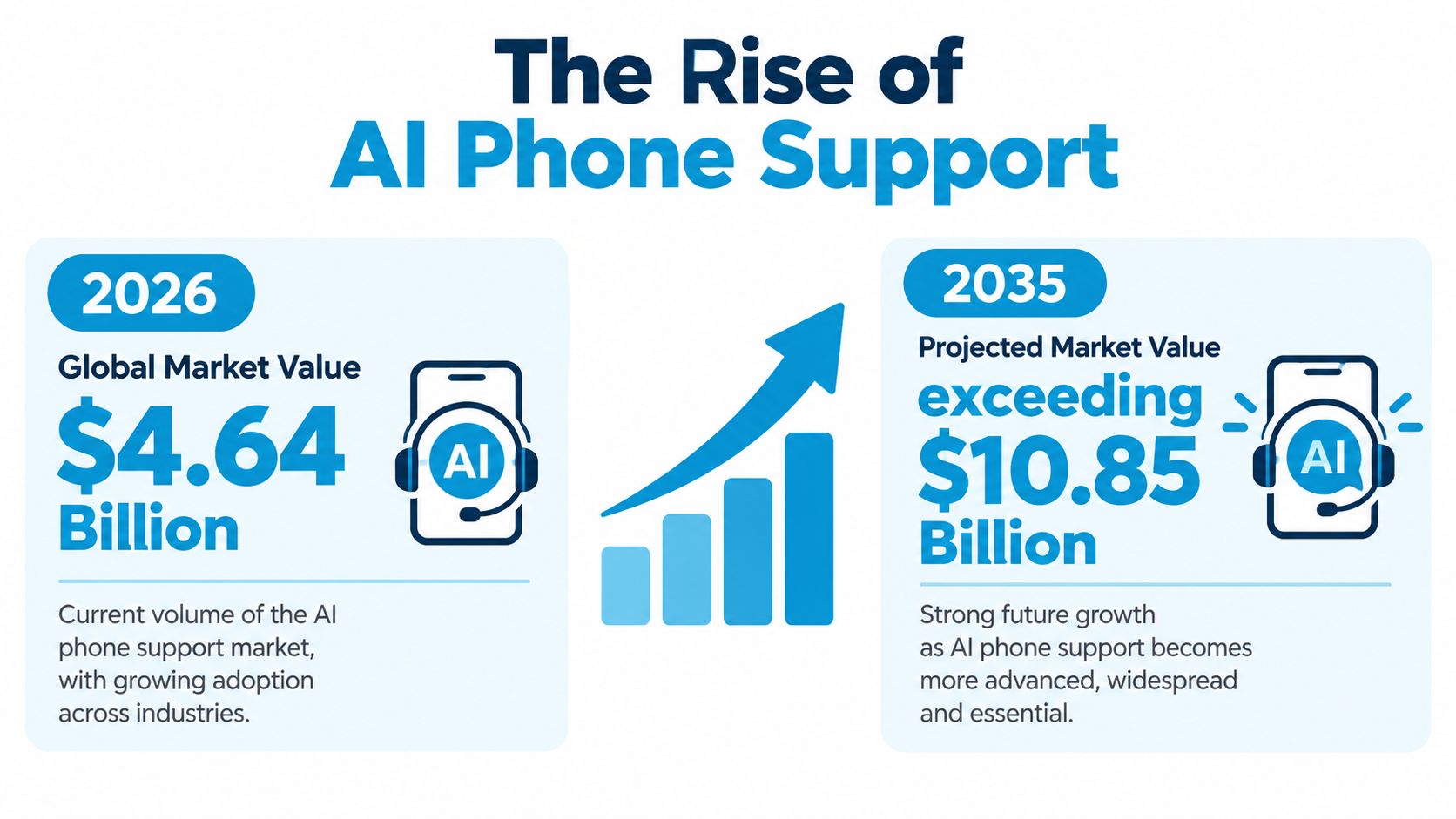
The market signals point to a broad shift in how companies handle first contact. The global virtual receptionist service market was valued at USD 4.64 billion in 2026 and is projected to exceed USD 10.85 billion by 2035, reflecting a 9.8% compound annual growth rate over that period, according to Business Research Insights' virtual receptionist market analysis.
The same market source estimates the U.S. market at USD 5.26 billion in 2025, Europe at USD 4.62 billion, and China at USD 3.34 billion. Those figures indicate that automated reception isn't confined to one local niche. Businesses across major markets are paying for call answering, routing, appointment scheduling, and lead capture as operational capabilities.
Voice AI adoption reinforces that direction. One industry report says 78% of surveyed businesses had deployed or were actively piloting a Voice AI solution in 2025, up from 45% two years earlier, while 84% planned to increase Voice AI spending during the following 12 months, as reported in this industry market overview.
Why adoption is moving beyond experiments
A pilot usually proves that a system can hold a conversation. A production deployment must also update records, respect business rules, route exceptions, and provide evidence of what happened. That distinction explains why adoption is spreading in industries where the telephone already drives scheduling, intake, dispatch, or customer support.
The opportunity also extends beyond reception. Teams assessing customer service automation use cases can see how voice interactions fit alongside service workflows, follow-up, and record management. An insurer, for instance, may use an AI agent for routine policy questions while directing claims or sensitive account issues to trained staff.
The projected voice AI agents market illustrates the scale of the technology shift. One market outlook values that market at USD 2.4 billion in 2024 and projects it to reach USD 47.5 billion by 2034, a 34.8% compound annual growth rate, according to the cited industry outlook in the same research context.
The takeaway isn't that every business should automate every call. It's that AI phone support has become a serious infrastructure decision. Businesses should evaluate it like any other operational system, with clear ownership, integration requirements, test cases, escalation paths, and review cycles. Further context on the operational side appears in the benefits of AI in customer service.
AI Answering Service vs Human Receptionist
The comparison isn't just machine versus person. It's availability and repeatability versus judgment and empathy, and most practical deployments use both.
| Feature | AI Answering Service | Human Receptionist |
|---|---|---|
| Availability | Can answer outside normal office hours and during peak demand | Depends on staffing, schedules, breaks, and call volume |
| Simultaneous calls | Can manage multiple conversations when the platform and telephony setup support it | Usually handles one live conversation at a time |
| Routine questions | Delivers approved answers consistently | Can answer routine questions and clarify unexpected details |
| Scheduling | Can book, reschedule, or cancel through connected calendars and rules | Can manage complex scheduling decisions and exceptions |
| Routing | Uses caller intent, context, and configured rules | Uses judgment, familiarity, and direct conversation |
| Emotional situations | Can detect defined escalation signals, but has limited human empathy | Better suited to distress, conflict, and sensitive conversations |
| Consistency | Follows configured scripts, knowledge, and permissions | Performance can vary by person, training, and workload |
| Oversight | Requires monitoring, testing, and knowledge updates | Requires coaching, supervision, and quality review |
Where AI has a clear operational advantage
An AI answering service doesn't take breaks, call in sick, or stop accepting calls when several customers contact the business at once. It can give every caller the same approved opening, ask the required intake questions, and create a consistent record. That makes it useful for appointment requests, service-area checks, basic FAQs, lead qualification, and after-hours coverage.
A plumbing company could let AI collect the address and nature of a leak, then route an urgent request to the on-call technician. A receptionist may be better positioned to negotiate a complicated commercial appointment, calm an angry customer, or interpret a request that falls outside documented policy.
Businesses should also avoid assuming that “human” automatically means “better.” A human who is unavailable, rushed, or forced to repeat the same answers all day may deliver a poor experience. The right comparison asks which party can complete each task reliably, at the moment the caller needs it. A useful overview of the human role is available in what receptionists do.
Decision principle: Automate predictable work, not responsibility. Keep a human accountable for exceptions, sensitive decisions, and conversations where trust matters more than speed.
A hybrid model often works best. AI handles the first response and structured data collection, then transfers with a summary when the caller requests a person, expresses distress, asks for an exception, or reaches a high-risk workflow. The business gets wider coverage without pretending that a conversational system can replace human judgment in every circumstance.
How AI Call Handling Works Under the Hood
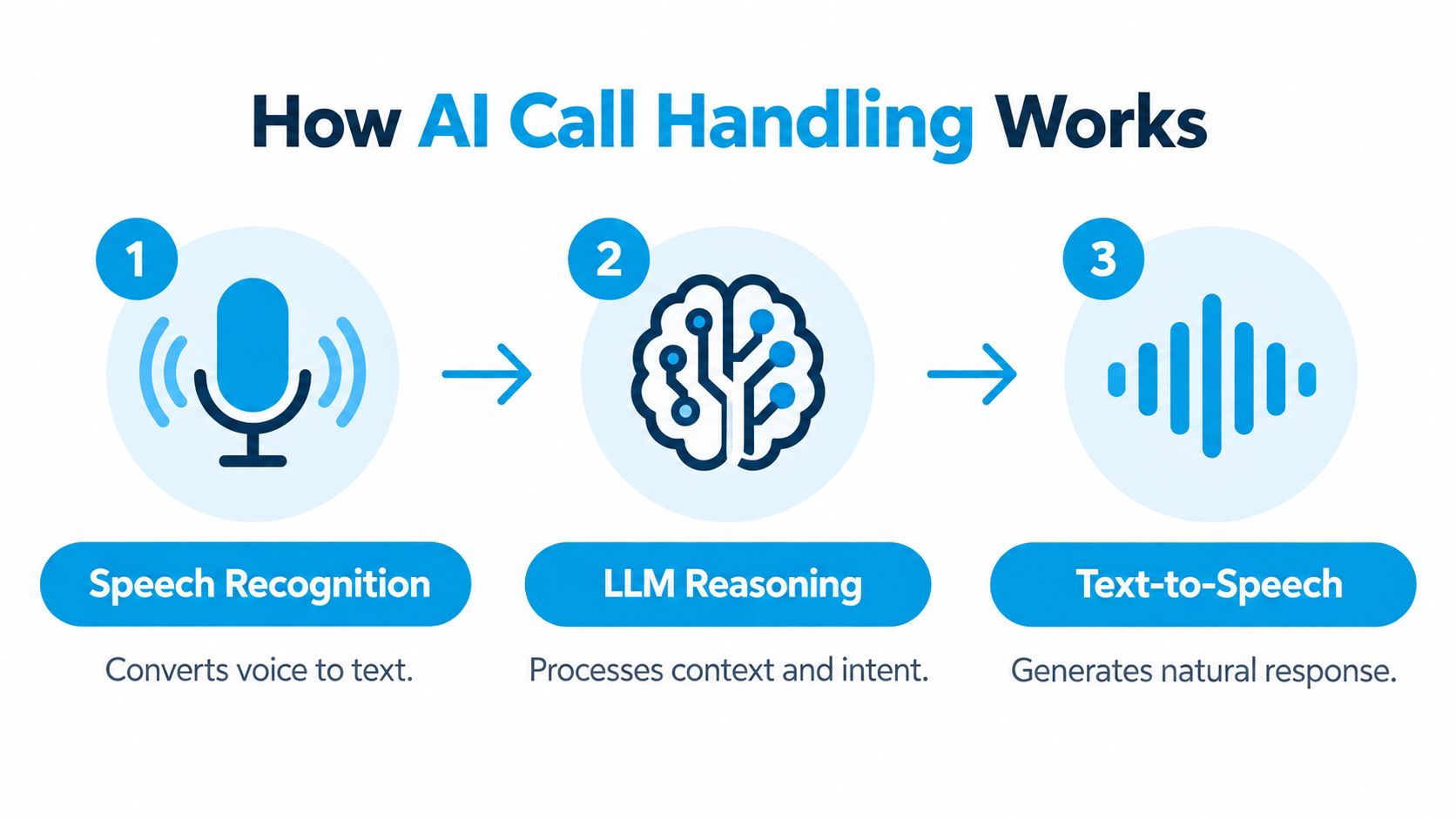
An AI answering service turns speech into a sequence of technical steps. The caller speaks, the system converts that audio into text, an AI model interprets the words and business context, and a voice engine produces the reply.
The voice pipeline
Speech recognition converts the caller's audio into text. Background noise, accents, names, poor connections, and industry terminology can create errors at this stage.
Language-model reasoning interprets the request, conversation history, business knowledge, and configured rules. It determines whether the caller wants to schedule, ask a question, provide information, or reach a person.
Text-to-speech turns the approved response into spoken audio. The system must also manage interruptions, pauses, confirmations, and corrections so the exchange doesn't feel like a rigid recording.
A fourth layer connects the conversation to business systems. The agent may check a calendar, write a CRM record, create a ticket, send a confirmation, or transfer the call. Without those integrations, the system may sound capable while still leaving staff to perform the administrative work manually. Teams looking at healthcare automation can also explore how connected systems help automate clinical workflows, provided privacy and authorization requirements are addressed.
Why latency changes the experience
Production guidance across contact-center and voice-AI sources converges on keeping total turn response below roughly 500 to 800 milliseconds for natural flow, with component budgets often cited around ASR under 200 milliseconds, LLM reasoning under 300 to 400 milliseconds, TTS under 150 milliseconds, and network overhead under 50 to 100 milliseconds, according to voice AI production guidance from Persistent.
Once the full turn rises above roughly 1.4 to 1.7 seconds, the interaction begins to resemble common median performance rather than best-in-class behavior. P90 latency above 3.5 seconds is generally considered broken for callers. Independent benchmark data reported median turn latency of 1.73 seconds for ElevenLabs, 1.96 seconds for Retell AI, 2.34 seconds for Vapi, and 3.16 seconds for Synthflow, while the same source notes that close infrastructure placement can reduce enterprise round-trip delay to below 200 milliseconds in production and below 50 milliseconds at the regional median, as described by Telnyx's voice AI provider benchmark.
Ask vendors for end-to-end latency measurements, not isolated model claims. The caller experiences the entire chain, including telephony routing, network travel, reasoning, and audio generation.
Practical Examples of Smart Routing and Booking
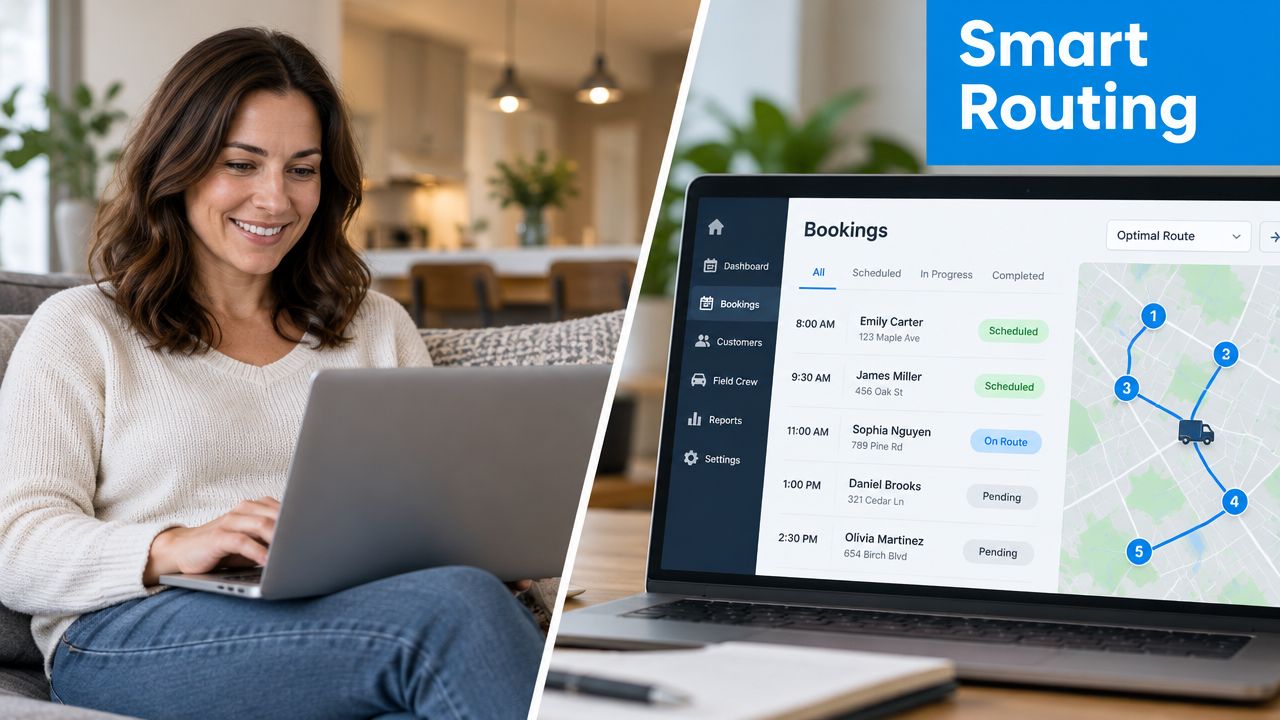
A useful AI answering service does more than say hello and record a message. It listens for intent, collects the information needed for the next action, and follows rules that determine whether to book, route, or escalate.
Home services
A homeowner calls an HVAC company and says the system has stopped working. The agent can ask whether the issue is urgent, collect the service address, check whether the address falls inside the company's service area, and identify available appointments. If the caller describes a condition that the business classifies as an emergency, the system can route the call to the on-call team instead of placing it into a routine booking queue.
The workflow should include confirmation. Before ending the call, the agent can repeat the address, appointment window, contact details, and any information the technician needs. A calendar entry and CRM record then give the dispatcher a usable handoff rather than a vague note that says “customer needs help.”
Legal intake
A law firm can configure a separate intake path for a prospective client. The system might ask for the caller's name, contact information, general practice area, and preferred consultation time. It can route a family-law inquiry differently from a personal-injury inquiry, while sending unusual or sensitive questions to the appropriate staff member.
The AI shouldn't promise representation, provide legal advice, or make a conflict determination beyond the firm's approved process. Its role is to gather structured information and schedule the next conversation. Human staff still review the intake and make professional decisions.
Clinics and appointment-based businesses
A clinic can use connected scheduling rules to offer available appointment types, reschedule an existing booking, or answer basic questions about hours and location. The system can also recognize when a caller is asking about a medical concern that belongs with trained staff rather than a scheduling workflow.
Intent-based routing works because the system uses keywords and conversation context to send callers to the correct human agent, department, location, or line. One caller may need sales, another billing, and another technical support. The routing logic should be tested with different phrasings, interruptions, accents, and incomplete information before it handles live traffic.
A fast transfer to the wrong person is still a failed call. Measure the quality of the handoff, not just the existence of one.
Governance Risks and Compliance Essentials
Launch-day accuracy is not a permanent property. A business changes its hours, services, prices, appointment rules, staff assignments, escalation contacts, and regulatory obligations. If those changes don't reach the AI's knowledge and workflows, the system can remain fluent while giving outdated or unauthorized answers.
That is operational drift. It's often more dangerous than a visibly broken bot because callers and managers may assume a smooth conversation was a correct one.
What governance should control
A regulated business should define which information the AI may use, which actions it may take, and when it must stop. The control framework should include:
- Knowledge ownership: Assign a named person or team to approve updates to FAQs, policies, hours, and service information.
- Permission boundaries: Prevent the system from making commitments, disclosing protected information, or changing records without the required verification.
- Escalation rules: Specify triggers for human handoff, such as distress, uncertainty, complaints, emergencies, or requests outside policy.
- Conversation evidence: Retain appropriate transcripts, summaries, dispositions, and audit records so managers can review what the system did.
- Continuous testing: Re-run representative calls after prompt changes, integration changes, new regulations, and staffing updates.
- Incident handling: Create a process for correcting inaccurate answers, notifying affected teams, and temporarily disabling a workflow when necessary.
Recent industry coverage frames governance as a legal exposure issue rather than merely a policy preference. It also reports that 62.6% of voice AI deployments were on-premises in 2026 because of regulatory and security concerns, while 76.4% of demand favored fully integrated platforms, according to Parloa's conversational AI trends coverage.
Questions for vendors
Ask how the provider separates customer data, controls access, records changes, tests workflows, and supports deletion or retention requirements. Healthcare buyers should review a provider's configuration and contractual commitments rather than assume that an AI label means the workflow is compliant. A focused guide to HIPAA-compliant answering services can help teams organize that due diligence.
For finance, insurance, and legal operations, ask to see an escalation demonstration. Test an ambiguous request, a request for restricted information, a complaint, and a call that needs a human. The vendor should explain what gets transferred, what the human sees, and how the organization verifies that the system followed policy.
Making the Switch, Key ROI and Next Steps
The financial case should start with your own call records, not a vendor's headline promise. Count unanswered calls, voicemail outcomes, appointment requests, after-hours inquiries, staff time spent on repetitive questions, and the value of calls that require an immediate response.
Use a pilot to compare baseline performance with the new workflow. Track:
- Answer coverage: How often callers reach a live AI or human path.
- Qualified lead capture: Whether the system records complete, usable details.
- Booking completion: Whether callers finish with a confirmed appointment.
- Escalation quality: Whether exceptions reach the right person with context.
- Data accuracy: Whether CRM and calendar records match the conversation.
- Governance performance: Whether tests remain successful after changes to knowledge, prompts, and business rules.
Publisher-provided customer reports for Recepta.ai cite up to 30% more qualified leads, 80% cost savings versus in-house reception, and a 15× ROI, as stated in the company's product information. Treat those figures as reported outcomes, not a forecast for your business, and ask for definitions, measurement periods, and comparable operating conditions before using them in a financial model.
A practical vendor checklist includes calendar and CRM integration, transparent analytics, configurable permissions, reliable human escalation, testing support, and a clear compliance posture. Start with one call type, define the allowed actions, review transcripts, and expand only after the system performs reliably under real conditions.
Recepta.ai combines 24/7 AI and human receptionist support for inbound and outbound calls, lead capture, appointment scheduling, follow-ups, and escalation when a conversation needs human expertise. Visit Recepta.ai to assess how its integrations, call summaries, analytics, and compliance-ready workflows could fit your phone operations.