
How Do You Get Sales Leads? a Practical Guide for 2026

An average B2B lead waits 47 hours for a first reply, only 23% of companies responded within five minutes, and 42% took more than 24 hours, according to Spara's speed-to-lead benchmark. That changes the question. How do you get sales leads isn't only a traffic problem, it's a response-operations problem. Home services, healthcare, legal, insurance, and other appointment-driven businesses lose winnable inquiries after capture, through missed calls, slow follow-up, and no clear owner. Fix the handoff first, then scale the sources that feed it.
Choose the Lead Sources That Fit Your Business
At least six in ten consumers use Google Search or Google Maps as their first destination when searching for a local business, according to BrightLocal's 2025 SMB Marketing Report. B2B buyers behave differently. They use an average of 10 interaction channels during a purchase, up from five in 2016, in McKinsey research published in 2024. Pick channels by buying behavior, not habit. If you're weighing awareness work against direct capture, our guide to lead generation versus demand generation helps separate the two jobs.
Lead Sources Compared for Service Businesses
| Lead source | Best for | Time to first leads | Main effort |
|---|---|---|---|
| Google Business Profile | Local services such as plumbing, dental and cleaning | Days to weeks | Keep hours, categories and photos current |
| Website content and gated resources | Law firms, insurers and pest control | Weeks to months | Publish guides and maintain a lead form |
| Referrals and reviews | Home services and franchises | Days to weeks | Ask every satisfied client for a review or referral |
| Social outreach | B2B services and property management | Weeks | Research prospects and respond with specific help |
| Outbound calls and email | Reactivation and targeted accounts | Days | Verify contact data and personalize each message |
| Paid search | Urgent services such as emergency repair | Immediate | Requires same-hour follow-up to pay off |
A plumber should start with a verified Google Business Profile, accurate hours, service categories for emergency leak repair and drain cleaning, recent photos, and a direct call button. A law firm gets more from a workplace injury guide paired with a downloadable case-preparation checklist. A pest-control company can do the same with a seasonal infestation guide tied to a quote request.
Social outreach earns its place for cold prospects. In HubSpot's 2025 survey of 1,000 global sales professionals, 42% said social media produced their highest cold-outreach response rate. Outbound email only works if your sending setup is sound, which is why reviewing the basics of email infrastructure for outbound sales is worth doing before you scale volume. I would pick two sources that match where your customers already search and book, and run them well before adding a third.
How to Set Up Lead Capture and Fast Response
Treat form submission as the start of the race, not the finish. In a study of 2,241 U.S. companies cited by Vida's speed-to-lead guide, only 37% responded to web inquiries within an hour, the average response among companies that replied was 42 hours, and 23% never responded at all. Companies contacting prospects within an hour were nearly seven times more likely to qualify them than companies waiting one additional hour, and more than 60 times more likely than companies waiting 24 hours or longer.
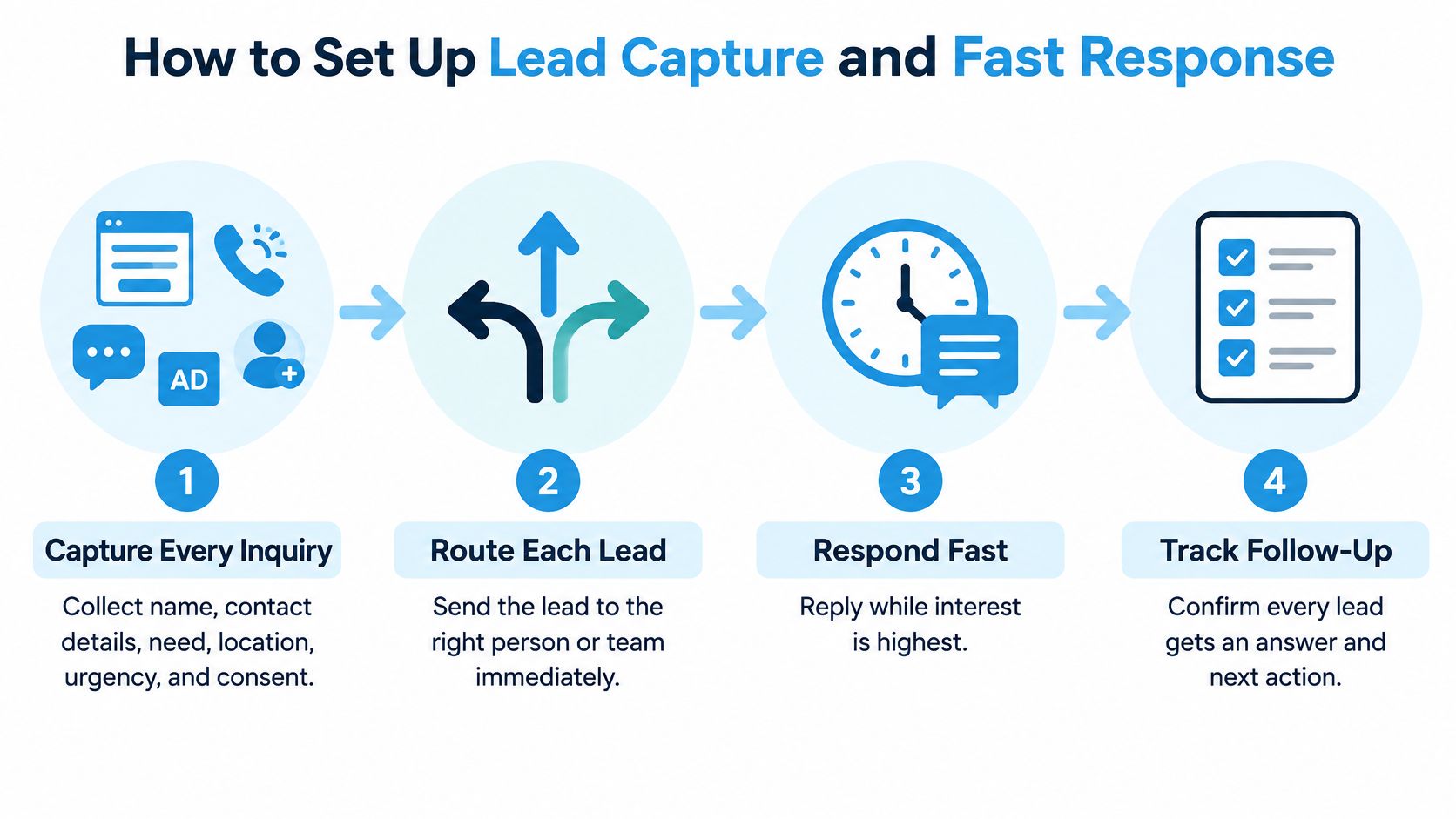
The Five-Minute Workflow
- Capture every inquiry. Pull website forms, phone calls, chat, advertising, and referrals into one place, with mandatory fields for contact details, need, location, urgency, and consent. The common slip is letting one source, usually chat or a Facebook form, sit outside the CRM.
- Route immediately. Assign by geography, service type, value, and availability so one person owns each lead. Shared inboxes without ownership are where inquiries die. Our lead capture examples show how different businesses structure this intake.
- Attempt contact within five minutes. Use the prospect's preferred channel first, then run a structured sequence of calls, messages, and personalized email over several days. This matters most for paid traffic, where paid advertising for service-area businesses sends you people who are comparing providers right now.
- Book the next step on the spot. Don't send a qualified prospect a link and hope. We capture and qualify leads based on your custom criteria, screen for fit immediately, place confirmed appointments directly on your calendar, and trigger follow-ups.
- Log every attempt in the CRM. Tag the source and measure contact rate, qualified-lead rate, appointment rate, and revenue by source. If it isn't logged, you can't tell which source pays.
Keep qualification questions short and specific to your work, such as case type for a law firm, vehicle model for a towing company, or project timeline for a remodeler. Generic forms collect names. Specific questions collect bookable jobs.
Weekly check: How many of last week's leads were contacted within five minutes? If you can't answer that in two minutes, that's your first fix.
Recover Missed Calls and After-Hours Inquiries
Say an emergency plumbing company gets a leak call at 10 p.m. Nobody answers. The homeowner doesn't leave a voicemail and wait until morning, she calls the next company on the list. Now picture the same call handled well. The intake assistant confirms the address and urgency, books the first visit for 7 a.m., and sends the on-call technician a written summary. Same lead, opposite outcome.
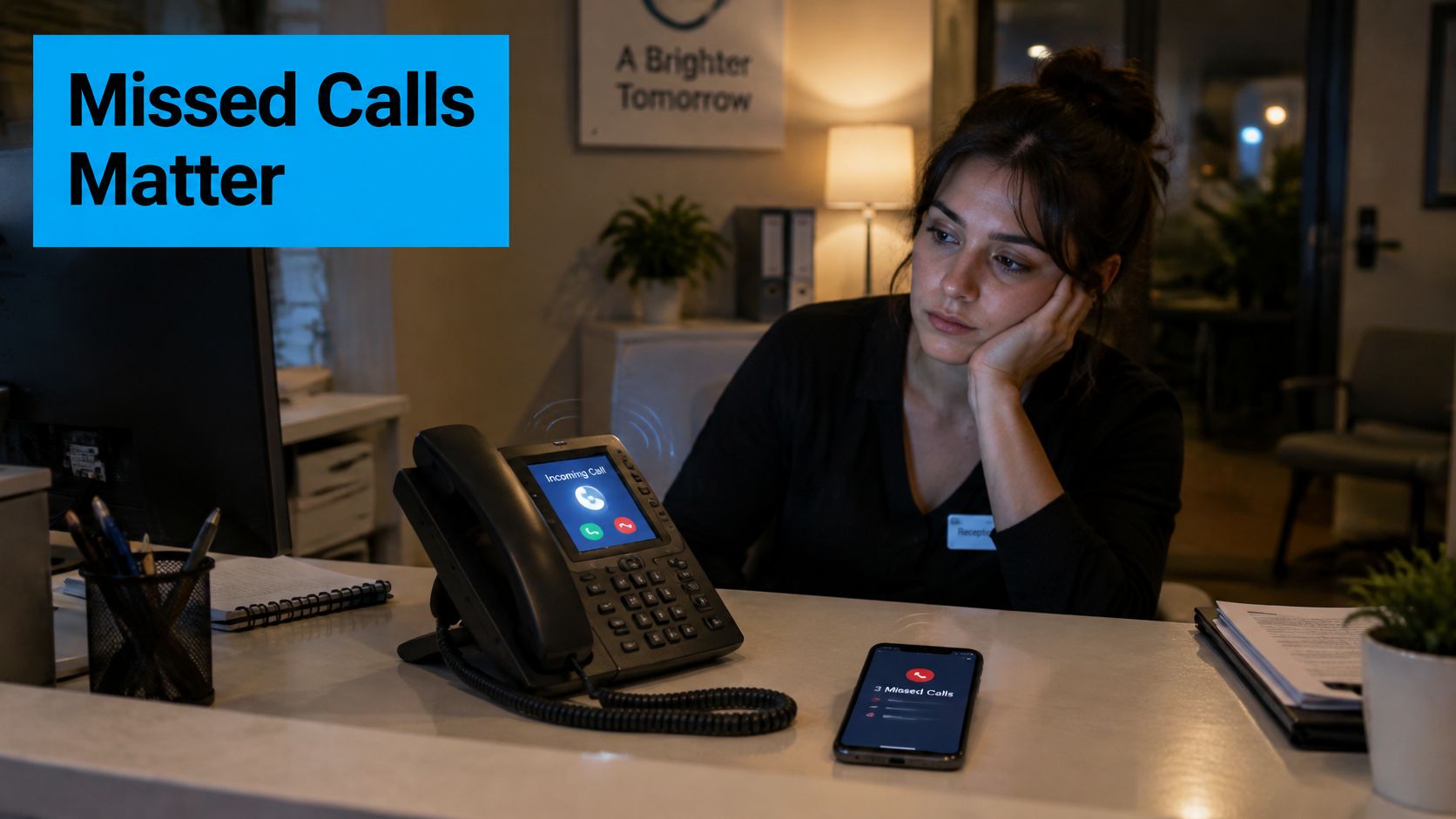
For dental offices, HVAC companies, and law firms, after-hours demand isn't a bonus. It's often the highest-intent demand you get, because something just broke, started hurting, or became urgent.
Three Fixes in Order
- Answer around the clock. Cover every call, text, and web chat with the same intake questions your daytime team uses, so a 9 p.m. prospect gets a real reply in minutes. Our 24/7 web chat engages website visitors, handles inquiries, captures leads, and books appointments from your site day or night.
- Filter before you escalate. Call filtering removes spam, solicitors, and low-value calls, and escalates only important inquiries to your team. Your on-call person should see real customers, not robocalls.
- Text back automatically. Messaging can be triggered by new leads, missed calls, upcoming appointments, or customer lifecycle milestones, as configured in your account. An instant text after a missed call keeps the conversation alive, and a reminder before the appointment cuts no-shows.
Set the escalation rule before you automate anything. Pricing, scheduling, and availability questions get answered immediately. Complex legal, medical, or warranty questions go to a person within a window you define. An AI receptionist such as Recepta.ai can cover this intake well, provided that rule is configured first.
Track missed-call recovery as its own metric, the percentage of missed calls that became booked appointments. If you don't measure it separately, recovered revenue hides inside your general call volume and you'll underfund the fix.
Outbound Prospecting That Gets Replies
Cold outreach fails when it's untimely, not when it's cold. Start with buying triggers that make your message relevant today, a new location, a staffing shortage, an appointment backlog, missed-call exposure, or an expansion. Segment by industry, size, geography, and operational complexity. Then verify contact data before sending anything, because bad records waste your reps' time and damage deliverability for the good records.
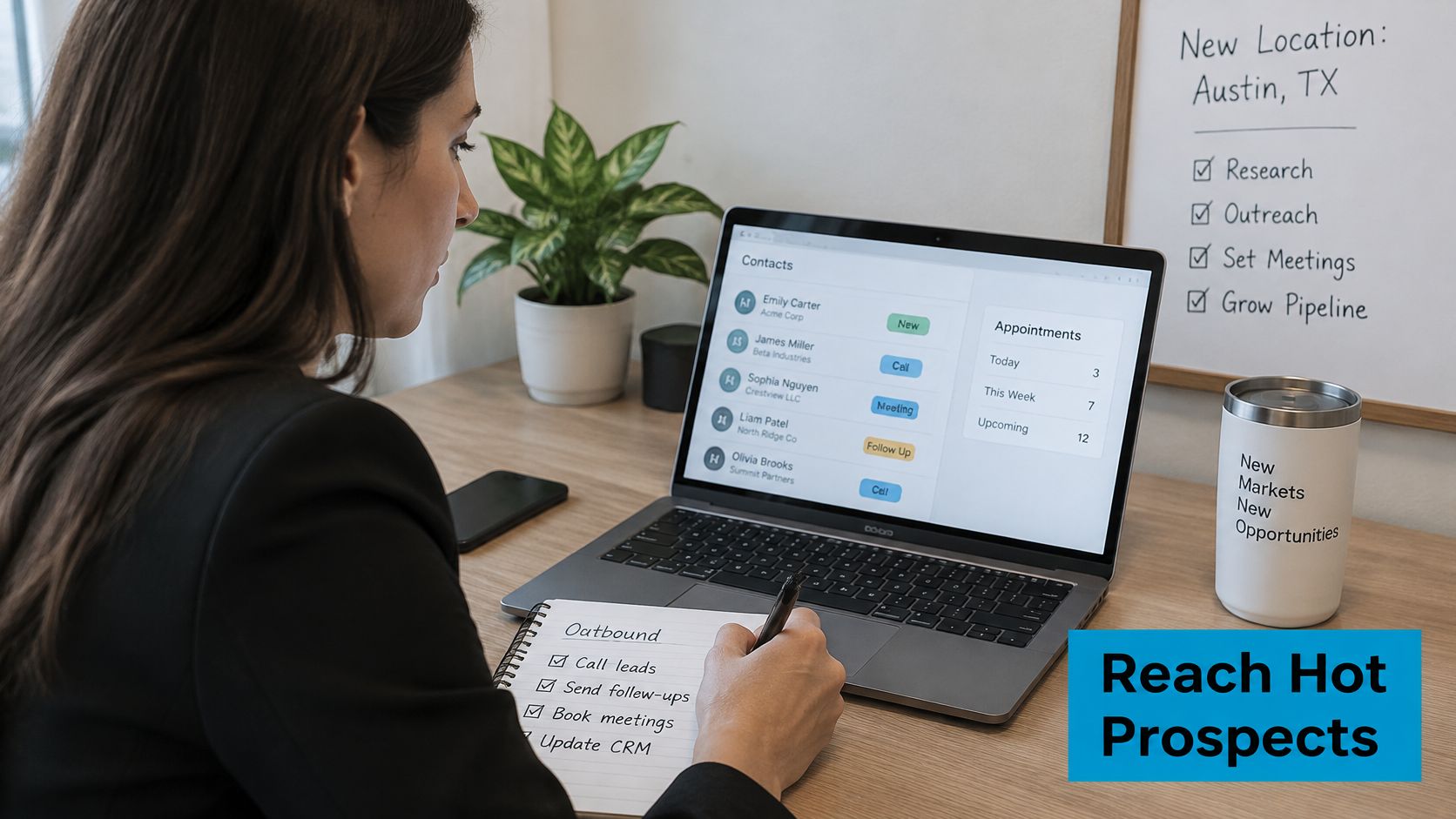
HubSpot reports that 96% of prospects research companies and products before engaging with a sales representative, and its prospecting guidance describes a 3-3-3 framework, spend three minutes researching a prospect, identify three relevant insights, and use them to create a three-sentence outreach message. That structure respects the research your prospect has already done.
A Worked Example
Say you run a commercial cleaning company. You spot a property manager whose firm just added a building. Your three insights are the new address, the building type from their website, and a likely turnover cleaning need during move-ins. Your three sentences reference the new building, name the specific problem of keeping common areas ready during tenant transitions, and offer one low-friction step, a 15-minute walkthrough. That reads as useful. A generic pitch about your services reads as noise.
If you want a fuller sequence framework, Ploot's guide to outbound lead generation is a solid complement, and our outbound call script gives your reps the talk track for the calls inside that sequence.
Test one variable at a time, the offer, subject line, call to action, or segment, and judge by qualified meetings, not opens. The mistakes that burn lists are predictable, buying unverified data, sending generic claims, optimizing for cheap contacts, and failing to suppress existing customers. Pick one trigger and one segment, and run a two-week test before you broaden.
Nurture Leads Until They Are Ready to Buy
Say a law firm publishes a detailed article on what to do after a workplace injury. Most readers aren't ready to hire anyone that day. So the firm offers a downloadable case-preparation checklist that collects name, email, and case type, then sends educational follow-ups over several weeks. When a contact replies or returns to the consultation page, an attorney offers a call. The content did the early work, the checklist captured the lead, and the sequence kept the firm present until the timing was right.
A pest-control company runs the same play with a seasonal pest-prevention guide offered as a checklist that collects address and property type. Different trade, identical mechanics.
The Three-Step Sequence
- Offer one useful resource per lead source. Place it where the visitor is already searching, not buried on a resources page.
- Send two or three educational messages over one to three weeks. Each one teaches something specific and ends with a single clear next step. Our guide to lead nurturing automation covers how to schedule these without manual effort.
- Hand off on intent signals the same day. A reply, a return visit to your pricing page, or a quote request means a salesperson calls today, not next campaign cycle.
The Content Marketing Institute's 2025 B2B benchmark found 74% of marketers said content marketing generated demand or leads, 62% said it nurtured subscribers or leads, and 49% said it generated sales or revenue. Content isn't just awareness, it carries leads through to revenue when it's tied to a capture event.
The common slip is sending the same newsletter to hot and cold leads. The downloaded checklist is your simplest segmentation tool, because what someone downloaded tells you what they're worried about.
Measure Each Stage of Your Lead Funnel
A raw lead count tells you almost nothing. A dental practice can celebrate rising form fills while its booked appointments fall, because nobody's watching what happens between inquiry and chair. Track four conversions instead, lead to qualified lead, qualified lead to booked meeting, meeting to opportunity, and opportunity to customer, and start with speed, the stage most businesses skip entirely.
Lead Funnel Benchmarks to Track
| Funnel stage | Metric to track | Reported benchmark |
|---|---|---|
| Inquiry response | Share of leads contacted within one hour | 37% of companies (U.S. study) |
| Speed to qualification | Qualify rate when contacted within one hour vs. one hour later | Nearly 7x higher within one hour |
| Response time | Average first reply, B2B | About 47 hours |
| Lead to qualified | Share of leads that qualify | Record your first four weeks |
| Qualified to meeting | Share of qualified leads booked | Record your first four weeks |
| Opportunity to customer | Share of opportunities that buy | Record your first four weeks |
Read the benchmark rows as reference points, not targets. The three baseline rows matter more, because they show whether your own funnel is improving. A local firm handling 20 leads a week should judge its trend first and industry averages second.
Compare each source against its own history. A source that's improving beats a source that merely looks good against someone else's benchmark.
Build a Monday routine. Pull leads, qualified leads, booked meetings, and revenue by source for the last four weeks. Then move budget from sources with low qualified rates toward sources with high ones, changing one thing at a time so you know what caused the shift.
Say that dental practice finds its paid-search leads rarely book when they arrive after hours. The right move isn't more ad spend. It's after-hours answering first, then a budget increase once the leak is closed. Measurement tells you where the funnel leaks. Spending before you know just fills a leaking bucket faster.
Confirm Your First Lead Source This Week
You don't need a quarter to get this running. You need seven days and a willingness to fix response before reach.
The Seven-Day Plan
- Day one. Pick the two lead sources from the comparison table that match where your customers search and book. Write them down and ignore the rest for now.
- Day two. If local search matters, claim and verify your Google Business Profile. Add service areas, accurate hours, and a direct call or booking action.
- Day three. Put your intake fields and five-minute response target into your CRM or phone system. Name one owner for each inbound source.
- Day four. Choose one outbound trigger and one segment. Verify the contact data, then write three three-sentence messages using real account research.
- Day five. Start a nurture sequence built around one useful resource for your main source, a checklist, a guide, or a quote tool.
- Day six. Build the funnel table with this month's numbers as your baseline, including response time and missed calls.
- Day seven. Review the week's response times and missed calls, find the slowest step, and fix that before anything else.
If you add support at any point, keep setup simple. Our onboarding flow has four steps, tell us about your business, upload or build your scripts, set routing rules, and connect your calendar. That sequence mirrors the plan above, sources first, then intake, then routing.
Do one thing today, claim your Google Business Profile or set the five-minute response target, whichever is still missing.
If missed calls and slow follow-up are costing you booked jobs, Recepta.ai answers every call, text, and web chat around the clock, qualifies each lead against your criteria, and places confirmed appointments directly on your calendar. Visit Recepta.ai to hear how it would handle your next after-hours inquiry and start recovering leads you're already paying to attract.