

Administrative Burden: Causes, Costs, and How to Reduce It
The OECD found that red tape can account for about 4% of annual company turnover, with the smallest firms carrying the heaviest relative load (OECD analysis of businesses' views on red tape). That isn't an irritation to file away under “general overhead.” It's a business design problem that can absorb selling time, delay service, frustrate employees, and push customers toward competitors.
Administrative burden includes the work required to understand obligations, collect information, complete forms, retain records, and prove compliance. It also includes the friction created when a digital process fails and someone has to recover an account, repeat identity checks, re-enter data, or wait for a human escalation. The practical question isn't whether your company has admin. Every company does. The question is whether the work is necessary, well designed, and measured closely enough to improve.
What Administrative Burden Actually Costs Your Business
The OECD uses administrative burden to describe the regulatory costs of complying with government information obligations, including requesting licenses, filling out forms, and meeting reporting or notification requirements. Its cross-country work helped turn “too much paperwork” into a measurable policy and management issue, while the Standard Cost Model gave governments a way to estimate monetary cost by combining compliance time, labor cost, and obligation frequency (OECD cross-country study of administrative burdens).
For a business owner, the same logic applies. Count the activity, identify who performs it, estimate the time involved, and connect it to the cost of that person's capacity. Then add the opportunity cost. A technician entering information after a job isn't only doing admin. That technician is unavailable for another appointment, a follow-up call, or a profitable project.
Why small businesses feel the pressure first
Consider a neighborhood cleaning business. The owner may personally handle payroll records, insurance certificates, licensing renewals, customer changes, supplier paperwork, and employee questions. A national franchise can distribute comparable obligations across operations, finance, HR, and legal teams. The rule may be identical, but the burden's share of available capacity isn't.
That's why administrative burden should be reviewed against margin, staffing, and workflow dependency, not just the invoice from an accountant or software provider. A task can look inexpensive in isolation while creating delays throughout the operation.
The UK government's burden-reduction program illustrates the scale of the issue. It estimates a baseline administrative burden of £22.4bn in 2024 prices and sets a 25% reduction target worth £5.6bn (UK government administrative burden program documentation). For a small company, the immediate response isn't to chase a national target. It's to identify the few recurring activities that consume the most owner, manager, or frontline time.
Practical rule: If a compliance task happens repeatedly, has a single point of failure, and requires information your team already entered elsewhere, treat it as a process defect until proven otherwise.
Start with a simple operating-expense view using this operating expenses calculation guide. Then separate unavoidable obligations from duplicated entry, unclear ownership, preventable calls, and rework. A plumbing company might use Exayard plumbing estimating software to standardize estimating information rather than rebuilding job details across proposals, spreadsheets, and internal notes.
The goal isn't to eliminate control. It's to make control proportionate, visible, and repeatable.
The Three Hidden Costs of Administrative Burden
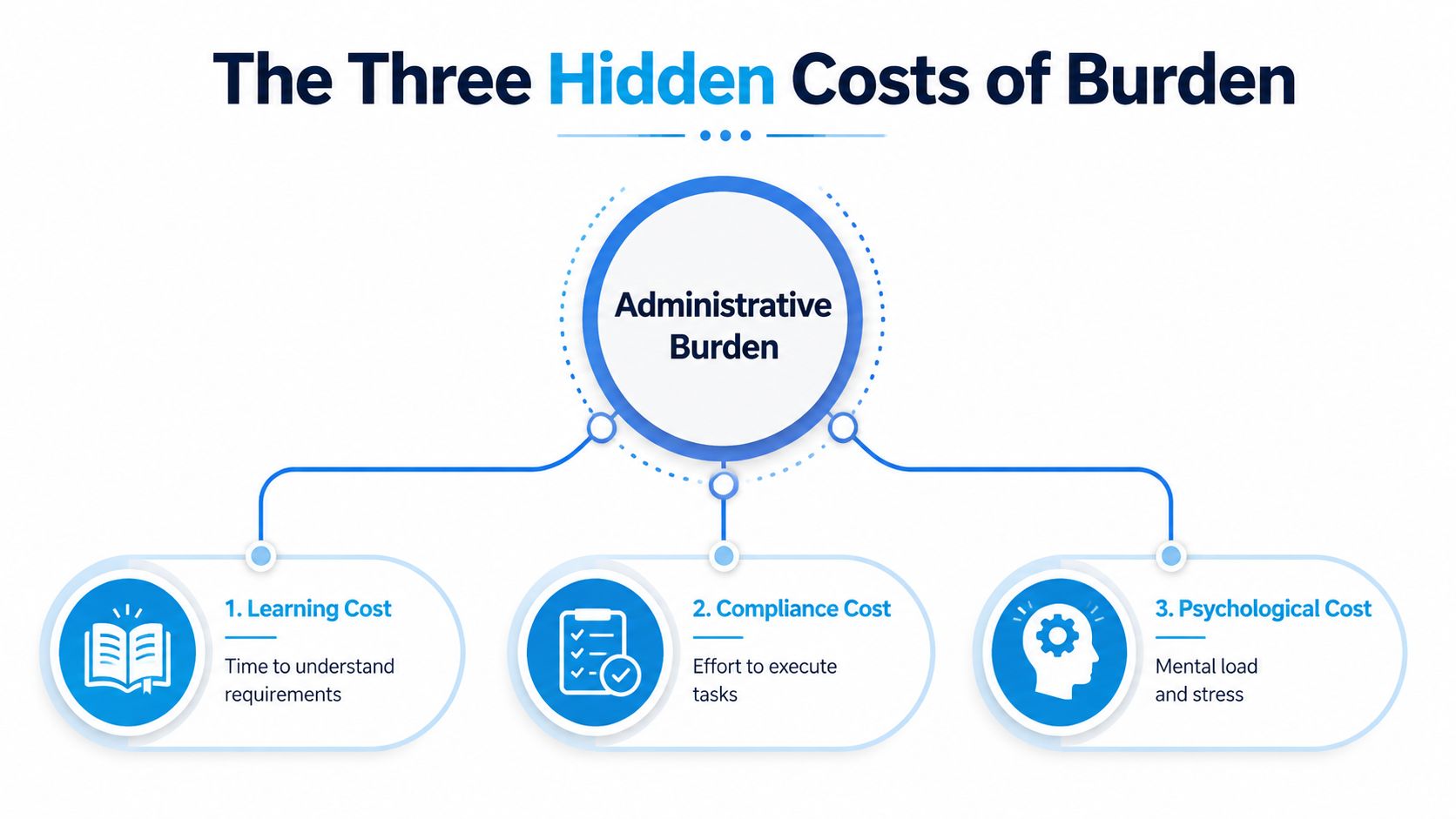
Administrative burden has three connected layers: learning costs, compliance costs, and psychological costs. This framework matters because a company can reduce one layer while worsening another. A new portal may remove paper handling but increase the time employees spend learning unfamiliar rules, recovering logins, or correcting rejected submissions.
Learning costs
Learning cost is the effort required to work out what must be done, when, by whom, and in what format. A small employer may understand the purpose of a filing but still lose time locating the right portal, interpreting terminology, finding the current template, or determining which supporting documents apply.
The experience resembles adopting software without usable documentation. Employees click through screens, ask colleagues, search old emails, and build private workarounds. That knowledge becomes fragile when the person who created it takes leave or leaves the company.
Create a one-page obligation map for each recurring process. Include the trigger, owner, deadline, source records, approval point, submission method, and evidence retained. If a new employee can't follow the map without an informal tour, the learning cost remains high.
Compliance costs
Compliance cost is the direct work of collecting, processing, reporting, retaining information, and completing forms. The OECD distinguishes these information obligations from ordinary business activities a company would perform anyway (OECD review of tax-regulation administrative costs).
A dental clinic, for example, may maintain patient and payroll information for ordinary operations, but it may also need to collect and submit payroll or tax records because the law requires it. The practical improvement is to identify the original data source and create a controlled handoff, rather than asking staff to recreate the same record for every recipient.
Psychological costs
Psychological cost is the mental load associated with uncertainty, risk, repetition, and fear of making a mistake. It shows up when a supervisor keeps a deadline in their head, when a receptionist avoids a complicated request, or when a business owner postpones a renewal because the process feels opaque.
These costs don't fall evenly. Organizations and users with less time, money, expertise, or access to assistance face higher friction, which can produce unequal access outcomes (research on administrative burden and unequal access).
Digitization can help, but it can also relocate the burden. A customer may avoid a phone queue yet face account recovery, repeated verification, data re-entry, or a human escalation after failed self-service. Measure the complete journey, not only the number of paper forms removed.
Use resource allocation optimization guidance to examine who absorbs each step. The best redesign reduces effort for the customer and the employee who supports that customer.
How Administrative Burden Shows Up Across Industries
A dental practice can have modern clinical software and still operate an administrative maze. A coordinator moves between appointment scheduling, insurance information, payroll records, tax documentation, supplier invoices, and patient follow-up. The clinic may need a record for clinical care, another for billing, and another for a statutory submission. Each handoff creates an opportunity for missing information or duplicate entry.

A useful fix is to assign one source of truth for contact details, appointment status, and required documents. Practices should also define which requests staff can resolve immediately and which require a clinician, billing specialist, or insurer. A clear guide to HR document centres can help businesses organize employee records and reduce time spent searching across personal drives and email threads.
Home services
In plumbing, HVAC, pest control, and cleaning, administrative burden often appears between the customer's call and the completed job. A dispatcher captures an address, service issue, access instructions, urgency, and preferred time. A technician later repeats some of the same information in a job note, while an office employee prepares an invoice or warranty record.
The operational cost comes from interruption. A field worker stops to clarify a detail that should have been captured once. A dispatcher calls back because the original request omitted access information. An owner reviews jobs at night because no one has a reliable queue for incomplete records.
Standardize intake fields, use job-specific checklists, and make missing information visible before dispatch. Don't automate every customer interaction. A burst pipe, an upset homeowner, or a complex commercial request may need judgment that a rigid script can't provide.
Legal services
Law firms face intake forms, conflict checks, engagement letters, identity verification, matter-opening procedures, time records, billing rules, and document retention. A prospective client may submit an online form, then repeat the same facts during a consultation because the intake record doesn't reach the attorney in a usable format.
The firm should distinguish between information needed to evaluate a matter and information needed later for onboarding. Capture the first category cleanly, run a controlled conflict check, and route exceptions to a person. Automation is useful for completeness and routing, but legal judgment should remain with qualified staff.
Finance, insurance, and franchises
Finance and insurance teams manage customer verification, documentation, regulatory reporting, renewals, and exception handling. A digital upload may speed up a straightforward case while making an unusual case harder if customers can't explain the problem or staff can't see where the application stalled.
Multi-location franchises add another layer. Each branch may submit sales, staffing, safety, supplier, and brand-compliance information through different local habits. Central teams then spend time reconciling inconsistent formats. One reporting calendar, common definitions, and controlled templates usually outperform another layer of reminders.
The European Commission estimated that 42 EU acts created roughly €115 billion to €130 billion in administrative costs, with tax and customs representing about 60% and company law about 20% (European Commission administrative-cost assessment). The lesson for a multi-location operator is practical: map the obligations by function before buying another dashboard.
Proven Strategies to Reduce Administrative Burden
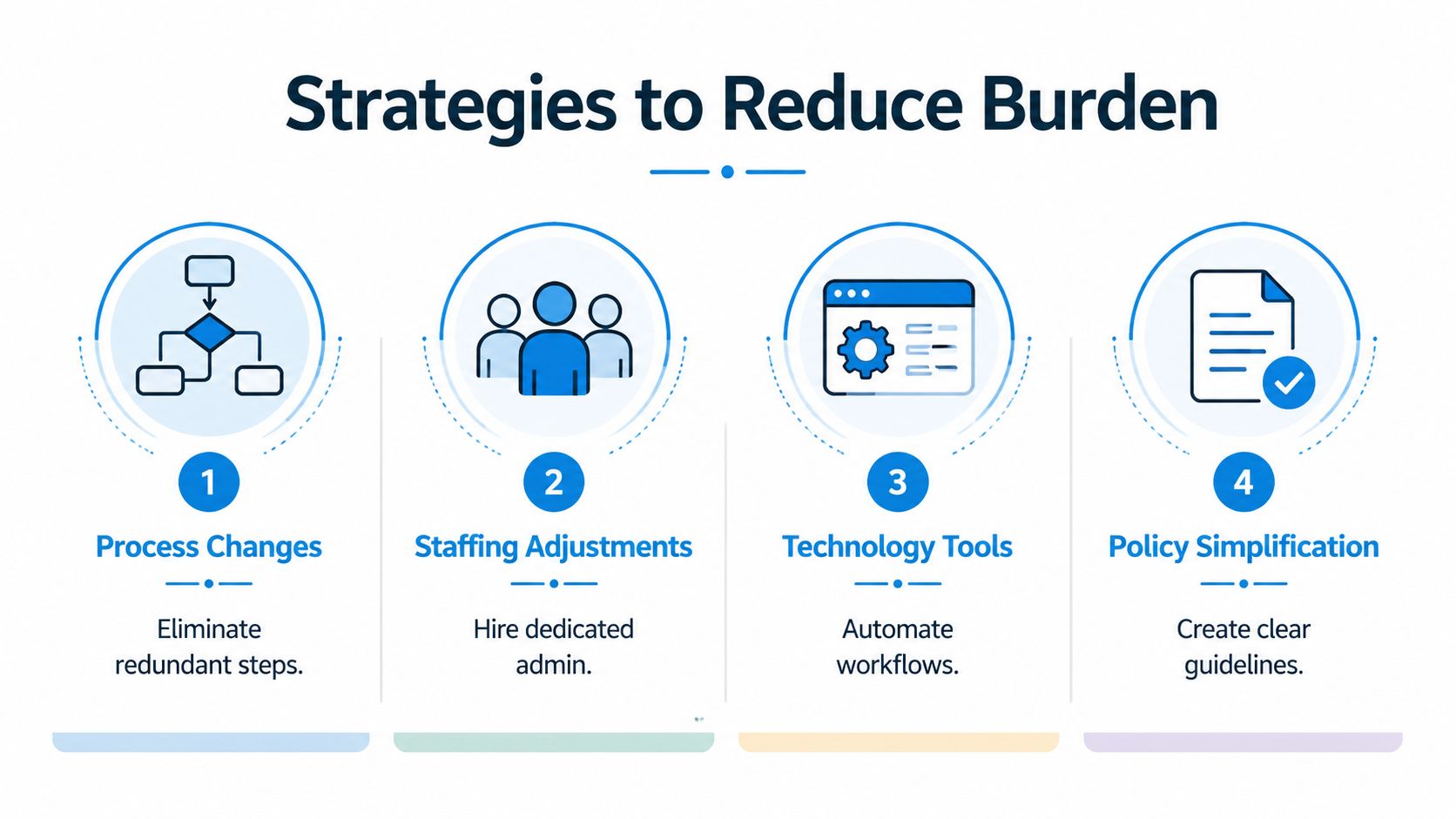
Reduction works best when leaders treat burden as a portfolio of processes rather than a single software problem. Start by listing recurring activities, their owners, inputs, outputs, deadlines, and failure points. Then rank them by frequency, interruption, rework, customer impact, and risk.
Process changes
Remove duplicate approvals, combine related forms, and standardize the information employees collect at the first interaction. A five-person plumbing company shouldn't begin with a complex automation project if its real problem is that every employee records job details differently.
Run a short process audit:
- Trace one transaction: Follow a customer request from first contact through completion and billing.
- Mark re-entry: Highlight every point where someone copies information from one system or document to another.
- Separate control from habit: Ask which step a rule requires and which step exists because “that's how we've always done it.”
- Define exceptions: Create a human review path for unusual cases instead of making every customer follow the hardest route.
Staffing adjustments
Dedicated administrative support can be the right answer when the work requires judgment, relationship management, or frequent exceptions. It can also add supervision, training, scheduling, and payroll overhead. Cross-training helps prevent a single employee from becoming the only person who understands a critical filing, but it takes protected time and clear documentation.
A practical test is to compare the cost of the role with the capacity it releases. If an office coordinator can keep technicians working, prevent missed follow-ups, and maintain accurate records, the role may produce value beyond its wage. If the process itself is defective, hiring someone to operate it faster only conceals the problem.
Technology tools
Use CRM integration, scheduling software, document management, and workflow automation when the task is repetitive, rules-based, and dependent on consistent data. Begin with one workflow, define the desired record, and test exceptions before expanding.
A multi-location dental practice might prioritize automated scheduling, confirmations, rescheduling, and reminders across locations. A smaller practice may get more value from a shared calendar and standardized intake before adopting a broader platform.
Policy simplification
Businesses can also reduce burden by clarifying internal policies and participating in industry groups that advocate for simpler requirements. Internally, write rules in operational language. State who acts, what evidence is needed, and when escalation occurs.
Technology can support this work, but it can't replace ownership. Use the following video as a practical visual companion for thinking about burden reduction workflows.
How AI Receptionists Eliminate Manual Admin Work
Phone-based admin creates a special problem because it combines interruption, incomplete information, and follow-up. A receptionist may answer a call, write notes, update a calendar, create a lead, send a confirmation, and remember to call back later. If any step is missed, the customer experiences delay while the business loses visibility.
Recepta.ai handles inbound and outbound calls, appointment scheduling, lead capture, and follow-ups, then escalates to trained human agents when empathy or expertise is required. Its stated integrations cover 2,500+ tools, including CRMs, calendars, and industry systems, allowing call outcomes and records to move into existing workflows rather than sitting in a separate message queue. The platform also provides call summaries, real-time analytics, and automatic data logging, according to the publisher's product information.
Automation versus traditional reception
Traditional staffing offers judgment, warmth, and context. It also depends on coverage, training, workload, and consistent recordkeeping. Automation offers availability and repeatability, but a poorly designed bot can increase learning and psychological costs by forcing customers through menus that don't match their problem.
The useful comparison isn't “AI or humans.” It's automation for predictable work, humans for consequential ambiguity.
For a home-services company, an AI receptionist can capture the service address, job category, urgency, and preferred appointment window, then write the information into the company's system. A human can take over when the caller reports a dangerous condition, disputes an invoice, or needs a solution outside standard service rules. In healthcare, scheduling and reminders may be suitable for automation, while clinical questions and sensitive conversations need trained staff.
Businesses considering financial outcomes should verify assumptions against their own call volume and staffing model. Recepta.ai reports up to 30% more qualified leads, 80% cost savings versus in-house reception, and a 15× ROI, but those are publisher-reported outcomes, not universal guarantees. The operational value may also come from preventing opportunities from disappearing into voicemail.
Digital tools should be judged by the burden they create as well as the work they remove. Account recovery, repeated verification, incomplete handoffs, and unclear escalation can turn self-service into another queue. A hybrid design avoids that failure when the system logs context and gives the human agent a usable record.
For businesses with significant phone-based admin, this AI receptionist guide for small businesses provides a useful starting point. Teams should also automate adjacent records carefully, just as tools that help save time with autobankstatement need a review process for documents that don't parse cleanly.
Measuring Your Administrative Burden Reduction Progress
You can't manage administrative burden from anecdotes alone. Build a baseline before changing the workflow, then track whether the work declines without increasing errors, missed deadlines, customer frustration, or employee stress.
Germany provides a useful public example of longitudinal measurement. Its administrative burden index was anchored to 1 January 2012 and later tracked changes in businesses' obligations under federal law. The index fell from 97.60 in December 2022 to 95.94 in December 2023, then reached 93.3 in 2024 and 93.5 in 2025, showing why a multi-year series is more informative than a single before-and-after comparison (Germany's Federal Statistical Office burden barometer).
The same source reports that federally mandated statistical reporting cost businesses around €324 million annually as of early 2024, and that statistical reporting represented less than 1% of businesses' administrative burden in Germany. That benchmark prevents a common mistake: optimizing a visible task while ignoring the larger burden concentrated elsewhere.
A practical KPI set
Track four categories, using the same definitions each reporting period:
- Time: Hours employees spend on compliance, re-entry, follow-up, and exception handling.
- Cost: Administrative labor and vendor costs as a share of revenue, plus overtime or outsourced processing.
- Quality: Submission errors, rejected forms, missing fields, late filings, duplicate records, and unresolved exceptions.
- Experience: Customer wait time, abandoned calls, employee-reported mental load, and the number of interactions required to complete a request.
Use leading indicators, such as workflows standardized, integrations completed, and staff trained, alongside lagging indicators, such as reduced rework and lower administrative cost. A dashboard can make trends visible, but only if its inputs are consistent. This performance dashboard resource can help teams think through reporting design.
Administrative Burden KPIs by Business Type
| Business Type | Primary KPI | Secondary KPI | Measurement Frequency |
|---|---|---|---|
| Home services | Admin minutes per completed job | Missing job information and callback volume | Weekly |
| Healthcare practice | Scheduling and follow-up time per appointment | Rescheduling errors and patient wait time | Weekly |
| Law firm | Intake-to-matter-opening time | Conflict-check exceptions and incomplete forms | Monthly |
| Finance or insurance | Processing time per verified customer | Documentation rework and escalation volume | Weekly |
| Franchise network | Time spent consolidating location reports | Submission errors by location | Monthly |
Review the numbers with the people doing the work. If the report says processing time fell but employees now handle more failed escalations, the redesign shifted burden rather than reducing it.
Your Next Steps to Reduce Administrative Burden
Administrative burden is a measurable cost category, not a vague complaint. It combines learning, compliance, and psychological costs, and the impact varies with business size, industry, staffing, and process design. The strongest reductions usually combine simpler workflows, clear ownership, selective staffing, appropriate automation, and continuous measurement.
A phased plan is safer than trying to change everything at once:
- First 30 days: Map one high-volume workflow, record re-entry and exception points, and establish baseline time, cost, quality, and experience measures.
- By 60 days: Remove redundant steps, standardize intake, assign owners, and test one automation or staffing change.
- By 90 days: Compare results, review failed handoffs, train the team, and decide whether to expand, redesign, or stop the intervention.
For businesses spending substantial time on phone-based admin, Recepta.ai reports 80% cost savings versus in-house reception and a 15× ROI, while its hybrid model is designed to combine automated handling with human escalation. Treat those figures as a business case to test, not a promise to accept without measurement.
The objective isn't zero administration. It's fewer avoidable interruptions, cleaner records, faster customer responses, and more capacity for revenue-producing work.
Recepta.ai combines 24/7 AI call handling, scheduling, lead capture, follow-ups, integrations, summaries, and human escalation to reduce phone-based administrative work. Visit Recepta.ai to review the platform and use its 30-day risk-free trial to test one high-friction workflow in your business.