
What Is an Answering Services Company? A Practical Guide for 2026
Ever had that sinking feeling when you look at your missed calls, knowing each one was a potential customer—and a lost opportunity? That’s the exact problem an answering services company is built to solve. It’s much more than a glorified voicemail; think of it as a flexible, on-demand extension of your front office.
Beyond the Voicemail Box: What an Answering Service Truly Is
At its heart, an answering service acts as your remote front desk, making sure every single call gets a professional, human response. This is the partner that captures every lead, reassures every customer, and frees your team to focus on what they do best.
Forget the old-school image of a simple message-taking service. A modern answering telephone service is a communications hub. These services often plug directly into your CRM to book appointments, qualify new leads based on your criteria, and ensure the right information gets to the right person instantly. It’s a serious operational upgrade for any business tired of letting calls—and revenue—slip through the cracks.
How It Works in the Real World
So, what does that look like day-to-day? Here are some practical examples.
For a plumbing company: A frantic homeowner calls about a burst pipe at 2 AM. Instead of the call going to a voicemail box, a live agent answers.
- Actionable Step: The agent follows a pre-set emergency script, calmly gathers the address and issue, and immediately dispatches the on-call technician according to the company's protocol.
- Result: The plumber secures a high-value emergency job, and the homeowner becomes a loyal customer for life.
For a busy law firm: The office gets dozens of calls a day, but many are sales pitches or from people needing a different type of lawyer.
- Actionable Step: The answering service uses a script to pre-screen callers, asking key questions like, "Are you seeking representation for a personal injury case?" and "Have you already spoken to another attorney?"
- Result: This filters out irrelevant calls, gathers key details from potential clients, and ensures the attorneys only spend their valuable time on qualified, high-potential cases.
An answering service transforms a missed call from a lost opportunity into a captured lead. It’s the difference between a frustrated customer hearing a dial tone and a relieved one hearing a helpful voice, no matter the time of day.
The Growing Demand for Scalable Communication
This isn't just a niche service; it's a reflection of how business communication is fundamentally changing. The virtual receptionist market is on track to hit $4.64 billion by 2026, and the use of voice AI is exploding at a 34.8% compound annual growth rate.
With 50% of businesses already using AI-powered tools, the trend is clear. For home service businesses, the need is even more dramatic. During a polar vortex event in January 2024, one small HVAC company with just two trucks was swamped with 180 calls in 48 hours—a volume that would cripple most internal teams. This is where an answering service proves its worth, allowing businesses to handle massive spikes in demand without hiring an army of staff. You can see more data on this evolving market in the full industry report on AI answering trends.
Ultimately, a great answering service delivers far more than just call coverage. It provides:
- 24/7 Availability: You're always open for business, ready to capture leads and help customers on nights, weekends, and holidays.
- Improved Efficiency: Your team can finally break free from constant phone interruptions and concentrate on their core responsibilities.
- Enhanced Customer Experience: Every caller gets a prompt, professional, and welcoming first impression, building trust from the very first hello.
Choosing Your Answering Service Model: Human, AI, or Hybrid?
Once you’ve decided an answering service is right for you, your next big decision is picking the right engine to power it. There are really three main flavors to choose from: traditional human agents, fully automated AI, and a blended or hybrid approach that combines the two.
There’s no single “best” option—the right choice hinges entirely on your call volume, the kind of conversations you have, and the experience you want to create for your callers.
Think of it like this: when the phone rings and your team can't pick up, where does that call go? You really only have a few paths.
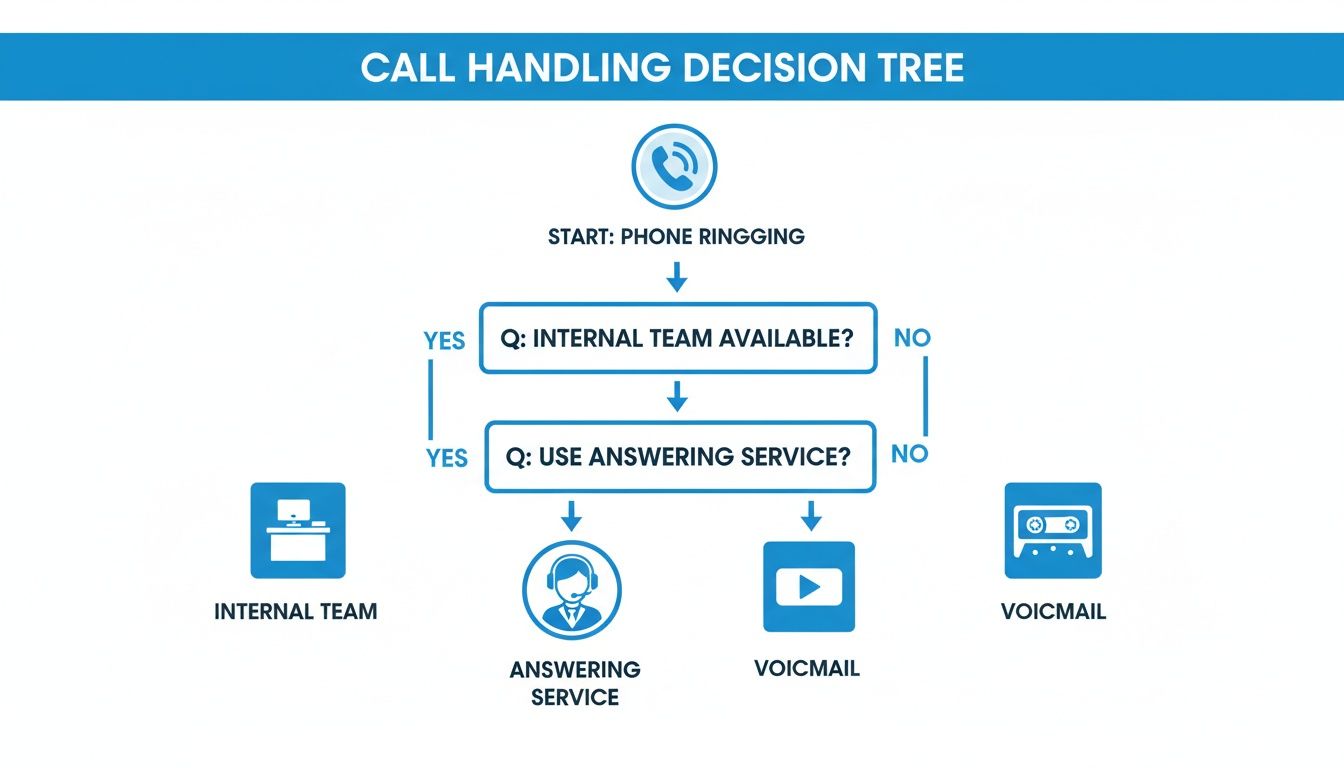
This simple decision tree shows exactly where an answering service fits. It's the powerful alternative to voicemail, ensuring that when your team is swamped, every single caller gets an immediate, professional response instead of a beep.
Traditional Human-Powered Services
This is the classic model. Think of it as outsourcing your front desk to a dedicated team of real people. These services shine when it comes to providing genuine empathy, picking up on nuance, and navigating complex or emotionally charged conversations.
Human agents are perfect for industries where trust and compassion are everything.
- Practical Example: A potential client calls a law firm about a sensitive personal injury case. A human agent can offer a reassuring voice, express sympathy, and gather information with care—something an automated menu can't replicate. In fact, 62% of potential clients report hiring the first law firm that gets back to them, which shows just how much that immediate, personal connection matters.
The trade-off, of course, is cost. Because you're paying for a person's time and skill, pricing is typically based on the minutes used. This can get pricey if your phones are ringing off the hook.
Fully Automated AI Receptionists
On the other end of the spectrum, you have fully automated AI receptionists. These systems use advanced conversational AI to answer calls, book appointments, field common questions, and take messages around the clock. Their biggest selling points are speed, 24/7 availability, and serious cost savings.
A single AI receptionist can field hundreds of calls at once without ever getting tired or fumbling a routine task.
- Practical Example: A local restaurant gets a high volume of calls for reservations and hours. An AI receptionist can instantly handle these requests, book tables directly into the restaurant's system, and answer FAQs like "Are you open on holidays?" This frees up hosts to focus on in-person guests. It works tirelessly to make sure you never miss a call. To see just how far this tech has come, you can get a closer look at how an AI phone answering service can automate your front office.
The main downside? AI still struggles with ambiguity and deep emotional intelligence. If a caller’s needs are complex or they simply need a compassionate ear, an automated system can quickly feel cold and frustrating.
Blended (Hybrid) Solutions
Here’s where things get really interesting. The hybrid model gives you the best of both worlds, and it’s quickly becoming the go-to solution for many businesses. It uses AI as the first line of defense to efficiently handle routine calls, then seamlessly hands off more complex conversations to a human agent.
The blended approach is all about balance: you get the cost-efficiency and speed of AI for the simple stuff, plus the empathy and problem-solving skills of a human for the conversations that count.
- If the patient says "change appointment," the AI handles it in seconds.
- If the patient says "speak with a nurse" or sounds distressed, the system instantly routes them to a live agent or on-call nurse who can provide the expert, empathetic support they need. This creates a smart, scalable system that drives down costs without sacrificing patient care.
Human vs. AI vs. Blended Answering Services Comparison
To make the decision a little easier, we've broken down the core strengths and weaknesses of each model in this table. Think about your most common call types and what your customers truly need.
| Feature | Human-Powered | AI Receptionist | Blended (Hybrid) Solution |
|---|---|---|---|
| Best For | Complex, high-value conversations requiring empathy and trust. | High-volume, routine tasks like scheduling and FAQs. | Businesses wanting both efficiency and a human touch. |
| Pros | High emotional intelligence, flexibility, builds strong rapport. | 24/7/365 availability, extreme cost-effectiveness, scalability. | Optimized costs, seamless customer experience, highly scalable. |
| Cons | Higher cost per call, potential for human error, limited scalability. | Lacks genuine empathy, can struggle with unexpected queries. | Requires well-defined escalation protocols to work smoothly. |
Ultimately, whether you choose human, AI, or a blended solution, the goal is the same: to ensure every caller feels heard and valued, turning every interaction into an opportunity for your business.
What to Look For: Essential Features of a Modern Answering Service
When you're shopping for an answering service, it's easy to get lost in a sea of feature lists. But the real value isn't just about what a service does—it's about how it can fundamentally change the way you do business, turning missed calls into captured leads. Let's break down the features that actually matter.
First and foremost is 24/7/365 availability. This isn't just a nice-to-have; it's about being there the moment opportunity knocks. A homeowner with a burst pipe or a potential client with a pressing legal issue isn't going to wait for your office to open at 9 AM. They'll just call the next person on the list.
With around-the-clock coverage, you're always open for business. Every single lead, whether they call at 3 PM on a Tuesday or 3 AM on a Sunday, gets a professional, immediate response. This single capability turns your business hours from a weakness into a serious competitive advantage.
Automation and Integration
The secret sauce of a truly great answering service is how well it plays with the software you already use. This is where CRM integration comes in, and it’s what separates a basic message-taker from a genuine extension of your team.
When your answering service is hooked into your CRM, every call becomes a piece of actionable data, not just a scribbled note.
Let's look at a real-world scenario. Imagine a potential customer calls your HVAC company on a Saturday afternoon looking for a quote. Here’s how it works:
- The agent (human or AI) gathers the caller's name, number, address, and what they need.
- Since the service is connected to your CRM (like Salesforce or HubSpot), a new lead record is created instantly and automatically.
- The full call transcript and agent notes are attached right to that record.
- Your sales manager gets an alert, so that lead is teed up for a follow-up call first thing Monday morning.
This seamless connection eliminates tedious data entry, stops leads from ever falling through the cracks, and gives your team the full context they need to make the sale.
Appointment Scheduling and Lead Qualification
A top-tier service does more than just answer the phone—it actively fills your pipeline. With appointment scheduling that syncs to your existing calendar (like Google Calendar or Calendly), agents can book consultations, service calls, or product demos directly for you. You can literally make money while you sleep.
Lead qualification is another huge one. You can give the service a simple script or a few key questions to ask callers. This turns your answering service into a powerful filter.
A great answering service acts like a filter, ensuring your team only spends time on high-priority, qualified opportunities. It systematically separates the signal from the noise.
- Practical Example: A marketing agency wants to book more strategy sessions but is wasting time on calls with businesses that aren't a good fit. They can instruct their answering service to ask two key qualifying questions: "What is your approximate monthly marketing budget?" and "What is your project timeline?" Only the leads who meet the minimum budget and have a near-term timeline are booked directly into a strategist's calendar. This makes their sales process incredibly efficient. For more tips on getting this right, check out our guide on call handling best practices.
The Financial Impact of Essential Features
All these features sound great, but what about the bottom line? The numbers speak for themselves. The average cost per customer service call can run from $2.70 to $5.60. When you factor in the 30% to 40% turnover rate for in-house call center staff, the costs of managing it yourself add up fast.
Outsourcing to a professional service isn't just about saving money; it's about making more of it. Customers have reported getting 30% more qualified leads, seeing 80% cost savings compared to an in-house receptionist, and achieving an incredible 15× return on investment. These aren't just vanity metrics—they prove that the right answering service is a powerful revenue driver, not a cost center. To see how these numbers stack up across different providers, you can discover more insights about top answering services on findansweringservice.com.
How Answering Services Adapt to Different Industries
Think of an answering service as a high-performance engine. By itself, it has potential, but its real value comes when you put it in the right vehicle—a plumber’s emergency van is going to have vastly different needs than the town car for a high-profile law firm. An answering service is no different; a one-size-fits-all approach just doesn't cut it.
To truly work, the service has to speak the language of your industry. That means knowing the specific terminology, anticipating customer needs, and understanding what’s at stake with every single call. Let's look at how this specialization plays out in the real world.
Home Services: Emergency Dispatch and Peak Season Management
For businesses like plumbing, electrical, or HVAC, the 9-to-5 workday is a myth. Emergencies are your bread and butter, and a single missed call after hours means you just sent a paying customer straight to your competition. This is where a specialized answering service becomes your business's lifeline.
- Triage calls: Use a custom script to sort true emergencies ("My furnace is dead and the house is freezing!") from routine requests ("I'd like a tune-up next week.").
- Dispatch technicians: For urgent problems, the service texts the on-call technician with the customer's details, guaranteeing the fastest response.
- Schedule non-urgent jobs: For everything else, agents book appointments directly into the company's calendar for the week ahead, turning potential chaos into a full, profitable schedule.
- Practical Example: A dental office has a patient cancel a 2-hour appointment for tomorrow morning. This leaves a significant gap in their schedule. The office manager notifies the answering service, which immediately starts calling a pre-approved waitlist of patients who wanted to get in sooner. Within an hour, the slot is filled, turning a potential loss of revenue into a win.
- 24/7 Availability: This ensures a potential client calling at 10 PM on a Friday after a car accident speaks to a live person, not an impersonal voicemail.
- Case-Specific Screening: Agents ask smart, qualifying questions to make sure the leads passed to your attorneys are relevant to their practice areas.
- Instant Professionalism: Every call is answered with your firm’s name, building a foundation of trust and competence from the very first word.
- Pricing Clarity: "Can you explain exactly what a billable minute includes? Does it start when the phone first rings or when an agent picks up? Are there extra fees for after-hours calls, holidays, or patching calls to my cell phone?"
- Integration Capabilities: "You mention integration with my CRM. Can you show me a live demo of how your system syncs with my specific software, like Jobber or Clio? I want to see how a new lead's information flows from a call into a new contact record."
- Industry Expertise: "What specific training do your agents receive for my industry? For our medical practice, can you provide your HIPAA compliance documentation? For our law firm, can your agents differentiate between a personal injury and a family law matter based on our script?"
- Onboarding and Setup: "What does the onboarding process look like, step-by-step? How long does it typically take to go from signing the contract to being fully live with our custom scripts and integrations?"
- Agent Quality: Call your new service number from a personal phone at different times—once during business hours and once at 10 PM. Did the agent follow your script? Were they professional and easy to understand?
- Platform Usability: Log in to their client portal. Try to perform a common task, like updating your on-call schedule for the weekend or listening to a call recording from yesterday. Is it intuitive or confusing?
- Speed and Reliability: Time how many rings it takes for an agent to answer. Was the connection clear? Send a test message and see how quickly it arrives in your email or as a text.
- In-House Receptionist (Fully-Loaded): A salary of $42,000 + 30% for taxes, benefits, and overhead = $54,600/year
- Answering Service Plan: A mid-tier plan at $700/month = $8,400/year
- Result: In this scenario, the direct annual savings are over $46,000. This doesn't even account for the non-financial costs of recruiting, managing, and covering for sick days or vacations.
- Leads Captured Per Month: 2 leads/week x 4 weeks = 8 new leads
- Your Closing Rate: They typically convert 25% of qualified inquiries.
- New Clients Per Month: 8 leads x 25% = 2 new clients
- Average Client Lifetime Value: Each new client is worth $1,500.
- Result: The service directly generates $3,000 in new monthly revenue ($1,500 x 2)—money that was previously vanishing into thin air. This alone pays for their $700/month plan more than four times over.
- Practical Example: A small plumbing company realizes on Monday morning that they're missing after-hours calls. By that afternoon, they've worked with their provider to create a simple script to dispatch emergency calls and schedule routine ones. They set their office phone to forward calls to the new service number starting at 5 PM. That very night, trained agents are answering their phones, and they capture their first lead that would have otherwise gone to voicemail.
- Option 1 (Live Transfer): The agent says, "That's a great question. Let me see if Sarah, our property manager, is available to answer that for you right now." They then attempt a live transfer.
- Option 2 (Scheduled Callback): If Sarah is unavailable, the agent says, "Sarah is currently assisting another resident, but I can schedule a call for her to contact you this afternoon. Would 2:30 PM work for you?"
- Option 3 (Detailed Ticketing): The agent takes a detailed message, including the caller's specific question about the lease clause, and sends it via an urgent email to Sarah, ensuring she has all the context for a quick follow-up.
Suddenly, that chaotic night becomes a structured, revenue-generating event. And you, the business owner, can actually get some sleep.
Healthcare: Patient Intake and Empathetic Support
In healthcare, every call carries weight. Patients are often worried or in pain, so empathy and accuracy are absolutely critical. An answering service for a medical practice can't just be a message-taker; it must be a HIPAA-compliant, compassionate extension of your front office.
In the medical field, a professional answering service acts as a seamless and secure extension of the care team. It ensures patient trust is maintained with every interaction, from scheduling a routine check-up to handling a sensitive after-hours call.
A huge challenge for any practice is managing the constant flow of patient calls without burning out the in-house staff. A specialized medical office answering service can solve this.
Legal Services: New Client Intake and Professional Screening
For a law firm, that first phone call is everything. A potential client is often reaching out during a moment of crisis and needs to feel they’ve found a competent, professional team. When you learn that only 40% of law firms even answered their phones in 2024, you see how easy it is to fail at this first hurdle.
A legal answering service functions as both a gatekeeper and a welcoming presence. It delivers:
It’s interesting—despite all our digital tools, 71% of Gen Z customers still say a live call is the fastest way to solve a problem. This demand for a human touch is universal. While fields like healthcare do a great job with a low 7% call abandonment rate, other sectors fall short—only 39% of U.S. customers feel that retail agents understand their needs. This gap is exactly why industry-specific training is so important for any answering service you consider. For more on these trends, you can review the latest call center statistics from Xima.
Your Checklist for Choosing the Right Partner
Picking an answering service isn't just another purchase—it's more like hiring a new, front-facing team member. This decision sits right at the intersection of your customer experience and your bottom line, so it pays to get it right. This checklist is your guide to vetting providers like a pro, helping you find a true partner and steer clear of a costly mismatch.
First things first, you need to know what you're trying to accomplish. What's the number one goal? Are you desperate to stop losing leads that call after 5 PM? Are you trying to free up your in-house team from constantly answering the phone? Or is it simply about giving your clients a better, more professional first impression?
Your primary goal changes everything. If lead capture is your focus, then seamless CRM integration isn't just a nice-to-have; it's a dealbreaker. If you're all about trimming operational costs, a provider's billing model becomes the most important detail.
Key Questions to Ask Every Vendor
Once you've defined your mission, it's time to talk to potential partners. This is where you get to peel back the polished sales pitch and see what's really going on. Don't be shy about digging into the nitty-gritty.
Here are the critical questions every single vendor should be able to answer without hesitation:
Clear, confident answers build trust. If you get vague responses or feel like you're being dodged, that's a huge red flag.
A vendor’s transparency on things like billing and tech is a direct reflection of the kind of partner they’ll be. If they can’t give you a straight answer on what a “minute” costs, you’re looking at a warning sign.
Evaluate Technology and Test the Experience
A beautiful website doesn't mean much if the service behind it is a letdown. The only way to truly know what you're buying is to experience it for yourself. Insist on a free trial or a short pilot program. This is your chance to secretly shop your own company.
During the trial, you're the detective. Here’s a practical test plan:
This is a preview of how your actual customers will experience your brand. If you're not impressed, they definitely won't be. This choice is especially vital for smaller companies where every customer interaction counts. For a deeper dive, our guide on the best answering service for small business offers more targeted advice.
Think of this process as a roadmap. Following it will help you find a service that fuels your growth, not one that creates constant headaches.
Calculating the True ROI of Your Answering Service
When you're thinking about investing in an answering service, it's easy to get stuck on the monthly price tag. But to see the real picture, you have to look past the cost and understand its true financial impact—how it saves you money, generates new business, and protects your reputation.
Building a solid business case means getting comfortable with the numbers. If you really want to dig into the mechanics, understanding how to use a standard ROI Excel formula is a great place to start. Let's break down the return on investment into three key areas.
Direct Cost Savings
First up, the most straightforward calculation: comparing the service’s monthly fee to what it costs to have a full-time, in-house receptionist. A person's salary is only part of the story. You also have to factor in benefits, payroll taxes, paid time off, training, and overhead like a desk, computer, and phone line.
New Revenue Generation
This is where an answering services company stops being an expense and starts becoming a profit center. Think about it: how many potential customers call after hours, get your voicemail, and simply hang up to call a competitor?
Let's do some quick math on the value of those captured leads.
The most expensive call is the one you never get to answer. An answering service turns missed calls from a liability into a direct stream of revenue by ensuring you capture every opportunity, 24/7.
Brand Protection and Loyalty
Finally, there’s the value you can’t always put on a spreadsheet but can definitely feel. Every single time a call is answered quickly and professionally, you're building trust and reinforcing your brand's credibility.
This isn't just about making a good first impression. It's about preventing the frustration that leads to bad reviews and lost customers. Consistent, reliable communication fosters loyalty and tells your clients you value their business, which is a priceless investment in your reputation.
Frequently Asked Questions About Answering Services
Deciding on an answering service is a big decision, and it’s completely normal to have a few nagging questions. You're essentially trusting a partner with your customer interactions, so you want to be sure it’s the right move. Let's walk through the concerns I hear most often from business owners.
How Long Does Setup Take?
One of the first things everyone asks is about downtime and a complicated setup. You’re probably picturing a long, drawn-out process that disrupts your business. The reality is quite the opposite.
Getting a professional answering service up and running is remarkably fast—often taking just a few hours. Think about it: hiring a new employee can take weeks of interviews, onboarding, and training. Here, the initial legwork is simply mapping out your call scripts and basic rules. For most businesses, this can be done in a single business day.
Will My Customers Know It Is a Service?
This is probably the biggest fear: will my customers feel like they're talking to a call center? The short answer is no, not with a good service. A high-quality partner works to become a truly invisible extension of your team.
The experience is designed to be seamless. Agents answer with your business name and follow your script to the letter. They have your key business information at their fingertips. The best providers even offer industry-specific training, so the agents sound like they genuinely know your world—whether you’re in healthcare, home services, or law. When done right, your callers will be convinced they're speaking to your in-house receptionist.
What Happens With a Complex Question?
This is a great question. What if a caller asks something that isn't in the script? This is where a professional service really shines. You don’t just get a script-reader; you get an intelligent filtering system with clear escalation paths that you control.
When an agent hits a question they can't answer, you’ve already decided what happens next.
An effective escalation path means the answering service acts as an intelligent filter. It handles what it can and ensures the complex issues land with the right expert on your team, every time.
This structured process guarantees every caller gets what they need, whether it's an instant answer or a clear, quick path to the person who has it.
Ready to see how a blend of AI and human expertise can capture every lead and delight every caller? Recepta.ai provides a 24/7 answering service that integrates seamlessly with your tools and acts as a true extension of your team. Discover how Recepta.ai can transform your communications with a 30-day risk-free trial.