
Medical Office Answering Service: Discover medical office answering service
Think of a medical office answering service as a specialized communication partner, acting as a seamless, 24/7 extension of your front desk. It's far more than just a person picking up the phone; it’s a system designed to handle everything from scheduling appointments and relaying urgent messages to answering routine questions, making sure every patient call is handled professionally.
What Is a Medical Office Answering Service, Really?
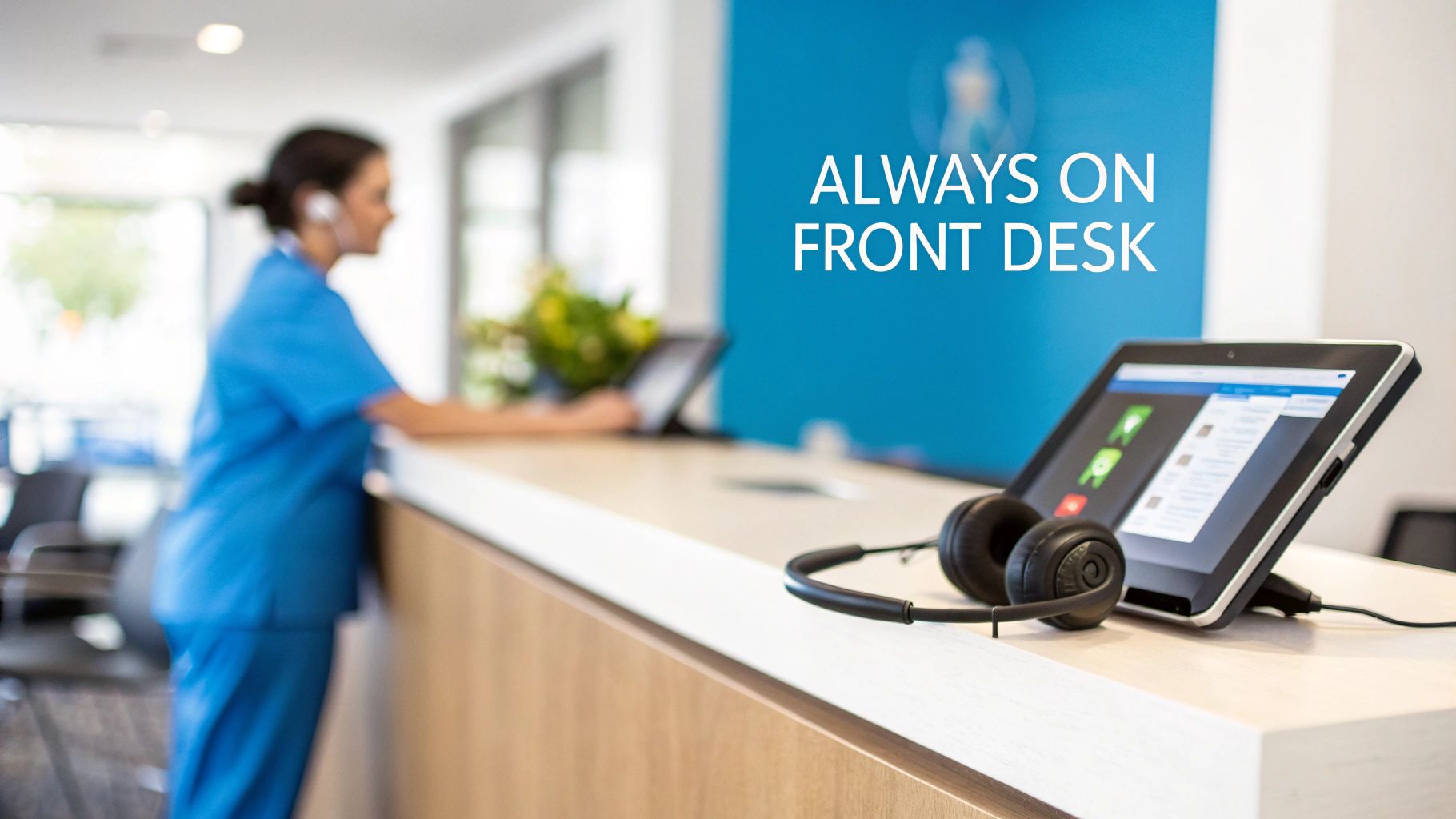
Imagine your practice having a front desk that never sleeps, never takes a lunch break, and never calls in sick. That's the essence of a modern medical office answering service. It’s a dedicated system built to solve the all-too-common problems of missed patient calls, administrative overload, and the communication void that opens up the moment you close for the day.
This isn't just about forwarding calls. A true medical answering service acts as an intelligent first point of contact. For example, a trained agent on the other end knows how to differentiate between a simple question about office hours and a situation that needs a doctor's immediate attention. They can calmly handle an anxious patient asking about pre-op instructions while simultaneously triaging another call that might be an emergency, blending human expertise with smart technology to ensure your patients are always cared for.
From Voicemail to a Virtual Extension
We’ve all been there. A patient calls at 5:01 PM and gets a voicemail. For someone worried about their health or trying to book a crucial appointment, that’s a dead end. A modern answering service completely replaces that outdated, frustrating experience with a live, responsive person.
This shift isn't just a trend; it's a direct response to rising patient expectations and the immense pressure on healthcare providers. The market for these services was valued at around USD 2.5 billion in 2023 and is expected to nearly double, hitting USD 4.9 billion by 2032. As this market growth report shows, practices are increasingly turning to these solutions to manage patient communication effectively, 24/7.
An effective medical answering service isn’t about replacing your staff; it's about empowering them. For instance, it can handle all routine appointment confirmation calls, freeing up your in-office team to manage complex insurance verifications for patients standing right in front of them.
How It Works in Practice
Think of it as creating a custom playbook for all your incoming calls. You set the rules based on your practice's specific needs, and the service executes that playbook perfectly every single time.
Here’s what that looks like day-to-day:
- During Business Hours: Your receptionists are juggling check-ins, paperwork, and in-person questions. When the phone lines get backed up, the answering service can handle the overflow. So, if your first three lines are busy, the fourth call automatically goes to a live agent who can schedule a follow-up, instead of a patient getting a frustratingly endless ring or a cold voicemail.
- After-Hours and Weekends: A new parent calls at 10 PM, worried about their child's fever. Following your specific protocols, the agent can calmly provide information on managing a low-grade fever or, if the parent reports a temperature over 102°F, patch the call directly through to the on-call pediatrician's cell phone.
- Appointment Management: Someone finds your dermatology practice online at midnight and wants to book a consultation for a suspicious mole. Instead of having to wait until morning—and possibly changing their mind—they can call right then and schedule their first appointment. The service agent books it directly into your clinic’s calendar, capturing a new patient while you sleep.
The Real-World Benefits for Your Medical Practice
While the features of a medical answering service sound great on paper, what really counts is how they impact your practice day-to-day. The benefits go way beyond just picking up the phone; they help you create a stronger, more efficient, and more profitable clinic.
Think of the advantages in three key areas: improving the patient experience, smoothing out daily operations, and capturing revenue that was slipping through your fingers. Each of these pillars works together, turning your practice's communication from a constant headache into one of your biggest strengths.
Elevating the Patient Journey
Let's be honest, today's patients expect healthcare to be as convenient as ordering a pizza. An unanswered call or a full voicemail box isn't just an inconvenience—it's a source of real anxiety when someone is worried about their health. A dedicated answering service gets rid of that friction completely.
Picture this: a patient wakes up with severe back pain at 3 AM. They can call your chiropractic office right then and book the first available appointment for that morning. The live agent confirms the time, provides pre-appointment instructions, and sends a calendar invite. That simple act provides immediate peace of mind and shows that your practice is there when it truly matters.
By offering 24/7 accessibility, you aren't just providing a convenience; you're building trust. That kind of responsiveness tells patients they're a priority, strengthening their relationship with your practice from the very first call.
This round-the-clock availability is a game-changer. For a deeper dive, you can learn more about how after-hours answering services specifically benefit medical practices and their patients.
Streamlining Your Daily Operations
One of the first things you'll notice is the sense of calm it brings to your front desk. Your staff are the heart of the clinic—juggling check-ins, payments, paperwork, and the patients standing right in front of them. Constant phone interruptions shatter their focus, leading to mistakes and burnout.
When you offload the call handling, you free up your team to focus on the people in your office. For example, instead of answering five calls in a row about prescription refills, your receptionist can dedicate that time to helping an elderly patient fill out their new intake forms correctly. This single change has a ripple effect:
- Fewer Administrative Errors: With fewer distractions, accuracy in scheduling, billing, and data entry goes way up.
- Better In-Person Care: Your staff can give their undivided attention to patients at the desk, creating a more welcoming and efficient clinic flow.
- Lower Staff Burnout: Taking the pressure of nonstop calls off their shoulders reduces stress and boosts job satisfaction, which is crucial for keeping your best people around.
Suddenly, your team is working at its best, and the entire practice runs more smoothly.
Capturing Previously Lost Revenue
Every call you miss is a missed opportunity. It's a hard truth, but medical offices miss a surprising number of calls, especially during busy lunch hours or after closing time. Each one of those could have been a new patient, a follow-up appointment, or a high-value procedure.
Let's crunch some numbers. Imagine your practice misses just five calls from potential new patients each month. If the average lifetime value of a new patient for your dental practice is $500, that’s $2,500 in lost revenue walking out the door every single month.
- Monthly Loss: 5 patients x $500/patient = $2,500
- Annual Loss: $2,500 x 12 months = $30,000
A medical office answering service catches those calls, turning a frustrating loss into a reliable revenue stream. It’s a simple shift that transforms your phone system from a passive expense into an active tool for growth.
Essential Features Your Answering Service Must Have
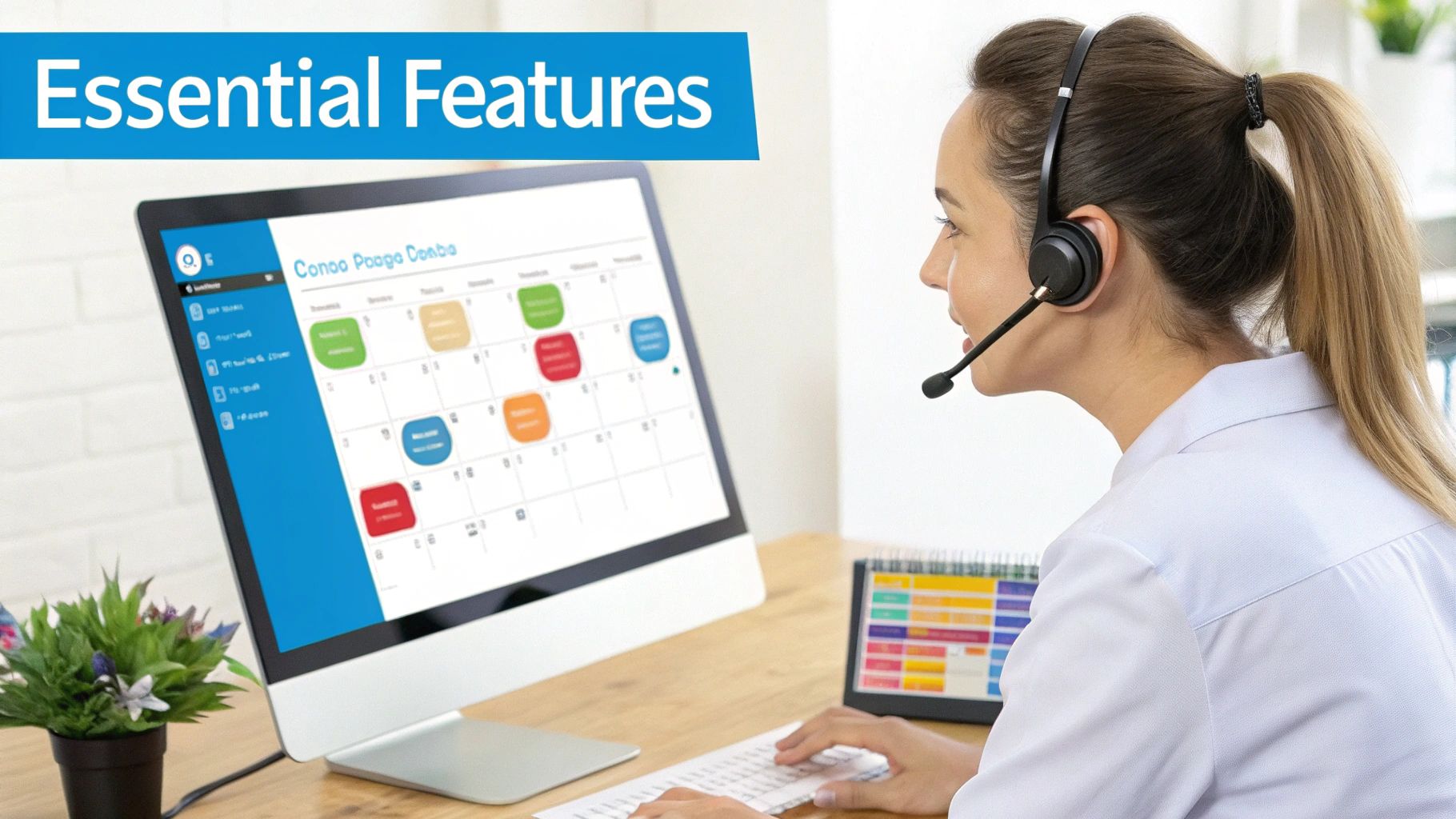
Choosing a medical answering service isn't just about finding someone to pick up the phone. It's about entrusting a partner with your most critical asset: patient communication. Not all services are equipped for the unique demands of a healthcare environment, so you need to look beyond the sales pitch and focus on the non-negotiable features.
Think of this as a scorecard for any potential vendor. A service that can't tick all these boxes might end up creating more problems than it solves, leaving your patients frustrated and your staff scrambling to clean up the mess.
24/7 Live Agent Availability
The first thing you need is 24/7 live agent availability. It’s the absolute bedrock of a good service. Patient needs don't clock out at 5 PM. When a patient calls with chest discomfort at 10 PM or a worried parent needs advice about a child's fever overnight, a voicemail just won't cut it.
A quality service guarantees that a trained, compassionate human is always there to answer. This provides immediate reassurance and ensures urgent situations are handled exactly according to your protocols. For instance, the agent can escalate a call about a possible post-surgical infection directly to the on-call physician while calming a different patient who just needs to confirm their appointment time for the next morning. It's the ultimate safety net for your patients and your practice.
HIPAA-Compliant Messaging and Security
In healthcare, data security isn’t just a good idea; it's the law. Any answering service you consider must operate on a foundation of ironclad HIPAA compliance. This is more than a simple promise; it means every single interaction, from call notes to appointment details, is handled within a secure, encrypted environment.
Every potential partner must be willing to sign a Business Associate Agreement (BAA). This is a legally binding contract that makes them accountable for protecting patient health information (PHI). Without a BAA, you are putting your practice at serious legal and financial risk. For example, if an agent emails patient details to your personal Gmail account, that's a breach. The BAA ensures the service is liable for such an incident, not just your practice.
An answering service that isn't HIPAA compliant is a liability waiting to happen. Make sure any potential partner can walk you through their security protocols, including data encryption, access controls, and regular security audits.
Seamless Appointment Scheduling and EMR Integration
A modern answering service should do more than just take messages—it should take action. Automated appointment scheduling is a feature that elevates a service from a simple call center into a powerful extension of your administrative team. This allows agents to book, reschedule, or cancel appointments directly in your calendar.
The real game-changer, however, is the ability to sync with your existing Electronic Medical Record (EMR) or Practice Management software. For example, when an agent books a new patient appointment at 8 PM, the service automatically creates a new patient shell in your EMR. This ensures that any appointment made by the service instantly appears in your system. No more double bookings, and no more manual data entry for your staff. This is a huge driver of operational efficiency.
The push for this kind of integrated technology is a major reason why North America dominates the medical answering services landscape, holding 36% of the global market. With over 51,000 healthcare companies navigating strict regulations, the demand for connected solutions like EHRs has pushed the market to a USD 5.86 billion valuation, and it's projected to keep climbing. For a deeper dive, check out the findings on the healthcare contact center market.
Intelligent and Customizable Call Routing
Finally, you need intelligent call routing. Think of it as a smart traffic controller for your phone lines, making sure every call gets to the right place on the first try. It’s all about creating custom workflows based on the caller's specific needs—workflows that you define during setup.
Here’s how it works in the real world:
- A New Patient: The system recognizes phrases like "new patient" or "first appointment" and sends the call directly to an agent trained for new patient intake, who can then collect insurance information and schedule a 30-minute new patient slot.
- A Prescription Refill: A call about a "refill" can be automatically routed to a secure voicemail box that your clinical staff checks twice a day, ensuring a streamlined process without interrupting front-desk workflow.
- An Urgent Medical Question: If a caller mentions "chest pain" or "difficulty breathing," the system immediately escalates the call to the on-call provider's dedicated line, bypassing everyone else.
This level of customization is crucial for both efficiency and patient safety. And as technology gets better, some platforms are integrating even smarter systems. To see what’s on the horizon, take a look at our guide on the role of an AI phone answering service in modernizing medical communications.
Understanding HIPAA Compliance and Data Security
In a medical practice, nothing is more valuable than your patients' trust. And nothing protects that trust more than ironclad data security. A data breach isn't a simple IT headache; it's a practice-shattering event that can trigger massive legal fines and ruin the reputation you've spent years building.
This is exactly why HIPAA compliance isn't just a feature to look for in a medical answering service—it's the absolute, number-one requirement.
Any outside company that touches your patients' Protected Health Information (PHI) is legally defined as a Business Associate. That means your answering service isn't just some vendor you hired. They are a direct extension of your practice and share your legal duty to safeguard patient data.
The BAA: Your First and Most Important Question
Before you get into pricing, features, or call scripts, you have to ask one simple, direct question: "Do you sign a Business Associate Agreement (BAA)?"
A BAA is a legally required contract. It spells out exactly how the answering service will handle and protect PHI, what happens if there’s a breach, and how they will follow all HIPAA rules. If a potential partner can't produce a BAA, hesitates, or tries to tell you it's not a big deal, you need to end the conversation right there. Working without one is a massive gamble for your practice. It’s like letting someone perform surgery without a medical license—you are inviting disaster.
Security in Action: A Tale of Two Messages
Let's look at a common, everyday situation to see why this matters so much. Imagine an on-call physician needs to get urgent test results after hours.
The High-Risk Way (Non-Compliant Service): A patient calls with serious symptoms. The operator jots down the message and shoots off a standard text to Dr. Smith's personal phone: "Jane Doe, DOB 1/15/85, called about chest pain. Her troponin levels are high. Call her at 555-123-4567." That single, unencrypted text sitting on a personal device is now a major HIPAA violation.
The Secure Way (Compliant Service): The agent takes the same call. But instead of a text, they log into a secure messaging platform. The message is sent through a fully encrypted, HIPAA-compliant app. Dr. Smith gets a notification on her phone, uses two-factor authentication to log into the secure app, and views the patient's information in a protected environment. Every part of that communication is logged and auditable.
The difference isn't subtle; it's the foundation of responsible patient care.
A truly HIPAA-compliant answering service doesn't just talk about security—they live it. It's built into everything they do, from their encrypted messaging and secure data centers to the intensive, ongoing training their staff receives.
To get a better handle on the specifics, it's worth reading up on the details of HIPAA Compliance and how it applies to modern communication.
Key Questions to Ask About Security
Don't just take their word for it. You need to dig deeper than a simple "Are you HIPAA compliant?" Ask sharp, specific questions that show you what’s really going on behind the scenes.
- How do you train your agents on HIPAA? Actionable follow-up: "Can you provide a summary of your training curriculum?" You want to hear about regular, ongoing training, not a quick video they watched during hiring.
- Where is our patient data stored, and is it encrypted? Actionable follow-up: "Are your data centers SOC 2 certified?" The answer should involve secure data centers with controlled access. Data must be encrypted both "at rest" (on the server) and "in transit" (when it's being sent).
- What is your exact plan if a data breach occurs? Actionable follow-up: "Can I see a redacted copy of your incident response plan?" A professional service will have a detailed, documented plan ready to go.
- Can you show me a detailed audit trail for calls and messages? The ability to track every single interaction involving PHI is non-negotiable for accountability.
How to Calculate the ROI for Your Practice
It’s easy to look at a medical office answering service as just another monthly expense. But that's a mistake. The smart way to think about it is as a revenue-generating engine—one that often pays for itself many times over. The key is to look past the monthly fee and calculate its true return on investment (ROI).
When you run the numbers, the business case becomes crystal clear. It starts with a simple comparison: the predictable cost of an answering service versus the fully-loaded cost of an in-house receptionist. A receptionist’s true cost isn't just their salary. You have to factor in benefits, payroll taxes, paid time off, and the money spent on a temp when they're out sick. Suddenly, that all-inclusive monthly fee for a service looks a lot more attractive.
Quantifying New Revenue Generation
The most powerful way to see the ROI is by tracking the new business it brings in. Every missed call is a potential lost patient, especially after hours. A 24/7 service doesn't just answer the phone; it converts those missed opportunities into booked appointments.
You can actually put a hard number on this. First, figure out the average lifetime value of a new patient to your practice. Then, just track the number of new appointments the service books for you each month when your office is closed.
A Quick Example:
- Average New Patient Value: $600
- New Appointments Booked by Service per Month: 8
- Monthly New Revenue: $600 x 8 = $4,800
- Annual New Revenue: $4,800 x 12 = $57,600
In this simple scenario, the practice adds nearly $60,000 in new revenue a year, all from calls that would have otherwise gone to an answering machine. That kind of return easily covers the cost of the service.
This is also where risk mitigation comes into play. A secure, HIPAA-compliant service prevents costly data breaches, which is a crucial—and often overlooked—part of the ROI equation.
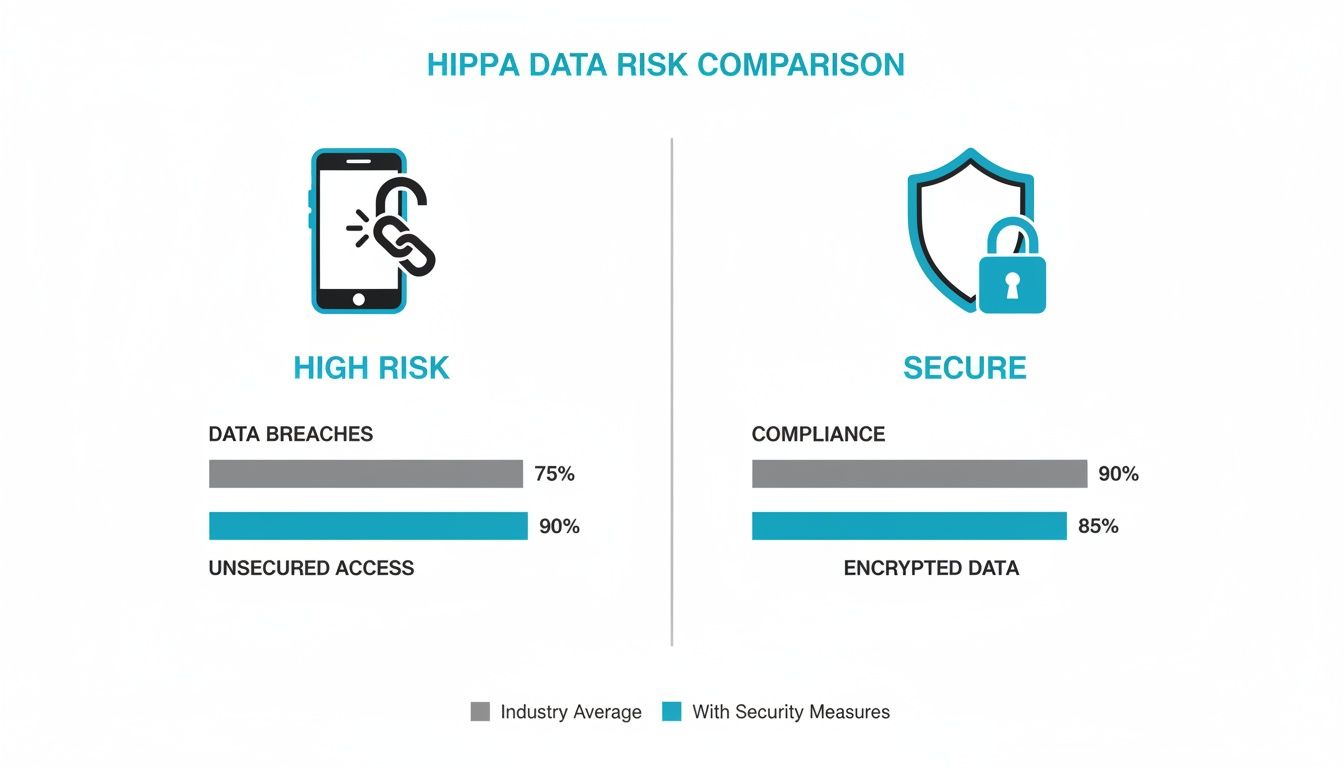
As you can see, the right protections aren’t just about compliance; they’re about protecting your practice from financial and legal fallout.
Accounting for Cost Savings and Soft ROI
The financial benefits don't stop at new revenue. A quality answering service also creates serious cost savings. Think about it on a larger scale: massive healthcare call centers can have annual operating costs of $13.9 million, with labor making up a staggering 43% of that. Outsourced services can slash those costs by up to 80%.
Plus, with an industry average 7% call abandonment rate, a busy practice could lose 140 calls and up to $45,000 in revenue every single day. Preventing even a fraction of that loss is a huge win. You can dig deeper into the medical answering services market to see just how significant these numbers are.
And then there's the "soft ROI"—the benefits that are incredibly valuable but harder to fit into a spreadsheet.
- Happier, More Productive Staff: When your front desk team isn't chained to the phone, they can focus on the patients right in front of them. This reduces burnout and lowers costly staff turnover.
- Better Patient Experience: Patients love being able to reach someone anytime. It builds trust, boosts satisfaction, and leads to glowing online reviews that attract new patients.
- Smoother Operations: Offloading routine calls and appointment booking frees up your team for more complex, high-value tasks. For example, they can now proactively make patient recall calls instead of just reactively answering the phone. You can learn more about streamlining this process with medical appointment scheduling software.
When you look at the whole picture—the new revenue, the direct cost savings, and the powerful soft benefits—the value is undeniable. It's a strategic move that strengthens your practice from every angle.
Here’s a sample breakdown illustrating the potential savings and gains for a typical three-physician practice.
ROI Calculation Example: In-House vs. Answering Service
This simple table shows that moving to an answering service doesn't just cut costs; it flips a major expense into a significant source of profit, all while improving patient and staff satisfaction.
Picking the Right Service and Getting it Set Up
Choosing a medical office answering service isn’t just about hiring a vendor; it’s about bringing a new partner onto your team. This decision directly impacts patient trust and the sanity of your front office staff. If you get it right, the transition can be a huge upgrade for your practice. If you get it wrong, it can be a major headache.
The whole process boils down to asking the right questions upfront, having a smart game plan for implementation, and knowing what a "win" looks like before you even start. You wouldn't hire a new receptionist without a serious interview, right? The same logic applies here. You're looking for a service that feels like a seamless extension of your own front desk.
Creating Your Vendor Checklist
Before you even think about signing a contract, you need a solid checklist to put potential providers through their paces. We're talking about questions that go way beyond the monthly price tag and get to the core of how this service will actually work for your practice. A good place to start your search is by looking into the top VoIP providers for business, as many answering services are built on these kinds of platforms.
Here’s what you should be asking:
- EMR and Scheduling Integration: Don't just ask if they integrate. Ask, "Can you show me a live demo of your service working with [Your EMR Name]?" For example, if you use Athenahealth, they should be able to demonstrate booking an appointment that appears in a test environment instantly.
- Agent Training and Protocols: "Walk me through your training process. How do you ensure agents are not just HIPAA compliant, but also understand our specific call-handling rules for something like a post-operative concern?"
- Reporting and Analytics: "What does your performance dashboard look like? I want to see real-time metrics like average call wait time, call duration, and a report showing how many calls resulted in a booked appointment versus just a message."
- Onboarding and Support: "Who is my dedicated person during setup and after we go live? If I need to change an on-call schedule at 9 PM on a Friday, what is the exact process?"
Don't let them off the hook with vague promises. A truly great partner will be excited to pull back the curtain and show you exactly how their system operates and how they safeguard patient data. That kind of transparency is a huge green flag.
A Proven Implementation Plan
A chaotic launch can disrupt everything. Instead of just flipping a switch overnight, the smart move is a phased rollout. This lets your team—and your patients—get used to the new system gradually and gives you a chance to iron out any wrinkles before you're fully committed.
Here's a simple, three-step plan that works every time:
- Phase 1: After-Hours Pilot (Weeks 1-2): Start small. For the first couple of weeks, only forward your after-hours and weekend calls. This is the perfect low-risk test drive. You can listen to call recordings the next day to ensure agents follow instructions and that their messaging is accurate.
- Phase 2: Overflow Support (Weeks 3-4): Once you're happy with their after-hours performance, bring them in for daytime call overflow. Set your phones to forward any call that isn't answered by your staff within three rings. This is a great way to handle the lunch hour rush without any disruption.
- Phase 3: Full Integration (Week 5+): Now that you've seen the service in action and trust the process, you can move to full integration, perhaps even using them as your primary answering point. You've built confidence in the system and know they can handle the volume.
This methodical approach makes for a smooth, stress-free transition. If you're looking for a flexible starting point, a virtual medical receptionist can be an excellent way to build this kind of scalable plan from the ground up.
Got Questions? Here’s What Clinic Managers Often Ask
Even when the benefits seem clear, it's natural to have a few questions before you bring a new service into your practice. Let's tackle some of the most common things clinic and practice managers want to know.
What Happens If a Patient Asks a Medical Question?
This is a big one, and the answer is simple: a professional answering service will never give medical advice. That's not their job, and they're trained to know the boundaries.
Their role is to act as an intelligent filter. For instance, if a patient calls asking, "Can I take Tylenol with the antibiotic Dr. Smith prescribed?" the agent’s protocol is clear. They won't answer the question. Instead, they will take a detailed message and route it directly to the clinical staff's secure message queue for a call back, ensuring patient safety and strict compliance.
Will My Patients Realize They're Speaking to a Service?
Honestly, with a quality service, they shouldn't. The entire experience is designed to feel like a natural part of your practice.
Agents will answer the phone with your clinic's name, follow the exact greeting you prefer ("Thank you for calling Sunshine Pediatrics, this is Maria, how may I help you?"), and use scripts that you've approved. The goal is a seamless, professional interaction that makes your practice look good, whether it's 2 PM on a Tuesday or 2 AM on a Sunday.
A top-tier answering service is all about consistency. The patient on the line should feel like they're talking to a trusted member of your team, building confidence and reinforcing the reliability of your practice with every call.
How Quickly Can We Get This Up and Running?
You’d be surprised. Modern, cloud-based answering services are built for speed. For most practices, you can be live in just a few business days.
The setup process is pretty straightforward. It usually starts with an onboarding call where you'll map out your call-handling rules and scripts. For example, you’ll define exactly what information to collect from a new patient (name, DOB, insurance provider, reason for visit) and what constitutes an urgent call that requires paging the on-call physician. After that, it's just a matter of setting up call forwarding from your main line. While deeper integrations with specific EHR platforms might add a little more time, the core service is designed to get you relief fast, without a long, drawn-out implementation.
Ready to capture every patient opportunity and streamline your front desk? Discover how Recepta.ai can transform your practice's communication with a blend of AI efficiency and expert human support. Book your free demo today!