
24/7 Customer Service: Models, Costs and KPIs

64% of consumers expect to be able to reach a business at any time of day, and CM.com's international consumer survey makes clear that round-the-clock availability has moved from a nice extra to a baseline expectation. Most operators translate a number like that into "hire someone for the night shift." That translation is expensive, and for plenty of businesses it's the wrong one.
The more useful translation is a routing decision you make in advance and repeat every hour: what can be answered immediately, what can be booked without a human, what has to wait for someone with authority, and what must wake somebody up. A burst pipe at 1 a.m. and a question about Tuesday's appointment arrive through the same phone line. Treating them the same way wastes money in one direction or the other.
That's why this is an operations problem before it's a technology purchase, and it gets easier once you stop thinking of 24/7 customer service as a switch that's either on or off.
What Round-the-Clock Service Really Means
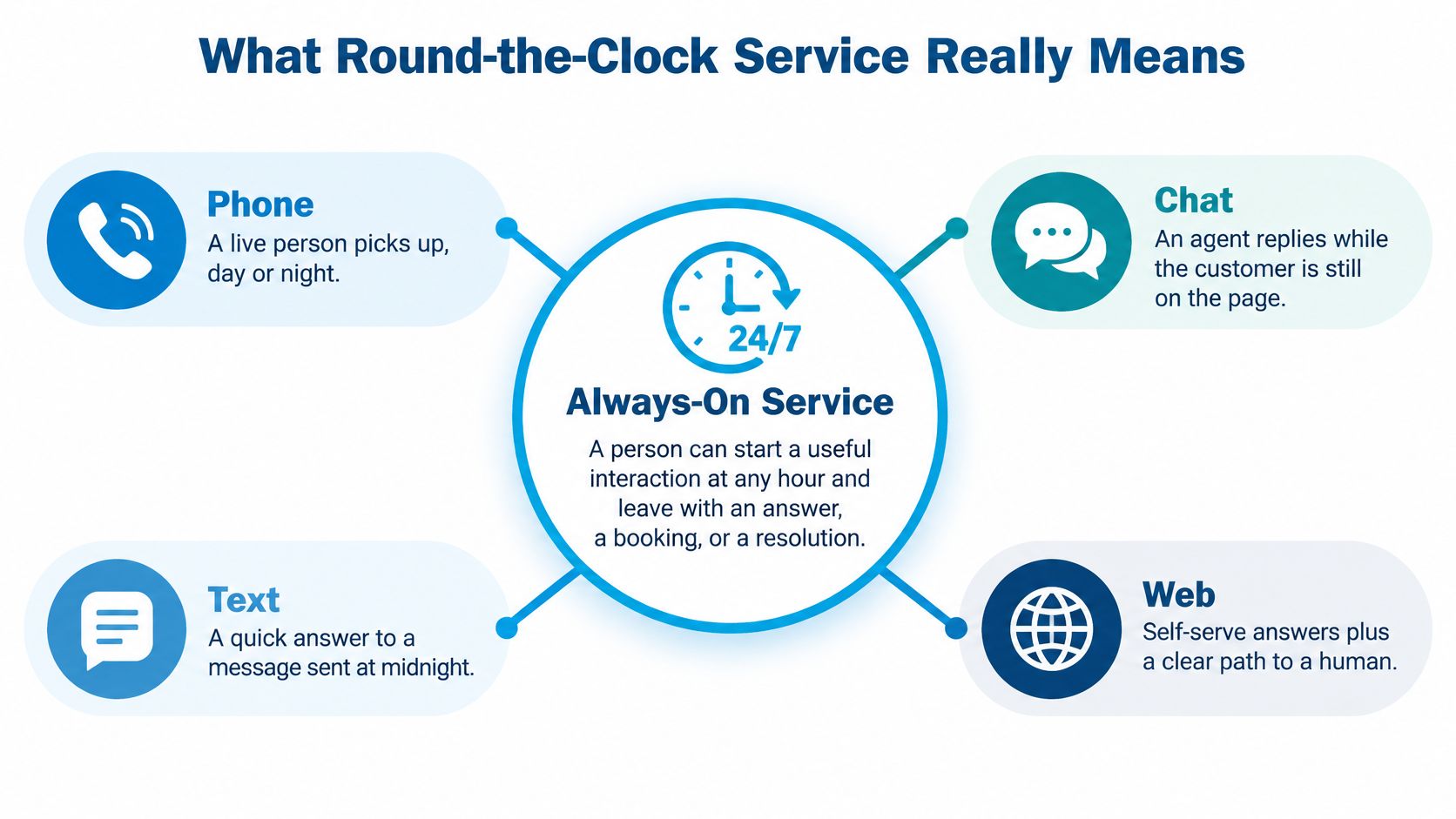
24/7 customer service means a person can start a useful interaction at any hour, by phone, chat, text, or web, and come away with something concrete: an answer, a booking, a logged request, or a scheduled next step. A recorded greeting that promises someone will call back during business hours is not round-the-clock service. It's a holding pattern with better branding.
The demand side is settled. CM.com's survey of 7,078 people, fielded in October 2022, found that nearly three in four consumers younger than 35 said they highly valued round-the-clock reachability. Expectation and delivery are two different things, though, and the gap between them is where most overnight plans fail.
The four layers behind an open line
A useful way to picture the whole system is a hotel lobby that never locks its front door. Four things have to be true at once, and each one can break on its own.
- The door stays open. Phone, chat, text, and web are monitored. A published after-hours number that rings to voicemail is a locked door with a sign on it.
- A host greets you within seconds. Someone or something acknowledges the caller fast, takes a name, and says what happens next. Silence fails here even when help is on the way.
- Routine work gets done on the spot. Hours, pricing ranges, service areas, appointment slots, and job status don't need a specialist.
- A specialist is reachable when it matters. Anything that can cause harm, lose money, or become a complaint reaches a person with the authority to act.
Being technically open is not the same as resolving the problem. A line that rings out at 2 a.m. is worse than one that says, in plain words, when a person will call back.
Expectations also aren't identical everywhere. A two-person trades firm and a national retailer shouldn't copy the same hours from the same survey. One is trying to catch emergency work, the other is trying to stop a midnight cart from being abandoned. Both need the same four layers, sized to their own call mix.
The web layer is one most businesses already run by accident. Search "no heat" at midnight during a cold snap and you land on pages like this after-hours oil heating repair guide, which tells a homeowner what to check before a technician arrives and what a genuine emergency looks like. That page answers a question at an hour no staffed office could, and it earns the call that follows.
Coverage then comes down to four decisions: who answers, what you measure, what it costs against the calls it saves, and which calls must never sit with automation alone.
In-House, Outsourced, or Hybrid Coverage
Four coverage models look similar on a proposal and behave nothing alike at 3 a.m. Here's the comparison a team usually needs before anyone opens a pricing page.
| Model | Who answers | Best fit | Main strength | Main failure |
|---|---|---|---|---|
| In-house night shift | Employees on a rota | Regulated or fast-changing local rules | Full control of systems and script | Gaps when someone calls in sick; highest labor cost |
| Outsourced answering | Third-party live agents | Overflow and simple message taking | Coverage without hiring | Generic scripts and weak escalation context |
| AI only | Automated voice or chat | FAQs, hours, and status checks | Instant reply at low marginal cost | Breaks on urgency, complaints, and trust |
| AI plus human hybrid | AI for routine work, people for edge cases | Appointment and urgency businesses | Speed plus judgment so calls are not missed | Fails if handoff rules and disclosure are vague |
What the table leaves out
In-house coverage means employees on a rota with CRM access and the authority to book or dispatch. It's the right answer when the rules change daily or the work sits behind strict privacy duties, because your own staff already know which caller is a repeat, which postcode gets priority, and which technician is on call. It fails in a way you can predict: one sick day empties the shift, and labor cost per overnight call is the highest of any model.
An outsourced answering bureau buys live agents who take messages and sometimes book. It fits overflow and simple intake well. It fails when the agent doesn't know your urgency rules and reads a generic script to a caller with water coming through a ceiling.
AI-only coverage suits FAQs, hours, and status checks at the lowest marginal cost per interaction. It breaks on emergencies, billing disputes, clinical questions, legal intake, and angry callers. The limit isn't intelligence. It's authority, because a bot can't waive a fee, dispatch a truck at double rate, or tell a frightened parent to hang up and dial emergency services.
Decision rule: route by consequence, not by channel. A booking with no downside can be automated; anything that can cause harm, cost money, or turn into a complaint needs a person with authority.
Hybrid coverage is where most appointment- and urgency-driven businesses land. We run that model at Recepta.ai: AI handles high-volume routine calls, chats, and texts at any hour, qualifies and routes callers, and books straight into the live calendar. Our AI brings in live agents for complex calls, and the Hybrid Receptionist design gives routine volume to automation and hard cases to trained people, so an overnight call isn't stranded on a bot.
If booking and status checks dominate your call mix, start hybrid. If most of your calls are sensitive judgment, keep humans primary and let automation greet, log, and schedule only inside written rules. If you're weighing a bureau, our guide to outsourced call center solutions covers where handoffs typically lose context.
Whichever model you pick, it has one job it can't fail: meeting a speed target at the hour the call arrives.
Payoffs and the Failures That Follow
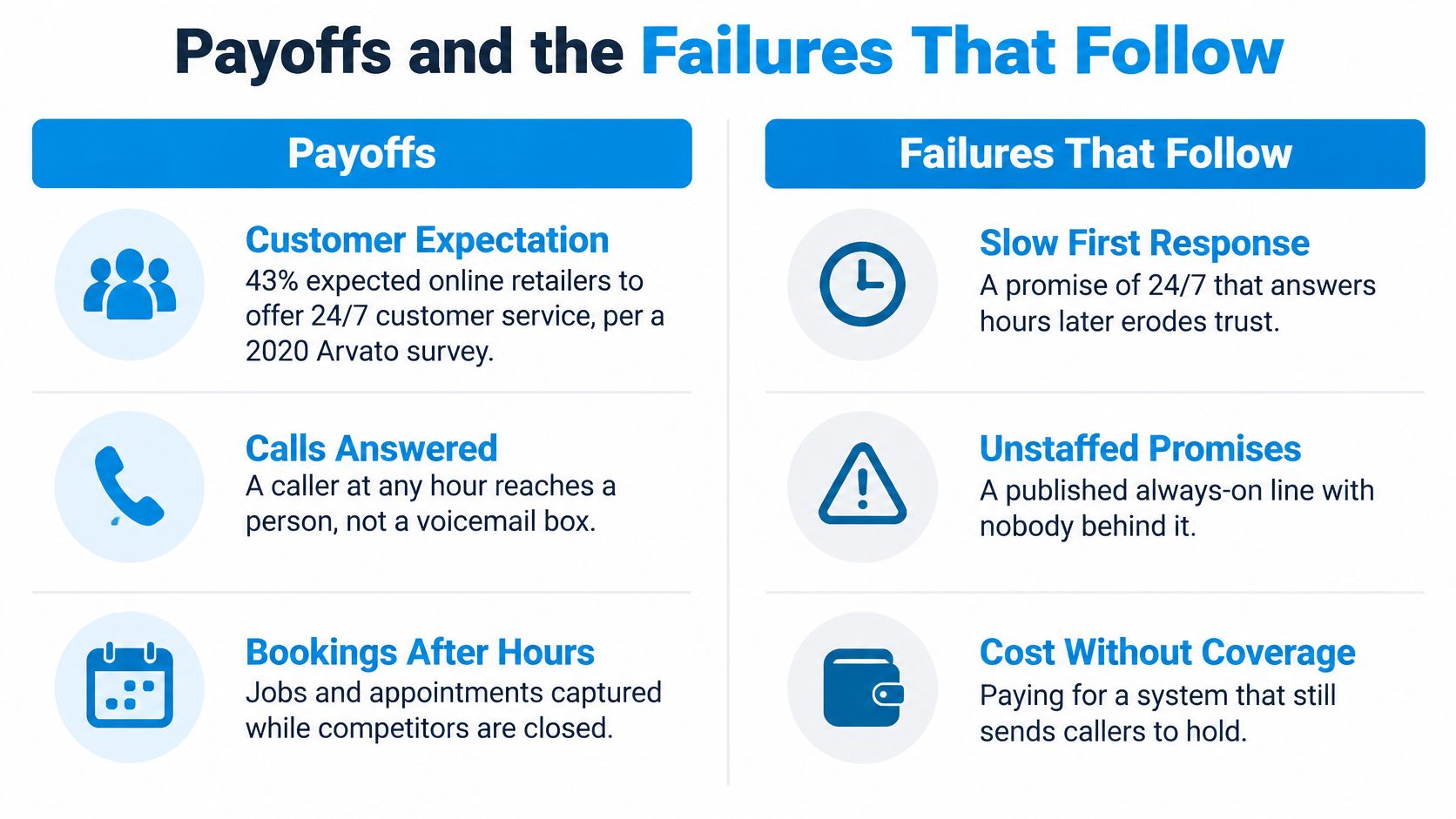
Respondents in a 2020 Arvato survey rated customer service's effect on brand loyalty at 7.8 out of 10, a number that only means something next to the rest of the findings. In that same study, 43% of consumers expected online retailers to offer customer service 24 hours a day, seven days a week, while another 36% preferred coverage of about 12 hours per day, according to the 2020 Arvato survey reported by Retail TouchPoints.
Read the split carefully. Fewer than half wanted the full round-the-clock version, and most of the rest wanted a long, reliable day. That's a coverage design question rather than a staffing emergency. The loyalty payoff comes from never being surprised by a closed door, not from paying for a full night roster you can't fill.
For a plumber, an insurer, or a dental practice, the payoff shows up as a booking taken at 8:40 p.m. instead of a name at the top of a search result. Continuous coverage also spreads demand, so Monday morning isn't a pile of voicemails that all need callbacks in the same hour.
Where the payoff turns into a failure
Availability amplifies whatever the interaction does next. More than a third of consumers report frustration with inadequate accessibility, including limited service hours, language barriers, difficulty reaching a human, and too few contact options. And 56% still prefer a human for support issues even though 71% report satisfaction with AI-supported service, per Capgemini's customer service transformation research. The same pattern shows up in the failure modes you can list on one page:
- A bot giving advice it shouldn't. Clinical, legal, or coverage guidance delivered at 3 a.m. by a system with no licence and no liability.
- A fast hello followed by a clumsy handoff. The caller repeats their address, their problem, and their account number, which erases the speed they just experienced.
- No language path. A greeting in one language only, at the exact hours when a chunk of your customers need another.
- Outbound follow-up without consent. Texts and calls the customer never agreed to, at times they didn't choose.
The loyalty case doesn't rest only on a 2020 e-commerce sample, either. Zoho Australia's 2024 Consumer Insights and Perceptions Study found 39.65% of surveyed Australian consumers considered 24/7 customer service extremely important, which belongs on the same ledger as the access complaints above.
The honest test of any overnight system is a single question: what happens at 2 a.m. when the system can't solve the problem? The safe answer is fixed. Acknowledge the caller, capture the need, commit to a callback window, and hand off with the transcript attached so the second conversation starts where the first one ended.
Service Levels Worth Tracking by the Hour
The working benchmark for a phone line is the 80/20 service level: answer at least 80% of inbound calls within 20 seconds. Contact centers use it because it measures queue performance and staffing capacity together rather than whether the doors are technically open, as Nectar Desk's call center statistics reference sets out. Pair it with average speed of answer, where reported reference values sit near 28 seconds and top-performing operations answer in under 15 seconds.
Why monthly averages hide the problem
A month can look healthy while every Saturday is a disaster. One strong weekday plus one abandoned weekend averages into a figure nobody should trust. Track service level, abandonment, and callback completion by hour, with particular attention to the edges: before 8 a.m., after 5 p.m., and the whole of Sunday.
Practical rule: judge coverage by the worst hour of the week, not the average of the month.
| Metric | Starting target | What a miss usually means |
|---|---|---|
| Service level | At least 80% of calls answered within 20 seconds | Not enough people or bots for that hour |
| Average speed of answer | Near 28 seconds typical; under 15 seconds for top teams | A queue forms before anyone greets |
| Hold time | 3 minutes or less; 46.4% reject longer waits | Callers leave or don't return |
| Chat connect time | About 13 seconds in one large dataset; each extra 5 seconds cuts messaging odds by 1.75% | Digital visitors drop before the conversation starts |
| Abandonment by hour | Compare daytime with nights and weekends | Coverage exists on paper but not when demand arrives |
| First-contact resolution | Separate urgent from admin queues | The greeting was fast but the problem wasn't handled |
Set the target by urgency
Hold tolerance has a ceiling. Most consumers accept telephone hold times of three minutes or less, yet 46.4% consider longer waits unacceptable, and roughly one quarter say they'll stop doing business with the company after an excessive wait, per Metrigy's research on wait times published by RingCentral.
Chat is harsher. In one large academic chat dataset, customers waited an average of 13.17 seconds to connect, and every additional five seconds of waiting cut the probability of sending messages by 1.75% and the likelihood of receiving an agent message by 8.64%, according to Stealth Agents' research on support response times. Digital visitors don't queue. They leave.
Split targets by consequence. A burst pipe or a chest-pain call needs a stricter answer target, and the chest-pain call needs an immediate redirect to emergency services. A records request can wait inside the three-minute band. Then measure first-contact resolution separately, so a quick greeting isn't counted as a solved job. If you only watch one number, watch average speed of answer at the hour the call arrives.
Log a timestamp at greeting, at transfer, and at booking. When a call goes wrong, that trail tells you whether the miss happened in the queue, the bot, the human handoff, or the calendar.
The Cost of Coverage and the Calls You Lose
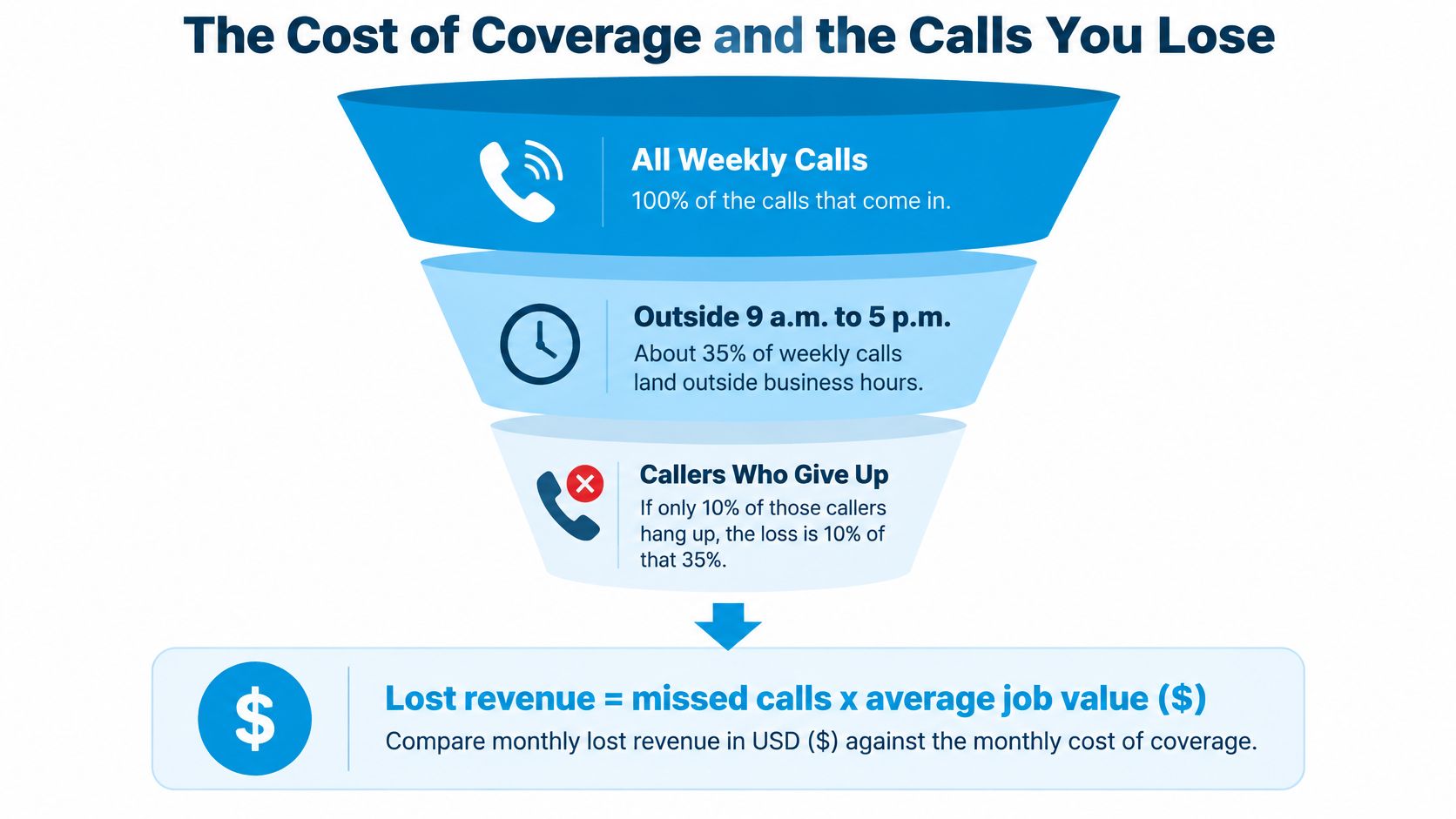
Run the arithmetic on a normal week before you price anything. Coverage works like a four-layer door: an open line, a fast greeting, a routine job resolved safely, and a human for the calls that need one. Missed calls break all four layers at once. About 35% of weekly calls arrive outside standard 9 a.m. to 5 p.m. hours, and if only 10% of those callers leave a voicemail while callbacks wait until the next day, roughly 30% of inbound lead flow is lost before anyone responds, per Impact Research Group's missed calls and lost revenue analysis.
The arithmetic on a 200-call week
- Multiply weekly volume by 0.35. At 200 calls, about 70 land outside business hours.
- Count the voicemails. At 10% of that pile, roughly 7 messages are waiting in the morning, which leaves about 63 callers uncaptured.
- Treat next-day callbacks as late. By the time someone dials back at 9 a.m., plenty of those prospects have booked the next name in the search results.
- Convert with your own numbers. Multiply the uncaptured calls by your booking rate and your average job value. Don't treat every ring as a sold job. Treat it as a conversation you didn't get to have.
| Step | Figure | What it means |
|---|---|---|
| Weekly calls | 200 | Example HVAC inbound volume |
| Outside 9 a.m. to 5 p.m. | About 70 (35%) | Calls that miss a staffed desk |
| Leave a voicemail | About 7 (10% of 70) | The only after-hours records next morning |
| Never captured | About 63 | Prospects gone before a callback |
| Share of lead flow at risk | Roughly 30% | Loss if callbacks wait until the next day |
| What 24/7 intake saves | Need, address, preferred time | First-contact capture instead of a recording |
Now price coverage against that figure with three lenses. First, loaded overnight wages, plus benefits, plus the cost of the sick-day gap when your one night person calls out. Second, a per-minute or per-call bureau, cheap per minute until you count the bad bookings and the weak escalation. Third, a hybrid subscription plus usage overage, tested against the bookings it recovers rather than against the bureau's sticker price. Usage beyond plan limits carries overage fees at the rates shown on the pricing page or in the order, and our breakdown of the cost of answering service walks through the same three lenses.
Recepta.ai is one hybrid built for exactly that intake: the caller's service need, address, and preferred time captured at first contact rather than left on a recording. Recepta.ai's stats show a 30% increase in qualified leads with 24/7 answering, a benchmark worth testing against your own lost-call total.
Then run a one-week tally of after-hours calls, voicemails left, next-day connects, and jobs booked. Four columns, seven days, and the argument about coverage ends with your own data on the table.
How Clinics, Trades, and Firms Use It
A Sunday-night call is rarely just a call. It's a decision about who gets the work, and the same three scenes play out across most of the businesses that need round-the-clock coverage.
A Sunday night no-heat call
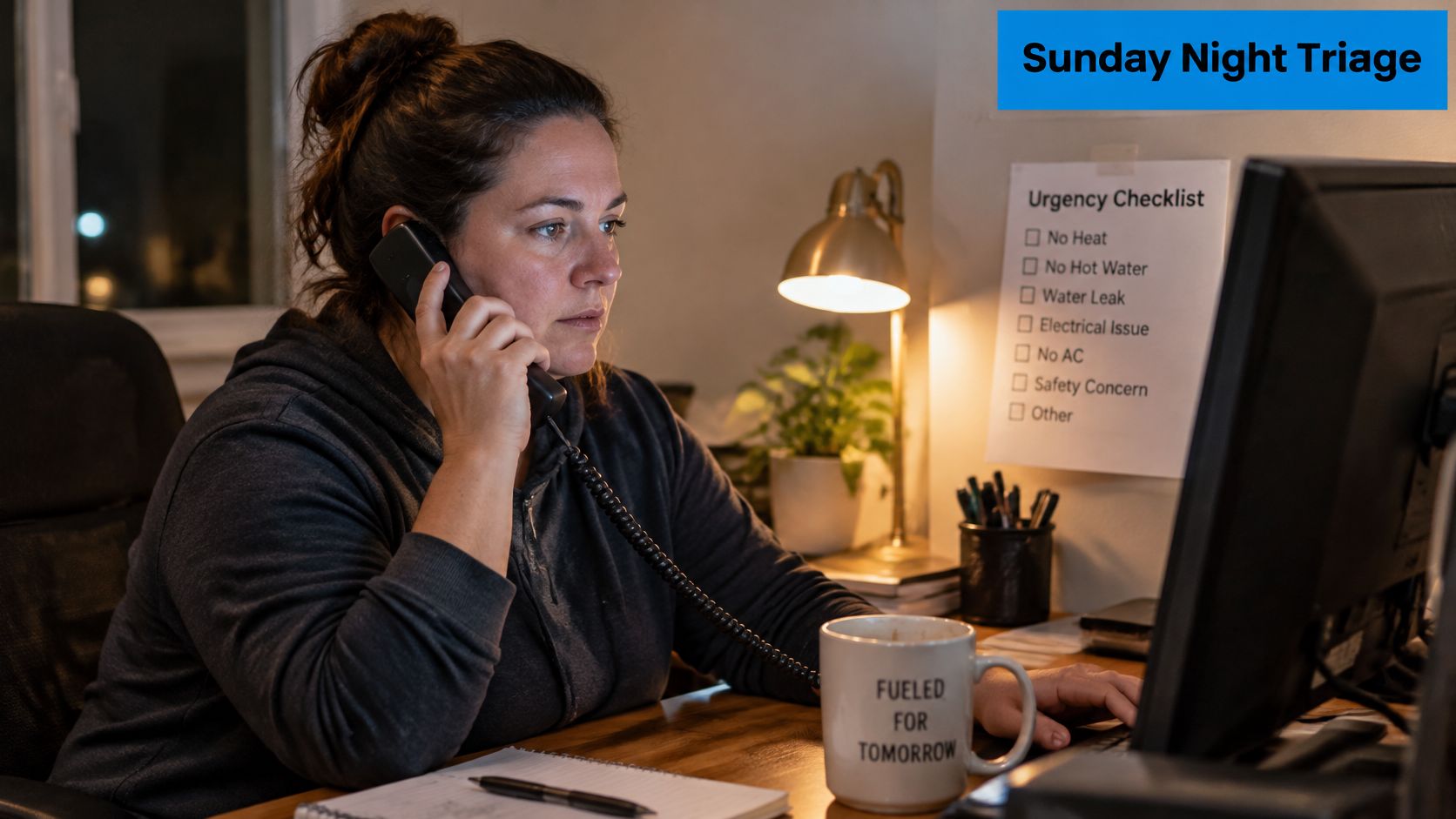
A homeowner with no heat in freezing weather should get a dispatch window or an on-call technician, triaged against your own urgency rules rather than a generic promise. A quote request at the same hour should get the address, two photos by text, and a morning slot. The rule that call proves: triage by consequence, and don't send every ring to voicemail or every ring to a technician.
This short walkthrough shows how an after-hours conversation should run, from the first ring to a confirmed slot.
The clinic that told nobody
At a dental or medical office, automation earns its keep on hours, directions, and routine booking during the peak crush, while billing disputes, clinical questions, and complaints go to a person rather than sitting in a queue. Healthcare also offers the clearest warning about promotion. In a randomized study of an inner-city general medicine clinic, only 7.6% of eligible patients used an after-hours physician service during the first 18 months, equal to 6 calls per 1,000 patients per month. After repeated promotion, usage rose to 19.4%, or 24.1 calls per 1,000 patients per month, with no significant difference in hospitalization or emergency-room visits, according to the study indexed by PubMed.
For a practice manager, the lesson is to tell patients the line exists, more than once, through channels they already read. It also means routing urgent symptoms to emergency care instead of letting an answering service stand in for clinical triage. Our work with after-hours answering for medical practices is built around that boundary.
Intake without advice
A law firm, insurance agency, or finance desk can capture intake overnight: name, matter type, conflict basics, and a callback time. What it must refuse to do is give case-specific advice at 2 a.m. The overnight script should state plainly that no advice is being given and that an attorney or advisor will call within a stated window. Where a large share of customers speak Spanish, a bilingual greeting isn't a nicety. It's the difference between a captured lead and a hang-up.
Every one of those scenes ends with the same artifact: a one-page after-hours decision tree taped next to the phone and pasted into the automation. Two columns, book or escalate, with a named trigger for each row. Write it once and the Monday morning argument stops recurring.
Choose a Model and Turn It On
Three checks settle the choice faster than any vendor demo.
- Start from your own after-hours share. Use an industry average only as a stand-in until a week of your calls replaces it.
- Mark what a script can safely handle. Hours, status, address, and a time slot can be booked from a script. Health, money, law, and complaints cannot.
- Test against the tracked service level. At your busiest hour, can you answer most calls inside the target without burning out the team?
Mostly booking and intake points to an AI-plus-human hybrid. Small, highly sensitive volume points to longer evening hours plus a callback window instead of an overnight roster.
Disclosure is a launch step, not a footnote. In a 2025 holiday-season survey, 78% of U.S. consumers had used AI or automation for customer service, yet only 22% said companies clearly disclosed when AI was being used, and 69% believed companies should always disclose it, per LiveOps' survey findings. Being told appears to help rather than hurt: across Australia, China, Malaysia, Singapore, the United Kingdom, and the United States, customers who knew they were interacting with AI reported satisfaction rates 34 percentage points higher than customers who weren't informed, the same research found.
What the opening line must do: name the assistant, offer a person immediately, say what's recorded, and ask before sending a follow-up text.
We answer every call, chat, and text instantly, 24/7, with live human backup on every plan, and we offer a 30-day trial that's risk-free, backed by a money-back guarantee. Then score the first week on after-hours bookings, night abandonment, and urgent handoffs that reached a person inside the promised window. Those three numbers tell you more than any dashboard tour.
Your voicemail box shouldn't be doing a receptionist's job after 6 p.m. Recepta.ai puts conversational AI and trained human receptionists on every call, chat, and text around the clock, booking routine work straight into your calendar and handing the sensitive conversations to people who can act on them. Bring your own after-hours call mix, run it for a week, and let the bookings answer the question. Start at Recepta.ai.