
Call Escalation Process: When and How to Hand Off
It's 8:40 on a Monday. Your front desk has two lines lit, a technician waiting on a dispatch address, and a caller who has now described the same leaking water heater to an automated menu, a voicemail, and two different people who each promised a callback. Nobody called back. That caller isn't angry about the leak anymore. They're angry about the repeating.
Too often, the answer is another transfer rule. The better answer is to treat escalation as a governed decision about risk, authority and context, with a named owner at every stage and one measured question behind it: did this call reach the right person with what they needed to act? Get that right and your transfer count stops being the scoreboard that matters.
The Call Escalation Process at a Glance
Think of a relay race. The next runner can only sprint if the baton arrives with momentum, not dropped on the track behind them. A call escalation process lives or dies on the same detail: the value of the handoff is entirely in what travels with it.
Escalation is rarely one event. A call that automation cannot finish passes through six stages, and each one has an owner and a clock.
| Stage | What happens | Owner | Time target |
|---|---|---|---|
| Detect | AI classifies intent and urgency from the caller's words | Automation | Immediately at call start |
| Triage | Call is screened against the approved red-flag and risk list | Automation or front desk | Within the same call |
| Transfer | Call is routed to a skilled agent with a structured summary | Routing engine | Handoff in seconds where staffed |
| Acknowledge | Receiving agent accepts the call or it is re-queued | Human tier | 10 to 15 minutes before escalating up |
| Resolve or hand up | Agent resolves, books a follow-up or escalates to a supervisor | Human tier and supervisor | Set by severity; 4 hours to mitigation for critical incidents |
| Review | Reason, elapsed time and outcome are logged and reviewed | Team lead | After each escalated call or in weekly review |
Plan for this path rather than treating it as a failure. In an HDI technical-support benchmark covering 506 support centers, 72% of incidents were resolved at Level 1, leaving 28% to be handled by higher tiers or management. Those are technical-support tickets rather than voice calls, so read the ratio as a planning signal: roughly a quarter of what arrives will need more authority or a different skill than the first line has.
Phone traffic gives you a tighter number. The ContactBabel 2025 U.S. Contact Center Decision-Makers Guide reports a mean live call-transfer rate of 9.9%, with a 5.0% median, from interviews with 213 U.S. contact centers. Roughly one answered call in ten needs a live transfer, and one in twenty at the median.
The ownership test: Walk your own process and put a name against every stage. The stage with no name is where escalation quietly becomes repeated routing, and where the caller starts telling their story a third time.
Read the table that way, as an accountability chart rather than a queue map. Detect and triage decide whether the call should have been automated at all. Transfer and acknowledge decide whether the caller waits or moves. Resolve and review decide whether you learn anything from the call.
Which Calls Must Reach a Human Immediately
Most escalation guidance answers a question you already solved. It tells you to transfer after two failed attempts and stops there. The decision that shapes cost, safety and satisfaction comes earlier: which calls were never a candidate for automation in the first place?
Callers have opinions about this. Research summarized by Phone.com on AI in customer service found that 61% of consumers across 23 countries preferred a human-mediated channel for nine common interactions, and that inability to reach a human was the leading automation annoyance for 47% of respondents. Satisfaction follows the same line: the same account cites Verizon research across seven countries showing 88% satisfaction for mostly or fully human interactions versus 60% for AI-driven ones.
None of that argues for routing everything to a person. It argues for drawing the boundary by consequence instead of by how hard the conversation felt.
The three tiers
| Call type | Action | Example |
|---|---|---|
| Clinical symptoms | Escalate immediately to clinician or emergency service | Patient reports chest pain or heavy bleeding |
| Legal deadline or identity dispute | Escalate immediately to a qualified staff member | Caller says a filing deadline expires today |
| Threats or safeguarding concerns | Escalate immediately to the designated manager | Caller reports a threat against staff |
| Payment dispute or distressed caller | Escalate immediately to a trained agent | Customer disputes a charge and is upset |
| Refunds, pricing exceptions, regulated advice | Human approval required before any commitment | Request for a discount outside the approved range |
| Scheduling, FAQs, reminders, data collection | Automate and log the outcome | Booking an HVAC maintenance visit |
The first tier is about harm that grows while the call waits. A dental patient describing heavy bleeding after an extraction is not asking for an appointment; they need a clinician or an emergency service on the line now, and the front desk's job is to recognize the phrase and route it without a second opinion.
The middle tier is about authority. A caller pushing for a price match on a quarterly pest contract isn't a routing problem, it's a permissions problem, and no amount of empathy from someone without approval authority fixes it. The agent needs a supervisor's yes before committing.
The bottom tier is volume you should keep. A patient moving a cleaning, a homeowner confirming a maintenance window, an adjuster collecting a claim reference: automate these, log the outcome, and let your people spend their attention where judgment pays.
Minimizing handoffs lowers labor and raises abandonment, repeat contacts and complaints at the same time. A low transfer rate is not a trophy if the calls came back.
The test to apply to any new call type takes one sentence: what is the harm if the automated answer is wrong? If the answer is money out the door, a missed legal deadline, a safeguarding risk or a clinical consequence, the call needs a human decision. If the answer is a mild inconvenience, automate it and audit the result. Teams that run 24-hour operations already apply this discipline elsewhere, and what round-the-clock security monitoring covers shows the same logic at work: a named responder, an alert path and a documented escalation chain for the hours when nobody is walking the floor.
Severity Levels and Response Timers
One timer for every call creates two failures at once. Routine appointment changes escalate too early and clog your senior people, while a suspected data breach sits in the same queue as a rescheduling request. Timers have to follow impact.
| Severity | Example call | Response target | Escalate when | Escalate to |
|---|---|---|---|---|
| P1 critical | Multi-location phone outage or suspected data breach | 15 to 30 minutes, around the clock | Mitigation not reached in 4 hours | Designated executive immediately |
| P2 high | Single-site booking system failure | 4 hours in business hours | No progress within 4 hours | Operations manager |
| Clinical urgent | Patient reports red-flag symptom | Immediate live clinical response | Any failed contact on first attempt | Clinician or emergency service |
| Clinical callback | Routine remote consultation request | One callback within 2 hours | Second attempt fails after defined interval | Clinician or duty manager |
| Routine | Appointment change or general question | Team-defined; no external benchmark | Team-defined; no external benchmark | Team lead |
Arkansas State University's published IT communication and service-level standards show what a working matrix looks like: a P1 critical incident gets a 15 to 30 minute response around the clock, mitigation within four hours or continuous work until it happens, hourly updates and immediate escalation to leadership. A P2 gets a four-hour business-hours response and escalates if there's no progress within four hours. Borrow the mechanics directly. A phone outage across three locations or a suspected breach in your CRM is your P1: the designated executive hears about it immediately, updates go out hourly, and the case escalates itself when a deadline is missed.
Callback rules carry the same weight in clinical settings. Guidance from the Medical Defence Union for Scotland says patients requesting remote consultations should get a clear timeframe for clinician contact and instructions on when to contact the practice again if that contact doesn't happen. It also asks for written guidance on how many attempts staff make before documenting a failed contact. A workable policy: one callback within two hours, a second attempt after a defined interval, escalation to a clinician or duty manager when attempts fail or symptoms sound urgent.
Why a shorter list beats a longer one
Triage lists get better by subtraction. In UCHealth's telephone-triage program, a "Red Flag List" used by non-clinical staff was refined against established clinical protocols and cut from 84 red-flag symptoms to 39, a change associated with average speed to answer for emergent calls falling from 1 minute 17 seconds to 22 seconds, as reported in this account of the red-flag list work. A short list that front-desk staff can recognize under pressure beats a lengthy one they have to search.
Whatever you set, write each timer as a trigger and a consequence in the same line. "No acknowledgment in 12 minutes moves the call to the duty supervisor's mobile" leaves nothing to interpret. If you want the customer-facing side of these commitments aligned with the internal ones, our guide to service level agreements covers how response, resolution and communication targets fit together.
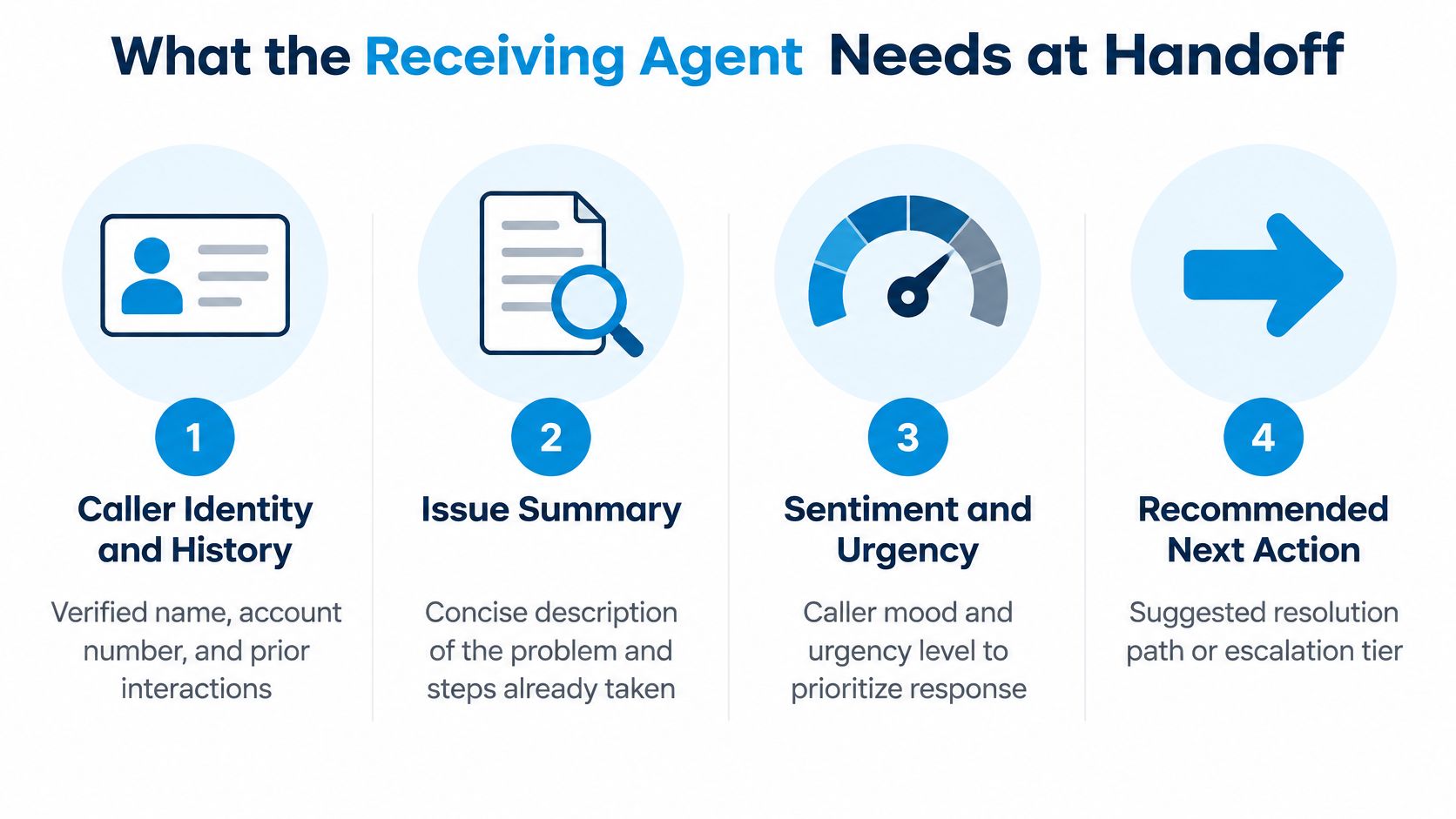
What the Receiving Agent Needs at Handoff
The handoff is where most escalation designs collapse, and the damage isn't the transfer itself. It's the silence. The receiving agent opens with "how can I help?" and the caller starts over, often for the third time that day.
Context is worth real money. Research cited by Intercom's guide to AI in customer service found that human agents receiving full AI-prepared context can resolve escalations 35 to 45% faster than agents starting from scratch. The same account notes that 55% of shoppers in a 2025 holiday study had to escalate an AI-handled issue to a human. Speed to a person means little if that person starts cold.
The handoff package
Build the record once, attach it to the transfer, and make it visible to the receiving agent before they speak:
- Identity and consent: Verified name, account or patient reference, and whether consent for recording or data sharing is on file.
- The stated goal in the caller's words: Not your internal category. "I want the leak fixed before the tenants arrive Friday" tells an agent more than "plumbing, urgent."
- What already happened: Steps attempted, answers given, and any promise made that wasn't kept.
- Frustration and urgency signals: How many times they've called, whether they asked for a supervisor, and how the tone has moved.
- Account and schedule data: The appointment, the claim, the matter file, the contract value, pulled from your CRM or booking system rather than retyped.
- The reason automation stopped: Low confidence, out-of-scope request, failed verification, or a policy boundary. This is what makes the escalation auditable.
- The exact decision required: Approve the exception, authorize the refund, confirm the clinical advice, or make the booking. An agent who knows the ask can act in the first sentence.
Then handle the transfer itself out loud. Tell the caller a person is joining, name the team, and confirm the context arrived. A silent drop into a hold queue undoes everything the data package bought you. If you're unsure where your current process sits, our breakdown of cold transfer versus warm transfer maps the difference in caller effort and repeat contacts.
For healthcare, legal, finance and insurance, two extra rules apply. Expose only the sensitive fields the receiving agent needs to act, not the whole record. And log who accepted responsibility, with a timestamp, because "nobody told me" is the sentence that turns a complaint into a liability question. Structured logging is the backbone here: every interaction following the business's script and being recorded in a form that can trigger follow-ups, so nothing depends on someone's memory of a Monday morning.
Here's a short walkthrough of what a warm handoff looks like in practice.
The 30-second test: Hand the record to a colleague who wasn't on the call. If they can't take a meaningful action within 30 seconds without asking the caller to repeat anything, the package is incomplete.
How to Build an Escalation Path Step by Step
A sound process rests on four things: severity-based service-level agreements, acknowledgment timers, ownership rules and fallback contacts. The NIST incident-handling guide recommends setting maximum response times by incident type, resource criticality, severity, SLA commitments, time of day and concurrent workload, and its example pattern duplicates the initial contact, waits about 15 minutes, then escalates to a manager and repeats upward until ownership is established.
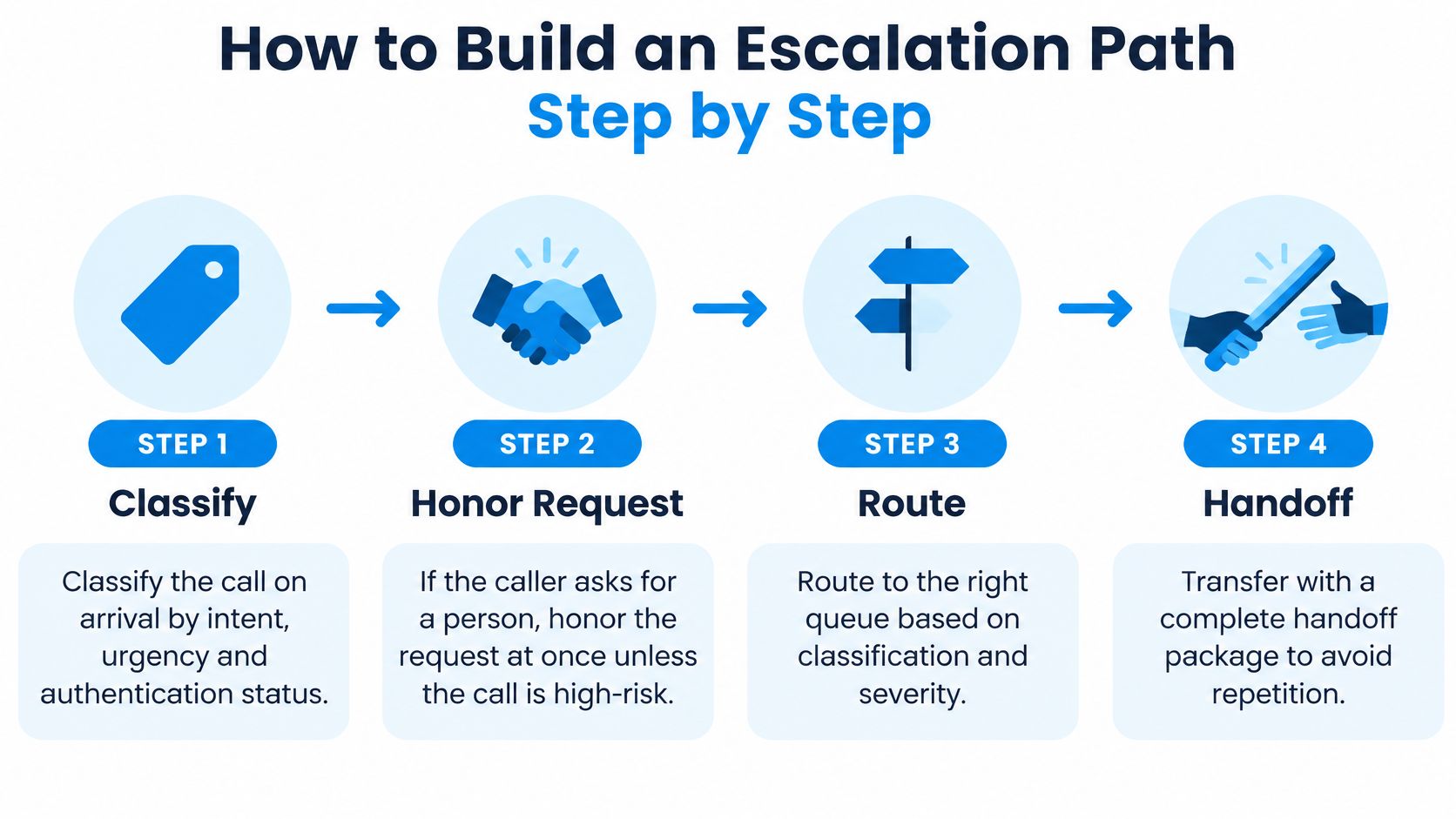
Here's the build order that holds up under load.
- Classify on arrival. Capture intent, urgency and authentication status in the first few seconds, because that classification sets the route for everything after it. The common slip is classifying by department ("billing") instead of by need ("disputed charge on a closed account"), which sends the caller sideways.
- Honor the request for a person at once. If someone says they want a human, hand them one. Making them finish a triage loop first is the single fastest way to turn a neutral caller hostile. The exception is a call that screens as fully automatable and the caller is in the habit, in which case offer the automated path once, clearly, and then comply.
- Assign a required skill. HVAC troubleshooting, dental scheduling, legal intake, insurance claims, Spanish, or a specific state license. Routing on skill rather than seniority gets the call to someone who can close it, and simulation work on skill-based routing models suggests agents with two skills can perform close to fully pooled agents under sensible pooling conditions. If the skill doesn't exist in-house, filling it is a staffing decision rather than a process one, and hiring medical virtual assistants is one route practices use for trained remote coverage.
- Score eligible responders. Rank them on urgency, waiting time, current occupancy and demonstrated resolution performance, then widen the skill set gradually if nobody is free. Sending every difficult call straight to a general queue is the slip, and it's why so many escalations land with someone who has to transfer again. Our guide to intelligent call routing covers how skill and queue-state signals combine.
- Start the acknowledgment timer and transfer with the package. Use the severity targets you set, not a single house number. The slip here is starting the timer only during business hours, which leaves after-hours calls with no clock at all.
- Offer a callback instead of a hold when no agent frees up in time. Take the details, commit to a stated response window, and send the caller away with a reference. A 14-minute hold that ends in abandonment is worse than a callback booked at minute three.
- Duplicate the handoff upward if nobody accepts. Follow NIST's pattern: copy the request to a manager, then the next level, until a person owns it. The failure mode to watch is an "escalated" flag that lands in a shared inbox nobody is assigned to.
- Log every timeout, transfer, callback and final resolution. Without the record you can't compute acknowledgment time, time-to-human, transfer failure or repeat-contact rate, and the process can't improve.
Take a home-service firm with a high-value install booking stuck unresolved. A workable rule, of the kind a documented incident-escalation framework describes with a 10 to 15 minute no-progress baseline, moves that call to a supervisor after ten minutes with the reason, elapsed time, customer impact and receiving team recorded. Same day, a caller who asks for a human at minute one goes straight to a qualified agent. Both calls are escalations. Only one of them needed a timer.
Metrics That Prove Escalation Is Working
A fast transfer is easy to produce and tells you almost nothing. You can move every call to a supervisor in 20 seconds and still leave callers unresolved, repeating themselves and calling back the next morning. So measure the outcomes around the transfer, not the transfer.
ContactBabel's 2025 U.S. Contact Center Decision-Makers Guide puts mean first-call resolution at 76%, mean speed to answer at 99 seconds and mean abandonment at 8.9%. Those three give you a reference point for whether your operation is behaving like a normal one or has a structural problem.
| Metric | What it reveals | Healthy direction | Reference value |
|---|---|---|---|
| Time to answer | How long a caller waits before a person or AI picks up | Lower | 99 seconds mean speed to answer in U.S. benchmark |
| Qualified-transfer rate | Share of transfers that reached a skilled agent | Higher | Set baseline in pilot |
| Warm-transfer completion | Share of handoffs with context passed and accepted | Higher | Set baseline in pilot |
| First-contact resolution | Share of calls resolved in the first call | Higher | 76% mean in U.S. benchmark |
| Repeat-contact rate | Share of callers who call back about the same issue | Lower | Set baseline in pilot |
| Abandonment | Share of callers who hang up before resolution | Lower | 8.9% mean in U.S. benchmark |
| Repeat-explanation rate | Share of handoffs where the caller repeats information | Lower | Set baseline in pilot |
Repeat contacts are the most honest proxy you have for failed resolution, because a caller only dials again when the last answer didn't hold. There's a real trade-off between waiting time and resolution quality, and it doesn't disappear because you optimized the queue.
The trap in one example: A team drops its transfer rate from 14% to 8% in a quarter and celebrates. Repeat contacts rise from 11% to 17%, and complaints about being "passed around" climb. Nothing got solved. The calls were delayed, then returned.
None of this is measurable unless every inbound and outbound call, message and configured action is logged, which is the point of structured call records. Real analytics beat sampling: our post on call detail reporting shows how the logging layer feeds these calculations. Pick one target per metric before your next review, write it down, and change one variable at a time. Raising first-contact resolution by three points while repeat explanations fall is progress. Cutting transfers in half while abandonment climbs is not.
Confirm Your Escalation Rules Before Launch
Before anything goes live, four items need a yes:
- Every call type has an action and an owner. Walk the decision matrix row by row and confirm the destination exists, is staffed and has accepted the responsibility.
- Every severity level has a timer and a named next responder. A timer that expires into a shared queue is decoration.
- The handoff package is defined and has been shown to the receiving agents. They should be able to tell you what they'll see on screen before the call connects.
- Every timeout and transfer writes to a log. If it isn't recorded, it didn't happen, and you can't review it.
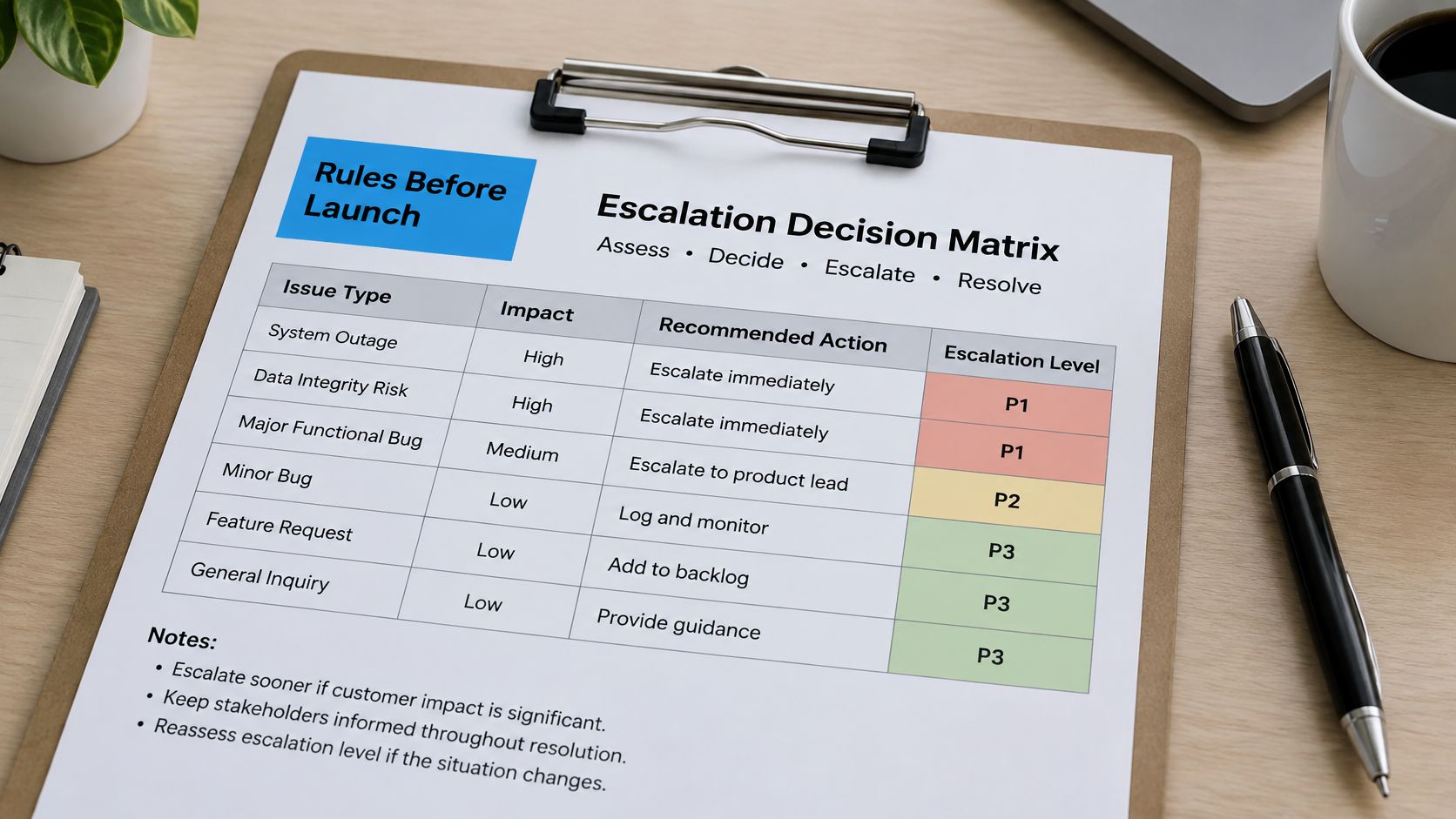
Then run a two-week pilot on a single call type rather than switching everything at once. Track repeat-contact rate and repeat-explanation rate against the numbers you recorded before the pilot, fix the handoff package wherever callers still repeat themselves, and only widen scope once those two lines move in the right direction.
Test each routing option the team will use: transfer by rule during staffed hours, schedule a follow-up when the right person is booked, and take a detailed message with a committed response time when nobody is free. Confirm the failure paths too. An after-hours test call is worth more than an hour of documentation review, and this walkthrough of testing AI answering with Lighthouse Legal covers how to script those test calls and what to listen for. Screen out spam, solicitors and low-value calls so only genuine inquiries reach the team, because a queue clogged with robocalls hides the urgent ones. The structure that fits most operations is a hybrid one, where AI handles high-volume routine conversations and trained agents take the complex cases, which is how our hybrid receptionist service runs.
Start this week with one action. List your call types on a single page, assign each to one of the three tiers, and put a name and a timer against every one that isn't tier three. Then read your first week of pilot logs with the team lead and look for the calls where somebody asked the caller to repeat themselves. That list is your real backlog.
Recepta.ai answers calls around the clock, follows your custom scripts, and hands the nuanced ones to a trained human receptionist with the context already attached, so your escalation rules run the same way at 2 a.m. as they do at 10 a.m. If you want to hear how the handoff sounds before you build your own decision matrix, visit Recepta.ai and get the AI live on a 15-minute call.