
Top 7 Virtual Receptionist Companies for 2026

Missed calls rarely stay a phone problem for long. They turn into lost appointments, slower intake, lower close rates, and more admin work for someone on your team.
That is why virtual receptionist companies have become a practical operations tool for small and mid-sized businesses. The right service can answer inbound calls, route urgent issues, capture lead details, book appointments, and log conversations into the systems your staff already uses. The wrong one creates extra handoffs, weak notes, and billing that stops making sense once volume changes.
The key decision is not just which provider has the longest feature list. It is which model fits your business. A law firm with intake-heavy calls needs different coverage than a home services company that wants fast booking after hours. A clinic may need stronger escalation rules and cleaner call handling than a solo consultant who mainly wants message capture. Some teams will get better ROI from live agents. Others will save more with AI-first coverage, especially if the workflows are predictable. If you are comparing models at that level, this guide to an AI receptionist for small business is useful background.
If you also want context on broader assistant roles, Fluidwave explains virtual assistants. This shortlist focuses on how these services work in day-to-day operations, where they fit best, and how to choose based on call volume, integration needs, and your tolerance for AI versus live-agent handoff.
1. Recepta.ai
Recepta.ai stands out because it doesn't force a bad trade-off between speed and judgment. Its model combines always-on conversational AI with human escalation, which is exactly what many service businesses need when some calls are simple and some are not.
In practice, that means the system can answer inbound calls, capture leads, book appointments, place outbound follow-ups, and log interactions automatically. When the caller needs empathy, nuance, or industry-specific handling, the workflow can shift to trained agents instead of leaving the customer stuck in a rigid script.
Why the hybrid model matters
A lot of virtual receptionist companies look similar until you test edge cases. The key question isn't whether a service can answer the phone. It's what happens when a caller is upset, confused, medically sensitive, or trying to explain a problem that doesn't fit the normal script.
That gap is still underexplained in the market. Independent coverage of escalation quality notes that AI-powered answering is better suited to straightforward tasks like message-taking, while more complex requests may need live-agent escalation, but it leaves open the operational details buyers prioritize, including handoff quality and failure modes in sectors like healthcare, legal, and home services, as ReceptionHQ's overview makes clear.
Practical rule: If your front desk handles both routine scheduling and emotionally loaded conversations, don't buy a voice bot without a clean escalation path.
Recepta.ai is built for those mixed environments. The platform is positioned for home services, healthcare, legal, finance, insurance, franchises, and small businesses, where one missed or mishandled conversation can hurt trust as much as revenue.
What works well in operations
The strongest operational advantage is integration depth. Recepta.ai connects with 2,500+ tools, so calendars, CRMs, and industry systems can stay in sync without someone retyping notes after every call. That's a bigger deal than it sounds. Manual logging is where a lot of receptionist workflows break.
It also includes analytics, call summaries, real-time guidance, and automatic logging. For managers, that means you can spot routing problems, script gaps, and booking friction instead of guessing. Businesses considering AI-first coverage for smaller teams can also review Recepta.ai's guide to AI receptionists for small business.
- Best fit: Teams that want 24/7 coverage without giving up human backup.
- Watch for: Public pricing isn't transparent, so you'll likely need a demo to model cost.
- Strong use case: A plumbing company that needs after-hours booking, plus escalation when the caller is dealing with a leak and can't explain the issue cleanly.
2. Ruby
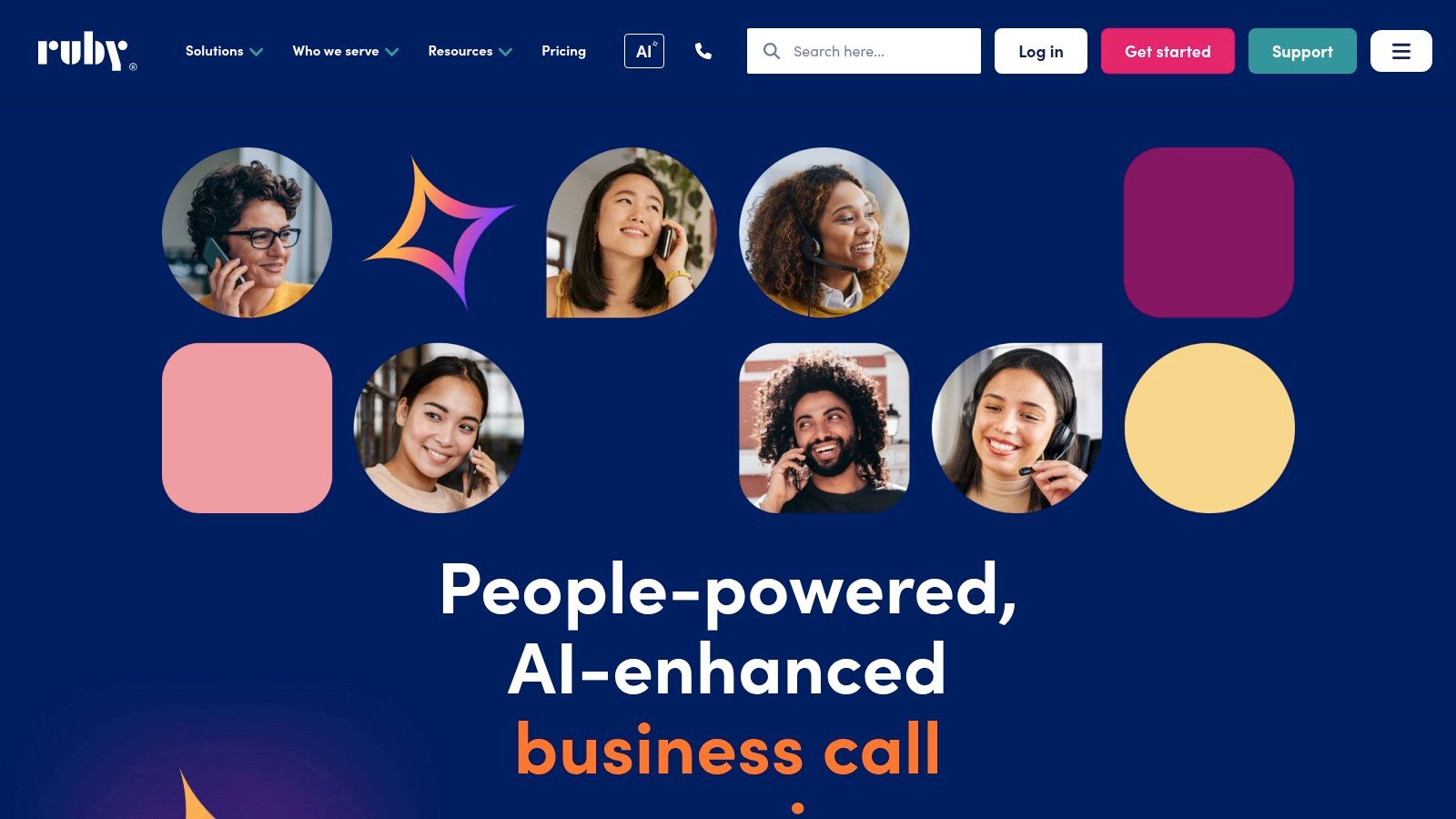
Ruby is the pick for businesses that want a polished, fully human caller experience and don't mind paying premium rates for it. If brand tone matters on every call, Ruby is usually on the shortlist for good reason.
Ruby offers live call answering and website chat around the clock, with optional HIPAA-compliant handling. It also adds AI-assisted transcripts and sentiment tools, which gives managers a better review trail without changing the human-first feel of the service.
Where Ruby fits best
Ruby makes the most sense for firms that care about consistency and caller comfort more than squeezing every possible cost out of the phone stack. Think law offices, boutique agencies, medical practices, and service businesses where a warm first impression helps close work.
Its published minute-tier pricing is also helpful. Many virtual receptionist companies still make buyers talk to sales before they can do basic cost modeling. Ruby is easier to forecast, although long or complicated calls can push minute-based plans up quickly. For a broader market view of alternatives, this roundup of virtual receptionist service options for small businesses is useful.
A good Ruby deployment usually starts with script discipline. Give the receptionists exact rules for urgency, transfer conditions, and scheduling windows. Don't assume brand polish alone will fix a messy intake process.
- Best fit: Professional service firms that want every caller to reach a person.
- Trade-off: Great live coverage, but long conversations can make minute usage harder to control.
- Practical example: A family law office that needs a calm, empathetic first touch for intake and after-hours calls.
3. Smith.ai
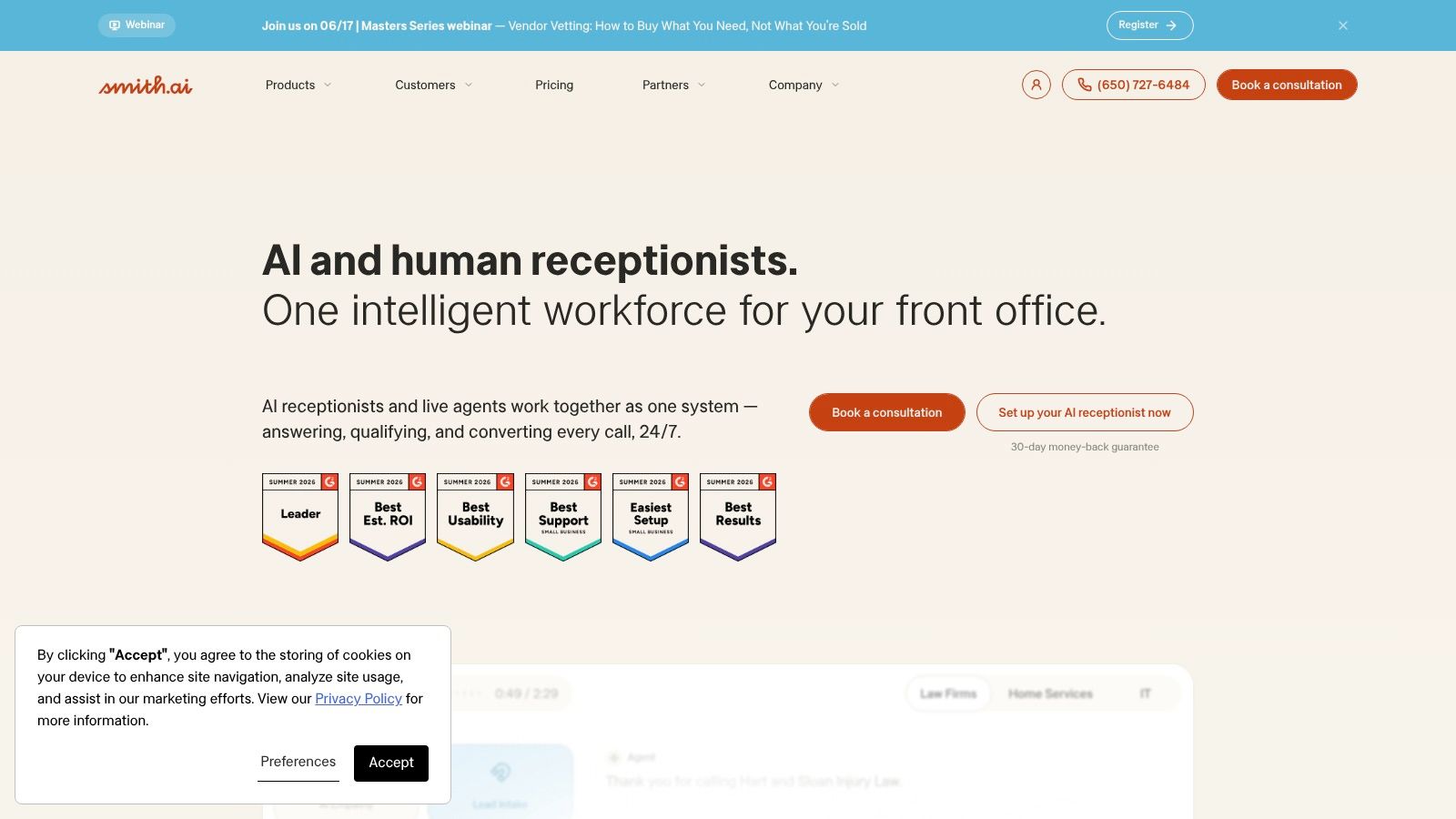
Smith.ai takes a more structured hybrid approach. AI handles intake, screening, scheduling, and spam filtering. Live agents step in when needed. For operators, that blend is attractive because it gives you scale without making every unusual call a failure point.
Its per-call pricing is also easier to reason about than minute-heavy plans if your calls vary in length. That's especially useful in lead-gen environments where you care more about completed handling than raw talk time.
Why operations teams like it
Smith.ai is strong on integrations. CRM sync, calendar sync, industry tools like Clio and ServiceTitan, and messaging platforms like Slack all reduce the admin drag that usually follows phone coverage. It also offers real-time summaries and transcripts, which helps managers audit outcomes quickly.
One independent market study describes virtual receptionist services as a mainstream customer-operations layer across communication types including voice reception, video reception, and web chat, serving both enterprises and SMEs, with the market projected from US$ 4.64 billion in 2026 to US$ 10.85 billion by 2035. Smith.ai fits that broader shift well because it isn't just a message-taking layer. It plugs into the rest of the workflow.
If you're comparing hybrid systems for smaller teams, this overview of virtual receptionists for small business helps frame the choice.
- Best fit: Businesses with variable call volume and a strong need for software integration.
- Trade-off: Lower-cost tiers can involve more self-service setup.
- Practical example: A legal intake team that wants new matters screened, logged, and routed before staff reviews them.
4. PATLive
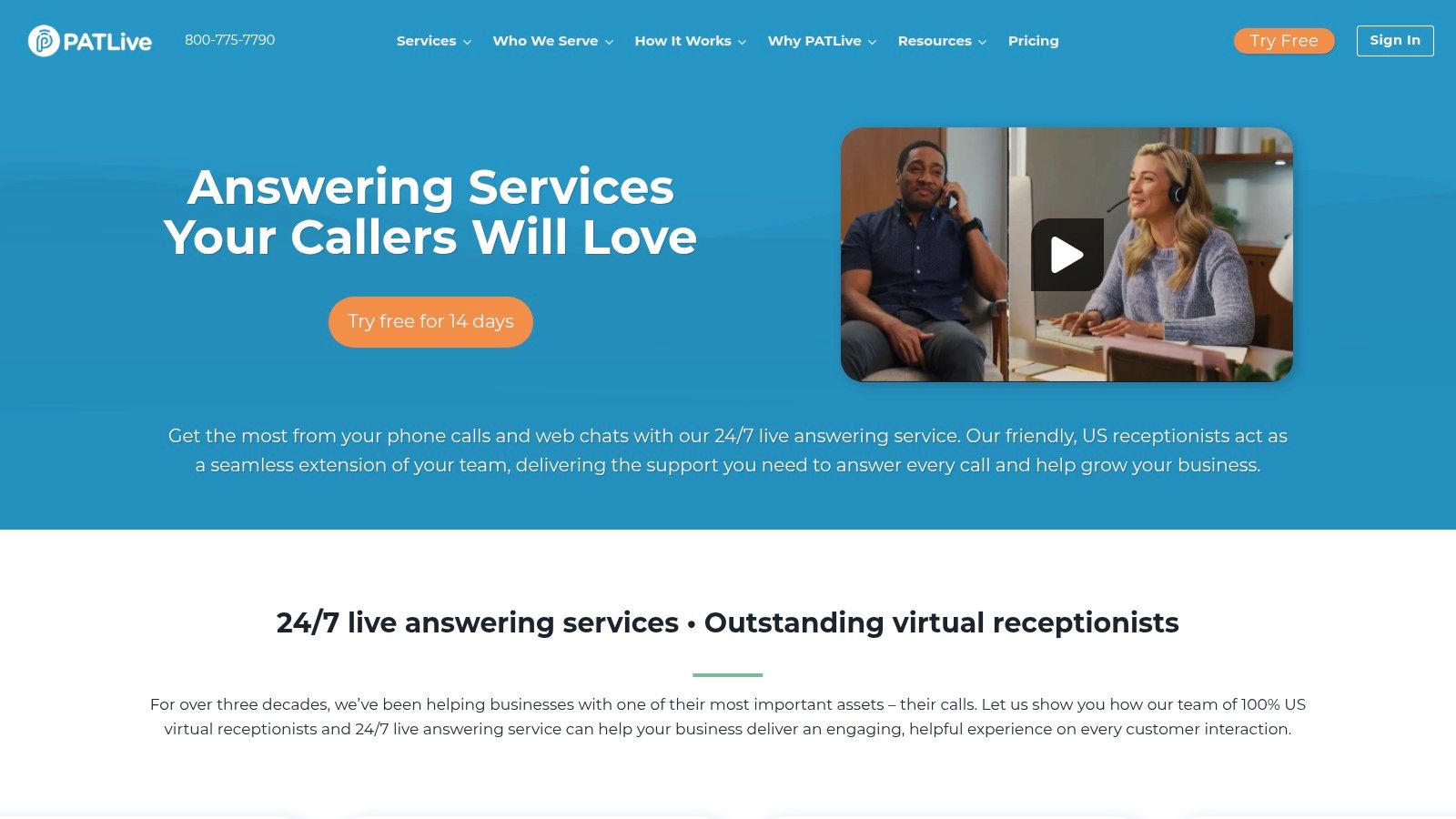
PATLive is one of the steadier traditional options in this space. It's a live-agent service with 24/7/365 coverage, U.S.-based receptionists, and a feature set providing the basics most SMBs need. Lead capture, scheduling, intake, payments, outbound follow-ups, and analytics are all in the mix.
This is the kind of service that works well when you don't want to reinvent your call handling process. You want a reliable team, clear scripts, and predictable service.
Best use case for PATLive
PATLive is a solid fit for home service companies, local practices, and owner-led businesses that need a human answering layer without building one in-house. Its mobile and web apps make it easier to review call activity and message flow, which matters when the owner is often in the field.
The pricing model is straightforward because plans are published by minute and offered month to month. That's a real advantage for buyers trying to compare vendors without a long sales cycle. This guide to virtual receptionist pricing is also useful if you're deciding between minute-based billing and other models.
Operator note: PATLive works best when your call patterns are stable. If your business has sharp seasonal spikes, overages and add-ons can change the economics fast.
- Best fit: Businesses that want a fully live receptionist service with clear pricing.
- Trade-off: Minute overages and paid add-ons can stack up during busy periods.
- Practical example: An HVAC company that needs after-hours coverage, appointment booking, and simple lead intake.
5. AnswerConnect
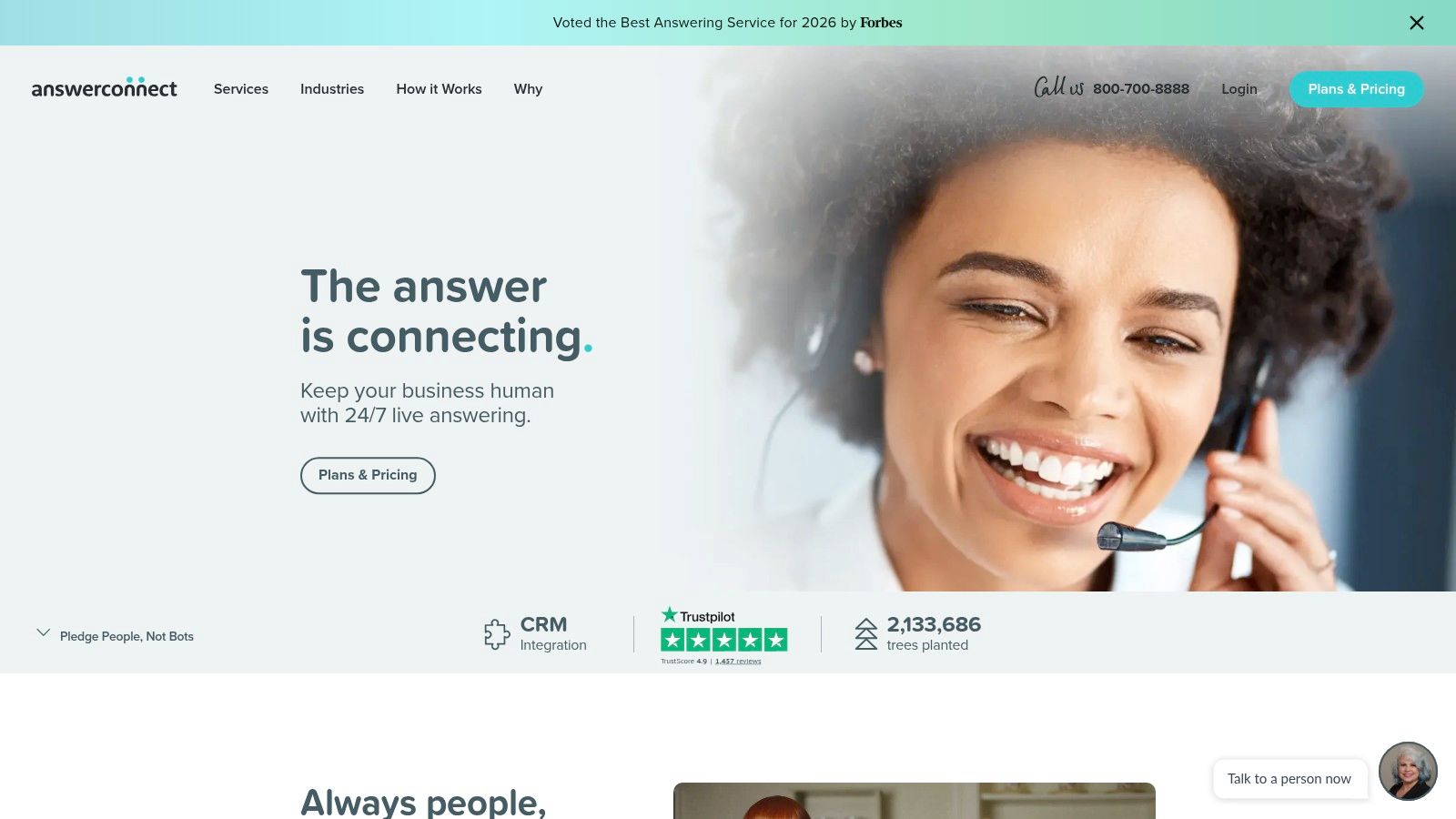
AnswerConnect is a good middle-ground choice for companies that want broad coverage across phone, chat, and text without overcomplicating the setup. The client portal and mobile access are practical strengths. Managers can check call logs, tweak scripts, and monitor activity without chasing support for every small change.
Its feature set leans toward reliable generalist intake. Message taking, transfers, appointment booking, custom scripts, and omnichannel support cover what most small businesses need.
What to like, and what to watch
AnswerConnect is easy to picture in a real business because it doesn't try to be too clever. If your needs are straightforward, that can be a benefit. A dental office, small legal practice, or restoration company often just needs someone to answer consistently, gather the right details, and route the call correctly.
The trade-off is specialization. If your intake process depends on deep industry logic, layered qualification, or highly specific escalation rules, you may need more onboarding work or a more specialized provider.
- Best fit: SMBs that want 24/7 live handling with portal visibility and omnichannel options.
- Trade-off: Public pricing isn't consistently visible, so comparison shopping takes extra effort.
- Practical example: A multi-location cleaning company that needs calls, chats, and texts managed from one operational layer.
6. Nexa
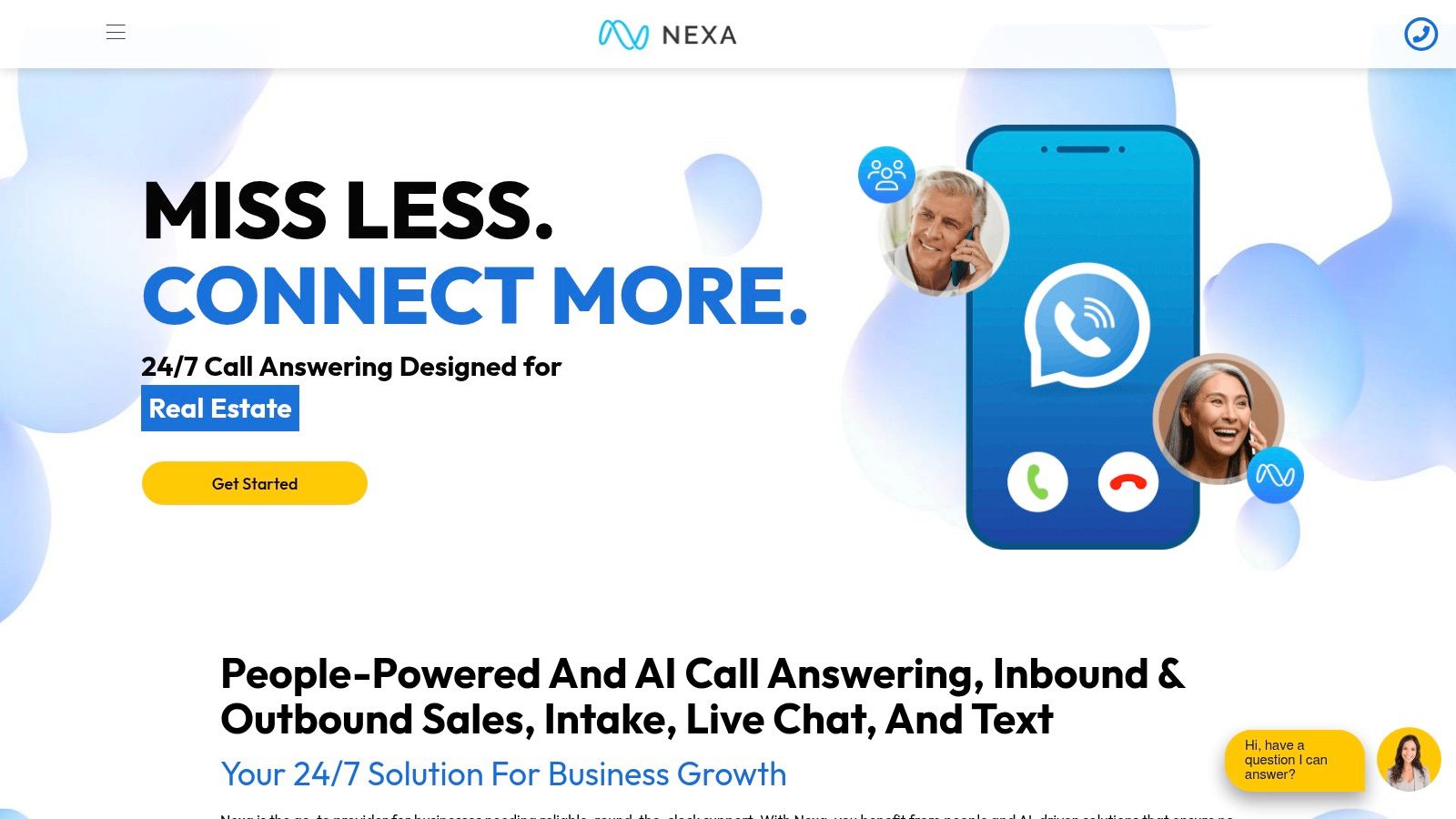
Nexa earns its place because it leans harder into industry workflows than many broad answering providers. It focuses on home services, healthcare, and legal, with live virtual receptionists, bilingual support, intake, scheduling, outbound follow-up, and after-hours coverage.
That matters if your calls aren't interchangeable. A medical intake, a legal consult request, and a home service emergency don't need the same script, and buyers usually regret choosing a provider that treats them like they do.
Where Nexa has an edge
Nexa is a better fit when the phone process itself is part of your sales or service workflow. Client or patient intake, lead qualification, and outbound follow-ups can make the service feel closer to an extension of operations than a standard answering line.
The client portal, analytics, and CRM or calendar integrations support that model well. But because the service menu is broad, onboarding matters. If your scripts are vague or your transfer rules are inconsistent, you'll feel that quickly.
Businesses with specialized intake should test the hard calls first. Run mock calls for a new patient, an upset homeowner, and a caller who doesn't fit the usual script. That reveals more than a polished sales demo.
- Best fit: Teams in healthcare, legal, and home services that need more than basic message taking.
- Trade-off: Pricing usually requires a sales conversation, and setup needs careful scripting.
- Practical example: A personal injury firm that wants consultation intake handled consistently after hours.
7. Davinci Virtual
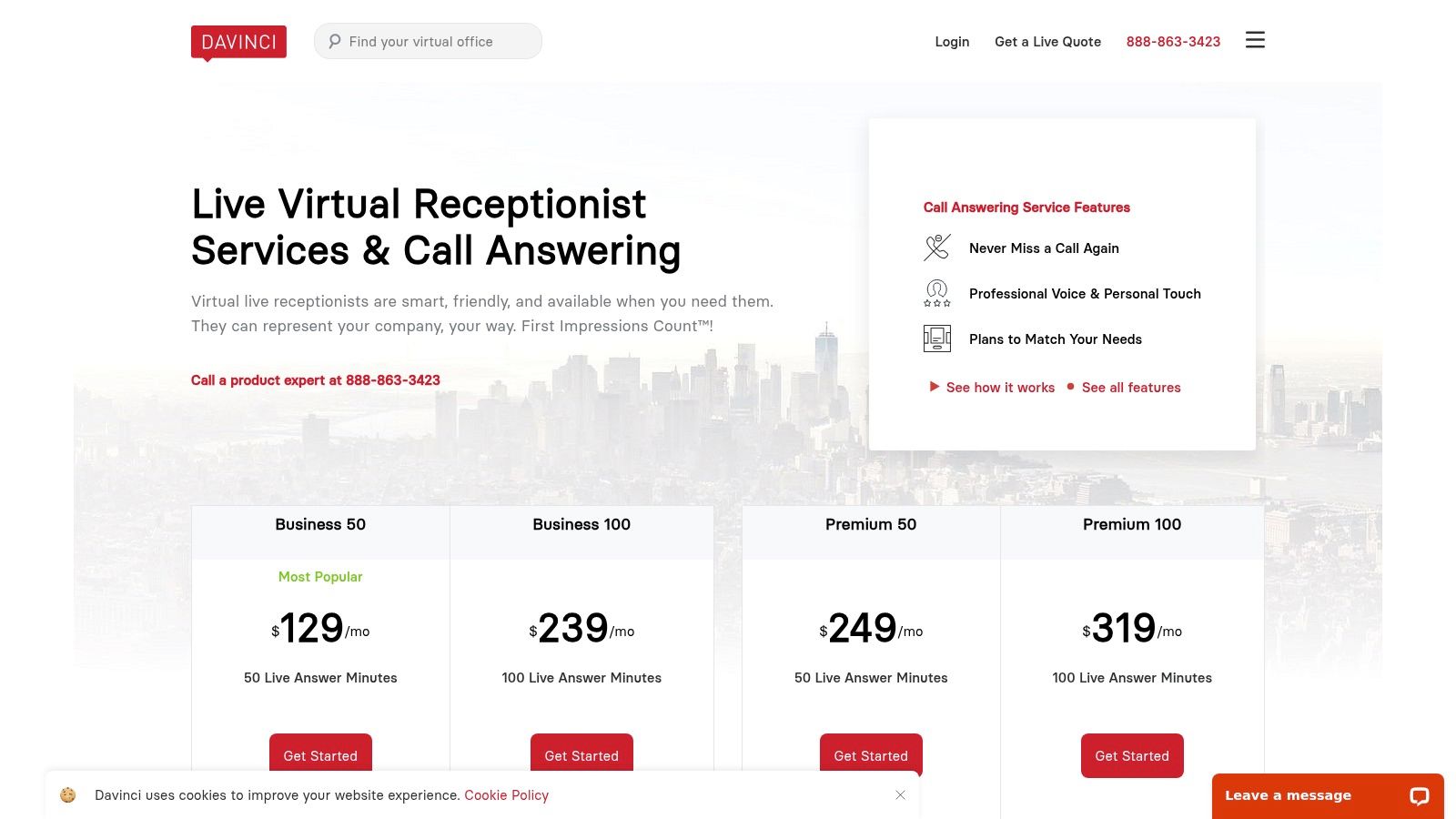
Davinci Virtual is the most distinct option on this list because it pairs live receptionist service with broader virtual office offerings. If you need a business address, phone presence, and receptionist support from one vendor, that combination can be convenient.
Its Business and Premium plans cover foundational handling such as answering, screening, forwarding, and voicemail management. Premium adds more involved work like scheduling, outbound calls, and order processing.
Who should choose Davinci Virtual
This isn't the provider I'd pick first for highly customized, industry-heavy call workflows. But for solo operators, startups, remote-first firms, and businesses that want a simple professional front without building a complicated stack, it makes sense.
The public plan structure is also helpful for early-stage teams. You can usually understand where you fit before talking to anyone, which isn't always true with virtual receptionist companies.
- Best fit: Startups and small professional businesses that want receptionist coverage plus virtual office support.
- Trade-off: Smaller minute bundles can get tight if call volume jumps.
- Practical example: A solo consultant who wants calls answered professionally, voicemails managed, and appointments scheduled without hiring staff.
Top 7 Virtual Receptionist Companies Comparison
A side-by-side table is useful, but the core buying question is fit. The wrong pricing model, handoff process, or integration setup can turn a receptionist service from a cost saver into another admin problem. Use this comparison to narrow the field by operating model, call pattern, and how much automation you want in front of callers.
| Solution | Implementation Complexity (🔄) | Resource Requirements (⚡) | Expected Outcomes (📊⭐) | Ideal Use Cases | Key Advantages (💡) |
|---|---|---|---|---|---|
| Recepta.ai | Low, fast setup with hybrid routing configuration required | Low to Moderate, wide integration coverage and limited live staffing unless escalated | 📊 Stronger lead qualification, lower in-house admin load, clear reporting; ⭐⭐⭐⭐ | Home services, healthcare, legal, finance, franchises, SMBs needing scale and compliance | Hybrid AI plus human escalation, broad integrations, built-in analytics and compliance tools |
| Ruby (Ruby Receptionists) | Medium, onboarding and script setup for a polished live voice | Moderate, 24/7 U.S.-based agents; costs rise with minutes; optional HIPAA support | 📊 Consistent caller experience and straightforward minute-based budgeting; ⭐⭐⭐⭐ | Brand-conscious small firms, practices that want polished live agents, teams with HIPAA-related needs | Transparent published pricing, U.S.-based quality controls, AI transcripts |
| Smith.ai | Low to Medium, AI-led intake setup with human backup included | Moderate, per-call pricing, CRM and legal tool integrations, bilingual support | 📊 Better lead qualification and booking, less CRM cleanup; ⭐⭐⭐⭐ | Legal, home services, SMBs needing scalable intake and CRM sync | Per-call pricing for easier forecasting, smooth AI→human escalation, strong integrations |
| PATLive | Medium, scripting and onboarding for 24/7 live coverage | Moderate, 100% live U.S. receptionists; per-minute plans; optional bilingual add-ons | 📊 Reliable live answering, scheduling, and payment capture, with higher costs during spikes; ⭐⭐⭐ | Businesses that want fully live reception and outbound follow-ups | Published pricing, month-to-month flexibility, broad built-in feature set |
| AnswerConnect | Low to Medium, standard scripts and quick portal-based setup | Low to Moderate, omnichannel agents, web and mobile portal; pricing often quote-based | 📊 Dependable message-taking, routing, and appointment booking with real-time visibility; ⭐⭐⭐ | SMBs wanting omnichannel intake and simple monitoring | Client portal and app, omnichannel options, straightforward monitoring and control |
| Nexa | Medium, industry-specific onboarding to tune scripts and workflows | Moderate, bilingual teams, CRM and calendar integrations; minute-based plans | 📊 Better conversion handling for specific industries, with stronger coverage for Spanish-speaking callers; ⭐⭐⭐ | Home services, healthcare, legal teams with bilingual or industry-specific needs | Industry-focused workflows, bilingual support, outbound follow-ups |
| Davinci Virtual (Live Receptionists) | Low, clear tiered plans and documentation; Premium handles more advanced tasks | Low, smaller minute bundles available; add-ons for scheduling and outbound calls | 📊 Solid front-desk coverage for basic call handling, with Premium needed for more involved workflows; ⭐⭐⭐ | Early-stage businesses needing low-cost entry and virtual office services | Low entry point, virtual numbers and routing, clear setup docs and FAQs |
One practical way to read this table is by first separating AI-first hybrid providers from fully live ones. Recepta.ai and Smith.ai make more sense when speed, intake consistency, and after-hours coverage matter more than having a person answer every call from the first second. Ruby and PATLive fit better when caller experience is part of the brand and the conversation itself carries more weight.
Then check the pricing logic. Per-call pricing often works better for short, high-frequency intake. Minute-based plans are usually easier for lower volume teams with longer conversations, but they can become expensive fast if receptionists end up doing triage your internal team should have handled.
Integration depth is the other filter buyers tend to underestimate. If your receptionist service cannot write cleanly into your CRM, calendar, or case management workflow, someone on your staff will spend time fixing handoffs. That labor cost usually matters more than a small difference in plan price.
How to Choose the Right Virtual Receptionist Company
The wrong receptionist setup usually fails in one of four places: it misses the lead, books the wrong slot, hands off incomplete notes, or costs more to run than an internal coordinator for the same workload. The right choice starts with your call flow, not the vendor's feature grid.
Start by sorting your business into one of three operating patterns. High-urgency teams, such as plumbers, restoration companies, and locksmiths, need fast pickup, clear triage, and reliable after-hours coverage. Appointment-driven businesses, such as clinics, med spas, and consultative service firms, need accurate scheduling and fewer booking errors. Relationship-heavy firms, such as law offices and high-end professional services, usually care more about tone, context, and call handling quality than raw speed alone.
That distinction narrows the field fast.
Four filters that actually decide fit
- Call type and volume: Short, repetitive calls with predictable intents often fit AI-first or hybrid services well. Lower-volume calls that run longer and require judgment usually fit live receptionist plans better.
- Pricing model: Per-call pricing can work well for quick intake. Minute-based plans are easier to forecast for modest volume, but they become expensive if receptionists are doing extended screening, reschedules, or back-and-forth message taking.
- System fit: Confirm what the service can write into your CRM, scheduler, or industry software. If your staff has to re-enter lead details, correct appointments, or chase notes across inboxes, the cheaper plan stops being cheaper.
- Escalation style: Decide where you want automation to stop. Some businesses want AI to answer, qualify, and book before handing off edge cases. Others want every caller to reach a person immediately, even if that raises cost per call.
I usually tell buyers to map ten real calls from the last two weeks before they compare vendors. Not ideal calls. Real ones. Include a new lead, a repeat customer, a pricing question, a reschedule, an upset caller, and one request that does not match your normal script. Then ask each provider how those calls would be handled from answer to handoff.
That exercise exposes the trade-offs quickly. Ruby and PATLive tend to make more sense if the conversation itself is part of the service experience. Smith.ai and Recepta.ai tend to fit better when consistency, speed, lead capture, and after-hours coverage matter more, and when your team wants fewer manual steps after the call. AnswerConnect, Nexa, and Davinci Virtual sit in the middle depending on how much scripting, overflow support, and scheduling depth you need.
The AI growth mentioned earlier matters for one reason. Buyers are putting more weight on operational efficiency. Live agents still make sense for sensitive, nuanced, or brand-critical conversations. Hybrid models make sense when your business gets enough routine volume that missed calls and admin cleanup cost more than the difference in plan pricing.
Before signing, run a short pilot. Route a limited call segment, review transcripts or messages daily, and measure three things: booked outcomes, handoff accuracy, and internal cleanup time. If a service answers quickly but your staff still spends an hour a day fixing notes and appointments, it is not the right fit.
If you want a service that combines always-on AI answering with human escalation, Recepta.ai is the one I'd test first. It's built for teams that need leads captured, appointments booked, calls logged, and complex conversations handed off cleanly, without forcing staff back into manual follow-up and data entry.