
Outbound Calling Rules: What Businesses Must Follow

Civil penalties for telemarketing violations can accrue per call, making repeated calls from a faulty process costly. The FCC's unwanted communications guidance underscores why outbound calling rules belong in operating procedures, not just on a consent checklist. Stale contact lists, unrecorded opt-outs, and automated campaigns using incorrect permissions can repeat the same compliance failure at scale.
Outbound Calling Rules at a Glance
A number on a list is not permission to call. The record tells you how to reach someone, but the business still needs to check whether the call is allowed for its purpose and dialing method. Treat compliance as a process: stale lists, missed opt-outs, and automated workflows that repeat an error can turn one bad decision into many calls.
U.S. requirements draw on the Telephone Consumer Protection Act, FCC rules, and the FTC's Telemarketing Sales Rule. The national Do Not Call Registry and rules for telemarketing robocalls add separate checks. Build those checks into campaign setup and list handling, rather than relying on a single consent field.
Core outbound calling rules by region and call type
Use the table to identify the checks that may apply to your campaign. Registry clearance, consent, scheduling, and caller identification address different obligations, so passing one check does not settle the others.
| Rule | Where it applies | What it requires |
|---|---|---|
| Autodialed or prerecorded calls to mobile phones | US | Prior express consent; written consent when the call contains advertising |
| Advertising calls to numbers on the National Do Not Call Registry | US | Generally blocked unless an established business relationship or prior express written consent exists; automated advertising has separate consent requirements |
| Residential calling hours | US | Generally call homes only from 8:00 a.m. to 9:00 p.m., in the called person's local time |
| Live marketing calls to TPS-registered numbers | UK | Not permitted unless the person has specifically told the organization they don't object |
| Automated marketing calls | UK | Prior consent required; screen numbers against TPS and internal suppression lists |
| Honoring opt-out and revocation requests | US, FCC | Act within a reasonable period |
| Abandoned calls | UK, historic Ofcom guidance | Historically subject to a limit of 3% in any 24-hour period; current guidance treats silent calls as unacceptable |
Match the rule to the list
Start with how you obtained each number and what the campaign will do with it. A purchased prospect list needs a different review from appointment reminders generated by a booking system. Check the contact's permission, the campaign's purpose, the dialing method, and any suppression or objection records before releasing the list.
For example, an HVAC company should not put its entire customer database into an automated promotional campaign just because those customers previously booked repairs. The operations lead must establish whether the proposed campaign is permitted and remove contacts whose records show an objection or do not support that use. Automation makes this control more important: a faulty list or workflow can repeat the same mistake at scale.
Practical rule: Review the list, purpose, and dialing method separately. A pass on one check does not clear the others.
Keep inbound and outbound workflows distinct. The difference between inbound calls and outbound calls matters because answering a customer's call and initiating a new one are different actions, with different checks before the call takes place.
Consent Rules for Each Type of Outbound Call
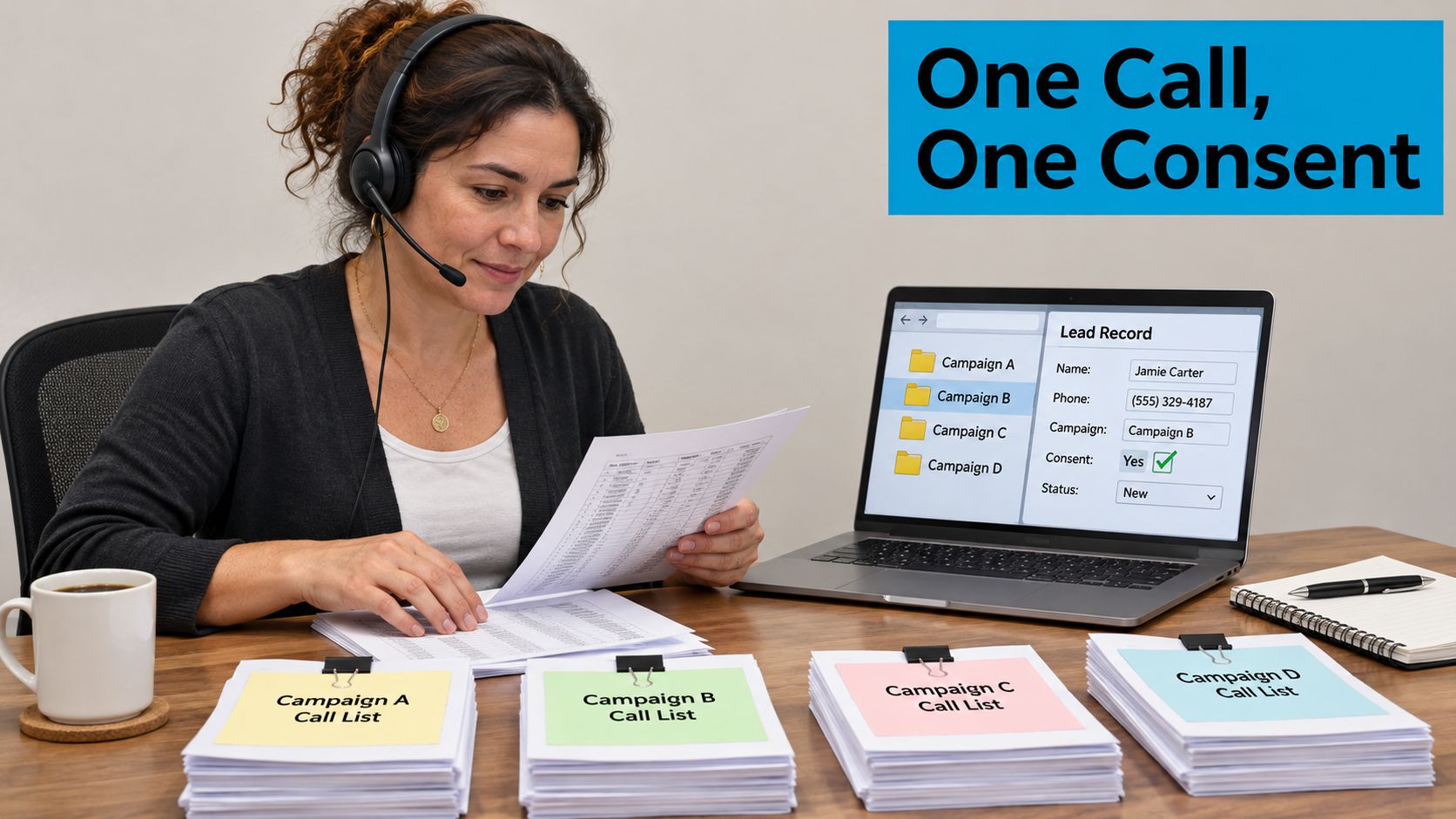
The mistake behind weak consent controls is treating one lead record as permission for every future conversation. Classify the workflow before choosing its consent basis.
Under the FCC's unwanted communications rules, non-emergency autodialed or artificial/prerecorded calls to mobile phones generally require prior express consent, with written consent generally required for advertising or telemarketing. Registry restrictions also reach manually dialed advertising calls, and an entity-specific do-not-call request must be respected.
Use the customer record to inspect the actual permission, not just a green consent status.
Consent basis by outbound call type
These are recordkeeping categories, not blanket exemptions. Apply the relevant technology and recipient rules to every row.
| Call type | Typical example | Consent basis | Record to keep |
|---|---|---|---|
| Transactional | Payment or order notice the customer expects | Customer transaction and relevant notice, plus applicable automated-call consent | Order ID, date, notice sent, and relevant permission |
| Service | Appointment confirmation or reminder | Consent for service contact from the booking | Booking source, timestamp, and channel |
| Lead follow-up | Callback after a web form or quote request | Consent given on the form for that purpose | Form version, disclosure text, and timestamp |
| Marketing | Promotional offer or seasonal campaign | Applicable prior express consent; written consent for automated advertising | Written consent, purpose, source, and any applicable expiry |
Keep permission tied to the purpose
A plumbing company receives a repair-quote request through its website. Keep the form submission and disclosure with the callback record; don't automatically classify the same number as eligible for a seasonal maintenance promotion.
For that promotional workflow, require a fresh, purpose-specific consent record under your campaign policy. That's a more defensible control than asking agents to interpret an old customer relationship while the dialer runs.
Store phone number, purpose, channel, timestamp, disclosure version, and source. Preserve the actual disclosure text or a retrievable version, not merely a form name that someone might overwrite later.
- Purpose: What exactly will this call accomplish?
- Permission: What consent supports this purpose and dialing method?
- Evidence: Can the business produce the underlying record during an audit?
Recording the conversation raises a separate compliance question. For teams using Microsoft Teams, Vight on call recording compliance is a useful resource for reviewing recording practices alongside, rather than instead of, outbound-call permission.
Don't make agents resolve ambiguous records during a live campaign. Put those contacts into a review queue and release them only when the evidence supports the intended call.
How to Screen Your Contact List Before Every Campaign
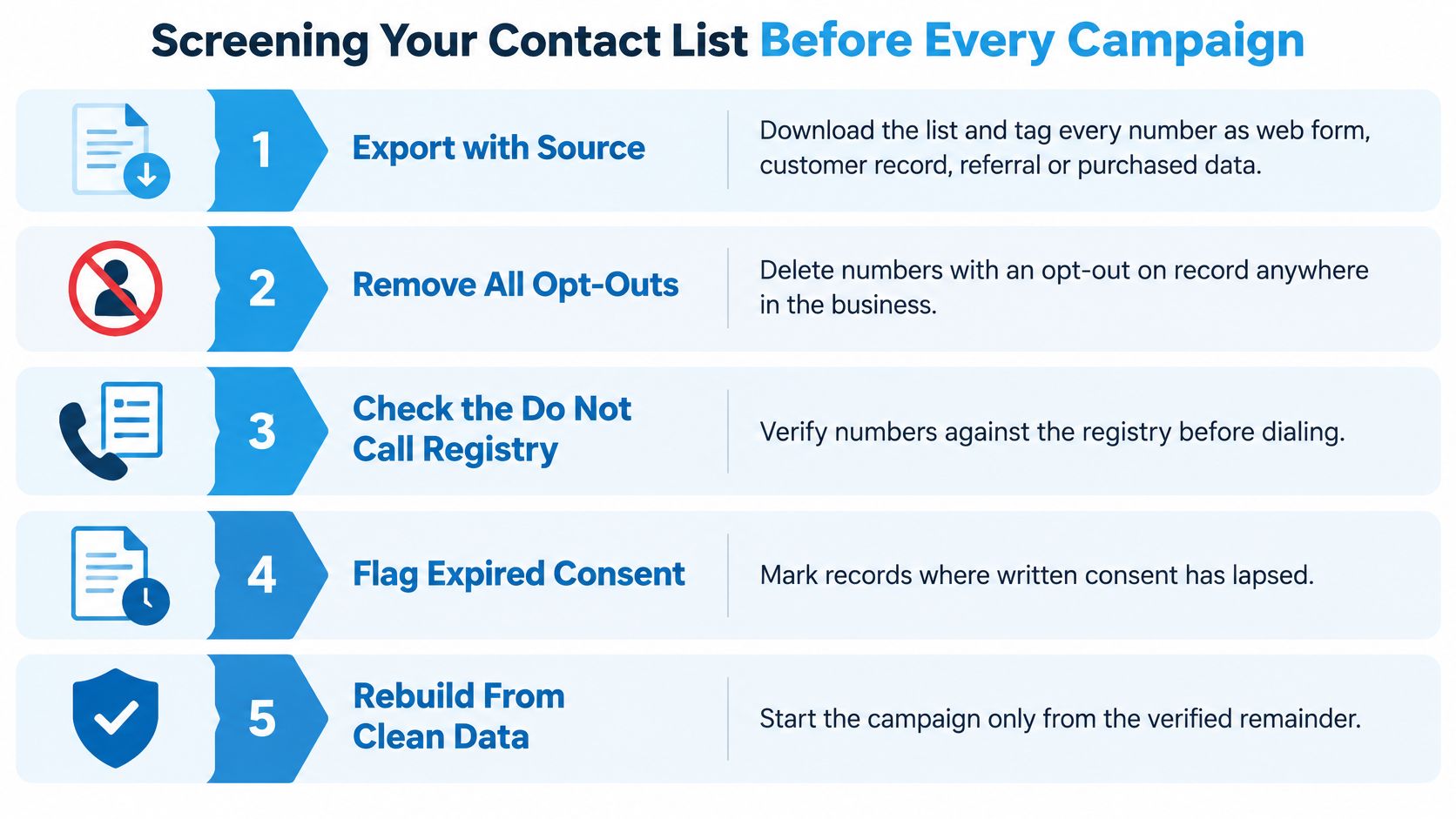
Screen the actual campaign file immediately before release. An old export can include people who have since objected, while an automated workflow can repeat the same mistake across the whole list.
The UK Information Commissioner's Office reported that it fined a solar firm £105,000 after the company made 194,379 unsolicited marketing calls to people registered with the Telephone Preference Service (TPS) over a year. In the UK, using live agents does not remove TPS obligations. A person must have specifically told the organization that they do not object to its calls.
Build a clean campaign export
Keep each record's source. Label numbers from web forms, customer records, referrals, or purchased lists. A supplier's consent label alone is not evidence of permission.
Apply objections across the business. Check branch, franchise, and central suppression records before creating the dialing file. Keep suppression records separate from active campaign data, and make sure future imports cannot restore an opted-out number.
Screen U.S. numbers against the National Do Not Call Registry. Record when screening took place and document the basis for any applicable exception. Agents should not override a registry block because a contact seems promising.
Screen UK numbers against TPS and internal suppression records. If relying on a person's specific statement that they do not object, keep evidence showing that the statement applies to your organization. Another company's permission does not establish permission for yours.
Compare permission with the campaign. Check that the disclosure supports the script, channel, and dialing technology. Flag revoked or limited permissions, and check any applicable expiry without assuming all records have the same lifetime.
Resolve duplicates without losing objections. Normalize phone numbers and reconcile conflicting preferences before deduplication. When records disagree, preserve the objection rather than choosing the more permissive status.
Approve a versioned release. Record the screening date, list version, exclusions, and approving person. Check internal suppression again before dialing, since preferences may change after the export is approved.
Use this visual checklist to keep the preflight process consistent.
Don't let a merge rewrite permission
Suppose a cleaning franchise combines purchased prospects with existing customers. If an import applies the supplier's consent status to every matching number, it can overwrite an objection previously recorded by a branch.
An import should add evidence, not manufacture permission.
Keep the original records, record which preference prevailed, and document the reason. You control who is called, when they're called, and what messaging is used, subject to applicable law and the Terms. You are also responsible for the accuracy and legality of uploaded contact lists.
Calling Hours, Time Zones, Connection Limits and Abandoned Calls
Use the recipient's clock, not your office clock. The FTC's Telemarketing Sales Rule guidance generally restricts residential outbound telemarketing to 8:00 a.m. through 9:00 p.m. local time, unless the consumer has previously consented to different hours, and defines abandonment as failing to connect an answering person to a sales representative within two seconds after the completed greeting.
A home-services company in New York can't use its Eastern schedule as the sole control for California homeowners. The dialing system must evaluate the customer's location before it places the call.
Make scheduling a pre-dial control
- Store the time zone at import. Use reliable location information and flag uncertain records for review. Don't assume a phone number's area code proves where its owner currently lives.
- Apply daylight-saving-aware scheduling. Store a named time zone rather than a fixed offset, then evaluate the permitted window at execution.
- Block before dialing. A report showing out-of-hours calls afterward isn't a preventive control.
- Test queued callbacks. A request generated during business hours may execute later after a backlog, retry, or integration delay.
If you evaluate outbound calling software, inspect its handling of scheduled retries and cross-time-zone campaigns. A scheduling screen that displays your office time can conceal mistakes unless the underlying execution uses the recipient's local time.
Match dialing volume to connection capacity
Measure connection performance from greeting completion, not from pickup. Dialer pacing, answering-machine detection, AI startup latency, and human escalation capacity all affect what the recipient experiences.
For example, a roofing company shouldn't launch a burst of quote follow-ups while every estimator is already occupied. Reserve transfer capacity first, reduce pacing when queues grow, and pause campaigns when the handoff path fails.
For a UK insurance agency, configure an approved information message identifying the business and providing a callback route when no adviser is available, rather than leaving a silent connection. Review abandoned and silent calls daily, investigate spikes, and record corrective action instead of treating an old percentage benchmark as a safe harbor.
Capacity test: If you can't explain who or what answers every connected call, you haven't approved the dialing volume.
Different call purposes also need different escalation designs. Businesses assessing wellbeing services can compare costs of senior check-in calls through Velma, but should evaluate missed-answer handling and escalation alongside price. A routine sales callback and a wellbeing check shouldn't share an unexamined retry policy.
Opt-Outs, Caller ID and Keeping an Audit Trail
Getting consent once isn't enough. A valid opt-out can fail operationally after the customer has already given it.
Make the preference record part of the audit, not an agent's private note.
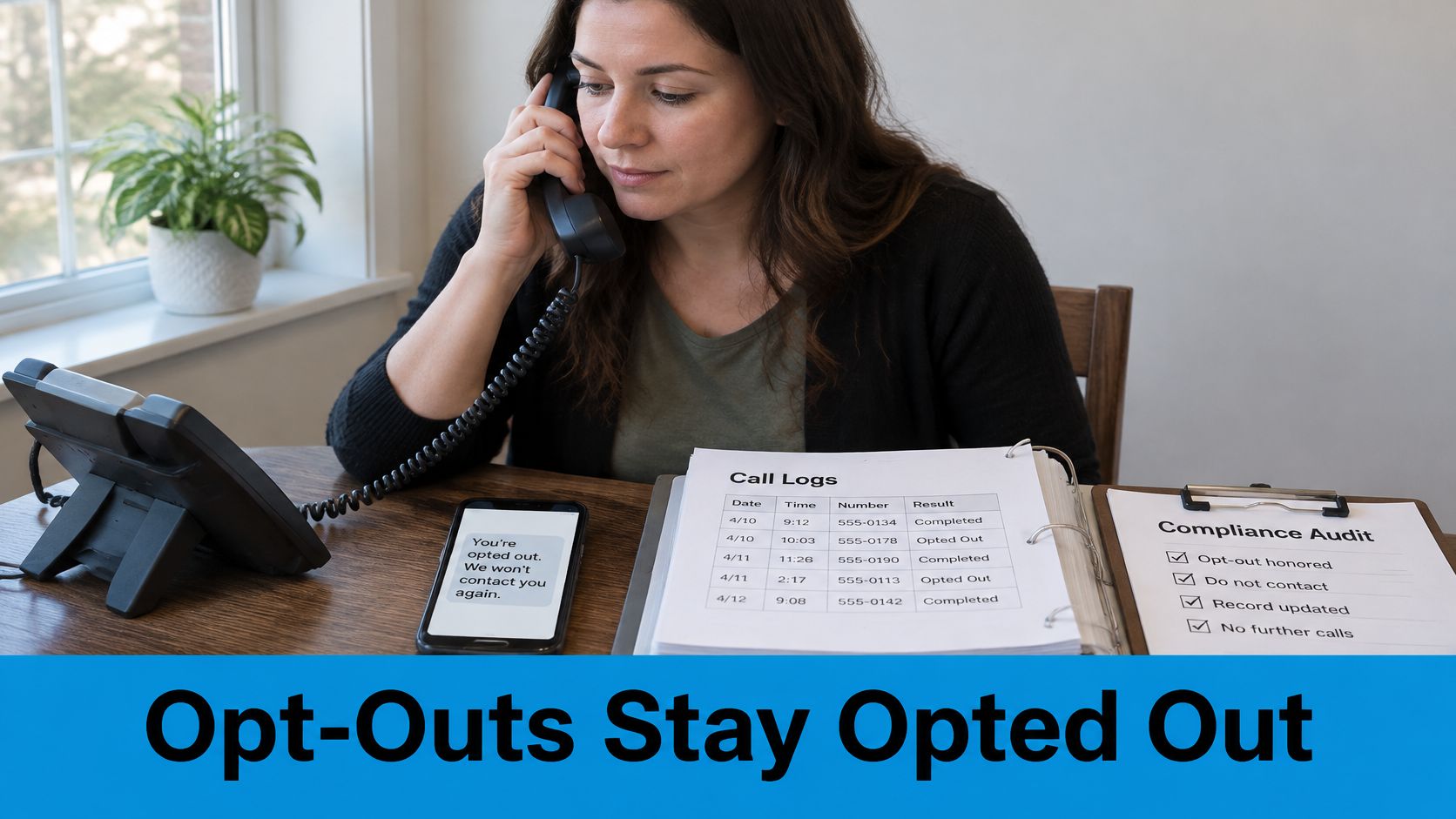
The FCC's robocall materials describe honoring do-not-call and consent-revocation requests within a reasonable period, no more than 10 business days, and require artificial or prerecorded messages to identify the initiating individual or company at the beginning and provide a telephone number during or after the message. Treat that processing limit as a ceiling, not a reason to keep an opted-out number in an active queue.
Give every channel the same destination
A customer may tell an answering bot to stop, reply to a text, email a branch, or speak to an employee. Route each request to a central suppression record with the number, request time, channel, scope, and processing status.
The failure points are predictable:
- Stale exports: A campaign file remains active after the CRM changes.
- Duplicate contacts: One record is suppressed while another still permits dialing.
- Branch databases: A local employee records the objection somewhere headquarters never checks.
- Broken integrations: The CRM updates, but the dialer or calendar-triggered workflow doesn't.
Use proportionate identity checks to avoid changing the wrong person's preferences, but don't turn verification into an obstacle to honoring a clear objection. When scope is uncertain, suppress promotional outreach while a reviewer resolves it.
Prove what happened after the request
Say a dental patient opts out of marketing but still expects an appointment reminder. That reminder should continue only when a separate, valid service-contact basis remains and the request didn't revoke it too.
Keep service and promotional purposes distinct in the record and in the script. Adding a whitening offer to a reminder can change the analysis; an appointment label doesn't protect promotional content.
Use the following video as a prompt for reviewing your handling of calls and records, then test the actual workflow against your own policy.
Before each campaign, place a test call and verify caller-ID transmission, the spoken business name, and the callback route. Keep a lawful test recording with the preflight log, or retain an alternative verification record where recording isn't appropriate.
Recording permission is separate from dialing permission. Review call recording compliance before storing audio, and preserve timestamped preference events even when you don't record conversations.
AI Calls and Automated Voice Rules
AI calls aren't simply legal or illegal. Classify each workflow by purpose, automation level, recipient type, and jurisdiction before deciding whether it can run.
The FCC's robocall guidance treats AI-generated voices as artificial voices under the TCPA. Automated AI calls to wireless numbers generally require consent, and telemarketing robocalls require written consent; an AI receptionist isn't a blanket exemption.
Compare the actual workflows
| Workflow | Operational judgment |
|---|---|
| AI receptionist returns a requested callback | Preserve the request and keep the conversation within its documented purpose |
| AI sales campaign calls purchased prospects | Require applicable written consent and suppression clearance before release |
| Employee uses AI assistance during a live call | Assess how the call is dialed and delivered; staff assistance alone doesn't describe the legal category |
A dental clinic returning a patient's requested callback should retain the request, the intended purpose, and the script classification. A promotional AI campaign to purchased contacts needs its own permission evidence, not an assumption that the supplier handled compliance.
Use this distinction when evaluating automated workflows.
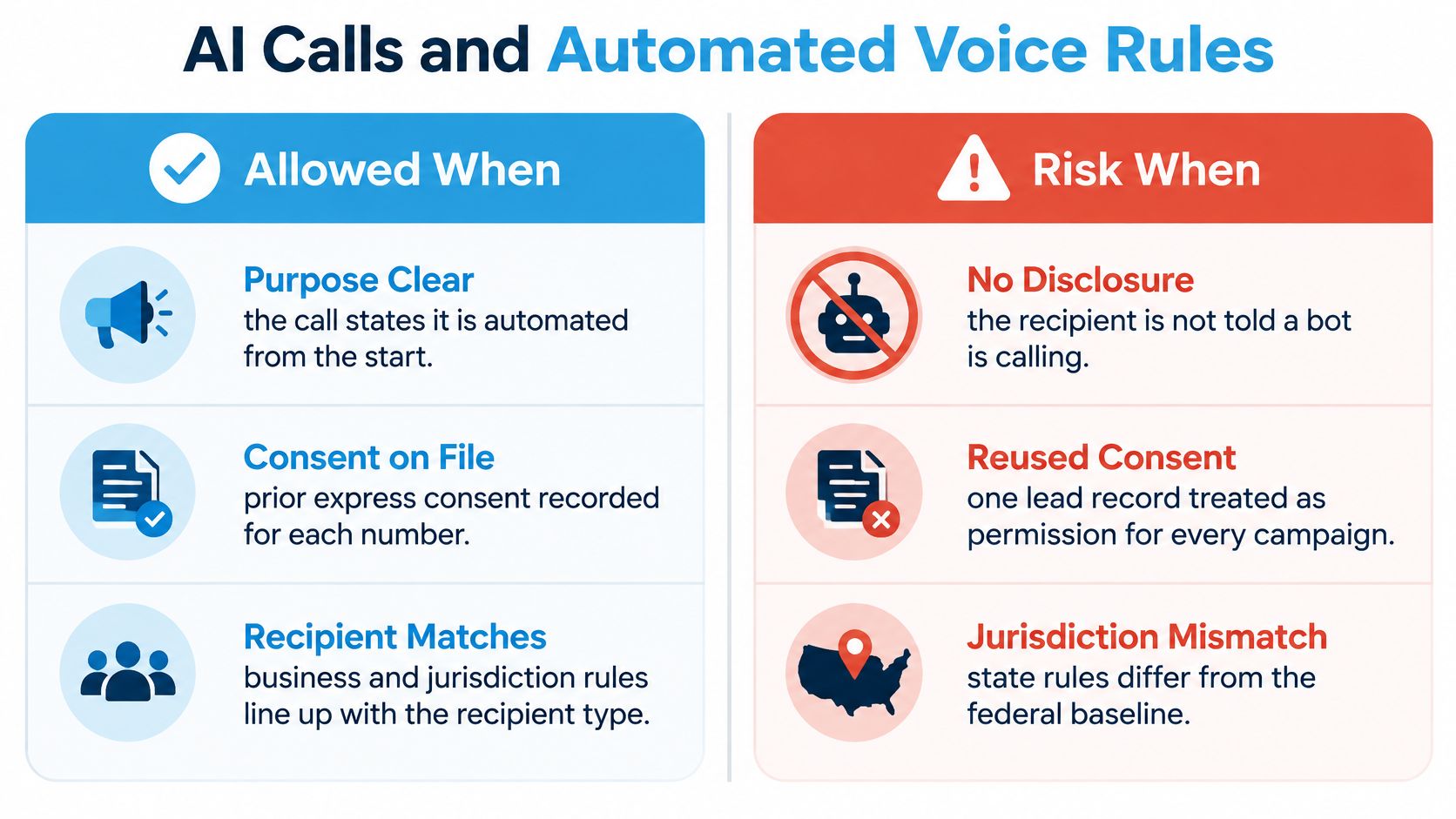
Automation amplifies process mistakes
An incorrect consent mapping can affect every number imported through the same workflow. Require a stop mechanism, an exception queue, and human review when the system can't confidently classify a request or objection.
UK teams should also distinguish historic thresholds from current expectations: Ofcom's abandoned-call guidance historically used below 3% in any 24-hour period, while more recent guidance rejects an acceptable silent-call rate and calls for minimizing abandoned calls. Don't configure an automated system to operate just beneath an old benchmark.
When assessing scheduling tools, you can explore the AI appointment setter from Ever Outbound Inc., then examine the proposed permission, scheduling, and escalation workflow separately. A booking feature doesn't establish a legal basis to contact someone.
Keep every outbound call automation workflow under its own classification, with the script version and permission basis attached to its call records. The audit trail should show which rule applied to each call, not merely that an AI system made it.
Go or No-Go Sign-Off Before the First Campaign
Name an accountable launch owner and a separate evidence reviewer. The owner authorizes release; the reviewer checks that the supporting artifacts exist and match the actual configuration.
Don't accept a verbal assurance that everything has been checked. Require a campaign file that another person can inspect.
Required launch evidence
- Classification sheet: Label each workflow transactional, service, lead follow-up, or marketing.
- Consent sample: Show the permission fields and retrievable evidence for every number in the release.
- Screening log: Record registry or TPS screening, internal suppression checks, the date, and list version.
- Time-zone test: Demonstrate that contacts outside the permitted window are blocked.
- Identification test: Verify the business name, callback number, and caller ID; retain a recording where lawful.
- Suppression test: Show that objections from the bot, text, branch, and human agent reach the dialer and calendar-triggered workflows within your set processing window.
- Connection dashboard: Establish monitoring for abandoned and silent calls, with an assigned responder.
Launch decision: Any missing artifact means no launch.
Approve the workflow, not just the tool
Our outbound setup lets customers upload reactivation lists or connect web forms to trigger immediate lead calls; the AI qualifies contacts using the customer's script and books appointments. That makes the launch checks especially important: an immediate trigger must still pass applicable restrictions.
You control recipients, timing, and messaging, subject to applicable law and the Terms. Calls are recorded and transcribed only if you opt in. Keep approved artifacts after launch, and require renewed review when the list source, script, or workflow changes.
Recepta.ai offers outbound appointment booking, confirmations, reminders, and follow-ups based on your lists and instructions. Visit Recepta.ai to discuss a workflow built around your approved scripts, contact permissions, and scheduling requirements before activating your next campaign.