
7 Best Telephone Answering Service Providers for 2026
At 7 p.m., a plumbing line rings while the owner is under a sink. A legal intake call arrives after the office closes, reaches voicemail, and the prospective client books with a competitor before anyone checks the message. That's why the best telephone answering service is a revenue decision, not just an administrative expense.
A foundational 30-day study of 85 U.S. small businesses found that only 37.8% of inbound calls reached a live person, while 37.8% reached voicemail and 24.3% received no response, meaning approximately 62% failed to connect with a human employee (SchedulingKit's missed-call benchmark). The providers below are matched to practical scenarios, including after-hours overflow, regulated intake, AI-led qualification, scheduling, integrations, compliance review, and billing transparency. I've also called out where each service works well, where it can become expensive, and what to test before signing.
1. Recepta.ai
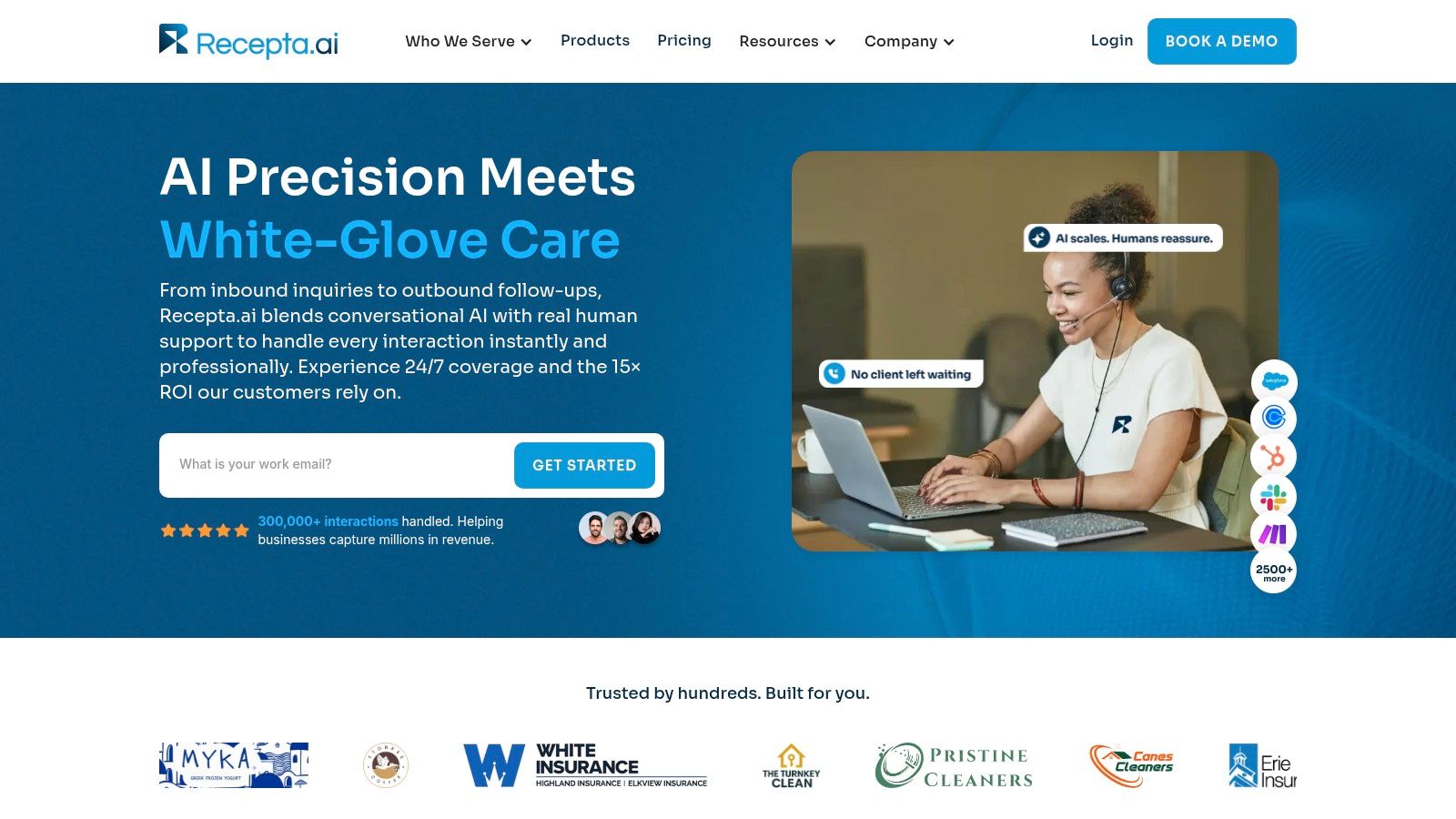
Recepta.ai is the strongest fit for service businesses that want AI speed without abandoning human judgment. It provides 24/7 inbound and outbound call handling, lead capture, qualification, appointment scheduling, follow-ups, automatic call logging, summaries, and escalation to trained human agents when a caller needs empathy or specialized expertise.
That combination matters in home services, healthcare, legal, insurance, finance, and franchise operations. An AI receptionist can collect a caller's location, service request, preferred appointment window, and contact information. A human can then take over when the caller describes a sensitive medical concern, a complicated insurance issue, or an urgent plumbing problem that needs interpretation rather than a scripted answer.
Recepta.ai connects with 2,500+ business tools and CRMs, allowing booked appointments, new leads, reminders, and other completed actions to sync into existing systems. The platform says businesses can create a receptionist in approximately 15 minutes and offers a 30-day risk-free trial with a money-back guarantee. Its public materials also report customer outcomes of up to 30% more qualified leads, approximately 80% cost savings versus in-house reception, and 15× ROI, so buyers should validate those results against their own qualified-lead and revenue data rather than treat them as guarantees.
Practical rule: Test the handoff, not just the AI greeting. Ask a difficult question, interrupt the agent, request a human, and confirm that the receiving employee gets the conversation context.
Best use case and trade-offs
Recepta.ai is particularly useful when missed calls create expensive operational gaps. Analysis of more than 60 million home-services calls estimates that approximately 27% go unanswered, while an average missed sales call can represent about $1,200 in lost revenue, with high-value HVAC work potentially exceeding $3,500 (Hicira's home-services call analysis). Those are estimates, not guaranteed losses, but they make reliable coverage commercially important.
The main drawback is pricing transparency. Detailed public tiers and per-call or per-agent fees aren't listed, so you'll need a custom quote. Businesses in regulated sectors should also confirm regional data residency, retention rules, required agreements, and any certifications relevant to their operations. Recepta.ai emphasizes encrypted communications and compliance-ready security practices, but buyers should verify the exact controls they need.
2. Ruby
Ruby suits a law firm, medical practice, or growing home-services company that wants polished human reception around the clock. Its service combines live answering with AI-supported tools such as transcripts, sentiment information, and CallNav. Businesses can also add live chat, use the mobile app for notifications and voicemail transcription, and work with bilingual English and Spanish receptionists.
Ruby states that its average answer time is under 10 seconds, a useful fit for callers who may hang up quickly when they encounter silence or a long queue. Its HIPAA-trained teams make it worth evaluating for healthcare offices, although a practice should still review its exact workflow, privacy obligations, and documentation process before sending sensitive calls through the service.
For a dental office, Ruby could answer after-hours calls, identify the practice, confirm whether the caller needs an appointment or urgent guidance, and route clinical questions to authorized staff. For a legal practice, the receptionist can capture the matter type, conflict-check information, contact details, and preferred callback time rather than just recording “please call me.”
Teams that want a broader comparison of live reception workflows can also review virtual receptionist companies and their operating models.
What works well:
- Fast human pickup: The service is designed for callers who expect a professional voice rather than an automated menu.
- Regulated-industry fit: HIPAA-trained teams and bilingual coverage support healthcare and diverse customer bases.
- Operational visibility: The mobile app, notifications, voicemail transcription, and usage tracking help owners monitor calls away from the office.
Where it falls short: Plan details and minute tiers can be less transparent during the buying process. Usage-based overages may also apply, so ask for a quote based on your actual call length, after-hours volume, transfers, and scheduling requirements. Ruby is a strong choice when caller experience matters more than having a fully self-service rate card.
3. Smith.ai
Smith.ai is a practical match for professional-services and home-services teams that want per-call billing plus workflow automation. It provides 24/7 live U.S.-based coverage, bilingual answering, lead intake, qualification, scheduling, payment collection options, and an optional AI receptionist.
The per-call model can be easier to budget than open-ended minute billing when calls have predictable outcomes. A law firm might pay for a completed intake interaction, while a contractor could use the service to qualify a project, collect the job address, and route an urgent request. The model becomes less attractive when the business receives many short calls or requires extended conversations and complex routing, because advanced actions can be billed as add-ons.
Smith.ai's integration layer is one of its main advantages. Notifications can reach email, SMS, Slack, or Teams, while CRM and calendar connections help turn a conversation into a task or appointment. Call recording and transcription are available as add-ons, which is useful for reviewing intake quality, but buyers should confirm consent requirements and retention controls in their jurisdiction.
The useful question isn't “Did someone answer?” It's “Did the call create the correct next action?”
That distinction is important because speed-to-lead research cited in secondary reporting found that contacting a lead within one minute produced a 391% higher conversion rate than waiting 30 minutes, based on 3.5 million leads across more than 400 companies (Plura's speed-to-lead analysis). Treat that as an observational finding, not a promised lift. Test Smith.ai against your own qualified leads, booked appointments, and revenue.
For a deeper look at call-based billing structures, compare virtual receptionist pricing models. Smith.ai is a good fit for teams that want rich post-call actions and human backup, but high-volume operations should model the total cost of add-ons before choosing per-call coverage.
4. PATLive
PATLive is the straightforward choice for an SMB that wants 100% human, U.S.-based answering with transparent per-minute tiers. It provides 24/7/365 coverage without AI answering or offshore agents, and its receptionists can handle intake, scheduling, dispatch, sales support, and message taking.
The all-inclusive structure works well for a plumbing company that needs a receptionist to identify an emergency, collect the address and callback number, dispatch the appropriate team, and record the details for the morning staff. It also suits a construction company that wants quote requests captured consistently while field employees are on job sites.
PATLive publishes tiered per-minute pricing and offers a 14-day free trial, with no extra night, weekend, or bilingual surcharges. That clarity makes it easier to compare the service with an internal receptionist or another minute-based provider. The company also offers optional cloud phone features, including auto attendants, routing, and recording.
Choose PATLive when:
- Human judgment is central: Callers need a real person to understand urgency, not just collect keywords.
- Minute-based budgeting fits: Your average calls are short and your volume is stable enough to select a sensible tier.
- You want simple scope: Intake, scheduling, dispatch, and sales support are included rather than split across many add-ons.
The main limitation is the billing clock. Long consultative calls can consume more minutes than expected, especially for legal consultations, complex estimates, or healthcare scheduling. Live chat and outbound calling are separate plan types, so PATLive may not be the most efficient choice if you need one provider for voice, chat, and proactive follow-up.
5. AnswerConnect
AnswerConnect fits a small business that needs reliable after-hours and overflow coverage, especially when the internal team answers calls during the day but needs backup during evenings, weekends, breaks, or demand spikes. The service provides live answering, call transfers, message taking, appointment scheduling, on-call scheduling, and dispatch.
Its mobile and desktop apps provide access to call recordings and transcripts. That feature is valuable for quality assurance because an owner can review whether the receptionist asked for the job address, captured the correct phone number, scheduled the requested time, and followed escalation instructions. Managers can also use recordings during staff coaching instead of relying on incomplete notes.
A home-services company could forward calls to AnswerConnect after business hours, instruct the team to identify emergencies, and send urgent details to the on-call technician. A medical practice could use it for appointment requests and rescheduling while keeping clinical questions with authorized staff.
This comparison of call-answering services is useful when you're deciding whether you need full-time coverage or an overflow layer.
The trade-off is public pricing. AnswerConnect commonly requires a form or quote, and its primarily per-minute structure can become expensive for heavy call volume or long conversations. Ask for separate estimates for normal hours, after-hours calls, transfers, appointment bookings, and dispatch. Also confirm whether recordings and transcripts are included in the quoted plan or treated as a separate feature.
AnswerConnect is strongest when the business needs a mature operational layer rather than an AI-first receptionist. It's less compelling when transparent self-service pricing or automated CRM actions are the main priority.
6. Abby Connect
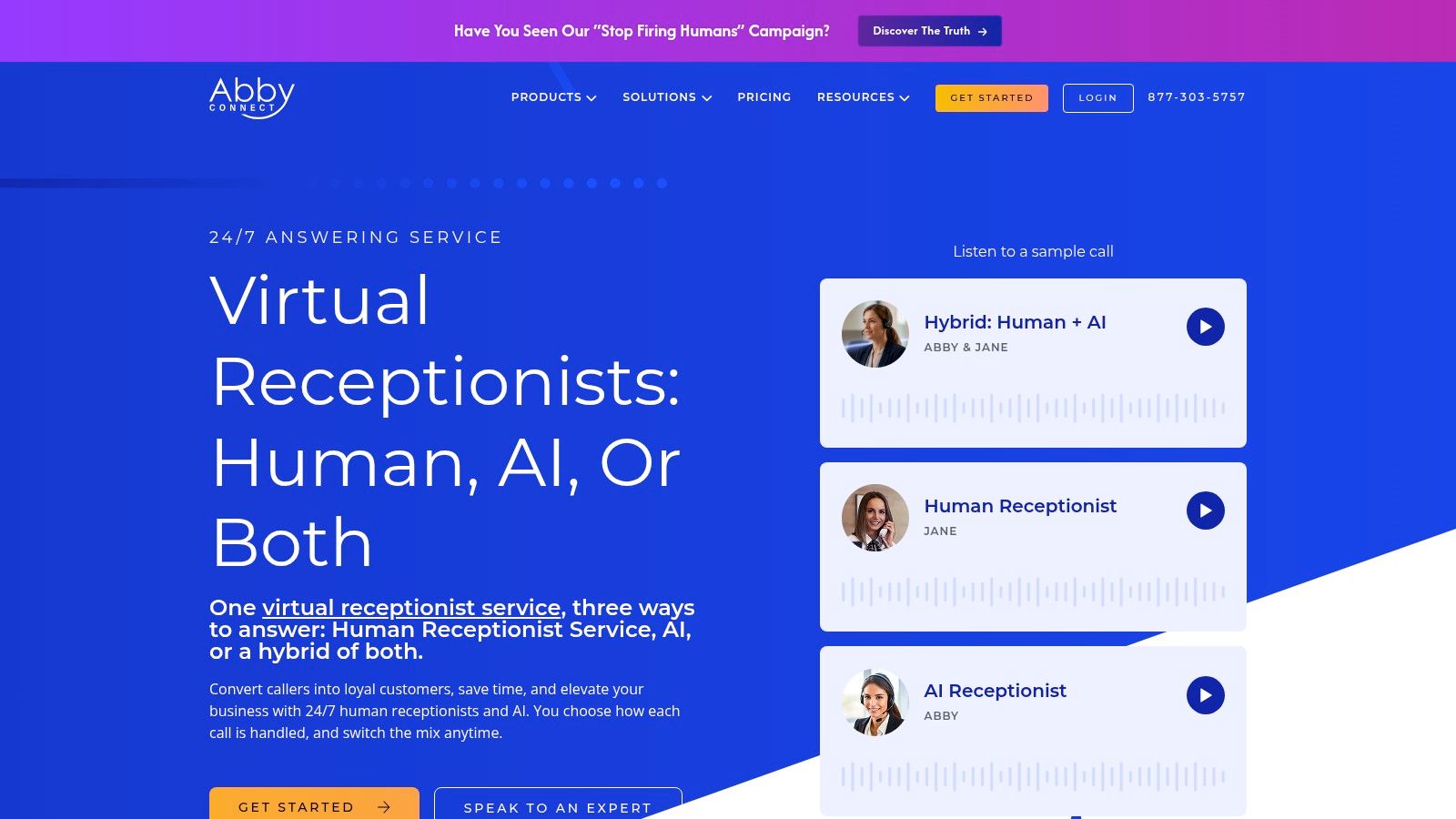
Abby Connect is a useful option for a business that wants to compare human and AI reception under one vendor. It offers 24/7 human answering, an AI receptionist trained on business workflows, appointment scheduling through Calendly, bilingual support, and CRM or calendar integrations that vary by product.
That flexibility matters when a company isn't sure which calls require a human. A cleaning company might let AI handle service-area questions, availability requests, and basic lead capture, while routing cancellation disputes or complex commercial estimates to a live receptionist. A law firm could use AI for basic intake fields but require human escalation before a potential client discusses sensitive case details.
Abby communicates entry messaging of plans from $165 per month, which gives smaller teams an initial budgeting reference. Exact human and AI rates can still vary by plan and call volume, so request a written quote that separates included minutes or calls, scheduling, transfers, bilingual support, and overages.
The practical advantage is testing: You can compare a human-led workflow with an AI-led workflow without immediately managing two separate vendors. That also exposes the main risk. Human and AI plans may use different billing rules, and the most attractive entry price may not reflect the cost of longer calls, transfers, or more involved intake.
Live chat is a separate product, so Abby Connect may require an additional decision if your team wants voice and chat under the same operating model. It's best for owners who value flexibility and want to test automation gradually, rather than for buyers seeking one simple rate card with every channel included.
7. Moneypenny U.S.
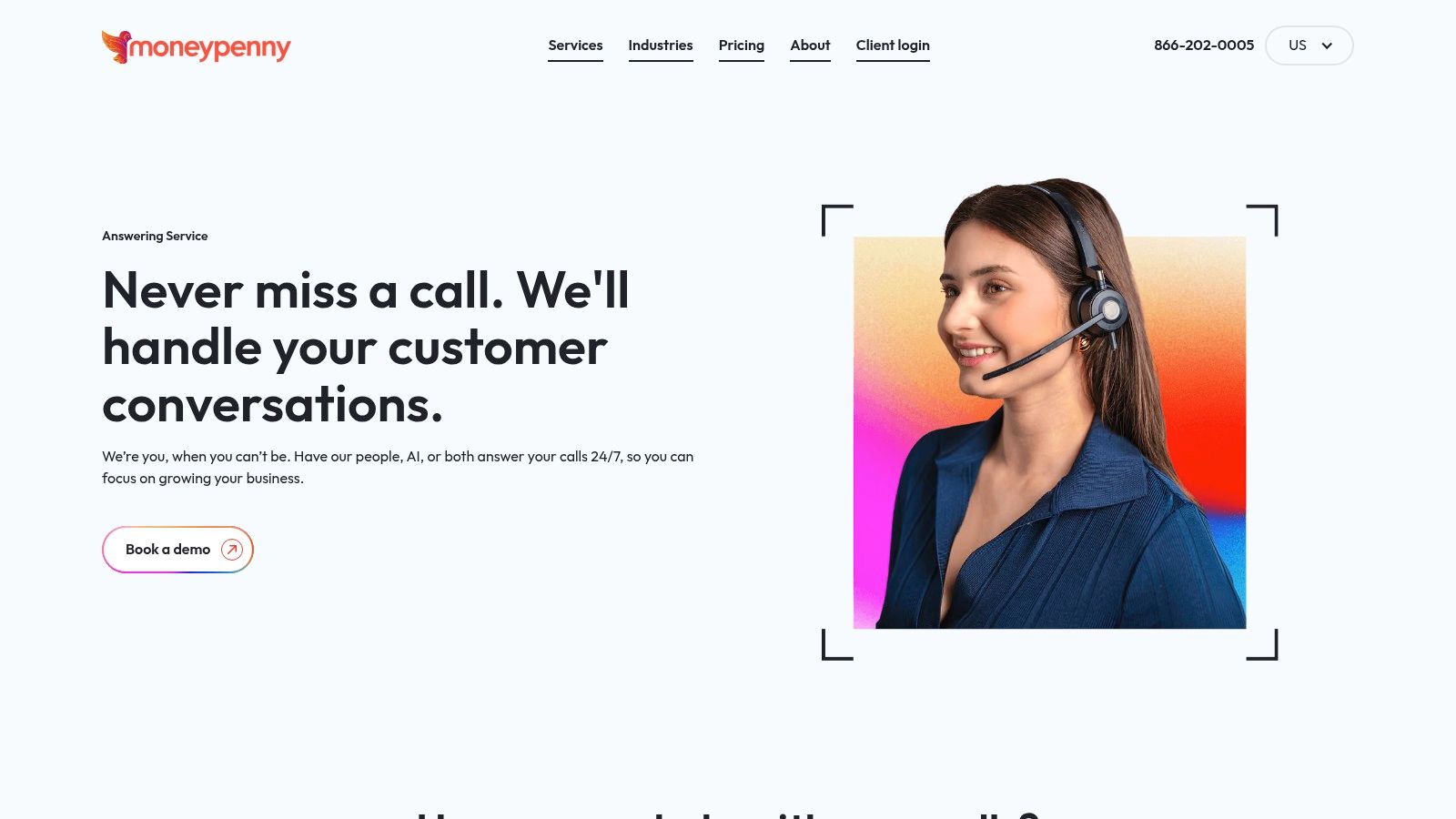
Moneypenny's U.S. service is well suited to a small business that wants live reception, small dedicated teams, and clearly posted minute pricing without a long-term contract. Its People Answering offering includes 24/7 live coverage, bilingual support, warm transfers, mobile access, CRM integrations, and minute tiers billed in 30-second increments.
The dedicated-team approach can improve continuity for law firms, home-service companies, and franchises. A caller who reaches a familiar team is less likely to repeat the company's service area, appointment rules, or escalation preferences from scratch. Warm transfers are also useful when the answering team needs to connect a qualified caller to a salesperson, attorney, dispatcher, or office manager.
Moneypenny publishes overage rates and separates its AI answering option from its People Answering plans. That distinction matters during procurement. If you want live receptionists, select the People Answering tier and confirm that your quote doesn't default to the separate AI product.
The minute-based model remains the primary limitation. A long legal intake, detailed construction estimate, or complicated healthcare scheduling exchange can use more minutes than a short message-taking call. Ask the provider to model your average and longest calls separately, then compare the result with per-call and hybrid alternatives.
For readers comparing the underlying service model, this guide explains what an answering service does. Moneypenny is a strong choice when pricing visibility and no long-term commitment matter, but it won't automatically be the lowest-cost option for long conversations.
Top 7 Telephone Answering Services Comparison
| Service | Implementation 🔄 | Resources ⚡ | Expected outcomes ⭐📊 | Ideal use cases 💡 | Key advantages |
|---|---|---|---|---|---|
| Recepta.ai | 🔄 Low, fast setup (~15 min); AI+human escalation workflow | ⚡ AI-first reduces staffing; integrates with 2,500+ tools for automation | ⭐ High, reported +30% qualified leads; 📊 ~15× ROI; ~80% cost savings (customers) | 💡 Service-heavy & regulated industries (healthcare, legal, franchises); 24/7 coverage | Deep integrations, fast onboarding, automatic logging, secure/compliant communications |
| Ruby | 🔄 Moderate, human-centric with AI-assisted tools; quick deployment | ⚡ U.S. live receptionists (bilingual/HIPAA-trained); mobile app for alerts | ⭐ Strong, <10s average answer time; 📊 polished caller experience and reputation | 💡 SMBs in legal, healthcare, home services needing fast pickup and polished service | Very fast pickup, scalable plans, bilingual/HIPAA capability, polished UX |
| Smith.ai | 🔄 Moderate, hybrid AI + U.S. live receptionists; per‑call model available | ⚡ U.S.-based staff with rich integrations and workflow automations | ⭐ Reliable, predictable per‑call costs; 📊 strong post-call actions (lead intake, payments) | 💡 Professional services and teams needing CRM workflows and automation | Transparent per‑call pricing, deep automations, optional AI hybrid |
| PATLive | 🔄 Low, straightforward onboarding with tiered minute plans | ⚡ 100% U.S. live staff; minute-based billing with no surcharges | ⭐ Consistent, predictable minute billing; 📊 all-inclusive handling (intake, dispatch) | 💡 SMBs and higher-volume teams that prefer predictable minute tiers | Transparent pricing ladder, bilingual/24/7 included, 14‑day trial |
| AnswerConnect | 🔄 Moderate, mature provider with quote-based plans | ⚡ 24/7 human coverage, apps with recordings/transcripts and integrations | ⭐ Reliable, strong after‑hours/overflow support; 📊 QA via recordings/transcripts | 💡 Businesses needing dependable after‑hours coverage and QA access | Multi-channel options, recording/transcript access, established provider |
| Abby Connect | 🔄 Flexible, supports human, AI, or hybrid workflows; variable setup | ⚡ 24/7 human + AI receptionist option; per‑call or per‑minute billing | ⭐ Adaptive, supports testing of pricing/workflows; 📊 includes scheduling integration | 💡 Teams wanting to compare human vs AI under one vendor | Choice of billing models, hybrid testing flexibility, entry pricing visible |
| Moneypenny (U.S.) | 🔄 Low–Moderate, clear minute tiers and no‑contract option | ⚡ Small dedicated teams, 30s billing increments, published U.S. rates | ⭐ Predictable, transparent minute tiers reduce billing surprises; 📊 continuity from small teams | 💡 Small businesses, law firms, home services seeking no-contract predictable plans | Clearly posted pricing, dedicated teams, bilingual support, no long-term contracts |
Matching a Telephone Answering Service to Your Call Volume
Start with the calls you miss, not the feature list. Separate normal business-hours calls from after-hours calls, weekend demand, emergency calls, appointment requests, sales inquiries, and calls that need a transfer. A vendor that looks affordable across all traffic may perform poorly during the exact periods when your highest-value callers need help.
The industry contact-center target is to answer 80% of inbound calls within 20 seconds, known as the 80/20 objective. First-call resolution commonly benchmarks at 70% to 75%, while 80% or higher is considered world-class (CallForce's contact-center KPI benchmarks). Use those as operating references, not universal guarantees. Put service-level expectations in the contract and request reporting by location, business line, hour, and call type.
Your scorecard should include:
- Answer and abandonment performance: Track answer rate, queue time, abandonment, and the percentage of calls resolved without voicemail.
- Business outcomes: Measure qualified leads, booking completion, transfer success, repeat callers, no-shows, and revenue per answered call.
- Escalation quality: Record escalation latency, transfer success, and whether the receiving employee gets the full context.
- Data quality: Check whether the service captures names, numbers, addresses, service needs, consent, and appointment details consistently.
- Segmented reporting: Review results by branch, campaign, service type, and after-hours period rather than relying on one blended average.
A human-first provider makes more sense when callers need interpretation, empathy, negotiation, or sensitive judgment. PATLive and Ruby are logical candidates for that model. Smith.ai and Recepta.ai fit businesses that want automation with human support, while Abby Connect suits teams that want to test both approaches. A more automation-heavy workflow can work for routine FAQs, lead capture, reminders, and scheduling, provided the handoff rules are explicit.
Governance matters when AI answers the phone. A survey of 2,000 U.S. consumers and 250 small-business owners found that 80% wanted to know whether they were speaking with a human or AI, 22% would immediately hang up on AI, and 37% said hidden AI reduces trust (Franchise.org's AI call report). Decide whether the greeting discloses AI, which triggers require a human, how transcripts are reviewed, how long data is retained, and whether context survives the handoff.
Healthcare practices need an additional review. Federal rules allow certain healthcare reminder calls and texts, including appointment confirmations, wellness reminders, pre-registration instructions, post-discharge follow-up, prescription notifications, and home-healthcare instructions. The messages must identify the provider and contact information, exclude advertising, follow HIPAA privacy rules, and generally stay within one minute for voice messages and 160 characters for texts (the relevant federal regulation). A dental practice should avoid exposing diagnosis or billing details in voicemail and route clinical questions to authorized staff.
Accessibility should also appear in the vendor review. The FCC requires most Telecommunications Relay Service providers to operate 24/7 and answer at least 85% of incoming calls within 10 seconds (FCC guidance on Telecommunications Relay Service). Your answering partner may not be a relay provider, but it should explain how it supports relay callers, interpreters, confidentiality, and urgent-call documentation.
Request trials where they're available. Recepta.ai lists a 30-day risk-free trial, while PATLive offers a 14-day free trial. Ask every provider for a quote based on your real call length, transfer rate, booking requirements, and after-hours volume. Then test two options against the same scenarios, including a routine question, a high-value lead, an urgent call, a scheduling change, and a request for human escalation. The best telephone answering service is the one that completes the next business action reliably at a cost your actual call mix can support.
Recepta.ai combines 24/7 AI reception, lead capture, appointment scheduling, outbound follow-ups, CRM integrations, and white-glove human escalation for complex calls. If you want to test a revenue-focused answering workflow against the same scenarios used to evaluate other providers, visit Recepta.ai and start with its 30-day risk-free trial.