
Customer Communication Strategy: Build a System That
90% of customers want a response in 10 minutes or less, but the average team replies in 12 hours and 10 minutes. That gap is where leads leak, and it's why customer communication strategy is now a revenue question, not just a service question.
A lot of teams still treat communication as a support script problem. They write better templates, add a chatbot, maybe assign a few more inbox rules, then wonder why people still churn, abandon quotes, or call twice. The core issue is simpler and harder to fix: response timing, channel routing, and escalation design.
If you run a multi-location service business, you already know the pattern. A lead comes in from ads, website chat, phone, SMS, or email, and the business loses money every time that path breaks. The winning play is a system that decides which channel reaches which customer, in what order, with what message, and at what speed.
Why a Customer Communication Strategy Is Now a Revenue Lever
The clearest reason to care about customer communication strategy is the speed gap. Customers now expect fast replies, and research cited in 2026 customer communication statistics says 90% define a quick response as under 10 minutes, while customer service teams average 12 hours and 10 minutes in response time. That gap is not a minor service flaw, it's a conversion leak, a retention risk, and a signal that the business is easier to ignore than its competitors. customer communication statistics
Speed is now part of the buying decision
For a plumbing company, the math is blunt. If a homeowner submits an emergency request at 7 p.m. and hears nothing until the next morning, that lead often gets quoted by someone else first. The same logic applies to insurance, dental, HVAC, and legal intake, because the buyer isn't waiting around to be “served,” they're deciding who feels responsive enough to trust.
That's why a customer communication strategy can't live only inside support. It has to cover ads, intake, follow-up, and escalation, because every stage carries a timing risk. The strategy becomes the operating system for how a business captures attention, keeps context, and moves people forward without making them repeat themselves.
Practical rule: if a customer has to wonder who owns the next step, your communication system is already leaking revenue.
The bigger shift is historical. Customer communication used to mean email replies and phone coverage. Now it means routing, channel consistency, and timing across the full journey. If you want a retention-oriented view of that shift, the Pipeline On retention guide is a useful companion because it frames communication as part of keeping customers, not just replying to them.
For teams thinking about AI support, the operational point is the same as in this overview of AI in customer service. Automation only helps when it shortens the path to a human or resolves the request cleanly.
The Four Building Blocks Every Strategy Needs
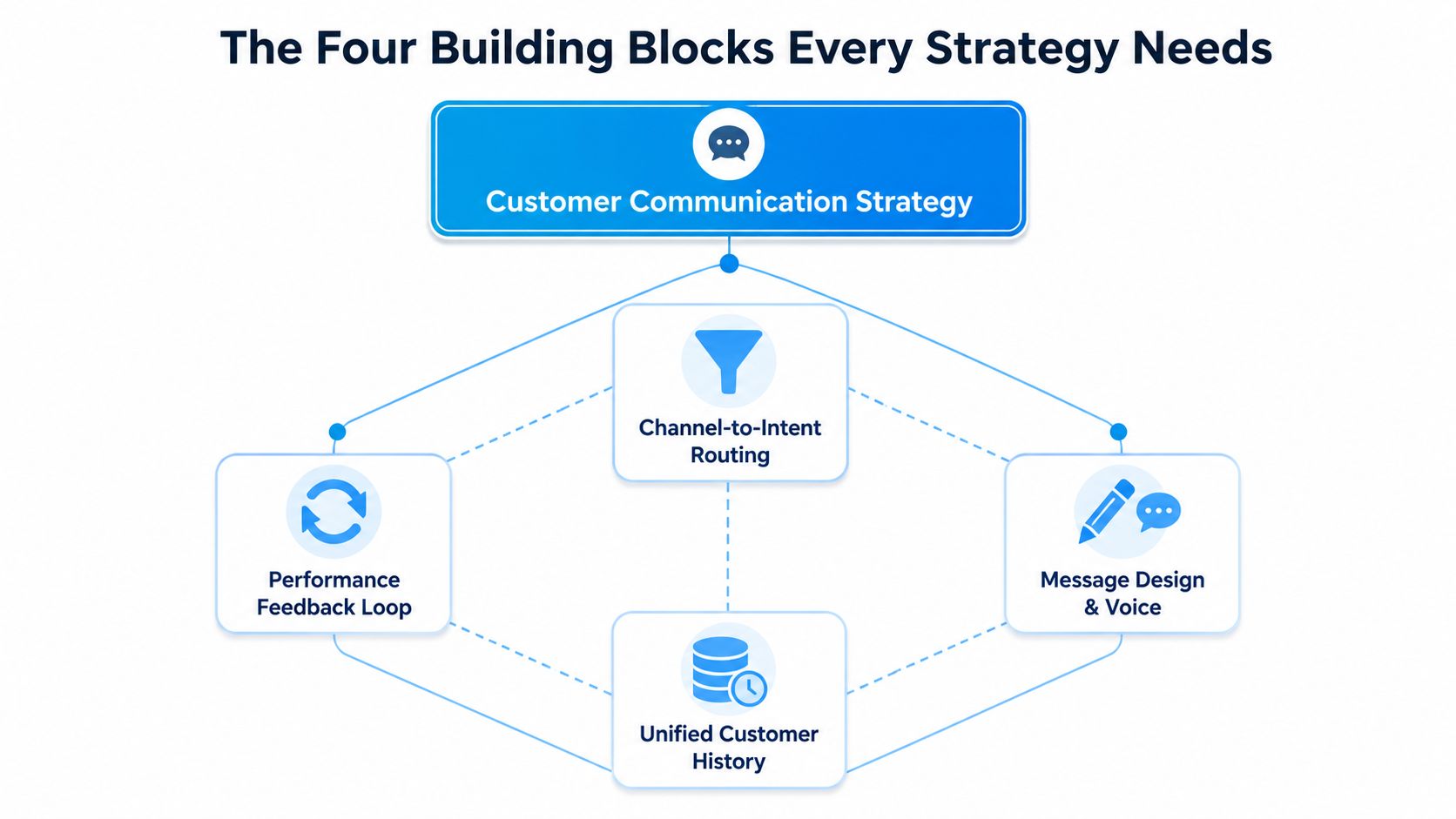
A useful customer communication strategy has four moving parts, and they only work when they're connected. If one of them is missing, the rest start to wobble. A business can have great templates and still fail if routing is sloppy, or have strong routing and still frustrate customers if the message sounds disconnected from the channel they used.
Start with channel-to-intent routing
The first block is channel-to-intent routing. Use the channel that matches the customer's task, then carry that context into the next step. A website chat can capture the lead, SMS can confirm the appointment, phone can handle the final questions, and CRM can preserve the history so no one starts from zero.
A plumbing company is a clean example because the journey is easy to trace. Someone asks about a leak in chat, gets a text confirming the request, books by phone, and shows up in the CRM with the issue, time, and address already logged. That's not extra polish. That's fewer handoffs, fewer missed details, and fewer chances to lose the job.
Make message design and history work together
The second block is message design and voice. The words have to fit the channel and the moment. A short SMS reminder should read differently from a post-call follow-up email, and both should sound like they came from the same company.
The third block is unified customer history. If voice, chat, email, and CRM don't share context, your team will ask customers to repeat themselves. That's where frustration starts, and it's why guides on CRM integration matter in practice, not just in theory.
A short way to think about it is this. Channel routing gets the right door open. Message design makes the first sentence useful. Unified history keeps the conversation from resetting every time it moves.
A strategy that looks polished in a single tool often falls apart once the customer switches channels. The test is continuity, not aesthetics.
The fourth block is measurement wired into analytics, which is what turns all of this into an operating system instead of a collection of habits. The next sections turn that architecture into a rollout plan, then into the numbers that tell you whether the system is working.
Building the Strategy in the First 30 and 90 Days
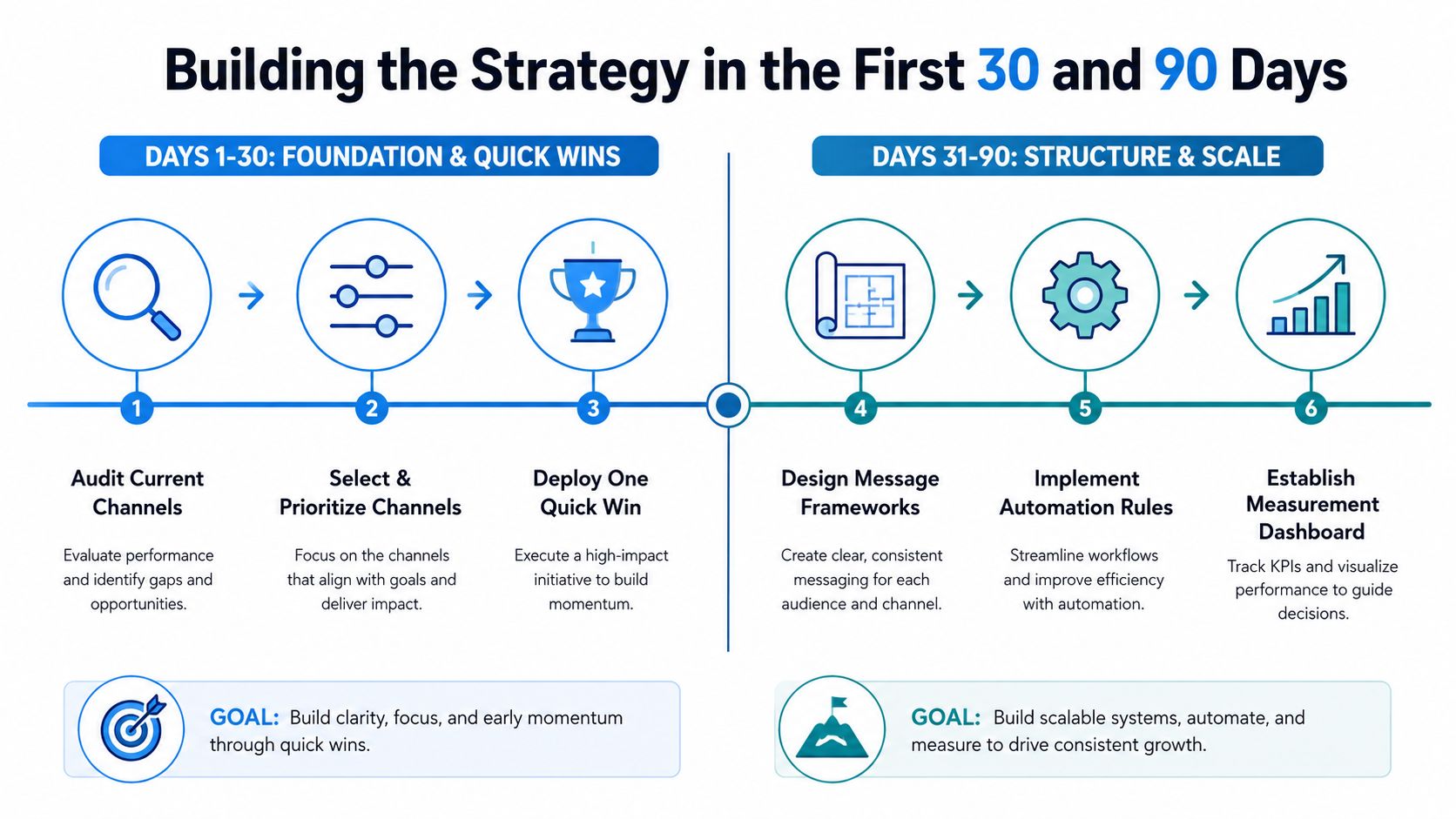
The cleanest way to build this is to stop thinking in features and start thinking in phases. The first 30 days are about seeing the mess clearly, fixing the biggest timing break, and choosing the channels that matter most. The next 60 days are about making the workflow repeatable, measurable, and hard to break.
Days 1 to 30 should expose the bottlenecks
Start with a channel audit. List every place customers can reach you, then mark where calls, texts, chats, emails, and reviews go. Many teams discover redundancies, dead ends, and one or two channels that drive most of the revenue.
Next, choose the first response path that deserves immediate attention. For an insurance agency, that might be quote requests, because speed-to-lead can decide whether the buyer gets on the phone with you or with someone else. For a dental clinic, the quick win is often reminder flow, because missed appointments are a visible cost and a fixable one.
Practical rule: pick one workflow that touches revenue every day, then make that path faster before you touch anything else.
This is also the point where a practical resource helps. A guide from Mail Tracker for Gmail can be useful when the team needs to tighten follow-up discipline, because outreach only works when the next touch happens.
Days 31 to 90 are about structure, not volume
Once the main bottleneck is visible, build the scripts and escalation rules around it. Define what gets automated, what gets a human, and what gets sent only once. That keeps the process from turning into a noisy pile of reminders.
This is also where CRM integration matters, because a delayed handoff is still a broken handoff if no one can see the conversation. Use this CRM integration guide as a reference point for why the record has to follow the customer, not the other way around.
The measurement side should go live before the strategy expands. If the team can't see response time, transfer points, and completion rates, it will guess wrong about what's broken. By day 90, the goal isn't “more communication.” It's tighter control over the moments that decide whether the customer stays engaged.
KPIs That Actually Tell You Whether It Is Working
Most dashboards are full of activity and short on decisions. If a number doesn't tell you what to change, it's decoration. For customer communication strategy, five metrics matter because each one points to a different failure mode in the workflow.
Use the metric that matches the bottleneck
First-response time tells you whether the intake layer is fast enough to keep the lead warm. If it climbs, staffing, routing, or after-hours coverage is off. That's usually an ownership problem before it's a script problem.
First-contact resolution, or FCR, shows whether the first touch solves the issue or just opens a loop. If FCR is weak, the team is either missing context or handing customers around too much. The fix is usually better intake, clearer routing, or less transfer friction.
CSAT tells you whether customers felt taken care of after the interaction. NPS tells you whether the experience was strong enough to support loyalty and referral behavior. Customer effort score, or CES, is the sharpest clue for routing problems, because high effort usually means the customer had to repeat themselves, wait too long, or bounce between teams.
Practical rule: if CES rises while CSAT stays flat, look at routing and handoffs first, not agent attitude.
The right way to use these metrics is as workflow triggers. Faster routing should improve response time. Fewer transfers should support FCR. Shared visibility should lower effort. If a metric changes but nothing in the workflow does, you're probably measuring the wrong thing or looking at it too late.
A tool like the performance dashboard guidance from Recepta.ai fits here because real-time summaries and analytics only matter when they point directly to the next operational move.
How It Plays Out Across Industries
The same framework works across industries, but the pressure points change. Home services cares about missed calls and speed-to-lead. Healthcare cares about appointment flow and no-shows. Legal cares about intake clarity and confidentiality. Franchises care about consistency across locations.
| Industry | Top Channel | Biggest Risk | Key Metric |
|---|---|---|---|
| Home Services | Phone and SMS | Missed leads after hours | First-response time |
| Healthcare | Phone, SMS, and reminders | No-shows and confusion | FCR |
| Legal | Phone and secure intake | Weak after-hours capture | CES |
| Franchises | Omnichannel mix | Inconsistent brand experience | CSAT |
Home services and healthcare need different timing rules
In home services, the work starts the moment the phone rings. A caller who gets voicemail during a burst of demand often calls someone else, which is why routing and coverage matter so much. A hybrid receptionist setup can answer, capture details, and push the lead into the CRM before a human even picks up the case.
In healthcare, the problem looks quieter but costs are still real. A dental clinic can use reminders, confirmation messages, and callback escalation to keep appointments from slipping through the cracks. The message has to be clear, but the bigger win is making sure the right channel gets used for the right task.
Legal and franchise teams need control more than volume
A law firm usually cares less about blasting more messages and more about making intake feel orderly and confidential. The wrong channel or a sloppy handoff can make a prospect hesitate before they ever book a consult. That's where a structured intake sequence matters more than a busy inbox.
Franchises have the opposite problem. One location may handle follow-up well while another goes off-script, and the brand feels inconsistent to the customer. The fix is a shared communication system, not a pile of local exceptions. A useful reference point for medical office workflows is this answering service guide for medical offices, because it shows how practices think about coverage, tone, and continuity under pressure.
The Over-Communication Trap and How to Avoid It
More touchpoints don't automatically create more trust. Sometimes they do the opposite. Customers stop opening messages, mute alerts, or opt out when every channel pushes the same nudge at the same time.
Set rules before you add another message
Start with a clean distinction between urgent and routine communication. Urgent messages deserve fast, direct contact and a clear escalation path. Routine updates should be scheduled, limited, and tied to a real customer need.
Then put frequency caps on each channel. A reminder that arrives by email, text, voice mail, and a second text can feel less like service and more like pressure. If the customer already replied, the sequence should stop. If the issue is simple, automation should handle it once and get out of the way.
A good external reference for this problem is CleanMyList's no reply deliverability tips, because deliverability and trust both suffer when businesses treat every channel like a megaphone.
Escalate when automation starts to add friction
The smartest workflow is the one that knows when to stop automating. A healthcare practice doesn't need five texts to confirm a routine visit if one call from a real person settles the question faster. A home services company doesn't need to keep nudging a customer who already booked the job.
A white-glove escalation path matters. If automation can't resolve the task cleanly, it should hand the customer to a human before frustration builds. Recepta.ai fits that use case as one option for teams that want AI handling first contact and a human taking over when the conversation gets messy.
Don't count messages, count usefulness. If a follow-up doesn't move the customer toward resolution, it's noise.
Your 90-Day Rollout and the Three Failure Modes to Avoid
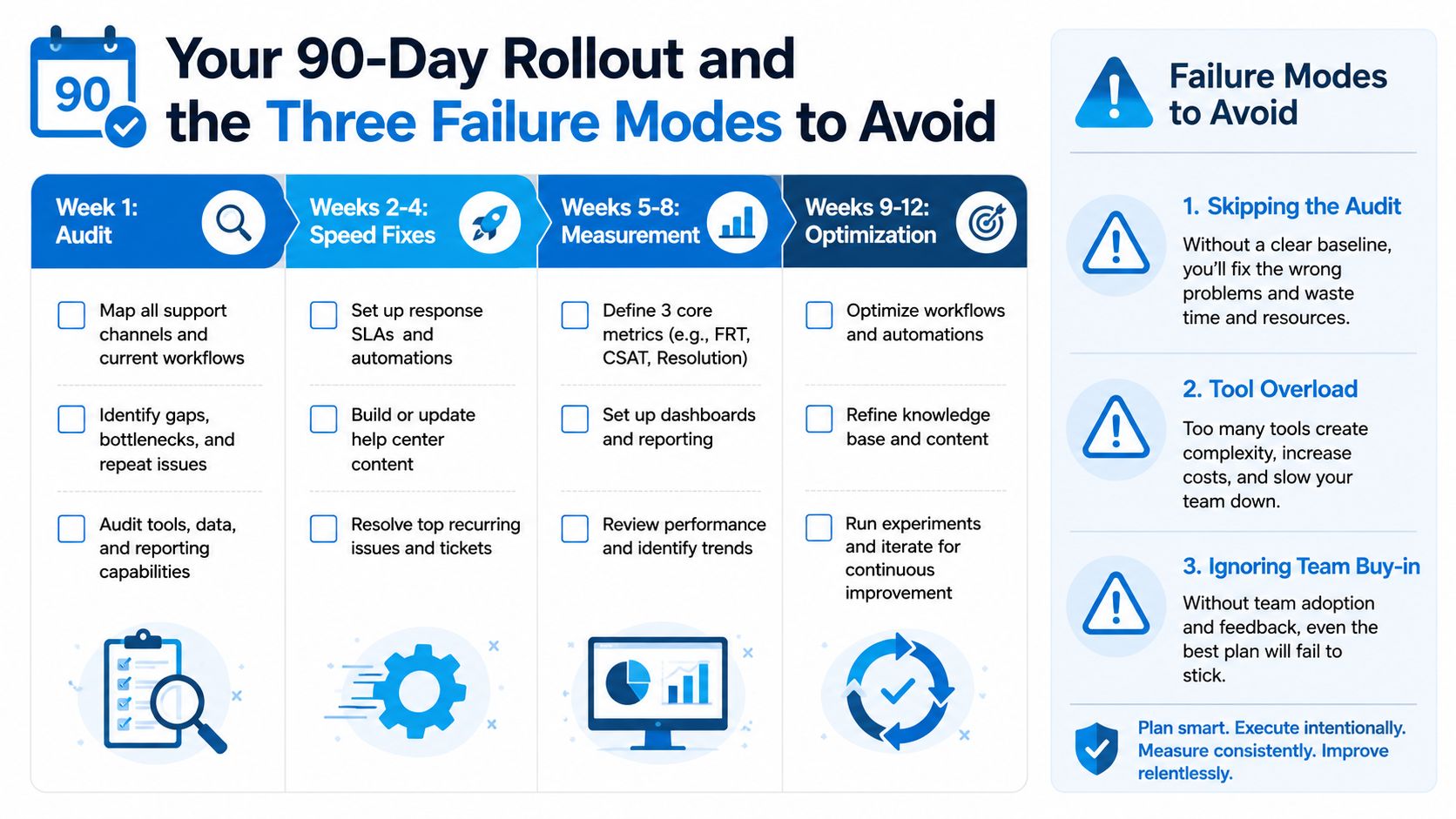
The rollout should be simple enough to run on a Monday and strict enough to survive a busy month. Week 1 is audit and triage. Weeks 2 to 4 are speed fixes and channel cleanup. Weeks 5 to 8 are measurement and automation. Weeks 9 to 12 are optimization, escalation tuning, and rollout to the rest of the business.
The three mistakes that sink most plans
The first failure mode is treating this like a software purchase instead of a workflow change. A tool can help, but it won't fix broken routing, missing ownership, or sloppy escalation rules.
The second is measuring the wrong KPIs. If the dashboard rewards activity instead of resolution, the team will produce noise and call it progress. Use the metrics that map to response speed, effort, and closure.
The third is never assigning an owner. Someone has to own the channel map, the scripts, the exceptions, and the dashboard. Without that, the strategy drifts back into inbox habits.
If speed-to-lead and after-hours coverage are still your weakest links, an AI receptionist platform like Recepta.ai belongs in the early phases, not as a final polish. It handles inbound and outbound calls, appointment scheduling, lead capture, and follow-ups, then escalates when a human needs to take over.
If you want a communication system that routes calls, texts, and follow-ups instead of just collecting them, visit Recepta.ai and see how the platform can fit into your intake, escalation, and follow-up workflow. It's a practical next step for teams that need faster response times, cleaner handoffs, and fewer missed opportunities.