
10 Customer Service Experience Examples to Scale Your Business in 2026
In today's competitive market, merely providing "good" service is no longer a differentiator; it's the bare minimum for survival. Exceptional customer service is the new battleground for growth, yet many businesses struggle to deliver consistent, high-quality interactions, especially after hours or during peak times. Missed calls, delayed responses, and fragmented communication don't just create friction, they actively push potential clients toward your competitors, resulting in lost revenue and a damaged reputation.
This article moves beyond abstract theories and generic advice. We will provide 10 practical, industry-specific customer service experience examples that are not only effective but highly replicable. From seamless 24/7 appointment scheduling to intelligent lead capture that works while you sleep, each example is designed for service-based businesses like yours.
We will dissect the strategy behind each scenario, breaking it down into concrete actions and measurable outcomes. You will find actionable takeaways and practical templates that you can implement immediately to transform routine customer touchpoints into powerful opportunities. You will learn how blending smart automation with a human touch can create unforgettable experiences, drive customer loyalty, and build a scalable system for growth. This guide is built to ensure you never miss a chance to capture a lead or impress a client, turning every interaction into a competitive advantage. Let's dive into the examples that will redefine your approach to customer engagement.
1. 24/7 Appointment Scheduling and Confirmation
One of the most impactful customer service experience examples is implementing an automated, 24/7 appointment scheduling system. This technology allows customers to book, reschedule, and confirm appointments at their convenience, even outside of standard business hours. For instance, an AI-powered virtual receptionist can field a call at 10 PM from a parent needing to book a pediatric check-up, find the next available slot, and send an instant SMS confirmation, all without human intervention.
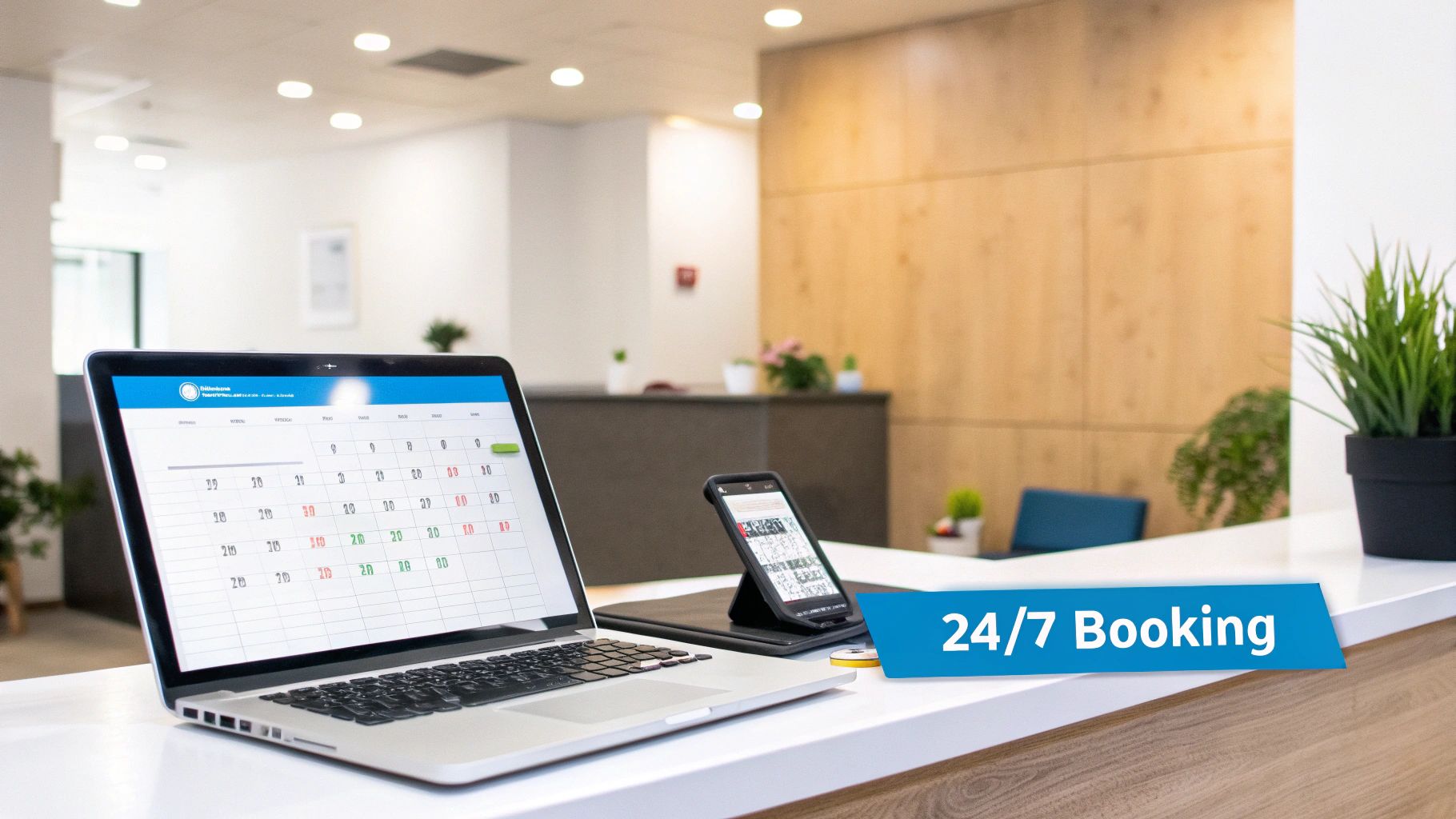
This approach solves a critical pain point: lost business. Many potential customers, like a homeowner with a broken AC at 2 AM or a professional scheduling a consultation after work, will simply move on if they can't book an appointment immediately. Automation captures this otherwise lost revenue and elevates the customer experience by providing instant gratification and control. To create truly unforgettable customer experiences, businesses must prioritize a customer-focused user experience design for their digital presence.
Strategic Breakdown
- Problem Solved: Missed opportunities and scheduling friction. Businesses without 24/7 booking capabilities lose leads who inquire after hours. Manual scheduling is also prone to human error, leading to double bookings and frustrated customers.
- Action Taken: A dental practice integrated an AI receptionist to handle all inbound scheduling calls. The AI was configured to understand different appointment types (e.g., a 30-minute cleaning vs. a 90-minute root canal) and book them according to specific calendar rules, such as only booking new patient consultations on Tuesday afternoons.
- Measurable Outcome: The practice reduced its patient no-show rate from 15% to just 4% due to automated SMS confirmations and reminders. It also captured an average of 12 new patient appointments per month that were booked after business hours.
Actionable Takeaways
- Implement SMS Confirmations: Instead of relying on email, send an immediate text message after booking with clear details:
"Hi [Name], your cleaning with Dr. Smith is confirmed for Oct 25 at 2 PM. Reply C to confirm or R to reschedule." - Configure Service-Specific Rules: Set up different availability and duration rules for various services. For example, an HVAC company can configure its system so a "New Installation Quote" is always a 60-minute slot, while a "Filter Change" is only 30 minutes.
- Create Buffer Times: Automatically add a 15-minute buffer period between appointments in your scheduling software. This accounts for travel, setup, and unexpected delays, preventing a domino effect of late arrivals for your field technicians.
2. After-Hours Lead Capture and Qualification
A transformative customer service experience example is the implementation of an automated after-hours lead capture and qualification system. Instead of funneling valuable after-hours calls to a generic voicemail, this approach uses a conversational AI to engage potential customers immediately. The AI asks a series of predefined discovery questions to qualify the lead, gathering crucial details like the type of service needed, urgency, budget, and contact information.
This system directly solves the problem of lost revenue from missed calls. For instance, a potential legal client researching attorneys after work calls a firm at 8 PM. Instead of voicemail, an AI answers, asks if they are a new or existing client, what area of law they need help with (e.g., "Family Law," "Real Estate"), and schedules a consultation for the next day. This captures a high-value lead who would have otherwise called a competitor. This proactive engagement is a cornerstone of modern customer service.
Strategic Breakdown
- Problem Solved: Lost leads and delayed follow-up. When businesses close, they miss out on motivated customers ready to make a decision. Voicemail often lacks the structure to capture qualifying details, leading to inefficient follow-ups.
- Action Taken: A home cleaning service deployed an AI receptionist to handle all calls after 6 PM. The AI was programmed with a script:
"Are you looking for a one-time deep clean, recurring service, or move-out cleaning?"Based on the answer, it collected their address, home size (in square feet), and best callback time, creating a detailed lead profile in the company's CRM. - Measurable Outcome: The service captured an average of 25 qualified leads per month that previously would have gone to voicemail. This resulted in a 15% increase in monthly revenue, as the sales team could prioritize these pre-qualified, high-intent leads for their first calls each morning.
Actionable Takeaways
- Design a Qualification Script: Create a simple 3-question flow. For a plumber: 1) "Is this for a residential or commercial property?" 2) "Are you dealing with a leak, a clog, or an installation?" 3) "How urgent is the issue?" This provides immediate context for the follow-up call.
- Set Up Urgency Alerts: Configure the system to automatically flag and send an email or SMS alert to an on-call manager for high-urgency keywords like "emergency," "flood," or "burst pipe," enabling an immediate response when necessary.
- Integrate with Your CRM: Connect your AI receptionist directly to your CRM to automatically create new lead profiles with tags like "After-Hours Lead" or "Emergency Inquiry." This eliminates manual data entry and ensures no lead ever falls through the cracks, a key benefit of a robust after-hours answering service.
3. Seamless Escalation from AI to Human Agents
One of the most sophisticated customer service experience examples is creating a seamless handoff process from an AI receptionist to a human agent. This hybrid approach acknowledges that while AI excels at handling routine tasks, complex or emotionally charged situations require a human touch. A practical example is an AI detecting a caller saying, "I'm very upset about my last service," and immediately responding, "I understand your frustration. Let me connect you with a senior manager right away," while simultaneously transferring the call and a transcript of the conversation.
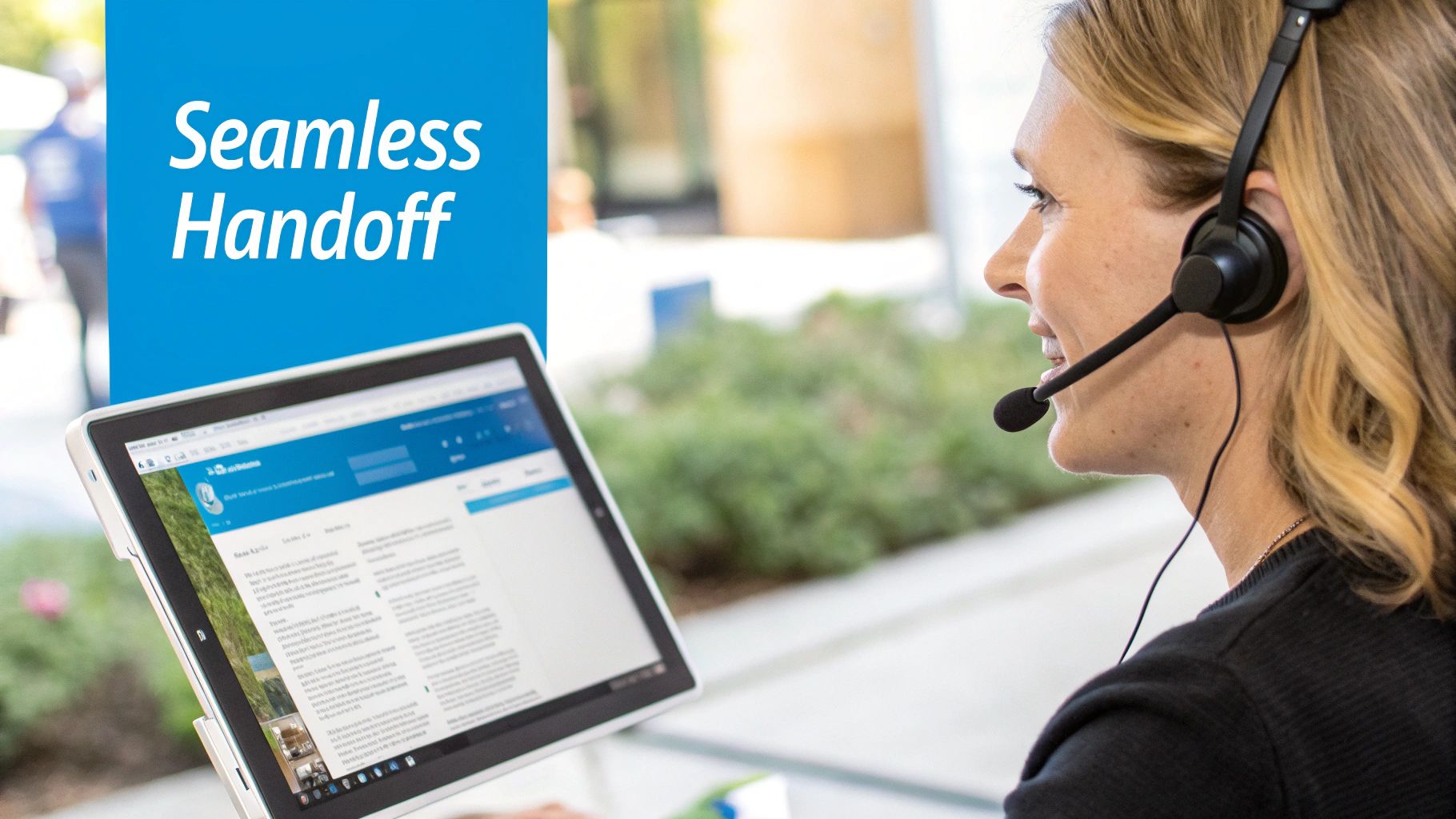
This strategy prevents the frustration of "robot jail," where customers are stuck in an automated loop unable to reach a person. By providing the human agent with a transcript of the AI conversation, the customer doesn't have to repeat themselves, turning a potential point of friction into a demonstration of competence and efficiency. This intelligent escalation preserves the benefits of automation while ensuring empathy and expert problem-solving are available when needed most.
Strategic Breakdown
- Problem Solved: Customer frustration with automated systems and inefficient transfers. Without a smooth handoff, customers are forced to restart their story with a human agent, leading to poor experiences and brand damage.
- Action Taken: A multi-location HVAC franchise configured its AI receptionist to recognize keywords like "complaint," "major leak," or "confused about my bill." When these triggers are detected, the AI automatically places the customer in a priority queue for the next available human agent and sends the agent a screen-pop with the conversation history.
- Measurable Outcome: The franchise saw a 25% decrease in negative customer reviews mentioning phone system frustrations. First-call resolution for complex billing issues improved by 40% because agents had the necessary context before even speaking to the customer.
Actionable Takeaways
- Define Clear Escalation Triggers: Program your AI to identify specific keywords (e.g., "speak to a manager," "legal," "cancel service"), expressions of frustration (raised voice volume), or a caller repeating the same question three times.
- Implement Callback Escalation: Instead of forcing customers to wait on hold, offer an automated callback option. The AI can inform them, "Our specialists are busy, but I've saved your place in line. Press 1 to receive a call back in approximately 15 minutes."
- Analyze Handoff Data: Every week, review a report of the top 5 reasons for escalation. If "billing questions" is consistently number one, it's a clear signal to improve the AI's script and knowledge base on that topic to reduce future handoffs.
4. Intelligent Call Screening and Spam Detection
One of the most effective yet overlooked customer service experience examples is implementing an intelligent call screening and spam detection system. This technology acts as a frontline defense, using AI to analyze incoming calls in real-time. For example, when a known telemarketing number calls, the system automatically blocks it. For unknown numbers, it can ask, "May I ask who is calling and the reason for your call?" before ringing through to a human, effectively filtering out unsolicited sales pitches.
This process creates a better experience for both staff and customers. Employees are not bogged down by a flood of irrelevant calls, which reduces stress and boosts morale. Customers who do get through receive faster, more focused attention because the phone lines aren't tied up with telemarketers. By filtering the noise from the signal, businesses can dedicate their resources to high-value interactions, leading to greater efficiency and improved service quality.
Strategic Breakdown
- Problem Solved: Wasted time and reduced productivity. Unfiltered call volumes force staff to spend significant time answering and vetting unwanted calls, distracting them from legitimate customer needs and operational tasks. This leads to missed genuine calls and frustrated employees.
- Action Taken: A multi-location law firm deployed an AI receptionist configured with advanced call screening rules. The system was trained to identify common spam patterns, such as insurance solicitations and scam client inquiries, and automatically block them. It also used a whitelist to ensure calls from existing clients and court clerks were always prioritized and routed correctly.
- Measurable Outcome: The firm reported a 70% reduction in unwanted calls within the first month. This saved their paralegal team an estimated 8-10 hours per week, allowing them to reallocate that time to billable case work and client follow-ups, directly impacting revenue.
Actionable Takeaways
- Create Industry-Specific Blocklists: Customize your filter rules based on common annoyances in your sector. For example, a marketing agency can block known SEO service sales calls, while a dental office can filter out calls from medical supply companies they don't use.
- Establish a Whitelist for VIPs: Ensure important callers are never accidentally blocked by creating a "whitelist" of trusted phone numbers. This can include your top 20% of clients by revenue, key suppliers, and partner organizations.
- Regularly Review Filtered Calls: Once a month, spend 15 minutes checking the log of blocked calls to ensure the system's accuracy. This helps you identify any "false positives" (legitimate calls that were blocked) and fine-tune the screening algorithm.
5. Multi-Channel Customer Inquiry Consolidation
One of the most powerful customer service experience examples is consolidating all customer inquiries into a single, unified system. This means a message from a website contact form, an SMS text, and a voicemail from the same person all appear in a single conversational thread. When a team member responds, they see the full history, preventing them from asking questions the customer has already answered.

This strategy solves the critical problem of fragmented communication, where a customer might call, then text, then email. Without a unified view, the context of their journey is lost, forcing them to repeat themselves and creating a disjointed, frustrating experience. By creating a 360-degree view of each customer relationship, businesses can provide seamless, informed service. This is a core principle behind a successful omnichannel customer service strategy.
Strategic Breakdown
- Problem Solved: Fragmented communication and missed leads. Businesses managing separate channels (phone logs, email inbox, social DMs) often miss urgent inquiries or respond slowly, leading to lost revenue and poor customer perception.
- Action Taken: An HVAC company implemented a unified communications platform like Recepta.ai. All inbound phone calls, website service request forms, and text messages were automatically routed into a single dashboard. Emergency calls were flagged with high-priority tags for immediate action.
- Measurable Outcome: The company reduced its average first-response time from over 2 hours to just 15 minutes. This led to a 20% increase in converting web and SMS inquiries into booked service appointments within the first quarter.
Actionable Takeaways
- Set Up Smart Routing: Configure automatic routing rules. For example, any message containing the word "quote" can be automatically assigned to the sales team's inbox, while messages with "invoice" go directly to the billing department.
- Create Channel-Specific Templates: Develop pre-written response templates. For SMS:
"Hi [Name], thanks for your inquiry. We'll call you back within 15 mins."For email: A more detailed template with company info and next steps. This ensures consistency and efficiency. - Monitor Channel SLAs: Use your dashboard to track response times. Set a goal, such as "respond to all website forms within 30 minutes," and use the analytics to ensure your team is meeting performance targets across all platforms.
6. Proactive Follow-Up and Appointment Reminder Sequences
An exceptional customer service experience example is the implementation of an automated, proactive follow-up and reminder system. This means that after a customer books a dental cleaning, they automatically receive an SMS reminder two days before, with an option to confirm by replying 'C'. If they don't respond, they get a second reminder 24 hours before. This simple sequence significantly reduces no-shows without any manual effort from the front desk.
This strategy directly tackles the costly issue of no-shows and boosts customer retention. For a plumbing company, it can mean sending an automated text six months after a water heater installation: "Hi [Name], it's time for your semi-annual water heater flush to maintain its warranty. Ready to book?" Automating these touchpoints demonstrates that a business values the customer's time and business, dramatically improving attendance rates while freeing up staff. To better understand the financial impact, businesses can explore how to drastically reduce no-show appointments with these automated strategies.
Strategic Breakdown
- Problem Solved: High appointment no-show rates, low customer retention, and manual administrative burden. Staff spending hours on reminder calls leads to inefficiency and lost revenue from missed appointments.
- Action Taken: A multi-location HVAC franchise implemented an automated communication sequence. The system sent an SMS reminder 48 hours before a scheduled maintenance visit, a follow-up SMS 24 hours before, and a final "technician is on the way" text 30 minutes prior to arrival.
- Measurable Outcome: The franchise saw a 60% reduction in missed appointments across all locations within three months. Post-service feedback collection rates also increased by 45% due to an automated "how did we do?" text sent two hours after job completion.
Actionable Takeaways
- Segment Your Sequences: Create different reminder cadences for different services. For a legal consultation, send reminders 72 hours, 24 hours, and 2 hours before. For a quick pest control check-up, a single reminder 24 hours prior may be sufficient.
- Include Easy Action Links: Every reminder message should include a simple, one-click option to "Confirm Appointment" or "Reschedule Now." This removes friction and gives the customer control, reducing last-minute cancellations.
- Personalize with Key Details: Go beyond just the customer’s name. A great example:
“Hi Sarah, just a reminder about your appointment with our technician, Mike, tomorrow between 2-4 PM for your annual furnace inspection.”
7. Customer Service Feedback and Sentiment Analysis
Another powerful customer service experience example involves using technology to analyze customer interactions in real time. An AI system can transcribe phone calls and automatically flag conversations where the customer's tone indicates frustration or anger. A manager can then receive an immediate alert, allowing them to review the interaction and proactively reach out to the customer to resolve the issue before it escalates into a negative online review.
This approach provides immediate, data-driven insights into the customer experience, allowing businesses to pinpoint systemic problems, address agent training gaps, and recognize outstanding performance. For instance, a law firm can detect client anxiety about case progress, or an insurance agency can identify widespread confusion about a new policy’s terms, enabling them to proactively address concerns before they escalate.
Strategic Breakdown
- Problem Solved: Reactive problem-solving and lack of visibility. Businesses often learn about poor customer experiences long after they happen, through negative reviews or surveys, making it difficult to address the root cause or salvage the relationship.
- Action Taken: A multi-location home services franchise used sentiment analysis to review transcripts from its AI receptionist and human call center. The system flagged conversations where customers used words like "confused," "waiting," and "another delay" when discussing project timelines.
- Measurable Outcome: By identifying this recurring issue, the company updated its communication protocols and trained staff to provide more proactive timeline updates. This led to a 25% reduction in negative post-service survey feedback related to communication and a 15% increase in repeat business over the next six months.
Actionable Takeaways
- Create Critical Sentiment Alerts: Set up automated alerts for managers when a customer's sentiment score drops below a certain threshold (e.g., -0.5 on a -1 to +1 scale) during a call, allowing for timely intervention or follow-up.
- Identify Best Practices: Analyze calls with the highest positive sentiment scores. If you notice agents who say, "Let me repeat that back to make sure I've got it right," have higher scores, turn that phrase into a required best practice for the whole team.
- Refine Call Scripts and FAQs: Use sentiment data to pinpoint common points of confusion. If many calls about "Service Plan B" have negative sentiment, it's a sign that the plan's description needs to be clarified in your scripts and on your website.
8. Intelligent Call Routing and Load Balancing
Intelligent call routing is a sophisticated system that goes beyond simple call forwarding. It analyzes incoming calls and directs them to the most appropriate person. For example, when an existing customer calls a home services company, the system recognizes their phone number, checks the CRM, sees they have an ongoing project with "Technician Bob," and automatically routes the call directly to Bob's mobile, bypassing the front desk entirely.
This approach creates one of the most efficient customer service experience examples by eliminating the frustration of being passed from one agent to another. For businesses with specialized departments, like a legal firm with distinct practice areas (e.g., routing a call about "divorce" to the family law team) or an HVAC company with separate emergency and maintenance teams, this optimization is crucial for delivering expert service quickly and effectively.
Strategic Breakdown
- Problem Solved: Inefficient call handling, long wait times, and customer frustration from multiple transfers. Simple routing systems often send callers to general queues, where agents may lack the specific knowledge needed, leading to poor first-call resolution.
- Action Taken: A multi-location insurance franchise implemented an AI-powered routing system. The AI asked callers, "Are you calling about an existing claim, a new policy, or something else?" Based on the answer, it routed claim calls directly to the assigned adjuster, new policy inquiries to the sales team, and billing questions to the accounts department.
- Measurable Outcome: The franchise decreased average call handling time by 35% because calls reached the right expert immediately. First-contact resolution improved from 60% to 85%, significantly increasing customer satisfaction scores and reducing operational costs tied to repeat calls.
Actionable Takeaways
- Create Skill-Based Routing Rules: Program your system to route calls based on need. For example: "If caller mentions 'emergency repair,' route to on-call Tier 1 technician. If they mention 'quote' or 'new install,' route to the sales queue."
- Prioritize High-Value Callers: Use CRM integration to identify your top 10% of customers by lifetime value. Create a priority routing rule so when their number is recognized, their call jumps to the front of the queue and is handled by a senior agent.
- Implement Load Balancing: Distribute calls evenly among available agents. If Agent A has been on the phone for 45 minutes of the last hour and Agent B for only 15, the system automatically routes the next call to Agent B to prevent burnout and maintain consistent service.
9. Real-Time Call Analytics and Performance Dashboards
Providing real-time visibility into call performance is a powerful customer service experience example that shifts teams from reactive to proactive. Instead of waiting for month-end reports, a manager at a busy plumbing company can look at a live dashboard at 10 AM on a Monday, see that the average call wait time has jumped to 3 minutes (from a normal 30 seconds), and immediately assign a third person to answer phones to handle the unexpected surge.
This data-driven approach transforms how businesses operate. A home service company can see which marketing campaigns are driving the most qualified service requests, while a healthcare practice can track appointment booking rates by time of day. By turning raw call data into actionable insights, businesses can refine their processes, optimize staffing, and ultimately deliver a more responsive and efficient customer experience. Understanding the tools available is key; you can explore some of the best call tracking software to see how this technology works.
Strategic Breakdown
- Problem Solved: Lack of visibility and slow response times. Without real-time data, managers can't identify why call wait times are spiking or which agents need coaching until long after the fact, leading to recurring customer frustration.
- Action Taken: An insurance agency implemented a call analytics platform with role-specific dashboards. Agents saw their personal call handling times and resolution rates, while managers viewed team-wide wait times and first-call resolution trends. A large screen in the office displayed the live dashboard for everyone to see.
- Measurable Outcome: The agency improved its first-call resolution rate by 22% within three months by using dashboard insights to guide targeted coaching sessions. They also reduced average customer wait time by 45 seconds, significantly boosting caller satisfaction.
Actionable Takeaways
- Create Role-Specific Dashboards: For a sales agent, display their personal "calls to booked appointments" conversion rate. For a manager, display the team's "average answer speed" and "call abandonment rate." For the CEO, show "cost per lead" from different marketing channels.
- Focus on Leading Indicators: Track metrics like call abandonment rate. If you see it spike from 3% to 10% between 12 PM and 2 PM every day, you know you have a staffing shortage during the lunch hour and can adjust schedules accordingly.
- Use Insights for Coaching: Instead of generic feedback, use specific data. "Jane, I see your average call time is 8 minutes, while the team average for that issue is 5. Let's listen to a few calls together and see if we can find ways to be more efficient."
10. Compliance-Aware Conversation Handling and Documentation
In regulated industries, a positive customer service experience is linked to trust and security. A practical example is an AI receptionist for a medical clinic that, upon receiving a call from a new number, immediately says, "For your privacy, please do not share any personal health information on this recorded line until we have verified your identity." This single step demonstrates a commitment to HIPAA compliance and builds patient trust from the very first interaction.
An AI-driven system can manage call recording consent, verify identities securely, and automatically document interactions in a compliant format. This not only protects the customer and the business but also streamlines operations by removing the burden of manual, error-prone compliance checks. For a medical office, this means every call is handled with HIPAA in mind; for a law firm, it ensures confidentiality is paramount from the first contact.
Strategic Breakdown
- Problem Solved: Risk of non-compliance, data breaches, and manual documentation errors. Businesses in regulated fields face severe penalties for compliance failures, and manual processes often lead to inconsistent application of rules, creating significant legal and financial risks.
- Action Taken: An insurance agency operating in multiple states deployed an AI phone system to manage inbound client calls. The AI was programmed with state-specific scripts to handle required disclosures and consent for recorded lines, ensuring every call met the specific regulations of the caller's location before connecting them to an agent.
- Measurable Outcome: The agency completely eliminated compliance infractions related to call disclosures, passing 100% of its internal quarterly audits. This automation also reduced the time agents spent on manual documentation by an average of 45 minutes per day, allowing them to focus on serving clients.
Actionable Takeaways
- Create Industry-Specific Scripts: For a financial advisor, embed a script that automatically includes the required disclaimer:
"Past performance is not indicative of future results."For a healthcare provider, the script must include a clear statement about patient privacy before asking for a date of birth. - Implement Automatic Call Disclosures: Use your phone system to automatically play required disclosures (e.g., "This call may be recorded for quality and training purposes") at the beginning of every call to ensure universal compliance across your entire organization.
- Audit and Monitor Regularly: Set up a process where a compliance officer reviews a random sample of 10 call transcripts and their associated documentation each week to ensure the automated system is performing as expected and remains aligned with regulations.
10-Point Customer Service Experience Comparison
Turn Every Interaction Into a Growth Opportunity
The diverse array of customer service experience examples detailed in this article reveals a powerful, unifying truth: exceptional service is no longer a luxury but a fundamental driver of business growth. We've journeyed through various industries, from the urgency of a home services emergency to the precision required in healthcare scheduling and the confidentiality demanded by legal practices. Each example underscores a shift from reactive problem-solving to proactive, intelligent engagement.
The common thread weaving these scenarios together is the strategic integration of technology and human touch. It’s about creating a system where no call goes unanswered, no lead is lost, and every customer feels heard and valued, regardless of the time or day. This isn't just about efficiency; it's about building a foundation of trust and reliability that translates directly into customer loyalty and a stronger bottom line.
From Examples to Action: Your Strategic Blueprint
Reflecting on the 10 core examples, from 24/7 appointment setting to compliance-aware documentation, we can distill them into a clear, actionable blueprint for modernizing your customer interactions. The goal is to build an operational engine that not only serves but also anticipates customer needs.
Key strategic takeaways include:
- Availability is the New Standard: The era of 9-to-5 customer service is over. As we saw with after-hours lead capture and scheduling, being available 24/7 is a critical competitive advantage. It meets customers on their terms and captures revenue opportunities that would otherwise be lost.
- Intelligence Before Escalation: Intelligent call screening, spam detection, and multi-channel inquiry consolidation are not just about filtering noise. They are about ensuring your skilled human team spends their time on high-value, complex issues where their expertise makes a tangible difference, transforming your front desk from a cost center into a strategic asset.
- Proactivity Builds Relationships: Proactive follow-ups and appointment reminders do more than reduce no-shows. They communicate care and professionalism, reinforcing the customer's decision to choose your business. This consistent, helpful communication is the bedrock of long-term loyalty.
- Data is Your Growth Compass: Real-time analytics and performance dashboards provide the insights needed to move beyond guesswork. Understanding call volume, peak times, and resolution rates allows for data-driven decisions on staffing, marketing, and operational improvements.
The Financial Impact of Superior Service
Mastering these customer service experience examples directly impacts your financial health. A seamless, positive experience reduces friction, making it easier for new customers to engage and for existing customers to return. This directly combats customer churn, which is a silent killer of growth. Beyond just good service, understanding metrics like your revenue churn rate can highlight the financial impact of customer experiences and inform strategies to turn every interaction into a growth opportunity.
Ultimately, each positive interaction is a deposit into your brand's bank of goodwill. It's what turns a one-time client into a lifelong advocate who refers friends, family, and colleagues. By implementing the strategies outlined, from intelligent call routing to sentiment analysis, you are not merely fixing service issues. You are building a resilient, scalable business engine designed for sustainable growth and market leadership. The future belongs to businesses that see every customer touchpoint not as a transaction, but as a chance to strengthen a relationship.
Ready to transform these customer service experience examples from theory into reality for your business? Recepta.ai provides the intelligent, 24/7 conversational AI and human support needed to capture every lead, delight every caller, and unlock new growth opportunities. See how our unified front desk solution can elevate your customer interactions by visiting Recepta.ai today.