
Customer Service Follow Up Call Script: Templates and Tips
It's 4:15 p.m. on a Tuesday, and three sticky notes are sitting beside your monitor. One says a homeowner's boiler is still rattling after yesterday's repair, another says a dental patient had a question about a billing adjustment, and the third is a missed call with no voicemail. Every one of those people heard some version of "someone will get back to you," and none of them knows when the phone will ring or who is calling.
Most callbacks fail before the caller even picks up because teams treat follow-ups as polite check-ins instead of operational commitments. When you run follow-up queues for home service crews or front-desk clinic teams, you see the same pattern fast: vague promises breed repeat inbound calls, irritated customers, and wasted handle time.
A strong customer service follow-up call script treats every callback as a promise with a deadline. Instead of ending on a soft "let us know if you need anything," each call ends with a named owner, a specific action, and a time on the calendar.
The Base Follow-Up Script You Can Customize
Callbacks either rebuild trust or burn what's left of it, depending on whether you hit the time you promised. Benchmark figures from Genesys, cited in Stealth Agents' callback statistics report, show that only 78% of callbacks arrived inside the promised window, and late callbacks carried a 9-point CSAT penalty. The same report cites SQM Group data showing that callbacks delivered within five minutes of the promised time matched the satisfaction scores of immediate inbound calls.

The Eight-Stage Fill-in Template
Paste the framework below into your team's call notes and swap out the bracketed fields before dialing. Keep the stage order intact so every agent moves from context to a dated commitment without forcing the caller to repeat their history.
- Identify and anchor the call: "Hi, this is [name] from [company]. I'm following up on the [service or request] you asked about on [day]." Naming the prior interaction right away proves you read the record and stops the customer from wondering why you're calling.
- State the purpose: "I'm calling to make sure the [repair, refund, or adjustment] is working the way we discussed." A specific purpose line separates a real service check from a generic courtesy call.
- Ask permission to talk: "Is this a good time for two minutes?" If they're busy, offer two concrete slots right away: "Would [time option A] today or [time option B] tomorrow work better?" Asking first respects their schedule and turns a rushed "no" into a booked window.
- Ask an open status question: "How has the [heating, billing update, or unit] been since [event]?" Open questions uncover lingering issues that a closed "is everything okay?" hides.
- Reflect the concern: "So [restate issue in their words]. Did I get that right?" Brief active listening confirms you understood the problem before jumping into fixes, and you should always verify the caller's identity before discussing any account-specific details.
- Confirm the desired outcome: "What would make this fully resolved for you?" Letting the customer define done prevents your team from closing a ticket prematurely.
- Give one owned next step with a deadline: "I'll [specific action] and confirm by [exact time and day]." Replacing "someone will get back to you" with a personal commitment and a clock makes promise-window control measurable in your CRM.
- Close with an escalation channel: "If anything changes before then, call [direct number] and ask for [team or desk]." Giving a direct backstop keeps the customer from feeling stranded if the issue flares up again.
Customizing Wording Without Breaking the Flow
Your team doesn't need to sound identical across every industry. A plumbing dispatcher in Texas and a dental coordinator in Ohio will naturally choose different phrasing, and with Recepta.ai, customers can upload their existing scripts, set specific instructions for different call types, and adjust the AI's tone of voice to match their brand.
Line-length rule: Keep every scripted sentence under fifteen words. Anything longer forces your agent to take a breath mid-clause and makes the delivery sound read from a screen.
Adapting the Script to Six Common Situations
You don't need six separate scripts from scratch. Keep the eight-stage backbone from the base template, and swap only three elements: the purpose line, the status question, and the close.
| Situation | What to change | Opening line example |
|---|---|---|
| Post-resolution check | Ask whether the promised fix actually worked | "I'm calling to check that the refund we discussed on Monday reached your account." |
| HVAC or plumbing repair follow-up | Ask about performance since the visit | "Has the heating stayed on since the technician left Tuesday?" |
| Dental billing correction | Verify the correction appears on the account | "I'm checking whether the billing correction from yesterday has shown up for you." |
| Missed or dropped inbound call | Offer a callback time without retelling the story | "We noticed your call did not reach an adviser. Can we call you back today?" |
| Upset or escalated customer | Acknowledge first, then offer a human handoff | "I'm sorry this has taken this long. Let's settle it, starting with what went wrong." |
| Medical or legal matter | Verify identity before any detail and keep voicemail vague | "I'm calling from [practice] about your recent appointment. Can you confirm your date of birth?" |
Every follow-up attempt has to earn the caller's attention on the first sentence because connection odds fall steeply after the initial reach. In a 2025 calling dataset summarized by Bebop AI's follow-up statistics report, conversations dropped 73% between attempt one and attempt two, and fell another 60% between attempt two and attempt three, while three attempts captured 93% of all conversations and five attempts captured 98.6%. Treat those figures as directional calling benchmarks rather than a guarantee for your service queue, since urgency and privacy rules vary sharply across healthcare, legal, and home trades.
Walking Through Three Everyday Scenarios
Say you're running a post-resolution refund check. You open with the table's exact line: "I'm calling to check that the refund we discussed on Monday reached your account." If the customer confirms the money landed, close the ticket and state where to reach billing if another question comes up. If they say no, don't log the call as complete; reopen the case on the spot, assign an owner, and give a fresh deadline such as "I'm flagging our accounting lead now and will text you the transaction confirmation by 2 p.m. tomorrow."
For an HVAC or plumbing repair follow-up, skip "Is everything okay?" because polite homeowners say yes even when a furnace is still short-cycling. Ask directly about equipment performance: "Has the heating stayed on since the technician left Tuesday?" If the homeowner says it shut off again overnight, reflect their exact symptom, confirm whether they have backup heat, and book a priority return window before hanging up.
Missed calls deserve the same discipline. According to Ofcom's 2024 UK telecom service-quality report, 6% of calls to mobile providers and 7% of calls to broadband and landline providers were abandoned before reaching an adviser, with mobile callers waiting an average of 1 minute 52 seconds. When you call back a dropped inquiry, never force them to start over; confirm their phone number, the brief reason already captured in the log (such as a leaking pipe marked non-emergency), and a callback slot that fits their day.
For upset callers, acknowledge the delay before you run stage one, shorten your purpose line, and offer a live supervisor transfer immediately if tension stays high. For medical or legal practices, confirm two identifiers like full name and date of birth before referencing any visit or billing line, and keep voicemails strictly limited to your practice name and callback number. Look back at the table, pick the row that matches your highest-volume callback, and rewrite that version first.
When and How Often to Call Back
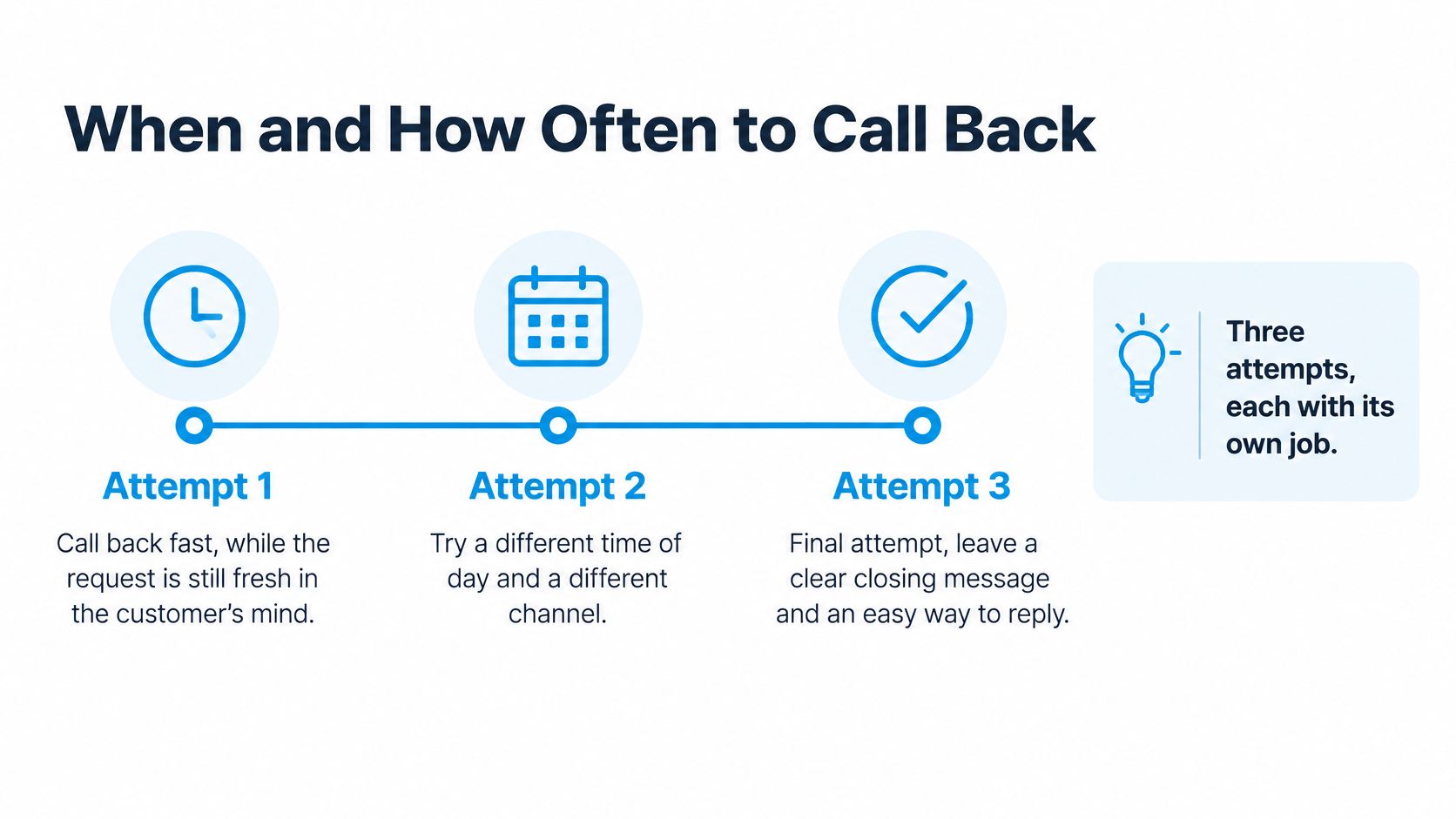
Persistence works only when each attempt has a distinct job. Calling three times in two hours to repeat "just checking in" creates caller fatigue and drives opt-outs.
| Attempt | Timing | Objective | Stop when |
|---|---|---|---|
| Attempt 1 | Within the first hour after the inquiry | Confirm receipt and urgency | Customer reached and issue resolved |
| Attempt 2 | Later the same day, in a different time window | Add an update or an alternative resolution | Customer opts out or asks for no more calls |
| Attempt 3 | Next business day, text or email first | Give a final clear choice or an escalation path | Issue resolved or escalated to a human |
The horizontal sequence below illustrates how to spread those three touches across time windows and channels rather than stacking identical phone dials.
Why Speed and Channel Choice Decide Contact Rates
Your first attempt carries the highest odds of catching the customer while the problem is still top of mind. A Harvard Business Review study of 1.25 million sales leads across 42 companies, cited in Voiso's lead response time analysis, found that teams attempting contact within one hour were nearly seven times more likely to qualify a lead than teams waiting an extra hour, and over 60 times more likely than teams waiting 24 hours or longer. The same guide cites the 2007 Lead Response Management Study of more than 15,000 leads across six companies, where calling within five minutes produced roughly 100 times higher odds of reaching the lead than waiting 30 minutes, and 21 times higher odds of qualifying.
Still, dialing fast isn't enough if the callback catches someone in traffic or an exam room. Consumer preference data is mixed: a November 2025 survey cited by Nextiva's callback report found that 75% of U.S. adults prefer a callback over waiting on hold, whereas Genesys data in the same report found only 4% preferred a representative callback when facing a wait. That gap shows callers only want a callback when it feels predictable and under their control.
Structuring Each Attempt and Stopping Cleanly
On attempt one, call promptly to confirm you received the request, check urgency, and book the next step. If no one picks up, leave a brief, privacy-safe voicemail and follow immediately with a text containing a secure scheduling link instead of redialing ten minutes later.
On attempt two, shift to a different part of the day and bring something useful to the table, such as a confirmed parts arrival window or an earlier technician opening. On attempt three, lead with text or email on the next business day, offer one clear choice to reschedule or close out the inquiry, and state a direct escalation line if the matter is still open. For deeper timing playbooks across inbound inquiries, see our guide to lead follow-up best practices.
Stop the sequence immediately the moment a customer opts out, confirms the issue is resolved, or turns out to be a wrong number. Tag every attempt with a consistent outcome code: reached-resolved, reached-pending-customer, voicemail, wrong number, do-not-contact, or escalation-required. Recepta.ai places outbound calls for appointment booking, confirmations, reminders, and follow-ups based on your lists and instructions, while you control who is called, when they are called, and what messaging is used in line with your sector's consent rules. Set your attempt cap and calling hours in writing before launching any outbound queue.
Disclosure, Consent and Escalation Rules
Automated callbacks break customer trust fast when callers can't tell who they're speaking with or can't reach a real person. Research conducted by Twilio between August and October 2025, published in Twilio's conversational AI adoption report, found that 51% of consumers were uncomfortable sharing personal or financial details with AI agents, 66% were uneasy about AI accessing their full customer history, and 90% mistakenly identified AI-generated voice clips as human.

Opening With Honest Identity and Permission
Because most callers can't tell an AI voice from a human one on their own, hiding automation feels like a trick the second something goes sideways. Start every AI-led follow-up with a plain identity statement:
"This is Sam, an AI assistant calling for [company] about your inquiry from Monday."
Follow that immediately with explicit consent before gathering account or payment data: "Is it okay if I confirm your account details now?" Asking permission respects caller boundaries and gives hesitant customers an immediate chance to request a person.
Apply data-minimization language across every voicemail and follow-up text. Never mention a medical diagnosis, an overdue balance, an insurance claim number, or legal case facts in a message someone else might overhear or read on a lock screen. When booking a callback window, confirm the caller's preferred time range, time zone, language, and maximum attempt limit, and always send a self-service reschedule link so they stay in control.
Hard Triggers and Warm Handoffs
Disclosure alone doesn't protect customer trust if a caller gets trapped in a loop. Write your escalation rules before turning on automated follow-ups, and trigger an immediate transfer to a live representative whenever any of these conditions appear:
- High-stakes disputes or fraud: Billing challenges, suspected unauthorized charges, or threatened cancellations need human judgment right away.
- Medical symptoms or legal questions: Any caller describing physical symptoms, medication reactions, or legal liability must move straight to qualified staff.
- Emotional friction or stalled progress: Raised voices, explicit requests for a person, or two failed attempts to resolve the question should end automation immediately.
When our AI detects a caller needs something more nuanced, it hands off to a human receptionist following the business's playbook, and any routing to your internal team follows your configured rules. Pair every transfer with a short warm-transfer summary so the caller never has to start from zero:
"Customer: [name]. Issue: [summary]. Already tried: [steps]. Wants: [outcome]. Promised time: [time]."
If you haven't mapped out your transfer thresholds yet, review how to build a clean call escalation process and write down your top three escalation triggers before placing a single automated callback.
Delivery Tips That Keep the Call Human
A good script collapses if it sounds like someone reading terms and conditions off a laminated card. Whether a call is handled by a front-desk coordinator or an AI voice assistant, our AI and human receptionists follow your custom playbook so every caller receives the same consistent response, while still leaving room for natural pacing.
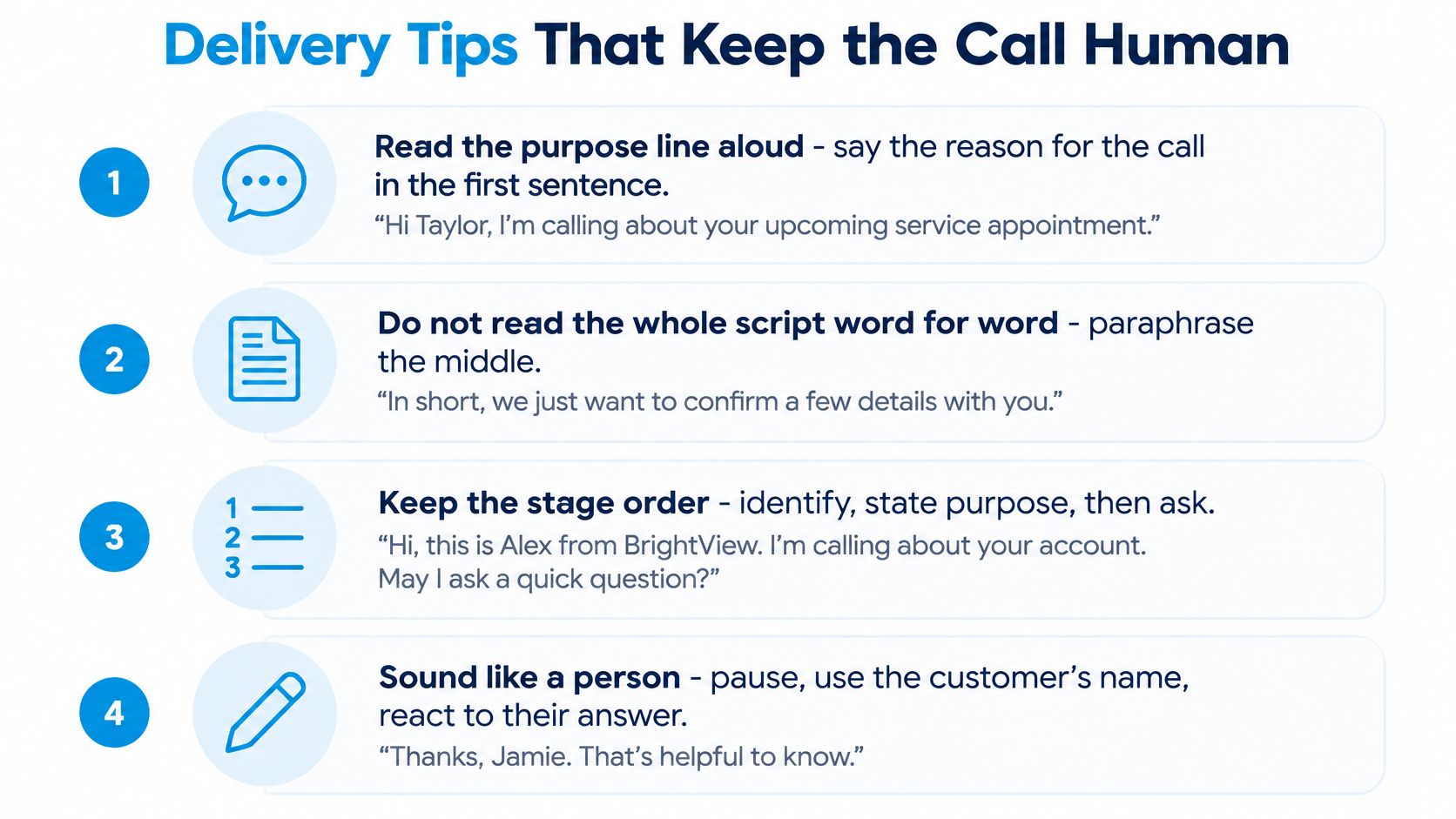
Use these delivery habits to keep calls grounded and clear, and apply the same principles when training staff to build rapport with customers:
- Read the purpose line aloud, then paraphrase the middle: Deliver stage two word for word ("I'm calling to check whether yesterday's drain clearing held up"), then let the conversation flow naturally while keeping the eight-stage sequence intact.
- Pause for two full seconds after the permission question: After asking "Is this a good time for two minutes?", stop talking. A homeowner holding groceries or stepping out of a meeting needs that beat to say "Now is bad" so you can book a better slot.
- Mirror the customer's exact words during reflection: If a caller says "the water keeps dripping under the sink," reflect back "so the water keeps dripping under the sink," rather than translating it into stiff jargon like "the leak issue persists."
- Keep the entire opening under twenty seconds: A sprawling introduction on a Monday morning triggers sales-call defenses; state who you are, why you're calling, and ask permission fast.
- Ban "just checking in" from your vocabulary: Replace vague filler with a concrete test of your prior commitment, such as "Did the updated insurance form land in your inbox?"
- Read back the phone number, time, and next step out loud: Before hanging up, say "I have 555-0194, and I'll call you back between 2 and 2:30 p.m. tomorrow with the part ETA." Saying it aloud catches typos and locks in expectations.
- Switch to text when the caller is in transit: If you hear road noise or someone whispering from a waiting room, say "Sounds like you're on the move, would you rather I text the booking link to this number?"
A follow-up call is a promise with a deadline, and warmth matters only once that promise is clear.
Every tip above works equally well for human receptionists and AI-assisted voice agents because both depend on crisp pacing, accurate listening, and an unmistakable next step.
Logging Results and Measuring Follow-Up
You can't fix a weak script by guessing which line went flat. Track six core metrics directly from your call log so you know whether callbacks happen fast enough, land on time, and close the loop.
| Metric | What it shows | How to calculate |
|---|---|---|
| Time to first follow-up | Speed of response | Minutes from inquiry to first attempt |
| Callbacks within promised window | Reliability of promises | Callbacks on time divided by all callbacks |
| Contact rate | Whether customers are reached | Reached contacts divided by total attempts |
| Resolution after callback | Whether the issue closed | Resolved cases divided by callbacks |
| Repeat-contact rate | Whether the fix held | Customers calling again within seven days divided by resolved cases |
| CSAT after follow-up | Customer satisfaction | Average post-call survey score |
Why Structured Fields Beat Raw Transcripts
Response speed shapes how callers judge your entire operation. Recent customer-service findings summarized in Stealth Agents' support response-time report indicate that 90% of customers rate an immediate response as important or very important for a service question, 60% define "immediate" as 10 minutes or less, and a separate global study cited there found 88% expected faster responses than a year earlier.
Measuring against that bar requires structured CRM fields, not just a wall of raw call transcripts. Every completed follow-up should log six standardized fields: original contact date, issue category, promised action, verification result, outcome code, and next owner. On Recepta.ai, every interaction follows your custom scripts, is logged in a structured way, and can trigger follow-ups automatically. If your team is still tracking callbacks in spreadsheets or inbox folders, review what a call logging system does so every outcome becomes countable by call type.
Mapping Slipping Metrics Back to Script Lines
Review your six metrics monthly, split by call type, because an outbound estimate follow-up and a dental billing verification carry very different contact baselines. When a number slips, trace it straight to the stage that owns it:
- Low contact rate: Tighten stage one's opening and check whether your first attempt is dialing inside the customer's preferred window instead of mid-morning work hours.
- Missed callback windows: Audit stage seven's promised-time line. Agents often promise overly tight windows they can't keep instead of realistic ranges with exception alerts.
- High repeat-contact rate: Look at stages four and six. If callers ring back within seven days, agents are likely asking "is everything okay?" instead of verifying the exact fix and confirming the customer's definition of resolved.
Start by tracking time to first follow-up this month. It's the easiest field to log accurately, and cutting minutes off that first dial usually lifts contact rate and satisfaction together.
Test the Script on Five Real Calls This Week
Don't rewrite your entire call playbook before testing a single line on live customers. Run a tight five-call experiment this week so you can hear where callers hesitate and fix one variable at a time:
- Pick one high-frequency call type: Choose the single row from the situation table that makes up the biggest slice of your callback queue, and draft that version of the eight-stage script first.
- Run five real follow-up calls: Deliver the script on five live inquiries, logging the exact outcome code and the minutes elapsed from initial inquiry to a booked next step.
- Isolate one friction point: After the fifth call, mark the single stage where customers paused, asked you to repeat yourself, or pushed back. Edit only that sentence.
- Hold your guardrails constant: Keep your escalation triggers and promised callback windows unchanged during the test so any shift in contact or resolution traces cleanly back to your wording edit.
- Compare against your baseline two weeks later: Check your contact rate, callbacks delivered within the promised window, and seven-day repeat-contact rate before rolling the final version out to the rest of your team.
Before closing this tab, write your opening line and your dated next-step sentence on paper, then block thirty minutes on your calendar to make those first five calls.
If your team wants every missed call, estimate, and post-service check-in handled on time without adding headcount, Recepta.ai pairs 24/7 AI receptionists with trained human support that follows your custom scripts, logs structured outcomes, and escalates smoothly to your staff. Every plan includes a 30-day risk-free trial backed by a money-back guarantee so you can test the workflow on real customer calls with zero pressure. Visit Recepta.ai to see how we can help you keep every callback promise on schedule.