
The Ultimate Guide to Empathy in Customer Service
When we talk about empathy in customer service, we're not just talking about being polite. It’s the ability to genuinely understand a customer's feelings and see things from their perspective. It’s about digging deeper to solve the real problem, not just the ticket in front of you.
This means moving beyond canned responses to forge a real connection. Done right, it can turn a routine service call into an opportunity to build a meaningful, long-lasting relationship with your customer.
Why Empathy Is Your New Competitive Edge

It’s time to stop thinking of empathy as a "soft skill." In today’s market, it’s a powerful business driver that directly impacts your bottom line. Customers aren't just buying products anymore; they're buying experiences and investing in brands they feel connected to.
Think of it like this: you have two auto mechanics. The first one plugs in a diagnostic tool, reads an error code, and gives you a quote. The second one does that too, but he also listens to you describe that weird rattling noise your car makes on the highway. He understands your worry about being stranded and works with you to find the real source of the problem, reassuring you along the way. Which mechanic are you going back to?
That’s the difference empathy makes.
Building Trust in Critical Moments
This kind of deep understanding is never more important than during a high-stakes moment. Imagine a homeowner dealing with a burst pipe—an empathetic voice on the phone can turn pure panic into a sense of relief. Or think of a patient calling to schedule a difficult medical test; a calm, understanding receptionist can ease their anxiety immensely.
These are the moments of truth where brands are made or broken. A cold, robotic interaction can lose you a customer for life. An empathetic one, on the other hand, builds instant trust and can even create a vocal advocate for your business. To truly get ahead, it's crucial to learn how to improve customer experience and forge that lasting loyalty.
Empathy isn't about simply being nice. It's about being effective. It's the practical skill of seeing a situation from the customer's point of view and using that insight to guide your actions toward a better resolution.
The Financial Impact of Genuine Care
This isn't just a feeling; the numbers back it up. A global survey revealed that a massive 60% of consumers will only do business with companies that demonstrate genuine care and empathy. What's more, 61% of those customers are willing to pay more for it. That creates a direct, undeniable line between empathy and revenue.
Investing in empathy isn't a cost—it’s a direct strategy for winning and keeping high-value customers. When you deliver service with real understanding, you aren't just closing a ticket; you're securing future business. In a crowded market, the ability to connect on a human level is what truly sets you apart.
The difference in outcomes is stark when you compare an empathetic approach to an indifferent one.
The Business Impact of Empathy vs Indifference
Ultimately, every single interaction pushes a customer either toward loyalty or toward a competitor. Empathy ensures you're winning them over, one conversation at a time.
The Real ROI of Empathetic Customer Interactions
While empathy feels good, its true power lies in the concrete, measurable results it delivers to your bottom line. Investing in empathy in customer service isn't just a feel-good branding exercise; it's a direct strategy for financial growth that turns emotional connections into tangible business outcomes.
When an empathetic agent handles a customer's problem, they're doing far more than just closing a ticket. They are actively building brand loyalty, chipping away at operational costs, and boosting the lifetime value of that customer. This shifts empathy from a soft skill to a hard asset with a clear return on investment.
Boosting Key Performance Indicators
You can see the impact of empathetic interactions show up directly in your most important Key Performance Indicators (KPIs). Instead of looking at these metrics in a vacuum, you can draw a straight line from empathetic actions to positive results across the board.
Take the Net Promoter Score (NPS), a classic measure of customer loyalty. Imagine a long-time customer calls, frustrated by a sudden billing error. An indifferent agent might just mechanically correct the charge and end the call. But an empathetic agent acknowledges the customer's frustration, saying something like, "I can see how unexpected that charge would be, especially after being with us for so long. Let's get this fixed for you right away."
That simple moment of validation completely changes the interaction. The customer feels heard and valued, not just processed. It’s that positive emotional experience that can turn a potential detractor into a passionate promoter, giving your NPS a direct boost.
Customer Lifetime Value (CLV) also gets a significant lift. Research from Ipsos found that empathy strengthens brand closeness, leading consumers to spend up to 7 times more with companies they feel truly understand them. This makes perfect sense when you consider that 76% of customers now expect personalized experiences—something empathetic service delivers by its very nature. You can explore the research on brand connection to see just how deep this impact goes.
Reducing Operational Costs
Beyond driving revenue, empathy is also a powerful tool for cutting costs. Empathetic agents are natural de-escalators, skilled at turning tense situations into productive conversations. This has a direct, positive effect on several operational metrics.
- First-Contact Resolution (FCR): Empathetic agents practice active listening to get to the root cause of a problem, not just the surface-level symptom. For example, a customer might call because their internet is slow. An indifferent agent resets the modem and hangs up. An empathetic agent asks, "What are you usually using the internet for around this time?" They discover the customer's son is gaming online, which explains the lag. The agent can then suggest a better router or an upgraded plan, solving the real problem permanently. This leads to more complete solutions on the first try, which means fewer costly follow-up calls.
- Reduced Handle Time: It might seem counterintuitive, but empathy can actually shorten call times. By quickly defusing anger and building trust, agents sidestep lengthy arguments and can get to a solution much more efficiently.
- Lower Agent Churn: A supportive, empathetic culture is good for employees, too. When agents feel empowered to genuinely connect with customers and solve problems, their job satisfaction skyrockets. This leads to lower turnover, which in turn reduces hiring and training costs.
The ultimate ROI of empathy is loyalty. A loyal customer not only spends more but also costs less to serve and becomes your most effective marketing channel through positive word-of-mouth.
By tracking these KPIs before and after you roll out empathy-focused training and tools, you can build a rock-solid business case. The data will show that investing in human connection is one of the smartest financial decisions a company can make, delivering returns that only grow over time.
Building an Empathetic Customer Service Team

Knowing empathy is valuable is the easy part. Actually weaving it into the DNA of your customer service team? That’s where the real work begins.
An empathetic team doesn’t just materialize. It’s the direct result of intentional training, a genuinely supportive internal culture, and a leadership commitment to move beyond robotic, one-size-fits-all scripts. The mission is to empower your agents to be more than just ticket-closers—they should be expert problem-solvers who connect with customers on a human level.
To do that, you need to give them the right tools, frameworks, and—most importantly—the freedom to act with real understanding in every conversation.
Actionable Training Techniques
Let's be honest: theory is useless if it can't be applied on a tough call. Effective empathy training has to be practical, interactive, and laser-focused on building real-world skills. To truly build a team that gets it, consider dedicated customer experience training that includes:
Active Listening Drills: Forget lectures. Pair agents up and have one person vent about a frustrating customer experience (real or made-up). The listener's only job is to reflect back the speaker's feelings and concerns. No solutions, just "What I'm hearing is..." This simple exercise forces them to truly hear before they try to fix.
Challenging Scenario Role-Playing: Go beyond the easy stuff. Create realistic, emotionally charged scenarios. Imagine a work-from-home professional whose internet dies minutes before a huge presentation. This isn't just a technical problem; it's a high-stress human problem. Role-playing these situations helps agents practice de-escalation and collaborative problem-solving when the pressure is on.
Emotional Intelligence Workshops: Agents need to become experts at reading the room, even when they can't see it. These workshops help them recognize subtle emotional cues in a customer’s tone and word choice. This skill is absolutely crucial for phone support, where you're flying blind without visual cues. You can learn more about perfecting your team's customer service on the telephone in our detailed guide.
Moving Beyond Robotic Scripts
Scripts are great for consistency but they are absolute killers of genuine connection. The key isn't to get rid of them entirely, but to evolve them.
Instead of rigid, word-for-word lines, give your team a playbook of flexible, empathetic phrases they can adapt to fit the moment. This one change can transform an interaction from purely transactional to truly relational.
The most powerful tool for empathy isn't a script; it's a genuine question. Asking "How has this impacted your day?" shows you care about the person, not just the problem.
This approach validates the customer’s feelings and immediately opens the door to a more human conversation.
Empathetic Communication Do's and Don'ts
Swapping out a few key phrases can make a world of difference. Here’s a quick-reference guide to help your team make that shift from sounding robotic to sounding like a helpful human.
These small changes in language reframe the entire interaction around partnership instead of policy.
Fostering a Supportive Internal Culture
Here's a hard truth: your team can't pour from an empty cup. If you want them to show empathy to customers, you have to show empathy to them. This all comes down to creating a supportive environment where agents feel valued, trusted, and empowered.
It starts with the metrics you celebrate. If your team is constantly chasing a low Average Handle Time (AHT), you’re telling them that speed matters more than connection. Instead, balance those efficiency metrics with KPIs that actually measure the quality of the interaction, like CSAT and First-Contact Resolution.
Ultimately, building an empathetic team means giving your people the psychological safety and autonomy to spend an extra few minutes on a call when it’s needed. When your agents know they're trusted to build relationships, not just close tickets, they will deliver the kind of experiences that create customers for life.
Real-World Examples of Empathy in Action
It’s one thing to talk about empathy in theory, but seeing it work in the real world is what really makes the concept stick. The right words and actions can turn a frustrating customer experience into a moment that builds genuine, lasting loyalty. It's all about remembering there's a person on the other end of the line and responding to what they're actually feeling.
These moments don't have to be grand, over-the-top gestures. In fact, the most powerful displays of empathy are often the simplest. They're proactive, thoughtful, and show you're already thinking one step ahead.
Let’s look at what this actually looks like in a couple of different fields.
Home Services Done Right
Think about any home services business—plumbing, HVAC, electrical work. Your technicians aren't just there to fix a problem; they're walking into someone's home, often when things are already stressful. A burst pipe or a dead air conditioner on a hot day isn't just an inconvenience; it's a crisis for that homeowner.
Here’s a common scenario: A technician is scheduled to arrive between 1 PM and 3 PM for an urgent AC repair. The customer texts at 1:15 PM, "So sorry, I'm stuck in traffic and running late. I'll be there as soon as I can!"
- A Standard Response: "Okay, let me know when you arrive."
- An Empathetic Response: The technician calls the customer. "No problem at all, I completely understand how stressful traffic can be. Look, I'm already at your property and can see the outdoor unit. To save you some time and stress, I’ll start all the exterior work right now. That way, we're ready to go the moment you get home."
See the difference? This proactive approach does more than just save time. It sends a clear message: "I get it, I value your time, and I'm already working to make this easier for you." That small act of understanding turns the customer's anxiety into relief. You've practically guaranteed a glowing 5-star review. For more on handling these crucial interactions, check out our guide to call handling best practices.
The goal of empathy isn’t just to solve the stated problem. It's to solve the emotional problem the customer is experiencing—be it stress, anxiety, frustration, or confusion.
Healthcare With a Human Touch
Nowhere is empathy more vital than in healthcare. Patients are often at their most vulnerable—they're anxious, in pain, and looking for a little reassurance. From the first phone call to the post-visit follow-up, every single touchpoint is a chance to provide comfort and build trust.
Imagine a patient calling to book a procedure they're clearly nervous about. They might say something like, "I need to book a follow-up for... um... the thing Dr. Smith mentioned. I'm a little worried about it."
- A Standard Response: "Okay, what's your date of birth? The first available is Tuesday at 10 AM."
- An Empathetic Response: The receptionist uses a calm, reassuring tone. "I can certainly help you with that. It's completely normal to feel nervous before this procedure; many of our patients do. Let's find a time that works for you, and then I’m happy to walk you through exactly what to expect on that day, step-by-step."
This response immediately validates the patient's feelings ("it's completely normal to feel nervous"), normalizes their anxiety ("many of our patients do"), and offers a clear path forward. The patient is no longer alone with their fears. They feel heard, supported, and cared for—the very things that lead to better patient outcomes and create unshakeable loyalty.
How to Blend AI and Human Empathy
Lots of business owners get nervous about automation, thinking it's the natural enemy of empathy. They imagine a future of cold, robotic interactions completely replacing the warm, human touch customers need. But that’s the wrong way to look at it. The best strategy isn’t AI versus humans; it’s a smart partnership where technology handles the routine stuff so your people can deliver amazing, empathetic support when it really counts.
Think of AI not as a replacement for empathy in customer service, but as a tool that lets you deliver it on a much larger scale. When you automate the high-volume, low-emotion tasks, you free up your best agents to focus their energy on the complex or emotionally charged problems where their skills truly shine.
This just makes for a smarter, more efficient workflow. Instead of tying up your top problem-solvers with scheduling appointments or answering basic “where is my order?” questions, an AI can handle that 24/7. Your team gets to spend their valuable time on the conversations that actually build relationships and loyalty. For a deeper look, you can explore how an AI phone answering service can help with those initial customer touchpoints.
Designing the Ideal AI to Human Handoff
The real magic is in the handoff. A well-designed system makes sure the transition from AI to a human agent is smooth, intelligent, and, most importantly, empathetic. The customer should feel helped, not just passed along.
The process begins with the AI acting as a smart filter. It gathers the initial context, figures out what the customer wants, and can even pick up on their emotional state through sentiment analysis. When it detects keywords like "frustrated," "confused," or "urgent," the AI knows instantly that a human needs to step in.
Here’s a perfect example of how this plays out:
- AI Gathers Context: A customer starts a chat, typing, "My new software update is a mess, and I can't find anything. I have a client presentation in an hour and this is urgent!"
- AI Detects Urgency and Sentiment: The AI flags the words "mess," "can't find," and "urgent" as signs of high frustration and a time-sensitive issue.
- AI Executes a Seamless Handoff: Instead of a generic "Please hold for an agent," the AI routes the chat to a specialized human agent and gives them a quick summary of the problem.
- The Human Agent Begins with Empathy: The agent joins the chat and immediately says, "Hi, I see you're having trouble with the new interface right before a big presentation. That sounds incredibly stressful, but I'm here to walk you through it right now."
This transition is incredibly powerful. The agent starts the conversation already understanding the problem and the customer's emotional state. The customer doesn't have to repeat a single thing, which instantly defuses their frustration and makes them feel heard from the get-go.
Technology as an Empathy Amplifier
This hybrid approach isn't just about efficiency; it's about giving customers exactly what they want. A Salesforce study found that 81% of service reps agree customers want a personal touch, and 68% of customers now expect empathy in every single interaction. When you deliver, the results are huge—customers who have a great, empathetic experience are 5.1 times more likely to recommend your brand.
This simple flow is the core of any great interaction, whether it's handled by an AI, a human, or both.
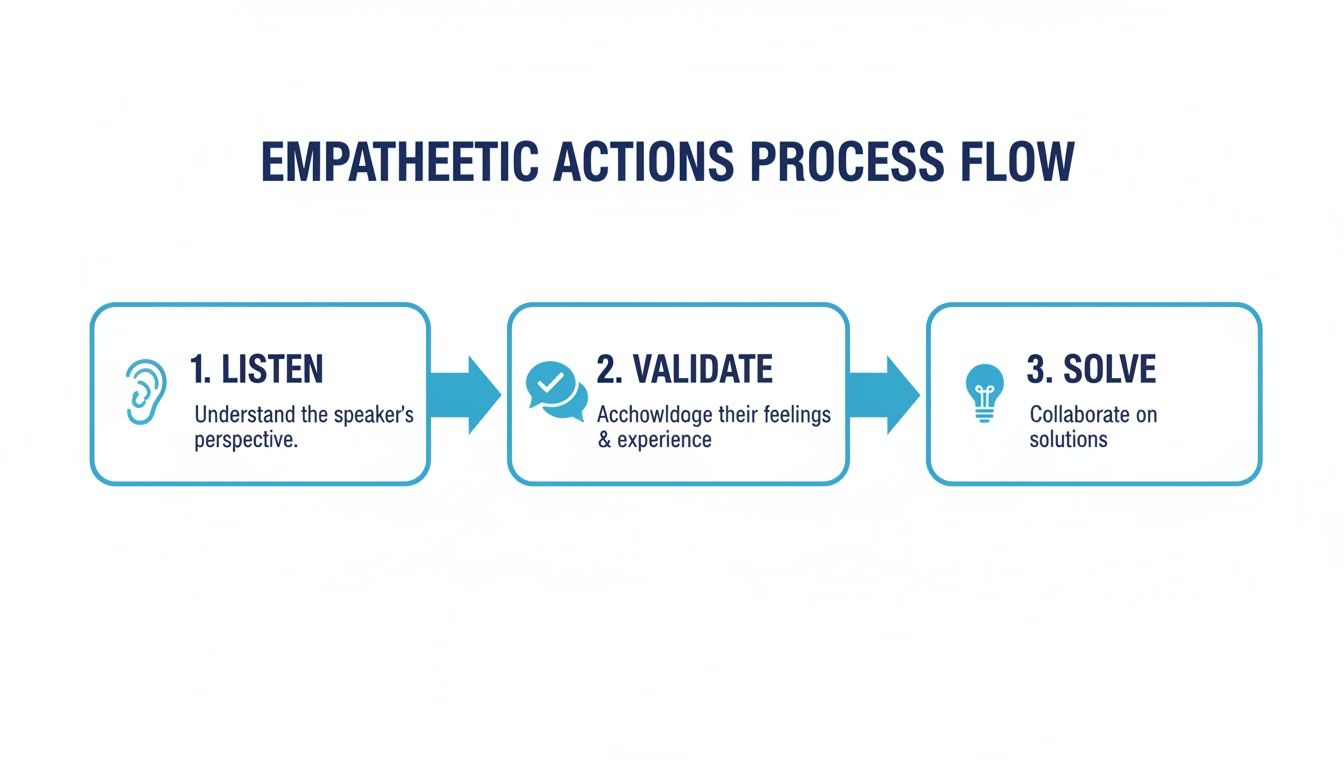
Moving from listening, to validating, and then to solving is the blueprint for effective, empathetic service. By using AI to support this process, you build a system where technology and humanity work hand-in-hand to create the best possible customer experience.
Got Questions About Empathy in Service? We've Got Answers.
When teams start to build an empathy-first culture, it’s only natural for questions to pop up. Managers and agents alike wonder how to apply these ideas when the pressure is on. Getting these practical details right is what turns empathy in customer service from a nice idea into a daily reality.
This section tackles the most common questions head-on with clear, straightforward answers. Think of it as your field guide for overcoming the real-world hurdles of empathetic support.
How Can I Actually Measure the ROI of Empathy Training?
This is the big one for any manager. To measure the return on your empathy training, you need to connect it directly to business results. The goal is to create a clear "before and after" picture by tracking the numbers that great customer interactions actually move.
First, get a baseline of your key metrics before you kick off any new training. Then, keep a close watch on them for the next few months. You're looking for a clear correlation between your investment in empathy and positive changes in your KPIs.
- Customer-Facing KPIs: Keep an eye on metrics like Customer Satisfaction (CSAT), Net Promoter Score (NPS), and Customer Lifetime Value (CLV). A real bump in these scores after training is a huge win.
- Operational KPIs: Look at your internal efficiency. Things like first-contact resolution and customer churn tell a powerful story. When agents solve the real problem with empathy, customers don't need to call back, and they're less likely to leave.
- Service-Specific Metrics: If you're in a service business, watch your repeat business and referral rates. Happy customers who feel understood don't just come back—they tell their friends.
Is It Possible to Be Empathetic When You Have to Say No?
Absolutely. In fact, this is where empathy shines. Being empathetic doesn't mean giving customers everything they want. It means you see their point of view and respect their feelings, even when you can't approve their request. The aim is to protect the relationship, not just enforce a rule.
The key is how you deliver the news. It starts with genuinely listening to their request and understanding why they're making it. Only then can you share the outcome in a way that keeps you on their side.
The most empathetic way to say "no" is to start by finding a "yes." Not "yes" to the request, but "yes" to their feelings. Something like, "Yes, I completely understand why you're asking for that. It makes perfect sense from your perspective."
Let’s walk through a real-world example. A customer wants a refund, but they are well past the 14-day refund period.
- Acknowledge and Validate: Start by showing you get it. "I've taken a look at your request, and I can see why you were hoping for a refund. It sounds like the service really didn't hit the mark for you."
- Explain Calmly and Clearly: Now, gently state the limitation. "Our policy for this service has a 14-day refund window, and it looks like we're just outside of that timeframe."
- Offer a Helpful Alternative: This is the most important step. Pivot to a solution. "While I can't process a refund today, here's what I can do. I can offer you a 25% credit toward your next service with us. Would that help at all?"
This simple shift turns a potential conflict into a moment of collaboration.
How Can Busy Teams Practice Empathy Without Slowing Down?
This is a classic fear, but it's based on a myth. Empathy and efficiency aren't enemies—they actually fuel each other when you get the balance right. The secret is using technology smartly to free up your team for the conversations that matter most.
Use AI-powered tools to handle the simple, repetitive tasks that don’t need a human touch. Think password resets, order status updates, or appointment confirmations.
This doesn't slow your team down; it makes them more strategic. It lets you aim your most powerful resource—your agents' emotional intelligence—at the moments where it makes the biggest difference. Your team is freed from the grind and can focus their energy on the complex, emotional issues where a human connection is everything.
What’s the Real Difference Between Sympathy and Empathy?
People use these words interchangeably, but for customer service, a practical example makes the difference clear. Imagine a customer's package was stolen from their porch.
- A Sympathetic Response: "Oh no, that's terrible! I'm so sorry to hear that happened to you." This expresses sorrow but positions the agent as an outside observer.
- An Empathetic Response: "That must be so frustrating, to be expecting a delivery only to find it's gone. Let's work together to see how we can make this right for you." This response acknowledges the customer's feeling of frustration and immediately creates a partnership to solve the problem.
In practice, sympathy often just acknowledges a problem. Empathy, on the other hand, is an active skill. It’s what motivates an agent to partner with the customer to find a real solution.
Ready to create more time for empathetic connections? Recepta.ai combines intelligent AI with expert human support to handle every customer interaction flawlessly, 24/7. See how we can help you capture more leads and delight your customers by visiting https://recepta.ai today.