

Disaster Recovery Planning for Small Businesses
The outage usually starts with a phone that won't ring. Your scheduling platform is unavailable, the internet provider has no clear restoration time, and customers are still calling for appointments, estimates, prescription questions, or urgent help. Someone on staff starts forwarding calls to a personal mobile, another person searches for yesterday's spreadsheet, and nobody knows who can tell customers what happened.
That isn't a documentation problem. It's an execution failure under pressure.
A useful disaster recovery plan tells people what to do when systems, locations, staff, and communications fail at the same time. It assigns decisions, protects critical data, restores work in the right order, and keeps inbound conversations alive through a defined human and AI handoff. The test of the plan isn't whether it looks complete. The test is whether the person on call can use it when the office is dark and customers are waiting.
Why a Disaster Recovery Plan Is an Execution Problem, Not a Document
Many small businesses confuse possession with preparedness. They have a backup service, a shared document, and perhaps a page titled “emergency contacts.” That feels responsible until the main phone stops working and nobody knows who owns the callback queue.
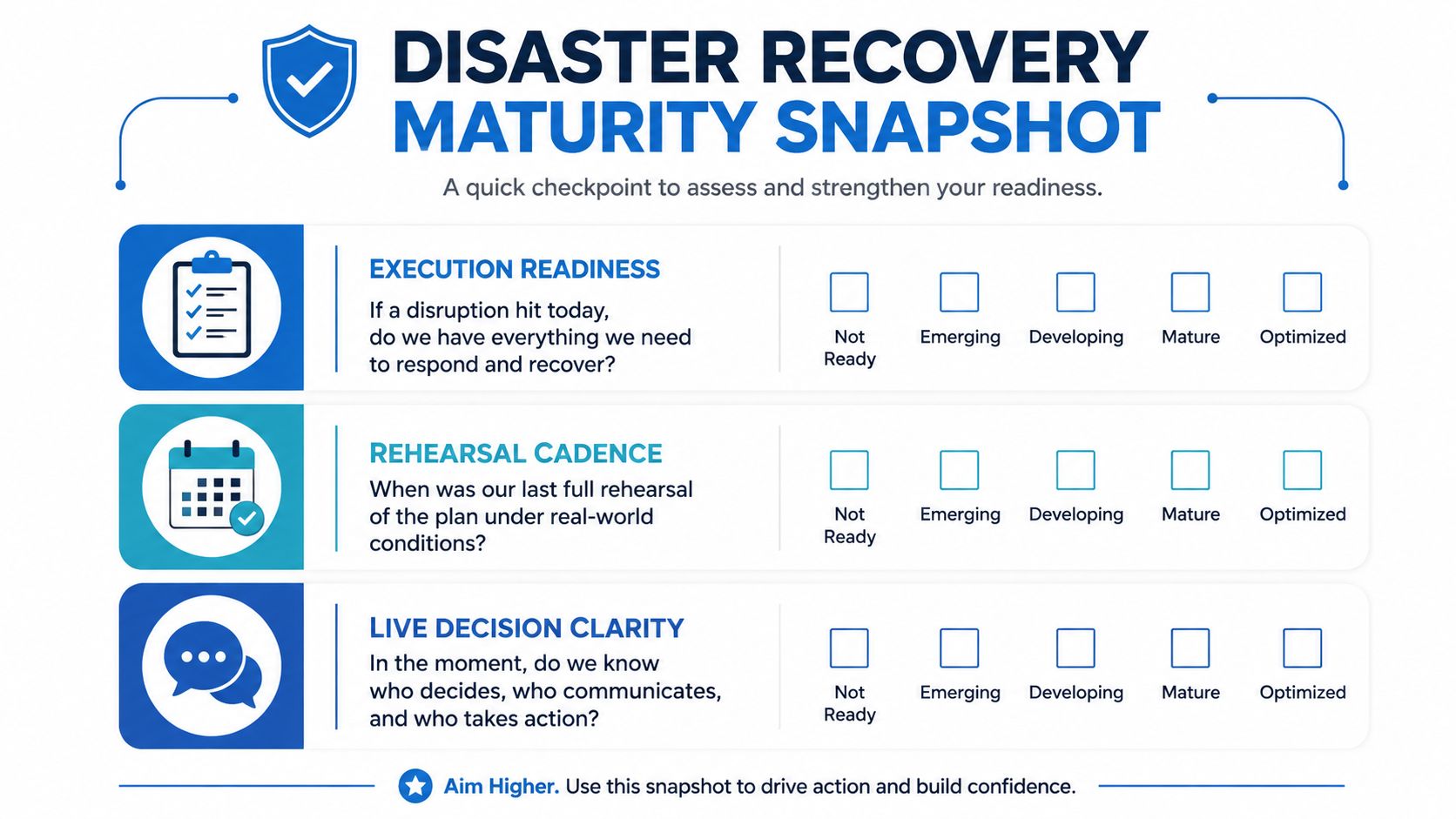
A quick maturity snapshot exposes the difference:
- Execution readiness: Who calls customers when the phone system fails? Where can staff find the latest customer and appointment information?
- Rehearsal cadence: When did anyone restore a backup, reroute a number, or operate from an alternate location?
- Live decision clarity: Who declares the incident, who approves customer messaging, and who decides when normal operations resume?
The historical gap is clear. A 2021 industry survey found that only 54% of organizations had a documented, company-wide disaster recovery plan, while 50% tested those plans annually or less often and 7% didn't test at all (ZipDo's disaster recovery industry statistics). Those figures describe a broad industry benchmark, but the operational lesson applies directly to small firms. A written procedure can coexist with weak governance, infrequent exercises, and no proof that the team can recover under stress.
Turn the plan into something people can run
Your plan should produce operational artifacts, not just pages:
- A callback roster: Assign a role to every customer communication task.
- A recovery sequence: List systems in dependency order, not in the order people remember them.
- A communications failover: Define how inbound calls move to an AI receptionist and then to a trained human when required.
- A test record: Capture what worked, what failed, and what changed afterward.
Process standardization for service businesses process standardization for service businesses is critical. Standardized steps reduce improvisation when the people who normally hold the process in their heads are unavailable.
Operational rule: If a recovery step can't be assigned, timed, and tested, it isn't ready for an outage.
Treat the rest of your plan as a set of rehearsable tools. The contact list must work outside the company network. The backup must restore cleanly. The call route must reach a real person when the AI receptionist encounters an emergency or a complex customer issue. Anything less is paperwork with good intentions.
Setting RTO, RPO, and Recovery Priorities That Match Your Business
Recovery targets should reflect business consequences, not what a software vendor promises. Recovery Time Objective, or RTO, is the maximum acceptable time before a service returns. Recovery Point Objective, or RPO, is the point in time to which data must be recovered after an outage. NIST-aligned guidance also treats RPO as the acceptable window of data loss, while practical guidance distinguishes RTO as the maximum service interruption (SentinelOne's RTO and RPO explanation).
Add Maximum Tolerable Period of Disruption, or MTPD, to the conversation. It describes the longest period a business process can remain disrupted before the consequences become unacceptable. A business impact analysis helps assign these values by ranking processes and their supporting systems (business continuity and disaster recovery planning template).
Start this week with four questions:
- Which customer-facing process stops revenue or creates safety risk first?
- Which system does that process depend on?
- How much recent data could staff recreate manually?
- What temporary operating method keeps customers informed while the system is down?
Consider billing and scheduling. Billing might tolerate older data if the team has a reliable export, but a prolonged outage can disrupt close processes. Scheduling may need recent appointment information, yet a team could continue operating if calls are captured and staff can confirm bookings manually.
| System | RTO Target | RPO Target | Priority Tier |
|---|---|---|---|
| Customer scheduling platform | Short recovery window | Near-real-time records | Critical |
| Billing database | Recovery within the operating window | Recent export may be acceptable | High |
| Customer relationship management system | Same-day service restoration | Recent contact activity | High |
| Internal reporting tool | Recovery after customer operations | Latest available copy | Standard |
These are planning examples, not universal targets. Replace them with targets your team can defend. A scheduling platform that depends on authentication should be restored only after authentication is available. A billing system that relies on customer records should follow the data source it needs.
Your targets then drive design. A tight RPO requires more frequent data protection. A short RTO may justify a warm secondary environment or manual coverage. A customer communication system with a strict availability requirement needs a fallback route, not merely a backup of call recordings.
Use service-level agreement planning to make these expectations explicit with vendors and internal owners. If a provider can't explain its recovery path, escalation process, and customer communication responsibilities, don't treat its availability promise as your recovery plan.
Building the Plan Itself, Roles, Contacts, and Runbooks
A usable plan should read like an operating manual for a tired person. Put the activation trigger on the first page, followed by the incident commander, communication channels, recovery priorities, and the first actions to take. Don't bury the decision to invoke the plan in a long policy document.
Assign authority before the outage
Use roles first and names second. People change jobs, but responsibilities remain:
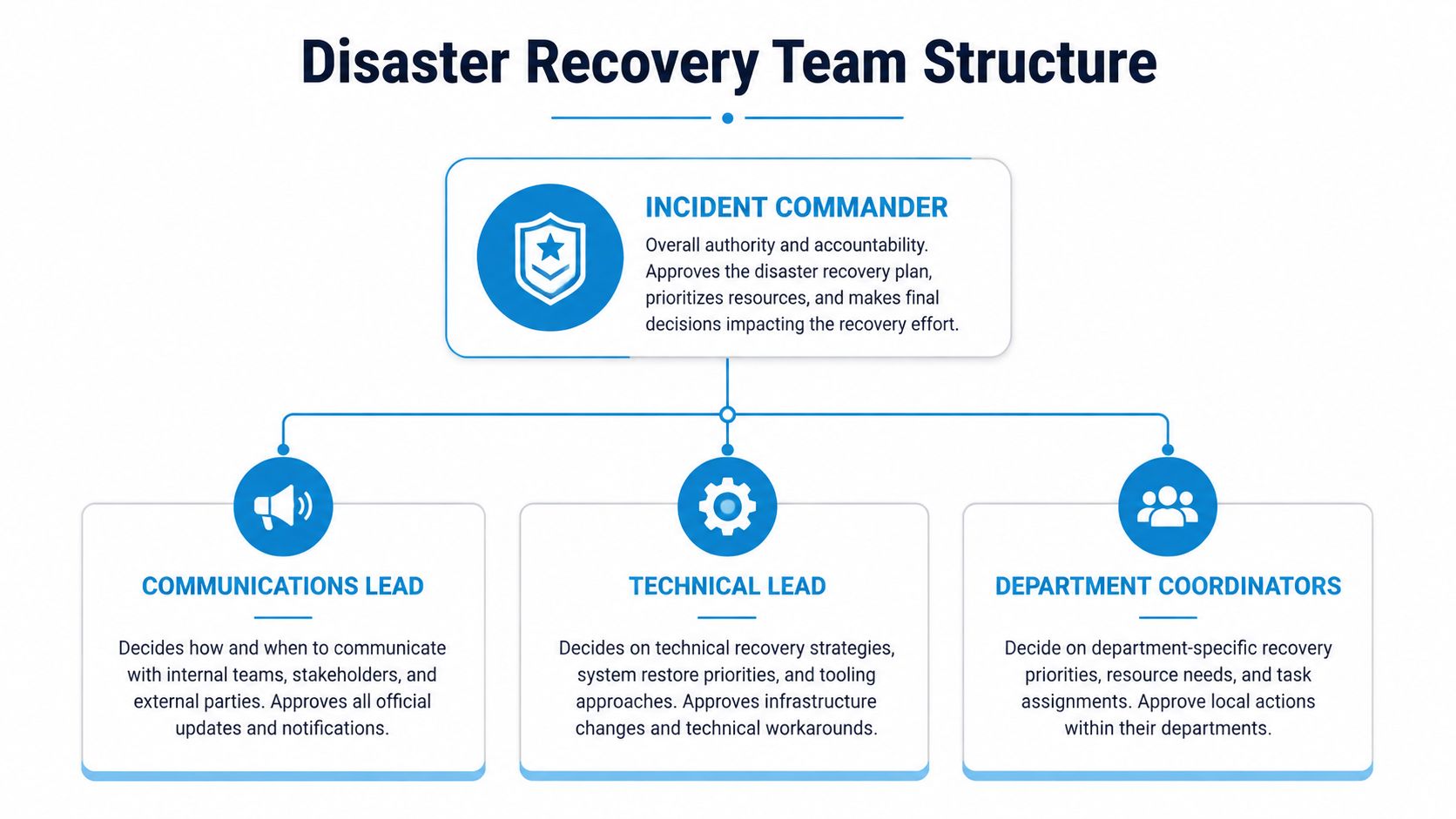
- Incident commander: Declares the incident, sets priorities, approves major decisions, and ends the recovery phase.
- Communications lead: Sends staff, customer, supplier, and stakeholder updates without getting pulled into technical work.
- Technical lead: Diagnoses the failure, protects systems, restores services, and records technical decisions.
- Department coordinators: Confirm operational needs for scheduling, billing, field teams, clinical work, or client service.
Give each role a decision boundary. The communications lead can publish an approved outage message. The technical lead can isolate a compromised device. The incident commander can authorize a move to manual scheduling or an alternate site.
Make contacts survive the failure
Store the contact list in a location available when company systems aren't. Keep a printed copy in a secure place and an offline copy accessible from approved personal devices. List the role, primary person, backup person, after-hours number, vendor escalation route, and an out-of-band communication method.
Include contacts for:
- Internet and phone providers
- Scheduling, billing, CRM, and hosting vendors
- Backup and security providers
- Building management and alternate-site contacts
- The AI receptionist provider and human escalation team
- Insurance, legal, and regulatory contacts where applicable
Your documentation requirements for operational processes should support this kind of retrieval. A document that only works inside the failed environment has no recovery value.
Write runbooks for decisions, not decoration
Each runbook should contain:
- Trigger: What condition starts the procedure?
- Owner: Who performs or coordinates it?
- Numbered actions: What happens first, second, and third?
- Decision points: What evidence changes the path?
- Expected outcome: What should responders see?
- Exit criteria: What proves the service is stable?
Document alternate operating arrangements as carefully as technical recovery. Define remote-work access, alternate workspaces, manual forms, call-forwarding options, and supplier dependencies. Restore upstream services before dependent applications. For example, authentication must work before the customer portal can serve users.
Practical rule: Every runbook needs a stopping point. “Restart the service” isn't an outcome. “Confirm staff can authenticate, view current appointments, and complete a test booking” is.
Backups, Failover, and Keeping Communications Alive
Backups protect data. Failover keeps operations moving. They overlap, but they aren't interchangeable.
Use a layered backup design with multiple copies, different storage locations or media, and at least one offsite cloud copy. Protect the backup system itself with restricted access and recovery credentials stored outside the primary environment. A practical file-backup reference is this computer file backup guide from CTF Mobile Phones & Computer Repairs, which can help small teams review the basics before they formalize their own restore process.
Map every critical system to a recovery destination. Scheduling may use a warm secondary environment or a controlled manual workflow. Customer records may need a clean restore within the defined RPO. Internet access may require a secondary provider, mobile hotspots, or a prearranged alternate connection.
Test restores regularly, not just backup completion. A successful backup job proves that data was copied. It doesn't prove that the right person can locate the clean version, restore it, sign in, and use it.
Give communications their own failover track
Phones often fail before the rest of the business. Your communications runbook should define:
- Detection: A failed call to the main number, a health-check timeout, or a manual declaration.
- First route: Send inbound calls to the AI receptionist.
- Conversation: The AI receptionist greets callers, identifies the reason for the call, captures details, records appointment requests, and offers an emergency callback.
- Human handoff: Escalate clinical emergencies, urgent safety matters, VIP customers, sensitive billing disputes, and any conversation the AI can't resolve.
- Callback ownership: Assign a named team or role to each captured message.
- Recovery confirmation: Return calls, update records, and reconcile manually captured appointments when systems return.
| Failure Mode | Detection Signal | Failover Destination | Handoff Trigger |
|---|---|---|---|
| Main phone platform unavailable | Test call fails or provider alert arrives | AI receptionist | Emergency, sensitive, or unresolved request |
| Office internet outage | Connectivity check fails | Mobile hotspot or secondary connection | Staff can't access required systems |
| Scheduling platform unavailable | Login or health check fails | AI receptionist plus manual intake sheet | Customer needs immediate human confirmation |
| Staff shortage during incident | Queue remains unassigned | AI receptionist with on-call human coverage | Priority customer or operational exception |
The AI layer should never become a dead end. It needs a known inbox, a visible callback queue, clear urgency labels, and a human who owns the handoff. Business continuity solutions for inbound communications can inform that design, but your runbook must still specify who acts and when.
Print a fallback sheet with the top 15 customer-facing scripts, approved service statements, emergency instructions, and the information staff must capture. Keep call forwarding sequences and hotspot instructions on that sheet. A recovery plan that restores servers while customers hear silence has missed the business.
Testing, Drills, and What to Do When It Actually Goes Wrong
A multi-location plumbing company discovers the weakness during an internet outage at its main office. The field teams can still work, but calls are landing nowhere, the scheduling board is inaccessible, and two locations are giving customers different answers. The incident commander activates the plan. The communications lead routes the main number to the AI receptionist, the technical lead checks system availability, and the department coordinators open the manual appointment process.
The AI receptionist captures new jobs and urgent service requests. A human takes over emergency calls and disputes. The team posts one approved customer message, assigns callbacks, and records every temporary booking for later reconciliation. Nobody solves the outage instantly. They prevent confusion from becoming a second outage.
Use three levels of rehearsal
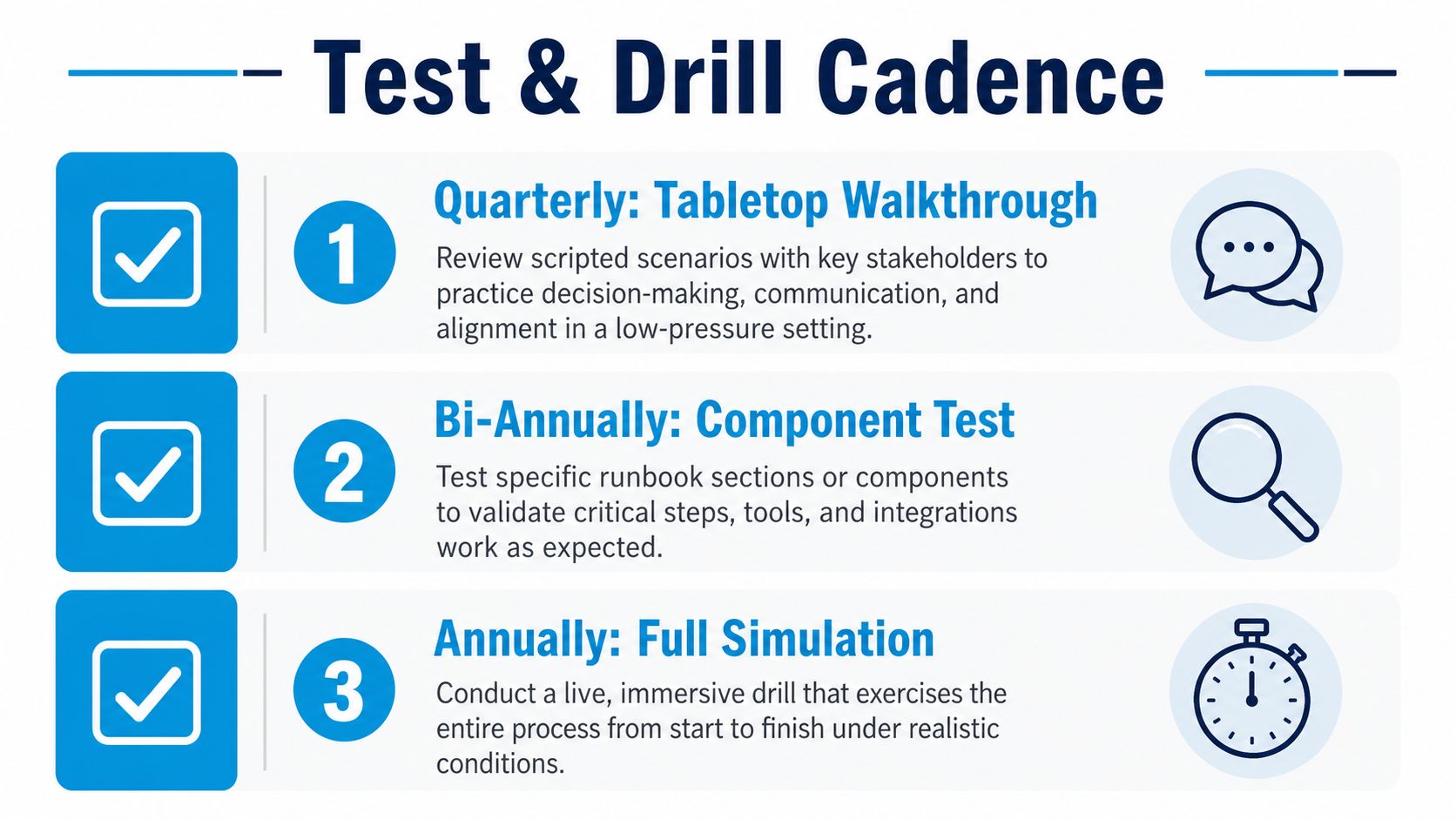
Quarterly tabletop walkthroughs require no production changes. The on-call owner reads a scripted scenario aloud, such as ransomware on a file server, a multi-day power loss, or an ISP outage during extreme heat. Participants explain who declares the incident, which service gets priority, and how customers receive updates.
Monthly component checks should touch one recovery path at a time. Restore a single backup, fail one server, reroute one phone number, and confirm the AI receptionist uses the correct greeting and sends captured messages to the known inbox. The exact cadence should match your risk, but an untested component is only an assumption.
Full failover exercises should use a named incident commander, a stop-clock, real handoffs, and a controlled operating window. The exercise should include failback, because returning to the original site can expose network and dependency problems that the initial failover didn't reveal.
Industry evidence shows why this discipline matters. Most organizations update plans only once per year, and 56% never perform a full simulation, according to business continuity preparedness research summarized by Askantech (disaster recovery RTO and RPO strategies). The same source reports that 62% encountered networking problems during failback, a warning to test restoration order, routing, and the return to normal operations rather than stopping when the secondary environment starts.
Put the first 30 minutes on one page
Your checklist should tell the team to:
- Declare: Identify the incident commander and record the start time.
- Stabilize: Protect people, isolate suspected cyber threats, and stop unsafe changes.
- Open the war room: Use an out-of-band channel that doesn't depend on the failed system.
- Route communications: Activate the AI receptionist, human escalation, call forwarding, and manual message capture.
- Set priorities: Confirm the critical systems and dependencies from the recovery map.
- Notify: Send the approved internal and customer message.
- Record decisions: Capture owner, action, time, result, and next decision point.
- Escalate: Involve legal, compliance, insurers, or suppliers when the activation criteria require it.
The DRJ coverage on preparedness describes a continuing operational gap. Fewer than 40% of respondents felt very or extremely prepared for a site failure or disaster, about 40% had completed a partial or full failover to a DR site, and fewer than 20% updated BIAs, risk assessments, and DR plans twice a year or more often (Disaster Recovery Journal preparedness coverage). Rehearsal is how you replace confidence based on paperwork with evidence based on action.
Post-Incident Review That Turns an Outage Into Progress
Schedule the review within five business days of resolution, while the timeline is still clear and before blame hardens into the official story. Invite the incident commander, communications lead, technical lead, department coordinators, and any vendor who controlled a failed dependency.
Keep the meeting blameless and evidence-led. Reconstruct what happened, what the team knew, when it knew it, which decisions were made, and how customers experienced the interruption. Quantify customer impact with the measures you track, such as dropped calls, missed appointments, delayed work, and deferred billing.
Ask questions that expose execution gaps
Start with detection. Did the team recognize the failure through monitoring, a customer call, or staff intuition? If the first alert came from a customer, the problem isn't only response speed. It's also observability.
Then examine response:
- Did the right person declare the incident?
- Could staff access the plan outside the failed environment?
- Did the communications lead have authority to send an update?
- Did the AI receptionist capture the right information?
- Did human handoff occur for urgent or sensitive calls?
- Were recovered records complete enough to reconcile temporary work?
Separate findings into three useful categories:
- Detection gaps: The team didn't know a critical service had failed.
- Response gaps: The call route, escalation, or runbook step wasn't ready.
- Systemic gaps: The business depended on one provider, one location, one connection, or one untested restore path.
Don't leave the review with a general promise to “improve communication.” Assign one owner, one due date, and one acceptance test to every finding.
| Finding Category | Finding | Owner | Due Date | Acceptance Test |
|---|---|---|---|---|
| Detection gap | Main phone failure wasn't identified promptly | Communications lead | Assigned review date | Test call triggers the outage workflow |
| Response gap | AI receptionist captured messages but didn't route urgent cases | Operations lead | Assigned review date | Scripted urgent call reaches a human |
| Systemic gap | Restore path depended on a single administrator | Technical lead | Assigned review date | Backup restore succeeds with the designated backup owner |
| Process gap | Temporary bookings weren't reconciled consistently | Department coordinator | Assigned review date | Test reconciliation produces a complete appointment record |
Close the loop with another test
Track these actions in the same operational dashboard as routine work. A disaster recovery action that lives in meeting notes will compete with daily priorities and disappear.
Update the runbook, rerun the affected component test, and include the change in the next tabletop. If the outage exposed a supplier weakness, update the escalation path and confirm the supplier's contact details outside the primary system. If the communications handoff failed, test the full call journey from the failed main number to the AI receptionist, message queue, human callback, and final record update.
ISO 22301 frames continuity as a management system that organizations plan, implement, monitor, review, maintain, and continually improve, rather than a one-time document (ISO 22301 standard). That is the standard your operations should follow even if certification isn't on your roadmap. Every incident should make the next response clearer, faster, and less dependent on individual memory.
Recepta.ai helps small businesses keep inbound calls alive during outages with an AI receptionist, structured message capture, appointment handling, and smooth escalation to trained human support. Build your communications failover around a reliable AI-to-human handoff, then visit Recepta.ai to see how it can support your disaster recovery plan.