
Process Standardization: Boost Efficiency & Scale
A lot of small businesses don't have a work ethic problem. They have a consistency problem.
The phone rings while your front desk is helping a walk-in. One estimator writes detailed notes in the CRM, another keeps them on paper, and a third says, “I'll remember it.” A patient gets booked without the right intake details. A plumbing lead asks for emergency service, but the team handles the call differently depending on who answers. By the end of the day, everyone feels busy, but the business still lost time, missed opportunities, and created extra cleanup for tomorrow.
That's where process standardization earns its keep. Not as a corporate exercise. As a practical way to make sure important work gets done the same way, with less confusion, fewer avoidable mistakes, and less dependence on memory.
What Is Process Standardization and Why It Matters
When owners hear process standardization, many picture binders, policy manuals, and rigid rules that slow everyone down. In a service business, it's the opposite when done well. It's defining the steps for repeatable work so your team stops reinventing routine tasks.
If you run an HVAC company, that might mean every new inquiry gets logged with the same core details before a technician is dispatched. In a local clinic, it might mean every new patient intake follows the same sequence, insurance check, appointment type confirmation, contact details, and next-step instructions. The point isn't bureaucracy. The point is fewer dropped balls.

What standardization actually means in day-to-day work
At a practical level, process standardization means you define activities, sequence them, and document them so the same workflow is executed the same way each time. That reduces variation and improves accountability, a concept with deep roots in industrial practice. One early example often tied to this idea is Eli Whitney's 1798 contract to produce 10,000 muskets, which became associated with interchangeable parts and repeatable methods that shaped modern standardization, as described by Pipefy's overview of business process standardization.
That history matters because the same principle now applies to front desks, schedulers, dispatchers, and intake teams. Repetition without a standard creates chaos. Repetition with a standard creates usable capacity.
Practical rule: If a task happens every day and the outcome matters to revenue or customer experience, it needs a defined process.
This is also why process standardization connects so closely to automation. Once you know the right sequence, you can support it with software, forms, call handling, and follow-up workflows instead of depending on whoever happens to be available. If you want a plain-English primer on that connection, this guide on business process automation is a helpful next read.
Why small businesses feel the pain faster
A larger company can sometimes absorb inconsistency for a while. A small business can't. One missed roofing lead, one incorrect insurance entry, or one forgotten follow-up can affect this week's cash flow.
That's also why sales teams and service teams overlap more than most owners realize. The handoff from first contact to booked job often determines whether you achieve peak sales performance or miss out on winnable business before a quote is even sent.
The Business Case for Standardizing Your Processes
A good process works like a reliable recipe. Different cooks can use it, but the customer should still get the same dish.
In service businesses, customers don't judge your internal effort. They judge the experience they receive. If one office manager handles intake thoroughly and another skips key questions, the customer sees inconsistency, not personality. Standardization closes that gap.
Where the payoff shows up
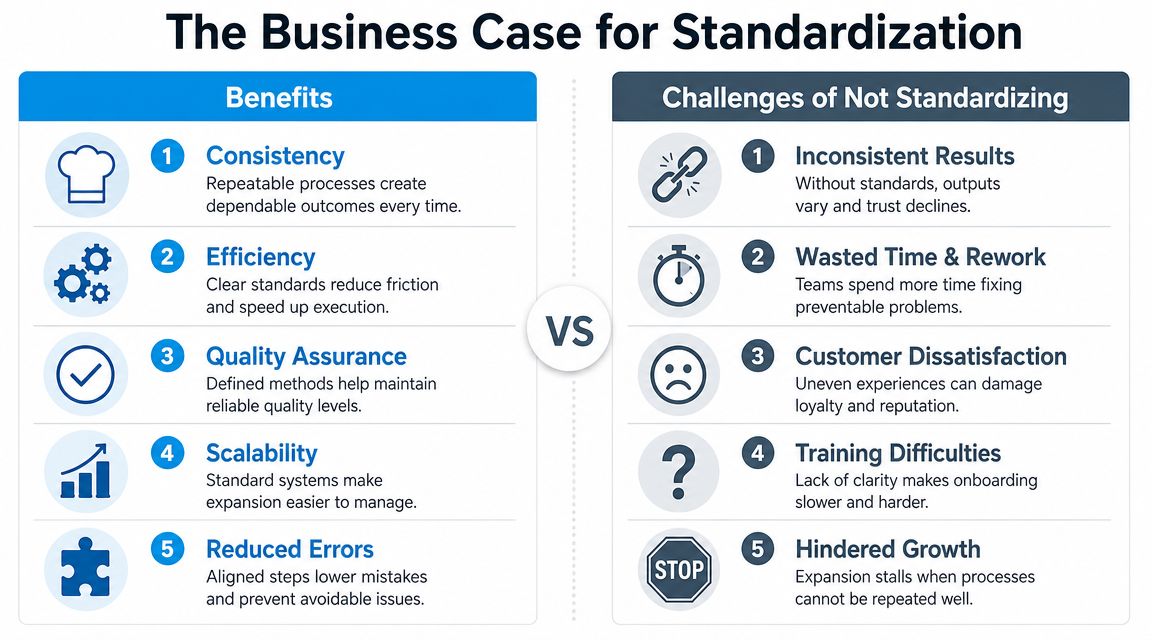
The most immediate win is less rework. A pest control company that collects the right property details on the first call doesn't need technicians calling back for missing information. A dental office that verifies the right appointment type upfront avoids schedule reshuffling later.
The second win is more consistent quality. Customers don't care which employee picked up the phone. They expect the same competence every time. Process standardization helps your team deliver that, especially in recurring interactions like scheduling, quote follow-up, check-in, billing, and service updates.
Then there's scale. If your business depends on one experienced employee who “just knows how it works,” you don't have a scalable operation. You have a bottleneck. Standardized work makes it easier to train a new CSR, onboard a second location, or move tasks between team members without quality dropping.
Specific examples small businesses will recognize
Home services: A plumbing company standardizes emergency call intake. Every caller gets asked the same critical questions, urgency is categorized the same way, and dispatch notes are entered in one format. That reduces missed details and helps technicians arrive prepared.
Local clinics: A front desk team standardizes appointment booking by visit type. Staff follow one checklist for new patients, one for follow-ups, and one for insurance-related exceptions. The schedule becomes more reliable because appointments are booked correctly the first time.
Legal and professional services: A law office standardizes lead screening. Staff gather issue type, timeline, opposing party status, and preferred contact method before routing the lead. Attorneys stop wasting time on incomplete intake.
A process that saves five minutes per transaction matters. A process that also prevents lost leads, billing errors, and frustrated staff matters even more.
Owners often miss one more benefit. Team morale improves when people know what “good” looks like. Clear expectations reduce finger-pointing. If you're trying to understand where process confusion is draining profit, it's worth reviewing how operating expenses really add up. Hidden inefficiency usually shows up there first.
A 6-Step Framework for Implementing Standardization
Most businesses overcomplicate this. They think process standardization means documenting everything at once. It doesn't. Start with one repeatable workflow that causes pain when it breaks.
A strong place to begin is the path from first contact to booked appointment. That process touches lead capture, scheduling, handoff quality, and customer experience.
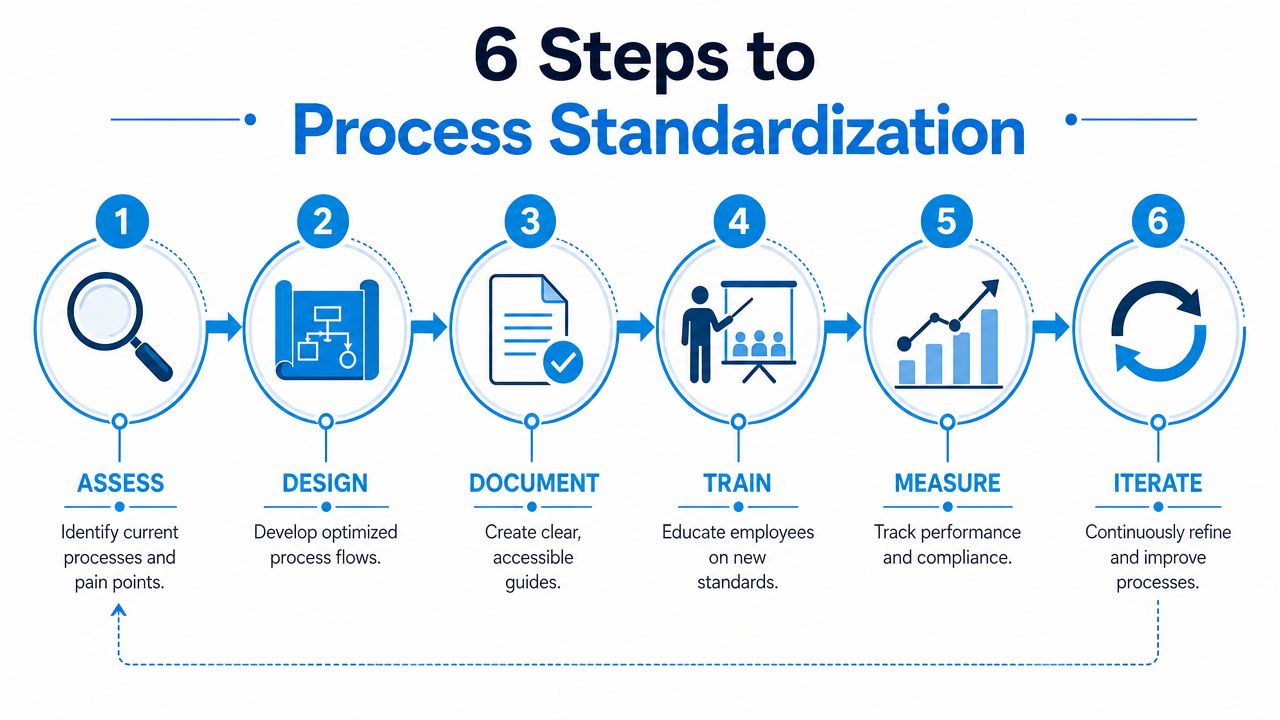
Step 1 Assess the current reality
Start by mapping what happens, not what you think happens. APQC's guidance is clear on this point. Effective standardization starts with understanding the current state through process mapping, then identifying bottlenecks and inconsistencies before testing changes in a pilot, as explained in APQC's article on process standardization.
For a plumbing company, map the emergency call flow from the first ring to dispatch. Who answers? What questions do they ask? Where do they record answers? When does the technician get notified? You'll usually find handoffs, duplicate entry, or decision points that nobody defined.
A simple exercise works well:
- Shadow the work: Watch three people handle the same task.
- Capture differences: Note what one person asks that the others don't.
- Mark failure points: Highlight where delays, confusion, or missing data show up.
Step 2 Design the standard
Don't design around your strongest employee. Design around a clear, repeatable path that a competent team member can follow.
For example, a local clinic redesigning patient intake might decide every new patient booking requires five fixed fields before the appointment is confirmed. It may also decide that insurance exceptions go to one designated person instead of letting every scheduler improvise.
The standard should answer practical questions:
- What must happen every time
- What can vary
- Who owns each handoff
- When an exception gets escalated
Step 3 Document it simply
Most SOPs fail because they're too long to use. A one-page checklist, intake form, decision tree, or call guide is usually better than a dense manual.
For a cleaning company's quote request process, the document might include:
- Required lead details: Name, service address, contact info, service type
- Qualification questions: Property size, timing, special requirements
- Routing rules: Same-day callback, estimate scheduling, escalation path
- Closeout step: Confirm next action and log notes in the CRM
That's enough to create consistency without overwhelming the team.
To see how this plays out in a communications-heavy workflow, it helps to look at a small business contact center setup, especially if your phones, bookings, and follow-ups all run through a lean team.
Step 4 Train in live context
Don't hand people a document and call that training. Walk through real examples.
Use yesterday's missed lead. Use a real intake form with missing fields. Role-play the awkward insurance question that usually throws the team off. The more training matches actual situations, the faster the standard sticks.
A front desk lead should be able to explain not just the steps, but why they matter. That's what gets adoption.
Here's a useful walkthrough on the broader idea before you roll changes out:
Step 5 Measure what changes
If your new standard doesn't change anything observable, it isn't working yet. Track a few clear indicators. For a service business, that might be completeness of intake notes, speed of follow-up, booking accuracy, or billing corrections needed after the fact.
Don't chase a huge dashboard at first. Pick the few indicators that tell you whether the process became more reliable.
Standardization should remove guesswork. If the team still handles the same task three different ways, the standard hasn't landed.
Step 6 Iterate before scaling
Pilot first. That matters. If one office, one scheduler, or one service line can use the standard successfully, then you can expand it.
A pilot reveals friction quickly. Maybe the intake script is too long. Maybe one field is unnecessary. Maybe a dispatch rule creates delay after hours. Better to learn that in a controlled rollout than across the whole business.
The businesses that do this well treat process standardization as a working system, not a filing project.
Common Pitfalls and How to Avoid Over-Standardizing
The biggest mistake isn't failing to standardize. It's standardizing the wrong way.
A lot of owners swing from chaos to control too hard. They write a rigid script for every scenario, insist every employee follow it word for word, and then wonder why customers feel handled instead of helped. That's where standardization starts hurting service quality.
Rigid SOPs break in real customer conversations
A strict SOP works well for high-volume, predictable tasks. It works less well when a customer arrives with unusual details, emotion, urgency, or conflicting information.
That matters in service businesses because edge cases are common. A dental receptionist can standardize routine cleaning appointments. But if a patient has a complex insurance issue, pain symptoms, and a timing conflict, a rigid script can trap the interaction instead of helping it move forward.
A better approach is to build guided workflows. The standard covers the common path, and the workflow clearly defines when the employee should pause, escalate, or transfer ownership.
As noted in Finyear's discussion of global process standardization, the overlooked challenge is standardizing without over-standardizing exception-heavy work. The stronger approach treats standardization as an ongoing journey with clear protocols for when the process can flex. That's especially important where inbound calls, lead capture, and customer-facing conversations involve edge cases.
What over-standardization looks like
You're probably overdoing it if you see these signs:
- Employees ask permission constantly: The process doesn't give them a safe lane for routine judgment.
- Customers hear robotic language: The team follows wording instead of focusing on outcomes.
- Unofficial workarounds spread: Staff bypass the official process because it doesn't match reality.
- Exceptions have no path: Unusual cases stall because nobody knows when to escalate.
How to find the right balance
Use this split:
| Type of work | Best approach |
|---|---|
| Routine, repeatable, low-judgment tasks | Tight standard with checklists |
| Customer-facing tasks with common variations | Guided workflow with required checkpoints |
| Sensitive or exception-heavy issues | Escalation rules, not rigid scripts |
Then make the boundaries explicit.
For example, a home services office can standardize how calls are answered, what lead details are captured, and how appointments are offered. But it should also define when the call moves to a manager, technician, or billing specialist. The script should support the employee, not trap them.
Good process standardization creates confidence for normal work and clarity for unusual work.
Another common failure is writing standards without team input. Frontline staff usually know where customers get confused, where forms fail, and which steps create friction. If they don't help shape the standard, they won't trust it once it goes live.
How to Measure and Govern Standardized Processes
A standardized process is only useful if you can tell whether it improved the business. Clean documentation isn't enough. Owners need proof in the form of better service, better capacity, and fewer expensive mistakes.
That's why measurement should connect operations to outcomes. MGMA's guidance makes that point well. To justify standardization, businesses should connect it to revenue and service capacity, using metrics such as quality, cost reduction, cycle time, and billing accuracy, with digital monitoring instead of static documents, as outlined in MGMA's article on process standardization.
The KPIs that matter most
Use a small scorecard first. If you run a home service company, don't track twenty things. Track the few that show whether the standard is being followed and whether customers feel the difference.
| KPI | What It Measures | Example for a Home Service Co. |
|---|---|---|
| Lead response time | How quickly the team responds to a new inquiry | Time from incoming call or form submission to booked estimate or callback |
| Intake completeness | Whether required customer and job details are captured | Percentage of service requests logged with address, problem type, contact details, and preferred appointment time |
| Booking accuracy | Whether appointments are set correctly the first time | Fewer jobs rescheduled because the wrong service type or wrong time window was booked |
| Cycle time | How long the process takes from start to completion | Time from first contact to confirmed appointment |
| Billing accuracy | Whether work is documented and billed correctly | Fewer invoice corrections due to missing notes or wrong service codes |
| Quality outcome | Whether the service met the intended standard | Fewer callbacks caused by incomplete job information at dispatch |
| Escalation rate | How often exceptions need manager review | Share of calls that require handoff because the situation falls outside the standard path |
Governance doesn't need to be complicated
Most small businesses only need three governance habits.
- Assign an owner: One person should own each core process. Not the whole company. The process.
- Review exceptions: Look at the cases that broke the standard. Those teach you more than the easy ones.
- Update on a schedule: A quarterly review is often enough to keep standards current without creating churn.
The owner's job isn't policing. It's maintenance. If the business adds a new service line, changes scheduling rules, or updates billing logic, the standard has to change too.
Judge both efficiency and service quality
A faster intake process that frustrates callers isn't a win. A highly polished customer interaction that creates back-office confusion isn't a win either.
Measure both sides. That's how process standardization becomes an operating discipline instead of a paperwork exercise.
Using Automation and AI to Enforce Standardization
Manual standards break down when people are rushed. Technology helps because it can enforce required steps, required fields, and required follow-up without relying on memory.
That's where automation becomes more than convenience. It becomes compliance with your own operating model.

What software should enforce
At the data layer, standardization is an engineering control. Rules for dates, names, units, and other formats should be enforced at ingestion points like forms and APIs so downstream systems receive data in a canonical structure, reducing reconciliation work across CRMs, dashboards, and business systems, as explained in Atlan's guidance on data standardization best practices.
In plain English, that means your tools should stop messy data before it spreads.
A few examples:
- CRM forms: Require the same lead fields every time.
- Scheduling software: Restrict appointment lengths and booking types based on defined rules.
- Call workflows: Prompt the agent or system to ask the next required question before closing the interaction.
- Ticketing and dispatch systems: Use consistent categories so reporting and handoffs stay clean.
Where AI fits in service workflows
AI is useful when the process depends on consistent communication at scale. If your office misses calls during lunch, after hours, or during peak periods, the standard doesn't matter if nobody is there to execute it.
Tools in this category can answer calls, gather intake information, schedule appointments, summarize interactions, and sync outcomes into the rest of your stack. One example is AI in customer service, where the practical value isn't novelty. It's process adherence. The right system asks the required questions, logs the same fields, and triggers the same next steps every time.
Recepta.ai is one option in that category. It handles inbound and outbound calls, appointment scheduling, lead capture, follow-ups, and escalations while syncing records across connected systems. In a business with lots of call volume, that kind of setup can help enforce one intake standard instead of letting every employee create a different version.
Automation works best after the process is clear
Don't automate a messy workflow and expect clarity to appear later. First define the standard. Then use software to enforce it.
The best automation doesn't replace judgment. It protects the routine parts so your people can spend their judgment on the exceptions that matter.
That's the substantial payoff. Less manual cleanup. Fewer missed fields. Cleaner reporting. A process that still works when the office gets busy.
Start Small Your Path to Scalable Operations
The businesses that benefit most from process standardization usually don't start with a massive operations project. They start with one recurring headache.
Pick the process that creates the most daily friction with the least technical complexity. For many small businesses, that's new lead intake, appointment scheduling, quote follow-up, or billing handoff. Those are common, visible, and tied directly to revenue and customer experience.
Then keep the first version simple. Map the current workflow. Define the required steps. Write a short checklist. Train the team using real examples. Watch what breaks. Adjust. That's enough to create momentum.
You don't need a perfect operating system by next week. You need one process that runs more predictably than it did before.
Once that first process becomes reliable, the rest gets easier. Your team starts to expect clarity. Handoffs improve. New hires learn faster. Owners spend less time fixing preventable mistakes. The business feels less chaotic because it is less chaotic.
Process standardization isn't about making your company robotic. It's about making good work repeatable.
If you want a practical way to standardize call handling, lead capture, appointment scheduling, and follow-up without losing the human handoff when it matters, take a look at Recepta.ai. It gives small businesses a structured way to keep customer interactions consistent while still routing complex situations to trained people.