
Service Level Agreements: A Small Business Guide
A customer calls your office during the lunch rush. Your receptionist service is down. The online scheduler won't load. Your staff writes appointments on sticky notes, then spends the afternoon untangling double bookings, missed callbacks, and one very unhappy client who says, “I called twice.”
That's the moment most small business owners realize they never bought a service. They bought a dependency.
A service level agreement, or SLA, is the document that defines what happens when that dependency fails. Not in legal theory. In practical business terms. What is the provider supposed to deliver? How do you measure it? What happens if they miss the mark? And how quickly do they need to fix it when your phones, software, or support channel becomes the bottleneck?
For a plumbing company, that could mean missed emergency calls. For a dental office, it could mean patients who can't confirm appointments. For a law firm, it could mean a prospective client calling the next attorney on the list. Small businesses feel service failures fast because there's less buffer, fewer backup people, and less tolerance for wasted time.
Why Service Level Agreements Are Your Business Safety Net
A lot of owners assume SLAs are enterprise paperwork. They're not. They're the business version of a prenup. Before anything goes wrong, both sides agree on expectations, responsibilities, and consequences.

Take a simple example. A home services company hires a call answering vendor because no one in the field can reliably answer every inbound lead. The vendor promises “excellent support.” That sounds comforting until a storm hits, call volume spikes, and nobody can say what “excellent” means. Is a call supposed to be answered immediately? Logged within a certain time? Escalated to the on-call technician? Without an SLA, you're left arguing over impressions.
With an SLA, the conversation changes. You stop asking, “Did you do a good job?” and start asking, “Did you meet the agreed standard?”
Why this matters more than owners think
Service Level Agreements became widely codified in IT outsourcing during the mid-1990s, and organizations with rigorously managed SLAs saw 15–20% fewer service-related disputes and 10–15% lower incident-handling costs compared with peers using informal guarantees, according to AWS's overview of service level agreements. That matters for a small business because disputes are expensive even when the service bill itself isn't. They consume owner attention, staff time, and customer goodwill.
Practical rule: If a provider touches your customer experience, your schedule, or your cash flow, you need more than a proposal and an invoice.
An SLA also provides you with an advantage before problems happen. If your clinic uses a scheduling platform, your law office uses a virtual receptionist, or your HVAC company depends on dispatch software, you need a written standard for uptime, response, reporting, and escalation. Otherwise, your provider decides what “reasonable” means after the failure.
Where owners often get stuck
Many people hear “SLA” and think “I need a lawyer before I can even read this.” Sometimes legal review is wise, especially for regulated businesses. But first, you need to understand the business logic underneath the legal wording. If you operate in a jurisdiction where local contract structure matters, a practical resource like this legal guide for Israeli commercial SLAs can help you see how terms are applied in real commercial settings.
Think of an SLA as your written answer to one simple question: when this service is mission-critical, what has to happen every time, and what happens if it doesn't?
Anatomy of an SLA Breaking Down the Core Components
An SLA works like a house blueprint. If the blueprint is vague, the builder improvises. If the blueprint is clear, everyone knows what belongs where.
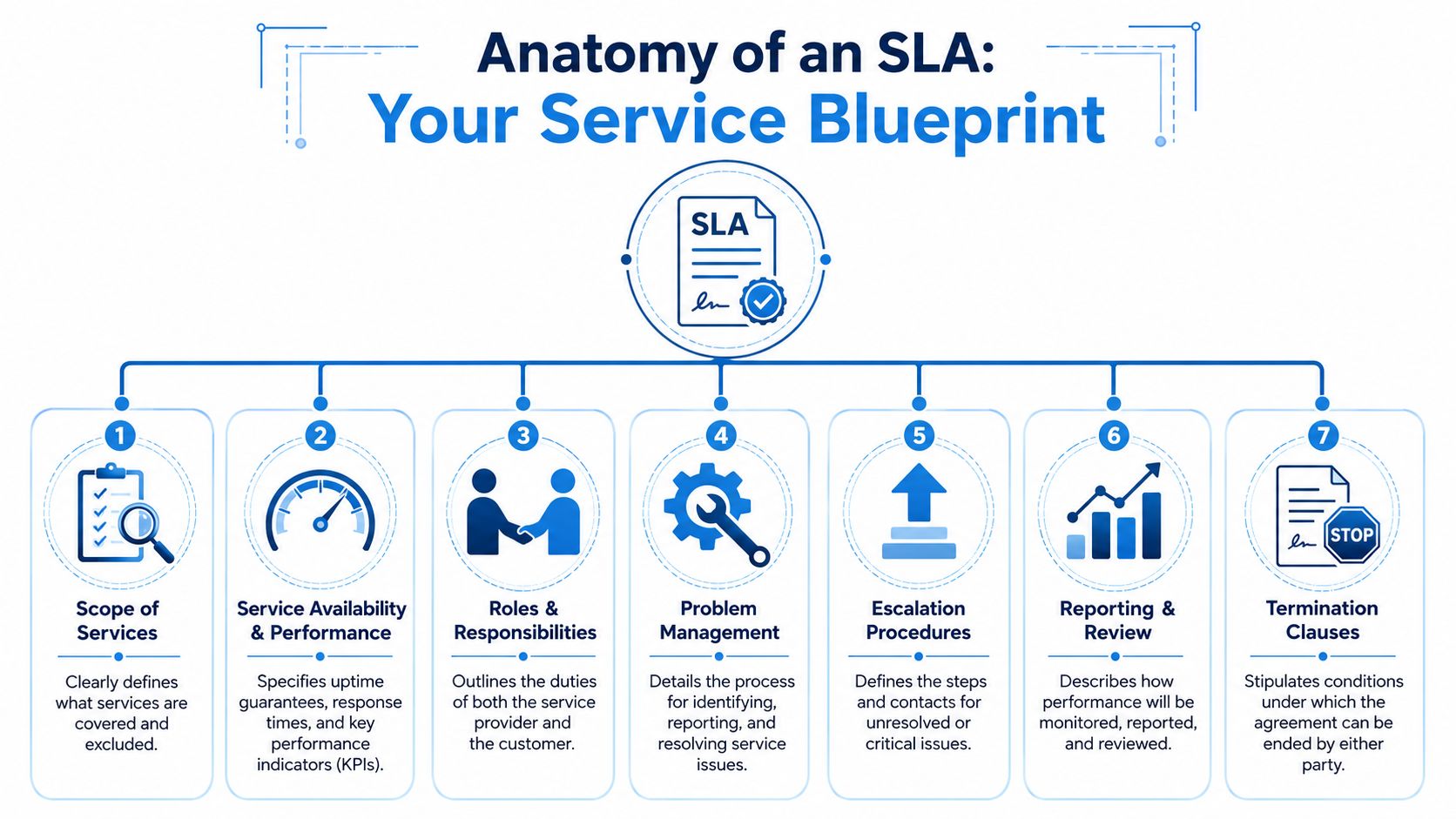
When you review service level agreements, don't start with the legal boilerplate. Start with the structure. You're looking for the handful of parts that tell you what is promised, how it's measured, and how a problem gets handled.
Scope of services
This is the “what are we buying?” section.
If you hire a call handling provider, scope should spell out whether they answer only inbound calls or also make outbound callbacks, book appointments, capture leads, transfer urgent issues, and sync notes into your CRM or calendar. If you hire a software platform, scope should define which modules, support tiers, and integrations are included.
A practical way to test the scope is to ask this: if your busiest employee read only this section, would they know what the provider is and is not responsible for?
For teams that need help getting those details into writing, strong process documentation matters. A useful companion is this guide to documentation requirements for service workflows, because undocumented edge cases become SLA disputes later.
Performance metrics and availability
At this point, the promises become measurable.
A common example is uptime. A 99.9% uptime guarantee means the service can be unavailable for no more than about 8.76 hours per year or roughly 43.8 minutes per month, as explained in Flexential's SLA guide. That number matters because “near constant availability” sounds better than “you may still lose almost three quarters of an hour this month.”
Here's how to read that kind of metric as a buyer:
| SLA term | What it means in plain language | Why you care |
|---|---|---|
| Uptime | Whether the service is available to use | If customers can't reach you, your business stalls |
| Response time | How fast the provider acknowledges an issue | Silence during an outage raises your risk |
| Resolution time | How fast the issue is fixed | Acknowledgment without repair doesn't help |
| Accuracy or completion | Whether the work was done correctly | A booked call with wrong details still costs money |
SLOs versus SLAs
Here, readers often get confused.
An SLO is usually an internal target. An SLA is the external commitment with consequences. If a provider says, “We aim to answer most calls quickly,” that may be an objective. If the contract says, “We guarantee a stated level of performance and provide credits or other remedies if we miss it,” that's an SLA.
A bakery doesn't care what a vendor hopes to do. The bakery cares what the vendor is obligated to do at 7:30 a.m. when order calls begin.
A useful test is simple. If the provider misses the target, does the contract trigger a remedy? If yes, you're probably looking at an SLA. If no, it may just be a goal.
Roles, responsibilities, and problem management
Good service level agreements don't only talk about the provider. They also define what you have to do.
You may need to submit support requests through a specified channel, maintain updated user permissions, supply correct business hours, or flag which calls count as emergencies. If your team doesn't do its part, the provider may argue the SLA never applied.
Look for these details:
- Customer obligations: What information must you provide so the provider can perform?
- Issue reporting method: Email, portal, phone, or ticket system?
- Priority rules: What counts as urgent, standard, or low priority?
- Escalation path: Who gets involved when the first line of support doesn't resolve the issue?
Remedies, reporting, and termination
This is the accountability layer.
If the provider misses the target, the SLA should say what happens next. That may include service credits, formal review meetings, corrective action plans, or termination rights if failure becomes chronic. Reporting terms should also explain how often you'll receive performance summaries and what those reports include.
The final section many owners skip is termination. Don't. If the partnership stops working, you need to know how to exit cleanly, recover your data, and avoid a messy transition.
An SLA isn't one clause. It's a chain. If any link is vague, the whole agreement gets weaker.
From Theory to Practice Measuring and Monitoring Performance
An SLA only helps if someone watches the scoreboard.
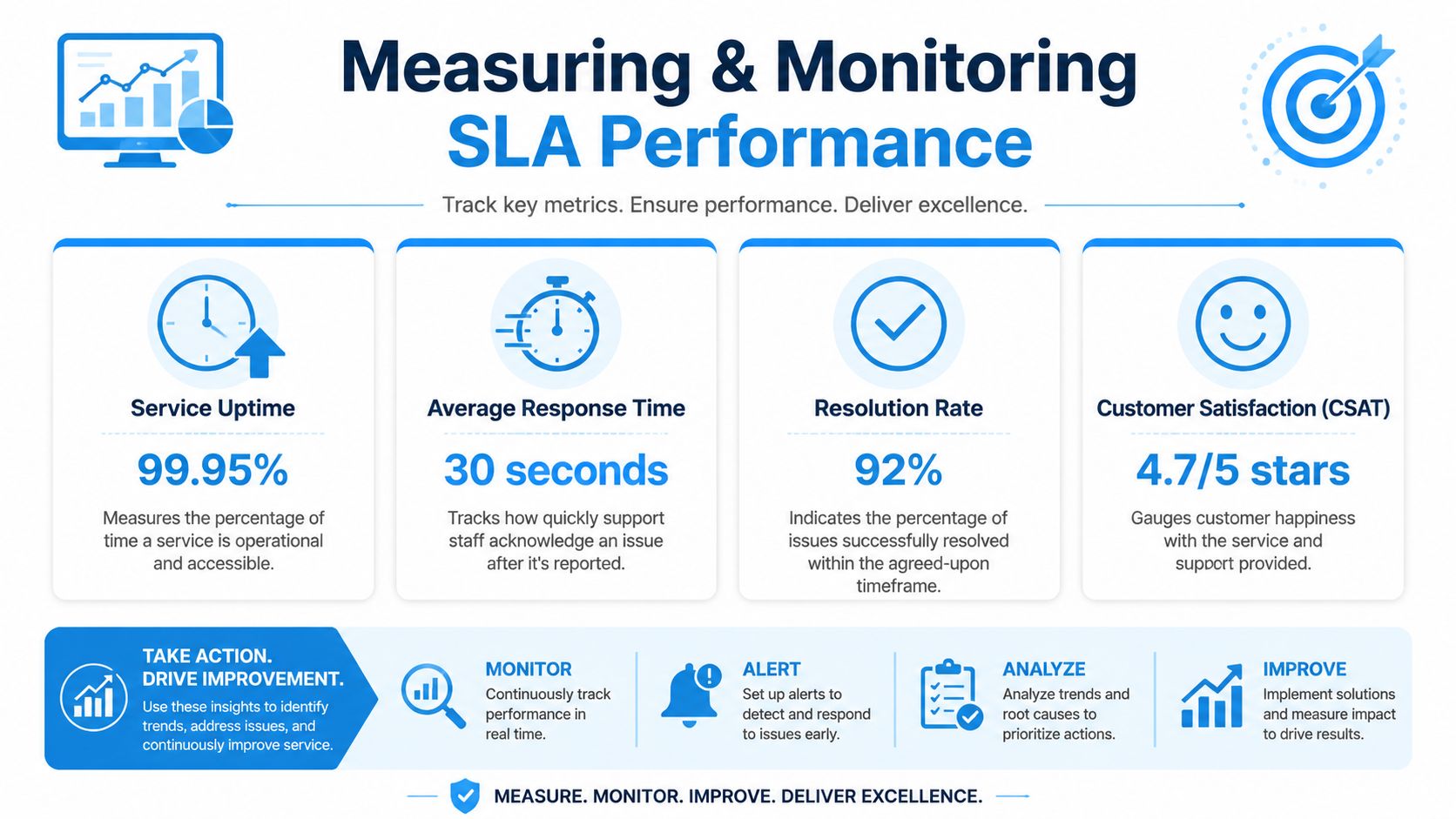
Small business owners don't need a network operations center to monitor service level agreements. They do need a way to compare the provider's promise with the customer impact they experience. Those are not always the same thing. A vendor dashboard might show green across the board while your office still missed calls, delayed intake, or lost time chasing support.
The metrics that matter in real life
Start with the basic categories most owners can verify:
- Availability: Could your team or customers use the service when they needed it?
- Acknowledgment: How fast did the provider respond after you reported a problem?
- Fix time: How long did it take before the issue was resolved?
- Business outcome: Did the outage create missed appointments, duplicate work, or delayed follow-up?
Modern cloud SLAs have tightened targets, with major vendors offering 99.95% to 99.99% monthly uptime SLAs and service credits of 10–25% of the month's fees if availability falls below the threshold, according to this discussion of effective service level agreements. That sounds strong, but don't stop at the percentage. Ask whether the credit meaningfully offsets the disruption to your business.
For a deeper operational view, this guide to performance monitoring systems for service delivery is a useful reference point because it connects monitoring to actual workflows instead of just dashboards.
Translate metrics into business language
A roofing company doesn't care about abstract “platform degradation.” It cares that storm-damage calls weren't captured. A pediatric clinic doesn't care that a support system was “partially impacted.” It cares that parents couldn't confirm appointments.
That's why you should track two records at once.
| What the provider reports | What your business records |
|---|---|
| Uptime and outage logs | Missed calls, delayed bookings, customer complaints |
| Ticket response timestamps | How long staff waited for a useful answer |
| Resolution status | Whether operations actually returned to normal |
| Service credits issued | Whether the remedy matched the disruption |
Don't measure only whether the system was down. Measure whether your business could still operate.
This short video gives a practical overview of how SLA performance is commonly monitored in service environments:
A simple monitoring rhythm for SMBs
You don't need to check metrics every hour. You do need a routine.
- Review provider reports monthly. Look for repeated incidents, not just dramatic failures.
- Keep your own incident log. Note the date, issue, customer impact, and how long the problem lasted.
- Compare promises to outcomes. If the provider met uptime but failed badly on support responsiveness, the contract may need a stronger support clause.
- Escalate patterns early. A minor recurring issue often becomes a major operational headache.
Monitoring isn't about trying to catch vendors doing something wrong. It's how you protect a partnership from drifting into ambiguity.
How to Draft and Negotiate a Fair Service Level Agreement
Many owners avoid negotiating SLAs because they think negotiation means confrontation. In practice, it's closer to pre-construction planning. You're not fighting with the contractor. You're making sure everyone agrees where the walls go before the concrete sets.
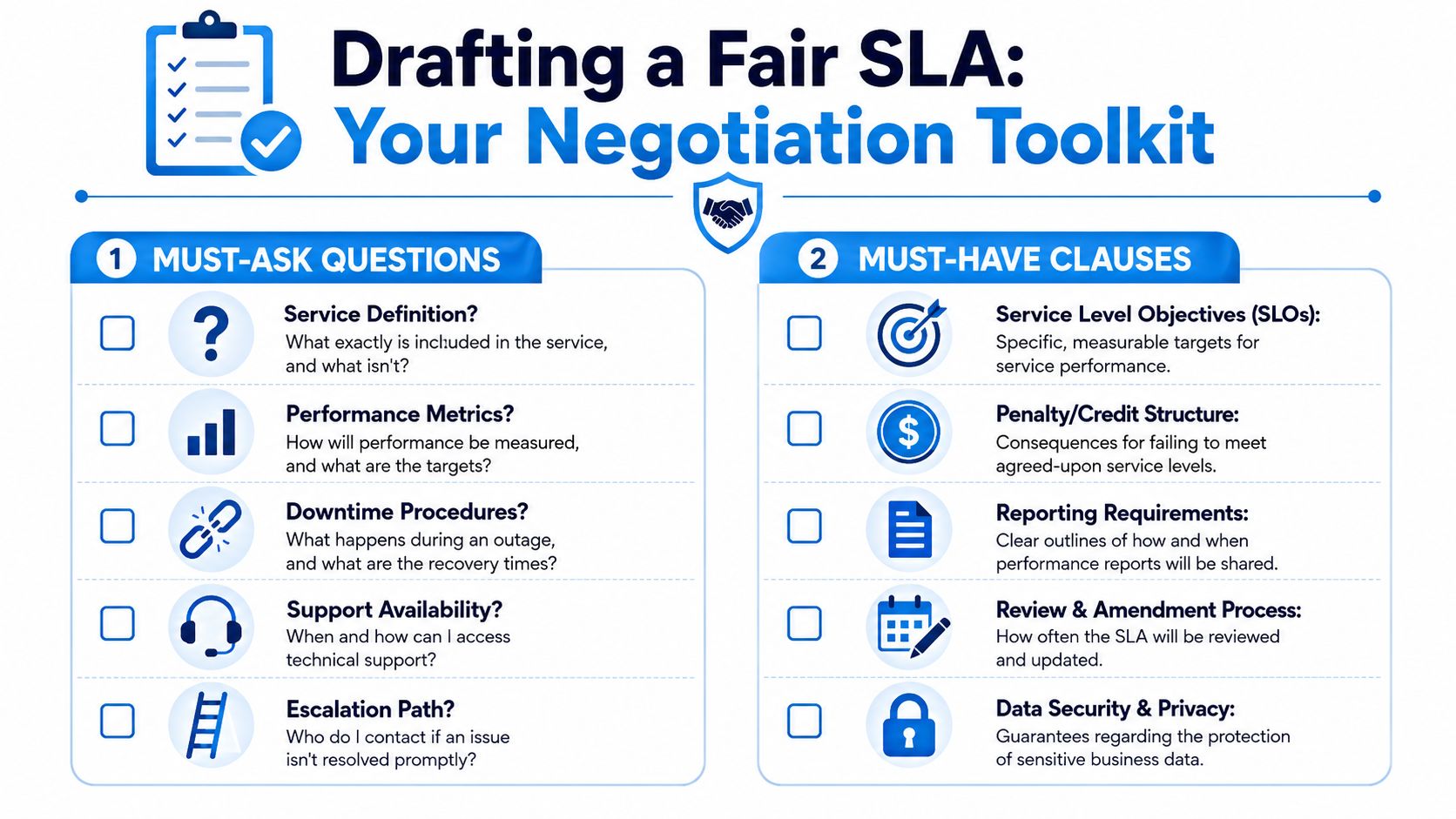
The most useful SLA negotiations are calm, specific, and tied to business impact. You're not asking for “better service.” You're asking for terms that match how your business operates.
Questions worth asking before you sign
If you buy answering, scheduling, dispatch, intake, or software support, ask these in plain English:
- What exactly is covered? Ask for examples. “Does this include after-hours calls, appointment changes, and urgent escalations?”
- How is performance measured? If the provider can't explain the measurement method clearly, the metric will be hard to enforce.
- What happens during downtime? You want backup procedures, not just a promise to investigate.
- Who can we contact when something breaks? Generic support inboxes are fine for routine issues, not for business-critical failures.
- What remedy applies if the target is missed? Credits matter, but communication and recovery steps often matter more.
A company that offers on-call or after-hours support should be able to define ownership clearly. This overview of on-call services and response planning is a useful benchmark for the kind of operational clarity buyers should look for.
Watch the exclusions carefully
In this regard, many SLAs tilt too far in the provider's favor.
SLAs commonly exclude scheduled maintenance windows communicated in advance, which lets providers perform upgrades without breaching the agreement as long as those windows are clearly defined and limited, as noted in Coursera's explanation of SLA exclusions. That's normal. What isn't normal is an exclusion so broad that the provider can declare long periods of unavailability “maintenance” whenever it suits them.
Use this checklist when reviewing exclusions:
- Defined window: Does the contract specify when maintenance can happen?
- Advance notice: Are you told early enough to plan around it?
- Limited scope: Is maintenance occasional and bounded, or open-ended?
- Critical hours protection: Does the provider avoid your busiest times?
If an exclusion swallows the promise, the SLA isn't protection. It's decoration.
Clauses that make an SLA fair
A balanced agreement usually includes these elements:
| Clause | What fair looks like |
|---|---|
| Performance target | Specific and measurable, not vague |
| Support access | Clear contact methods and escalation path |
| Remedy | Credits or corrective action that actually matter |
| Review process | A schedule to revisit terms as needs change |
| Data handling | Clear treatment of sensitive business and customer information |
If you want sample language to pressure-test a draft, ask for concrete wording such as: service included, service excluded, issue severity levels, response expectations, maintenance notice process, credit claim process, and termination rights after repeated failures.
Good service level agreements aren't one-sided. They give the provider a clear operating standard and give you a reliable way to hold the relationship together when stress hits.
Practical SLA Examples for Your Industry
Service level agreements make the most sense when you stop thinking like a buyer of “technology” and start thinking like the owner of a business with very specific risks.
Home services business
A plumbing company depends on speed. A missed call often isn't a minor inconvenience. It's a lost job that goes to the next company on the search results page.
So the SLA for a call answering or dispatch service should focus less on generic platform language and more on operational outcomes. It should define which calls count as emergencies, who gets alerted after hours, what information must be captured before a booking is made, and what happens if the system can't route a call normally.
A practical example would include:
- Which inbound calls must be answered live
- How urgent leaks, no-heat calls, or same-day requests are flagged
- What booking details must be recorded before an appointment is confirmed
- What fallback process applies if the calendar sync fails
For businesses that route calls through cloud telephony, this matters even more. For a business like Recepta.ai routing calls via cloud telephony, missing a partner's 99.9% availability SLA, which allows no more than 43 minutes of downtime per month, can cascade into missed leads and reputational damage. That's why buyers should audit upstream provider SLAs for both network availability and specific APIs, as described in IBM's service-level agreement overview.
Healthcare clinic
A healthcare practice has a different risk profile. The issue isn't only whether someone answers the phone. It's whether intake, scheduling, and message routing happen in a way that protects patient trust and supports compliance.
The SLA should define:
- How patient messages are documented
- Which categories of calls require immediate escalation
- What information can and cannot be collected by a third-party service
- How appointment changes, prescription requests, and urgent callbacks are routed
In healthcare, a vague SLA creates workflow confusion. Staff may assume the vendor handles urgent patient messages one way while the vendor follows a different process. That kind of mismatch can trigger delays, frustration, and unnecessary exposure.
A good healthcare SLA reads almost like a triage playbook. It identifies call types, ownership, and handoff rules in plain language.
Law firm
Law firms need speed, but they also need discretion.
If a legal intake vendor, receptionist service, or communications platform is involved, the SLA should cover confidentiality expectations, urgent inquiry routing, message accuracy, and escalation for time-sensitive matters. Not every caller is a fit, but every caller should be handled in a way that protects the firm's reputation.
A practical legal-services SLA might define:
- Which inquiries are passed directly to an attorney or paralegal
- How conflict-sensitive or confidential matters are documented
- How after-hours intake is stored and delivered
- What turnaround standard applies to urgent potential-client messages
The best legal SLA language doesn't just say “messages will be relayed promptly.” It says who receives what, how, and under which circumstances.
Multi-location business
A franchise or multi-site operator faces a consistency problem. One location may get excellent service while another gets slower response, weaker documentation, or different handling standards.
That's where service level agreements should include location-by-location responsibilities. If a vendor supports several offices, define whether service rules are standardized or customized by site. Clarify who owns local exceptions such as holiday hours, location-specific services, or regional escalation contacts.
For multi-location operators, the hidden risk isn't one dramatic outage. It's uneven service that erodes customer trust over time across sites.
Holding Partners Accountable Enforcing SLAs and Reviewing Terms
Signing an SLA doesn't solve anything by itself. The value shows up after the first miss.
When a provider falls short, many small businesses do one of two things. They either overreact and threaten to cancel immediately, or they absorb the problem and move on because chasing it feels like too much work. Neither approach helps. A better approach is disciplined enforcement.
Step one is documentation
If the service failed, create a clean record before details get fuzzy.
Write down:
- What happened: Outage, delay, routing failure, inaccurate booking, or support failure.
- When it happened: Date, time, and duration as best you can confirm.
- What the impact was: Missed calls, delayed appointments, customer complaints, staff workarounds.
- What evidence you have: Screenshots, call logs, ticket IDs, emails, or timestamps.
If the issue involves telephony quality, gather objective details instead of vague complaints. A practical troubleshooting checklist like this guide on troubleshooting Hosted PBX audio quality can help your team separate a provider-side issue from a local device or network problem before you escalate.
Step two is formal notice
Don't rely on a frustrated phone call. Use the reporting method your SLA specifies.
That usually means sending a written notice through the correct support channel with:
- The specific SLA term you believe was missed
- The incident window
- The business impact
- Your request for confirmation, investigation, and remedy
Be factual. Avoid emotional language. “We experienced call-routing failure between these times, which resulted in missed inbound inquiries and manual callback work. Please confirm whether this event qualifies as an SLA breach and outline the next steps under the agreement.”
That tone gets better results because it points the provider back to the contract.
Step three is verify the remedy
Many SLAs require the customer to request service credits rather than issuing them automatically. Check that process carefully. If credits apply, ask for the calculation and written confirmation.
But don't stop with credits. In many SMB situations, the more valuable remedy is operational correction. You may need:
- A root-cause explanation in plain language
- A revised escalation path
- A change to backup procedures
- A commitment to better reporting next month
Service credits compensate for failure. Process fixes reduce the chance of repeat failure.
Step four is review patterns, not isolated annoyances
One bad week can happen. Repeated misses point to a structural problem.
Use a simple review table like this:
| Pattern you see | What it may mean | What to ask for |
|---|---|---|
| Frequent small outages | Weak reliability or poor maintenance planning | Better notice, stronger escalation, revised targets |
| Slow support replies | Understaffed support or unclear severity rules | Dedicated contacts, clearer response commitments |
| Inaccurate handling | Weak training or poor documentation | Updated scripts, better QA, revised workflows |
| Different results across sites | Inconsistent delivery model | Location-specific reporting and accountability |
Keep the SLA alive
An SLA shouldn't sit in a folder until the next crisis. Review it on a regular cadence that makes sense for your business relationship. If your service affects customer communications, scheduling, or sensitive records, put reviews on the calendar and bring examples.
This is also the right time to revisit security expectations. If a provider handles customer details, intake records, or appointment data, the SLA should stay aligned with your operating standards and internal policies. A practical baseline is this guide to data security best practices for customer-facing workflows.
Review meetings should answer a few grounded questions:
- Are the current metrics still tied to real business risk?
- Have our hours, call types, or service lines changed?
- Are exclusions still reasonable?
- Does the remedy structure still make sense?
- Are both teams following the documented process?
When owners treat service level agreements as living operating documents, providers usually respond more professionally. Expectations stay visible. Problems get easier to address. And the partnership becomes easier to manage under pressure.
Conclusion Making SLAs Work for Your Business
Most small businesses don't need a complicated lecture on contract theory. They need a reliable way to protect customer experience when an outside provider becomes part of daily operations.
That's what service level agreements do when they're written and used well. They turn vague promises into clear standards. They give both sides a shared definition of success. And when something breaks, they replace finger-pointing with a process.
The non-negotiables worth remembering
Keep these principles in front of you whenever you review service level agreements:
- Tie the SLA to real business risk. If a service affects leads, appointments, intake, or urgent communication, define the standard clearly.
- Insist on measurable terms. “Reliable” and “prompt” sound nice, but they don't help much in a dispute.
- Read exclusions closely. A promise with broad carve-outs won't protect you when it matters.
- Track your own experience. Provider reports matter, but your business impact matters more.
- Review the agreement regularly. Your operations change. The SLA should change with them.
- Treat enforcement as process, not drama. Clear documentation and calm escalation usually get better results than anger.
A strong SLA doesn't signal distrust. It signals that both parties take the relationship seriously.
For home services companies, healthcare practices, law firms, and multi-location operators, this is especially important. You may not have an in-house IT manager or procurement team. But you still buy critical services. You still depend on outside systems and people. And you still need a written standard for what happens when performance slips.
The best time to think about failure is before the busy season, before the next software migration, and before the first missed call turns into a lost client. A fair SLA won't eliminate every issue. It will make the issues easier to measure, discuss, and fix.
If you want a practical way to apply these ideas to call handling, scheduling, escalations, and lead capture, Recepta.ai offers an AI receptionist platform with human support that can fit into structured service workflows for small businesses. It's useful when you need clearly defined handling rules for different call types, documented escalation paths, and more consistency in how customer interactions are captured and routed.