
Top Business Continuity Solutions for 2026
Most business continuity advice starts in the wrong place. It treats server backups and data recovery as if they were the whole problem, then leaves owners exposed to the failure that hurts first, the phone rings, nobody answers, and the lead goes cold. For an SMB, that's often the real outage, a lost appointment, a missed estimate, an unanswered patient call, or a client who assumes you're closed and moves on.
That's why business continuity solutions need to protect the customer conversation as aggressively as they protect files and systems. IBM's continuity overview notes that in 2020, 51% of companies worldwide did not have a business continuity plan when COVID-19 hit, while a separate summary says only 26% of companies have a disaster recovery plan and Invenio IT cites about 61% of businesses globally having some form of continuity plan, a gap that matters because downtime can cost from $427 to $15,000 per minute and about £258,000 per hour in the UK (IBM). Those numbers explain why continuity stopped being an IT sidebar and became an operating discipline.
Why Most Business Continuity Plans Fail Where It Hurts Most
The standard playbook still starts with backups, storage, and failover. That matters, but it misses the moment most SMBs lose money: the customer tries to reach you, the line is busy, the office is closed, or the inbox sits untouched until the next day. For intake-heavy businesses, that gap can be more damaging than a crashed server because revenue disappears before the technical incident is even resolved.
The hidden failure is customer access
Home services, healthcare practices, law firms, insurance agencies, and franchises all depend on being reachable. If a plumbing company's dispatch line goes unanswered during an outage, the job doesn't wait politely. The customer calls the next contractor, and the revenue leaves with them.
Practical rule: if a disruption blocks customers from contacting you, your continuity plan is incomplete.
That's the contrarian point most templates ignore. Business continuity is defined around keeping essential functions operating during disruption, but many guides translate that into systems, backups, and documentation without mapping it to calls, bookings, lead capture, and customer updates (LogicManager). In practice, a missed call can cost more than a file restore because the lost lead rarely comes back on its own.
What this means for SMB planning
A useful continuity plan has to protect both sides of the business, the technical core and the customer-facing front door. Microsoft's framework is helpful here because it separates resilience, recovery, and contingency, which makes it easier to assign ownership instead of treating “continuity” as one vague objective (Microsoft).
The point isn't to overbuild. It's to make sure a power outage, staff absence, or software failure doesn't stop your business from answering, scheduling, and updating people who are waiting on you. If a customer can still get through, still get informed, and still get booked, the disruption is much easier to absorb.
The Three Pillars of Effective Business Continuity
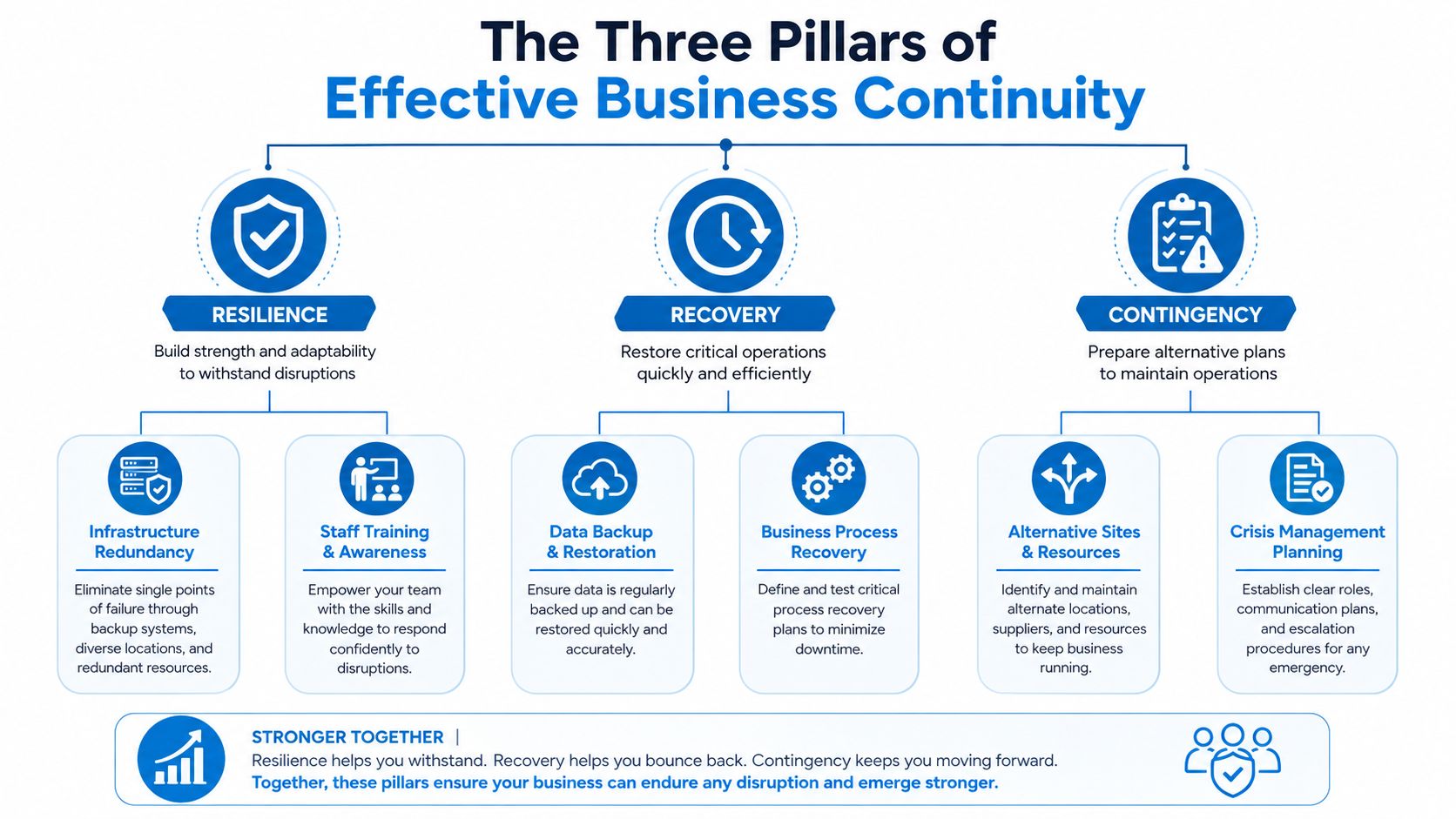
Microsoft divides continuity into resilience, recovery, and contingency, which gives small teams a practical way to assign ownership instead of treating continuity as one vague objective (Microsoft). The value of that structure is in the work it separates. One part reduces fragility before a disruption, one part restores what failed, and one part keeps the business operating while the disruption is still active.
Resilience means fewer single points of failure
Resilience is the design work. It asks whether a business can keep moving if one person is unavailable, one system is offline, or one location cannot operate. For a service company, that can mean separating phone coverage from the main office, keeping dispatch access available remotely, and training more than one employee to handle urgent customer communication.
Resilience also depends on the basics behind the scenes. Good planning for infrastructure security reduces the odds that a preventable systems issue turns into a customer-facing outage. If the tools that take calls, route jobs, or send updates are fragile, the business will feel the break immediately.
Recovery means deciding what comes back first
Recovery is prioritization. Not every system matters equally during a disruption, so the restoration order has to match business impact. A scheduling platform may matter before analytics, and customer communications may matter before back-office reporting. Continuity plans fall short when they list everything as critical, because then nobody knows what to bring back first.
That ranking should reflect the way the business earns and serves. For many SMBs, the first restore target is the workflow that keeps leads from going cold, customers from going unanswered, and appointments from disappearing into a voicemail box. Technical systems matter, but the sequence has to follow revenue and service pressure, not habit.
Contingency means a live operating plan
Contingency is the action plan for the outage itself. It should spell out the chain of command, who handles customer communication, who coordinates technology, who calls vendors, and where staff work if the main site is unavailable. A plumbing company can assign one person to customer updates, another to dispatch, and a third to backup vendor coordination. That keeps the response orderly instead of improvised.
The same logic applies outside the office. If the phone system fails, the website form breaks, or the front desk is closed, someone still has to answer, log the lead, and tell the customer what happens next. A continuity plan that leaves those jobs unnamed usually turns into silence at the exact moment the business can least afford it.
For a practical regional example, the business continuity for Saskatchewan businesses resource from Accelerate IT Services Inc. shows how continuity works as an operating discipline, not just an IT checklist.
A strong continuity plan gives customer accessibility the same weight as technical restoration, with named owners for answering, escalating, and updating people during disruption.
Conducting a Business Impact Analysis That Actually Works
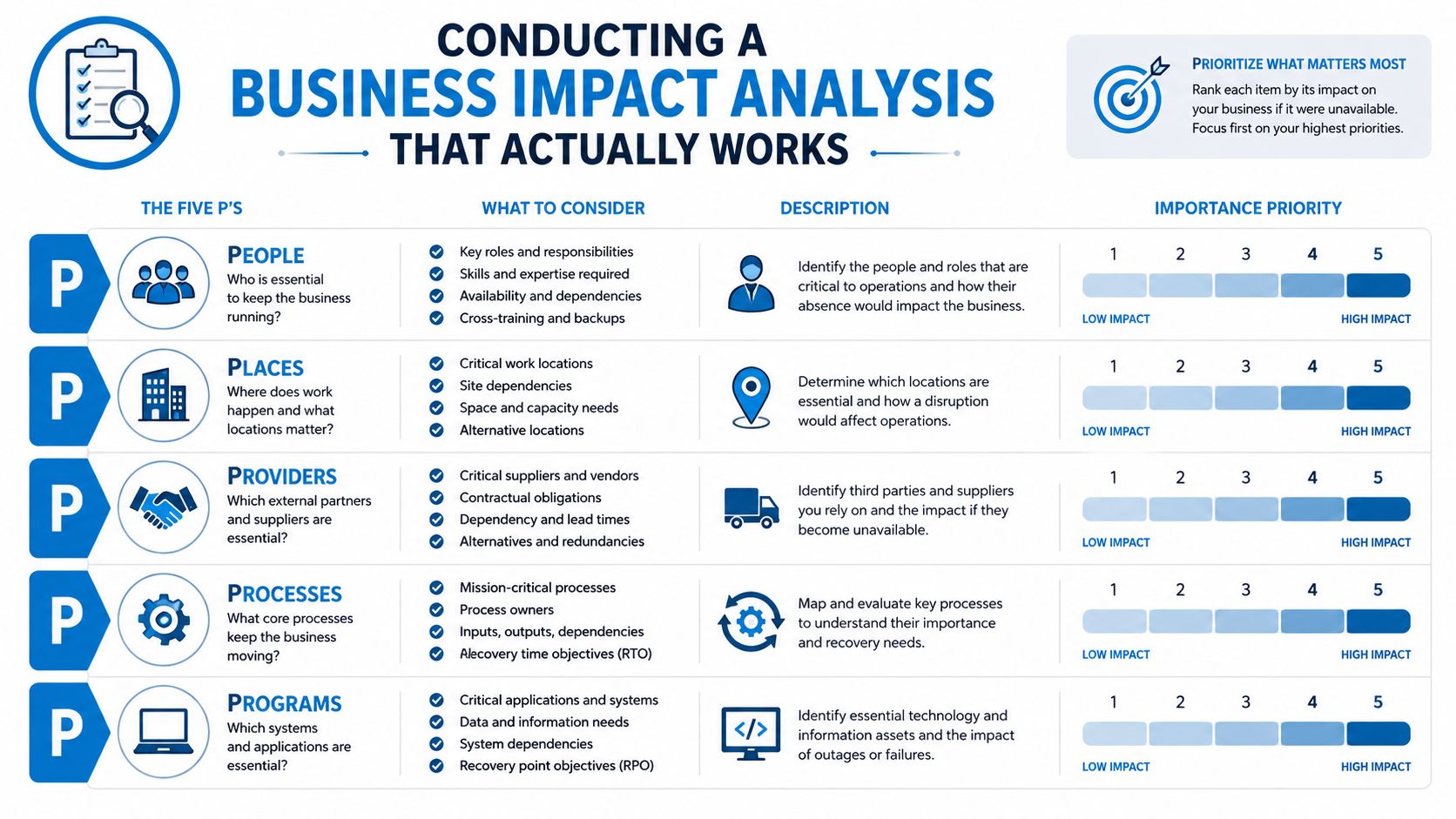
A business impact analysis only works when it separates what's merely useful from what's mission-critical. Travelers' five P's, People, Places, Providers, Processes, and Programs, give teams a practical way to rank the functions that matter most and the time they can tolerate without them (Travelers). That ranking is where continuity budgets should start, because it tells you what to protect first.
Rank by recovery time, not by habit
Most owners overrate the systems they know best and underrate the ones that drive actual cash flow. An HVAC contractor might rank technicians and scheduling software above nonessential analytics because technicians create revenue and scheduling keeps the pipeline moving. That doesn't mean analytics are unimportant, it means they're not the first thing that determines whether the business survives a disruption.
Put fixed costs into the analysis
Travelers also recommends a financial impact assessment that includes fixed expenses such as rent, payroll, and insurance so leaders can estimate how long operations can continue during downtime (Travelers). That part is often skipped, but it's the difference between a continuity wish list and a plan that matches reality. If revenue pauses for several days, the question isn't just what is down, it's what still has to get paid.
The best BIA isn't a spreadsheet exercise. It's a decision tool for where limited money should go first.
Make the output actionable
A useful BIA should end with three clear answers.
- What must stay available: the people, places, providers, processes, and programs that keep revenue moving.
- What can wait briefly: the functions that can be delayed without breaking customer commitments.
- What needs backup now: the areas where downtime would immediately interrupt sales, service, or compliance.
ARPHost's business resilience steps are a helpful reference if you want to see how a continuity program can be translated into implementation steps rather than policy language. The key is to decide, in plain terms, what your business can't afford to lose first.
Industry-Specific Continuity Requirements and Real Scenarios
A continuity plan that works for a law firm won't fit a plumbing company, and a healthcare front desk has different risks than an insurance agency. That's exactly why generic templates disappoint. The failure mode changes by industry, but the customer-facing breakdown is usually the same, nobody answers, nobody confirms, and nobody closes the loop.
Home services need dispatch continuity
A plumber can survive a brief accounting delay, but not a lost emergency call. If the office line goes silent during a storm or after hours, the next available contractor gets the job. In that setting, continuity means someone always captures the call, books the work, and passes the right details to dispatch without relying on one person being reachable.
Healthcare and wellness need appointment continuity
Healthcare practices have a different pressure point, patient communication. Missed calls can become no-shows, delayed intake, or unanswered questions that create frustration before the visit even happens. If a clinic is reviewing its front-desk resilience, the right question isn't only how the EMR is restored, it's how patients still confirm appointments and receive updates when staff are overloaded. For that reason, the guidance in HIPAA-compliant answering service is especially relevant to practices that can't let intake slip during a disruption.
Legal, insurance, and franchises have their own failure points
Law firms need continuity for client confidentiality and case file access, but they also need a dependable way to acknowledge client calls during disruption. Insurance agencies face similar pressure around claims intake and policy questions, because a missed call can delay service at exactly the wrong moment. Franchises add another layer, since multi-location coordination and brand consistency have to survive even when one branch is short-staffed or offline.
Each of these scenarios points to the same lesson. If your continuity plan only protects infrastructure, it still leaves the customer experience vulnerable. That's why the strongest business continuity solutions in service businesses always cover communication routing, appointment handling, and escalation paths, not just data restoration.
Building and Testing Your Implementation Roadmap
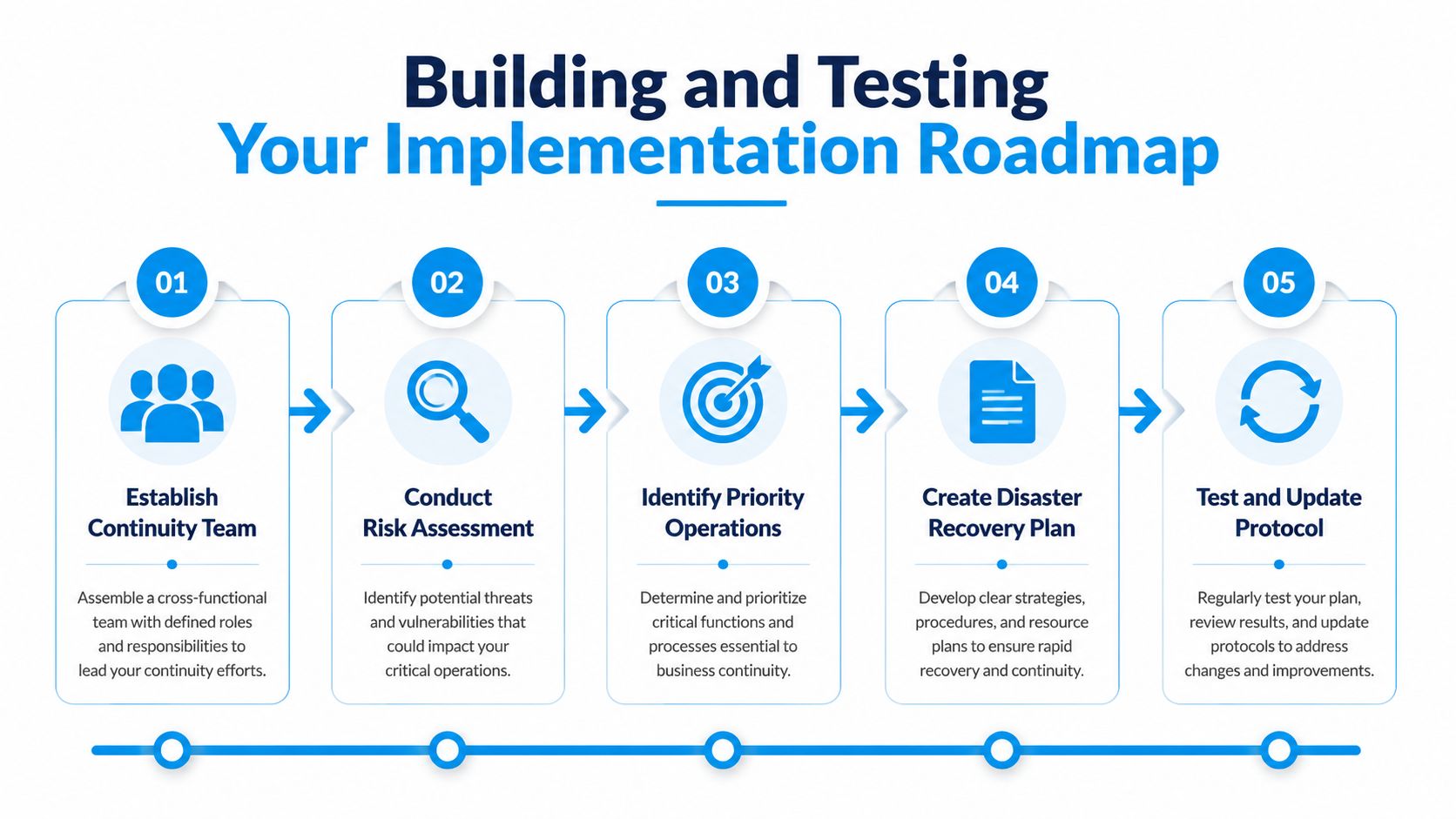
A continuity roadmap fails fast when it starts with systems instead of customers. The first question should be how the business keeps answering calls, following up on leads, and protecting appointments when the office is disrupted, because that is where small businesses usually lose revenue first. Oracle's continuity guidance is practical on this point, with a sequence that starts with the team, risk assessment, priority operations, disaster recovery, and an alternate site or remote-work path when the primary one fails, Oracle which keeps teams from buying tools before they know what those tools need to protect.
Define the recovery targets first
RPOs and RTOs force specificity. They push the team to decide how much data loss is acceptable and how fast each function must come back, which is why they belong near the start of BCDR planning. For a law firm, email and case files may need a tighter target than internal reporting. For a service business, phone response and booking availability may deserve the shortest target of all.
Test under realistic failure conditions
Tabletop exercises and walk-throughs expose confusion before a real outage does. They work well when different people own different parts of the response, because the handoffs are where plans usually break. In a law firm, staff can test whether email and case files restore within target while working from home on backup systems, which tells you more than reading a policy document aloud.
If a test does not involve the people who answer customers, restore access, and make decisions, it is not a real test.
Use a small set of readiness KPIs
The best continuity metrics are simple enough for managers to verify without a dashboard overhaul. Track whether priority functions have named owners, whether alternate work paths are documented, whether tests were completed, and whether the last review led to real changes. The point is to prove that the plan still matches how the business works today.
If you need a supporting read on the technology side of this, the internal guide on network reliability pairs well with continuity planning because customer access depends on stable connectivity as much as it depends on policy. A written plan only matters when it holds up during real outages with real people involved.
Choosing the Right Continuity Solutions and Vendors
Evaluate vendors by the outcomes they deliver during disruption, not by the features listed on a spec sheet. Enterprise platforms can centralize risk tracking, backups, and testing. Specialized tools handle narrower jobs such as customer communications or workflow routing. Consulting services can help shape the plan, but they do not answer the phone when the front desk is empty and the office is closed.
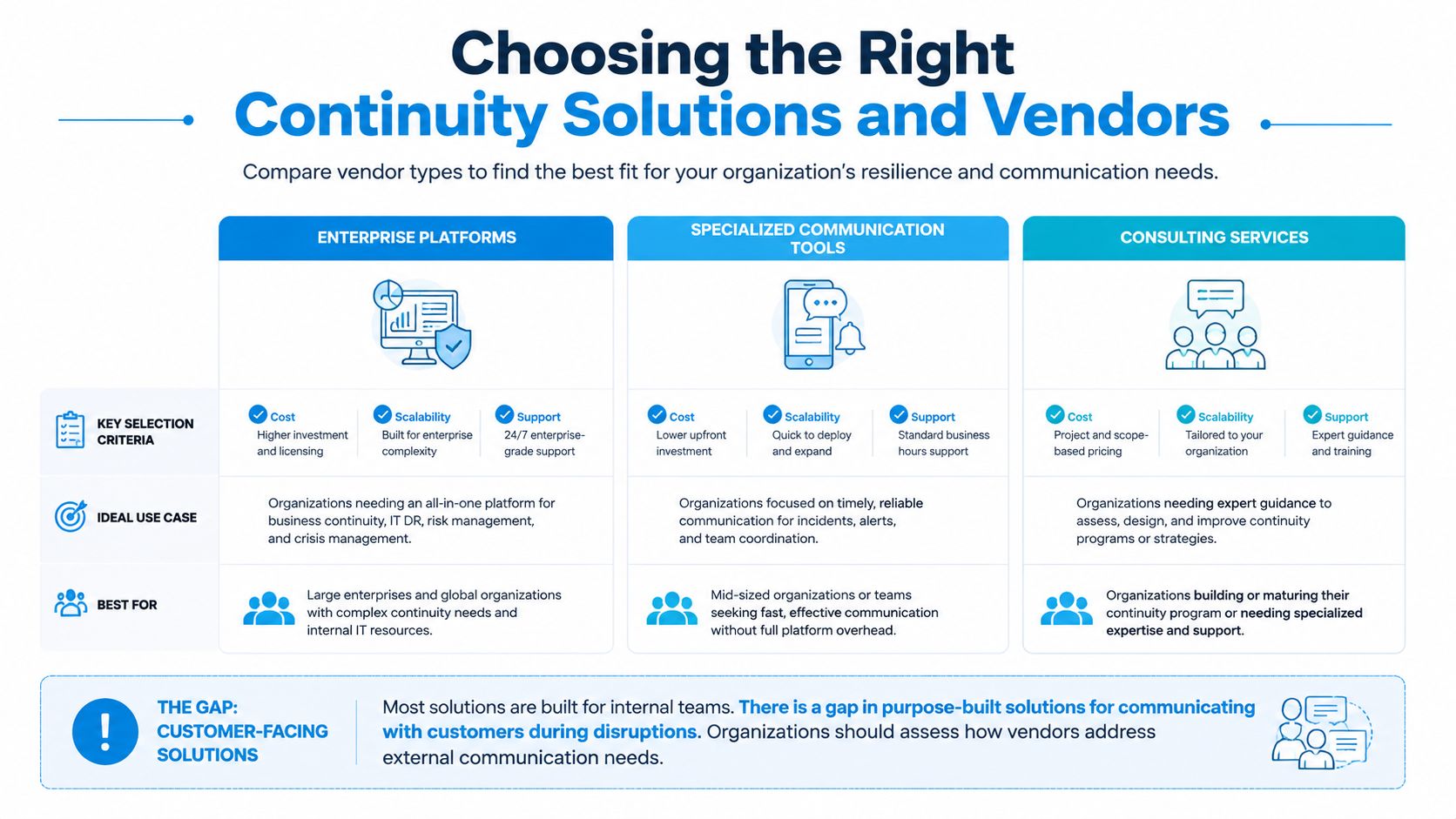
Compare by continuity outcome, not feature list
A useful vendor review starts with the customer path. Does the solution keep calls, bookings, and follow-ups moving when staff are unavailable, or does it only help after the disruption is already over? Call forwarding and voicemail leave a lot of gaps if nobody captures context, qualifies the request, or books the next step. Modern AI-driven reception and automation tools are more useful when they answer consistently, escalate when needed, and log the result into the systems the business already uses.
Where communication continuity fits
Most BCP templates leave this gap open. They cover infrastructure recovery well, but they often miss missed calls, unrecovered leads, and appointment gaps as continuity risks. A customer-facing continuity layer needs to keep intake running, keep updates moving, and keep records clean even when staff are unavailable. That is the role a tool like Recepta.ai can play inside a broader stack.
When you review vendors, focus on four checks:
- Integration depth: can it sync with your CRM, calendar, or service system cleanly?
- Reliability and escalation: does it hand off to a human when the situation needs judgment?
- Compliance fit: can it handle the privacy and security requirements of your industry?
- Operational proof: does it preserve bookings, calls, and follow-ups during disruption?
For claim-related continuity planning, especially where revenue interruption is part of the risk discussion, the complete business interruption recovery resource from NW Claims Management is worth reviewing alongside your vendor evaluation. It helps connect continuity planning to the financial consequences of downtime.
A good vendor does more than sound resilient. It keeps customer traffic flowing when the office is understaffed, the line is busy, or the team is offline.
Your 90-Day Business Continuity Action Plan
Start with what will break first, not what looks impressive in a policy binder. A practical plan should move from assessment to implementation to testing, and each phase should end with a decision, not a meeting note. If you want a process lens on automation that supports this kind of rollout, the internal guide on what is business process automation is a useful companion.
Days 1 to 30
Form a continuity owner group, then list your top customer-facing and operational risks. Rank the functions that keep revenue moving, identify who answers during an outage, and document what gets restored first. By the end of month one, you should know where missed calls, appointment gaps, and system outages would do the most damage.
Days 31 to 60
Select the tools and procedures that close those gaps. That means deciding how calls get answered, how customers get updates, how appointments are captured, and how critical systems are recovered. If a vendor can't show how it supports those outcomes, it doesn't belong in the stack.
Days 61 to 90
Run tests, fix the failures, and update the plan. Use tabletop exercises for decision-making, walk-throughs for process clarity, and a live review of whether customers can still reach you through the channels that matter most. If the team still depends on one person to make the whole plan work, the plan isn't finished yet.
A readiness checklist should be blunt. Named owners, documented priorities, alternate communication paths, tested recovery steps, and a review date. If any of those are missing, the business is still vulnerable.
If you want continuity that protects more than files, Recepta.ai helps businesses keep calls answered, appointments captured, leads qualified, and updates moving when staff can't get to the phone. Visit Recepta.ai to see how an always-on reception layer can strengthen your continuity plan without adding more manual work.