
Keeping a Conversation Going and Building Customer Connections
You know that feeling when a promising customer call just… fizzles out? It’s a common frustration, and it feels like a door slamming shut on a potential sale. Keeping a conversation going is about more than just filling the silence; it’s an art that transforms routine calls into real opportunities.
This guide isn't about theory. It’s about practical, real-world strategies to master that art, turning every chat into a chance to build loyalty and capture leads. Let's be honest, mastering this skill is a core business strategy, and it directly impacts your bottom line.
Why Every Conversation Is a Growth Opportunity

Think about it: every single phone call or in-person chat is a chance to learn something new, build a little trust, and maybe even guide a customer toward the perfect solution. When the dialogue flows naturally, you start to uncover the real pain points and motivations—the stuff they’d never write on a contact form.
The True Cost of a Dropped Conversation
A dropped conversation is so much more than a missed call. It’s a lost opportunity.
For a home services business, that could be a lucrative HVAC installation that goes straight to a competitor. If you run a dental office, it’s a new patient who decides to call the next clinic on their list because the first interaction just felt flat.
Practical Example: A potential client calls a plumbing company and says, "Hi, I have a leak." The receptionist replies, "Okay, what's your address?" The conversation ends, an appointment is booked, but no connection is made. The client, feeling like just another number, calls a competitor who asks, "Oh no, that sounds stressful. Can you tell me a little more about where the leak is coming from so we can be prepared?" That second plumber wins the business.
The ability to maintain conversational momentum is a tangible asset. It shows customers you’re present, engaged, and genuinely invested in helping them. This is never more critical than in those first few moments of contact, where a strong first impression sets the tone for everything that follows. From the very first "hello," how you manage the dialogue truly matters. You can find some excellent advice on nailing that opener by reviewing professional phone greetings for businesses.
A conversation is more than an exchange of words; it's an exchange of value. When you successfully keep a conversation going, you are actively building the foundation for a long-term customer relationship.
Shifting from Transaction to Interaction
So many businesses fall into the trap of treating customer calls as simple transactions. The goal becomes: get the information, provide an answer, and hang up. But the companies that really win treat these moments as meaningful interactions. That subtle shift in mindset makes all the difference.
- Transactional Mindset Example: "What's your address? Okay, a technician can be there Thursday between 8 AM and 12 PM."
- Interactional Mindset Example: "To make sure we send the right person, could you tell me a bit more about the issue you're seeing with your AC unit? That will help us get this solved for you faster."
See the difference? The second approach invites more detail and makes the customer feel heard and understood. It’s this commitment to genuine engagement that can turn a one-time caller into a loyal advocate for your brand.
Master The Art of Active Listening and Empathy

Here’s a secret that great conversationalists know: momentum isn't about being a smooth talker. It's about being a great listener. Instead of mentally rehearsing your next line, the real key is active listening—truly concentrating on what the other person is saying, not just waiting for your turn to speak.
This simple shift builds instant trust and shows the other person you’re genuinely invested in what they have to say. It’s the foundation of any meaningful dialogue and the difference between a shallow exchange and a productive conversation. To keep things flowing naturally, it's always a good idea to improve your active listening skills.
Paraphrase to Confirm You’re on the Same Page
One of the most powerful tools in your listening toolkit is paraphrasing. It’s simple: you just restate what the person said in your own words. This isn't just about avoiding miscommunication; it’s about making the speaker feel genuinely heard and understood.
Think about a customer support call where a client is clearly at their wit's end with a technical glitch.
- Customer says: "I'm so fed up. Every time I try to run the monthly report, the whole system freezes and then just shuts down on me. I've lost my work twice now!"
- You respond: "Okay, so it sounds like the system is crashing specifically when you run that monthly report, which has caused you to lose your work. Is that right?"
That one sentence completely changes the dynamic. You've confirmed you understand the problem and shifted the tone from confrontational to collaborative, opening the door for real troubleshooting.
By reflecting what you hear, you’re not just repeating words; you are demonstrating that you grasp the situation's importance. This small step is a giant leap toward building rapport.
Dig Deeper with Clarifying Questions
Often, the first thing a person says isn't the root of their problem. Asking smart, clarifying questions helps you dig deeper to find the real issue without jumping to conclusions. The trick is to ask open-ended questions that encourage them to give you more detail.
Take a look at these examples:
Instead of: "Do you need a new faucet?"
Try asking: "What problems have you been noticing with your current faucet?"
Instead of: "Are you in pain?"
Try asking: "Can you describe the discomfort you're feeling and where it's located?"
This approach doesn't just get you the information you need to find the right solution; it keeps the conversation moving forward by prompting the other person to share more.
This technique is all about showing genuine curiosity. When you combine that with empathy, you create a space where customers feel safe and respected. That blend of listening and showing you care is a cornerstone of great communication. In fact, you can see just how much it transforms interactions by learning more about empathy in customer service. A dental receptionist who says, "That sounds very uncomfortable, let's find the soonest appointment for you," does more than just book a time—they acknowledge the patient's feelings and instantly put them at ease.
Building Momentum with Powerful Questions
Once you’ve mastered listening, the real engine of a great conversation is asking powerful questions. It's what turns a passive chat into an active, productive dialogue—the difference between just collecting data and genuinely understanding a customer’s world.
Think about the last time a prospect called your insurance agency only to get swallowed by voicemail. That's a lead lost, game over. Strong conversation skills completely flip that script. In fact, an incredible 97% of workers say communication is critical to their daily success. This really drives home how vital it is to keep a conversation moving, especially in fields like home services or healthcare where trust is everything. If you're curious, you can dig into more workplace communication statistics to see the bigger picture.
Using Open and Closed-Ended Questions
The two most important tools in your conversational toolkit are open-ended and closed-ended questions. The secret is knowing which one to use and when. Get it right, and you can guide any conversation with confidence.
Closed-ended questions are your go-to for getting quick, specific answers and confirming details. They usually just need a "yes," "no," or a single piece of information, making them super efficient and direct.
Practical Examples of Closed-Ended Questions:
- "Do you need this plumbing repair completed by Friday?"
- "Is this your first time visiting our clinic?"
- "Can I confirm the project address is 123 Main Street?"
On the flip side, open-ended questions are designed to get the other person talking. They invite detailed responses, encouraging customers to share the full story, including their thoughts and feelings. These are your best bet for discovery and building real rapport.
Practical Examples of Open-Ended Questions:
- "Could you tell me more about what you're hoping to achieve with this project?"
- "What has your experience been like with your previous provider?"
- "When you say the system is 'acting up,' what does that look like?"
To make this crystal clear, here’s a quick guide showing how these question types work in different business scenarios.
Open-Ended vs Closed-Ended Questions: A Practical Guide
Understanding when to use each question type can dramatically improve your ability to gather information and connect with customers. This table breaks down their specific purposes with real-world examples.
Ultimately, a great conversation uses a mix of both. You might use an open-ended question to uncover a problem and then a few closed-ended questions to nail down the specifics.
Advanced Techniques for Deeper Insights
Ready to go beyond the basics? A couple of tried-and-true questioning frameworks can help you uncover a customer's real needs and build a much stronger connection. This is where you separate yourself from the competition.
The "5 Whys" technique is a brilliantly simple way to find the root cause of a problem, not just the symptom. You start with the initial issue and ask "Why?" five times, using each answer as the starting point for the next question.
Practical Example: A customer tells you, "My website is down."
- Why is it down? (Because the server crashed.)
- Why did the server crash? (Because it ran out of memory.)
- Why did it run out of memory? (Because a process was consuming too much.)
- Why was the process consuming so much? (Because of a recent software update.)
- Why did the update cause this? (Because it has a known memory leak.)
This process uncovers the systemic failure (a buggy update), not just the surface-level glitch (a downed server).
Another fantastic method for building a more personal connection is the FORD method (Family, Occupation, Recreation, Dreams). You don't need to cycle through all four like a checklist, but these topics offer natural entry points for building rapport when the moment feels right. Even a casual observation like, "It sounds like you have a busy household," can make a customer feel seen as a person, not just another ticket number.
Navigating Lulls and Changing Topics Gracefully

Sooner or later, every great conversation hits a wall. That moment of silence where you're both left wondering, "What's next?" It can feel awkward, but it doesn’t have to be a conversation killer. An awkward pause isn't a sign of failure; it’s an open door to steer the discussion somewhere new and productive.
When a conversation stalls, especially in a business setting, the stakes are higher than just a moment of discomfort. In fact, poor communication practices are estimated to cost the world a mind-boggling $8.9 trillion in lost productivity every year. On the flip side, 64% of business leaders confirm that strong communication directly boosts productivity—a vital part of keeping customer chats moving forward and closing deals. You can find more on the impact of communication on business success in this fascinating report.
Your Toolkit for Smooth Transitions
Having a few "pivot phrases" in your back pocket is a game-changer. These phrases are the bridges that connect one idea to the next without making the shift feel jarring or forced. The goal is to feel like a natural conversationalist, not a robot following a script.
Here are a few simple but powerful phrases to try:
- To build on their point: "That's a great point, and it actually makes me think about..."
- To shift focus gently: "Speaking of timing, I wanted to quickly ask you about..."
- To circle back to a previous topic: "You mentioned earlier that you were concerned about [X]. Could we explore that a bit more?"
Phrases like these show you're not just listening, but you're also thoughtfully guiding the interaction. Mastering these small but mighty techniques is a cornerstone of great communication, and you can dig deeper with our guide to call handling best practices.
Think of a conversation lull as a crossroads, not a dead end. Your job is to simply choose the next path and invite the other person to walk it with you.
Real-World Scenarios and Solutions
Theory is great, but let's see how this works in the real world. Imagine you're a home inspector walking a new homeowner through a property. You've just wrapped up a detailed explanation of the plumbing, and now there’s… silence. What do you do?
Scenario 1: A Home Inspector's Walkthrough
- The Lull: You've finished explaining the condition of the pipes. The client nods, but doesn't ask a question. The silence hangs in the air.
- The Transition: "Alright, now that we've covered the plumbing, let's head outside. Based on what we just saw inside, I want to show you how the exterior grading affects water drainage away from the foundation."
See how that works? You created a logical link between two different topics (plumbing and grading), which keeps the tour’s momentum going strong.
Scenario 2: A Financial Advisor's Sensitive Topic
- The Lull: You've just discussed some significant financial challenges with a client. They fall quiet, clearly processing some heavy information.
- The Transition: "I know that's a lot to take in. Why don't we shift gears for a moment? Thinking about the future, what are some of your long-term goals that bring you the most excitement?"
This pivot does two things brilliantly. It acknowledges their feelings and gives them a moment to breathe, then gently moves the conversation to a more positive, forward-looking subject. Using tactics like these shows both confidence and empathy, turning what could be an awkward moment into a genuine opportunity to build trust.
Bridging the Gap Between AI and the Human Touch
Think of technology not as a barrier to human connection, but as the bridge. In today's business world, the secret to keeping a conversation—and a potential sale—alive is creating a seamless flow between your automated systems and your human team. Getting this right is how you prevent leads from falling through the cracks and make every customer feel heard from the very first hello.
An AI receptionist can be an incredibly powerful first line of defense. It can handle the initial intake, gather key details, answer routine questions, and even get appointments on the calendar. This frees up your people to focus on the more complex, high-value conversations where their expertise and empathy really shine. The most important piece of this puzzle is the "warm handoff," which makes the switch from AI to human feel completely natural to the customer.
As we dive into this balance, it's worth exploring the different AI chatbot platforms out there to see how technology can support, rather than replace, real dialogue.
Perfecting the Warm Handoff
A warm handoff is all about one thing: context. Nobody likes repeating themselves. When your human agent can pick up the conversation exactly where the AI left off, it sends a powerful message. It says you value your customer's time and that your internal process is dialed in.
To make this happen, your internal communication has to be rock-solid. Ever wonder why some customer interactions feel clunky while others close the deal? It often comes down to how well a team talks to each other. When 74% of employees feel they're missing out on company news, that disconnect inevitably leaks into customer-facing conversations. On the flip side, companies with connected employees see productivity jump by 20-25%. That kind of efficiency is a game-changer for keeping things moving in fast-paced fields like pest control or medical practices.
Here’s a simple checklist for a flawless warm handoff:
- Review the AI notes first. Before your agent even picks up the phone, they should have a quick look at the AI's summary.
- Acknowledge and confirm. Start the conversation by confirming the key details the AI already gathered.
- Get straight to the point. Cut the fluff and jump directly to the next logical step.
Sample Scripts for Seamless Transitions
Let's look at what this actually sounds like. The goal is to make the customer feel like they're having one continuous, intelligent conversation, not being passed around.
Scenario for an HVAC Company:
"Hi Sarah, my name is David. I see our automated receptionist got some details from you about a new AC unit. It looks like you're in the Northwood area and your current system is about 15 years old. Is that all correct?"
This opening is great because it immediately confirms three key facts. It shows Sarah that David is prepared and that the business is already working on her request.
Scenario for a Dental Clinic:
"Hello Mr. Chen, this is Maria from the clinic. I see our system scheduled a tentative appointment for you tomorrow at 10 AM for a broken tooth. I just wanted to personally confirm that time works for you and see if you’re in any pain right now so we can be prepared."
This approach nails the blend of efficiency and empathy. It confirms the details while also showing genuine care, moving the conversation forward and making the patient feel looked after. An integrated system like an AI phone answering service is what makes this possible, setting your team up for a successful, personal follow-up every single time.
Common Conversation Questions Answered
Even with the best techniques in your back pocket, some conversations are just plain tricky. Let's walk through a few of the most common snags I've seen over the years and cover some practical ways to handle them with confidence.
What's the Best Way to Start a Conversation with a New Lead?
The key is to open with a friendly, confident tone and an open-ended question that shows you’ve done your homework. Ditch the generic openers that immediately put the pressure on them.
Practical Example:
- Generic: "How can I help you?"
- Actionable: "Hi [Name], I saw your inquiry about our kitchen remodeling services. What's the main thing you're hoping to change about your current kitchen?"
This approach immediately centers the conversation on their specific problem and invites them to open up.
How Do I Handle a Customer Who Gives One-Word Answers?
Getting clipped, one-word responses is almost always a sign that your questions are too broad. When this happens, shift gears from general queries to more specific, observational ones. Give them an easy way in.
Practical Example:
- Broad: "What's wrong with your system?" (Can lead to "It's broken.")
- Specific: "I see you scheduled a repair for your furnace. Can you tell me what you're hearing or seeing that made you call us?"
This narrows the focus and makes it much simpler for a stressed-out customer to elaborate. Sometimes, adding a bit of your own brief, relevant commentary can also help them feel more comfortable sharing.
Remember, a quiet customer isn't necessarily a disengaged one. They might just need a more specific prompt to get the ball rolling. Your job is to make it as easy as possible for them to share their story.
How Can I Gracefully End a Conversation That's Gone Too Long?
When you need to politely wrap up a call that's dragging on, a simple three-part framework works wonders. It respects their time while bringing the conversation to a clear, professional close.
- Validate Their Time: Start by acknowledging their input. "I really appreciate you sharing all this detail with me; it's been very helpful."
- Summarize Key Points: Quickly recap the main decision. "So, to confirm, we've decided on the quarterly maintenance plan."
- State the Next Action: Clearly outline what comes next. "My next step is to send you that proposal. Is there anything else you need before I let you go?"
Should I Use a Script for Business Calls?
Think of it less as a rigid script and more as a flexible framework. A good framework outlines key talking points, must-ask questions, and standard answers to common objections. It’s all about ensuring consistency and quality across your team.
You should never, ever read from it word-for-word. Use it as a roadmap to keep the conversation on track, but always leave plenty of room for genuine dialogue and active listening. The goal is a perfect blend of solid preparation and authentic, in-the-moment interaction.
This is where a smart system, like an AI receptionist, can be incredibly helpful. It can handle that initial information-gathering and then hand off the conversation to a human agent seamlessly.
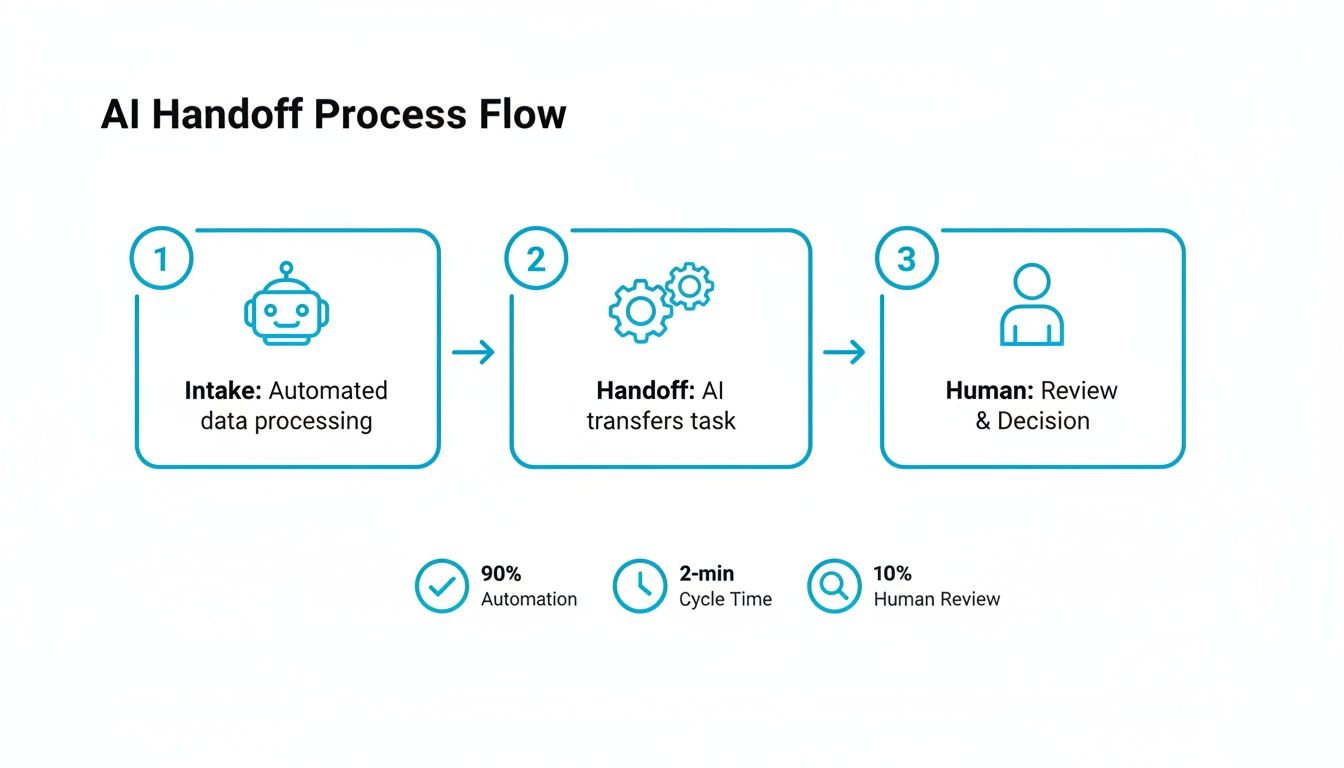
This kind of process means that by the time a human jumps in, they already have all the context they need for a productive and personal follow-up.
With Recepta.ai, you can ensure every conversation is a growth opportunity. Our AI-powered receptionists handle calls 24/7, capture every lead, and provide seamless handoffs to your team, so you never miss a chance to connect. See how it works at https://recepta.ai.