
Handling Difficult Customers: De-escalation & Support
The call comes in three minutes before lunch. A patient says your front desk never called back about a billing issue. Or a homeowner says the technician missed the appointment window and now nobody's answering with a straight answer. By the time your team member says hello, the customer is already angry.
That moment feels personal when you're the one taking the call. It usually isn't. In most businesses, the tension started earlier. A vague policy. A delayed handoff. A message that never made it into the CRM. A promised callback that nobody owned. The customer brings the emotion, but the business often built the conditions.
That's why handling difficult customers well has less to do with winning verbal battles and more to do with running a tighter operation. The best teams I've seen don't train people to “deal with angry customers” as if every issue is just a personality problem. They train people to spot failure points, calm the interaction, and feed what they learn back into the business.
In a dental office, that might mean discovering that treatment estimates are explained one way by the clinical team and billed another way by the front desk. In an HVAC company, it might mean your scheduling window is technically accurate but practically useless because customers hear “morning” and expect 9 a.m., not 11:55. In a law firm, an “impatient” client may not be rude at all. They may be staring at a filing deadline and hearing silence.
A lot of rapport building still matters. Tone matters. Word choice matters. Pace matters. A useful primer on that is how to build rapport with customers. But rapport alone won't fix a broken promise or a muddy policy.
The shift that changes everything is simple. Stop asking, “How do we control this customer?” Start asking, “What made this interaction hard in the first place, and how do we keep it from happening again?”
From Reaction to Resolution an Introduction
The phrase “difficult customer” can hide too much. It can describe a person who is yelling, but it can also describe someone who is confused, scared, rushed, embarrassed, or tired of getting a different answer every time they call. If your team treats all of those situations the same way, they'll either sound robotic or escalate things by accident.
Most tension starts before the call
A plumbing company gets a furious call about a late technician. The dispatcher sees “on the way” in the system and assumes the customer is overreacting. Then they learn the customer took unpaid time off work and has already been waiting half a day. The emotional spike isn't random. It came from a gap between internal status language and customer expectations.
That pattern shows up everywhere:
- Healthcare practices: Insurance coverage language is unclear, so patients think the office changed the price.
- Home services: Appointment windows are too broad, so customers feel trapped at home.
- Professional services: Clients hear “we'll review it soon” and interpret that as “today.”
Practical rule: If the same complaint keeps showing up in different words, you probably don't have a customer attitude problem. You have a process clarity problem.
Resolution starts with system thinking
Strong service teams still coach verbal de-escalation. They should. But they also look at what happened upstream. Was the policy easy to explain? Did the customer receive the same answer on the website, in email, and on the phone? Did the previous staff member leave usable notes? Did anyone own the next step?
When you reframe the work this way, handling difficult customers becomes less exhausting. Your staff no longer feel like they're absorbing chaos all day for no reason. They can resolve the person in front of them and improve the system behind the scenes.
That's the operating mindset worth building. Calm the call. Fix the root cause. Protect the team.
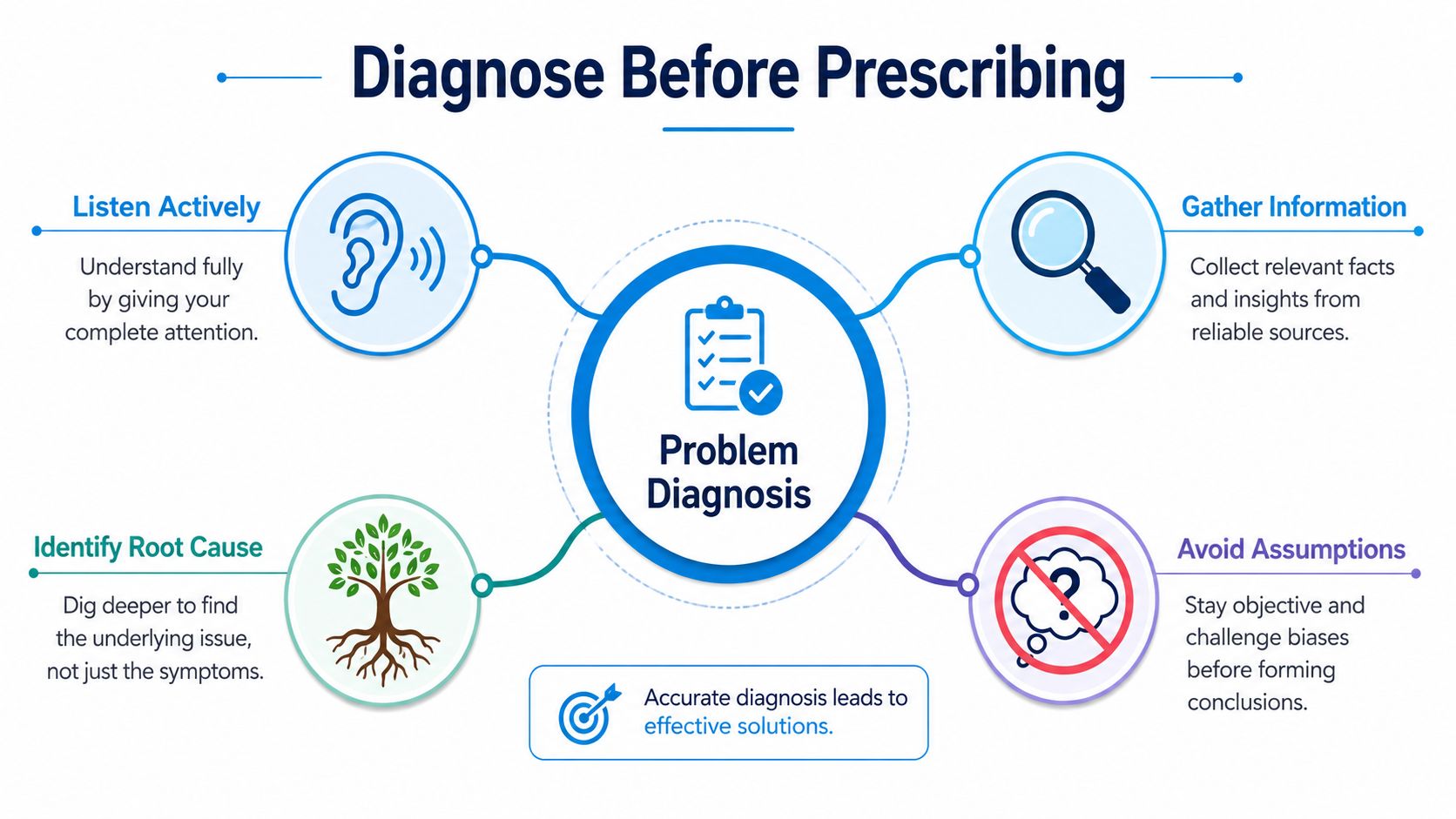
Diagnose the Problem Before Prescribing a Solution
Teams often move too fast. A customer says they're upset, and the agent starts offering fixes before they know what failed. That usually creates a second round of frustration because the customer hears, “You didn't listen.”
A better approach is to diagnose first. Most content labels customers as “difficult” and teaches deflection tactics, but 74% of so-called difficult interactions stem from confusing company policies or inadequate communication, according to a 2024 MIT study on customer service dynamics. That should change how you read almost every tense interaction.
Three customer types that get mislabeled
Some patterns show up often enough that it helps to name them. Not so your team can stereotype people. So they can choose the right response faster.
| Customer type | What's often really happening | Better first move |
|---|---|---|
| Impatient | They're anxious about time, money, or consequences | Set a timeline and offer the fastest realistic path |
| Aggressive | They feel ignored, embarrassed, or trapped | Lower emotional intensity before discussing facts |
| Complainer | They have multiple frustrations and no clear main issue | Narrow the conversation to one solvable problem |
The impatient customer needs clarity, not queue jumping
Don't reward the loudest person by moving them to the front just because they're forceful. That breaks fairness and teaches the wrong lesson. For the impatient customer, explain the delay timeline, thank them for their patience, and if possible direct them to a less-busy colleague who can help sooner, as advised in Aventis Learning's guidance on difficult customer types.
A legal example: a client calls three times in an hour asking about a filing. Instead of saying, “We're swamped,” say, “I understand the timing matters here. The attorney is in court until 2 p.m. I can have your file reviewed after that, or I can connect you with a colleague who can confirm the next procedural step now.”
The complainer often needs structure
Some customers vent broadly. They mention the wrong invoice, then the hold time, then the technician's tone, then the website. If your team tries to answer all of it at once, the call drifts.
A better script is: “I want to sort this out properly. Let me pull up your order and confirm I'm looking at the right account first.” For a complainer who vents without naming a clear issue, it helps to set professional boundaries, explain what your team can do, offer fair alternatives if the request isn't possible, and steer the discussion to concrete account details, as outlined in Zendesk's guidance on difficult customer strategies.
A useful test is this: if you can't summarize the issue in one sentence after the first minute, you're not ready to solve it.
Use a short diagnosis routine
Before proposing any fix, train agents to answer four questions:
- What happened first: The triggering event, not the loudest complaint.
- What does the customer think should have happened: Their expected outcome.
- What's the business constraint: Policy, schedule, compliance, authority.
- What can we do right now: Immediate next step, not perfect end state.
That simple discipline improves call quality fast. It also helps teams document patterns and apply stronger problem-solving techniques in customer service instead of guessing under pressure.
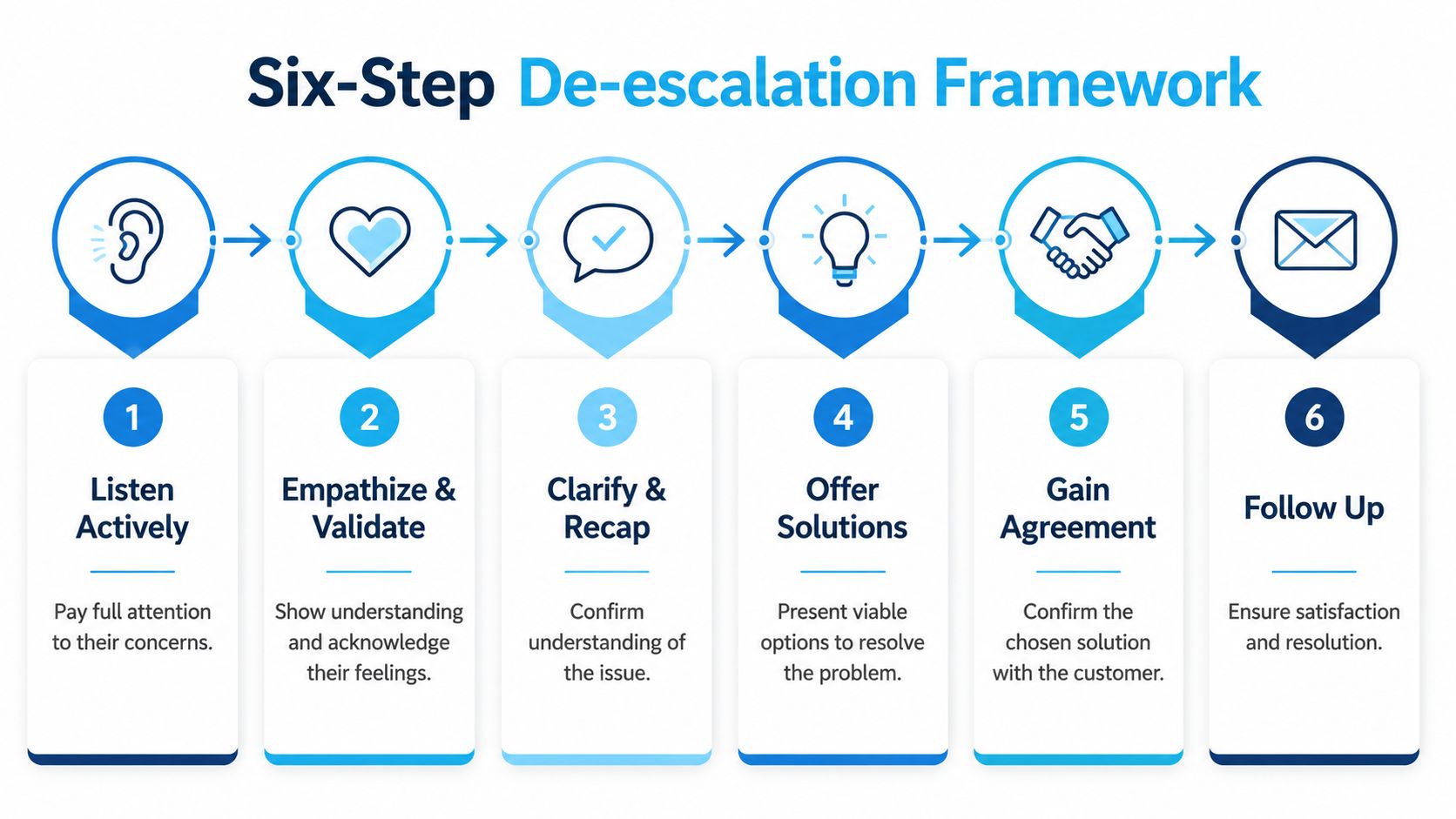
A Six Step Framework for De-escalating Tension
A customer calls furious about a missed appointment, a late fee, and three prior promises that went nowhere. The first minute decides whether this becomes a resolution or another complaint record. Teams do better when they follow a repeatable structure instead of relying on personality.
The point of a de-escalation framework is not to help staff absorb unlimited frustration. It is to lower the temperature, get to a fair next step, and surface the policy or process failure that caused the blowup in the first place.
Step one and step two stay calm and gather information
These first two steps happen together. The agent regulates their own tone, then narrows the conversation enough to get usable facts.
That matters because upset customers often speak in layers. They start with the latest irritation, then add older disappointments, then question your company's intent. If the agent reacts to each point as it appears, the call turns into a running argument.
What works:
- Pause before answering: A short pause prevents defensive replies.
- Use a steady pace: Calm speech lowers friction better than fast reassurance.
- Ask one question at a time: “Was the charge posted this week or last week?” gets better information than “Can you walk me through everything?”
- Reflect back the core issue: “I want to make sure I have this right. The technician missed the window and no one updated you.”
What usually makes things worse:
- Correcting minor details too early
- Sounding rushed
- Quoting policy before the customer believes they were heard
If you train supervisors, it helps to anchor this in the four components of emotional intelligence. Self-awareness keeps the agent from reacting personally. Self-management helps them stay useful under pressure.
Step three clarify the desired outcome
Customers rarely open with a clean request. They describe the history, the inconvenience, and the part that felt disrespectful. The agent still needs to find the practical outcome.
Ask it plainly: “What would feel like a fair next step today?”
That question exposes the trade-off. Sometimes the customer wants money. Sometimes they want speed, certainty, or proof that the problem will not happen again. Those are different fixes, and treating them as the same creates more conflict.
A strong agent also tests what is possible without overpromising. “I can review the fee and I can check for an earlier service slot. I can't waive a safety inspection, but I can tell you exactly what is delaying it.”
Step four present a step-by-step solution
People settle faster when they can see the path, the owner, and the timing. Vague reassurance sounds like stalling, especially if the customer has already been disappointed.
Use a sequence the customer can track:
- State the next action: “I'm pulling up the service notes now.”
- Name who owns each part: “I'm contacting dispatch while we're on the phone.”
- Give a time marker: “I'll have an update for you within 15 minutes.”
- Explain the fallback: “If we cannot restore today's appointment, I'll offer the next two available slots and review the fee.”
Empathy helps here, but it should sound specific, not theatrical. Statements like “I can see why this feels unreasonable after two missed updates” work better than generic apologies. Teams that want better language can keep a shared set of phrases of empathy for customer service so agents sound human without improvising badly.
A simple contrast helps in training:
| Say this | Not that |
|---|---|
| “I can see why you're frustrated. You were told the charge would not post yet.” | “Let me explain our policy.” |
| “Here's what I can do right now.” | “There's nothing I can do.” |
| “I'm checking the notes and I'll tell you the next step in two minutes.” | “Please hold while I look into it.” |
Step five follow up
De-escalation is incomplete until the promised action happens. Many teams frequently lose trust at this stage. The live conversation goes well, then the callback never comes, the note is unclear, or the customer has to start over with someone new.
Follow-up does not have to be elaborate. It has to be reliable.
Useful examples:
- Text after dispatch confirmation: “Your technician is booked for 3 to 5 p.m.”
- Call after review: “We reversed the duplicate charge and emailed the receipt.”
- Email recap: “Here's what we changed, what is still pending, and when you'll hear from us again.”
Step six log the data
Every tense interaction contains operational evidence. If agents only record the mood of the call, leadership learns nothing. If they log the trigger, promise made, and root cause, the business can fix the pattern behind the anger.
Good post-call notes should capture:
- What triggered the tension: missed expectation, billing error, delay, handoff failure
- What the customer wanted: refund, callback, same-day service, explanation
- What was promised: credit review, replacement visit, manager callback
- What caused it at the system level: unclear policy, staffing gap, bad automation, poor account notes
This step also protects employees. A team should not be told to “handle difficult customers better” if the underlying issue is a broken scheduling process, a fee policy no one can defend, or repeat understaffing during peak hours. Good de-escalation lowers heat in the moment. Better operations reduce how often your people get put in that position at all.
How and When to Escalate Interactions Seamlessly
Not every issue belongs with the first person who answers the phone. Some calls need authority. Some need technical depth. Some need a manager because the customer has lost confidence in the original handler. Escalation isn't failure. Poor escalation is.

Know your escalation triggers
Frontline staff shouldn't have to guess whether a call is still theirs to own. Define the triggers in plain language and rehearse them.
A practical escalation checklist:
- Safety or threat language: End personal debate and move to the designated lead.
- Legal or compliance complexity: Shift to the person authorized to respond.
- Repeated failure of prior fixes: A fresh owner often restores confidence.
- Manager request: Don't resist it for ten minutes. Confirm the request and hand off professionally.
- Abusive behavior: Set boundaries first, then escalate or end the interaction according to policy.
The handoff language matters as much as the trigger. “I'm transferring you” feels like abandonment. “I want to bring in the person who can resolve this fastest, and I'm going to brief them before you speak” feels controlled.
Make the customer repeat less
The worst handoff is the one where the customer retells the whole story. That tells them your team isn't coordinated.
A clean escalation has three parts:
- Recap the issue in one sentence
- Explain why the next person is the right owner
- Transfer notes before the conversation changes hands
For example: “You were billed after being told the adjustment had already been applied. I'm pulling in our billing supervisor because they can review and reverse charges directly. I'm sending them the summary now so you won't have to repeat this.”
That kind of transition lowers friction for both sides.
Where automation helps
Some organizations now use AI receptionist systems as the first layer for intake and triage. In emotionally charged scenarios, those systems can trigger automatic escalation to trained human agents within 45 seconds when voice stress metrics exceed 78%, achieving an 89% first-call resolution rate and reducing cost per interaction by 80% versus in-house staff.
That matters most when the alternative is a voicemail box, a frazzled receptionist, or an after-hours call that sits untouched until morning. The gain isn't just speed. It's consistency. The human agent receives context, signal, and a reason for escalation before saying a word.
This video gives a useful sense of how AI-assisted call handling can support smoother customer interactions:
Escalation should protect trust, not just move work
The trade-off is real. Escalating too early can make agents seem powerless. Escalating too late can make customers feel trapped. The right middle ground is to let frontline staff resolve normal friction, but remove ambiguity around the moment a case needs authority, specialization, or emotional reset.
The best escalation process doesn't feel like a transfer. It feels like momentum.
Turn Bad Experiences into Business Intelligence
A complaint becomes useful when it leaves a trail your team can act on. If it ends as a one-off apology, the same failure usually shows up again next week, with a different customer and the same avoidable stress on staff.

Follow-up is where credibility is tested
Customers remember whether you did what you said you would do. A calm call helps in the moment. Clear follow-through is what restores trust.
The strongest recovery workflows are simple enough to use under pressure:
- A same-day recap: Confirm the action taken and the next checkpoint.
- A named owner: One person is accountable for closing the loop.
- A final confirmation: Ask whether the issue is fully resolved, not just processed.
That last step matters more than teams expect. I have seen organizations close tickets because the refund was issued or the technician rescheduled, while the customer still had no idea what changed or what would happen next. Operationally, the case looked finished. From the customer's side, it still felt shaky.
Your CRM should capture patterns, not just anecdotes
CRM notes need to do two jobs at once. They need to help the next employee pick up the case without making the customer repeat themselves, and they need to help managers spot recurring friction.
Speed matters here. Notes entered right after the interaction are usually cleaner, more accurate, and more useful than notes written from memory at the end of a shift. What gets lost first is usually the trigger, the exact promise made, and the detail that points to the cause.
A simple call log structure works well:
| Field | Example |
|---|---|
| Trigger | Technician missed stated arrival window |
| Customer state | Frustrated, worried about leaving for work |
| Promise made | Supervisor callback within 15 minutes |
| Root cause | Overbroad scheduling language |
| Needed fix | Rewrite confirmation message and arrival updates |
Short, structured notes also protect your team. If a caller contacts you again, the next agent can continue the conversation without forcing the employee or the customer to start from zero.
Look for policy patterns, not isolated blame
One angry call can be random. Ten similar calls usually point to a broken policy, a vague message, or a handoff that no one owns.
Use CRM logs and call summaries to review themes such as:
- Billing language customers misunderstand
- Service windows that create false expectations
- Refund rules staff explain inconsistently
- Departments that hand off without ownership
This is management work. If the same issue keeps creating tension, the fix belongs upstream.
A script can help an employee survive a bad interaction. It cannot repair a refund policy that sounds punitive, a scheduling system that overpromises, or a billing notice written in language customers read as threatening. Those problems create repeat contacts, longer handle times, lower trust, and more strain on frontline staff.
The useful question after a difficult interaction is not only, “How did the agent handle it?” It is also, “What in our process made this call likely?” Teams that ask both questions improve service faster and burn out fewer people in the process.
Protect Your Team and Reduce Employee Churn
A lot of customer service training treats staff as if professionalism means emotional absorption. Stay calm. Be empathetic. Don't take it personally. All of that matters. It's also incomplete.
A 2025 Harvard Business Review study indicates that 68% of customer service agents report “emotional exhaustion” as a primary reason for turnover, yet only 22% of companies provide structured post-interaction decompression sessions. That gap is a leadership problem, not an individual resilience problem.
Build decompression into the job
If your team handles high-friction calls all day, they need a reset protocol that is normal, quick, and stigma-free.
That can include:
- Two-minute post-call pauses: Especially after abusive or highly emotional interactions.
- Supervisor check-ins: Not to audit performance first, but to help the employee reset.
- Short peer debriefs: A place to offload the emotional residue without gossiping about customers.
Train boundaries, not just empathy
Empathy without boundaries burns people out. Staff need language for the moment a caller becomes insulting, threatening, or impossible to redirect.
Try scripts like:
- “I want to help, and I need us to keep this conversation respectful.”
- “I can continue if we focus on the issue and avoid personal insults.”
- “If the language continues, I'll need to end the call and reconnect through a supervisor.”
Good wellness practices outside the contact moment matter too. Resources like WeekdayDoc's burnout prevention are useful because they translate stress management into repeatable habits instead of vague advice.
Teams also benefit from a shared standard for the ultimate guide to empathy in customer service, especially when empathy is paired with clear limits and practical support.
Respectful service does not require your staff to absorb abuse as part of the job.
Protecting your team is part of handling difficult customers well. Tired employees miss cues, shorten their patience, and leave. Supported employees listen better, document better, and recover faster after hard calls.
If your team is buried in missed calls, tense handoffs, and after-hours voicemails, Recepta.ai can help create a calmer front line. It handles inbound conversations, captures context, routes urgent issues, and supports smoother escalation so your staff can focus on the calls that need human judgment most.