
Powerful Phrases of Empathy: De-escalate & Build Loyalty
You can hear the difference between a scripted response and a useful one in the first few seconds of a call. A patient says they've already taken time off work. A homeowner says water is leaking into the hallway. A legal client says nobody has called them back. In each case, the wrong phrase makes the problem feel bigger. The right one lowers the temperature and opens the door to resolution.
That's why phrases of empathy matter so much in business. They aren't decorative language. They help people feel understood, which makes them more willing to share details, accept next steps, and stay engaged long enough for your team to solve the issue. In customer-facing communication, empathy is also a clear expectation. A customer service summary reported that 96% of customers feel empathy is critical, while only 3% of contact-center representatives were found to demonstrate it consistently. The same summary also notes that emotionally connected customers can be more than twice as valuable as highly satisfied customers, which is why empathy affects loyalty as much as tone (customer empathy research summary).
This gap matters even more in a digital-first environment, where AI receptionists, chat tools, and call routing systems now shape the first impression. If you serve multilingual customers, even tools like real-time conversation translation work best when the wording itself is calm, respectful, and human.
The phrases below are the ones I'd put into frontline scripts, coaching notes, and AI call flows today. They work because they acknowledge emotion without losing accuracy, and they move the conversation toward action.
1. I understand how frustrating that must be

This phrase works because it names the emotion before you touch the process. Most upset callers don't want a policy first. They want confirmation that you understand the disruption.
Used well, it buys you cooperation. Used poorly, it sounds canned. The difference is what comes next.
Where it works best
In healthcare, a delayed appointment is rarely just a schedule issue. It may mean childcare changes, missed work, or anxiety about symptoms. “I understand how frustrating that must be when you've already arranged your day around this. Let me look for the next available opening.”
In home services, the same phrase helps when a visit gets rescheduled. “I understand how frustrating that must be. I'm checking the board now and I'll prioritize the earliest confirmed slot.”
Practical rule: Validation without a next step sounds performative. Pair this phrase with action in the very next sentence.
Qualtrics describes empathy in service as putting yourself in the customer's position and notes that empathy phrases work best when they're authentic and timely rather than scripted. It also frames useful empathy statements around validating feelings, appreciating the contact, promising advocacy, and offering a path forward (Qualtrics empathy phrases guide).
If you're building phone scripts, this is also where rapport starts. Recepta.ai's guidance on building rapport with customers fits this moment well. Lead with acknowledgment, then move fast into a concrete fix.
2. Thank you for your patience with us
This phrase does two jobs at once. It acknowledges a delay, and it reframes the customer as cooperative rather than difficult. That matters because people often mirror the role you give them.
It works best after a real inconvenience. Don't use it as filler at the start of every call. Use it when someone has waited, been transferred, or dealt with a complicated process.
Strong examples by industry
A legal firm can say, “Thank you for your patience with us while we reviewed every detail of the filing.” That signals care, not drift.
An HVAC dispatcher can say, “Thank you for your patience with us today. We've got your technician confirmed, and I'll stay on the line until you have the arrival window.” In insurance, this helps during underwriting or claims review: “Thank you for your patience with us while this is being processed. Here's what happens next.”
What doesn't work is thanking someone for patience when they haven't been patient. If the caller is still angry, go back to acknowledgment first. Thanking too early can sound like you're congratulating them for an experience they hated.
A simple internal coaching rule helps:
- After a wait: Use this when the delay is over and you can offer an update.
- After a transfer: Use it when the new person already has context and won't ask the customer to repeat everything.
- After a complex review: Use it when accuracy required extra time and you can explain why.
For AI receptionists, this phrase belongs after a measurable hold, callback gap, or queued handoff. It should trigger from real friction, not random intervals.
3. I hear you, and I want to help
This is one of the best first-response phrases in high-emotion situations because it combines listening with intent. “I hear you” tells the customer they've landed somewhere responsive. “I want to help” tells them movement is coming.
That second part matters. A lot of empathy language fails because it stops at emotional acknowledgment. Customers don't just want to be heard. They want progress.
Use it when urgency is obvious
Pest control: “I hear you, and I want to help. Let me get you onto today's emergency schedule.”
Dental clinic: “I hear you, and I want to help make this easier. I'm going to note your anxiety concerns so the dentist sees them before you arrive.”
Plumbing: “I hear you, and I want to help get this under control. First, tell me whether the main water valve is already shut off.”
Don't let this phrase float on its own. Anchor it to the first practical action within seconds.
In my experience, this is also one of the most useful phrases to automate at the front door of a business, especially when calls arrive after hours. But AI should only use it when it can also guide the caller somewhere useful. If the system can't gather the right details, route urgency, or escalate fast, the phrase feels empty.
That's where good design matters more than good wording. Recepta.ai's material on empathy in customer service lines up with this principle. The phrase should be tied to intent detection, note capture, and a clear handoff path.
4. Let me see what I can do for you
This phrase is valuable because it shows effort without making a promise you may not be able to keep. In CX work, that's a critical distinction. Overpromising creates a second failure.
When a customer asks for an exception, a rush, or a workaround, this wording keeps the door open while protecting accuracy.
Why this phrase is safer than “I'll take care of it”
“I'll take care of it” sounds strong, but it can lock you into an outcome you don't control. “Let me see what I can do for you” is more honest. It shows advocacy without pretending authority you may not have.
A medical office can say, “Let me see what I can do for you. I'll send this refill request to the on-call provider and call you back as soon as I have guidance.” A construction coordinator can say, “Let me see what I can do for you. I'm checking with the crew lead on that change order now.”
The phrase also works well in franchises and multi-location businesses where local calendars, staffing, and inventory vary. Customers usually accept limits if you show real effort and give a time-bound follow-up.
Use this format:
- State the effort: “Let me see what I can do for you.”
- Name the action: “I'm checking scheduling now.”
- Set the return point: “I'll call you back within the hour.”
That structure reduces anxiety because the customer knows what you're doing and when they'll hear back.
5. I appreciate you bringing this to our attention
Complaints are expensive when teams get defensive. They're useful when teams treat them as free visibility into broken moments. This phrase helps you make that shift in real time.
It tells the customer their complaint wasn't an annoyance. It was information worth acting on.
Best use cases
A cleaning company can say, “I appreciate you bringing this to our attention. I'm scheduling a return visit today so we can correct the missed area.”
A finance or real estate team can say, “I appreciate you bringing this to our attention. I'm reviewing the billing line now and I'll send you a corrected summary.”
A law firm can say, “I appreciate you bringing this to our attention. If communication hasn't been clear, we need to fix that. Let's set a regular update schedule.”
This phrase is stronger than a generic apology when the customer is pointing out a process issue, not just venting emotion. It also helps managers coach teams away from blame. If a caller says, “I've already told three people,” your team should not defend the handoff. They should thank the caller for surfacing the breakdown and fix the relay.
A good complaint workflow treats this phrase as the beginning, not the end:
- Acknowledge the report
- Correct the immediate issue
- Flag the pattern for quality review
That third step matters. Otherwise empathy becomes theater.
6. I want to make sure I understand correctly
A surprising amount of bad service comes from speed, not indifference. Agents rush to solve before they've confirmed what the problem is. This phrase slows the conversation just enough to prevent expensive mistakes.
It's one of the best phrases of empathy because careful listening is a form of respect. You're telling the customer their details matter.
Confirmation reduces friction
An HVAC office might say, “I want to make sure I understand correctly. The unit won't turn on at all, and this started last night after the storm. Is that right?”
In insurance: “I want to make sure I understand correctly. You need coverage for three vehicles, and you want the policy effective at the start of next month.”
In healthcare: “I want to make sure I understand correctly. The pain is in your lower back, it's sharp, and certain movements make it worse.”
A major healthcare review found that provider empathy had a positive and significant effect in 81% of 153 outcome analyses, and among the randomized controlled studies included, 91% showed a positive effect. The same review noted that the Jefferson Scale of Empathy was the most commonly used measure, appearing in 35.7% of studies, which matters because it shows empathy has long been measured with standardized tools rather than treated as a vague trait (systematic review on empathy in healthcare).
Telephone teams should train this as a paraphrase move, not a stall tactic. Repeating key facts back to the caller improves accuracy and makes handoffs cleaner. Recepta.ai's post on customer service on the telephone is relevant here because phone-based service falls apart fast when note-taking and confirmation are weak.
7. I'm here to help, not judge
This phrase creates safety. In sensitive conversations, safety is often the main barrier to progress. If callers expect shame, dismissal, or interrogation, they withhold the very details your team needs.
That's why this phrase belongs in healthcare, legal intake, financial hardship calls, and support settings involving personal risk.
Sensitive situations need more than generic empathy
A medical office can say, “I'm here to help, not judge. You can tell me what's going on, and we'll figure out the right next step.” A legal intake specialist can say, “I'm here to help, not judge. Share only what you're comfortable sharing, and I'll explain your options.” A financial services team can say, “I'm here to help, not judge. Let's look at where things stand and what's still possible.”
This phrase works because it lowers defensiveness. But it can backfire if your next question sounds cold or accusatory. Tone and sequencing matter. Sensitive communication guidance in health contexts also points to a bigger issue: one generic empathy list isn't enough when privacy, safety, cultural sensitivity, or trauma are part of the conversation (sensitive health communication research).
In high-stakes conversations, empathy isn't agreeing with everything the caller says. It's creating enough safety for the truth to come out.
For AI receptionists, this is a phrase to use carefully. It can support intake, but for trauma, discrimination, or crisis disclosures, escalation to a trained human is usually the right move. The phrase should open the door, not replace professional judgment.
8. I'll make sure this gets handled right
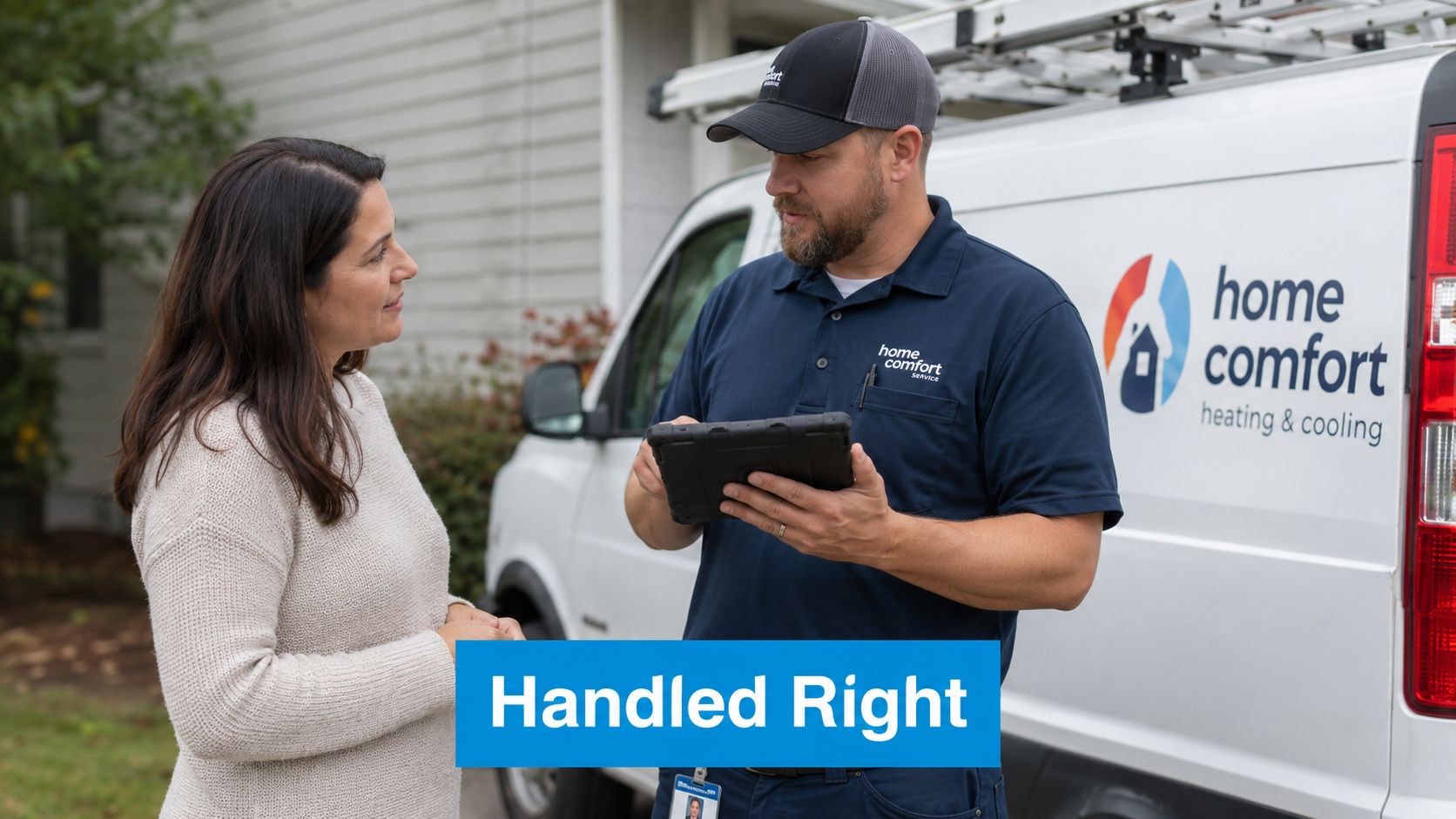
This phrase is about accountability. Customers use it as a signal that their issue won't disappear into a queue.
That makes it especially useful in complex or high-stakes situations where the customer fears being bounced around.
Accountability has to be visible
For a plumbing emergency: “I'll make sure this gets handled right. I'm assigning this to our lead emergency technician and noting the water-damage risk.”
For healthcare referrals: “I'll make sure this gets handled right. I'm checking that the specialist receives your records before we close this out.”
For a legal deadline: “I'll make sure this gets handled right. I'm flagging the filing date and making sure the case team sees it today.”
What makes this phrase credible is ownership. Someone has to track the issue. If your workflow can't show who owns the case, what the next step is, and whether the customer got closure, don't use this line casually.
That's where process discipline matters more than wording. Recepta.ai's article on customer service best practices fits this idea well. If you promise careful handling, your systems need notes, routing, and follow-up to support the promise.
9. That's a great question, let me explain
Customers often ask questions when they're unsure, skeptical, or trying to protect themselves from a bad decision. If your team reacts like the question is inconvenient, trust drops fast.
This phrase does the opposite. It tells the customer their concern is legitimate and worth a real answer.
Respect the question, then teach clearly
Insurance agents can use this well: “That's a great question, let me explain how the deductible applies before the carrier contributes to the claim.” A home services office might say, “That's a fair concern, let me explain how our arrival windows work and what updates you'll get on the day.” In dental care: “That's a great question, let me explain why this treatment is being recommended and what the alternatives are.”
The phrase is strongest when the explanation is short, plain, and specific. If your answer gets buried in jargon, the empathy opening won't save it.
A useful service sequence from AnswerConnect recommends acknowledging emotion first, restating the issue, and then moving to resolution, with examples such as “I understand why you feel this way, and I'm here to help” and “I'm committed to resolving this for you.” That sequence maps well onto educational moments too. Respect first. Clarify second. Solve third.
You can also coach teams to replace defensive wording:
- Instead of: “That's just our policy.”
- Say: “That's a fair question, let me explain how this works and what options you have.”
That simple shift keeps the customer in the conversation.
10. I want to find a solution that works for you
This phrase changes the posture of the call. Instead of defending the company's standard process, you're inviting collaboration within real limits.
That's why it works especially well when the default option doesn't fit the customer's schedule, budget, or circumstances.
Flexibility without losing control
A franchise scheduler can say, “I want to find a solution that works for you. If evenings are out, let's look at early morning or midday options.”
A real estate team can say, “I want to find a solution that works for you. Tell me your timeline, your must-haves, and where you have flexibility.”
A construction company can say, “I want to find a solution that works for you. Let's separate the essential repairs from the nice-to-have upgrades and build the project in phases.”
This phrase also translates well into AI-assisted service. A good receptionist system can gather constraints, suggest available windows, note preferences, and surface alternatives before a human steps in. A newer technical benchmark in multimodal AI, the EmpathicStories++ dataset, was built to support quantitative evaluation of empathic response in video, audio, and text. It contains 53 hours of multimodal data from 41 participants and is described as the first in-the-wild, long-term, multimodal dataset on empathy toward personal experiences, which is directly relevant to how AI systems may learn to tailor empathic responses more effectively (EmpathicStories++ benchmark).
The key point is simple. AI can support empathy at scale when it captures context, avoids overpromising, and knows when a human needs to take over.
Top 10 Empathy Phrases Comparison
| Phrase | 🔄 Implementation Complexity | Resource Requirements | ⭐ Expected Effectiveness | 📊 Expected Outcomes | 💡 Ideal Use Cases / Tips |
|---|---|---|---|---|---|
| I understand how frustrating that must be | Low, simple phrasing but needs authentic delivery | Low, agent scripting/training; optional sentiment detection for AI | ⭐⭐⭐⭐, strong de-escalation and rapport building | 📊 Reduced defensiveness; more cooperative interactions; may extend call time if not actioned | Use when customers express clear frustration; always follow with concrete next steps |
| Thank you for your patience with us | Low, easily automated after delays | Moderate, hold-time tracking, potential compensatory gestures | ⭐⭐⭐, builds goodwill despite service shortcomings | 📊 Increased customer goodwill and lower escalation; does not fix root causes | Deploy after waits or delays; pair with timeline or a small gesture |
| I hear you, and I want to help | Low–Medium, needs quick escalation capability | Moderate, rapid routing/escalation workflows and agent readiness | ⭐⭐⭐⭐, validates and commits to action, strong first-response impact | 📊 Sets expectation of resolution; improves trust if followed through | Use in initial contact for urgent reports; follow with a specific action within 30s |
| Let me see what I can do for you | Medium, requires information lookups and follow-up processes | Moderate–High, integrations (scheduling, CRM), callback workflows | ⭐⭐⭐, manages expectations without overpromising | 📊 Realistic commitments and flexible outcomes; can frustrate if vague | Use when investigation is needed; provide a clear follow-up timeframe |
| I appreciate you bringing this to our attention | Low, simple acknowledgment with QA linkage | Moderate, feedback flagging and quality review processes | ⭐⭐⭐, reframes complaints as improvement opportunities | 📊 Captures actionable feedback; prevents escalation when paired with fixes | Use for complaints; always follow with corrective action and document feedback |
| I want to make sure I understand correctly | Low–Medium, requires confirmation technique | Low, training and CRM note-taking; AI can assist with summaries | ⭐⭐⭐⭐, reduces callbacks and prevents errors | 📊 Fewer misunderstandings and service failures; may add a little call time | Use after detailed customer input; summarize and confirm key facts |
| I'm here to help, not judge | Low, tone-sensitive, needs genuine delivery | Moderate, trained agents for sensitive topics; confidentiality assurances | ⭐⭐⭐⭐, encourages disclosure and honest communication | 📊 More complete information from customers; greater trust in sensitive contexts | Use in healthcare, legal, or financial vulnerability scenarios; pair with confidentiality |
| I'll make sure this gets handled right | Medium, requires assignment and tracking to be credible | High, ownership assignment, specialist resources, tracking systems | ⭐⭐⭐⭐, signals accountability and quality commitment | 📊 Higher satisfaction and confidence if fulfilled; reputational risk if not | Use for high-stakes or complex issues; assign an owner and track completion |
| That's a great question/concern, let me explain | Low–Medium, depends on agent knowledge and KB access | Moderate, knowledge base, coaching, AI answer templates | ⭐⭐⭐⭐, educates customers and reduces repeat inquiries | 📊 Empowers customers; lowers future support volume if explanations are clear | Use for "why" questions; keep explanations concise and jargon-free |
| I want to find a solution that works for you | Medium, requires policy flexibility and empowered agents | High, empowerment, escalation channels, approval processes | ⭐⭐⭐⭐, highly effective when agents can create tailored solutions | 📊 Increases satisfaction and loyalty; risk of unsustainable precedents | Use for non-standard needs; clarify limits and document exceptions for consistency |
From Words to Workflows: Scaling Empathy
A consistency problem, not an empathy problem, is often the true challenge. One great receptionist handles a hard call beautifully, while the next interaction sounds rushed, defensive, or robotic. The fix isn't to hand people a longer script. It's to turn the right phrases of empathy into repeatable operating habits.
Start with sequence. In most service calls, the strongest order is acknowledgment, clarification, then action. That matches what works in practice. It also matches the broader service guidance already discussed earlier. First, name what the customer is feeling. Second, confirm the facts. Third, explain the next step in plain language.
Then build guardrails around authenticity. Popular empathy articles often stop at one-liners like “I understand how you feel” or “I'm here to listen,” but they rarely explain when those phrases start sounding fake, overused, or manipulative. That gap matters in real operations because customers can hear overagreement instantly. If your team says “I completely understand” when they clearly don't yet have the details, trust drops. Better phrasing is narrower and more credible: “I understand why that would be frustrating” or “I want to make sure I understand correctly.”
AI belongs in this system, but not as a shortcut for sincerity. It works best when it handles the repeatable parts well. Greeting the caller, detecting urgency, confirming details, logging notes, routing to the right person, and offering a clear path forward. It should not fake emotional depth or make promises outside policy. If you use an AI receptionist, train it on approved empathy language tied to actual workflows. That means a phrase like “I want to help” should trigger a useful next step, not a conversational dead end.
This is also where editing matters. If you publish customer-facing AI scripts, voice prompts, follow-up texts, or knowledge base responses, make sure they sound natural before they go live. Tools built to Humanize AI Text can help teams review robotic phrasing, but the essential standard is operational honesty. Does the sentence reflect what your business will do next?
Recepta.ai is one option that fits this workflow-oriented approach because it combines conversational AI with human escalation, scheduling, lead capture, and system integrations. That matters for empathy because the handoff from language to action is where trust is either built or lost.
Pick one phrase from this list this week. Add it to one call type, one training doc, and one automated workflow. Then listen to real conversations and tighten the wording until it sounds natural in your business. Empathy scales when teams practice it, support it, and connect it to follow-through.
If you want your phones, scheduling, and follow-up workflows to sound more human without losing speed, take a look at Recepta.ai. It can help your team capture leads, handle routine conversations, and escalate sensitive or complex interactions to trained humans when empathy needs to go beyond a script.