
Your Guide on How to Answer the Phone Professionally
That phone ringing off the hook isn't just noise—it's the sound of opportunity. For any service professional, whether you're in home services, healthcare, or law, every one of those rings is a potential client, often worth thousands of dollars. But here's the hard truth I've seen play out time and time again: most small businesses are fumbling the ball at the one-yard line.
The True Cost of a Missed Call
It’s almost hard to believe, but data shows that only 38% of small businesses consistently answer their inbound calls. Think about that. A staggering 37.8% of callers are funneled into voicemail, and another 24.3% get no answer at all. For a business that relies on appointments and new clients to generate revenue, that’s not just a leak; it’s a flood of lost income.

Why Every Ring Matters
We live in an on-demand world. When someone needs a problem solved, they want it solved now. In fact, 77% of customers expect an immediate response when they reach out to a business. If you don't pick up, you’re essentially giving them permission to call your competitor.
Imagine these real-world scenarios:
- Actionable Example (Plumber): A homeowner with a burst pipe under their kitchen sink isn't going to leave a voicemail. They're hanging up and immediately dialing the next plumber on their Google search list.
- Actionable Example (Dentist): A patient suffering from a severe toothache needs relief today, not a callback tomorrow. If your office doesn't answer, they'll book an emergency appointment with the clinic down the street that does.
- Actionable Example (Lawyer): Someone looking for urgent legal advice after a car accident will simply move on to the firm that actually answers the phone and can offer a consultation right away.
The most fundamental rule for answering the phone is simply being available. If you don't pick up, even the most polished script is completely worthless.
This is precisely the gap that a good AI receptionist can fill, ensuring 100% of your calls are answered 24/7. We've seen businesses capture up to a 30% increase in qualified leads just by making sure every call is handled, turning what would have been dead air into booked jobs and new clients.
Crafting the Perfect First Impression
The first five seconds of a phone call set the tone for the entire interaction. It's your first, and sometimes only, chance to show you're professional, competent, and ready to help. A simple, confident greeting is your best tool for building that instant trust.
To help you and your team nail this every time, here's a breakdown of the perfect opening line.
Anatomy of the Perfect Phone Greeting
This simple formula, when delivered with a warm tone, instantly puts callers at ease and signals that they're in good hands. Consistency is key, so make sure everyone who answers your phone—from you to an admin to an AI receptionist—uses this structure.
Greeting Examples for Different Industries
While the core elements stay the same, you can tweak your greeting to fit your industry's specific vibe.
- Home Service Company: "Thank you for calling Precision Plumbing, this is Sarah. How can I help you today?" This is friendly, direct, and gets straight to the point.
- Medical Office: "Good morning, you've reached Harmony Dental. This is Michael speaking. How may I direct your call?" The language is a bit more formal, which suits a healthcare environment perfectly.
- Law Firm: "Evergreen Law Group, this is Emily. How can I assist you?" This greeting is concise, professional, and conveys a sense of authority and competence.
Of course, answering the call is only half the battle. A surprisingly common mistake is jotting down a wrong number during intake, which is just as bad as missing the call in the first place. To protect against this, you might consider using a phone number validation checker in your process. It’s a simple step that ensures the valuable leads you capture are always reachable for follow-up. After all, a great first impression doesn't mean much if you can't get back in touch.
Mastering Your Tone and Professional Phrasing
Once someone answers the phone, what you say is only half the battle. How you say it—your tone, your choice of words, your pacing—is what really builds trust or creates friction right from the start.
Think about it. A warm, confident voice can make a caller feel instantly at ease. But the wrong phrasing can make them feel like just another number.
This is where the old advice to "speak with a smile" really holds up. It sounds a bit cheesy, but physically smiling when you answer the phone genuinely changes your vocal tone, making it sound warmer and more inviting. It’s a tiny action that can completely change a caller's first impression of your business.
The Power of Positive Language
The words you choose can either pour water or gasoline on a fire. The trick is to swap out negative, dead-end language for positive, action-focused phrases. This small shift projects confidence and a genuine desire to help, which is what professional phone handling is all about.
Here’s how this plays out in real-world situations:
Instead of: "I don't know."
- Try this (Practical Example): A caller asks about a specific HVAC filter model you're not sure you carry. Say, "That's a great question. Let me check our inventory system for you right now."
Instead of: "You'll have to call back."
- Try this (Practical Example): You're a lawyer in a meeting when a potential client calls. Have your receptionist say, "Mr. Smith is with another client right now, but I can have him call you back in about 30 minutes. What number works best?"
Instead of: "We can't do that."
- Try this (Practical Example): A client wants a Saturday appointment, but you're closed. Say, "While we're closed on Saturdays, here’s what we can do. I have a late appointment available Friday at 5 PM or first thing Monday at 8 AM. Would either of those help?"
These alternatives do more than just sound better—they actively push the conversation toward a solution. You're not just pointing out a problem; you're offering to solve it.
Professional phrasing is about shifting from "I can't" to "Here's what I can do." This simple change transforms you from a gatekeeper into a problem-solver in the caller's mind, building trust and paving the way for a positive outcome.
Using Active Listening Cues
A professional phone call should never be a monologue. You need to show the caller you’re engaged by using verbal cues that signal you’re actually listening. These small phrases are powerful tools for showing empathy and paying attention.
Try weaving these active listening cues into your conversations:
- "I understand." A simple, direct way to acknowledge what the caller is saying.
- "Let me make sure I have that right..." This proves you're not just hearing the words but processing them. Practical Example: "Okay, let me make sure I have that right. You need a quote for a full roof replacement on a two-story home, and you're also interested in new gutters?"
- "That makes sense." This validates the caller’s perspective and helps build rapport.
- "Thanks for explaining that." Shows you appreciate the effort they're taking to give you details, especially if the issue is complicated.
When a client is walking you through a complex problem, a quick "Okay, I see" lets them know you're following along without derailing their train of thought. It's the verbal equivalent of a nod. Mastering these little cues is a cornerstone of great phone communication. For even more ideas, check out our guide on crafting effective business phone greetings.
Beyond these specifics, brushing up on broader customer service best practices will give you a solid foundation for handling nearly any interaction.
Tone Examples for Different Situations
A one-size-fits-all tone doesn't work. You have to adapt to the caller's mood and their reason for calling.
Matching your tone to the situation shows you're adaptable and tuned in to the caller's emotional state. That’s the mark of a real pro. It proves you're not just a robot reading a script—you're a person connecting with another person.
Your Playbook for Common Call Scenarios
Not all phone calls are created equal. One minute you’re gently guiding a new lead, and the next you’re calming a long-time client who’s upset about a bill. The only way to navigate this is to have a solid game plan for the calls you know are coming.
Confidence is the bedrock of every successful call. It’s what turns a simple conversation into a trust-building interaction.
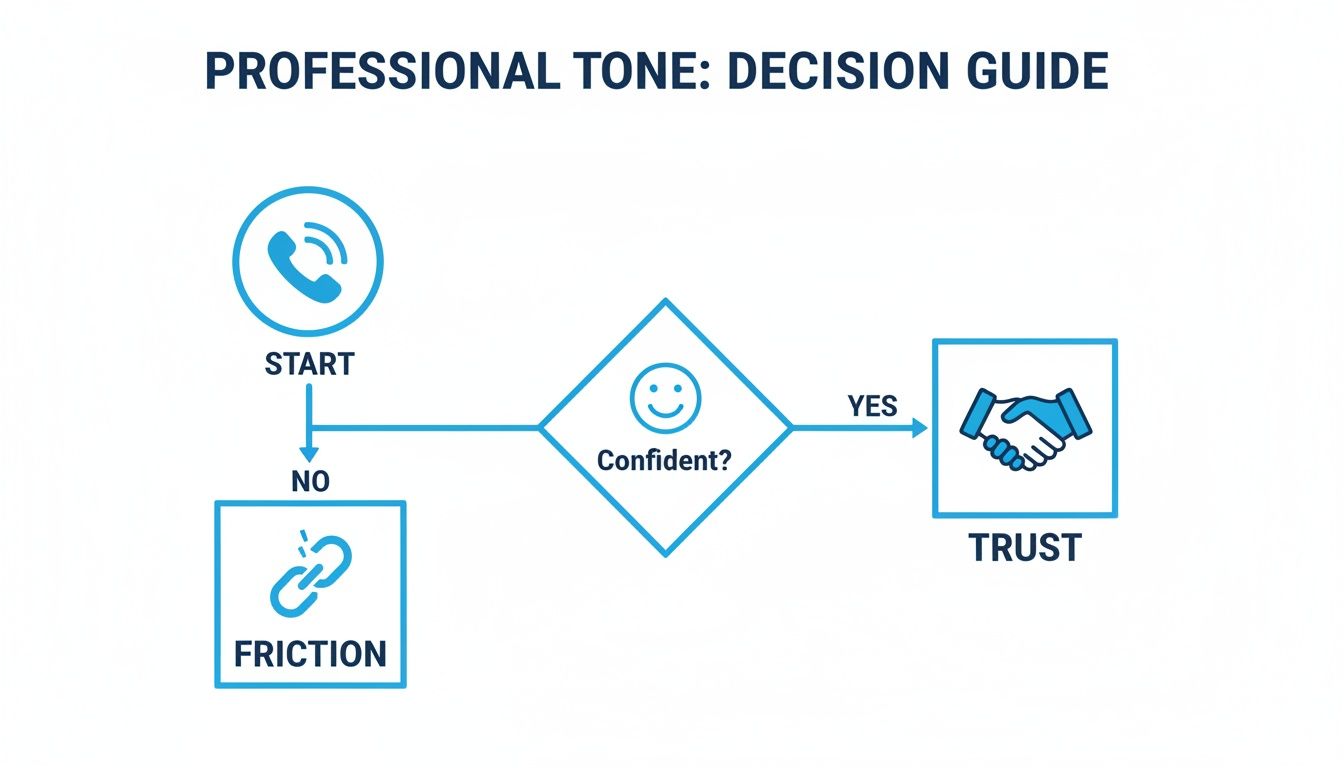
As you can see, there's a direct line from a confident tone to a trusting caller. Any hint of uncertainty introduces friction right away, and that’s a tough first impression to undo.
Handling New Client Intake and Appointment Scheduling
Let's be honest, this is the money call. When a potential new client is on the line, you have to capture their information and get them on the schedule without a single misstep. A clunky, disorganized intake process can make them second-guess whether you’re the right choice for the job.
The key is to lead the conversation without sounding like you're reading from a script.
Actionable Example (Dental Office):
- Greeting: "Thank you for calling Bright Smiles Dental, this is Maria. How can I help you today?"
- Intake: "I can definitely help you schedule your first appointment. To get started, could I just get the correct spelling of your first and last name?"
- Verification: "Perfect. And is the best number to reach you at (555) 123-4567?"
- Booking: "Great. Looking at the schedule, Dr. Evans has an opening next Tuesday at 10:00 AM or Thursday at 1:30 PM. Would either of those work for you?"
See how it flows? You’re not just firing off questions—you’re guiding them smoothly to the finish line. For a closer look at these techniques, our guide on call handling best practices is a fantastic resource.
Managing Urgent or Emergency Service Requests
Now for the high-stakes calls. When a customer's heat goes out in the middle of winter or a pipe bursts, they aren't just calling for information; they're calling for a lifeline. For plumbers, HVAC techs, and other home service pros, this is a moment of truth.
Your tone needs to be calm, in control, and fast. The caller needs to feel immediate relief, knowing they called the right person.
Actionable Example (HVAC Company):
- Initial Response: "Airflow HVAC, this is Tom. I hear you have an emergency. Tell me exactly what’s going on."
- Information Gathering: "Okay, no heat and the temperature is dropping. Got it. I need your full address, including the zip code, and the best number to reach you back."
- Action and Assurance: "Thank you. I'm dispatching a technician to you right now. You’ll get a call from them within 15 minutes to confirm their arrival time. We will get this handled for you."
When someone is in a panic, you have to be the calm in the storm. Your direct, confident approach instantly transfers the burden from their shoulders to yours, and they can finally breathe.
Dealing with Billing Questions and Concerns
Nobody enjoys calling about an invoice, so expect these conversations to start with a bit of tension. The caller might be confused about a charge, frustrated by the total, or just plain angry. Your first job is to bring the temperature down.
Let them talk. Don't interrupt. Sometimes, the most powerful thing you can do is simply listen and acknowledge their frustration. A simple, "I can absolutely see why that charge was confusing," works wonders.
Actionable Example (Law Firm):
- Caller: "I just got this invoice and it's way more than I thought it would be! What is all this?"
- Response: "I understand this is higher than you expected. Let me pull up your account so we can look at this together. Could you give me the invoice number, please?"
- Resolution: "Okay, I see the line item you're referring to for 'document preparation.' That charge covers the 4 hours our paralegal spent drafting, reviewing, and filing the motions for your case. Let's walk through exactly what that entailed so it makes more sense."
By immediately offering to review it with them, you pivot from being an adversary to an ally.
Politely Handling Unwanted Sales Calls
Sales calls are a part of doing business, but they don't have to derail your day. Being rude reflects poorly on your company, but letting them drone on wastes valuable time. The best approach is a polite, firm, and incredibly brief shutdown.
Have a go-to phrase ready that anyone on your team can use. It doesn't need to be complicated.
- Salesperson: "Hi, I'm calling from Marketing Solutions Inc. to talk about your SEO..."
- Your Response (Actionable Script): "I appreciate the call, but we handle our marketing in-house and aren't interested at this time. Thank you, and have a good day."
This is polite, professional, and leaves no room for negotiation. You can end the call and get right back to what's important: your actual customers. Mastering these common situations is what separates a good receptionist from a great one.
Navigating Holds, Transfers, and Voicemail
Putting a caller on hold or transferring them can feel like a small thing, but these are make-or-break moments. Handled poorly, you make callers feel ignored and like you're wasting their time. But when you get it right, it’s a seamless part of a professional, helpful conversation.
The real goal, of course, is to avoid transfers and holds altogether. We're always striving for a First Call Resolution (FCR) rate of 80% or higher, meaning we solve the caller's issue in a single interaction. The data is clear: hitting this mark slashes operational costs and sends customer satisfaction through the roof. A low FCR just means more transfers, longer waits, and frustrated callers—a huge risk when 90% of interactions still need a skilled human touch.
Mastering the Art of the Hold
Sometimes, putting someone on hold is unavoidable. The key is to handle it with absolute respect for their time. It doesn't have to be a negative experience.
When you must use the hold button, follow these simple rules of courtesy:
- Always ask for permission first. It's a basic sign of respect that shows you value their time. Never just press the button without warning.
- Give a quick "why." A simple explanation sets expectations. Saying, "I just need to pull up your file," is worlds better than dead air.
- Check in frequently. Don't let a caller linger in silence. Pop back on the line every 30-45 seconds with a quick update, even if it's just to say, "Still working on this for you."
Here’s what a good hold request sounds like in practice:
Actionable Example: A client calls your service business to ask about a past job. You say, "To get the details on that service history from last March, I'll need just a moment to access your account in our system. Is it okay if I place you on a brief hold?"
This approach is transparent, respectful, and keeps the caller in the loop. It turns a potential point of friction into a moment of professional care.
Executing a Seamless Warm Transfer
We’ve all been on the receiving end of a "cold transfer"—getting dumped into another department's queue with zero introduction. It’s one of the fastest ways to lose a customer, forcing them to repeat their entire story from scratch. It's incredibly frustrating.
The only professional way to transfer a call is with a warm transfer. This simply means you stay on the line, introduce the caller, and briefly explain their issue to the next person. It’s a smooth handoff that makes the caller feel looked after.
Here’s an actionable example of a warm transfer:
- Tell the Caller: "The person who can best handle this is Jessica in our billing department. Let me get her on the line for you. Please hold for just a moment."
- Brief Your Colleague: (While the caller is on hold) "Hi Jessica, I have David on the line. He has a question about an invoice from last month and needs clarification on the 'material fees' charge."
- Make the Introduction: (Bringing the caller back into the conversation) "David, I have Jessica here with me. I've explained your situation, and she's ready to help you."
This entire process takes maybe an extra 30 seconds, but the positive impact on the customer's experience is massive.
Crafting a Professional Voicemail Greeting
Even with perfect call handling, some calls will inevitably go to voicemail. Your voicemail greeting is your last chance to project professionalism and tell the caller exactly what to do next.
A great voicemail message should always include:
- Your name and the company name.
- A brief, simple reason for missing the call (e.g., "I'm on another call or away from my desk").
- A clear call to action, telling them what information to leave.
- An ETA for your callback.
Here’s an effective, actionable voicemail greeting script:
"You've reached Alex at Apex Construction. I'm sorry I can't take your call right now, as I'm likely on a job site. Please leave your name, phone number, and a brief message detailing how I can help. I check my messages at noon and 4 PM, and I will get back to you within a few business hours. Thank you."
This sets clear expectations and reassures the caller that their message won't just disappear into a void. To make sure you never miss an important message, you can also check out our guide on how to automatically forward voicemail messages to your email.
Combining Human Expertise with an AI Receptionist
In 2026, knowing how to answer the phone like a pro also means knowing when not to answer it at all. If you're running a busy home service company, law firm, or medical practice, you know that fielding every single call yourself just isn't sustainable. It kills your team's focus and pulls everyone away from the work that actually generates revenue.
The best approach I've seen is a hybrid one, where you blend the raw efficiency of AI with the critical thinking and empathy only a human can provide. Think of an AI receptionist, like Recepta.ai, as your first line of defense—a tireless gatekeeper that handles all the routine calls so your team doesn't have to.
Let AI Handle the Day-to-Day Grind
An AI receptionist is the perfect tool for managing the predictable, repetitive tasks that clog up your phone lines. It works 24/7, which means you’re not missing out on new business just because a potential customer called after hours or while your team was on another line.
Here's what you can confidently offload to AI:
- Capturing New Leads: The AI can ask those initial qualifying questions—like "What kind of service are you looking for?" or "Have you worked with us before?"—and will capture the caller's contact information perfectly every time.
- Booking Appointments: Instead of the endless back-and-forth of scheduling, the AI can sync directly with your calendar, find an open slot, and book the appointment on the spot.
- Answering Basic Questions: For all those common questions like "What are your business hours?" or "Where are you located?", the AI can provide instant, accurate answers.
When you automate these tasks, you free up your skilled people to focus on what they do best: building relationships with clients, solving complex problems, and closing important deals. The entire office becomes more productive, and your callers get faster answers.
By delegating all the routine calls to an AI, you empower your team to focus their expertise where it has the most impact—on building relationships and solving the complex problems that drive your business forward.
The Smart Handoff from AI to Human
Of course, not every call is routine. An emergency, an unhappy client, or a complex sales inquiry needs a human touch, and a good hybrid system knows exactly when to make that handoff. The AI is trained to listen for specific keywords, a frustrated tone of voice, or a request it can't handle.
When a trigger is detected, the AI doesn't just dump the call on someone. It executes a "warm transfer," giving your human team member all the context they need to jump in without making the caller repeat themselves.
Here’s how it works in an actionable scenario:
- AI Answers: The AI receptionist picks up, "Thanks for calling Apex Plumbing. How can I help you today?" The caller sounds panicked: "I have water pouring through my ceiling! I need someone here right away!"
- AI Escalates: The AI instantly recognizes the keywords "water pouring" and "right away" and understands the caller's urgent tone. It immediately initiates an emergency escalation.
- The Handoff: The caller is placed on a brief hold while the AI alerts your on-call plumber. The plumber gets a notification on their phone with the caller's info and the critical detail: “Emergency - Ceiling Leak.”
- Human Takes Over: The plumber picks up the line and says, "Hi, this is Mark with Apex. I see you have an emergency leak. I'm dispatching a technician to you right now. Can you confirm your address for me?"
The caller gets immediate reassurance that their problem is being handled, and your team gets the information they need to act fast. It’s the best of both worlds. To see how this can be tailored for your business, you can learn more about what an AI phone answering service offers.
So, how does this hybrid approach really stack up against having a traditional receptionist? The choice becomes pretty clear when you compare them side-by-side.
In-House Reception vs AI Receptionist
Ultimately, this isn't about replacing your people. It's about giving them the backup they need to do their best work and ensuring no customer ever feels ignored.
Even with the best playbook, some questions always pop up. Here are the answers to a few of the most common ones we hear from businesses dialing in their phone-answering process.
What Is the Single Most Important Rule for Answering the Phone Professionally?
If you only remember one thing, make it this: answer quickly and state who you are. The goal is to get to the phone within three rings. A fast pickup shows you respect the caller's time and are ready to help.
Combine that speed with a clear, welcoming greeting like: "Thank you for calling Precision Plumbing, this is Sarah. How can I help you?" In one sentence, you've eliminated confusion, established professionalism, and set a helpful tone for the rest of the call. It’s a small detail that makes a huge difference.
How Do I Train My Team to Handle Angry or Difficult Callers?
No one likes getting an earful from an upset customer, but it’s going to happen. The key is training your team to see it not as a conflict, but as a chance to turn a bad experience around. We've found the L.A.S.T. method is incredibly effective for this.
- Listen: Let them get it all out. Don't interrupt.
- Apologize: Offer a sincere apology for their frustration. Actionable phrase: "I am so sorry to hear about this experience. That is not the standard we aim for."
- Solve: Shift focus to what you can do. Actionable phrase: "Let's figure out how we can make this right. What would be an ideal outcome for you?"
- Thank: Always thank them for bringing the problem to your attention. Actionable phrase: "Thank you for letting us know about this. It helps us improve our service."
The best way to build confidence here is through role-playing. Practice with your team using these specific phrases. Just as important, make sure they know exactly when and how to escalate a call to a manager.
A well-handled complaint can turn a frustrated customer into a loyal advocate. The key is to shift the dynamic from conflict to collaboration, showing the caller you are on their side.
My Business Is Very Small. Do I Really Need a Formal Phone Process?
Yes, absolutely. In fact, a solid phone process is arguably more important for a small business. When you're small, every single caller represents a huge chunk of your potential revenue and reputation. You can't afford to let one slip through the cracks.
Having a simple script and a reliable way to answer every call ensures that every lead gets a professional, consistent experience. It instantly builds trust and helps you punch above your weight, competing with bigger companies that may have more resources but lack your personal touch.
How Can I Measure if My Team’s Phone Skills Are Improving?
If you're not measuring it, you can't improve it. Tracking a few key performance indicators (KPIs) will give you a crystal-clear picture of what's working and what isn't.
Focus on these core metrics:
- First Call Resolution (FCR): What percentage of issues are completely solved on the first try, without a callback or transfer? If this number is climbing, your team's skills and confidence are growing.
- Average Handle Time (AHT): How long does the average call take? The goal isn't just to be fast, but to be efficient. AHT helps you spot where people might be struggling.
- Call Abandonment Rate: What percentage of people hang up before they even talk to someone? A lower number here is a direct reflection of answering calls more quickly.
Beyond the numbers, listening to call summaries or recordings can give you priceless insights into the actual customer experience. This is where you'll hear if the tone is right, if the scripts are being used naturally, and if you're truly learning how to answer the phone in a way that builds your business.
Ready to ensure every call is answered professionally, 24/7? Recepta.ai combines the best of AI efficiency and human empathy to capture every lead, book appointments, and provide flawless service. See how our AI receptionist can transform your business by visiting https://recepta.ai and starting your risk-free trial today.