
How to Check if a Company Is Legitimate: A 2026 Guide
You're probably in a familiar spot right now. A new vendor looks polished, the quote is competitive, the salesperson is responsive, and the paperwork seems clean. But something feels slightly off. Maybe the payment terms are odd. Maybe the website looks fine until you read it closely. Maybe the company is registered, yet you still don't trust it.
That hesitation is worth listening to.
A lot of businesses still rely on surface checks. They confirm the company exists, skim a few reviews, and move forward. That used to filter out obvious scams. It doesn't anymore. If you want to know how to check if a company is legitimate, you need to test more than whether a business is on paper. You need to test whether it behaves like a real operating company under scrutiny.
Going Beyond the Initial Gut Check
A common scenario looks like this. An HVAC company needs a new equipment supplier before peak season. A dental practice needs a billing partner that promises faster onboarding. A law firm is comparing virtual staffing vendors. In each case, the vendor may look credible on first pass. There's a registration number, a business address, a phone line, and a polished proposal.
That's where legitimacy fraud gets dangerous.

A fake company used to be easier to spot. Today, the better scams are built to pass the checks most buyers run in the first ten minutes. According to the Commerce Bank overview of fake registered companies, the FTC's 2025 National Fraud Report reveals that 41% of business scams now involve registered fake companies that pass basic registry checks.
That changes the job. Registration matters, but it's only the first gate.
What basic checks miss
A scam operator can register a company, rent a mailbox, buy a domain, and publish a decent-looking site. They can answer the phone professionally. They can even send contracts that look routine. What they often can't do is hold up under layered verification.
Look for operational proof. Ask whether the company's ownership makes sense, whether its documents match across sources, and whether its people respond like a legitimate team when asked direct questions. That's the difference between a business that exists and a business you should trust.
Practical rule: A legitimate company usually doesn't resist verification. It may move slowly, but it won't act offended when you ask for normal business proof.
This matters beyond fraud loss. A bad vendor can create compliance exposure, billing errors, customer complaints, and recordkeeping problems that land on your team, not theirs. If your workflow depends on accurate handoffs, audit trails, and documented communication, disciplined vetting becomes part of operations hygiene. That's the same mindset behind strong reporting and compliance practices.
The standard to use
Don't ask, “Can I find this company online?” Ask better questions:
- Can I verify its legal status through an official registry?
- Do the address, phone, domain, and named contacts line up across sources?
- Does its public footprint look earned or manufactured?
- If I ask for ownership, licensing, or insurance proof, does the company provide it cleanly?
If the answer gets fuzzy on more than one front, pause the deal.
Your Foundational Five-Minute Verification
Start with a fast screen before you spend time on deeper due diligence. This isn't everything, but it eliminates a surprising number of bad fits quickly.
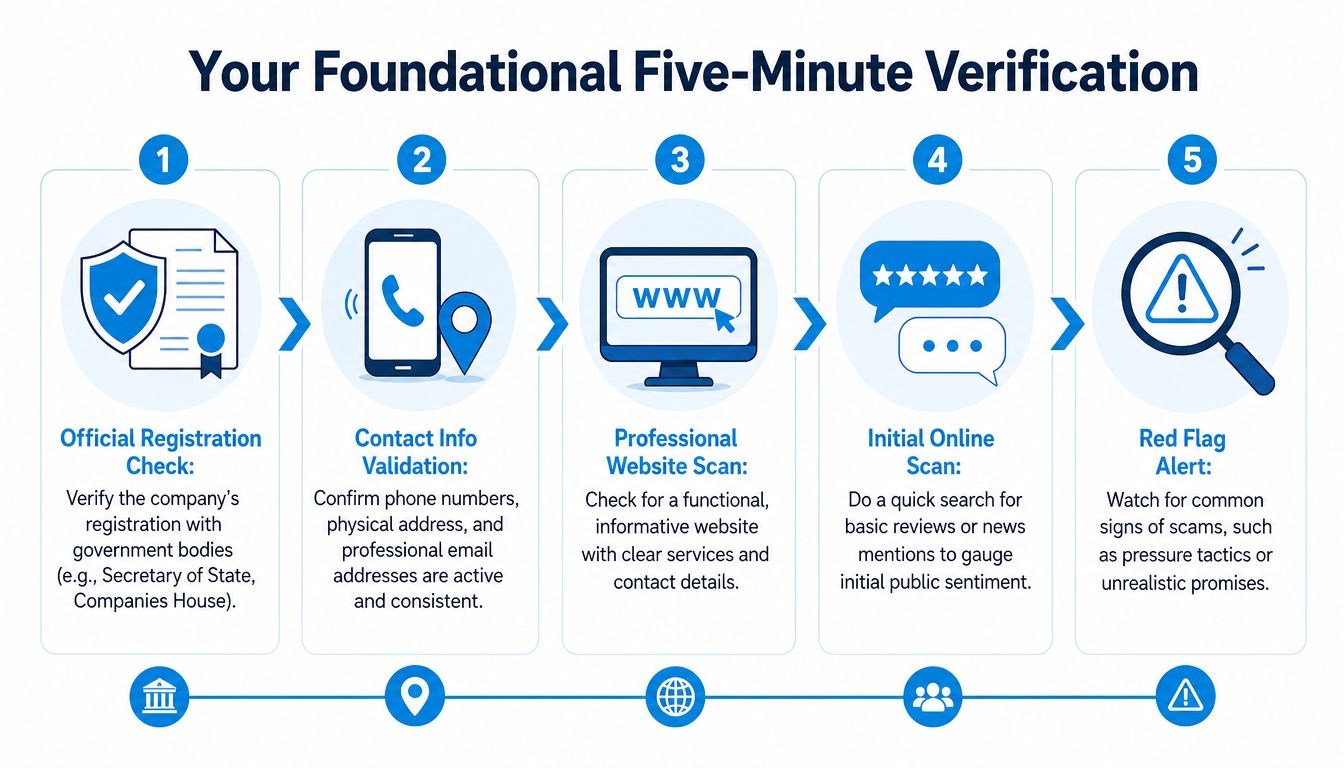
Check the official registration first
This step is fundamental. According to Ondato's summary of company legitimacy checks, verifying a company through official government registries is foundational, and companies with inactive or dissolved statuses account for approximately 18% of all scam-related business entities reported to the FTC in 2025.
For a U.S. company, search the relevant Secretary of State database using the legal business name, not just the brand name on the website. For a UK company, Companies House is the obvious first stop. If you work with Australian vendors and need to understand entity labels before checking records, this Pty Ltd guide for Australian business owners is a useful primer.
When you search, don't stop at “found a match.” Confirm:
- Status. Active is acceptable. Dissolved, inactive, forfeited, or delinquent is not.
- Formation date. A company claiming decades of experience but formed recently needs explanation.
- Registered address. Compare it to the website, contract, and invoice.
- Named officers or agents. See whether those names appear anywhere else the company presents itself.
Validate contact details like an operator would
A real business leaves a trail. A fake one often leaves fragments.
Call the listed number. Don't just see if someone answers. Listen for whether the greeting identifies the business clearly, whether the person can route you to the right department, and whether follow-up communication comes from a company domain rather than a free email account.
Then check the address. Put it into Google Maps or Street View. You're not trying to prove the company owns a flagship office. You're checking whether the address corresponds to something plausible for the type of business claimed.
A practical example:
- Plumbing supplier with a listed warehouse address. Street View should show an industrial or commercial site, not an unrelated residence.
- Medical billing vendor with a downtown suite. The building directory or business listing should make that plausible.
- Construction subcontractor using only a mailbox service while claiming multiple crews and local dispatch. That deserves questions.
If the address, phone number, and email domain all work but don't connect cleanly to the same business identity, slow down.
This is a good point to watch the short walkthrough below before you build your own checklist:
Scan the website and domain history
A polished website proves almost nothing by itself. Still, it's useful when you inspect it like a buyer, not a browser.
Check for these basics:
- Consistent branding. The company name in the footer, terms, invoices, and proposal should match.
- Real operating detail. Services, location, contact routes, and named team or leadership should be specific.
- Legal pages. Privacy policy, terms, and business disclosures should exist and fit the company.
- Domain clues. Use a WHOIS lookup to see whether the domain registration timeline fits the company story.
A practical example: if a vendor says it has served clinics “for years” but the domain is brand new and the site has only stock photos and generic copy, that doesn't prove fraud. It does mean you need more evidence before signing.
Assessing Public Reputation and Digital Footprint
Once the registry and contact checks pass, move to public reputation. At this stage, you stop asking whether the company exists and start asking whether real people have interacted with it in believable ways.

According to Sumsub's guide to checking if a company is legit, 88% of consumers trust online reviews as highly as personal recommendations as of 2026, and 91% of legitimate businesses maintain active professional social media profiles. That doesn't mean good reviews equal legitimacy. It means public signals matter, and patterns matter more than star counts.
Read reviews for patterns, not comfort
Review users often make two mistakes. First, they look only at the average rating. Second, they read only the first few comments.
Do the opposite. Read the negative reviews first, then the most recent positive ones. You're trying to spot repetition and timing.
Useful review patterns include:
- Repeated complaint themes. Missed deliveries, refund issues, unreachable support, or invoice disputes.
- Generic praise bursts. Many short five-star reviews posted close together with vague wording.
- Operational mismatch. Reviews talk about one service model while the company is now selling something else.
- Owner responses. A real operator usually replies with context, dates, and resolution steps, not copy-paste defense.
A practical example: if ten reviewers across Google, BBB, and Trustpilot mention being pressured to pay quickly before receiving documentation, treat that as a process warning, not a public relations issue.
Review the social footprint like a timeline
A legitimate business usually has some digital history. Not perfection. History.
Check LinkedIn, Facebook, and Instagram if those platforms fit the industry. For B2B vendors, LinkedIn often tells you more than the website. Look for employee profiles tied to the company, posting history, customer interaction, and signs that the page has existed over time rather than appearing last week.
Use this simple comparison:
| Signal | More Credible | More Suspicious |
|---|---|---|
| Posting history | Regular activity over time | Long silence or all recent posts |
| Engagement | Real comments and replies | Empty likes or no interaction |
| Team presence | Employees list the company | Few or no people tied to it |
| Branding | Consistent logo, tone, service focus | Mismatched visuals and claims |
If online reputation is part of your buying decision, it helps to understand how review ecosystems can be shaped, neglected, or manipulated. This breakdown of online review management is useful for understanding what healthy review behavior looks like from the business side.
Public feedback shouldn't make the decision for you. It should tell you where to investigate next.
What works and what doesn't
What works is cross-referencing. Compare the website, review platforms, business listings, and social profiles for consistency. What doesn't work is trusting a single polished channel. Scammers know buyers check websites. More careful buyers check the broader footprint.
If you find mixed signals, ask a practical question: does this look like a messy real business, or a manufactured front? Real businesses often have blemishes. Manufactured ones often have unnatural smoothness in some places and strange gaps in others.
Deep-Dive Due Diligence for High-Stakes Decisions
If you're signing a large contract, sharing customer data, outsourcing revenue-critical work, or paying a deposit that would hurt to lose, move past open-web checks. At this stage, disciplined buyers separate a shaky prospect from a defensible partner.
A strong benchmark is the Five-Step Corporate KYC Protocol described by BusinessScreen, which includes Ultimate Beneficial Owner verification and achieves a 94% success rate in identifying shell companies when cross-referenced with global credit databases.
Verify licenses and regulated status
In regulated sectors, registration alone is not enough. You need to confirm the company has the right to do the work it's selling.
Examples that matter in practice:
- Home services. Ask for insurance certificates and any trade licenses required locally.
- Healthcare vendors. Confirm any claimed certifications, data handling commitments, and business identity on contracts and forms.
- Legal and financial providers. Verify attorney bar status, broker registration, or other regulator listings directly through the relevant authority.
- Construction partners. Check contractor licensing and make sure the named entity matches the contracting party exactly.
Don't accept screenshots if the issuing authority has a searchable database. Search yourself.
Identify who actually owns the company
UBO verification sounds like a compliance term because it is one. It's also practical. You need to know who ultimately controls the company, especially if the vendor is in another jurisdiction or the deal size is meaningful.
Ownership review matters when:
- the company's named representatives change frequently
- the contracting entity differs from the brand name
- funds are being sent to a different company than the one selling the work
- the company uses layered entities that don't make operational sense
For major engagements, some firms use specialist investigators or due diligence providers to map ownership, litigation history, and hidden relationships. If you need that level of scrutiny, this overview of business investigations shows the kinds of checks investigators typically perform.
Review the contract like a fraud filter
A contract often exposes the problem faster than a sales call.
Look closely at:
- Payment timing. Large upfront requests without normal milestones deserve challenge.
- Entity names. The legal name on the contract should match the registered company you verified.
- Jurisdiction and dispute terms. Unexpected foreign venues or vague governing-law language can be a warning.
- Scope language. Fraudulent operators often stay vague on deliverables and precise on payment.
- Data handling clauses. If customer or patient data is involved, weak documentation is a serious issue.
If the paperwork is sloppy, ask for a clean revision. If the company resists, that itself is useful evidence. For teams that need a stronger intake process, a documented checklist for documentation requirements helps standardize what must be collected before approval.
Legitimate companies may negotiate. Suspicious ones often dodge.
A practical clarification email
Use direct language. Don't over-explain why you're asking.
Subject: Vendor Verification Items
Hi [Name],
Before we finalize review, please send the following for verification:
- Full legal entity name and registration number
- Registered business address
- Proof of current license or certification relevant to the services offered
- Certificate of insurance, if applicable
- Confirmation of the legal entity that will invoice and receive payment
- Primary operating contact for contract and compliance questions
Please also confirm whether the contracting entity has any parent company or affiliated ownership structure relevant to this engagement.
Thanks,
[Your Name]
A good company usually replies clearly, with documents that line up. A bad one often stalls, sends partial answers, or tries to redirect the conversation back to urgency.
Red Flag Checklist and Key Industry Tips
Some warning signs matter in any industry. Others depend on what the company is doing for you. That distinction matters because a red flag for an e-commerce supplier may not be the same as a red flag for a billing partner, subcontractor, or law-related service provider.
Cross-border deals deserve extra caution. According to the discussion citing International Organization of Securities Commissions 2025 data, cross-border fraud scams rose by 34%, yet less than 12% of consumer guidance articles address non-US verification methods specifically. If you work with overseas suppliers, offshore staffing firms, or international franchise support vendors, don't settle for advice that stops at “check the Secretary of State website.”
Legitimacy Red Flag Checklist
| Category | Red Flag Description | Action |
|---|---|---|
| Registration | Company appears in a registry but status is inactive, dissolved, or inconsistent with what the seller claims | Stop the deal until legal status is confirmed through the official registry |
| Identity | Website name, invoice entity, and contract party don't match cleanly | Request the full legal structure and reconcile every document before payment |
| Contact details | Phone works, but responses are vague or routed through generic email accounts | Ask for named contacts and a company-domain follow-up |
| Address | Listed address appears unrelated to the claimed operation | Verify via maps, directories, and direct questioning |
| Website | Site is polished but thin, generic, or inconsistent | Ask for customer references, licensing, and operating proof |
| Reviews | Feedback shows repeated complaints about the same issue or suspicious bursts of praise | Cross-check on multiple independent platforms |
| Social presence | Profiles are new, inactive, or disconnected from real staff | Treat digital footprint as incomplete and escalate review |
| Contract terms | Payment demands are front-loaded or unusually urgent | Renegotiate to milestones or walk away |
| Ownership | Company avoids naming controlling owners or invoicing entity | Request ownership clarification before approval |
| Due diligence response | Requested documents arrive late, partially, or defensively | Treat resistance as a risk signal, not an admin issue |
Industry-specific checks that save time
Different sectors need different proof.
For home service businesses, verify insurance, local licensing, and whether the company operates crews or only brokers work. If a subcontractor claims emergency capacity, ask how dispatch is handled and who appears on site.
For healthcare and wellness practices, pay attention to data handling language, business identity consistency, and the vendor's ability to explain its workflow without hand-waving. If patient communication or intake is involved, review the company's security posture and operational controls. A practical checklist for data security best practices helps frame what to ask.
For law firms, insurance agencies, and finance teams, check professional registrations directly and look closely at engagement letters, recordkeeping obligations, and where client information will be stored or processed.
How to handle non-US companies
International verification is where many teams get sloppy. They know how to vet a local LLC. They're less prepared when the vendor is based in the UK, Australia, the EU, or elsewhere.
Use this approach:
- Start with the home-country registry. Search the legal entity in that jurisdiction's official records.
- Request translated documents if needed. Don't rely on a sales rep's summary of foreign filings.
- Match the legal entity to the bank recipient. This is especially important in cross-border payments.
- Check sector regulators in that country if the service is licensed.
- Ask where operations occur. A registered address may not be the true operating location.
The trade-off is simple. International vendors can be perfectly legitimate, but they require more verification because your normal shortcuts don't work as well.
How to Proceed When a Company Seems Suspicious
Once a company triggers multiple concerns, your job changes. You're no longer trying to get comfortable. You're deciding whether the risk is acceptable.
Most of the time, the smart move is to stop. Don't send a deposit to “hold your place.” Don't keep sharing internal documents. Don't let a persuasive sales rep turn your caution into a problem you have to justify. Walking away is often the cheapest decision in the entire buying process.
Send one firm documentation request
If you're still on the fence, send a short request and set a deadline.
Subject: Final Verification Request
Hi [Name],
We're completing internal review and need the following before we can proceed: your full legal entity name, registration details, current license or certification where applicable, proof of insurance, and confirmation of the entity that will contract and invoice us.Please send these items by [date]. If anything differs from the proposal or website, note that clearly in your reply.
Thanks,
[Your Name]
The response often tells you everything. Legitimate companies usually answer directly. Suspicious ones deflect, rush, or go quiet.
Protect your business and report it
If you believe the company may be fraudulent, preserve the evidence. Save emails, invoices, contracts, screenshots, payment instructions, and notes from calls. Then report the business through the appropriate channels, such as the FTC and BBB Scam Tracker, or the relevant regulator in your jurisdiction.
A questionable deal you decline is not a missed opportunity. It's a prevented loss.
The best operators build this into routine procurement, not crisis response. That's how you make better vendor decisions without relying on gut feel alone.
If your team wants fewer missed calls, cleaner records, and a more consistent front door for prospects and customers, Recepta.ai is worth a look. It combines AI reception with human backup, helps businesses capture and document interactions around the clock, and supports the kind of operational discipline that makes vendor reviews, customer communication, and follow-up workflows easier to manage.