
Master Online Review Management: 2026 Guide
BrightLocal reports that 98% of people at least occasionally read online reviews for local businesses, 40% of shoppers decide after reading just one to three reviews, and product pages with reviews can see conversion rates increase by about 5x, according to BrightLocal's online reviews statistics. That changes the job of online review management completely. Reviews aren't a cleanup task for bad publicity. They're part of how buyers discover you, judge you, and decide whether to contact you.
Most small businesses still handle reviews like inbox debris. Someone checks Google when they remember. A manager replies to the worst posts. Positive feedback gets ignored. Nothing gets tracked, and nothing gets fed back into operations. That approach misses its full value.
A stronger model treats every review as customer intelligence plus public sales collateral. A complaint about long wait times isn't just a complaint. It's an operational signal. A detailed five-star review isn't just flattering. It's proof you can reuse in messaging, service training, and conversion paths. Even a neutral review can tell you where the handoff between front desk, field staff, and follow-up feels rough.
Your Introduction to Modern Review Management
Online review management works best when it's run like a system, not a series of ad hoc replies. ReviewTrackers defines it as the process of monitoring, analyzing, responding to, and generating customer reviews across multiple sites, and that definition matters because it pushes owners to think beyond reputation defense and toward repeatable process.
A single negative review rarely hurts a solid business by itself. What hurts is the pattern behind it. Slow response times, no ownership, no follow-up, and no process for preventing the next similar complaint. When owners say reviews feel unfair, they're often reacting to the lack of control. The fix is structure.
What review management actually includes
At a practical level, online review management has four jobs:
- Monitor public feedback: Track Google, Facebook, industry directories, and any niche platform your customers use.
- Respond in a disciplined way: Thank happy customers, address concerns, and move sensitive problem-solving into a private channel when needed.
- Generate fresh reviews: Ask for feedback consistently instead of waiting for the loudest customers to shape your public reputation.
- Learn from the content: Pull recurring themes from comments so operations, service, and front-office teams can act on them.
Practical rule: If a review process doesn't change staffing, scripts, training, or follow-up, it isn't management. It's just public replying.
Owners usually ask whether they should worry about every bad review. The better question is whether the business has a process for spotting repeated friction. If three customers mention scheduling confusion, you likely have a handoff problem. If several praise one technician by name, that person's language and workflow should be documented and taught.
The shift that matters
Modern online review management sits at the intersection of marketing, customer service, and operations. It affects trust before the first call, shapes response quality after the visit, and creates a feedback loop that can improve the business itself.
That makes reviews worth managing daily, with the same seriousness you'd give missed calls, appointment no-shows, or unpaid invoices.
The Business Impact of Every Star and Comment
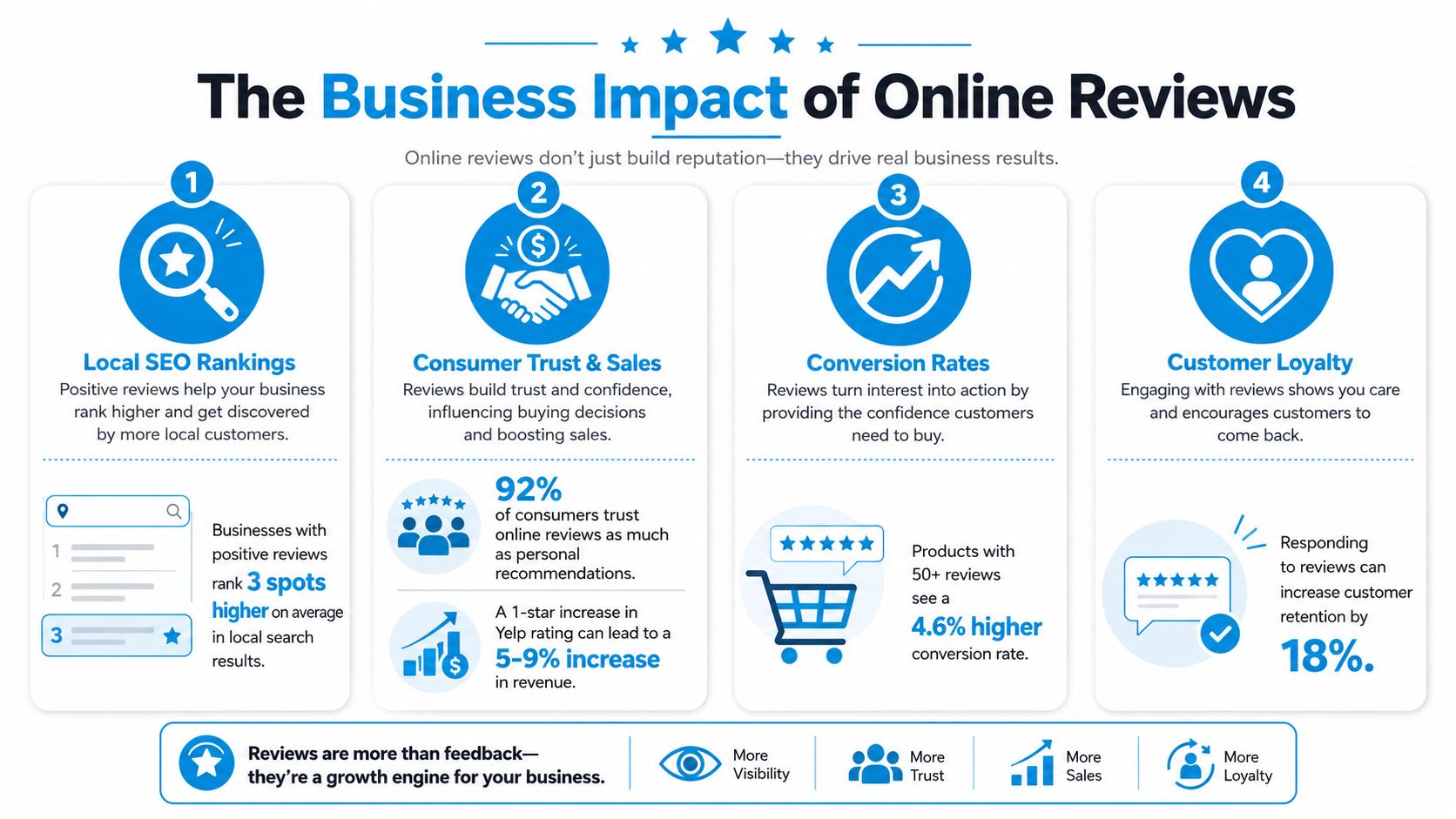
Birdeye reports that 71% of all online reviews were written on Google in 2021, and 49% of review requests were sent via SMS, according to Birdeye's online review statistics. For most small businesses, that tells you where to focus first. Google is usually the main stage, and text messaging is often the most practical request channel.
Reviews shape the first sales conversation
Before a buyer calls your office, they usually compare a few providers. They scan star ratings, recent comments, and whether the business replies like a professional operation or a neglected listing. That's why reviews function like digital curb appeal. They don't close every sale on their own, but they heavily influence whether a prospect gives you a chance.
Many teams waste effort. They spread themselves thin across too many platforms, write defensive replies, and never connect review activity to lead handling. A better approach is simpler. Prioritize the platforms that affect discovery, then tighten the handoff once reviews generate interest.
For example, if a plumbing company earns praise for fast response and clean work, but prospects who call after reading those reviews hit voicemail, the review program is creating demand that the phone process is failing to capture. That's not a marketing problem. It's an operations problem.
Google matters more than scattered effort
For local and service businesses, Google review performance usually deserves the first block of time, the clearest ownership, and the cleanest workflow. That doesn't mean ignoring every other platform. It means not pretending every platform has equal value.
A practical priority stack often looks like this:
- Google first: Because it's often where prospects discover and compare businesses.
- Industry-specific sites second: Healthcare, legal, home services, and hospitality often have niche review channels buyers trust.
- Secondary channels third: Facebook and other profiles still matter, but usually after the primary discovery surfaces are covered.
Review content also becomes more useful when teams stop reading it manually, one post at a time, and start categorizing themes. If you want a useful primer on understanding AI-driven sentiment analysis, it's worth reviewing how sentiment tools separate emotion, intent, and recurring language patterns. That thinking helps owners move from “we got a bad review” to “we have a recurring complaint category.”
The same logic applies to broader customer patterns. Review trends become more actionable when paired with customer behavior analysis, because the primary question isn't only what customers say publicly. It's when they say it, after which touchpoints, and about which parts of the experience.
Reviews don't just reflect trust. They expose whether your operation can deliver on the promise your listing makes.
The ARCS Framework for Mastering Reviews
The easiest way to make online review management repeatable is to use a framework your team can remember under pressure. ARCS works because it covers the full cycle without becoming academic: Acknowledge, Respond, Convert, Solicit.
Acknowledge
Acknowledgment starts before anyone writes a reply. It means your business sees new feedback quickly, knows which platform it came from, and understands whether the issue is routine or sensitive.
If a customer posts, “Great technician, but I waited two days for a callback,” the business shouldn't treat that as a generic four-star note. It contains two signals. Service quality was strong. Front-office responsiveness was weak. Acknowledgment means logging both.
Good acknowledgment habits include:
- Check every platform consistently: Not just Google, and not only when someone on the team remembers.
- Tag the issue type: Billing, scheduling, staff professionalism, wait time, quality, communication, or follow-up.
- Flag urgency early: Safety concerns, legal disputes, discrimination claims, or privacy issues should never sit in the same queue as ordinary praise.
Respond
The public response should match the purpose of the review. Too many replies sound like they were copied from a template bank with the business name pasted in. Customers can tell.
A strong reply does three things. It recognizes the actual experience. It shows accountability without arguing. It moves resolution to the right channel when needed.
| Review Type | Objective | Response Template Example |
|---|---|---|
| Positive | Reinforce trust and highlight what went well | “Thanks for the feedback, [Name]. We're glad our team helped with [specific detail]. We appreciate you taking the time to share your experience, and we look forward to helping again.” |
| Negative | Defuse tension and move toward resolution | “Thank you for the feedback, [Name]. We're sorry this experience fell short, especially around [specific issue]. We'd like to look into it directly and make this right. Please contact our team at [contact method] so we can review the details with you.” |
| Neutral | Show attentiveness and invite a better next experience | “Thanks for sharing this, [Name]. We appreciate the balanced feedback and take your comments about [specific point] seriously. Our team is reviewing it, and we'd welcome the chance to serve you again with a smoother experience next time.” |
What doesn't work:
- Generic “thank you for your review” replies to every post
- Public arguments over facts
- Copy-paste legal language
- Incentive language that pressures the reviewer to change the review
What to remember: The audience for your response isn't only the reviewer. It's every prospect reading that exchange later.
Convert
Conversion is where review management becomes commercial, not cosmetic. A negative review can still produce value if your team recovers the relationship, fixes the issue, and prevents repetition. A positive review can be converted into useful marketing language, sales proof, or staff coaching material.
Examples help here:
- A dental office sees repeated praise for “clear explanations.” Management uses that phrase in appointment reminders and front-desk scripts.
- An HVAC company notices complaints about arrival windows. It changes dispatch communication and updates pre-visit texts to set clearer expectations.
- A law firm gets several reviews praising responsiveness after intake. It turns that into a public promise and measures whether the phone team maintains that standard.
Solicit
This is the step most businesses underdo or do badly. Curogram notes that a common pitfall is chasing more review volume instead of more representative reviews, creating review-sampling bias where the most emotional customers dominate the public narrative, as explained in Curogram's guide to online review management.
That means you shouldn't only ask the obviously delighted customer or only react after a complaint. You need a steady, fair request process that reaches the quiet majority.
Practical ways to improve representativeness:
- Ask at consistent moments: After service completion, after a resolved support issue, or after a successful appointment.
- Use simple channels: SMS often works well because it reduces friction.
- Spread requests across customer types: New customers, repeat customers, simple jobs, complex jobs, high-ticket services, and routine visits.
A review profile built from representative feedback is more trustworthy, more stable, and usually more useful for operational decision-making.
Building Your Daily Review Management Workflow
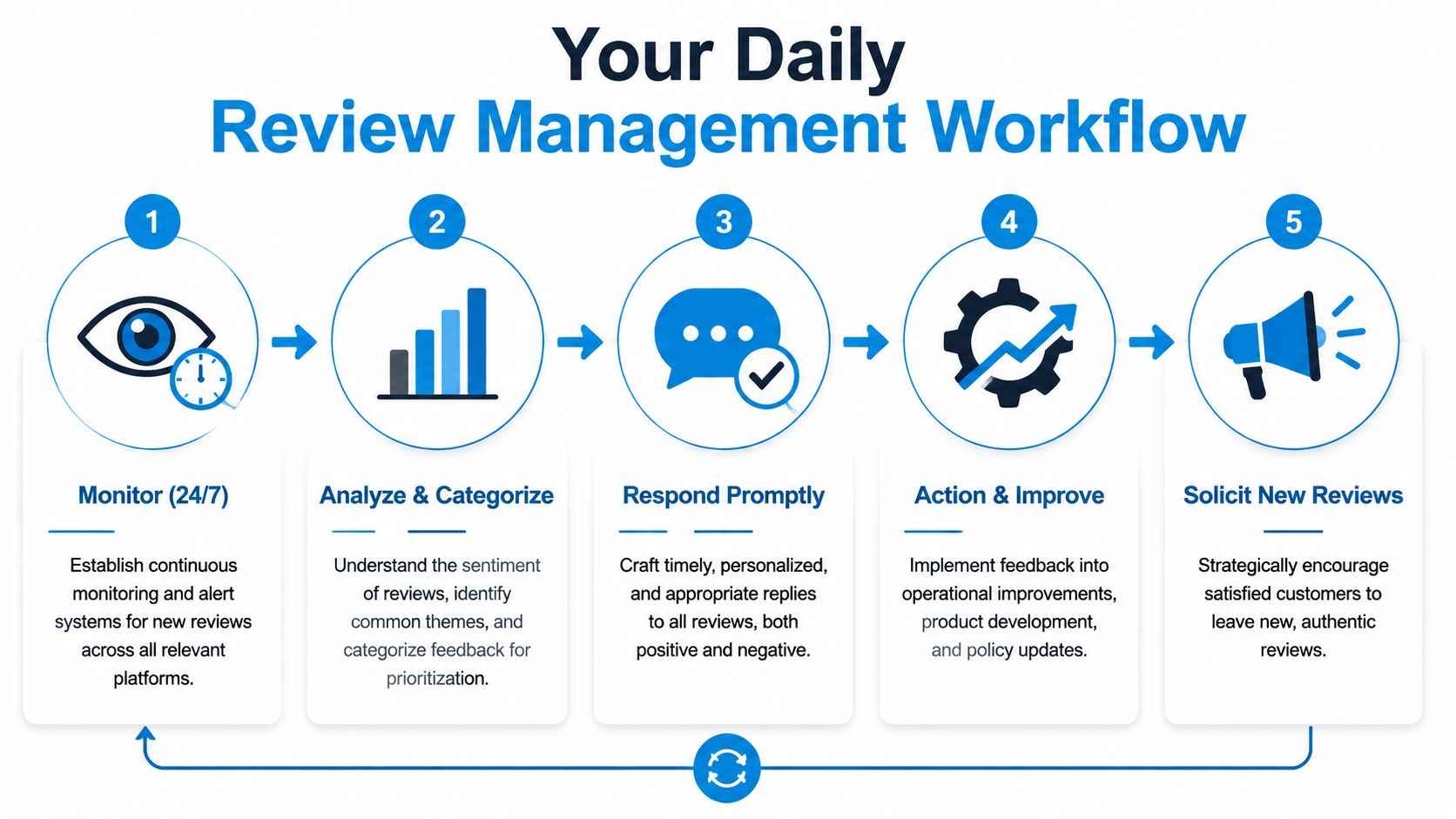
A review strategy breaks down when nobody owns the daily motions. Nextiva notes that an effective workflow relies on 24/7 multi-platform monitoring, automated alerts, and clear escalation rules, making it possible to track KPIs like response rate, response speed, and sentiment trends, as outlined in Nextiva's review management guidance.
That sounds technical, but the practical version is straightforward. Someone needs to know what arrived, what needs a reply, what needs a manager, and what must become an internal fix.
The five-part operating rhythm
Most small businesses can run a clean workflow with five parts.
Monitor continuously
Set alerts for every active review platform. If you operate multiple locations, route alerts by location first, then by severity.Categorize fast
Every new review should be tagged by sentiment and issue type. Keep categories simple enough that staff will use them.Respond with ownership
Front-line staff can handle routine praise and low-risk neutral feedback. Managers should own sensitive complaints, repeat issues, and anything involving policy failure.Push issues into operations
If reviews repeatedly mention scheduling errors or poor follow-up, that issue needs to leave the marketing lane and land with operations.Request new reviews systematically
Build requests into the post-service process so they happen even on busy days.
A simple escalation model
Businesses often overcomplicate escalation. You don't need a dense policy manual. You need a short decision tree.
- Front desk or coordinator responds: Positive reviews, neutral comments, simple compliments, routine feedback about staff friendliness
- Location manager responds: Complaints about delays, communication, pricing confusion, incomplete service, rescheduling
- Owner or senior lead reviews before posting: Legal issues, discrimination allegations, refund disputes, privacy concerns, safety incidents
That structure keeps response quality high without bottlenecking every single review.
The fastest way to miss patterns is to let each location answer reviews in isolation and never compare what customers keep saying.
What to measure each week
A useful review workflow tracks only the metrics that can change behavior. Start small. If your dashboard has too many fields, nobody will act on it.
Focus on:
- Response rate: Are you replying consistently?
- Response speed: Are reviews sitting too long before acknowledgment?
- Volume trend: Are review requests producing a steady flow or random spikes?
- Sentiment trend: Are recurring themes improving after process changes?
- Category trend: Which complaint type appears most often this month?
That data becomes much more valuable when tied to broader workflow optimization efforts. If review complaints cluster around one step, such as scheduling, billing, or post-visit communication, the workflow itself is probably the problem.
A practical daily example
Consider a three-location pest control company.
Morning starts with one dashboard view. Overnight reviews are tagged. One positive Google review gets a quick personalized thank-you. A neutral review mentioning “great service but hard to reach by phone” gets logged under communication. A negative review about missed arrival timing is escalated to the location manager because dispatch needs to verify the job notes.
By midday, the manager sees three recent comments tied to arrival-window confusion. That pattern triggers an operations fix. The company rewrites appointment reminder texts, tightens technician ETA updates, and updates the call script so customers hear the same expectation everywhere.
Ultimately, completed jobs trigger review requests automatically. No one waits for staff memory, and no one cherry-picks only the happiest customers.
That's what a working review system looks like. It doesn't just publish replies. It improves the business.
Integrating Reviews with Your Business Systems
Online review management becomes far more valuable when review data doesn't live in a silo. ReviewTrackers emphasizes running text and sentiment analysis across feedback to identify recurring themes, turning reviews into structured data that can drive operational changes, as described in ReviewTrackers' review management software overview.
That idea matters because isolated reviews don't scale well. Structured review data does.
What integration changes
When review data connects to your CRM, communications platform, scheduling system, or support workflow, the business gains context. A one-star complaint is no longer just a public post. It becomes tied to a customer record, service date, appointment history, staff assignment, and follow-up status.
That creates better decisions in both directions:
- Service teams can see whether a reviewer is a first-time customer or a repeat client.
- Managers can compare complaints against job notes or appointment records.
- Marketing teams can identify which praise themes are real enough to use in messaging.
- Leadership can see whether one location has a pattern that other locations don't.
If you're mapping that process, this guide to what CRM integration means in practice is useful because the integration question isn't just technical. It's operational. The issue is whether data moves to the people who can act on it.
The closed-loop review system
The strongest setups use reviews as triggers, not archives.
A closed-loop model usually looks like this:
- Customer interaction happens: Call, appointment, service visit, estimate, consultation
- System records the event: CRM, calendar, ticketing, or billing platform logs it
- Follow-up request goes out: SMS or email asks for feedback after the right milestone
- Review arrives and gets tagged: Positive, neutral, negative, plus issue category
- Operational action follows: Staff coaching, callback, service recovery, script update, or process change
That loop is what turns online review management into an engine for continuous improvement.
Practical examples by business type
A few examples show how this works on the ground.
| Business type | Useful integration point | Operational outcome |
|---|---|---|
| HVAC company | Completed job in field service system triggers review request | Fresh feedback arrives close to the service date, while details are still clear |
| Dental practice | Appointment status in scheduling software triggers post-visit follow-up | The office can separate feedback for hygiene, front desk, and billing |
| Law firm | Intake platform tags consultation source and matter type | Reviews can be analyzed by intake experience versus legal service delivery |
| Multi-location franchise | Central dashboard aggregates review tags by location | Operators can spot recurring issues at one branch before they spread |
Operator's view: When reviews tie back to records, teams stop guessing whether a complaint is isolated or systemic.
This is also where communications systems matter. If the customer journey includes missed calls, delayed callbacks, inconsistent intake, or uneven follow-up, review quality will reflect that. Businesses often blame reviews for exposing the problem when the underlying issue is service coordination.
The point isn't to automate empathy. It's to remove preventable friction so staff can spend their time on the moments requiring judgment and care.
From Reputation Defense to a Growth Engine
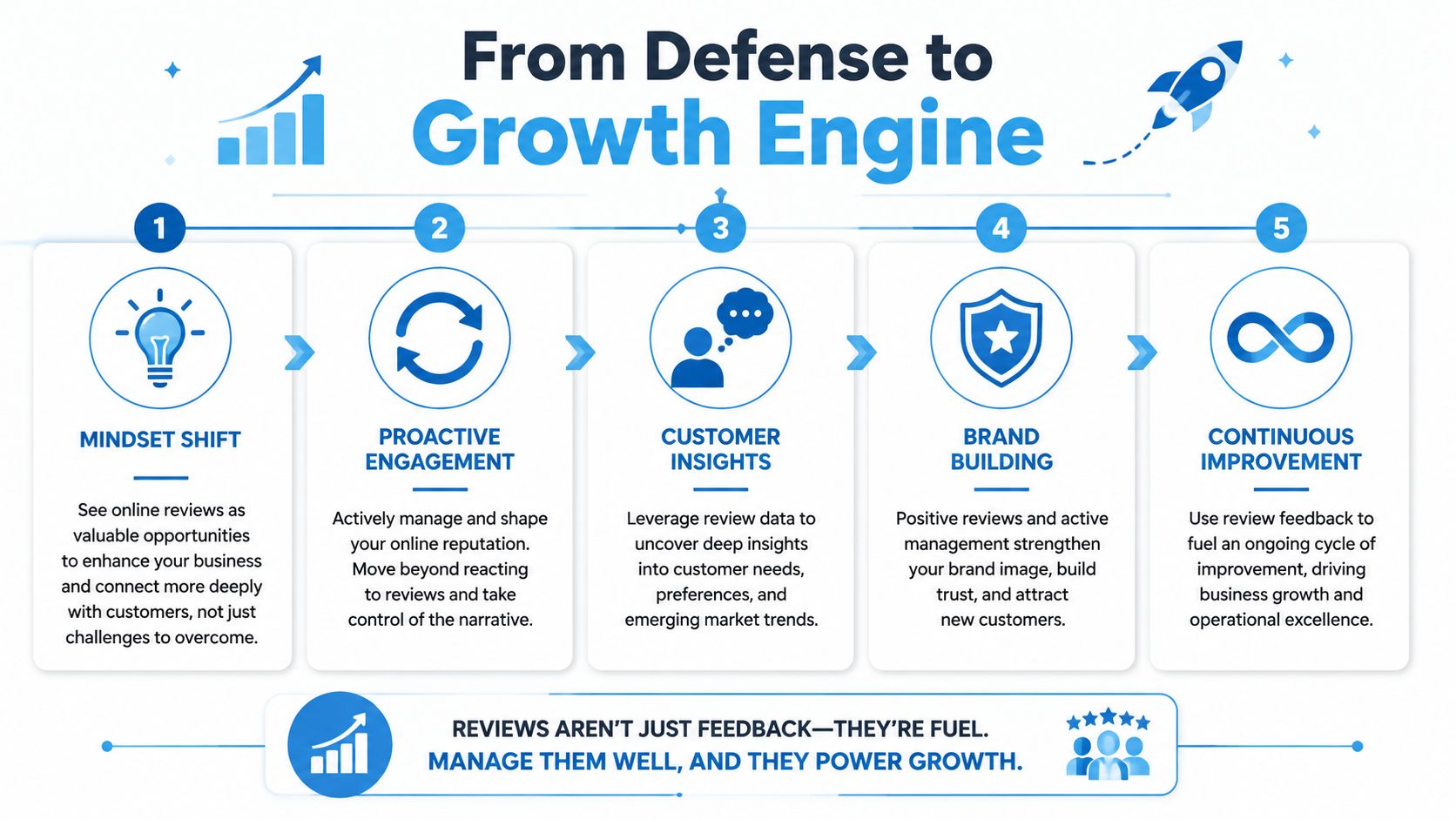
Most businesses start online review management because they want protection. They don't want a bad comment to sit unanswered. That's reasonable, but it's too small a goal. The stronger use case is growth.
A business that monitors reviews consistently, responds with discipline, requests representative feedback, and pushes patterns into operations gains an advantage in three places. It looks more trustworthy to prospects. It resolves customer friction faster. It learns from public feedback instead of treating it as noise.
The mindset shift that pays off
The ARCS model works because it keeps the team focused on actions that compound:
- Acknowledge feedback quickly so nothing important gets buried
- Respond in a way that builds trust with both the reviewer and future readers
- Convert feedback into service recovery, better messaging, and stronger operating habits
- Solicit reviews consistently so your public reputation reflects the whole customer base
That last point is easy to underestimate. A review profile should represent the business customers usually experience, not just the people who were delighted enough to post or upset enough to complain.
If you're tracking broader market shifts, this roundup of latest trends in reputation management is useful for seeing how reputation work is moving closer to automation, analytics, and integrated customer experience systems.
One move to make this week
Don't start by writing better responses. Start by building one reliable operating habit.
Choose one:
- Set platform ownership: Assign one person to review alerts daily
- Create an escalation rule: Decide which reviews front-line staff can answer and which need a manager
- Standardize review requests: Tie them to a completed appointment, visit, or service milestone
- Track one pattern: Pick a recurring complaint category and fix the underlying process
- Connect reviews to retention work: Use feedback trends to support stronger customer retention strategies
Do that for a week, then expand.
A mature review program doesn't ask, “How do we look online?” It asks, “What is customer feedback telling us to fix, repeat, and scale?”
When owners make that shift, reviews stop being a source of anxiety. They become a visible record of service quality, a source of operational clarity, and a lever for revenue.
If you want a practical way to support better reviews from the start of the customer journey, Recepta.ai helps businesses capture calls, schedule appointments, handle follow-ups, and keep communication consistent around the clock. That makes it easier to reduce missed interactions, tighten service handoffs, and build the kind of customer experience that earns stronger feedback naturally.