
Lead Generation vs Demand Generation: A Practical Guide
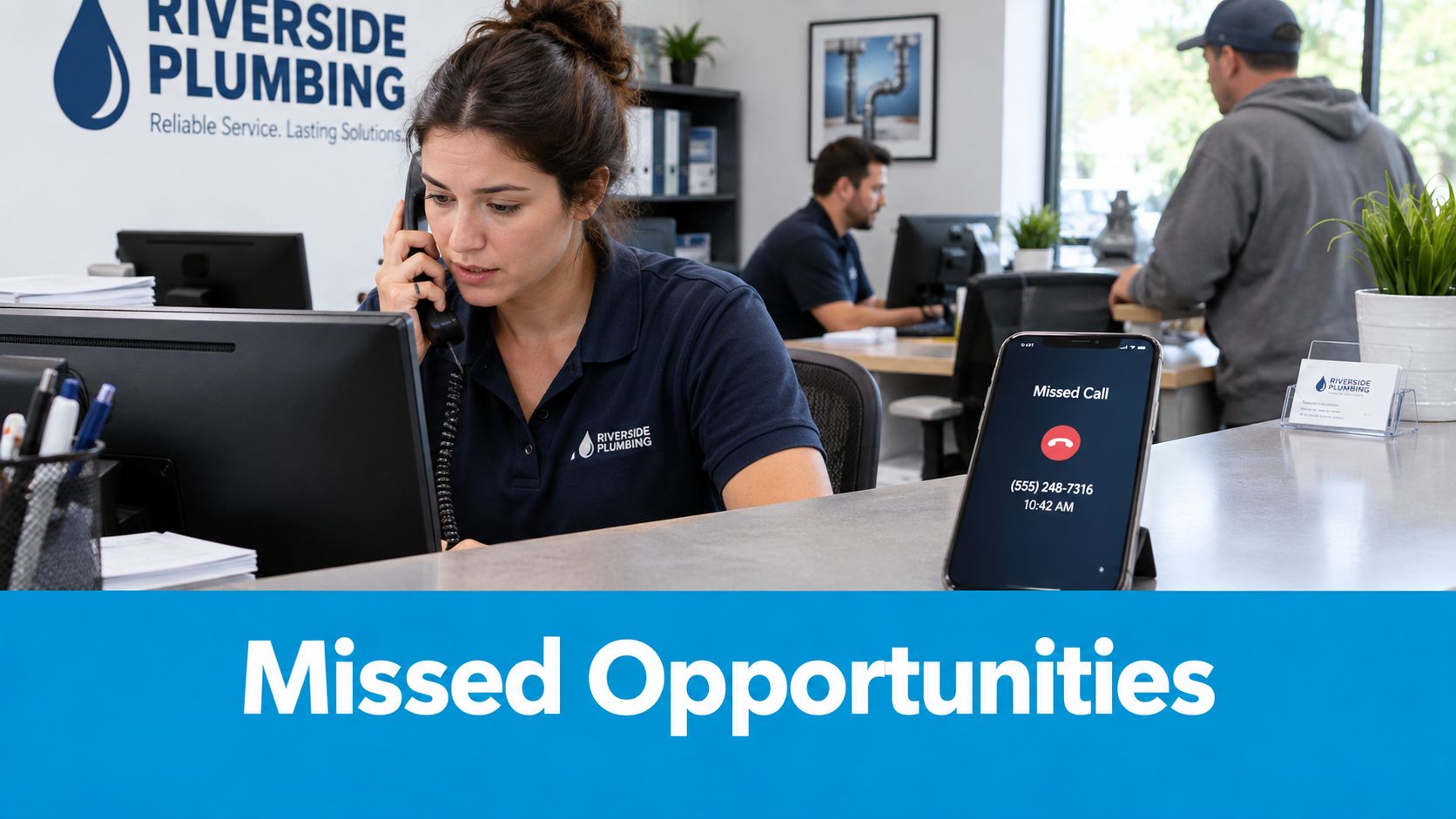
A plumbing company can spend heavily on Google Ads, rank for urgent repair searches, and still lose valuable jobs before anyone speaks with the team. A homeowner calls after hours, reaches voicemail, hangs up, and contacts the next company. A dental patient submits a consultation form, waits until the next business day, and books elsewhere. The marketing generated interest, but the business failed to make that interest reachable.
That's the practical issue behind lead generation vs demand generation. Lead generation captures people who are ready to raise their hands. Demand generation creates the awareness and confidence that make those hands go up in the first place. For service businesses, the missing piece is often neither strategy alone. It's the ability to respond when silent intent finally becomes a call, message, or appointment opportunity.
The Problem Most Service Businesses Ignore
The owner of a busy plumbing company usually knows when the phone rings during business hours. Staff answer calls, collect addresses, schedule jobs, and pass urgent work to a technician. The blind spot appears after hours, during lunch, or while every employee is already helping another customer.
A prospective customer searches for emergency pipe repair, visits the website, and calls. No one answers. The caller leaves a voicemail, but the office team doesn't return it until the next morning. By then, the customer has already found a competitor who responded immediately.
The same pattern appears in healthcare. A dental clinic may attract a patient through an educational article about implants or a paid campaign for consultations. The patient calls with questions about timing, insurance, or availability. If the call reaches a generic voicemail, the clinic may never learn that a high-intent prospect was ready to book.
Capture isn't the same as conversion
Many teams treat every marketing activity as a lead-generation problem. They add another form, buy more search traffic, or offer a discount in exchange for contact details. Those tactics can work when a prospect already understands the problem and is prepared to act, but they don't create much preference among people still researching.
Lead generation optimizes for identifiable action. A form fill, phone call, quote request, or consultation booking gives the business a contact to qualify and follow up with.
Demand generation works earlier. It helps a prospect recognize a problem, understand the available options, and remember a particular provider when urgency appears. Educational content, local expertise, patient resources, and useful explanations all contribute to that process.
Practical rule: If your team captures leads but responds slowly, you have a conversion problem. If your team responds well but very few qualified people reach out, you have a demand problem.
The two motions should support each other. A homeowner may discover an HVAC company through a maintenance guide, return later to compare repair options, and finally call during an evening breakdown. A healthcare prospect may read several pages before booking. The business needs both the trust-building experience and the instant response system that prevents intent from going cold. A missed call recovery system can address the second failure without pretending it replaces the first.
Defining Lead Generation and Demand Generation
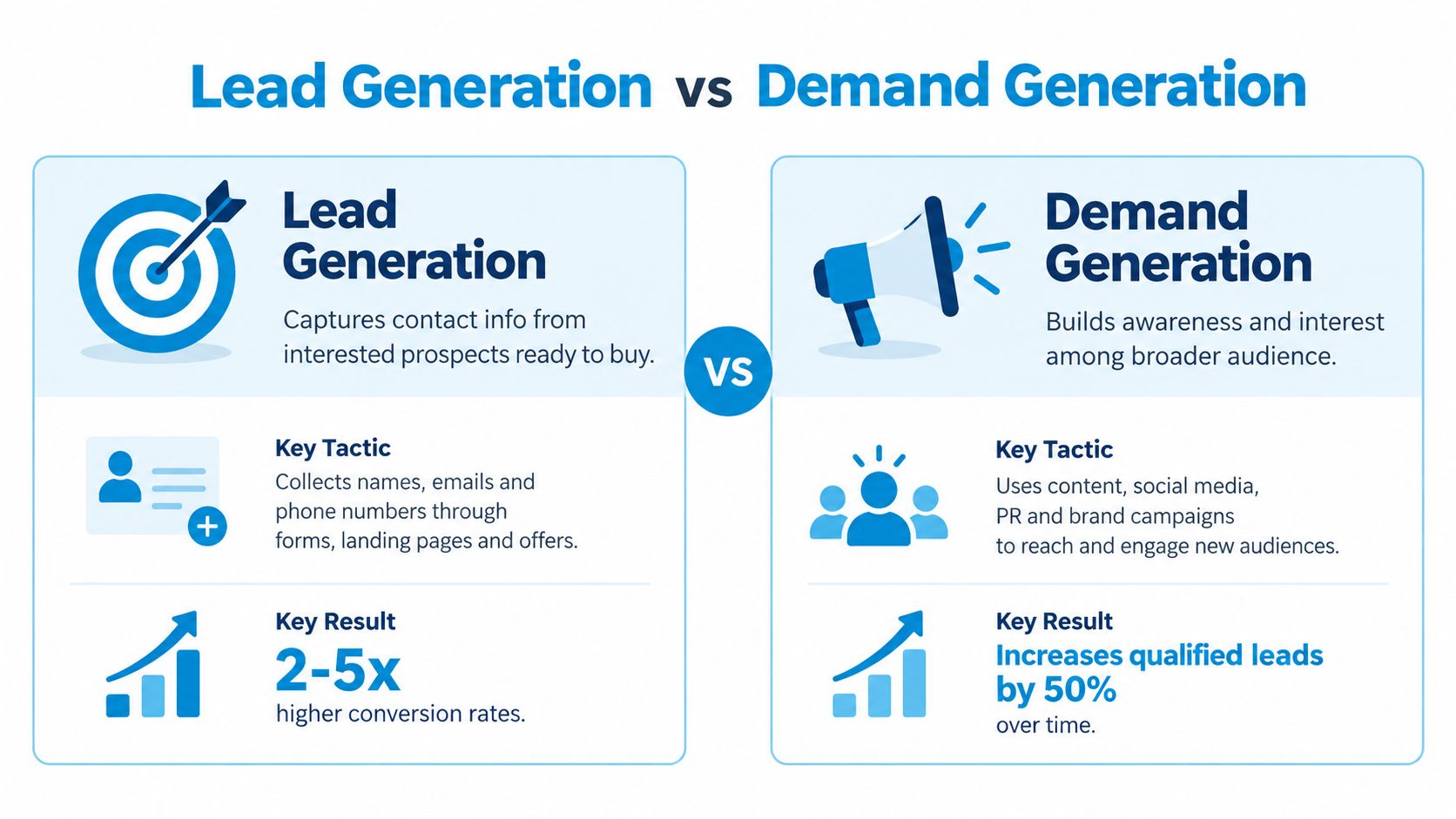
Lead generation captures contact information from prospects who have already shown intent. Typical examples include a quote form for a roofing project, a demo request for business software, a consultation scheduler for a law firm, or a treatment inquiry for a medical practice.
Demand generation builds awareness and interest across the buyer journey, from initial problem recognition through consideration and decision. It may involve educational articles, webinars, case studies, social content, local search visibility, or industry resources that help people understand why a service matters and what a credible provider looks like. This broader distinction is also reflected in Salesforce's explanation of demand generation and lead generation.
| Dimension | Demand generation | Lead generation |
|---|---|---|
| Primary job | Build awareness, trust, and interest | Capture contact details and buying intent |
| Typical audience | People researching a problem or category | People ready to ask, compare, or book |
| Friction level | Low friction, often ungated | Higher friction, usually a form or direct request |
| Common assets | Educational content, webinars, reports, case studies | Quote forms, consultation bookings, demos, calculators |
| Time horizon | Builds preference over time | Creates identifiable opportunities more directly |
| Core question | “Why should I care about this problem?” | “How can I speak with this provider now?” |
Consider a pest control company. It could host a webinar about seasonal pest prevention, publish supporting content, and answer questions from homeowners who aren't ready to buy. That is demand generation. At the end, the company could offer a free inspection quote through a landing page. That is lead generation.
A dental clinic follows the same sequence in a different category. An article explaining the differences between restorative options builds understanding. A consultation form captures the visitor who now wants a treatment plan. The content creates confidence, while the form creates a reachable sales opportunity.
Why the funnel label can mislead
The traditional funnel is useful, but service customers don't move through it in a clean line. Someone may discover a business through a social post, call immediately, return to read reviews, and then ask a question by text. Another person may read educational content for months before requesting a consultation.
The upper versus lower funnel marketing guide is useful for clarifying intent and message fit, but service businesses should avoid assigning every channel to one permanent stage. A webinar can create awareness, capture registrations, answer objections, and generate appointments. A search ad can capture urgent demand while also introducing a brand to someone who later returns for research.
Lead qualification determines whether a captured contact is worth immediate attention, and a practical lead qualification framework helps teams separate genuine service fit from incomplete or low-intent inquiries.
KPIs That Actually Matter for Each Strategy
Lead counts look reassuring because they're easy to report. They can also hide poor targeting, weak qualification, slow response, and low close rates. A service business should measure the stage it is trying to improve, then connect that stage to appointments, opportunities, and revenue.
Demand generation focuses on whether more of the right audience is becoming aware and engaged. Useful measures include brand search volume, share of voice, inbound pipeline growth, engagement rate, and intent-signal lift. These metrics don't prove revenue on their own, but they show whether the market is moving closer to active consideration.
Lead generation operates nearer to the handoff. Its practical measures include MQL volume, MQL-to-SQL conversion, cost per lead, lead-to-opportunity rate, and speed-to-lead. For an appointment-driven business, speed-to-lead should include more than form response time. It should cover missed calls, after-hours inquiries, SMS replies, and the time required to schedule the next step.
A 2026 benchmark set reports that 2% of B2B website traffic converts into a lead, leaving 98% untracked, while median pipeline coverage is 3.2x, MQL-to-SQL conversion is 13%, SQL-to-won conversion is 22%, and marketing-sourced revenue is 36%, as reported by the Revenue Marketing Index 2026. These figures make one point clear: a form submission represents only a narrow slice of total interest, and a lead still needs qualification and progression before it becomes revenue.
| Metric | Demand generation | Lead generation |
|---|---|---|
| Brand search volume | Shows whether awareness is growing | Indicates whether captured campaigns create branded interest |
| Share of voice | Measures visibility against competitors | Helps assess whether lead sources support market presence |
| Engagement rate | Reveals content relevance and depth of interest | Helps identify which assets assist conversion |
| Intent-signal lift | Shows movement toward active research | Helps prioritize follow-up and qualification |
| MQL volume | Secondary outcome of audience creation | Measures identifiable contacts |
| MQL-to-SQL conversion | Indicates audience quality over time | Measures qualification efficiency |
| Cost per lead | Useful only when connected to downstream value | Core efficiency measure |
| Speed-to-lead | Signals operational readiness | Directly affects contact and booking performance |
| Pipeline contribution | Measures influenced and sourced opportunities | Measures conversion from contact to opportunity |
Measure the handoff, not just the channel
Suppose a dental clinic reports that paid social produced many leads. That result means little if most inquiries don't match the clinic's location, treatment offering, or budget, or if staff respond after the patient has moved on. The meaningful question is which source produced qualified consultations and which workflow converted them.
The same principle applies to a home services company. A low-cost lead source may produce poor-fit requests, while a more expensive source may create fewer but better jobs. Calculate acquisition efficiency with a clear method, such as the one described in this guide to calculating cost per lead, then compare the result with qualification, booking, and close data.
Demand metrics also need discipline. Page views without meaningful engagement can flatter a campaign. A webinar registration without attendance, questions, or later inquiries may not represent useful demand. Track the sequence from exposure to interaction, from interaction to conversation, and from conversation to a commercial outcome.
Tactics That Drive Results in Each Approach
Demand-generation tactics reduce friction. They give people useful information before asking for a phone number, appointment, or sales conversation. Lead-generation tactics increase clarity at the moment a prospect is ready to act.
For demand generation, a service business can publish practical education, run a Q&A webinar, create a case study, contribute to an industry report, use social look-alike audiences, or send story-driven email campaigns. These approaches align with the low-friction examples described in Sendoso's demand-generation campaign guide.
An HVAC company could publish a free home maintenance checklist. The checklist might explain what homeowners can inspect safely, what warning signs require a technician, and which questions to ask before approving a repair. The company can place a clear booking option beside the content, but it shouldn't block the basic education behind a form.
A pest control company could publish a seasonal prevention series, then invite readers to a live Q&A. The audience gets value before it needs an inspection. People who want a property assessment can submit a form or call, while everyone else still gains familiarity with the provider.
Match the tactic to the intent
Lead generation should make the next step obvious. Useful mechanisms include:
- Demo and consultation forms: Keep the form relevant to the service, ask only for information the team will use, and explain what happens after submission.
- Quote calculators: Use a calculator when prospects need an initial estimate before they feel comfortable speaking with someone.
- Appointment schedulers: Show real availability where possible, especially for dental, wellness, legal, and other consultation-led services.
- Retargeting ads: Return to visitors who viewed a high-intent page, but change the message based on their behavior instead of repeating the first ad.
- Immediate call handling: Give callers a real conversation path when they don't want to type or wait.
Reviewing every channel with a resource such as audit your lead channels with Netco Design can reveal where forms, ads, landing pages, and follow-up processes break down.
A practical sequence looks like this: the HVAC checklist builds interest, a retargeting ad offers a seasonal inspection, the visitor books online, and an automated confirmation answers common questions. If the visitor calls instead, the same campaign should preserve the source and context rather than forcing the person to start over. A focused lead generation form supports capture, but the surrounding response process determines whether the contact becomes an appointment.
When to Prioritize Lead Generation
Lead generation deserves priority when the business has immediate demand and a clear offer. Emergency plumbing, urgent medical care, roadside services, and time-sensitive legal inquiries often involve prospects who are already searching for help. In those categories, a well-targeted search campaign, strong landing page, and responsive intake process can fill the pipeline quickly.
Budget pressure is another reason to start with lead generation. A small dental clinic may need near-term appointments rather than a broad awareness program. It could run targeted Facebook ads for teeth whitening, direct visitors to a concise offer, and let prospects choose a consultation time. A personal injury law firm may use Google Ads for high-intent case searches, provided the firm qualifies inquiries carefully and follows applicable advertising rules.
Lead generation works best when four conditions are present:
- The audience understands the problem.
- The service has a clear buying trigger.
- The offer is easy to explain.
- The business can respond quickly and consistently.
The fourth condition is routinely underestimated. Paid traffic can't compensate for unanswered calls, incomplete forms, or a scheduler that offers no convenient availability.
Avoid buying contacts without buying intent
Over-relying on lead generation creates predictable waste. Broad targeting can attract people outside the service area. Generic offers can bring in bargain seekers who never fit the business. A slow handoff can turn a qualified inquiry into an unreachable contact.
Recent coverage reports that 2% of B2B website traffic converts into a lead, leaving 98% untracked, which makes anonymous intent a significant operational gap for appointment-driven businesses, according to Sopro's demand-generation statistics coverage. The lesson applies beyond B2B. A form captures only people willing to identify themselves through that specific mechanism.
A better sequence pairs immediate capture with light demand creation. The dental clinic can run the whitening offer while publishing useful treatment guidance. The law firm can advertise consultations while answering common questions about the claims process. The plumbing company can bid on emergency searches while building local content that earns trust before an emergency occurs.
Lead generation should fill an urgent pipeline, not become a substitute for being known and trusted.
When to Prioritize Demand Generation
Demand generation matters most when the service requires trust, explanation, or comparison. Patients considering a significant healthcare procedure, families choosing a mental health practice, and clients evaluating legal representation rarely make decisions from a single ad alone. They look for competence, safety, relevance, and signs that the provider understands their situation.
A mental health practice can publish accessible educational content about therapy benefits, common concerns, and what a first appointment involves. The content shouldn't diagnose readers or make unsupported promises. It should reduce uncertainty and provide a respectful route to contact the practice when someone is ready.
A financial advisory firm can host educational webinars on retirement planning. The webinar creates a useful environment for questions, while a later consultation invitation gives attendees a direct path to speak with an adviser. People who aren't ready to book still receive value and may return when their circumstances change.
Demand creation earns the conversation
The strongest demand-generation assets answer the questions that prevent action:
- What problem does this service solve?
- Who is it appropriate for?
- What should a customer expect?
- How does the process work?
- What risks, costs, or alternatives should someone consider?
- Why should this provider be included in the shortlist?
This work takes patience. Demand generation doesn't provide the same immediate reporting comfort as a form campaign, and service businesses need a realistic measurement plan. Track branded searches, repeat visits, meaningful content engagement, calls influenced by educational pages, and the quality of consultations rather than expecting every reader to convert immediately.
High-consideration services should also connect content to practical capture points. A guide about preparing for a consultation can offer appointment scheduling. A webinar can provide a follow-up checklist and an invitation to ask questions. An article about treatment options can make it easy to call, text, or request an assessment without forcing every visitor through the same form.
The mistake is treating demand generation as an endless publishing exercise. Every asset needs a next step, but the next step should fit the reader's confidence level. Early-stage visitors may need another explanation. Returning visitors may need a comparison page. High-intent visitors may need a live conversation.
For service businesses, demand generation builds the preference that makes later lead-generation campaigns more efficient. It also gives the response team context. When a prospect calls after reading a detailed article, the business can answer from a more informed starting point instead of treating the caller as a cold inquiry.
How Recepta.ai Supports Both Strategies
A service business can publish ungated content, promote webinars, and run paid campaigns, but the system still needs to turn interest into a reachable conversation. Recepta.ai provides 24/7 inbound call answering, appointment scheduling, outbound follow-up sequences, CRM connections with 2,500+ tools, and escalation to human agents when empathy or expertise is needed.
For example, a website visitor may read a healthcare article and call with questions. The AI receptionist can handle the initial interaction, capture relevant details, schedule an appointment, and record the source. A home services visitor who submits a form can receive an automatic response across call, SMS, or email, while outbound sequences can follow up with new leads, unsold quotes, or dormant customers.
Customers report up to 30% more qualified leads, 80% cost savings versus in-house reception, and 15× ROI, as provided by Recepta.ai's publisher information. Treat those figures as reported customer outcomes, not a guarantee. The operational value is clearer: demand doesn't have to remain anonymous just because someone prefers calling, replies later, or reaches the business outside office hours.
Recepta.ai combines AI call handling, appointment scheduling, lead capture, and follow-up automation so service businesses can respond to demand before it goes cold. Visit Recepta.ai to see how a responsive intake layer can support both your awareness campaigns and your lead-generation workflow.