
What Is Lead Qualification: Your 2026 Guide

Your phone rings all day. The calendar still has gaps. Your office manager spends half the afternoon answering questions from people who want prices, options, or “just a little more information,” then your best tech or attorney gets pulled into conversations that were never likely to turn into revenue.
That's the problem lead qualification solves.
For service businesses, this usually doesn't break down on a polished web form. It breaks down in live conversations. A homeowner calls with a plumbing issue but isn't ready to book. A legal intake comes from someone who can't hire the firm. A dental inquiry sounds urgent until you realize it's cosmetic interest, not immediate care. Without a qualification process, every lead looks equally important for the first few minutes, and those minutes are expensive.
Most owners don't need more leads first. They need a better filter.
The High Cost of Chasing Unqualified Leads
A plumbing company owner might spend heavily on ads, use a strong website, and even follow a solid plumber lead generation playbook. Then the same problem shows up anyway. The phones are active, but too many calls come from people outside the service area, people shopping for the cheapest quote, or people with no real timeline.
That waste is bigger than ad spend. It ties up dispatch, front desk staff, estimators, and owners. It also obscures the underlying issue. You may think your marketing is underperforming when the actual problem is that your team treats every inquiry like a priority.
Industry data shows 34% of salespeople see lead qualification as their primary challenge (lead qualification challenges research). That tracks with what happens in service businesses every day. The challenge isn't just getting inquiries. It's deciding, quickly and consistently, who deserves a callback, a quote, an appointment slot, or a direct handoff to your best closer.
Where the money leaks out
- Staff time gets burned first: Your team repeats the same basic conversations with people who were never a fit.
- Real buyers wait too long: Good leads sit in line behind low-value inquiries.
- Forecasting gets distorted: A full pipeline looks healthy until you realize too much of it was never qualified.
- Owner attention gets pulled sideways: Instead of reviewing booked work, you're reviewing noise.
Practical rule: If your team can't explain why a lead is worth pursuing in one or two sentences, it probably isn't qualified yet.
A simple way to spot the issue is to compare lead volume with booked jobs, consults, or retained clients. If you're already reviewing cost per lead, go one step further and ask which leads matched your ideal job type, urgency level, and budget range. That's where lead qualification starts paying for itself.
What Lead Qualification Really Means
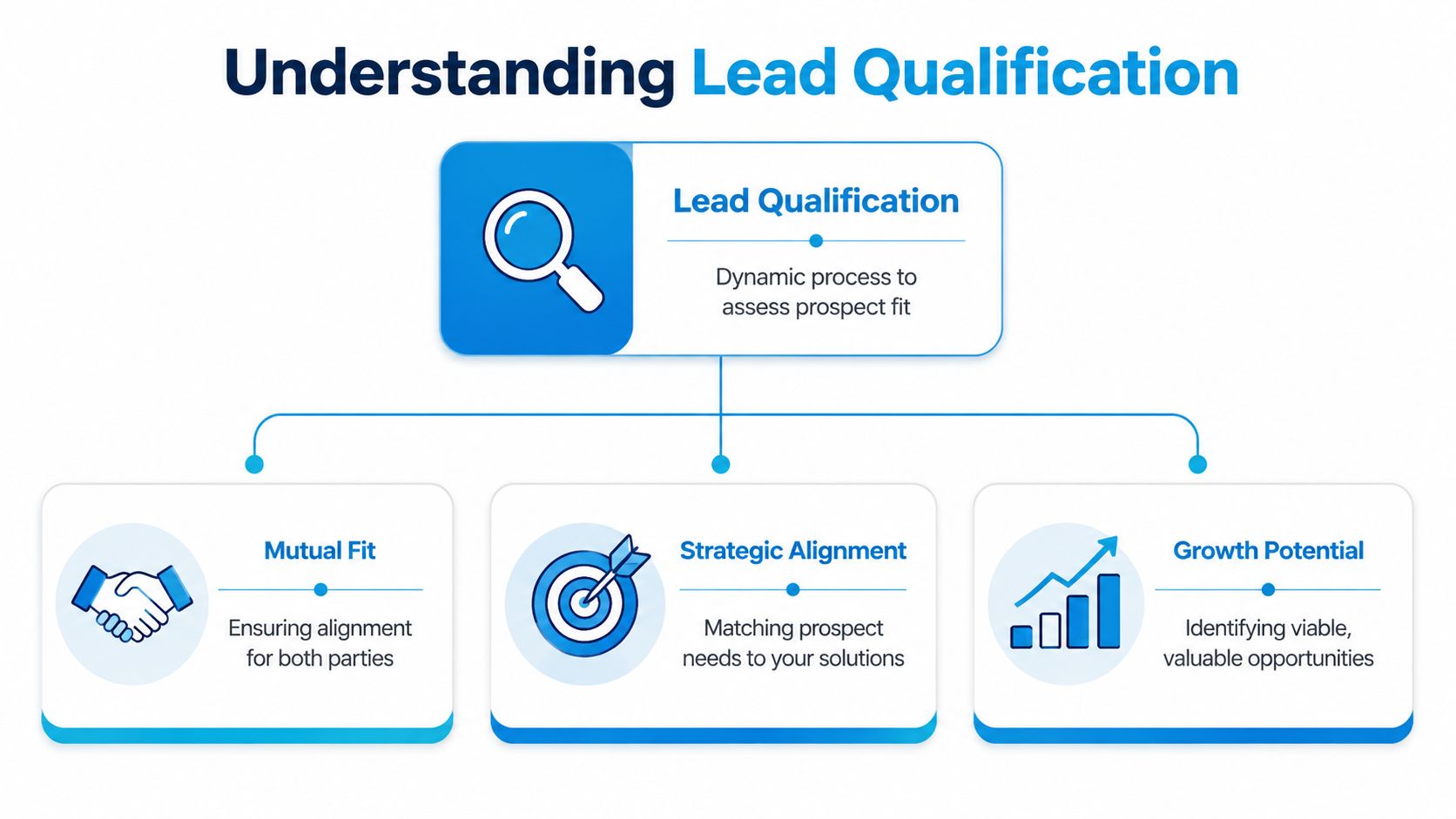
What is lead qualification? It's the process of deciding whether a prospect is a real fit for meaningful sales engagement based on relevance, behavior, and buying intent. In practice, that means sorting early interest from actual readiness so your team spends time where there's a real chance of closing.
A simple way to think about it is medical triage. A doctor doesn't prescribe treatment before understanding symptoms, urgency, and suitability. Service businesses should work the same way. You don't send your best technician, attorney, or treatment coordinator into a full sales conversation until you know the person has the right problem, the right urgency, and a realistic path to buy.
MQLs and SQLs are not the same thing
A lot of teams blur interest and readiness. That creates handoff problems, especially when marketing, intake, and sales all use different definitions.
| Lead stage | What it usually means | Service business example |
|---|---|---|
| MQL | Interested, but not fully vetted | Someone downloads a guide, fills out a form, or calls to ask about services |
| QO | A potentially relevant opportunity identified through signals | A target account or prospect shows signs they may be in-market |
| SQL | Ready for direct sales engagement | The caller has a real need, decision authority, and a credible timeline |
That distinction matters because the performance gap is large. SQLs with confirmed need and authority convert at 26%, while MQLs without those validations convert at 6% (MQL vs SQL conversion rates).
Qualification is a shared operating rule
Qualification works when everyone uses the same filter.
- Marketing should know what kinds of inquiries deserve pursuit.
- Front desk or intake staff should know what questions to ask early.
- Sales or business development should know when to engage directly.
- Operations should know which jobs or cases are profitable enough to prioritize.
Lead qualification isn't a script you read once. It's a decision system your team uses every day.
For service businesses, that system often starts on the phone, not in the CRM. That's why the old SaaS-style playbook misses the point. In home services, legal, and healthcare, the first conversation often happens before you know much about the caller. You have to qualify through the interaction itself.
Popular Lead Qualification Frameworks Explained
A complicated methodology isn't always necessary. What's often needed is a consistent set of questions. The two most practical frameworks are BANT and GPCTBA. BANT is faster. GPCTBA is deeper.
BANT for fast screening
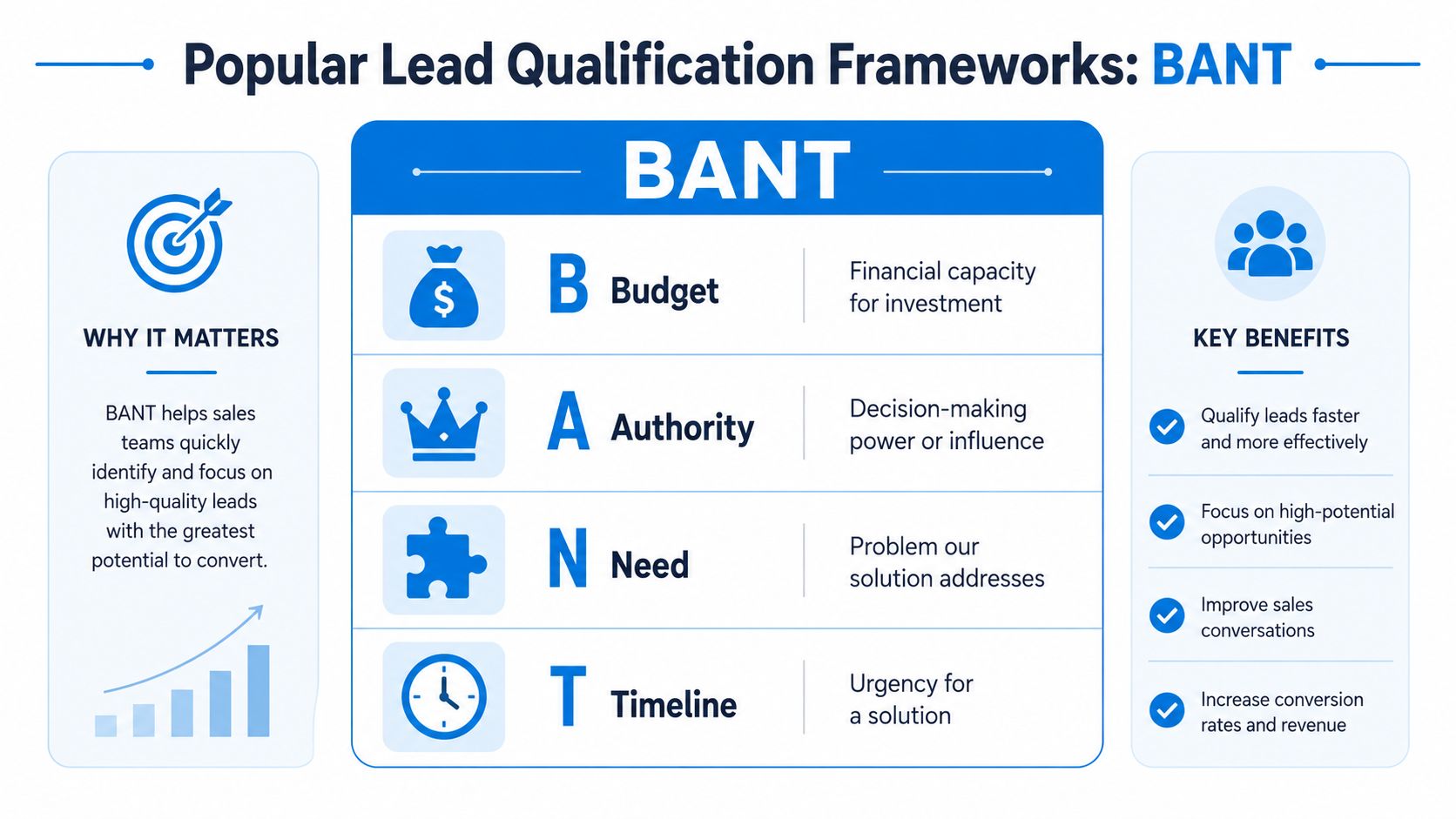
BANT stands for Budget, Authority, Need, Timeline. It works well when your team needs to decide quickly whether to continue, schedule, or route the lead elsewhere.
Budget
Can this person afford the service, project, or retainer level you offer?
Practical questions:
- For home services: “Do you already have a budget range in mind for this work?”
- For legal intake: “Are you looking for ongoing representation or just an initial consultation?”
- For healthcare or dental: “Are you planning to use insurance, self-pay, or financing?”
Authority
Are you speaking with the person who can say yes?
A useful direct question is: “Who will make the final decision about this purchase?” In legal and finance settings, this matters a lot. If the initial contact lacks authority, sales cycles often stall, and the lead should not be treated as ready for immediate outreach until authority is confirmed.
Need
Is there a real problem to solve, or just curiosity?
This is often the most revealing part of the call. A plumbing lead with active water damage is very different from someone casually pricing a future upgrade. A dental lead dealing with pain is different from someone browsing cosmetic options.
Timeline
When does this need action?
Timeline separates urgent revenue from low-priority pipeline clutter. In service businesses, it's often the fastest way to sort leads.
GPCTBA for consultative selling
GPCTBA stands for Goals, Plans, Challenges, Timeline, Budget, Authority. It's useful when the sale is less transactional and more advisory, such as legal services, larger home projects, or higher-value healthcare treatment plans.
| Framework | Best use case | Core strength | Example opening question |
|---|---|---|---|
| BANT | Fast-moving intake and first-call triage | Speed and clarity | “What do you need help with, and how soon?” |
| GPCTBA | More complex, consultative conversations | Context and decision quality | “What outcome are you trying to achieve?” |
GPCTBA is especially helpful when a lead sounds promising but the buying path is still murky. Instead of just asking if they have money and timing, you learn what they want, what they've already tried, and what's blocking progress.
If you're refining your ideal customer profile before building these scripts, this piece on insights into ICP jobs to be done is a useful complement because it helps connect qualification questions to the actual job the customer is trying to get done.
What works and what doesn't
What works
- Asking plain-language questions your receptionist can use
- Disqualifying early when budget, authority, or need is missing
- Adapting your script by service line
What doesn't
- Treating BANT like a robotic checklist
- Asking every question in the same order on every call
- Pushing for a sale before you know whether the lead is viable
Leads that pass strict BANT validation generate 4.5x higher revenue per opportunity than unqualified leads (BANT revenue impact research). That's why even simple frameworks are worth using. If you want a more detailed process for handoffs and criteria, this guide on how to qualify sales leads is a practical next step.
How to Score Leads Without Complex Software
A lead scoring system doesn't require enterprise software. A spreadsheet, shared inbox rules, and a simple call script can take you a long way. The point isn't to create a perfect model. The point is to help your team make the same decision every time.

Build a basic scorecard
Use a sheet with one row per lead and a few columns for fit and intent. Keep the categories visible enough that your front desk or intake coordinator can update them during or right after the conversation.
Try a simple model like this:
| Category | Example signal | Suggested action |
|---|---|---|
| Fit | In service area, target case type, accepted project size | Add positive score |
| Intent | Asked for appointment, quote, or immediate help | Add positive score |
| Authority | Decision-maker confirmed | Add positive score |
| Disqualifier | Outside territory, no relevant need, wrong service type | Mark for nurture or close out |
You don't need fancy math. You need clarity. If the lead has the right problem, can make the decision, and wants help soon, route it fast. If not, send it to a slower follow-up track or close it out.
Add negative scoring
Many small businesses err by scoring interest but ignoring disqualification.
- Wrong geography: Don't keep “working” leads you can't serve.
- Wrong service type: If you don't handle that case or job, mark it clearly.
- Weak intent: If the inquiry is exploratory and low urgency, don't let it jump the line.
- Budget mismatch: Route differently or disqualify if the gap is too large.
A simple scorecard is useful only if it tells your team when to stop chasing.
Set one threshold for “needs personal follow-up now” and another for “marketing nurture only.” That's enough for most local and professional service businesses. If your process is still stuck in email chains and sticky notes, dedicated lead management software for small business can help centralize scoring and routing without turning intake into an IT project.
Lead Qualification in Action for Service Businesses
The easiest way to understand qualification is to hear how it sounds in a real conversation. The questions change by industry, but the logic stays the same. Find the need. Confirm the decision-maker. Check urgency. Then decide whether the lead deserves immediate action.
Plumber example
A plumbing company gets two calls.
Caller one says, “We noticed a slow drip under the sink and wanted to ask about options.”
Caller two says, “A pipe burst and water is getting into the wall.”
Those calls shouldn't be treated equally. For home services, urgency is a major qualifier. Leads who need a fix within 24 hours should be prioritized because that urgency correlates with a 30 to 50% higher win rate for immediate service calls (urgency and conversion research).
Questions a plumber should ask:
- Timeline: “Do you need someone out today, or are you gathering estimates for later?”
- Need: “What specific problem are you dealing with right now?”
- Service fit: “Is this at your home, and are you in our service area?”
If the answer is active water damage and same-day need, route it to dispatch now. If it's a future remodel idea, it may still be a lead, just not the same kind.
For more contractor-specific examples, this guide on lead gen for contractors fits well with a qualification-first approach.
Law firm example
A small law firm gets an intake request from someone asking detailed questions about representation, fees, and timeline. The trap is assuming a detailed caller is a qualified buyer.
The better move is to confirm authority early.
Ask:
- Authority: “Are you the person who will decide whether to move forward with counsel?”
- Need: “What outcome are you trying to achieve?”
- Timeline: “Do you need representation immediately, or are you still reviewing options?”
If the caller is gathering information for someone else and can't retain the firm, the intake should not go straight to attorney time. It may deserve follow-up, but not prime calendar space.
Dental clinic example
A dental office also needs triage, but the signals differ.
One caller asks about whitening specials. Another says they're in pain and think they cracked a tooth. Both are leads. Only one should move to the front of the schedule.
A useful script:
- Need: “What's the main issue you want help with?”
- Urgency: “Are you in pain now, or are you planning care for later?”
- Readiness: “Are you looking to book an appointment today?”
When the pain is clear and immediate, qualification should move the patient toward scheduling, not a longer sales conversation.
That's what good qualification does. It doesn't just label leads. It tells your team what to do next.
Automating Your Qualification Process to Capture Every Lead
A homeowner calls at 6:12 p.m. about a leaking water heater. Your office closes at 6. The caller leaves a voicemail, gets no response for an hour, and books with the next company that answers. That lead did not go cold because of poor marketing. It was lost because your intake process depended on someone being available at the right moment.
Speed matters, especially for service businesses dealing with phone calls, voicemails, text replies, and after-hours demand. Harvard Business Review found a 400% drop in qualification odds when response time moves from 5 minutes to 10 minutes, which is why sub-five-minute response is the benchmark for high-performing teams (speed-to-lead research).
Automation is most useful when demand arrives faster than your team can screen it consistently.
The common breakdowns are operational:
- After-hours calls: A prospect hits voicemail and keeps calling down the list.
- Busy front desks: Staff answer quickly but skip key questions, so weak leads and strong leads get treated the same.
- Inconsistent intake: One coordinator asks the right questions. Another only logs contact details.
- Slow routing: A qualified lead sits in an inbox or spreadsheet while intent fades.
A good automated process handles the repeatable first step. It asks the same core questions every time, records the answers, tags urgency, and pushes the lead to the right next action. For a service business, that might mean booking an appointment, sending a text confirmation, or alerting the on-call person if the request is urgent.
The setup does not need to be complicated. A home services company might screen for issue type, service area, and same-day need. A law firm might capture matter type, timing, and whether the caller can hire counsel. A clinic might ask about symptoms, urgency, and appointment readiness. Those are qualification decisions happening in real time, often by phone, not just on a web form.
Recepta.ai is one example of a tool that handles inbound and outbound conversations, captures lead details, schedules appointments, and hands off to staff when human judgment is needed. The value is consistency. Your team gets cleaner intake, faster follow-up, and fewer missed handoffs.
A short walkthrough helps make that concrete:
Automate the repeatable intake work. Keep judgment, exceptions, and relationship-building with your staff.
That trade-off matters. If you run a criminal defense firm, specialty clinic, or high-ticket remodeling company, no automated system should make the final call alone. But it should capture every inquiry, apply the same first-pass screening, and keep good leads from slipping through because the phone rang at the wrong time.
Lead Qualification FAQs
Is lead qualification different for B2C and B2B?
Yes, but only in the details. The core questions stay the same. Does this person have a real need, the ability to move forward, and a credible timeline?
In B2B, you usually ask about budget ownership, internal approvals, and multiple stakeholders. In B2C or local services, you ask about urgency, household decision-making, insurance or payment readiness, and whether the service problem is immediate or optional. The principle is identical. The script changes.
Is qualification a one-time step?
No. Good teams re-qualify.
A lead may sound strong on day one, then go quiet, miss a callback, ignore scheduling options, or cancel an appointment. That lead shouldn't keep the same status forever. Qualification should change when behavior changes. For service businesses, especially those running around the clock, that means building a loop that reviews missed calls, voicemail non-response, and schedule drop-offs instead of assuming every “qualified” lead stays qualified.
What should a small business do first?
Start with one short script and one routing rule.
Use three questions:
- Need: “What problem do you need help with?”
- Authority: “Are you the person who'll decide?”
- Timeline: “Do you need help now, this week, or later?”
Then set one rule. If the lead has a real problem, a decision-maker, and near-term urgency, it gets immediate follow-up. If not, it goes to nurture or a lower-priority queue.
What's the biggest mistake owners make?
They confuse activity with opportunity.
A ringing phone feels like momentum. It isn't, unless the calls are being sorted correctly. Lead qualification is what turns noise into a pipeline your business can use.
If your team is missing calls, qualifying inconsistently, or struggling to respond fast enough, Recepta.ai gives you a practical way to capture, screen, and route leads around the clock without forcing every inquiry through your staff first.