
How to calculate cost per lead: A Simple Formula for 2026 Success

On the surface, calculating your Cost Per Lead (CPL) seems straightforward. Just take your Total Marketing Spend ÷ Total New Leads. Spend $1,000 on a campaign, get 50 new leads, and your CPL is $20. Simple, right?
But this simple math is dangerously misleading. It’s a vanity metric that only tells part of the story, and relying on it can lead to some seriously flawed budget decisions.
The True Cost Per Lead Formula Everyone Misses
The single biggest mistake I see businesses make is calculating their CPL using only direct ad spend. This is especially common for those new to models like Pay Per Click advertising, where the cost is so clearly tied to an action. But that ad spend is just the tip of the iceberg.
To get a real, actionable understanding of your marketing's financial health, you need to calculate your True CPL. This metric forces you to account for all the costs—both direct and indirect—that go into generating that one lead.
Uncovering Your Hidden Marketing Costs
A simplistic CPL looks great on a spreadsheet, but it completely ignores the full investment behind each prospect. A True CPL calculation is more honest. It includes a much wider range of expenses that are easy to forget.
Think about what it really takes to run a campaign:
- Software and Tools: What about your CRM subscription? Your marketing automation platform, best call tracking software, or analytics tools? For example, if you pay $150/month for a CRM and $50/month for call tracking, that's $200 you must add to your total cost.
- Creative and Content: Who created the ad visuals, wrote the copy, produced the video, or designed the landing page? That time and talent isn't free. A practical example: if you paid a freelance graphic designer $500 for a set of ad images, that $500 is a direct campaign cost.
- Personnel Costs: You also have to factor in a portion of the salaries for your marketing team or the fees you pay to agencies and freelancers who manage the campaigns. For instance, if your marketing manager earns $72,000/year ($6,000/month) and spends 10% of their time on a specific lead gen campaign, you must allocate $600 of their monthly salary to that campaign's cost.
Let's look at a more realistic example to see how quickly the numbers change.
Simple CPL vs True CPL: A Realistic Example
Imagine an HVAC company runs a Google Ads campaign. A surface-level look might seem promising, but digging into the true costs reveals a very different picture.
As you can see, the True CPL of $14.00 is more than double the simplistic $6.67 figure. This isn't just an accounting exercise; it’s the difference between thinking a campaign is wildly profitable and realizing it's barely breaking even.
Key Takeaway: Your True CPL reflects the total investment—including software, content, and salaries—not just what you paid for ads. Calculating this number is the only way to understand your marketing's actual profitability.
This visual really drives the point home.
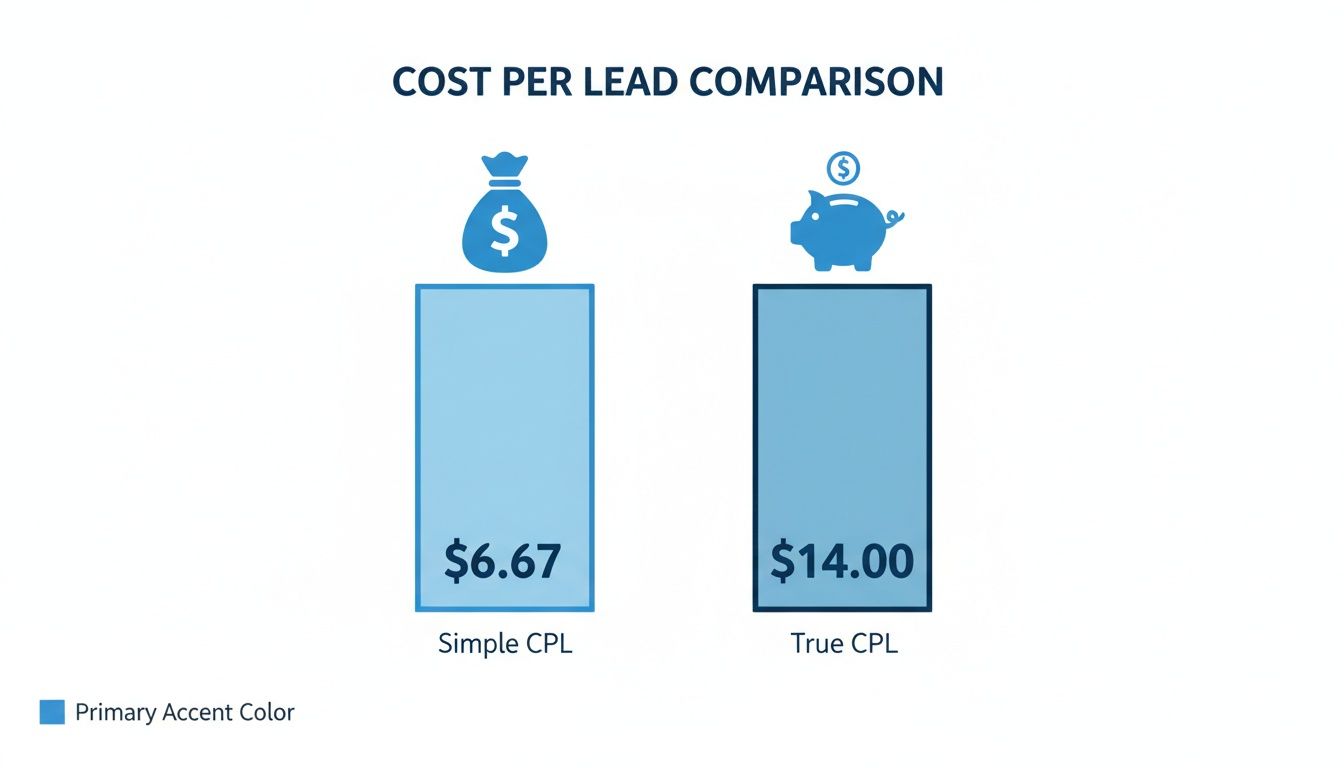
The gap between the "Simple CPL" and "True CPL" is where marketing budgets are wasted and opportunities are missed. Acknowledging this difference is the first step toward making smarter, more profitable decisions about where you invest every single dollar.
Hunting Down the Data for an Accurate CPL

Alright, you get the CPL formula in theory. That's the easy part. The real work—the part that separates a vague guess from a rock-solid business metric—is digging up all the right numbers.
An accurate Cost Per Lead is completely dependent on the quality of the data you feed it. So let's get our hands dirty and figure out exactly where to pull the numbers for both your total costs and your lead count. This isn't about pulling figures from memory; it's about building a repeatable process to get a crystal-clear financial view of your lead generation efforts.
Locating Your Total Marketing Costs
Your total marketing investment is rarely sitting in one neat spreadsheet. It's usually sprinkled across different platforms, tools, and even departments. To get the full picture, you have to play detective and consolidate everything.
Here are the usual suspects you'll need to round up for your expense data:
- Advertising Platforms: This is the most obvious starting point. You'll need to log in to your Google Ads and Meta Ads (for Facebook & Instagram) dashboards. Pull the "Cost" or "Amount Spent" report for the period you're measuring. And don't stop there—make sure to include any other platforms you're using, like LinkedIn Ads, TikTok, or niche industry directories.
- Software and Tool Subscriptions: Jot down every piece of marketing software you pay for. We're talking about your CRM (like Salesforce or HubSpot), your marketing automation tools (like Marketo), and any analytics or SEO software (Ahrefs). Tally up the monthly or annual fees for everything on that list.
- Agency and Freelancer Invoices: If you're working with an SEO agency, a content writer, or a PPC freelancer, their retainers and project fees are a direct marketing cost. Dig up those invoices from your accounting software or email history.
- Personnel Costs: This one is so easy to forget, but it's essential for what I call your "True CPL." You need to account for your team's time. A straightforward way is to estimate the percentage of a team member's time spent on lead-gen activities. For instance, if a marketing manager with a $6,000 monthly salary dedicates 25% of their time to managing a Google Ads campaign, you should add $1,500 of their salary to that campaign's cost.
Tracking these varied costs might feel a bit tedious, but it's non-negotiable. It’s the only way to move past a surface-level analysis and understand the true investment required to make your phone ring or your inbox fill up.
Pinpointing Your Total Lead Count
Just as crucial as tracking costs is correctly counting every single lead and knowing where it came from. A "lead" could be a form submission, a phone call, or a demo request. The trick is having the right systems in place to catch and attribute all of them.
Setting Up Your Digital Tripwires
Your website and digital campaigns are your frontline for capturing leads. You have to make sure you're tracking every single conversion point.
- Google Analytics Goals: This is your foundation. In Google Analytics 4 (GA4), you need to set up "Conversion Events" for every important action a user can take—think form submissions, "click-to-call" button taps, or live chat initiations. This tells you which channels are actually delivering the goods.
- UTM Parameters: Get into the habit of using Urchin Tracking Module (UTM) parameters for all your marketing links. These are simple tags you add to a URL that tell Google Analytics precisely where a user came from. For example, a link from a Facebook ad could be
yourwebsite.com?utm_source=facebook&utm_medium=cpc&utm_campaign=summer-sale. This practice cuts through the fog of attribution. - CRM Integration: Your Customer Relationship Management (CRM) system should be your single source of truth for leads. Make sure your website forms feed directly into your CRM, automatically creating and tagging new contacts with their source.
For any business that gets a significant amount of inquiries over the phone, call tracking is an absolute must-have. To see how you can connect inbound calls back to the exact campaign that drove them, you should explore some of the best call tracking software on the market. This kind of tech gives you a complete view of all your leads, not just the digital ones.
Calculating CPL in the Real World
The formula is one thing, but putting it to work is where you really start to see its power. This is where the theory gets real, and you get a feel for analyzing your own marketing campaigns.
Let’s walk through a few different scenarios I’ve seen play out time and again. We’ll use realistic numbers to show you exactly how to calculate your True CPL, whether you're a local shop or a national brand. The goal is to get you comfortable applying these principles directly to your own balance sheet.
Example 1: The Local Dental Clinic
First up, a classic case: a dental clinic aiming to attract new patients for high-value services like implants and Invisalign. They fire up a Google Ads campaign for one month, targeting keywords like "dental implants near me."
Let's break down all the money they spent to make this happen.
- Google Ads Spend: $2,500
- Landing Page Software (like Unbounce): $150 for the month
- Call Tracking Software: $50 for the month
- Agency Management Fee: $750 to have an expert run the campaign
Now for the results. Because they had proper tracking in place, they knew exactly how many inquiries came from this specific campaign.
- Form Submissions: 35
- Tracked Phone Calls: 25
Time to put it all together.
Total Costs: $2,500 + $150 + $50 + $750 = $3,450
Total Leads: 35 + 25 = 60 New Leads
True CPL: $3,450 / 60 = $57.50 per lead
A $57.50 CPL might raise an eyebrow at first glance. But when you consider that a single dental implant patient is worth thousands of dollars, it's clear this is a highly profitable investment. If they had only looked at the ad spend, they would've calculated a CPL of $41.67, giving them a dangerously inaccurate view of their true costs.
Example 2: The Multi-Location Franchise
Let's switch gears to a home services franchise with 10 locations. They're running targeted ads on Facebook and Instagram to get quote requests for plumbing and HVAC repairs. We'll look at their numbers over a full quarter.
This one is a bit more complex since we're dealing with shared costs across multiple locations.
Marketing Costs (Quarterly):
- Total Ad Spend (across all 10 locations): $30,000
- CRM Subscription (HubSpot): $1,200
- Graphic Designer (freelance): $1,500 for ad creative
- Marketing Manager Salary (allocating 20% of time to this campaign): $3,600 ($6k/mo salary x 3 mo x 20%)
Lead Generation (Quarterly):
- Total Quote Request Leads: 1,250 across all franchisees.
Here’s how the costs stack up.
Now we can get our final number:
True CPL = $36,300 (Total Costs) / 1,250 (Total Leads) = $29.04 per lead
That $29.04 CPL is a powerful metric for the franchise headquarters. It gives them a clear, birds-eye view of their social media strategy's effectiveness. From there, they can drill down to see which locations are crushing it and which might need a little extra help.
Example 3: The Law Firm and SEO
Finally, let’s look at a law firm playing the long game with SEO and content marketing. Unlike paid ads that deliver instant (but temporary) results, SEO is an investment where leads trickle in steadily over time. We'll analyze their performance over a six-month period.
Marketing Costs (6-Month Period):
- SEO Agency Retainer: $24,000 ($4,000 per month)
- Content Writing (4 articles/mo): $4,800 ($800 per month)
- Analytics Software (Ahrefs): $600 ($100 per month)
Lead Generation (6-Month Period):
- Organic Form Submissions: 95
- Organic Phone Calls: 70
This scenario really underscores why accurate attribution is non-negotiable. The firm uses call tracking to know for sure which calls came from organic search versus, say, a direct mailer. Having that raw data in one place is everything, which is why call detail reporting is a game-changer for so many businesses.
Let's run the numbers.
Total Costs: $24,000 + $4,800 + $600 = $29,400
Total Leads: 95 + 70 = 165 New Leads
True CPL: $29,400 / 165 = $178.18 per lead
A CPL of nearly $178 to acquire a potential legal case worth tens of thousands of dollars? That’s an incredible return. And the best part is, those SEO leads will keep flowing in for months or even years to come, making it a true business asset, not just a one-off expense.
Why a Low CPL Can Be a Vanity Metric
It’s tempting to get laser-focused on your Cost Per Lead. Seeing that number drop on a report feels like a clear win, but I've seen this become one of the most common—and costly—mistakes in marketing. Chasing a low CPL for its own sake is a trap.
Think of it this way: a cheap lead that goes nowhere doesn't just cost you the ad spend. It costs you the sales team's time, the follow-up effort, and the opportunity you missed by not pursuing a better lead. The real goal isn't just cheap leads; it's profitable customers.
To get there, you have to look past that initial number and understand what happens after a lead comes in. It's about tracking their entire journey through your sales funnel.
Moving Beyond CPL to Quality and Profitability
Let's be honest: not all leads are created equal. Some are just browsing, while others are genuinely looking for a solution. The real work begins when you start separating the tire-kickers from the serious buyers. This is where we introduce two crucial milestones in a lead’s journey:
- Marketing Qualified Lead (MQL): This isn't just a name on a list. An MQL is someone who has shown real interest by meeting specific criteria you've set. Maybe they downloaded a detailed whitepaper, attended a product webinar, or kept coming back to your pricing page. They’re engaged and a good potential fit.
- Sales Qualified Lead (SQL): This is an MQL that your sales team has personally vetted. They've confirmed the lead has a real need, the budget to make a purchase, and the authority to sign off on it. An SQL is ready for a direct sales conversation.
When you start tracking the cost to acquire these qualified leads, you get a much sharper picture of your campaign's actual performance. For a deeper dive into this process, check out our guide on how to qualify sales leads.
A Practical Example: From CPL to CAC
Let's walk through a real-world scenario with a B2B SaaS company using LinkedIn Ads. The initial CPL might look high, but the story doesn't end there.
Imagine your campaign delivers leads at an $80 CPL. That might cause some sticker shock, but let's see how the numbers play out as these leads move through the funnel. The key is understanding how CPL ultimately translates into your final Customer Acquisition Cost (CAC).
From CPL to CAC: A Funnel Conversion Example
The table below breaks down how that initial $80 lead cost evolves at each stage of the funnel, eventually revealing the true cost to acquire a new customer.
As you can see, the initial lead cost is just the starting point. The real value is determined by the conversion rates that follow. In this example, an $80 lead ultimately costs $1,600 to convert into a paying customer. Another B2B SaaS company with a $125 CPL and a strong 18% lead-to-customer conversion rate achieved a $681 CAC against a massive $10,800 LTV. This gave them a highly profitable 15.8:1 LTV-to-CAC ratio, easily justifying their marketing spend. You can explore more data points like this over at Prospeo.
This brings us to the two metrics that truly matter for profitability:
- Customer Acquisition Cost (CAC): The total cost to acquire one new paying customer. In our example, that's $1,600.
- Customer Lifetime Value (LTV): The total revenue you anticipate from a single customer throughout their relationship with your business.
Key Insight: A "good" CPL is simply one that leads to a profitable CAC. A healthy business model typically aims for an LTV that is at least 3x the CAC.
If the LTV for the SaaS product in our example is $10,000, that $1,600 CAC is a fantastic investment. It yields a 6.25:1 LTV-to-CAC ratio, which is incredibly healthy. Suddenly, that "high" $80 CPL from LinkedIn looks like a brilliant strategic move.
Conversely, imagine a Facebook campaign with a $20 CPL. You might get hundreds of leads, but if none of them ever qualify or convert, you’ve just wasted your budget and your sales team's precious time for a $0 return.
This is the mindset shift every marketer needs to make. Stop asking, "How low can I get my CPL?" and start asking, "Which channels are delivering my most profitable customers?"
Actionable Strategies to Lower Your Cost Per Lead
Knowing your True CPL is one thing, but actually lowering it is where you start to see real growth. This isn't just about slashing your budget, either. The real goal is to get more efficient—to make every dollar you spend bring in better, more valuable opportunities for your business.
Ultimately, you want to fine-tune your entire marketing funnel, from the very first ad someone sees to the moment they hit "submit" on a form. It’s all about making small, smart improvements across the board. These tiny adjustments add up, creating a huge impact on your bottom line.
Refine Your Audience Targeting
The quickest way to waste your marketing budget? Showing your ads to the wrong people. It sounds obvious, but it happens all the time. The more precisely you can define and reach your ideal customer, the lower your CPL will naturally fall because you're simply not wasting money on clicks that go nowhere.
Stop thinking in broad strokes and get granular with your data. Build out highly specific audience segments.
- Lookalike Audiences: Take a list of your absolute best customers—the ones you wish you could clone—and upload it to a platform like Facebook or LinkedIn. Their algorithms will find new people with similar traits, giving you a warm, pre-vetted audience to target.
- In-Market Audiences: On Google Ads, you can target users who are actively researching products and services just like yours. This is an incredibly powerful way to get your message in front of people who are ready to buy.
- Negative Keywords: This is a must for paid search. You should constantly be adding negative keywords to your campaigns. If you sell a premium service, for example, you need to exclude terms like “free,” “cheap,” or “discount” to stop paying for clicks from bargain hunters.
Think of it this way: a plumbing company could go from targeting all "homeowners" to instead targeting "homeowners in specific affluent zip codes who have shown interest in home renovation." That small shift ensures their ads for high-end bathroom remodels aren't wasted on people just looking for a quick drain cleaning. The lead quality goes up, and the cost per qualified lead goes way down.
A/B Test Everything
Never assume you know what works. Seriously. A/B testing, where you run two different versions of an ad or landing page to see which performs better, is how you eliminate guesswork. It's a data-driven process that lets you make consistent, small improvements that compound over time to lower your CPL.
The key is to test just one thing at a time. That way, you know exactly what made the difference.
- Ad Creative: Test different headlines, images, or videos. Does a photo of your product in action work better than a clean lifestyle shot? Does asking a question in your headline get more clicks than making a bold statement?
- Call-to-Action (CTA): The words on your buttons matter. "Get a Free Quote" might perform completely differently than "See Pricing" or "Book a Consultation." Test them!
- Landing Page Layout: Don't underestimate small design tweaks. Simply moving your lead form above the fold or changing your CTA button from blue to orange can have a massive impact on your conversion rates.
Just a 5% increase in your landing page conversion rate can be a game-changer. If you were spending $5,000 to get 100 leads ($50 CPL) with a 2% conversion rate, pushing that to just 2.1% would bring in 105 leads for the same spend. Your CPL would drop to $47.62.
Optimize Your Lead Capture and Qualification
Lowering your CPL isn't just about getting more leads—it's about getting more qualified ones without spending more money. This is where you stop wasting your sales team's valuable time on inquiries that were never going to pan out.
To really bring down your CPL, you have to nail your lead generation process. You can explore some powerful effective strategies for website lead generation to start attracting the right kind of attention from the get-go.
Once a prospect is on your site, the experience has to be frictionless. This is where smart tools come in to automate the initial screening. For instance, an AI-powered receptionist like Recepta.ai can engage with website visitors or inbound callers 24/7. It asks the qualifying questions you set, captures their details, and routes them right into your CRM.
This approach dramatically lowers your "true" cost per lead by filtering out the noise—spam, job applicants, and mismatched inquiries—before they ever reach your sales team. It ensures your team only spends time on prospects who are a genuine fit. Better lead management is a direct path to a lower CPL. For a deeper dive, check out our post on lead management software for small business.
Your Top Cost Per Lead Questions Answered
Once you start digging into your own CPL, you're bound to run into a few tricky questions. Let's tackle some of the most common ones that come up for marketers who are serious about getting this metric right.
What Is a Good Cost Per Lead?
This is the million-dollar question, and the only truthful answer is that there's no magic number. A "good" CPL is completely relative to your industry, your price point, and your business model.
Think about it: a $200 CPL might feel high, but for a B2B SaaS company with a high-value contract, it's a bargain. For an e-commerce store selling t-shirts, it would be a complete disaster.
The real measure of a "good" CPL is whether it leads to a profitable Customer Acquisition Cost (CAC). Your CPL has to fit comfortably inside your CAC, which in turn needs to be significantly lower than your Customer Lifetime Value (LTV).
A healthy benchmark many successful companies shoot for is an LTV to CAC ratio of 3:1 or better. Simply put, for every dollar you spend bringing a customer in the door, you should aim to get at least three dollars back over the course of your relationship.
Instead of hunting for a universal CPL figure, focus on benchmarking against your own industry first. From there, the goal is to consistently push your own CPL down while making sure lead quality doesn't suffer.
How Do I Track Leads from Phone Calls?
If you're in a business where customers pick up the phone—like home services, legal, or healthcare—you're likely missing a huge piece of the puzzle. Not tracking phone call leads means your CPL data is flat-out wrong.
The best way to solve this is with call tracking software that uses dynamic number insertion (DNI). It's a game-changer. This tech smartly shows a unique, trackable phone number to each website visitor depending on how they found you.
For example:
- A visitor from your Google Ads campaign sees one phone number.
- Someone who arrived via organic search sees a completely different one.
- A user who clicked through from a Facebook ad sees a third unique number.
When a prospect calls, the software instantly connects that call back to the specific source. That data gets piped right into your analytics platform or CRM, so every single phone lead is accounted for. This gives you the full, accurate picture you need to calculate a true Cost Per Lead.
Should CPL Differ Between Marketing Channels?
Absolutely. In fact, if your CPL is the same across all your channels, something is probably wrong. You should always calculate CPL for each channel individually because they all behave differently.
Take content marketing and SEO. These channels often produce a fantastic CPL over the long run, but they require a big investment of time and money upfront before you see a return.
On the other hand, a pay-per-click campaign on Google or LinkedIn might have a higher CPL, but it delivers leads who are often ready to buy right now.
Breaking down your CPL by channel is what allows you to make sharp, strategic budget decisions. You can confidently pour more resources into the channels that are driving your most profitable customers and pull back on the ones that just aren't cutting it. That’s how you build an efficient marketing engine.
Ready to stop missing leads and start lowering your CPL? Recepta.ai provides an AI-powered receptionist that qualifies every inbound call and website inquiry 24/7, ensuring your sales team only talks to high-quality prospects. Discover how you can capture up to 30% more qualified leads and see up to a 15x ROI at https://recepta.ai.