
Missed Call Recovery System: What It Is and How It Works
A small business can miss 20% to 35% of incoming calls during business hours, and nearly 100% after hours, according to industry data on missed calls for small businesses. That isn't just a staffing inconvenience. It means a caller who already chose your business may disappear before anyone records their name, understands their need, or offers an appointment.
A missed call recovery system closes that gap. It detects an unanswered call, responds through the right channel, captures useful context, and creates an accountable next step for an AI agent or human employee. The important distinction is that recovery isn't “send a text.” It's a speed-versus-fit problem. A fast callback can recover high-intent demand, while SMS, routing rules, after-hours handoffs, and human escalation determine whether that response works in the operating environment.
Why Missed Calls Are a Revenue Leak
At 6:07 PM, an HVAC owner sees the office phone light up. The team has gone home, the answering machine picks up, and the caller hangs up without leaving a message. Assuming that person will try again tomorrow creates avoidable risk. 86% of callers who reach voicemail hang up without leaving a message, and 75% of those callers call a competitor instead, according to small-business missed-call benchmarks.
The same pattern appears in a dental office during lunch, a law firm handling another intake call, or a plumbing company responding to a burst-pipe emergency. Call abandonment means an inbound caller disconnects before reaching an agent. Contact centers often treat abandonment near 5%, or about 1 in 20 callers, as an acceptable threshold. Healthcare environments can report higher ranges, including 7% to 10%, while another healthcare target is 5% to 7%, as described in the cited contact-center benchmark.
The leak starts before the sale
A missed call does not carry one fixed dollar value. Its impact depends on the service, urgency, and caller intent. An emergency dispatch, a new legal intake, a routine question, and an existing customer's billing request require different recovery decisions.
The operational question is, “Which missed calls represent qualified demand, and how quickly can we recover them?” Speed matters, but speed alone is not enough. A sub-five-minute callback can recover high-intent demand, while channel-aware escalation, after-hours handoffs, and human fallback determine whether the response fits the caller and the business.
| Vertical | Avg. Customer Value | Missed-Call Rate | Lost Revenue / 100 Calls |
|---|---|---|---|
| HVAC | Varies by job and urgency | 20% to 35% during business hours | Depends on qualified jobs recovered |
| Dental | Varies by procedure and patient value | 20% to 35% during business hours | Depends on appointments recovered |
| Legal | Varies by matter and intake quality | 20% to 35% during business hours | Depends on qualified consultations |
The rates in the table reflect the cited small-business benchmark, not a universal vertical average. Use CRM records and call data to model revenue. The calculation needs actual customer value, qualification, and close outcomes.
Practical rule: Treat every missed call as an unassigned opportunity until the system records an outcome.
A recovery platform detects the unanswered event, acknowledges the caller, offers a callback or booking path, and alerts the person responsible for the next step. A basic voicemail message usually records intent without creating ownership. For context, see how automated voicemail messages work. The workflow still needs to preserve caller context and route the conversation to a human or suitable self-service action. Regulated industries may require that human fallback before any automated response can move the intake forward.
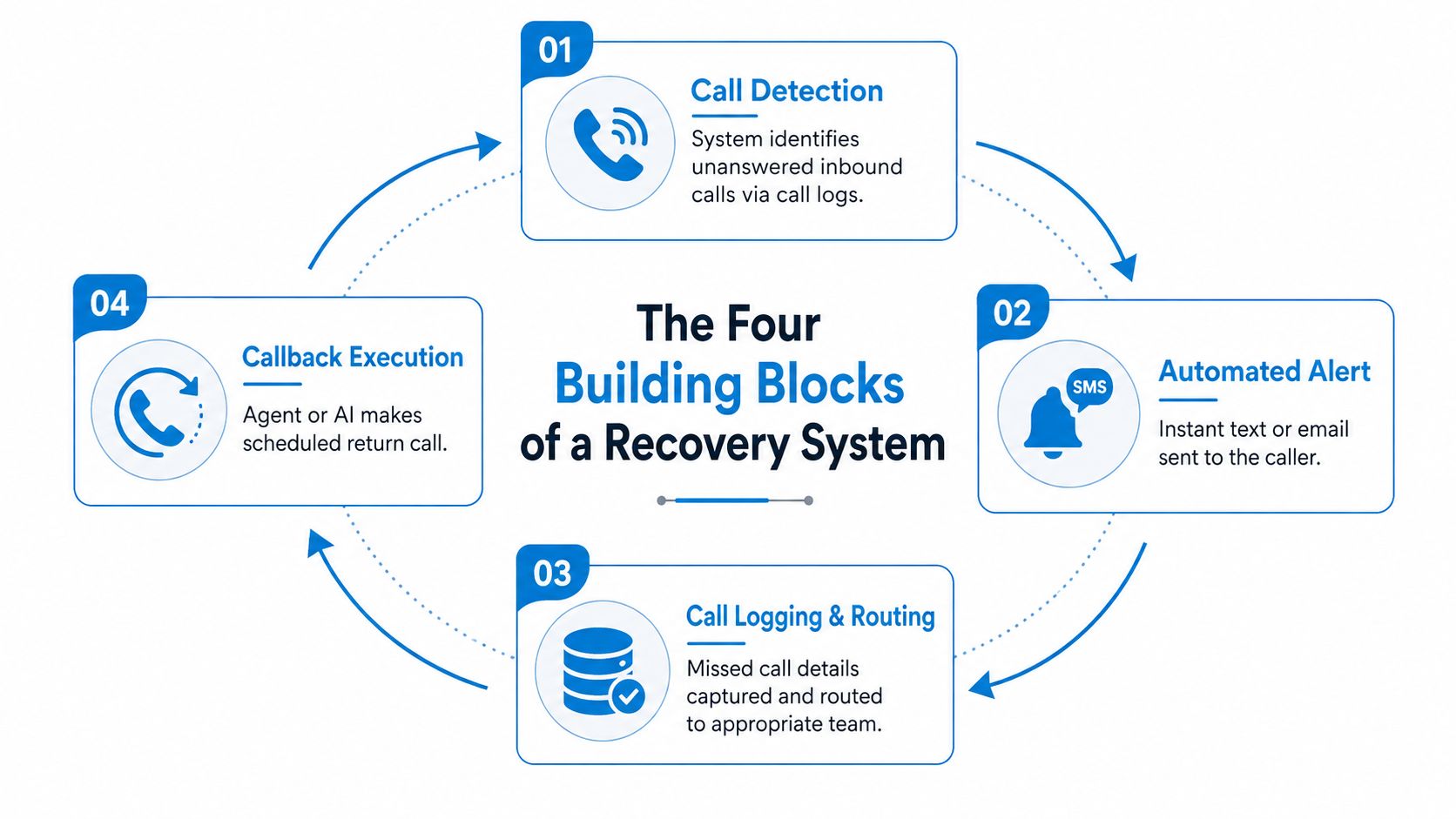
The Four Building Blocks of a Recovery System
A dependable missed call recovery system has four connected layers. If one layer is missing, the workflow may notify someone without contacting the caller, send a text without creating ownership, or generate activity that never reaches booked revenue.
1. Detection
The telephony layer identifies a ring-no-answer event, a busy signal, or an abandoned queue call. It should capture the caller ID, timestamp, destination number, campaign source when available, and whether the call occurred during business hours. Detection needs to happen within seconds, because a workflow that waits for a manual report has already lost the most valuable response window.
For example, a plumbing company can define separate events for a missed emergency line and a missed estimate line. The first can route to an on-call path, while the second can start a booking workflow.
2. Alerting
The alert layer contacts both the caller and the team. A concise SMS can confirm that the business received the call and offer a reply or booking option. An internal alert can create a task for the appropriate employee rather than dropping the responsibility into a shared inbox.
The first message should identify the business, avoid pretending to be a human, and make the next action obvious. If the caller replies, the system should preserve that conversation instead of forcing them to start over.
3. Routing
Routing decides what happens based on time, caller identity, location, urgency, service type, and CRM history. A returning patient may need a scheduling queue. A high-priority service customer may need an on-call technician. A new lead from a specific location may belong to a local team rather than a centralized receptionist.
Rules should include fallback behavior. If the preferred agent doesn't answer, the system can offer a callback window, transfer to an AI receptionist, or escalate to a human queue.
4. Execution and measurement
Execution is the actual return call, text conversation, booking, or escalation. The system should log the disposition, response time, owner, qualification status, and commercial outcome. A human agent then sees why the caller reached out, what the automated workflow collected, and what action remains.
A practical flow looks like this:
- The phone system marks an unanswered inbound call.
- The platform sends the caller an SMS acknowledgment.
- Routing checks business hours, caller history, urgency, and location.
- The AI or assigned employee gathers missing information.
- A human picks up the returned call with the conversation context visible.
- The CRM records whether the contact booked, deferred, declined, or remained unreachable.
That final record is what turns recovery from a notification feature into an operating process.
KPIs That Measure Recovery Success
Raw call volume can make a dashboard look active while qualified leads still disappear. Recovery measurement should follow each caller from abandonment through contact, qualification, appointment, and revenue. The operating question is whether the workflow restored a commercial opportunity, not whether it generated activity.
The first metric is speed to first human or automated touch. A missed-call recovery benchmark reports that responding within five minutes can be up to 21 times more effective than waiting 30 minutes. An recovery workflow guide recommends an immediate callback or SMS within seconds, supported by event-driven triggers and low-latency routing.
Speed still needs fit. A sub-five-minute text may protect intent for a routine request, while an urgent or regulated conversation may require a qualified human, an after-hours handoff, or escalation to a monitored queue. Track both response speed and whether the assigned channel could handle the caller's need.
Measure the funnel, not activity
Contact rate shows whether the caller engaged with the return attempt. Qualified-lead rate shows whether the conversation uncovered a genuine service need. Booked-appointment rate and recovered revenue show whether recovery changed the business result.
Separate queue performance from recovery performance. Contact-center guidance places typical abandonment around 5% to 8%, with strong performance below 5%, while an Australian best-practice report cited an 8% average abandonment rate in 2024 across more than 300 contact centers operational abandonment guidance. Treat those figures as directional, then segment results by queue, hour, location, service type, and acquisition source.
| Metric | Why It Matters | Benchmark / Threshold | Vanity or Recovery |
|---|---|---|---|
| First-touch response time | Shows whether the workflow reaches the caller while intent is fresh | Five-minute response benchmark, with immediate automation preferred | Recovery |
| Abandonment rate | Shows how many callers leave before live contact | Track against your queue baseline and operating target | Recovery |
| Contact rate | Shows whether recovery attempts reconnect with callers | Establish your baseline by queue and channel | Recovery |
| Qualified-lead rate | Separates genuine demand from wrong numbers and routine inquiries | Track by service type | Recovery |
| Booked-appointment rate | Connects recovered contacts to scheduled work | Track against qualified contacts | Recovery |
| Total calls handled | Measures workload, not recovered value | No universal recovery threshold | Vanity |
| SMS open rate | Indicates visibility, not intent or revenue | Use only as diagnostic context | Vanity |
| Internal alerts sent | Measures system activity, not customer outcome | No standalone target | Vanity |
A call-detail reporting guide can help teams structure records for this analysis. Log the caller, timestamp, channel, owner, response, qualification status, and final disposition. Count a call as recovered only when the business can identify a meaningful customer interaction and its outcome.
Avoid optimizing for “messages sent.” An instant text has little value if nobody answers replies, owns the follow-up, or can see why the caller contacted the business. Measure completed handoffs and outcomes instead.
Choosing the Right Recovery Channel
Channel selection should match caller intent, response speed, and the people available to handle the next step. Callback-only recovery suits high-intent conversations, such as an HVAC emergency or legal intake, when a qualified person can respond quickly. It fails when the queue is full or the office is closed. SMS scales more easily after hours, but a text may be inadequate when the caller needs reassurance, nuanced qualification, or urgent judgment.
The practical choice is usually a staged workflow. Send an immediate acknowledgment, offer a reply or booking action, then attempt a callback based on urgency. Keep the text thread open if the caller misses the return call. A sub-five-minute callback can protect conversion for urgent, high-value inquiries, while a channel-aware escalation prevents routine requests from consuming the same human capacity.
| Recovery Channel | Speed to First Touch | Cost per Contact | Typical Conversion Lift | Best Fit |
|---|---|---|---|---|
| Callback only | Fast when staff are available | Higher staff involvement | Depends on response speed and caller intent | Emergencies, high-ticket intake |
| SMS only | Immediate automated acknowledgment | Lower operational burden | Depends on reply quality and service complexity | Routine requests, after-hours triage |
| Hybrid SMS plus callback | Immediate message followed by voice attempt | Moderate, with automation supporting staff | Strongest when channel matches intent | Most service businesses with varied demand |
Why voicemail underperforms
Voicemail requires the caller to explain the need, wait for a response, and remain available. Many callers will not leave a message, and some will not call again, so a voicemail drop should support recovery rather than serve as the full system.
A dental office might send, “We missed your call. Reply with BOOK and your preferred day, or tell us whether this is urgent.” A scheduling request can continue by text. A pain or emergency message can move to a trained human. The channel changes because the risk and caller need change.
After-hours rules should define who receives urgent replies, how quickly a callback is attempted, and when a human takes over. Regulated industries also need a clear boundary for what automation can collect and what requires trained staff.
Campaign, location, and number-level attribution help identify which missed calls deserve investment. A practical call tracking for small businesses resource explains how that visibility supports channel decisions.
Use an automated phone answering service when callers need immediate voice interaction. Confirm that it supports human takeover, CRM context, and after-hours rules, rather than replacing one voicemail box with another.
Why AI Plus Human Support Wins
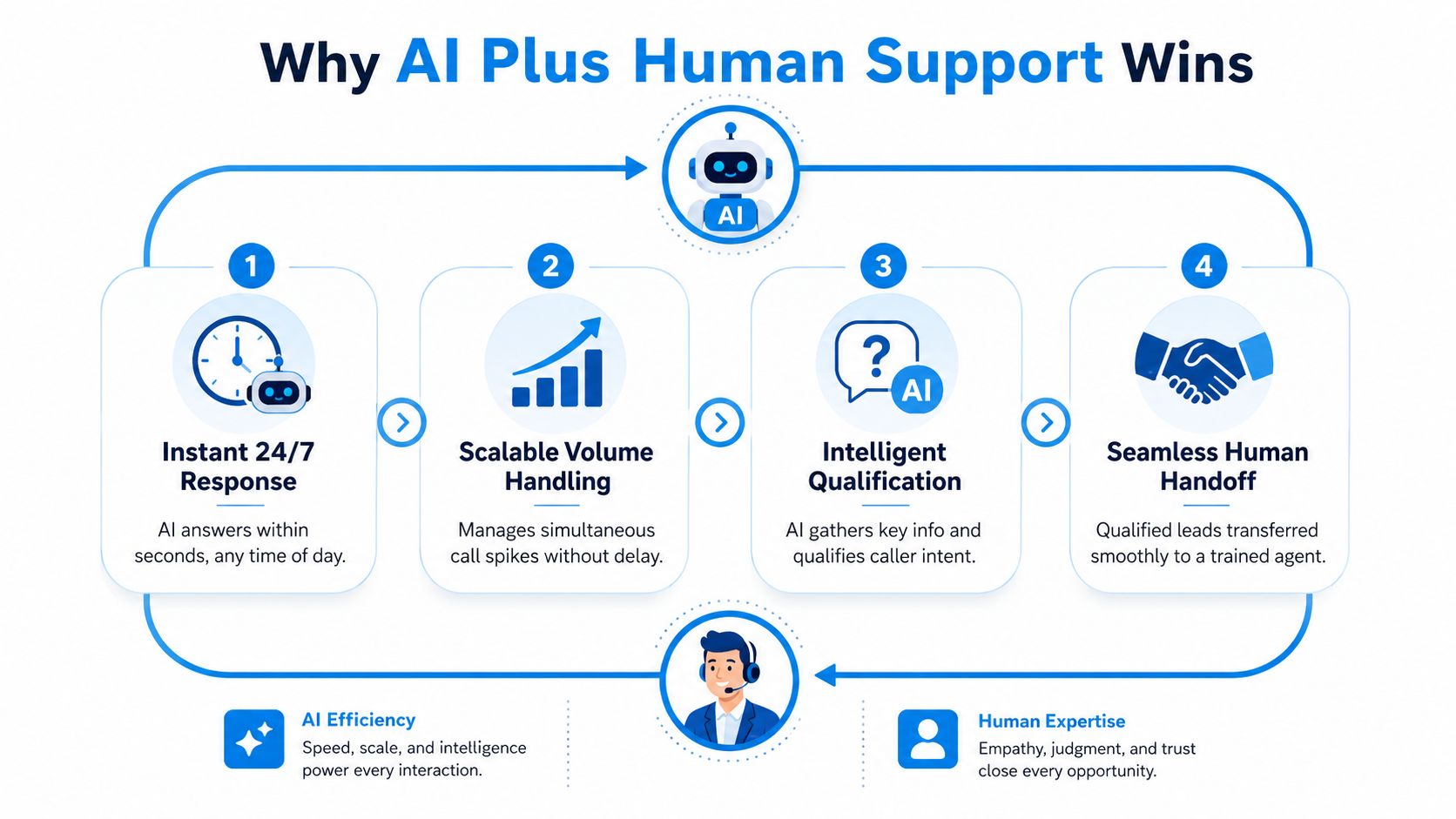
AI and human agents solve different failure modes. AI can answer instantly, operate outside office hours, manage simultaneous demand, ask consistent qualification questions, and preserve the first-minute response window. Human agents bring judgment, empathy, de-escalation, and accountability when the conversation becomes sensitive or commercially complex.
AI alone stalls when a caller is frustrated, describes an unusual situation, asks for advice the system shouldn't provide, or needs a regulated intake process. Human-only coverage stalls when every employee is busy, the office is closed, or a seasonal surge overwhelms the queue. A hybrid model works because it assigns the first interaction to the layer that can respond fastest and the difficult decision to the layer equipped to make it.
Define escalation before launch
Don't tell an AI system to “escalate when necessary” and expect consistent operations. Write explicit triggers into the workflow:
- Human request: Transfer or schedule a human callback when the caller asks for an employee.
- Intent failure: Escalate after the AI fails to understand two consecutive requests.
- High-value inquiry: Route complex or commercially important calls according to an internal value rule.
- Emotional distress: Use sentiment flags, complaint language, or repeated interruptions as reasons for human review.
- Regulated subject: Send healthcare, legal, finance, and insurance conversations to approved staff or approved scripts.
- Urgent risk: Route emergency-related language to the appropriate on-call path instead of continuing routine qualification.
The handoff should include the transcript or summary, caller identity, service need, urgency, and actions already taken. The caller shouldn't have to repeat the entire story because the automated layer did its job.
A platform such as Recepta.ai combines conversational AI with human support, inbound and outbound calling, appointment scheduling, lead capture, follow-up, and escalation. Treat that type of platform as one option to evaluate against your phone system, CRM, compliance requirements, staffing model, and channel rules.
The persuasive case for hybrid recovery isn't that AI replaces people. It's that AI protects response speed while trained staff protect judgment. That combination is especially valuable when the cost of a poor handoff is higher than the cost of a delayed routine callback.
Implementing a Recovery System Step by Step
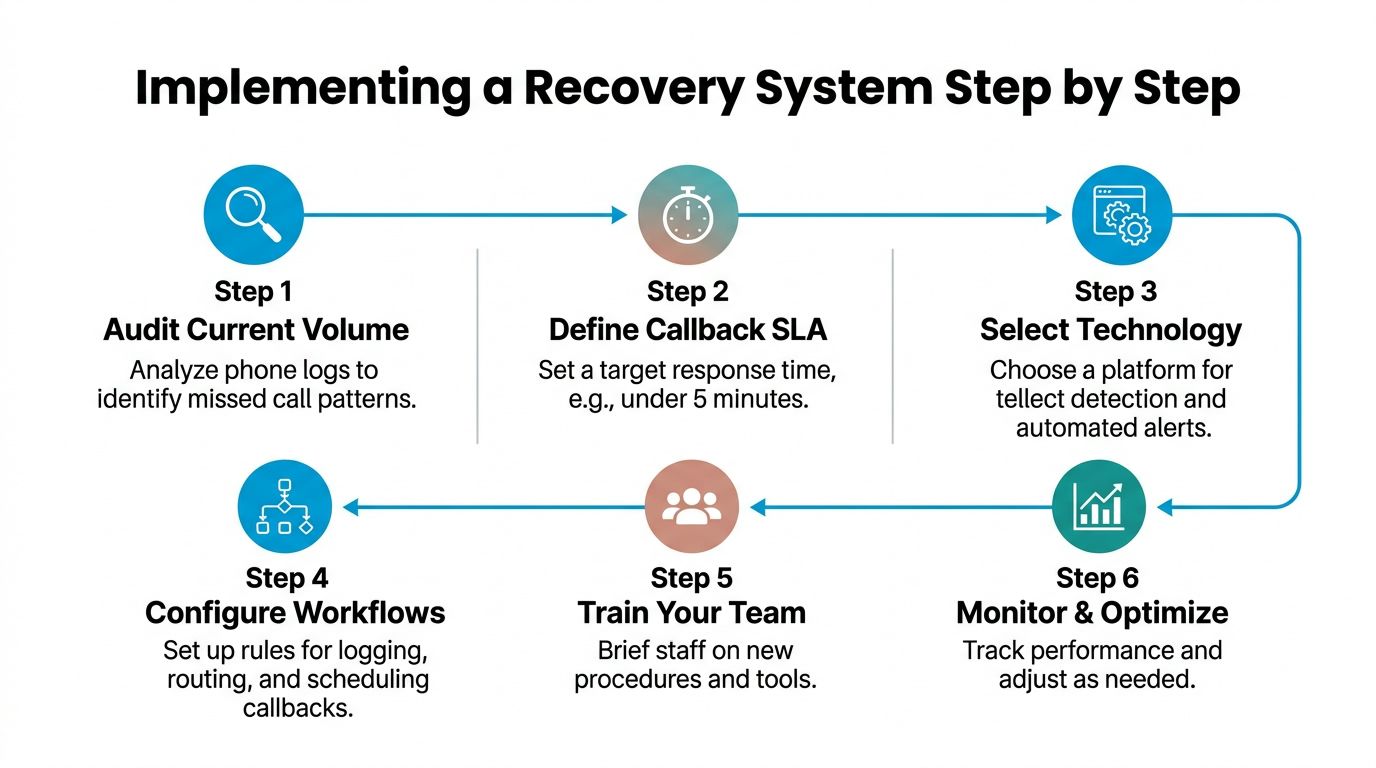
Implementation works best when the business starts with its existing call records rather than a vendor's default workflow. The objective is to identify where calls disappear, assign a response path, and make the result visible in the CRM.
1. Audit current volume
Export phone logs and group unanswered calls by hour, weekday, number, location, and campaign source. Separate ring-no-answer events from queue abandonment and intentional call rejection. Review a sample of recordings or transcripts where permitted, then classify the likely reason, such as lunch coverage, peak demand, after-hours closure, or routing failure.
The audit creates a baseline. Without it, a team can't tell whether a new workflow reduces abandonment or just generates more alerts.
2. Define the callback SLA
Set response targets by urgency. A new service inquiry may require a callback inside five minutes, while a routine administrative question may support a different path. Document who owns each queue, what happens when that person doesn't respond, and how the caller receives an update.
The SLA must be measurable from system timestamps, not from staff memory.
3. Select and connect the technology
Choose detection, messaging, routing, CRM, calendar, and analytics capabilities as one workflow. Test the connection with the existing business number or call-tracking setup. A system that requires staff to copy caller details manually into a second tool will create avoidable delays and incomplete records.
4. Configure the sequence
A practical starting sequence is an immediate SMS acknowledgment, a callback attempt within five minutes, and a second text-based attempt within an hour. Adjust the wording for business hours, after-hours, emergencies, existing customers, and new leads.
Build fallback behavior before launch. If the first callback fails, the system should offer a reply path, a booking option, or a scheduled callback window rather than ending the interaction.
5. Train staff and define escalation
Show employees where missed calls appear, how to read the AI summary, how to take over an SMS conversation, and how to record dispositions. Train the team on regulated conversations, opt-out handling, emergency language, and the difference between a qualified lead and a general inquiry.
6. Review analytics every 30 days
Track response time, contact rate, qualified contacts, appointments, abandonment, and recovered revenue. Compare each period with the original baseline, then change one variable at a time, such as message wording, callback ownership, or after-hours routing.
Operator's test: Run a real missed call during business hours, lunch, peak demand, and after hours. Follow it until a person can see the context and record the outcome.
Recovery in the Real World Across Industries
The same technical components need different rules in different businesses. A dental practice has privacy and triage concerns. An HVAC company has urgency and dispatch constraints. A franchise needs location accuracy before it worries about conversational polish.
At a single-location dental practice, a missed caller might receive an immediate acknowledgment and a scheduling question. The system can distinguish a routine appointment request from a potential emergency, then send the appropriate conversation to trained staff. Teams handling medical communication should evaluate answering services for medical offices with privacy, escalation, and record-handling requirements in mind.
An HVAC company may route after-hours calls to an on-call queue, ask whether the caller has an active emergency, and send routine estimate requests into a next-available booking path. During a demand spike, the system can acknowledge every caller while the dispatch team works through prioritized tasks.
A multi-location home-services franchise needs caller location, service area, and branch ownership captured early. If the local team is unavailable, a centralized agent pool can handle the callback while preserving the correct location and pricing context.
| Industry | Primary Recovery Channel | Avg. Recovery Rate | Escalation Trigger |
|---|---|---|---|
| Dental practice | SMS plus human callback | Establish from baseline | Emergency language, privacy-sensitive intake, human request |
| HVAC company | Callback plus after-hours SMS | Establish by demand period | Active emergency, dispatch need, no local technician response |
| Multi-location franchise | Location-aware hybrid workflow | Compare by branch and queue | Service-area mismatch, priority customer, local overflow |
Don't publish invented industry case-study results as if they were benchmarks. The right comparison is operational: how quickly did the system respond, how many contacts became qualified, which team owned them, and what happened after the handoff?
Putting Recovery Into Practice This Week
A useful launch doesn't require every automation feature on day one. It requires a visible baseline, a response owner, and a workflow that a real caller can complete without repeating information.
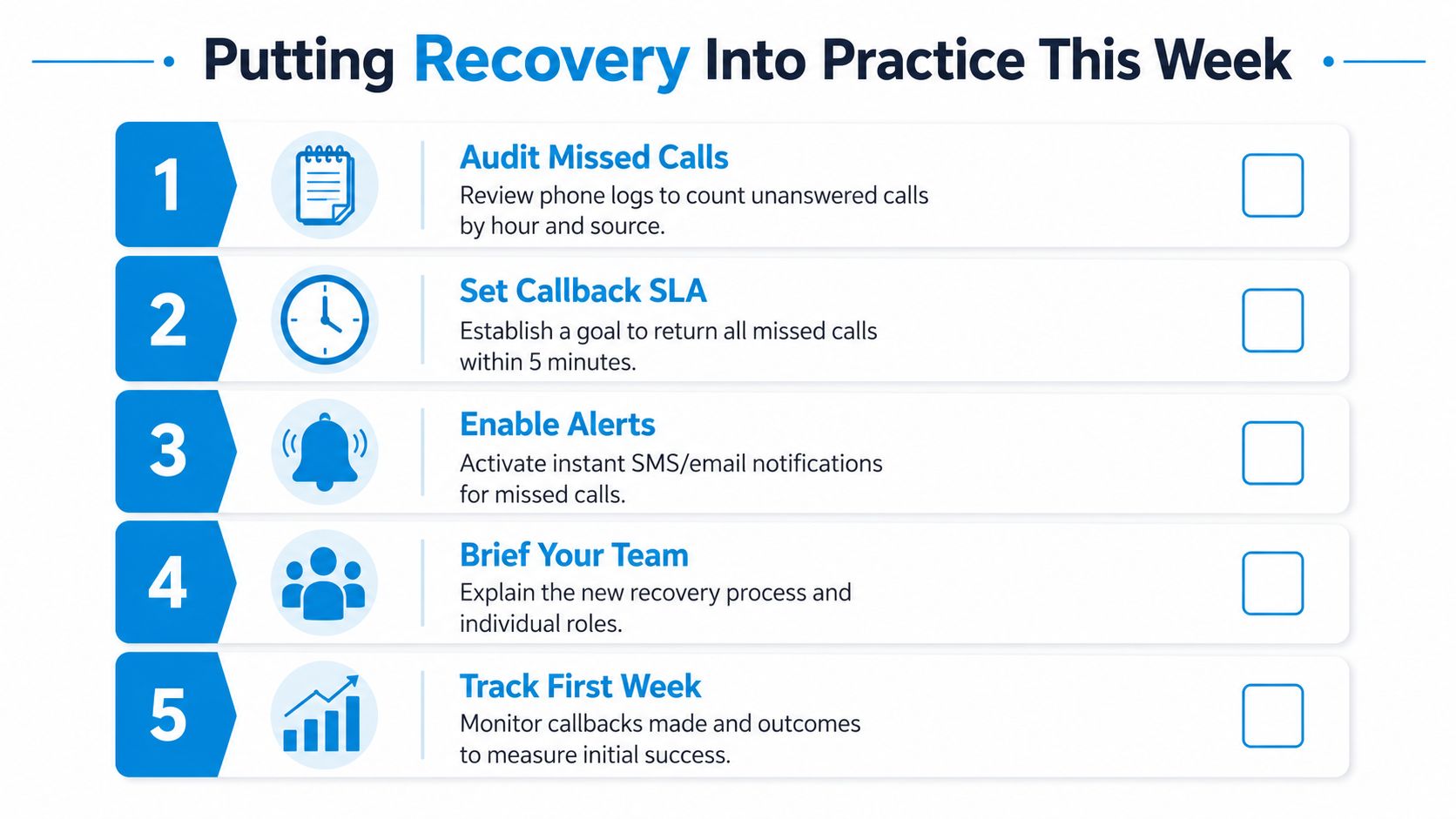
Use this first-week sequence:
- Audit missed calls: Review phone logs by hour, source, location, and reason for non-answer.
- Set a callback SLA: Choose a target under five minutes for high-intent calls and assign named owners.
- Enable alerts: Turn on immediate SMS or email notifications, then test the caller-facing message.
- Choose channels: Use one primary path and one backup, such as callback first with SMS fallback.
- Brief the team: Explain routing, escalation, CRM notes, opt-outs, and who handles after-hours requests.
- Track the first week: Record callbacks made, contacts reached, qualified leads, appointments, and unresolved conversations.
Review the results on day seven against the baseline. Don't change the callback timing, message, routing logic, and staffing model all at once. Test one variable, document the result, and keep the changes that improve recovered contacts without creating an unmanageable workload.
The target isn't zero missed calls. Busy periods, emergencies, meetings, and closed hours will continue to create them. The target is a measurable recovery rate that improves as the business learns which callers need voice, which accept SMS, and which require a trained human from the start.
Recepta.ai provides a 24/7 AI receptionist that can answer calls, qualify callers, schedule appointments, capture leads, and escalate conversations to trained human support. Visit Recepta.ai to evaluate a missed-call recovery workflow built around your phone system, staffing model, CRM context, and after-hours needs.