
Skyrocket Your Leads: Marketing Roofing Company 2026

A storm rolls through at 6:40 PM. By 7:15, homeowners are searching for help, calling the first few roofing companies they see, and filling out estimate forms from their phones. Your crew is still wrapping up. Your office line rolls to voicemail. A lead submits a form, gets no response, and calls the next contractor.
That’s the reality behind marketing roofing company in 2026. The problem usually isn’t just lead volume. It’s lead leakage.
There’s plenty of opportunity. The U.S. roofing market reached $31.38 billion in 2026, with 106,000 contractor businesses competing for the same jobs, and 82% of roofing businesses now consider digital marketing vital for success, according to roofing marketing statistics compiled here. More demand doesn’t make marketing easier. It raises the cost of being disorganized.
Most roofing companies don’t have a marketing problem in the strict sense. They have a systems problem. They run ads, post on Facebook, ask for reviews once in a while, and wonder why results feel inconsistent. Then a busy week hits, calls get missed, follow-up slows down, and paid leads go cold.
That’s why good marketing for a roofing company has to do two jobs at once. It has to generate demand and manage response. If those two parts aren’t connected, your spend gets less efficient every month.
If you want a useful primer on broader digital marketing for contractors, that resource does a good job showing how contractor demand generation fits together. Roofing just raises the stakes because homeowners often need fast answers and don’t give you much time to react.
Introduction
Roofing buyers don’t shop like retail customers. They search with urgency, compare quickly, and make judgments fast. They look at the map pack, reviews, photos, job examples, and how easy it is to reach a real person. If your online presence is thin or your phone process is sloppy, they move on.
The first part of marketing roofing company is local visibility. The second part is operational discipline. Most guides cover the first and skip the second.
Practical rule: If you’re paying to make the phone ring, you need a system that treats every missed call like lost inventory.
A durable setup starts with three local assets:
- Google Business Profile: Keep services accurate, hours current, service areas defined, and recent job photos active. Homeowners use this listing to decide whether to call now or keep scrolling.
- Service area pages: Build pages for the cities and towns you serve. A general homepage won’t do the work of a page designed for “roof repair in [city]” or “storm damage roofing in [city].”
- Review flow: Don’t ask for reviews randomly. Ask at job completion, send the direct link immediately, and make review collection part of your closeout process.
A simple starting checklist looks like this:
- Audit your map listing for missing categories, outdated hours, weak photos, and unanswered reviews.
- List your priority service areas based on revenue, crew coverage, and competition.
- Create a review request process your office or project manager can run every single week.
- Match your phone handling to your marketing spend so new leads don’t pile up unattended.
That’s the core theme of this article. The companies that win don’t just “do marketing.” They build a machine that turns attention into appointments.
Lay Your Digital Foundation with Local SEO
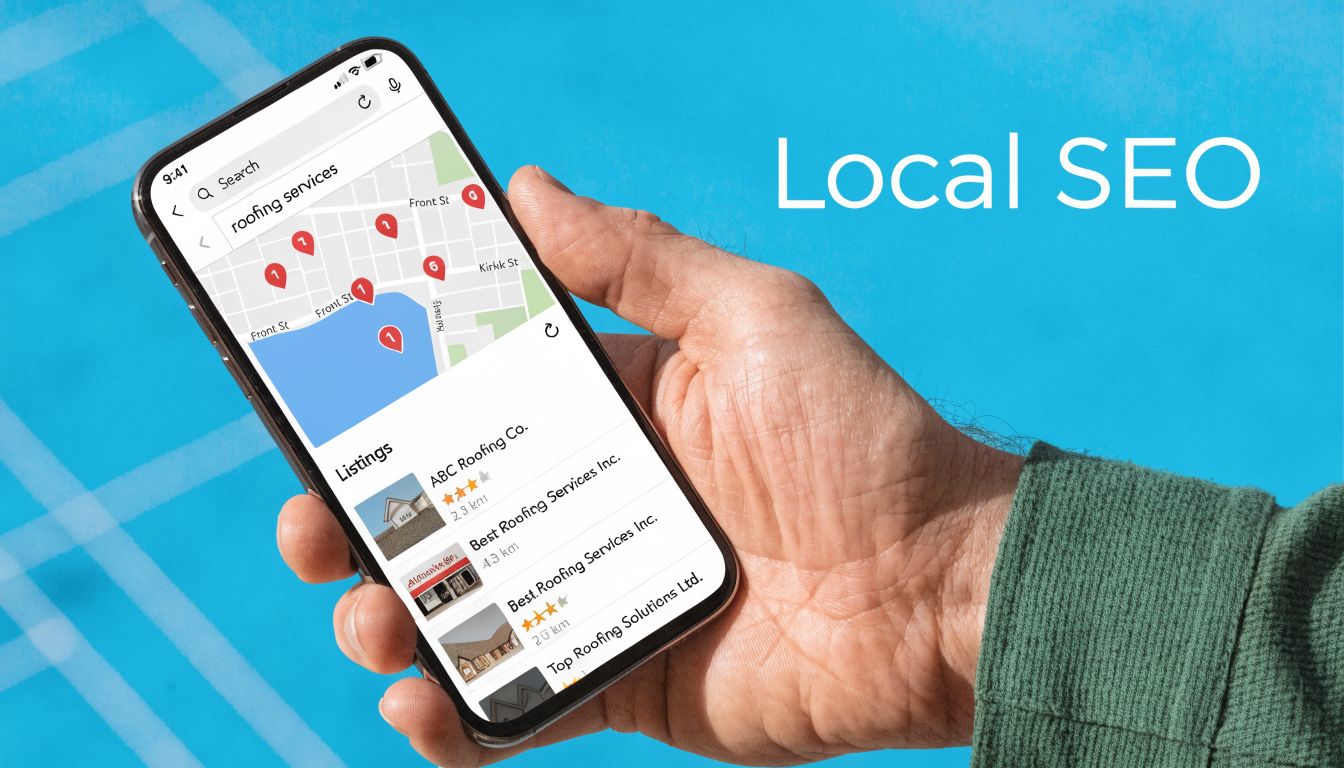
A homeowner notices a ceiling stain after a night of heavy rain, searches for a roofer on their phone, and calls one of the first three companies they see. If your company is not visible in that moment, or if the call goes unanswered, the lead is gone. Local SEO sets up the visibility side of that equation. Lead handling protects the return.
Google’s local results reward companies that keep their business information current, show proof of recent work, and earn steady reviews. For a roofing company, that means your map listing and location-focused service pages need to do more than exist. They need to reflect how people search, what jobs you want more of, and how quickly your team can respond.
Build a Google Business Profile that can compete
A claimed profile is only the starting point. In roofing, weak profiles usually have the same problems: broad categories, old photos, thin descriptions, and reviews that sit unanswered for months.
A stronger profile includes:
- Service categories that match your revenue goals: If you want more repairs, replacements, or storm-related work, your categories and descriptions should reflect that mix.
- Recent jobsite photos: Upload finished roofs, active repair work, flashing details, ventilation updates, and cleanup photos. Photos of your actual work are more effective than stock images.
- Clear service descriptions: Spell out inspections, leak diagnosis, storm damage repair, replacements, maintenance plans, and material types.
- Review responses: Answer both positive and negative reviews in a calm, professional tone. Prospects read those replies to judge how your company handles problems.
- Fresh activity: Post completed jobs, weather-related service updates, financing options, or seasonal inspection reminders.
One common mistake is writing a generic profile that tries to cover everything in one sentence. If you handle both retail replacement and insurance-claim storm work, say so plainly. That helps your listing match the language homeowners use.
Create service area pages that match intent and crew coverage
A single “areas we serve” page rarely ranks well for competitive searches. It also does a poor job of converting visitors who want proof that you work in their neighborhood.
Build separate pages for the city and service combinations that matter most to your business:
- Roof repair in a specific city
- Roof replacement in a specific city
- Storm damage roofing in a specific city
- Commercial roofing in a specific city, if that work fits your model
Choose those pages based on revenue potential, drive time, and operational capacity. I have seen roofing companies spread themselves across too many towns online, then struggle to service the leads fast enough. Ranking in a market you cannot cover profitably is not a win.
Each page should include local proof, a clear offer, and a direct path to contact.
| Page element | What to include |
|---|---|
| Headline | Specific service plus city |
| Opening copy | Common roofing issues in that area |
| Proof | Photos, reviews, or project summaries from nearby jobs |
| Service details | Materials, repair process, inspection approach |
| CTA | Call, form, or estimate request |
If you want a solid outside perspective on mastering local search for service companies, that guide is useful because it stays grounded in home service execution.
Local visibility also needs a process for capturing and routing inbound leads once those pages start producing calls and forms. This resource on roofing and siding contractor communication workflows is useful for connecting search demand to scheduling, follow-up, and response coverage.
Reviews influence ranking and close rates
Reviews affect more than reputation. They shape map visibility, click-through rates, and whether a homeowner trusts you enough to reach out.
The best review systems are built into operations, not left to memory. Ask at job completion, send the direct review link right away, and assign responsibility to the office or project manager so the process runs every week. A simple text works fine:
“Thanks again for trusting us with your roof. If the job met your expectations, would you mind leaving a quick Google review? I’ll text the link now.”
Keep it short. The timing matters more than the script.
Respond quickly, especially on negative reviews. A measured response can save credibility with future buyers even if the original customer never changes their rating.
What roofers should fix before chasing more SEO tactics
A lot of generic SEO advice pushes contractors toward constant blogging. For most roofing companies, that is not the first bottleneck. The higher-return fixes are usually operational and structural:
- Clean service pages
- Accurate service areas
- A complete map listing
- Better project photos
- Consistent review requests
- Fast mobile contact options
- A clear process for answering and following up on every inbound lead
That last point gets overlooked. Local SEO can increase calls, form fills, and direction requests, but the return depends on what happens after the click. If your office misses calls during peak hours or slow-plays web leads until the next day, your marketing performance drops long before rankings do.
Drive Immediate Demand with Paid Advertising
Paid advertising is where a lot of roofing companies confuse activity with efficiency. They launch campaigns, see clicks, maybe even see forms, and assume the machine is working. Then they look at actual jobs sold and realize too much spend went into leads they never reached, never qualified, or never followed up well enough.
That’s the core issue. The key challenge in roofing marketing is cost-per-lead efficiency, and operational bottlenecks like missed calls after ad spend can drive costs up. Effective lead management systems can reduce those losses by as much as 63%, according to Scorpion’s roofing marketing analysis.
Use Google for urgent intent
Google Ads are for people already looking. That means emergency repair, leak response, storm damage inspection, or replacement quotes. These searches have intent baked in. Your campaign setup should respect that.
Focus your search campaigns around tight ad groups such as:
- Emergency roof repair
- Storm damage roof inspection
- Roof leak repair
- Roof replacement estimate
- Local roofer near me, if your market supports it
Your landing pages should match the query. If someone searched for storm damage help, don’t send them to a generic homepage with broad copy about every service under the sun. Send them to a page that talks about inspection steps, documentation, and scheduling.
A simple ad example:
Headline: Roof Repair in [City]
Headline: Fast Inspections for Storm Damage
Description: Local roofing team. Call now to schedule an inspection or request an estimate online.
Keep the message direct. Roofing ads don’t need to sound clever. They need to sound available and credible.
Use paid social for timing and geography
Facebook and Instagram can work for roofing, but not in the same way search works. Social is interruption-based. The homeowner wasn’t actively searching when the ad appeared.
That changes the use case. Paid social works best when you have a strong reason to show up now:
- Recent storm activity
- Visible neighborhood damage
- A cluster of nearby jobs
- A seasonal push tied to inspections or maintenance
“Digital storm chasing” becomes useful if you handle it carefully. You target the affected area, use real project photos, and speak to the actual situation homeowners are dealing with. Don’t run broad image ads year-round and expect the same quality as search traffic.
Common paid social mistake: using stock roof photos and generic copy like “Need a new roof? Contact us today.” That blends into the feed and gets ignored.
Better approach:
- Use local project images
- Mention affected neighborhoods or service areas
- Offer a clear next step
- Send clicks to a storm-specific or inspection-specific page
If your campaigns need cleanup, this guide on optimizing small business PPC is a practical reference for controlling waste and improving account structure.
Budget by job quality, not by lead count
A lot of roofing owners ask, “Which channel gives me the cheapest lead?” That’s the wrong first question. Ask which channel gives you reachable, qualified, appointment-ready opportunities.
A simple comparison looks like this:
| Channel | Best use case | Common mistake |
|---|---|---|
| Google Search | High-intent demand capture | Sending traffic to weak pages |
| Local Services Ads | Trust-heavy local visibility | Poor profile management and delayed follow-up |
| Facebook and Instagram | Storm response and neighborhood targeting | Running broad branding ads with no clear trigger |
| Remarketing | Staying visible to undecided prospects | Showing the same message to everyone |
A campaign can look expensive on paper and still be profitable if the lead quality is strong. Another campaign can look cheap and ineffectively waste your team’s time.
This is why I push roofing companies to track more than ad metrics. You need call quality, appointment rate, inspection rate, and sold job value by channel. If you only optimize for form fills, you’ll reward low-intent traffic.
Here’s a useful walk-through on the broader topic of contractor lead generation systems if you want to connect campaign setup with response workflow.
Before adjusting bids or increasing spend, watch this kind of tactical breakdown to sharpen how you think about campaign mechanics:
What actually wastes roofing ad budgets
Most wasted spend doesn’t come from one dramatic mistake. It comes from repeated friction.
- Missed calls after hours: The ad worked. Your process failed.
- Slow callbacks: The lead keeps shopping while your team finishes the day.
- Poor qualification: Sales reps chase bad-fit inquiries because nobody filtered them early.
- Generic landing pages: Traffic arrives with one expectation and finds vague copy.
- No feedback loop: Marketing never hears which leads turned into booked estimates and closed work.
If you can’t answer “Which campaign produced actual inspections last month?” you don’t have a marketing system. You have ad spend.
Paid advertising is still necessary for most roofing companies, especially when you need immediate demand. Just don’t isolate it from the call handling and scheduling side. That’s where return gets won or lost.
Build Lasting Trust with Content and Reputation
A homeowner finds your company after a storm, checks your reviews, clicks through to your website, and looks for proof that you do the kind of work they need. If they see vague claims, thin photos, or unanswered complaints, they keep looking. Trust is built before your estimator ever gets to the driveway.
Roofing is a trust sale. Price matters, but confidence usually decides who gets the inspection and who gets ignored.
Publish proof that removes doubt
Good roofing content should answer the questions a homeowner asks right before they call, or right after they compare you to two other contractors. It should also help your sales team close, because the best content shortens the trust-building work your estimator has to do in person.
The pieces that pull their weight are specific:
- Project showcase pages: Before-and-after photos, city or neighborhood, roofing system installed, why the work was needed, and what the homeowner cared about most.
- Inspection and diagnosis videos: Short clips that explain what damage you found, what needs action now, and what can wait.
- Storm and insurance education pages: Clear explanations of what to document, how inspections work, and where homeowners get confused.
- Process pages: What happens after the call, how scheduling works, who shows up, how cleanup is handled, and when the customer gets updates.
A project page for a replacement in an older subdivision can do more for conversion than a generic service page. Show the actual roof. Explain why replacement made sense. Add a clear next step. Homeowners want to see work that looks like their house and a process that feels controlled.
Reviews need a system, not occasional attention
Reputation management is operational work. It is not a once-a-month task someone remembers after a good install.
Ask for reviews at the right moment, usually after the job is complete and the customer has seen the cleanup. Make it easy with a direct link. Route complaints to a manager fast, before they turn into public friction. Then respond to every public review in a way that shows future buyers your company is steady under pressure.
A simple framework works well:
| Review type | Response approach |
|---|---|
| Positive | Thank them, mention the job type, and keep the reply personal |
| Neutral | Acknowledge the concern, state what happened next, and offer direct follow-up |
| Negative | Stay calm, avoid debating details in public, and move the resolution offline |
Examples:
“Thank you for trusting us with your roof replacement. We’re glad the crew delivered a smooth install and left the property clean.”
“We’re sorry communication fell short during the job. Our team is reviewing what happened, and we’d like to speak with you directly to resolve it.”
Prospects read those replies closely. A measured response to a negative review can strengthen trust more than another five-star rating with no context.
Content and reputation only pay off if the handoff is tight
This is the part many roofing guides skip. Strong content gets the lead to raise a hand. Strong reviews lower resistance. But return depends on what happens in the first few minutes after that inquiry comes in.
If someone reads your storm damage page at 8:30 p.m., calls, and gets voicemail, your brand just broke its own promise. The same thing happens when a form submission sits in an inbox until morning or when the office and field team are looking at different notes.
That is why lead management belongs in the trust conversation. A company with solid content and a sloppy intake process still feels unreliable to the homeowner.
The handoff should be simple and consistent:
- Capture the inquiry from calls, forms, and messages in one place.
- Identify the need fast enough to route it correctly.
- Offer the next step such as an inspection or callback window.
- Send confirmation so the homeowner knows what happens next.
- Keep one shared record that the office and sales team can both use.
Roofers that need coverage after hours or during peak call volume often add a contractor answering service for inbound lead handling so new inquiries do not disappear between marketing and scheduling.
Recepta.ai is one example. It handles inbound calls, appointment scheduling, lead capture, follow-ups, and escalation to human staff when needed. That matters in roofing because many calls come in while owners are on jobs, crews are in the field, or the office is closed, and the lead expects an immediate response.
Your reviews, project pages, and service copy all set expectations. Your intake process confirms whether those expectations were real.
Trust is built through repeated proof. Show the work. Manage reviews with discipline. Then make sure every inbound lead is handled like it matters, because it does.
The Ultimate Lead Conversion and Follow-Up System
A roofing lead is most valuable right when it arrives. That’s the moment of highest urgency, highest intent, and highest risk of loss. If you wait too long, the homeowner keeps calling.
Research shows 40% of homeowners say poor communication is the hardest part of getting a new roof, citing unanswered calls and missed updates as major frustrations, according to this roofing communication guide. That one number explains why many marketing campaigns underperform. The issue often isn’t demand. It’s what happens after the lead shows up.
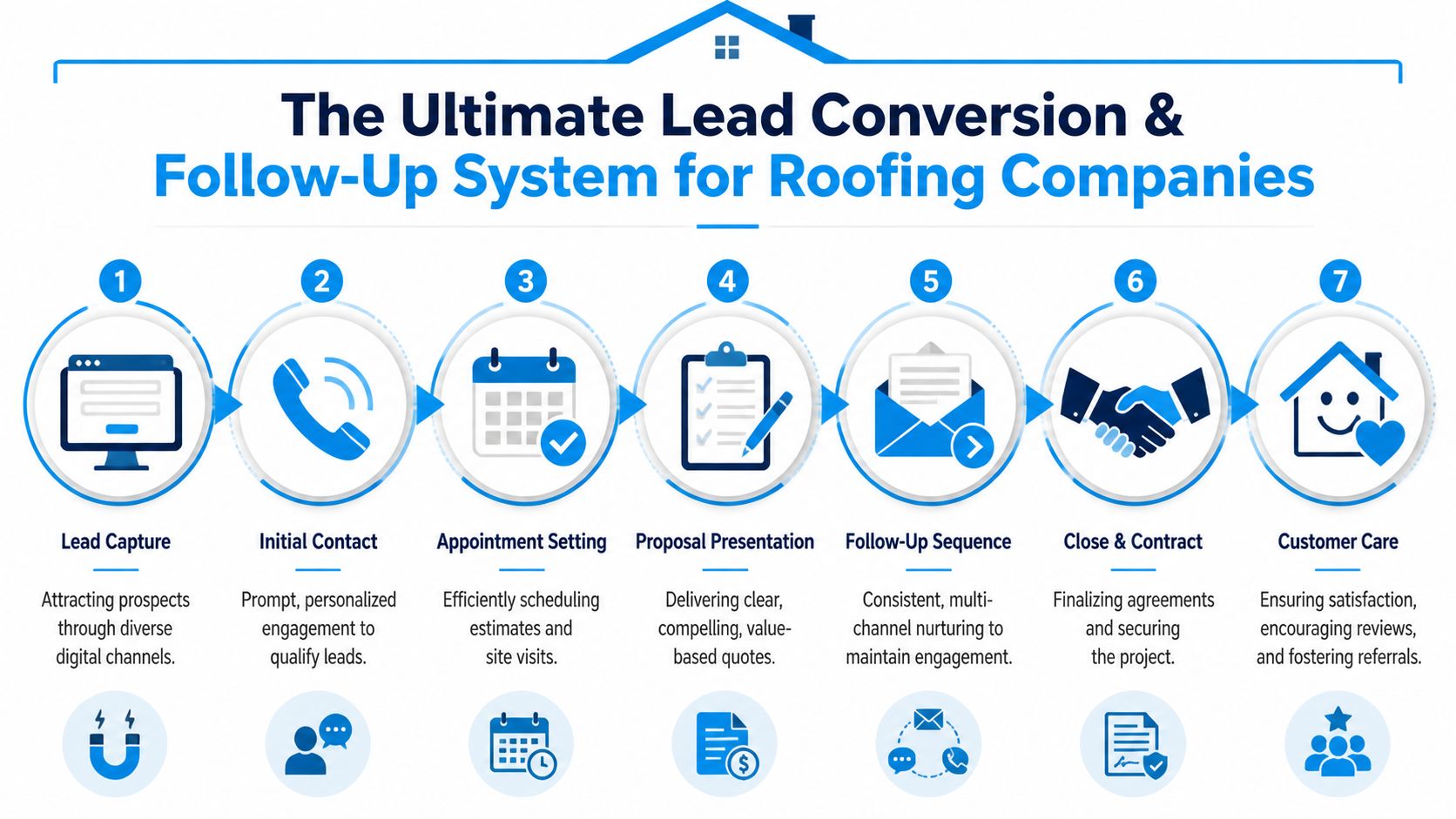
The workflow that keeps leads from leaking out
You need one path for every inbound lead, regardless of source. Not one path for calls, another for forms, and a third for social messages that nobody checks until tomorrow.
A practical workflow:
Capture instantly
Calls, forms, and chat requests should all create one lead record.Respond immediately
A live answer is ideal. If not, use an automated first-touch message that confirms receipt and offers scheduling.Qualify fast
Don’t turn this into an interrogation. Gather just enough to route correctly.Book the appointment
The goal of first contact is usually an inspection or estimate, not a full sales presentation.Confirm in writing
Send text or email confirmation with date, time, and next steps.Notify the team
Office staff, estimator, and CRM should all reflect the same status.Follow up until the outcome is clear
Not every lead books on first contact. That doesn’t mean it’s dead.
Use a qualification script your team can repeat
Roofing companies lose momentum when every rep handles inbound leads differently. Use a short script.
A simple call flow:
- Start with identity: Name, address, callback number
- Clarify the issue: Leak, visible damage, replacement inquiry, inspection request
- Ask timing: New damage, ongoing issue, insurance-related, or planned project
- Confirm service area
- Offer the next available appointment
- Set expectation: inspection window, who’s coming, what happens next
Example:
“Thanks for calling. Can I get your name, address, and best callback number? What’s going on with the roof right now? Is this storm-related, an active leak, or are you looking for a replacement estimate?”
That’s enough to move the lead forward without creating friction.
Build a follow-up cadence that feels professional
Most roofers either under-follow up or overdo it. One missed call gets ignored forever, or a prospect gets hit with too many generic check-ins.
A better cadence is simple:
| Timing | Action |
|---|---|
| Immediately | Confirmation text or call response |
| Same day | Appointment offer or callback retry |
| Next business day | Follow-up message with scheduling options |
| After estimate | Clear recap and next-step reminder |
| Pending decision | Short, useful check-in tied to their situation |
The message should match context. If a homeowner called after a storm, mention storm inspection availability. If they asked about replacement, mention estimate timing and project questions. Don’t send one canned template to every lead.
For teams tightening phone coverage, this overview of a contractor answering service workflow is useful because it focuses on what needs to happen operationally after a lead contacts you.
Track the numbers that actually change behavior
A lot of roofing dashboards over-report the wrong things. Clicks, impressions, and traffic don’t help the office manager decide what to fix tomorrow morning.
Use a basic performance view tied to conversion:
| Metric | What it tells you |
|---|---|
| Lead source | Where the inquiry originated |
| Contact status | Reached, not reached, pending |
| Appointment status | Booked, rescheduled, no-show |
| Estimate status | Sent, pending, accepted, lost |
| Lost reason | Price, timing, no response, competitor, bad fit |
That dashboard changes conversations. Instead of saying “ads feel expensive,” you can say “paid search leads are coming in, but too many after-hours calls aren’t reaching a scheduler.”
The lead isn’t really captured until it’s contacted, qualified, and moved to a scheduled next step.
Budget around capacity, not hope
Marketing roofing company gets expensive when demand exceeds your ability to respond. Don’t scale campaigns blindly.
Use this planning approach:
- Start with revenue targets
- Estimate how many jobs each crew can handle
- Look at appointment volume needed to support that workload
- Map which channels are feeding quality opportunities
- Increase spend only when response and scheduling are under control
If your office can’t consistently handle a surge after a weather event, adding more budget may just amplify waste. Fix the intake system first. Then scale.
The most impactful move for many roofing companies isn’t another ad variation. It’s a faster, cleaner, more accountable lead response process.
Measure and Scale Your Marketing Machine
If you don’t track channel performance all the way to sold work, you’ll keep rewarding the wrong activity. The strongest roofing companies don’t rely on one source. They diversify lead generation across referrals (30%), organic website and SEO (20%), paid advertising (20%), and other channels, while referral leads convert at over 50% and inbound leads convert at 20% to 40%, according to Glasshouse’s roofing lead generation benchmarks.
That mix matters because it shows two things. First, balance protects you when one channel softens. Second, not all leads deserve the same budget or the same urgency.
Roofing Marketing KPI Dashboard
You don’t need a complicated reporting stack to start. You need a dashboard your team will review.
| Metric (KPI) | Industry Benchmark | How to Calculate |
|---|---|---|
| Lead source mix | Referrals 30%, SEO 20%, paid ads 20%, other channels make up the balance | Leads by channel divided by total leads |
| Referral lead conversion rate | Over 50% | Closed referral jobs divided by total referral leads |
| Inbound lead conversion rate | 20% to 40% | Closed inbound jobs divided by total inbound leads |
| Lead-to-appointment rate | Hot direct-call leads should reach 80% to 90% appointment conversion | Appointments set divided by qualified hot leads |
| Cost per lead | Track internally by channel | Channel spend divided by leads from that channel |
If you need a clean framework for the math behind this, this guide on how to calculate cost per lead is a useful reference.
Reallocate based on outcomes
Here, most contractors hesitate. They keep spending evenly because it feels safer. It usually isn’t.
A better operating rhythm:
- Increase investment in channels producing booked estimates and sold jobs
- Reduce or repair channels producing low-quality inquiries
- Protect referrals with a formal ask and tracking system
- Review inbound handling before blaming campaign performance
For example, if SEO leads are fewer than paid leads but they close better, don’t starve SEO because the raw volume looks smaller. If referral leads close best, create a process that actively asks for them instead of assuming they’ll happen on their own.
The point of measurement isn’t reporting for its own sake. It’s deciding where the next dollar goes and where the next fix should happen.
Conclusion
Roofing companies don’t need more random tactics. They need alignment between visibility, trust, response, and follow-up.
That’s the key lesson behind marketing roofing company today. Local SEO gets you found. Paid ads create immediate demand. Content and reviews build confidence. But none of it reaches full value if leads hit voicemail, sit unassigned, or get uneven follow-up.
The companies that grow predictably treat marketing and operations as one system. They know which channels drive quality opportunities, they respond fast, and they make appointment setting easy. That combination is what turns busy seasons into sustainable growth instead of chaos.
If you’re looking for the highest-impact place to start, audit your lead handling before you buy more traffic. Listen to missed calls. Check form response times. Review how many inbound leads became appointments. That’s usually where the biggest gains are hiding.
If your roofing company is generating leads but losing them between the first call and the scheduled estimate, Recepta.ai is worth a look. It helps teams answer inbound calls, capture lead details, schedule appointments, and maintain follow-up coverage around the clock, which is especially useful when storm demand spikes and your team is already in the field.
.webp)