
The Modern Playbook for Lead Gen for Contractors
Effective lead gen for contractors isn't just about finding the next job. It’s about building a system that keeps your schedule full and your business growing predictably. This is what separates the pros who are booked out for months from the guys stuck in the constant feast-or-famine cycle.
The goal? Spend less time chasing work and more time actually doing profitable work.
Why Some Contractors Have Full Schedules and Others Struggle
Ever look at a competitor and wonder how their trucks are always busy while you're scrambling for the next call? I can tell you it isn't luck. It's because they have a dependable system for generating leads.
Imagine one contractor whose phone only rings when a past client remembers them. Their schedule is a rollercoaster, and so is their cash flow. Now, picture another contractor with a calendar booked solid for weeks, who gets to be selective about the jobs they take. This guide is about becoming that second contractor. The secret is to stop relying on just one way of getting work and start building a machine that pulls in customers from all over.
The Danger of a Single-Source System
Putting all your eggs in one basket—whether it's just word-of-mouth or a single lead service—is like building your business on a foundation of sand. The minute that source dries up, your entire operation is in jeopardy.
For example, if you get all your jobs from a platform like Angi, you’re stuck in a bidding war with a dozen other contractors, often driving your price down just to get the job. That’s a race to the bottom, not a path to real growth.
The key is shifting from being reactive (waiting for leads to come to you) to being proactive (making the phone ring). That means embracing a modern playbook that mixes new-school digital marketing with old-school, trust-based tactics.
The Core Difference: The most successful contractors don't just find leads; they build systems that attract them. They own their lead flow instead of renting it from third-party services, giving them total control over their growth and profitability.
Building a Modern Lead Generation Machine
A truly powerful lead generation strategy is a mix of channels designed to catch customers at every stage. Some homeowners are ready to hire you today; others are just starting to kick the tires and do their research. Your system needs to speak to both.
A well-rounded plan for any contractor should include a few key ingredients:
- High-Intent Digital Channels: This is about being there the moment a homeowner searches for your services. Think Local SEO and targeted Google ads that capture people actively looking to hire.
- Trust-Based Referrals: Don't just hope for referrals—build a program that actively encourages your happiest customers to spread the word.
- Strategic Partnerships: Team up with other non-competing trades. If you're a roofer, partner with a local solar installer. You can feed each other qualified leads all day long.
- Offline Tactics: Never underestimate the power of a branded truck wrap or a well-placed job site sign. They’re 24/7 billboards that generate local awareness and inbound calls.
Many of the top-tier contractors also supplement their efforts with professional Contractor Leads Services to keep their pipeline full, no matter what. It’s a direct solution to inconsistent schedules and the surest way to stay booked solid. This guide will give you the playbook to build your own machine, turning sporadic calls into a predictable stream of high-value jobs.
Mastering Digital Channels for High-Intent Leads
Forget waiting for the phone to ring or for a postcard to land in the right mailbox. Your best customers are online, right now, actively searching for a contractor to solve their problem. This is where you need to be. Mastering a few key digital channels is the difference between unpredictable dry spells and a steady stream of profitable jobs.
This isn't just about having a website. It’s about strategically placing your business exactly where homeowners are looking to hire, right when they need you most.
Let's break down the three digital powerhouses that work together to turn those online searches directly into booked jobs: local SEO, Google Local Service Ads, and targeted Pay-Per-Click ads.
Own Your Backyard with Local SEO and Google Business Profile
Think of your Google Business Profile (GBP) as your digital storefront. It’s the first thing people in your community see. When a homeowner searches "roofer near me," a well-managed GBP is what lands you in that coveted map pack at the top of the page. This is the most valuable real estate on Google because it’s where customers with an immediate problem go first.
Putting some real effort into your GBP is one of the highest-return activities you can do. Here’s how you can start dominating your local search results:
- Complete Every Single Section: Don't get lazy here. Fill out every field Google gives you—your full list of services, precise service areas, hours, and a description packed with the keywords your customers use.
- Upload High-Quality Photos Weekly: This is huge. Regularly add fresh, geotagged photos of your crew in action, your branded trucks, and your finished projects. It signals to Google that you're an active, legitimate business they can trust.
- Go All-In on Five-Star Reviews: Reviews are your social proof. They build instant trust. You need to have a system for asking every happy customer for a review and, just as importantly, responding to every single one—good or bad.
This relentless focus on local search pays off big time. In our world, calls coming from search results are gold, boasting an industry-leading 40% conversion rate. It’s no surprise that organic search consistently scores an 8.8 effectiveness rating for delivering scalable, long-term growth.
Build Instant Trust with Google Local Service Ads
While local SEO is a marathon, Google Local Service Ads (LSAs) are your shortcut to the very top. These ads often show up even above the traditional PPC ads and the map pack, giving you immediate visibility.
So what makes LSAs so powerful? It's all about the "Google Guaranteed" or "Google Screened" badge. This little green checkmark tells potential customers that Google has already done the homework on you, verifying your licenses, insurance, and even running background checks.
This verification builds a level of trust that other ads just can't buy. When a homeowner sees that badge, much of their hesitation disappears. It makes picking up the phone to call you a much easier decision.
The best part is the payment model. With LSAs, you only pay for qualified leads. You’re charged when a customer actually calls or messages you through the ad, not for someone just clicking and browsing.
Actionable Example: An HVAC contractor can run an LSA campaign targeting only "A/C repair" and "furnace installation" within a 20-mile radius. When a homeowner's AC dies in the middle of July, their LSA ad appears first with the Google Guaranteed badge. The contractor only pays when that desperate homeowner calls for service.
Comparing Top Digital Lead Gen Channels for Contractors
Deciding where to put your marketing dollars can be tough. This table breaks down the three core digital channels—Local SEO, LSAs, and PPC—to give you a clearer picture of how they stack up against each other.
As you can see, each channel has its own strengths. Local SEO is your long-term asset, LSAs are your trust-building machine, and PPC is your rapid-response tool for urgent jobs. The most successful contractors don't pick one; they build a system where all three work together.
Capture Urgent Jobs with Targeted PPC Ads
Pay-Per-Click (PPC) ads, run through platforms like Google Ads, are your surgical tool. They let you bid on hyper-specific keywords to appear at the top of search results. While LSAs are fantastic for general service calls, PPC is unmatched for capturing customers with an urgent, high-value problem right now.
This is where you get to think like your customer in a panic. What would they frantically type into Google?
- A plumber could bid on "24/7 emergency plumber near me."
- A roofer could target "emergency roof leak repair" the morning after a big storm.
- An electrician could own the keyword "power outage restoration services."
These phrases scream urgency. The person searching isn't casually shopping around; they need an expert immediately. By creating ad campaigns dedicated to these "money" keywords, you position your company as the go-to problem solver. Diving into a complete guide to Google Ads for Plumbers, for example, shows just how deep you can go to own a specific trade.
By weaving together local SEO, LSAs, and targeted PPC, you create a powerful digital net that catches qualified leads at every point of their search.
Building a Referral and Partnership Engine That Works
Digital ads and SEO can bring in a ton of new leads, no doubt. But if you've been in this business for a while, you know that some of your best, most profitable jobs come from a much simpler place: trust. A lead from a happy customer or another pro isn't just another name—they’re already convinced you’re the right choice.
The trick is to stop hoping for word-of-mouth and start building a system that creates it. We're talking about a reliable engine that sends pre-vetted, high-quality customers your way, turning your network into your best sales team.
Turn Happy Clients into Your Best Marketers
Your most satisfied customers are gold. But just doing a great job and crossing your fingers isn't a real strategy. You need a formal referral program that gives them a genuine reason to send new business to you.
The key is to make the incentive clear, valuable, and dead simple to claim. Vague promises won't cut it. You need to offer something tangible that shows you appreciate them and gets them to actually make the referral.
Actionable Examples of Referral Incentives:
- For the Referrer: Think a $100 gift card or a credit toward future maintenance for every single referral that turns into a signed contract. A direct reward like this makes it worth their time.
- For the New Customer: Give them a "Friends & Family" discount of 5% or $250 off their project. This makes your referrer look like a hero and gives the new lead an immediate reason to sign with you.
- Tiered Rewards: For bigger ticket items, get creative. A roofer could offer $100 for a simple repair referral but bump that up to $500 for a full roof replacement.
The most important part? Formalize it. Mention your referral program at the end of every successful project. Include a line about it in your final invoice email. Maybe even send a friendly reminder a few months down the road. Make it an official part of how you do business, not an afterthought.
Forge Strategic Partnerships for a Steady Lead Flow
Looking beyond your past clients, some of the best leads you'll ever get are from other professionals who work with the same homeowners you do, but aren't your competitors. These strategic partnerships create a win-win situation where you trade qualified leads, giving you a steady, low-cost stream of new work.
Just think about the natural flow of a home project. Who’s in the house right before or after you?
The goal is to become the go-to contractor for your partners. When their client has a need that falls under your expertise, your name should be the first—and only—one they mention.
This creates a powerful, exclusive referral network. You’re not just one of five contractors scrambling for a lead from some online directory; you're getting a warm handoff from a source the homeowner already trusts. This is also a perfect opportunity to build rapport with customers to make that initial contact even stronger and lock in the job.
Identifying and Approaching the Right Partners
The best partnerships are built on two things: reliability and mutual benefit. You want to find established, reputable businesses that care about quality as much as you do.
Top Partnership Ideas for Contractors:
- HVAC Contractors & Plumbers: These trades are constantly in the same homes and can spot opportunities for each other all day long.
- Roofers & Solar Installers: A solar installation almost always requires a roof check first, creating a perfect, natural referral point.
- Landscapers & Real Estate Agents: Agents always need solid contractors to get homes ready for sale or to recommend to new homeowners.
- Painters & Interior Designers: Designers need a painter they can trust to bring their client's vision to life.
- General Contractors & Specialized Subcontractors: A good GC is always looking for a reliable crew of electricians, plumbers, and drywall pros.
When you reach out, don't beat around the bush. Be direct and show them what's in it for them. A simple, honest email often works best.
Example Outreach Template:
Subject: Partnership Idea - [Your Company] & [Their Company]
Hi [Partner's Name],
My name is [Your Name], and I own [Your Company], a local [Your Trade] company here in [City]. I've seen your great work around town and have been really impressed.
I often have clients asking for a good [Their Service], and I'm looking for a reliable [Their Trade] I can refer them to with confidence. I figured you might be in a similar spot. I'd love to chat for 15 minutes sometime about how we could send some business each other's way.
Best,
[Your Name]
That’s it. No need to overcomplicate things. A straightforward approach focused on helping each other is the fastest way to start building a referral and partnership engine that works tirelessly for your business.
The Art of Capturing Every Lead Instantly
Getting leads is only half the job. The other, more important half, is actually catching them the second they reach out. In the contracting world, a missed call isn't just a small fumble—it's a customer, and their money, you just handed over to your competitor down the street.
Here’s the hard truth: an amazing marketing plan is worthless if your lead capture system is leaky. When a homeowner has a burst pipe or a leaky roof, they aren't going to leave a polite voicemail and wait. They're hanging up and dialing the next contractor on their Google search. Building a bulletproof system to grab every single lead is where the real money is made.
Why Speed Is Your Most Valuable Asset
Get this: responding to a new lead within the first minute can boost your conversion rate by a jaw-dropping 391%. You are literally 100 times more likely to connect with that lead if you call back in five minutes versus waiting just 30 minutes.
And yet, a shocking 23% of all leads contractors pay for are never contacted at all. That’s not a small leak; it’s a massive hole in your boat, sinking thousands of dollars in potential revenue every single month. The first contractor to answer the phone wins the job up to 50% of the time. Speed isn't just a nice bonus—it's the single most important factor in turning leads into paid jobs.
A missed call is the most expensive marketing mistake you can make. You've already paid for the ad or earned the ranking that got you the call—failing to answer it means you paid for your competitor to get a new customer.
Optimizing Your Digital Front Door
Think of your website as your 24/7 digital storefront. Its contact forms are your first line of defense, and if a potential customer can't easily send you their info—especially on their phone—they're gone. They'll just give up and find a competitor with an easier site to use.
Your website forms need to be built for instant action.
- Keep It Simple: Seriously, just ask for the basics: name, phone, email, and a quick note about the job. You can get all the other details when you talk to them.
- Mobile-First Is a Must: More than half of your website visitors are on a phone. Your forms need to have big, easy-to-tap buttons and fields. No one is going to pinch and zoom their way through a tiny form.
- Have a Clear Call-to-Action: Don't be vague. Use button text that tells them exactly what to do, like "Get a Free Quote Now" or "Schedule an Emergency Repair."
This flow chart breaks down how to build a powerful referral and partnership engine to get more of these high-quality leads in the first place.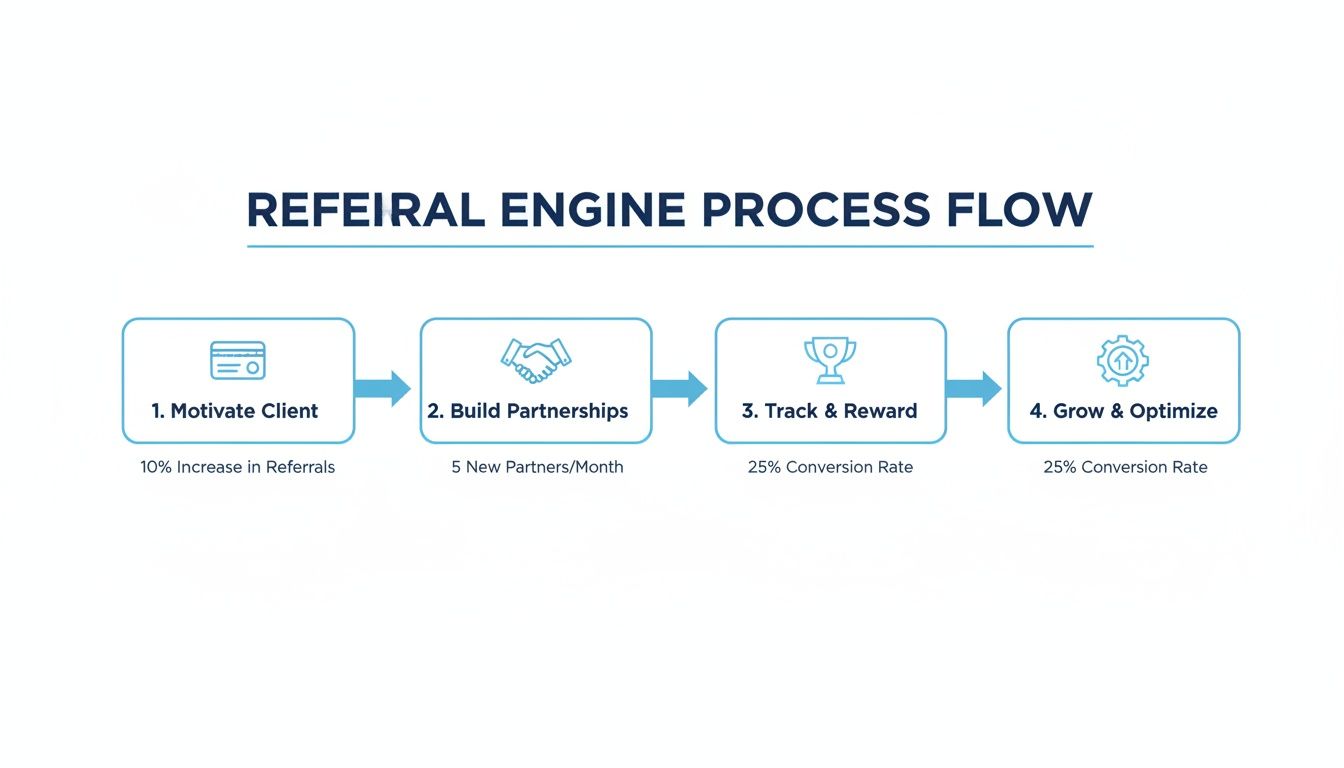
By actively encouraging happy clients to refer you and building strategic partnerships, you can create a reliable, ever-growing stream of new business.
Never Miss a Call Again with 24/7 Coverage
Web forms are great for those "I'll get to it later" inquiries. But your best, most profitable emergency jobs almost always come from a phone call. The problem? You can't be available 24/7. You're on a job site, with family, or trying to sleep. This is where modern tools can completely change the game.
An AI receptionist becomes your new front line, making sure every single call gets answered instantly, day or night. It’s not just a glorified answering machine; it's a smart system built to engage callers, qualify them, and turn them into booked jobs.
How an AI Receptionist Works for You:
- Instant Engagement: The AI answers immediately with a professional, custom greeting. This alone makes a great first impression and stops the caller from hanging up and dialing your competition.
- Smart Qualification: It then asks the key qualifying questions you've programmed it with. This weeds out the tire-kickers from the serious customers who are ready to hire.
- Direct Booking: For those qualified leads, the AI can look at your calendar in real-time and book an appointment or consultation right on the spot.
Practical Qualifying Question Examples:
- "To make sure you're in our service area, could you please provide the full address for the job?"
- "Are you the homeowner, or will we need to coordinate with the property owner?"
- "Could you briefly describe the issue you're having with your [roofing/plumbing/HVAC]?"
This whole process turns the chaos of inbound calls into a perfectly organized pipeline of jobs ready for you to quote. It means that even while you're on a ladder or under a sink, your business is still capturing and scheduling profitable work.
If you're serious about making sure every call is handled professionally, looking into a dedicated contractor answering service can be a powerful move for your trade. When you combine optimized web forms with a smart, 24/7 call-handling system, you build a fortress around your leads, ensuring none ever slip through the cracks again.
Turning New Leads into Booked Jobs With Speed
The moment a potential customer fills out your form or dials your number, a clock starts ticking. In the world of contracting, this isn't just any clock—it's a stopwatch where every single second is money. When it comes to turning a fresh lead into a paying customer, speed isn't just an advantage. It's everything.
Think about it from the customer's perspective. Their problem is urgent, and their motivation to hire is at its absolute peak right after they hit "submit." Responding to that new web lead within the first minute can boost your conversion rate by a jaw-dropping 391%.
The numbers don't lie. Your odds of actually connecting with a lead are 100 times greater if you call them back within five minutes compared to waiting just 30 minutes. Wait any longer, and you're practically letting that job—and the urgency behind it—slip right through your fingers and into the hands of a faster competitor.
The Multi-Touch Follow-Up Playbook
One phone call and a voicemail just doesn't cut it anymore. A real follow-up strategy is a system. It involves hitting them from multiple angles—call, text, and email—to make sure you get through. This multi-touch approach isn't about being annoying; it's about showing you're persistent, professional, and serious about their project.
Here's a scary thought: industry research shows that a staggering 23% of all leads contractors pay good money for are never contacted at all. By simply having a consistent follow-up process, you immediately put yourself ahead of nearly a quarter of your competition.
Let's break down a simple, three-step playbook you can put into action the second a new lead comes in.
Step 1: The Immediate Phone Call
As soon as that lead notification pops up, drop what you're doing and call them. Don't finish that email, don't grab another coffee—call them right now. The goal of this first call isn't to sell the entire job. It's just to make contact, let them know you got their request, and book the next step, which is usually the on-site estimate.
Initial Call Script Example:
"Hi, [Customer Name]? This is [Your Name] from [Your Company]. I just got your request about the new deck project. I wanted to call and confirm I received it, and see if you had a few minutes to chat about it now, or if it would be better to schedule a quick call for later today?"
This script works because it's direct, respects their time, and pushes the conversation toward a concrete action. Your only job here is to get that on-site visit on the calendar. If you find yourself fumbling with scheduling, you should know that modern appointment scheduling software for small business can completely automate this and lock in appointments for you.
Step 2: The Instant SMS Follow-Up
If they don't answer the phone—and a lot of people won't—don't just give up. Immediately send a simple, personal text message. SMS has a massive open rate, and a quick text often feels less intrusive than a second call right away.
SMS Follow-Up Template:
"Hi [Customer Name], this is [Your Name] with [Your Company]. I just left you a quick voicemail about your deck request. Are you free for a 5-minute call sometime this afternoon to go over the details?"
This is effective because it’s short, reminds them who you are, and gives them an incredibly easy way to reply. It keeps the ball rolling even when you can't connect live on the first try.
Step 3: The Nurturing Email Sequence
Okay, so you've called and you've texted, but still no response. It's time for the email sequence to kick in. These automated emails are designed to keep your company top-of-mind and build trust without you having to constantly chase them down.
- Email 1 (Day 1): Send this right after your initial call and text. Reiterate your message and include a link to your project gallery or a recent review to show them the quality of your work.
- Email 2 (Day 3): This email should offer pure value. If you're a roofer, for example, you could send a link to a blog post like, "5 Things Every Homeowner Should Ask Before Hiring a Roofing Contractor." It positions you as the expert.
- Email 3 (Day 5): The final, gentle nudge. A simple, "Just wanted to check in one last time on your project" email is often all it takes to get a response from someone who just got busy.
This combination of an immediate call, a quick text, and a smart email sequence creates a follow-up machine. It ensures no lead ever goes cold and shows every single prospect that you are organized, responsive, and the right pro for their job.
Measuring Your Growth and Optimizing Your Budget
Smart lead generation isn't about outspending your competition; it's about out-thinking them. If you’re not tracking your marketing results, you're essentially just guessing with your money. But you don't need to become a data scientist to figure this out.
This is all about getting a handle on a few key numbers. Once you know them, you'll see exactly which of your efforts are bringing in profitable jobs and which are just wasting your budget. It’s the only way to make decisions based on facts, not feelings.
Defining Your Core Growth Metrics
To get a true read on your marketing performance, you really only need to watch a few key performance indicators (KPIs). These numbers cut through all the noise and give you the real story.
Cost Per Lead (CPL): This is your most basic but crucial number. It tells you exactly what you paid to get a potential customer to call you or fill out a form on your website.
Lead-to-Appointment Rate: This metric measures how good your leads actually are and how well your team handles them. It answers the question, "Out of all the leads we got, how many did we successfully book for an on-site estimate?"
Customer Acquisition Cost (CAC): This is the big one—the true bottom line. It shows you the total cost to land a new paying customer, from the very first ad click all the way to the signed contract.
Calculating Your Key Metrics with Simple Formulas
Figuring out these numbers is much simpler than you might think. Let's walk through how to calculate them using real-world examples you can use for your own business.
Cost Per Lead (CPL)
The formula is as straightforward as it gets: Total Marketing Spend ÷ Total Number of Leads = CPL.
Practical Example: Let's say you spend $1,000 on a Google Ads campaign for the month, and it brings in 20 leads through your website form. Your CPL for that campaign is $50 ($1,000 / 20). If you also ran a Facebook Ads campaign that cost $500 but only delivered 5 leads, its CPL would be $100.
Right away, you can see that your Google Ads are twice as cost-effective at generating initial interest. If you want to dive deeper into this, we have a complete guide on how to calculate cost per lead.
Customer Acquisition Cost (CAC)
The formula for this is: Total Sales & Marketing Spend ÷ Number of New Customers = CAC.
Practical Example: You spent that $1,000 on ads. Then, you paid your salesperson $500 in commission to close 4 of those leads into actual jobs. Your total investment is $1,500. Your CAC is $375 per job ($1,500 / 4).
If your average profit on each of those jobs is $2,000, you know instantly that your marketing is paying for itself several times over. That’s a clear green light to keep investing.
Contractor Lead Gen: Your Questions Answered
When I talk with contractors about growing their business, the same few questions always pop up. It's natural to have them—you're an expert at your trade, not necessarily at digital marketing. Let's get you some straight-up answers based on what actually works in the field.
How Much Should I Actually Budget for Leads?
The classic rule of thumb is to put 5-10% of your total revenue back into marketing and lead generation. But let's be real—what that looks like in practice depends entirely on where your business is at.
If you're just starting out, that might be a smaller budget focused entirely on one thing: getting the phone to ring now. In that case, something like Google Local Service Ads is a great bet. For more established companies, that 5-10% gives you the breathing room to build a more robust system with local SEO, PPC ads, and a solid referral program.
The most important part isn't the percentage, though. It's tracking your Cost Per Lead (CPL) and Customer Acquisition Cost (CAC) obsessively.
If one channel is bringing in profitable jobs without breaking the bank, that’s your green light. Double down on what works. Don't just throw money at the wall; invest it where you see a clear return.
Should I Do This Myself or Just Hire an Agency?
This is a classic "time vs. money" debate, and the answer depends on your honest assessment of both. Going the DIY route can absolutely work, especially if you pick your battles wisely.
For example, you can definitely manage your own Google Business Profile and spend time building relationships for referrals. These are high-impact moves that don't require you to become a full-blown digital marketer overnight.
But when you get into the weeds of SEO and pay-per-click advertising, it’s a different ballgame. These channels require constant attention and a deep understanding of how the systems work. A hybrid approach is often the sweet spot: you handle the relationship-based stuff, and you bring in a pro who lives and breathes digital ads for the trades to get you results faster.
What's the Single Most Important Thing I Need to Get Right?
Answer your phone. Seriously.
It sounds almost too simple, but think about it. You can spend thousands on the perfect marketing campaign, but if a potential customer calls with a burst pipe or a dead AC and gets your voicemail, you've just wasted every penny. They aren't going to leave a message; they're going to hang up and call the next name on the list.
Every call you miss isn't just a lost lead—it’s a job you gift-wrapped and handed directly to your competition. The single most powerful investment you can make is ensuring someone is there to grab that call 24/7. Whether it's a person or a top-notch AI receptionist, capturing every call is the foundation of a lead generation system that actually works.
Stop losing jobs to your voicemail. Recepta.ai ensures every call is answered and every lead is captured, 24/7, turning missed opportunities into booked appointments. See how our AI Receptionist can transform your business with a 30-day risk-free trial at https://recepta.ai.