
Network Marketing Leads: A Modern Playbook for 2026
If you're still working network marketing leads the old way, you probably know the routine. You message people who never reply, follow up with contacts who forgot they even asked for info, and spend too much time trying to figure out who's curious versus who's just being polite.
That burnout usually isn't a work ethic problem. It's a systems problem. Most distributors were taught to chase interest manually, but lead flow in modern network marketing rewards speed, structure, and clean follow-up far more than random hustle.
Beyond Burnout The Case for a Lead Generation System
The old model was simple. Talk to everyone. Pitch often. Hope enough conversations turn into presentations.
That still creates activity. It doesn't always create momentum.
Network marketing is too large, and too competitive, to run on memory, sticky notes, and scattered DMs. The global industry is projected to reach about $650 billion by 2025, with more than 116 million distributors worldwide, and the US market accounts for about $40 billion in sales according to network marketing industry projections. If that many people are competing for attention, the ones who win won't just be more enthusiastic. They'll be more organized.
Why old-school prospecting breaks down
The "three-foot rule" worked best when attention wasn't fragmented across inboxes, group chats, social feeds, and short-form video. Today, a prospect might first notice you on Instagram, check your profile later, click a form from an email, and only then reply to a text.
If your process depends on you personally remembering every touchpoint, leads slip through.
A smarter way to think about network marketing leads is this:
- Lead generation creates interest: content, referrals, events, DMs, ads, and community conversations all play a role.
- Lead handling converts interest: capture, response, qualification, scheduling, and follow-up determine whether that interest becomes a real conversation.
- Automation protects momentum: when the first response is delayed, warm interest cools off fast.
Practical rule: Stop asking, "How do I find more people?" Start asking, "What happens the moment someone shows interest?"
That shift matters. It turns your business from prospect hunting into pipeline management.
A lead system is basic business process discipline
Most network marketers don't need a more complicated pitch. They need a cleaner operating system. Forms should feed contacts into one place. Follow-up should trigger automatically. Appointment booking should be simple. Notes should live in a CRM, not in a message thread you have to scroll through later.
If you want a useful broader framework, this guide to lead generation for SMBs is worth reading because it frames lead generation like a business function instead of a motivational exercise. The same principle applies here. Network marketing may be relationship-driven, but it's still a lead management business.
The easiest way to understand the shift is to look at business process automation in practical terms. You remove repetitive manual steps so that speed, consistency, and follow-through don't depend on your energy level that day.
That's what works now. Not less relationship building. Better infrastructure behind it.
Identify Your Ideal Prospect Before You Say a Word
Individuals were often advised to start with a list of friends, relatives, coworkers, and old classmates. That advice produces names. It doesn't always produce fit.
Strong network marketing leads start with clarity. You need to know who benefits from your product, who is open to a side-income conversation, and who matches the way you like to build. Those are not always the same person.

Build a prospect profile that reflects real buying behavior
Forget broad categories like "women 25 to 55" or "anyone who wants more income." That kind of targeting makes your messaging generic.
A better prospect profile answers five questions:
What problem do they already want solved?
Weight management, skin issues, convenience, community, flexible income, confidence, energy, or time freedom. Pick the actual problem before you talk about the offer.What stage of awareness are they in?
Some people know they want a product. Others know they want change but don't trust the business model yet. Your first message should match that awareness level.Where do they spend attention?
Facebook groups, Instagram reels, LinkedIn, YouTube, local networking circles, niche communities, podcast audiences, or referral networks. If you don't know where they already listen, you'll post content in the wrong place.What kind of decision-maker are they?
Fast starters, researchers, skeptics, discount-seekers, or relationship buyers. Each type responds to different follow-up.What would make them a bad fit?
This matters just as much. Some prospects want instant results, hate follow-up, or only respond when they need a quick emotional boost. Those leads drain time.
Use this simple prospect checklist
Write one profile for your best customer lead and one for your best business-opportunity lead.
- Daily frustration: What are they tired of dealing with?
- Desired result: What do they want to feel, fix, improve, or earn?
- Current habits: What are they already trying?
- Content behavior: What do they comment on, save, or ask about?
- Trust triggers: Do they respond to testimonials, education, community, or personal stories?
- Communication style: DM, email, phone call, text, or group discussion?
- Red flags: What usually signals low commitment or poor fit?
The right prospect isn't just interested. They're reachable, understandable, and coachable.
One practical example
If you sell wellness products, "busy moms" is too vague. A stronger profile might be: women balancing work and family, already buying supplements or healthier convenience products, active in Facebook communities, often searching for simple routines, and open to product-first conversations before any business discussion.
If you build on the business side, your best lead may not be "anyone who wants money." It may be a service professional who already understands client communication, has some sales confidence, and values flexible income more than hype.
When you define the prospect this way, your posts get sharper, your outreach gets more natural, and your network marketing leads improve before you spend a dollar or write a script.
Choose Lead Channels That Attract Not Just Collect
A lot of people enter this industry and immediately ask where to buy network marketing leads. That question sounds practical. Most of the time, it sends them backward.
The core issue is intent. A purchased list can give you names, numbers, and emails. It usually doesn't give you context, trust, or timing.
Why bought MLM leads disappoint
A major mistake is treating a purchased lead list like a qualified opportunity. Many so-called MLM leads are sold because someone showed broad interest in home business offers, not in your specific product or your business model, as explained in this discussion of MLM lead quality and inbound intent.
That means you often inherit three problems at once:
- Weak intent: they weren't searching for you.
- Message fatigue: several other marketers may already be contacting them.
- No relationship frame: your first outreach starts cold, even if the lead was marketed as warm.
Bought lists can still create conversations, but they usually force you to spend energy sorting, reviving, and requalifying. That's a poor use of your best hours.
Channels that create better-fit network marketing leads
The better strategy is to build channels that pull people toward a next step.
| Channel | What works | What fails |
|---|---|---|
| Social media groups | Answer questions, share practical advice, start conversations in comments | Dropping links and pitching strangers |
| Short-form content | Teach one small lesson, show a routine, address one objection | Vague motivation with no call to action |
| Referrals | Ask happy customers who else would value the product or community | Asking for referrals only when you're desperate |
| Local and niche communities | Attend with a problem-solving mindset and follow up personally | Treating every event like a recruiting ambush |
A useful filter is this. If a channel lets prospects raise their hand first, it's usually stronger than one where you're forcing attention.
A simple inbound setup
A clean inbound channel can be basic:
- A content asset: Instagram reels, Facebook posts, LinkedIn content, or YouTube videos.
- A capture point: form, landing page, keyword DM, or booking link.
- A response layer: business phone, SMS, email, or AI intake.
- A tracking system: CRM tags for source, interest, and next action.
If you're evaluating how calls and inquiries get handled after someone responds, this overview of an AI call answering service for lead capture is useful because it focuses on what happens after interest appears, which is where many lead systems break.
Good channels don't just generate contact info. They create context for a real conversation.
That's the standard. Don't ask only, "Can this channel produce leads?" Ask, "Can this channel produce leads who know why they're talking to me?"
The Modern Lead Capture and Outreach Workflow
When someone comments on a post, fills out a form, or calls your business line, the next few minutes matter more than most network marketers realize. A lead doesn't need a perfect presentation first. They need a fast, clear, human response that keeps momentum alive.
Sales research summarized in this lead generation statistics roundup says leads are 9x more likely to convert when businesses follow up within 5 minutes. In practical terms, that means your capture and response workflow can't wait until you "get around to it" after work.
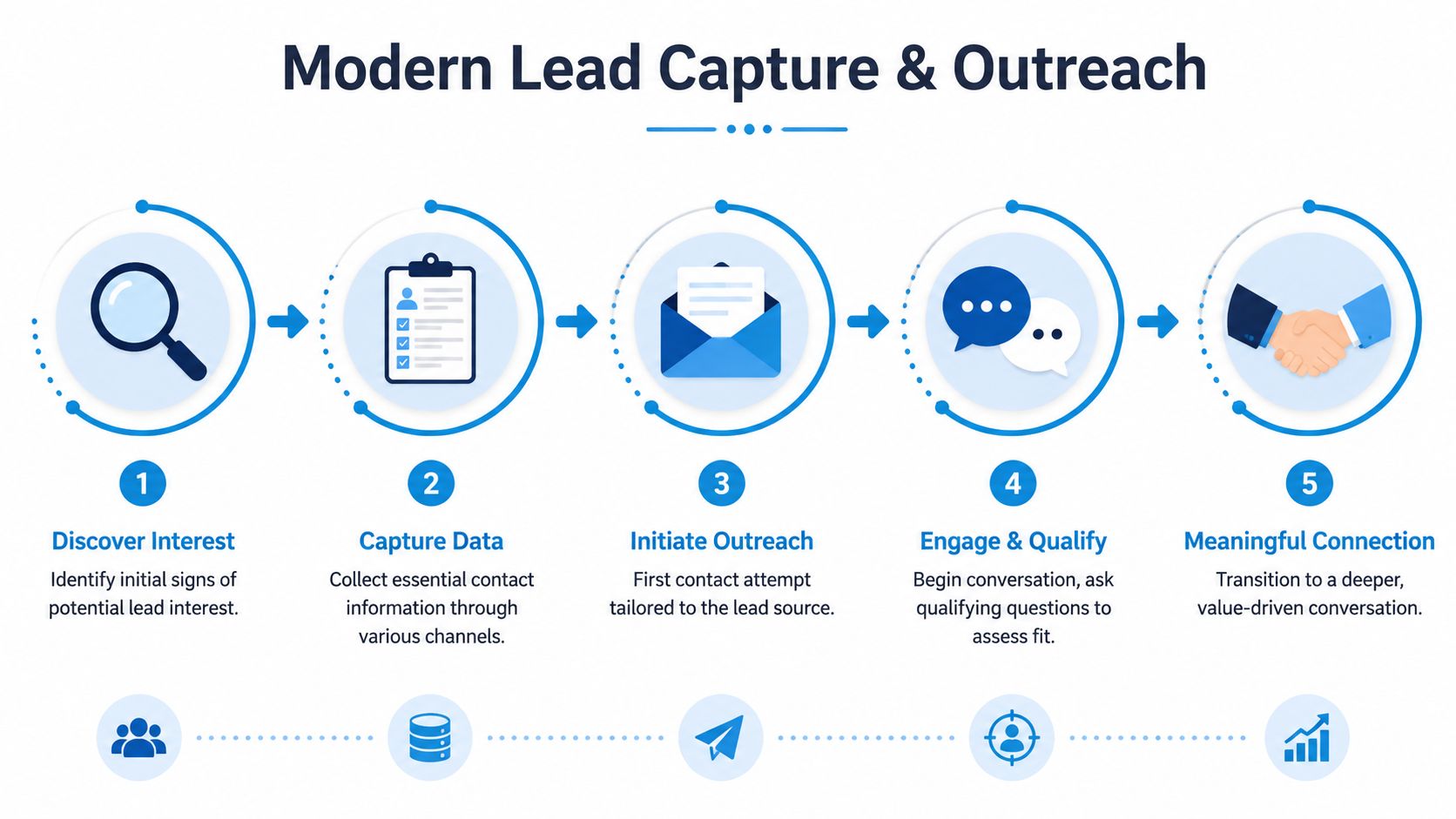
A modern workflow looks like this.
What a clean handoff looks like
Say someone comments "info" on a short-form video about working from home with flexible hours.
First, the platform action triggers a response. That can be a manual DM, an automation tool connected to your form, or a dedicated number they can text. Second, their details get captured into a CRM. Third, they receive an immediate acknowledgment. Fourth, you qualify before pitching. Fifth, you book the next conversation.
That sequence sounds simple because it should be simple.
Here is the mental model I use:
- Interest is not commitment
- Response is not qualification
- Qualification is not a presentation
- A booked appointment is the handoff point
If you collapse all four stages into one aggressive message, leads go cold.
For teams trying to centralize this process, a good reference point is lead management software for small business, especially for understanding how capture, assignment, and follow-up can live in one workflow instead of scattered apps.
Outreach Script Templates
Use scripts as guardrails, not as robotic copy. The tone should sound calm, direct, and easy to reply to.
| Scenario | Channel | Script Template |
|---|---|---|
| Social media comment on a post | DM | "Hey [Name], thanks for commenting on my post about [topic]. Happy to send details. Quick question first. Are you more interested in the product side, the income side, or both?" |
| Form submission from landing page | SMS | "Hi [Name], saw your request for more info on [offer/topic]. Thanks for reaching out. What's the main thing you're hoping to solve or learn more about?" |
| Missed inbound call | Text + callback | "Hi [Name], sorry I missed your call. I wanted to follow up right away. Are you looking for product details, pricing, or information about the business side?" |
| Referral introduction | Text or DM | "Hi [Name], [Referrer] mentioned you might be open to learning more about [specific benefit]. No pressure at all. If it's helpful, I can send a short overview and answer any questions." |
| Re-engaging a stale lead | SMS or email | "Hi [Name], circling back because you asked about [topic] a little while ago. If timing isn't right, no problem. If you're still open, reply with 'info' and I'll send the simplest next step." |
Don't send your whole story in the first message. Earn the next reply.
A short explainer can also help train your team on how this process should feel in real time:
The qualification questions that keep you efficient
Before you book a call, ask one or two direct questions:
- "What caught your attention?"
- "Are you mainly looking for product help, extra income, or just exploring?"
- "Have you looked at anything like this before?"
Those questions do two jobs. They show professionalism, and they stop you from giving a full presentation to someone who only wanted a price check.
Many network marketing leads are won or lost. Not on charisma. On speed, clarity, and a clean first exchange.
Build Your Automated Follow-Up Machine
Most sales in network marketing don't happen on the first touch. They happen after someone has had time to think, compare, hesitate, and come back with questions.
That makes follow-up one of the highest-leverage parts of the whole system. It also makes it one of the easiest places to fail if you're relying on memory alone.

What automation should actually do
Automation shouldn't replace the relationship. It should protect the relationship from inconsistency.
A practical setup looks like this:
- Lead capture form submits contact details into a CRM such as HubSpot, GoHighLevel, ActiveCampaign, or Zoho CRM.
- A welcome sequence starts immediately with email or SMS.
- Calendar booking is offered early so interested prospects can move faster.
- Behavior is tracked so engaged leads rise to the top.
- Manual outreach happens at key moments when a lead shows real intent.
This is the kind of workflow to build if you want follow-up to happen even when you're offline. If you need a starting point, this guide on how to automate follow-up emails shows the mechanics clearly.
What to send in the first 24 to 48 hours
According to guidance on advanced lead systems, stronger setups use segmentation and trust-building early, often with 3 to 5 welcome emails in the first 24 to 48 hours, plus behavioral scoring based on actions like email open rates above 50%, video watch time above 75%, multiple page visits, and form completion, as outlined in this network marketing lead generation system playbook.
That sounds technical, but the execution can stay simple.
Here is a workable sequence:
Welcome message
Thank them, confirm what they requested, and set expectations.Clarity message
Explain the product or opportunity in plain language. No hype.Objection-handling message
Address common hesitation like time, skepticism, or confusion.Story or proof message
Share a personal lesson, customer experience, or use case without over-selling.Next-step message
Ask them to book, reply, or request the right resource.
Basic lead scoring without complexity
You don't need enterprise software to score leads well. You need a few trigger points.
- Hot lead: opened emails repeatedly, clicked your booking link, watched your video, replied with a question
- Warm lead: opened one or two messages, viewed a page, hasn't booked yet
- Cold lead: no engagement after several touches
Build your follow-up so the system notices engagement before you do.
Once a lead becomes hot, switch from automation to personal contact. That's where text, phone, or voice notes can help.
The mistake I see most often is sending the same generic sequence to everyone. Product buyers, business-curious prospects, referrals, and old leads need different follow-up paths. Segment first. Then automate.
That's how a follow-up machine stays effective without sounding mechanical.
Qualify Leads and Measure What Actually Matters
If you only track how many network marketing leads came in this week, you won't know why growth stalled. More leads can hide poor contact rates, weak appointment setting, bad presentations, or sloppy follow-up.
The better approach is to qualify early and measure each conversion gate.
Industry guidance for network marketing points to a five-stage funnel of lead generation, contact, appointment, presentation, and follow-up, and notes that overall success rates are very low, with only 1% to 5% of distributors commonly estimated to achieve significant financial success, according to this breakdown of MLM funnel stages and success rates. That's exactly why raw lead volume is the wrong scoreboard.

A simple qualification framework
You don't need corporate jargon here. You need a quick way to determine fit.
I like four filters:
- Need: Do they clearly want the result your product or business offers?
- Readiness: Are they just curious, or are they open to a next step now?
- Capacity: Can they realistically buy, commit time, or stay engaged?
- Alignment: Do they fit your team culture and way of building?
You can qualify this inside a normal conversation.
Ask things like:
| Qualification area | Practical question |
|---|---|
| Need | "What are you hoping will improve if you start?" |
| Readiness | "Are you looking to begin soon, or are you still comparing options?" |
| Capacity | "Would you be able to plug into a simple onboarding process if this makes sense?" |
| Alignment | "What kind of support or business style works best for you?" |
A lead can be friendly and still be unqualified. That's fine. The point isn't to reject people harshly. It's to stop overinvesting in low-probability conversations.
Metrics that reveal the real bottleneck
The most useful numbers in a network marketing pipeline are conversion rates between steps, not just the total lead count.
Track these weekly:
- Lead-to-contact rate: how many new leads you reached
- Contact-to-appointment rate: how many conversations turned into booked time
- Appointment-to-presentation rate: how many people showed up and engaged
- Presentation-to-decision rate: how many gave a clear yes or no
- Follow-up completion: whether every undecided lead received the next touch
If one stage is weak, fix that stage first.
For example:
- Plenty of leads, low contact rate. Your response time or channel mix is the problem.
- Good contact rate, low appointments. Your first messages aren't creating enough clarity or trust.
- Good appointments, poor presentation conversion. The issue is likely offer fit, delivery, or qualification quality.
- Strong presentations, weak closes. Follow-up discipline is probably the leak.
The best operators don't guess where leads are dying. They track the handoff where momentum breaks.
Network marketing begins to function as a real business. You stop celebrating noise and start improving the process that produces results.
If you're serious about handling network marketing leads faster and more professionally, Recepta.ai is worth a look. It helps businesses capture inbound calls, schedule appointments, log lead details, and keep follow-up moving without relying on voicemail or manual admin. For teams that want a modern lead system instead of scattered replies and missed opportunities, it's a practical next step.